Author Archive

Dialogues des Carmélites

Posted in Opera with tags , , , , , on June 8, 2014 by telescoper

I don’t usually blog about Opera unless it’s to do with a performance I’ve actually attended in person, but I couldn’t resist posting something about the live broadcast from the Royal Opera House in Covent Garden of Dialogues des Carmélites by Francis Poulenc that I heard last night on BBC Radio 3.

I’m basically a complete ignoramus when it comes to the music of Poulenc. With the exception of a few small chamber pieces of his that I’ve heard (and very much liked) I don’t know much about him as a composer at all. Last night’s performance however has inspired me to rectify that omission. To that end I’d be grateful of any recommendations through the comments box.

Anyway, back to Dialogues des Carmélites. This is based on the true story of the martyrdom of sixteen Carmelite nuns during the French Revolution. Not knowing what to expect I was completely stunned by the music, much more melodic than I had expected, and beautifully played by the Orchestra of the Royal Opera House under the direction of Sir Simon Rattle. There are so many references to other composers in this piece that my head was spinning, but the strongest influence I could hear was Giacomo Puccini. Indeed, at times it sounded more like Puccini than Puccini ever did! I was gripped by the whole performance, but the ending, with the nuns singing the Salve Regina as they walk one by one to the scaffold, the dread sound of the guillotine repeatedly falling was utterly horrific and utterly compelling. In fact it was such a powerful experience I was trembling at the finish. Perhaps the fact that it was an audio broadcast only made it even more intense, precisely because so much was left to the imagination. It wasn’t exactly easy listening, but as a piece of music drama it was a triumph.

The entire performance is available for the next seven days on the BBC iPlayer in High Definition sound via this link. If you make time to listen to it, I promise you won’t regret it – although the ending might give you nightmares!

Another thing worth mentioning was that this was the largest cast ever to appear on the stage of the Royal Opera House; no less than 167 people altogether. Among those involved were members of Streetwise Opera, a charitable organization quite new to me, which uses music to help homeless people make positive changes in their lives. This is such a brilliant idea that I sent a donation to support their work. I urge you to do likewise.

The Logistics of Scientific Growth in the 21st Century

Posted in Science Politics, The Universe and Stuff with tags , , on June 8, 2014 by telescoper

Interesting piece that argues that the recent growth in STEM PhD and postdocs is not sustainable.

caseybergman's avatarAn Assembly of Fragments

ResearchBlogging.org

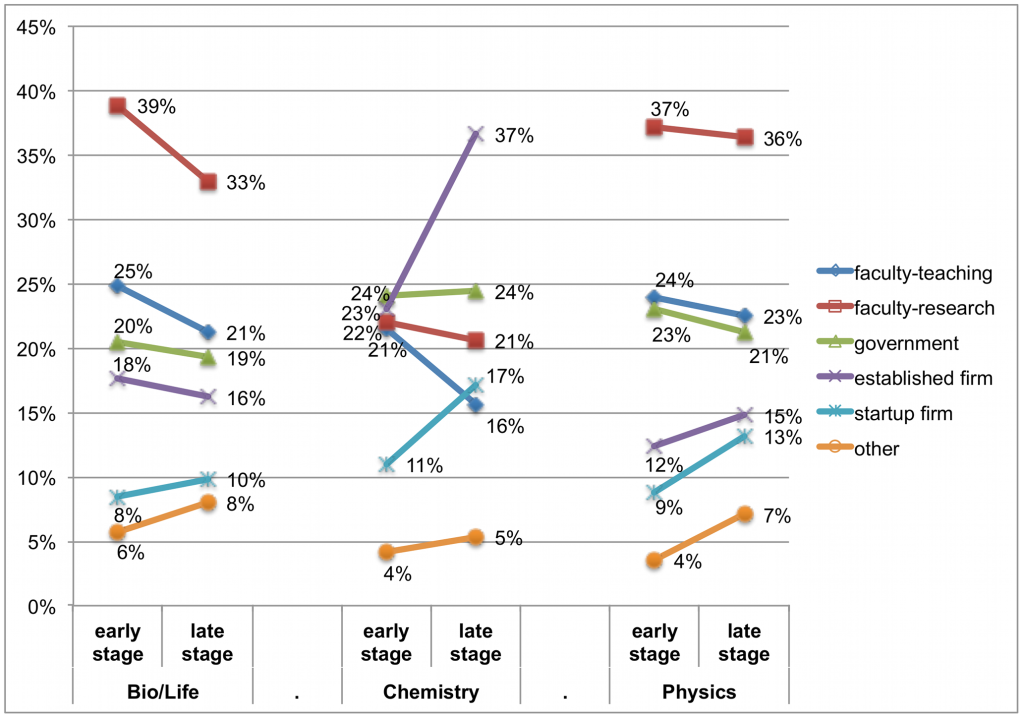
Over the last few months, I’ve noticed a growing number of reports about declining opportunities and increasing pressure for early stage academic researchers (Ph.D. students, post-docs and junior faculty). For example, the Washington Post published an article in early July about trends in the U.S. scientific job market entitled “U.S. pushes for more scientists, but the jobs aren’t there.” This post generated over 3,500 comments on the WaPo website alone and was highly discussed in the twittersphere. In mid July, Inside Higher Ed reported that an ongoing study revealed a recent, precipitous drop in the interest of STEM (Science/Technology/Engineering/Mathematics) Ph.D. students wishing to pursue an academic tenure-track career. These results confirmed those published in PLoS ONE in May that showed the interest to pursue an academic career of STEM students surveyed in 2010 showed evidence of a decline during the course of Ph.D. studies:

Figure 1. Percent of…

View original post 1,620 more words

Windows is shutting down

Posted in Poetry with tags , , on June 7, 2014 by telescoper

Windows is shutting down, and grammar are
On their last leg. So what am we to do?
A letter of complaint go just so far,
Proving the only one in step are you.

Better, perhaps, to simply let it goes.
A sentence have to be screwed pretty bad
Before they gets to where you doesnt knows
The meaning what it must of meant to had.

The meteor have hit. Extinction spread,
But evolution do not stop for that.
A mutant languages rise from the dead
And all them rules is suddenly old hat.

Too bad for we, us what has had so long
The best seat from the only game in town.
But there it am, and whom can say its wrong?
Those are the break. Windows is shutting down.

by Clive James (b 1939)

The Fallen Project

Posted in Art, History with tags , , , on June 6, 2014 by telescoper

It’s not known exactly how many people died on D-Day 6th June 1944 when the Normandy landings took place, but a  fairly conservative estimate is about 9000 (including about 3000 French civilians).

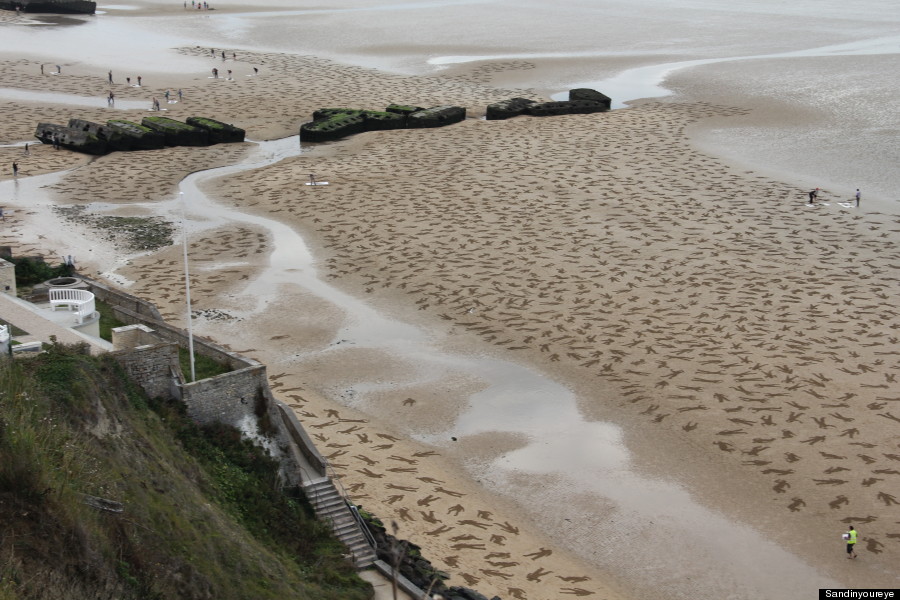
In September last year, the beach at Arromanches (code-named Gold ) was the site of a remarkable art installation called The Fallen 9000 during which hundreds of volunteers stencilled images of 9000 fallen soldiers into the sand.


o-FALLEN-900

It’s a moving image, not least because the figures were soon to be washed away by the incoming tide. Let’s hope the courage and self-sacrifice of the soldiers who gave their lives that day are not forgotten too. Seventy years on, fascism is apparently once again on the rise in Europe. We should not forget where that road has led in the past.

Lest we forget.

Has BICEP2 bitten the dust?

Posted in The Universe and Stuff with tags , , , , , , , , , , on June 5, 2014 by telescoper

Time for yet another update on twists and turns of the ongoing saga of  BICEP2 and in particular the growing suspicion that the measurements could be accounted for by Galactic dust rather than primordial gravitational waves; see various posts on this blog.

First there is a Nature News and Views article by Paul Steinhardt with the title Big Bang blunder bursts the multiverse bubble. As the title suggests, this piece is pretty scathing about the whole affair, for two main reasons. The first is to do with the manner of the release of the result via a press conference before the results had been subjected to peer review. Steinhardt argues that future announcements of “discoveries” in this area

should be made after submission to journals and vetting by expert referees. If there must be a press conference, hopefully the scientific community and the media will demand that it is accompanied by a complete set of documents, including details of the systematic analysis and sufficient data to enable objective verification.

I also have reservations about the way the communication of this result was handled but I wouldn’t go as far as Steinhardt did. I think it’s quite clear that the BICEP2 team have detected something and that they published their findings in good faith. The fact that the media pushed the result as being a definitive detection of primordial gravitational waves wasn’t entirely their fault; most of the hype was probably down to other cosmologists (especially theorists) who got a bit over-excited.

It is true that if it turns out that the BICEP2 signal is due to dust rather than primordial gravitational waves then the cosmology community will have a certain amount of egg on its face. On the other hand, this is actually what happens in science all the time. If we scientists want the general public to understand better how science actually works we should not pretend that it is about absolute certainties but that it is a process, and because it is a process operated by human beings it is sometimes rather messy. The lesson to be learned is not about hiding the mess from the public but about communicating the uncertainties more accurately and more honestly.

Steinhardt’s other main point is one with which I disagree very strongly. Here is the core of his argument about inflation:

The common view is that it is a highly predictive theory. If that was the case and the detection of gravitational waves was the ‘smoking gun’ proof of inflation, one would think that non-detection means that the theory fails. Such is the nature of normal science. Yet some proponents of inflation who celebrated the BICEP2 announcement already insist that the theory is equally valid whether or not gravitational waves are detected. How is this possible?

The answer given by proponents is alarming: the inflationary paradigm is so flexible that it is immune to experimental and observational tests.

This is extremely disingenuous. There’s a real difference between a theory that is “immune to experimental and observational tests” and one which is just very difficult to test in that way. For a start, the failure of a given experiment to detect gravitational waves  does not prove that gravitational waves don’t exist at some level; a more sensitive experiment might be needed. More generally, the inflationary paradigm is not completely specified as a theory; it is a complex entity which contains a number of free parameters that can be adjusted in the light of empirical data. The same is also true, for example, of the standard model of particle physics. The presence of these adjustable degrees of freedom makes it much harder to test the hypothesis than would be the case if there were no such wiggle room. Normal science often proceeds via the progressive tightening of the theoretical slack until there is no more room for manoeuvre. This process can take some time.

Inflation will probably be very difficult to test, but then there’s no reason why we should expect a definitive theoretical understanding of the very early Universe to come easily to us. Indeed, there is almost certainly a limit to the extent that we can understand the Universe with “normal science” but I don’t think we’ve reached it yet. We need to be more patient. So what if we can’t test inflation with our current technology? That doesn’t mean that the idea is unscientific. It just means that the Universe is playing hard to get.

Steinhardt continues with an argument about the multiverse. He states that inflation

almost inevitably leads to a multiverse with an infinite number of bubbles, in which the cosmic and physical properties vary from bubble to bubble. The part of the multiverse that we observe corresponds to a piece of just one such bubble. Scanning over all possible bubbles in the multi­verse, every­thing that can physically happen does happen an infinite number of times. No experiment can rule out a theory that allows for all possible outcomes. Hence, the paradigm of inflation is unfalsifiable.

This may seem confusing given the hundreds of theoretical papers on the predictions of this or that inflationary model. What these papers typically fail to acknowledge is that they ignore the multiverse and that, even with this unjustified choice, there exists a spectrum of other models which produce all manner of diverse cosmological outcomes. Taking this into account, it is clear that the inflationary paradigm is fundamentally untestable, and hence scientifically meaningless.

I don’t accept the argument that “inflation almost inevitably leads to a multiverse” but even if you do the rest of the argument is false. Infinitely many outcomes may be possible, but are they equally probable? There is a well-defined Bayesian framework within which one could answer this question, with sufficient understanding of the underlying physics. I don’t think we know how to do this yet but that doesn’t mean that it can’t be done in principle.

For similar discussion of this issue see Ted Bunn’s Blog.

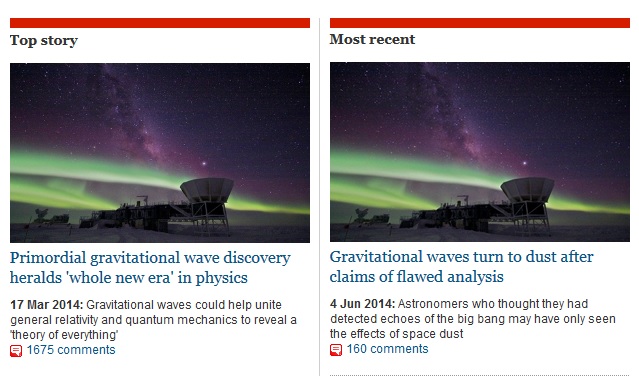
Steinhardt’s diatribe was accompanied  yesterday by a sceptical news piece in the Grauniad entitled Gravitational waves turn to dust after claims of flawed analysis. This piece is basically a rehash of the argument that the BICEP2 results may be accounted for by dust rather than primordial gravitational waves, which definitely a possibility, and that the BICEP2 analysis involved a fairly dubious analysis of the foregrounds. In my opinion it’s an unnecessarily aggressive piece, but mentioning it here gives me the excuse to post the following screen grab from the science section of today’s Guardian website:
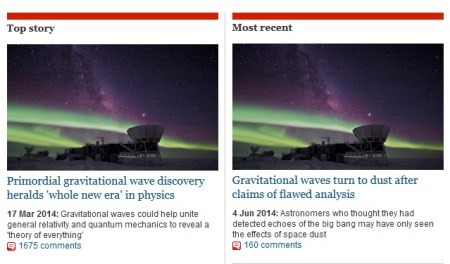
BICEP_thenandnow

Aficionados of Private Eye will probably think of the Just Fancy That section!

Where do I stand? I can hear you all asking that question so I’ll make it clear that my view hasn’t really changed at all since March. I wouldn’t offer any more than even money on a bet that BICEP2 has detected primordial gravitational waves at all and I’d offer good odds that, if the detection does stand, the value of the tensor-to-scalar ratio is significantly lower than the value of 0.2 claimed by BICEP2.  In other words, I don’t know. Sometimes that’s the only really accurate statement a scientist can make.

1963 and all that…

Posted in Biographical with tags , , on June 4, 2014 by telescoper

original_events-of-1963-51st-birthday-ladies-t-shirt

The Day in Pictures

Posted in Biographical, Education on June 3, 2014 by telescoper

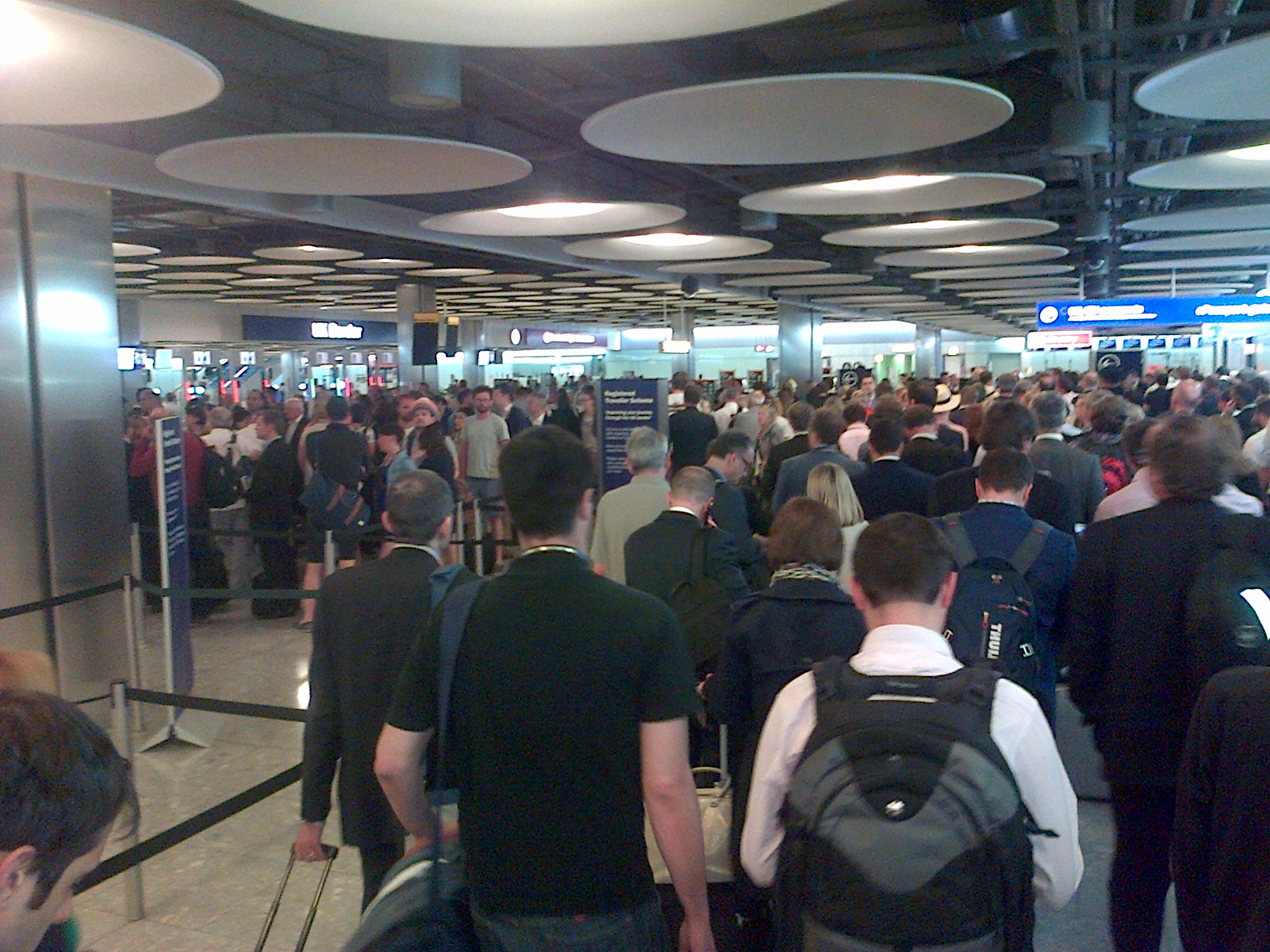
Just back home from Milan after a pretty long day, the story of which is told in the three photographs.

First of all, congratulations to Dr Eleonora Villa, who successfully defended her thesis this afternoon! The intriguing cover picture on the glossy copy shown is of course by Wassily Kandinsky

Then there’s my old apartment at No. 19 Via Beato Angelico which I successfully located after getting lost only twice. It is on the right of the building, on the second floor, with the balcony. The graffiti weren’t there when I was resident in 1994 but otherwise the area hasn’t changed much.


And finally there’s the shambolic overcrowding in the UKBA section of Heathrow Terminal 5 that delayed my return home by about an hour…

Via Beato Angelico

Posted in Biographical, Education with tags , , , , , on June 2, 2014 by telescoper

So here I am, then, in Milan(o). I’m just here for a short visit in order to participate in a PhD examination tomorrow at the Universita Degli Studi di Milano. I’m looking forward to it, actually, as I’ve never done such an examination in the Italian system before. It will also give me the chance to meet up with a couple of old friends I haven’t seen for a while before flying back to London tomorrow night.

I don’t know if I’ve mentioned this before on this blog but I was a fairly long-term resident in Milan some years ago. In fact I’ve just checked the dates and it was in 1994, i.e. twenty years ago. Time flies indeed. All those years ago I was here as a Professore a Contratto, which means I gave some lectures and did a small research project. The invitation for this came via Silvio Bonometto. I didn’t get paid a huge amount for this visit, but as part of the deal I did get use of an apartment organized by the University. It was on the Via Beato Angelico and this photograph, which I have just ripped off from my own facebook page, shows the view from the balcony:

Via Beato Angelico

It was a nice enough flat and in a good location just around the corner from the University. The one thing I remember well is that one of the main tram lines ran along the street below; their sound has stuck with me through the years, as they often woke me up very early in the morning. I think there was an ice cream place over the road too.

During my stay here I was accompanied by a friend, Anna, whom I invited to come when they told me I was going to have use of an apartment. Anna wanted to try to find a job in Italy so it seemed a great chance to spend three months or so looking around while I worked. The place was easily big enough for two and I was grateful for the company in the evenings. We had a lot of fun doing the tourist things, visiting night clubs, and the rest. Most people thought we were an item, I suppose, but we weren’t. Her long red hair gave her the nickname Anna Dai Cappelli Rossi, after the cartoon character. Here is a picture of Anna I took on the roof of the Duomo:

Anna

Anyway, when it was time for me to return to England, Anna stayed in Milan because she had found a job (and a man). She did return to England though and now lives in the Midlands in a place called Liverpool.

I’m mentioning all this because the hotel I’m now staying in, the Hotel Dieci, is just a short walk from that old place. I’ll probably have enough time in the morning to take a walk past and see if I can find it. I wonder how much the area around here has changed in the last twenty years? I’ll have time to find out tomorrow but for tonight I had better read the thesis again!

Out of Power

Posted in Biographical with tags , , on June 1, 2014 by telescoper

I had quite a few things to do on campus today before jetting off on a short trip tomorrow. I hoped to finish them in time for a decent blog post before heading home for tea and the Beelzebub crossword. Unfortunately when I got to the University just after 1pm I found the building in darkness. It turns out that the power went off about 10am. A little investigation revealed that all the buildings North-South Road (that’s the part of the Sussex University campus where all the science buildings are located) had a complete power outage due to a probably probably due to a fault in the high-voltage supply onto campus. Engineers had been called out as soon as the fault was reported but, not being qualified to work on such equipment themselves, power wasn’t restored until just after 4pm with the arrival of a specialist crew.

One thing worth saying about this is that the School of Mathematical and Physical Sciences does have an emergency response procedure for such eventualities and since as Head of School I’m officially a “responsible person” I had to make a judgement as to whether there was a serious threat to safety. If there had been, I would have had to execute the plan, contact all the relevant personnel, and order people out of the building. I decided that there wasn’t so just informed the students who were in the building what the situation was and that they could stay if they wanted. The emergency lighting was working and there was no immediate danger of anything nasty happening.

I went for a stroll around campus to see the extent of the outage. The only sign of life nearby was the sound from the emergency generators in the Shawcross building which kicked in to keep the main campus servers up and running. The PC room at the front of the building was deserted. Presumably the students who usually work there at weekends had found an alternative location, or were just outside enjoying the sunshine until the systems started up again, and any staff in attendance were presumably working on the backup systems in the bowels of the building.

No computers were working in our building either of course so some decided to work in the Library, which is on the other side of campus and wasn’t affected by the power cut. After checking out with the campus services what was going on I decided to stay until the fault was rectified just in case there were any problems. Some of our physicists had experiments running over the weekend and one or two came in to check that there was no serious harm done to their gear. There may be some faults to deal with tomorrow morning, but by then I’ll be elsewhere!

Such things as power cuts are inconvenient but they remind us how dependent we have become on electricity, especially for running computers. Fortunately this happened on a Sunday so there wasn’t much happening on campus, but a huge amount of our activities rely on digital devices of one form or another and it would have been much worse had it happened on a week day. The worst thing as far as I’m concerned, however, is that with no computer to work on I was deprived of displacement activities and was forced to start marking the scripts from Theoretical Physics examination…

Beards, Shorts & Sandals Code for 2014 Season

Posted in Beards, Biographical on June 1, 2014 by telescoper

The Beard, Shorts and Sandals season is officially open and I’ve been observing the relevant guidelines rigorously today…

kmflett's avatarKmflett's Blog

Beard Liberation Front

Communique 1st June

‘BEARDS, SHORTS & SANDALS’ CODE FOR 2014 SEASON

The Beard Liberation Front, the informal network of beard wearers, has said that as June starts it is issuing a reminder about the code for the 2014 Beards, Shorts and Sandals season which runs until the end of August.

Adherence to the guidelines is important if the beard wearer is to safely wear shorts and sandals in public during the summer months

2014 Code

1] Shorts and sandals may be worn after midday until 8pm at the discretion of the wearer.

2] Where sandals are worn the wearing of socks is discouraged but not forbidden

3] If socks are not worn toenails must be neat, trimmed, clean and fungus free

4] Shorts should ideally be around knee length to provide a balanced image with the beard

5] Shorts should be of conservative design and colour…

View original post 112 more words