I’m not sure whether my scepticism about the BICEP2 results is just a sign of my old age, so it’s time for a quick (and, it goes without saying, totally unscientific) straw poll to see what people think. Feel free to add comments through the box as well!
Follow @telescoperAuthor Archive
BICEP2 – A Straw Poll
Posted in The Universe and Stuff with tags Bicep2, gravitational waves on March 17, 2014 by telescoperBICEP2DAY
Posted in Astrohype, The Universe and Stuff with tags BICEP, Bicep2, Cosmic Microwave Background, Cosmology, Inflation on March 17, 2014 by telescoperWell, it’s official that this afternoon’s announcement of a “major discovery” is going to be from the BICEP team, and it specifically concerns the BICEP2 CMB telescope experiment. I’ve just got back to Sussex (after a weekend in Cardiff) and will be following the events in among other things I have to do before going off to give a lecture at 5pm GMT.
The schedule of events is as follows: there will be a special webcast presenting the first results from the BICEP2 CMB telescope. The webcast will begin with a presentation for scientists 10:45-11:30 EDT, followed by a news conference 12:00-1:00 EDT.
You can join the webcast from the link at http://www.cfa.harvard.edu/news/news_conferences.html
Papers and data products will be available at 10:45 EDT from http://bicepkeck.org/
EDT is four hours behind Greenwich Mean Time so the webcast will begin at 14:45 GMT, i.e. in about half an hour.
In the mean time, for those of you wondering what these BICEPS are all about, here is a useful graphic in which a Harvard astrophysicist demonstrates the possibilities:

LIVE BLOG:
14:36 The press conference server has gone down. There’s no truth in the rumour that ex-members of the Clover collaboration have sabotaged it.
14:42 There’s a grave danger that this press conference will run into tea time.
14:45 The BICEP2 papers are now live at http://bicepkeck.org/
14:48 Straight to the headline: R=0.2 (+0.07, -0.05) with R=0 rejected at about 7 sigma, if you like things stated in such terms…
14:53 Here’s the crucial graph. Results a bit higher than the expected signal at l in range 200-300?

15:06 The news avalanche has started, e.g. here at the BBC, but there is some concern about the shape of the spectrum.
15:10 I’m not getting anything from the press conference, so may have missed important details. It seems to me though that there’s a significant possibility of some of the polarization signal in E and B not being cosmological. This is a very interesting result, but I’d prefer to reserve judgement until it is confirmed by other experiments.
15:35 Despite the press hype there’s still some scepticism among cosmologists arising from the strange-looking shape of the spectrum. I’m not convinced myself. Anyway, I have to sign off now in order to prepare a lecture..
16:20 Back-of-the-envelope time: if the result is correct then the inflationary energy scale is about 2×10¹⁶ GeV. That’s just two orders of magnitude below the Planck scale…
18:19 Returned from my 5pm Theoretical Physics lecture. Couldn’t resist spending 30 minutes talking about BICEP2, though I did tell them it’s not in the examination.
18:25 Main points of controversy:
- there seems to be evidence of leakage of temperature into polarization (lines in Fig. 5);
- there’s an excess in the B-B spectrum at l~250 shown above;
- there’s an excess at low l in the E-E spectrum
- there’s a deficit at low l in the cross-correlation with Keck
There may be a connection between 1. and 2.-4. If 2.-4 are real then they may be evidence of something interesting that requires more than a straightforward modification of inflation (such as might include just a running of the spectral index).
18:35 Other controversy: why has this result been announced before the paper has been published or even peer-reviewed?
Ode on Solitude
Posted in Poetry with tags Alexander Pope, Ode on Solitude, Poetry on March 16, 2014 by telescoperHappy the man, whose wish and care
A few paternal acres bound,
Content to breathe his native air,
In his own ground.
Whose herds with milk, whose fields with bread,
Whose flocks supply him with attire,
Whose trees in summer yield him shade,
In winter fire.
Blest! who can unconcern’dly find
Hours, days, and years slide soft away,
In health of body, peace of mind,
Quiet by day,
Sound sleep by night; study and ease
Together mix’d; sweet recreation,
And innocence, which most does please,
With meditation.
Thus let me live, unseen, unknown;
Thus unlamented let me die;
Steal from the world, and not a stone
Tell where I lie.
by Alexander Pope (1688-1744; he wrote this poem when he was 12 years old)
Follow @telescoperPostcard from Cardiff
Posted in Biographical, Cardiff, Politics, Rugby with tags Cardiff, Royal Astronomical Society, Six Nations, Tony Benn on March 16, 2014 by telescoperSo here I am in Cardiff for the weekend, relaxing after a very busy and stressful week. It’s nice to have the option to get away like this, especially in the spring sunshine, so I’m glad I kept the Cardiff house going rather than try to sell it the moment I got the job at Sussex University. I have been working very long hours recently and with another month to go before the end of teaching term, I think I need to make better use of the weekends if I’m going to avoid a state of complete exhaustion.
On Friday I attended a meeting of the Council of the Royal Astronomical Society (of which I am an elected member) followed by a very interesting Open Meeting and a nice dinner with the RAS Club. After all that I took the late train to Cardiff instead of going back to Brighton.
During the journey I thought quite a lot about Tony Benn; the news of his death at the age of 88 was announced on Friday morning. Although I didn’t agree with his political views on some things, he was a person I admired enormously and I am very sad that he is no more.
I only ever met Tony Benn once, many years ago, as it happens, on a train from Brighton to London. It was one of those old-fashioned carriages, divided into compartments each with a door. I had almost missed the train and was so flustered when I got on that it took me some time to recognize the gentleman opposite who was just lighting his pipe.
I summoned up the nerve to speak, shook his hand, and introduced myself. We were the only occupants of the carriage and we talked for the entire journey – an experience I’ve never forgotten. In person Tony Benn was wonderful: charming, kindly, impeccably polite and above all absolutely fascinating to talk to. As I recall it, I did most of the listening. Not that I minded. I’m a man who likes talking to a man who likes to talk..
People also forget that Tony Benn was one of the very few politicians to champion LGBT rights. It’s now a fashionable thing, but it wasn’t then back in the dark days of Section 28.
So I’d just like to record a little personal farewell to Tony Benn. There’s nobody of his stature in current British politics, and none whose company I’d like to spend a train journey in, either.
Yesterday I was out and about in sunny Cardiff running various undemanding errands, in the course of which I came across an internet cafe. I’ve never actually used one of those before, and was quite surprised that an hour’s access cost just £1. I took the chance to sit down for a bit and wrote yesterday’s blog post there.
Saturday was the last day of the Six Nations rugby and Wales were hosting Scotland. The two sets of supporters were mingling and imbibing throughout the city. When it came to the match, Wales thrashed Scotland 51-3.
Earlier England had comfortably beaten Italy so were top of the table, but would only win the competition if Ireland lost the last game to France in Paris. It was an exciting finale, with stout Irish defence enabling them to cling on to a lead of just two points. So well played Ireland, who probably deserved the title, but also good signs for England whose young side have performed admirably this year. Better luck next year?
At least English supporters can now enjoy one of their favourite pastimes: blaming everything on the French.
It’s warm and sunny again today so I think I’ll take another walk around. I really miss Cardiff, but one has to follow one’s star wherever it leads.
Follow @telescoperSome B-Mode Background
Posted in Astrohype, Science Politics, The Universe and Stuff with tags B-mode, BICEP, Clover, Cosmic Microwave Background, Cosmology, gravitational waves, Inflation, parity, Physics, Quiet, Spider, STFC on March 15, 2014 by telescoperWell, in case you hadn’t noticed, the cosmology rumour mill has gone into overdrive this weekend primarily concerning the possibility that an experiment known as BICEP (an acronym formed from Background Imaging of Cosmic Extragalactic Polarization). These rumours have been circulating since it was announced last week that the Harvard-Smithsonian Center for Astrophysics (CfA) will host a press conference on Monday, March 17th, to announce “a major discovery”. The grapevine is full of possibilities, but it seems fairly clear that the “major discovery” is related to one of the most exciting challenges facing the current generation of cosmologists, namely to locate in the pattern of fluctuations in the cosmic microwave background evidence for the primordial gravitational waves predicted by models of the Universe that involve inflation.
Anyway, I thought I’d add a bit of background on here to help those interested make sense of whatever is announced on Monday evening.
Looking only at the temperature variation across the sky, it is not possible to distinguish between tensor (gravitational wave) and scalar (density wave) contributions (both of which are predicted to be excited during the inflationary epoch). However, scattering of photons off electrons is expected to leave the radiation slightly polarized (at the level of a few percent). This gives us additional information in the form of the polarization angle at each point on the sky and this extra clue should, in principle, enable us to disentangle the tensor and scalar components.
The polarization signal can be decomposed into two basic types depending on whether the pattern has odd or even parity, as shown in the nice diagram (from a paper by James Bartlett)

The top row shows the E-mode (which look the same when reflected in a mirror and can be produced by either scalar or tensor modes) and the bottom shows the B-mode (which have a definite handedness that changes when mirror-reflected and which can’t be generated by scalar modes because they can’t have odd parity).
The B-mode is therefore (at least in principle) a clean diagnostic of the presence of gravitational waves in the early Universe. Unfortunately, however, the B-mode is predicted to be very small, about 100 times smaller than the E-mode, and foreground contamination is likely to be a very serious issue for any experiment trying to detect it. To be convinced that what is being measured is cosmological rather than some sort of contaminant one would have to see the signal repeated across a range of different wavelengths.
Moreover, primordial gravitational waves are not the only way that a cosmological B-mode signal could be generated. Less than a year ago, a paper appeared on the arXiv by Hanson et al. from SPTpol, an experiment which aims to measure the polarization of the cosmic microwave background using the South Pole Telescope. The principal result of this paper was to demonstrate a convincing detection of the so-called “B-mode” of polarization from gravitational lensing of the microwave background photons as they pass through the gravitational field generated by the matter distributed through the Universe. Gravitational lensing can produce the same kind of shearing effect that gravitational waves generate, so it’s important to separate this “line-of-sight” effect from truly primordial signals.
So we wait with bated breath to see exactly what is announced on Monday. In particular, it will be extremely interesting to see whether the new results from BICEP are consistent with the recently published conclusions from Planck. Although Planck has not yet released the analysis of its own polarization data, analysis of the temperature fluctuations yields a (somewhat model-dependent) conclusion that the ratio of tensor to scalar contributions to the CMB pattern is no more than about 11 per cent, usually phrased in the terms, i.e. R<0.11. A quick (and possibly inaccurate) back-of-the-envelope calculation using the published expected sensitivity of BICEP suggests that if they have made a detection it might be above that limit. That would be really interesting because it might indicate that something is going on which is not consistent with the standard framework. The limits on R arising from temperature studies alone assume that both scalar and tensor perturbations are generated by a relatively simple inflationary model belonging to a class in which there is a direct relationship between the relative amplitudes of the two modes (and the shape of the perturbation spectrum). So far everything we have learned from CMB analysis is broadly consistent with this simplifying assumption being correct. Are we about to see evidence that the early Universe was more complex than we thought? We'll just have to wait and see…
Incidentally, once upon a time there was a British experiment called Clover (involving the Universities of Cardiff, Oxford, Cambridge and Manchester) which was designed to detect the primordial B-mode signal from its vantage point in Chile. I won’t describe it in more detail here, for reasons which will become obvious.
The chance to get involved in a high-profile cosmological experiment was one of the reasons I moved to Cardiff in 2007, and I was looking forward to seeing the data arriving for analysis. Although I’m primarily a theorist, I have some experience in advanced statistical methods that might have been useful in analysing the output. Unfortunately, however, none of that actually happened. Because of its budget crisis, and despite the fact that it had spent a large amount (£4.5M) on it already, STFC decided to withdraw the funding needed to complete it (£2.5M) and cancelled the Clover experiment. Had it gone ahead it would probably have had two years’ data in the bag by now.
It wasn’t clear that Clover would have won the race to detect the B-mode cosmological polarization, but it’s a real shame it was withdrawn as a non-starter. C’est la vie.
Follow @telescoperCharlotte Church and Physics
Posted in Music, The Universe and Stuff with tags A-level, Cardiff University, Charlotte Church, Physics, Sussex University on March 14, 2014 by telescoperI just noticed an interesting news item about popular vocal artiste Charlotte Church. Apparently she is thinking about doing a degree in physics. She is quoted on the BBC Website as saying
“I just think it’s important to keep the brain active and keep educating yourself.
“I have an interest in it and I should try to follow it. It’s something I’ve been interested in for the last year or two.”
I hope she does it, as it will set an excellent example. In the article, however, she also says “I will have to do an A-level in physics and maths first though”. That’s not necessarily the case, actually. It is possible instead to opt for a physics degree programme with a Foundation year. Many universities run such programmes. We have one here at the University of Sussex but there is also one at Cardiff University, which happens to be in Charlotte Church’s home town.
These courses are specifically designed for people who didn’t do the traditional mix of A-level subjects for a Physics degree and I always recommend that students who are coming to the subject late in life give them serious consideration rather than assuming they should go via the usual A-level route. Widening participation in higher education by offering such access courses is something many universities work very hard at and do very well.
In fact, as I’ve pointed out before, that the current A-level Physics courses are part of the reason why we have so few female physics students; the fraction is a meagre 20%. That might start to change if high-profile women like Charlotte Church lead the way, but in the mean time it’s definitely worth thinking about alternatives to A-level such as those I’ve described.
In any case, and whatever Charlotte Church does decide to do in the future, I’m sure I speak on behalf of the vast majority of physicists when I express thanks to her for putting such a nice story about physics into the news!
POSTRSCRIPT: I wasn’t aware of this when I wrote the above piece, but it seems a former colleague of mine from Cardiff University, Edward Gomez helped get Charlotte Church interested in physics.
Follow @telescoperFly through of the GAMA Galaxy Catalogue
Posted in The Universe and Stuff with tags Astrophysics, Cosmology, Galaxy and Mass Assembly Survey, GAMA, GAMA Survey, Large-scale Structure, large-scale structure of the Universe, redshift survey, video on March 13, 2014 by telescoperWhen I’m struggling to find time to do a proper blog post I’m always grateful that I work in cosmology because nearly every day there’s something interest to post. I’m indebted to Andy Lawrence for bring the following wonderful video to my attention. It comes from the Galaxy And Mass Assembly Survey (or GAMA Survey for short), a spectroscopic survey of around 300,000 galaxies in a region of the sky comprising about 300 square degrees; the measured redshifts of the galaxies enable their three-dimensional positions to be plotted. The video shows the shape of the survey volume before showing what the distribution of galaxies in space looks like as you fly through. Note that the galaxy distances are to scale, but the image of each galaxy is magnified to make it easier to see; the real Universe is quite a lot emptier than this in that the separation between galaxies is larger relative to their size.
Follow @telescoperOne Hundred Years of Zel’dovich
Posted in The Universe and Stuff with tags Cosmic Web., Large-scale Structure, Sergei Shandarin, Yakov Borisovich Zel'dovich, Zel'dovich Approximation on March 12, 2014 by telescoperLovely weather today, but it’s also been an extremely busy day with meetings and teachings. I did realize yesterday however that I had forgotten to mark a very important centenary at the weekend. If I hadn’t been such a slacker that I took last Saturday off work I would probably have been reminded…
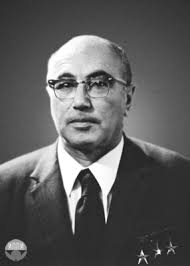 The great Russian physicist Yakov Borisovich Zel’dovich (left) was born on March 8th 1914, so had he lived he would have been 100 years old last Saturday. To us cosmologists Zel’dovich is best known for his work on the large-scale structure of the Universe, but he only started to work on that subject relatively late in his career during the 1960s. He in fact began his life in research as a physical chemist and arguably his greatest contribution to science was that he developed the first completely physically based theory of flame propagation (together with Frank-Kamenetskii). No doubt he also used insights gained from this work, together with his studies of detonation and shock waves, in the Soviet nuclear bomb programme in which he was a central figure, and which no doubt led to the chestful of medals he’s wearing in the photograph.
My own connection with Zel’dovich is primarily through his scientific descendants, principally his former student Sergei Shandarin, who has a faculty position at the University of Kansas. For example, I visited Kansas back in 1992 and worked on a project with Sergei and Adrian Melott which led to a paper published in 1993, the abstract of which makes it clear the debt it owed to the work of Ze’dovich.
The accuracy of various analytic approximations for following the evolution of cosmological density fluctuations into the nonlinear regime is investigated. The Zel’dovich approximation is found to be consistently the best approximation scheme. It is extremely accurate for power spectra characterized by n = -1 or less; when the approximation is ‘enhanced’ by truncating highly nonlinear Fourier modes the approximation is excellent even for n = +1. The performance of linear theory is less spectrum-dependent, but this approximation is less accurate than the Zel’dovich one for all cases because of the failure to treat dynamics. The lognormal approximation generally provides a very poor fit to the spatial pattern.
The Zel’dovich Approximation referred to in this abstract is based on an extremely simple idea but which, as we showed in the above paper, turns out to be extremely accurate at reproducing the morphology of the “cosmic web” of large-scale structure.
Zel’dovich passed away in 1987. I was a graduate student at that time and had never had the opportunity to meet him. If I had done so I’m sure I would have found him fascinating and intimidating in equal measure, as I admired his work enormously as did everyone I knew in the field of cosmology. Anyway, a couple of years after his death a review paper written by himself and Sergei Shandarin was published, along with the note:
The Russian version of this review was finished in the summer of 1987. By the tragic death of Ya. B.Zeldovich on December 2, 1987, about four-fifths of the paper had been translated into English. Professor Zeldovich would have been 75 years old on March 8, 1989 and was vivid and creative until his last day. The theory of the structure of the universe was one of his favorite subjects, to which he made many note-worthy contributions over the last 20 years.
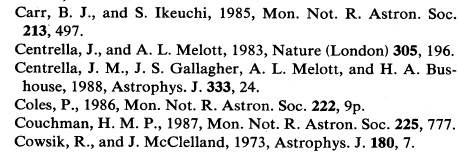
As one does if one is vain I looked down the reference list to see if any of my papers were cited. I’d only published one paper before Zel’dovich died so my hopes weren’t high. As it happens, though, my very first paper (Coles 1986) was there in the list. That’s still the proudest moment of my life!
Anyway, this post gives me the opportunity to advertise that there is a special meeting called The Zel’dovich Universe coming up this summer in Tallinn, Estonia. It looks a really interesting conference and I really hope I can find the time to fit it into my schedule. I’ve never been to Estonia…
Follow @telescoperNOvA and Neutrinos
Posted in The Universe and Stuff with tags Fermilab, neutrinos, Nova, Particle Physics, University of Sussex on March 11, 2014 by telescoperYesterday’s Grauniad blog post by Jon Butterworth about neutrino physics reminded me that I forgot to post about an important milestone in the development of the NOvA Experiment which involves several members of the Department of Physics and Astronomy in the School of Mathematical and Physical Sciences here at the University of Sussex. Here’s the University of Sussex’s press release on the subject, which came out a couple of weeks ago.
The NOvA experiment consists of two enormous particle detectors, one at the Fermi National Accelerator Laboratory “Fermilab” near Chicago and the other in Minnesota. The neutrinos are actually generated at Fermilab; the particle beam is then aimed at the detectors the, one near the source at Fermilab, and the other in Ash River, Minnesota, near the Canadian border. The particles, sent in their billions every couple of seconds, complete the 500-mile trip in less than three milliseconds.
The point is that the experiment has managed for the first time to actually detect neutrinos through the 500 miles of rock separating the two ends of the experiment. This is obviously just a first step, but it’s equally obviously a crucial one.
Colleagues from Sussex University are strongly involved in calibrating and fine-tuning the detector, which produces light when particles pass through it. Dr Abbey Waldron and PhD student Luke Vinton have developed a calibration procedure that uses known properties of muons to calibrate precise measurements of the neutrinos, which are less well understood. The detector sees 200,000 particle interactions a second, produced by cosmic rays bombarding the atmosphere, and scientists can’t record every single one. Sussex’s Dr Matthew Tamsett has developed a trigger algorithm that searches for events that look like neutrinos among the billions of other particle interactions.
Neutrino physics is an interesting subject to someone like me, who isn’t really a particle physicist. My impression of the field is that was fairly moribund until 1998 when the first measurement of atmospheric neutrino oscillations was announced. All of a sudden there was evidence that neutrinos can’t all be massless (as many of us had long assumed, at least as far as lecturing was concerned). Now the humble neutrino is the subject of intense experimental activity, not only in the USA and UK but all around the world in a way that would have been difficult to predict twenty years ago.
But then, as the physicist Niels Bohr famously observed, “Prediction is very difficult. Especially about the future.”
Follow @telescoperFrühling
Posted in Music with tags Four Last Songs, Gundula Janowitz, Richard Strauss on March 11, 2014 by telescoperI thought I’d post this recording of Frühling (“Spring”) which I heard on the radio at the weekend; it seems appropriate enough for the season and for the lovely weather we’re currently enjoying. It features the gorgeous voice of Gundula Janowitz, wonderfully bright and clear like finest crystal. I have so far posted two of the Four Last Songs by Richard Strauss; this makes it three.
Follow @telescoper
 In the Dark
