Author Archive

Bird’s Nest

Posted in Jazz with tags , , , , , on August 25, 2013 by telescoper

I know it’s a Bank Holiday weekend, but I’ve got so many things to do that I don’t have time for anything but a brief post today. I heard this track on BBC Radio 3 last night and it brought back a lot of memories for me so I thought I’d post it here with some brief comments. When I was at school most of my friends seemed to be into heavy metal, which I found completely tedious, so while they were out buying LPs by Hawkwind or Iron Maiden I was acquiring a secret collection of classic jazz records. Among my most prized purchases was a boxed set of six vinyl discs entitled The Legendary Dial Masters; they’re now available on CD, of course. I listened to these records over and over again and can easily understand why they’re regarded as some of the greatest musical performances of the twentieth century, not only in Jazz but in all music.

There’s a curious story about the Dial sessions, in that they took place in Hollywood California as part of an “exclusive” one-year contract (signed in 1946) between Dial records and Charlie Parker, who just happened to have signed another exclusive contract with the Savoy label based in New York.   By this time in his life, Parker was already seriously addicted to heroin and this example of duplicity is consistent with other aspects of his behaviour: he regularly cheated and scrounged off friends and strangers in  order to feed his habit and probably gave relatively little thought to the consequences of being found out. In this case, the clear breach of contract was pretty quickly rumbled, which could have led to a lawsuit, but it seems to have been settled amicably by the record labels, who agreed that both sets of recordings could be made commercially available.

It would take scores of blog posts to do justice to these great tracks, so I’ll just make a few comments now. First thing to mention is that the LPs forming the boxed set don’t just include the final versions as released, but usually a number of incomplete or discarded takes. At the session in question, recorded on February 19th 1947, there are 13 takes in all for just four tunes. It’s fascinating listening to these alternative versions (which are often, in my view, just as good if not better than the “final” version), not least because they demonstrate the wonderful spontaneity of Charlie Parker’s playing. They also have an experimental feel to them. The track I heard last night, Bird’s Nest, is, on one level, yet another bebop composition based on the chord changes of the George Gershwin standard “I got rhythm”, but what’s very special about it is just how free his improvisation is, both rhythmically and harmonically. It is, of course, well known that Charlie Parker’s nickname was “Bird” (originally Yardbird), and this track in particularly demonstrates that his playing really was very like birdsong – agile, quirky and above all intensely beautiful. The main difference is that most birdsong is actually atonal, which Bird’s music was not.

Another thing worth mentioning about this track is the identity of the piano player. When I heard it last night it triggered a vague memory that Errol Garner made some records with Charlie Parker. Was this one of them? I honestly couldn’t remember, but became increasingly convinced when I heard the piano solo. Later on, a quick search through my discography revealed that I was right. It is indeed a young Errol Garner. Although he doesn’t play badly, he doesn’t sound to me either comfortable or convincing playing bebop. Nevertheless, this session gives an important glimpse into the musical development of a major artist. You could say the same thing about the other tracks made around the same time by Bird and the young Miles Davis.

But that’s enough words. The whole point about music is that it says something that can’t be said with words. Birds manage perfectly well without them too.

Against Anonymity

Posted in Biographical with tags , , , on August 24, 2013 by telescoper

There’s been quite a lot of reaction on the interwebs about a recent decision by the Huffington Post to block anonymous comments in an attempt to prevent abusive behaviour, which is a serious problem on many websites. Many argue that this won’t stop trolls from trolling, which is of course true. What it might do is make some people think twice before they post a comment. It might also allow appropriate (possibly legal) action to follow up more extreme examples.

My own feelings about this are quite complicated actually. I don’t really care about randomly abusive comments from anonymous lowlife. I’ve learned to ignore such things, except when the abuse appears that it might come from, say, someone in your workplace. Some time ago something like that happened to me and I found it so distressing to think that a colleague or student might be behind it. That’s even worse than when somebody does such things brazenly under their own identity.

The Huffington Post’s policy is just one illustration of a wide issue,, namely to what extent one has a right to anonymity. I’m not at all sure what the law says on this or what it should say, in fact, especially when it comes to the internet.

In Britain we don’t have identity cards (not yet anyway), so there’s a sort of de facto right to anonymity there. However, with the increasing levels of surveillance and state intrusion into people’s lives, that is changing. The  issue generated by the Huffington Post, however, is how the right to anonymity extends into the blogosphere (or the internet generally) rather than how it applies in other spheres of life.

Some blogs I know are anonymous but I happen also to know who writes them. I presume the authors have reasons for wishing to conceal their identities so I wouldn’t dream of revealing them myself. However, these are all sites run by reasonably civilised people and it’s very unlikely that any of them would use their anonymity to engage in abusive or defamatory activities. If one of them did, I wouldn’t have any qualms at all about exposing their identity, but I’m not sure whether that would be a legally acceptable course of action.

But anonymity still makes me a  bit uncomfortable. In academic life we come across it in the context of refereeing grant applications and papers submitted to journals for consideration. Usually the default is for referees to remain anonymous is such situations. Most referees are fairly conscientious and if they have criticisms they are usually presented politely and constructively. There are, however, some exceptions. Fortunately these are few and far between, but there are some individuals who take the opportunity provided by anonymity to be downright abusive. Us old hands have sufficiently thick skins to brush such attacks off, but vitriolic comments made on papers written by inexperienced scientists (perhaps even research students) are completely out of order. This probably wouldn’t happen if referees didn’t have the right to remain anonymous. On the other hand, having your identity known might make it difficult for some  to write critically of, say, the work of more senior scientists. Perhaps the answer is to retain anonymity but for the journal editor, for instance, to monitor the reports produced by referees and reprimand any who transgress.

Going back to the subject of blogs, provides me with an opportunity to describe some of the behind-the-scenes issues with running this blog. In the beginning I decided to have an open comment policy so that anyone and everyone could comment without any form of intervention. That turned out to be a disaster because of the number of automatically generated  SPAM comments that clogged up the boxes. I therefore switched on a SPAM filter so it could veto obvious garbage, but otherwise kept an open policy. The alternatives offered by WordPress include one that requires all comments to be from people registered at the site (which I thought would probably be a deterrent to people only wanting to comment on the odd post). Another option is to maintain a blacklist which treats all messages from persons on the list as SPAM. It’s also possible to block all comments entirely, of course, but I enjoy reading most of them so I think it would be a shame to do that just because of a few breaches of netiquette.

All went fairly well and I only had to ban a couple of individuals for abuse. I did for a time receive a stream of crudely abusive comments (of a personal nature) from various anonymous sources. These were mostly depressingly puerile and they didn’t affect me much but I did find it very disconcerting to think that there are people sitting out there with nothing better to do.

Since WordPress notifies me every time a  comment is posted, it is quite easy to remove this junk but I found it very tiresome (when there were several per day) and eventually decided to change my policy and automatically block comments from all anonymous sources. Since this requires a manual check into whether the identity information given with the comment is bona fide, comments from people who haven’t commented on this blog before may take a little while to get approved.

There are still comments on here which may appear to a reader anonymous (or with a pseudonym) on here, but these are from people who have identified themselves to me with a proper email address or who the software has identified through their IP address or information revealed by their web browser (which is probably more than you think…). I’m happy for people to comment without requiring they release their name to the world, and will do my best to ensure their confidentiality, but I’m not happy to publish comments from people whose identity I don’t know.

If you’re interested, as of today approximately 17500 comments have been published on this blog. The number rejected as SPAM or abuse is about 350,000 (many of them from a Mrs Trellis of North Wales). That means that only about one comment in twenty is accepted.

Am I denying freedom of speech by rejecting anonymous comments? I don’t think so. If you want freedom of speech that much, you can write your own blog (anonymous or otherwise). And if every sight of this blog makes you want to write abusive comments, perhaps you should exercise your freedom not to read it.

I’d be interested to know from any fellow bloggers if they have the same problems with abusive comments. If not, perhaps I should start taking it personally!

More generally, I will not accept anonymous comments on the subject of the anonymity of comments, but any other contributions are welcome via the box.

Unless you’re banned.

Quantum Information and Quantum Computing

Posted in The Universe and Stuff with tags , , , , , on August 23, 2013 by telescoper

Having a very late and very short lunch break today because I was involved in a series of meetings this morning all of which overran. That, together with the heat, has put me in a bit of a fluster. Anyway, while I drink my sandwich and eat a cup of tea, I thought I’d post this very cute video that I stumbled across via Twitter. It’s by Jorge Cham, the creator of Piled Higher and Deeper (known to the world as PhDcomics); you can find his blog post about these videos here.

The Open Journal for Astrophysics – Update and Request

Posted in Open Access, The Universe and Stuff with tags , , , , , on August 22, 2013 by telescoper

I’ve been getting quite a few questions about my modest proposal The Open Journal for Astrophysics. I don’t want to give too much away before the site is revealed, but I can say that after a very positive meeting in London last week the project is right on track and will go live pretty soon for beta testing. We have an Editorial Board (names to be revealed in due course), a very nice website, a web team, and an excellent interface for editors and reviewers which, in my opinion, is far better than any offered by a “professional” journal. When the site does go live I’ll explain in more detail how it works and introduce all the people whose contributions enabled this project to get off the ground.

We are going to test everything extensively before the OJFA goes public, however, so please be patient. We will be testing the site initially using papers in a relatively restricted area of astrophysics (largely extragalactic astrophysics and cosmology), but hope to expand by the addition of other members to the Editorial Board. In anticipation of this future expansion, volunteers in areas of astrophysics outside this specialism are welcome!

That’s the update. Now time for the request. Although not essential for the initial testing phase of the project, we do think that it would benefit from a distinctive layout for the papers, which would be easily achieved by having our own Latex style. This came up in discussion some time ago when I first floated the idea of this project and somebody emailed me offering to design an appropriate Latex package. Unfortunately, however, in transit from Cardiff to here I appear to have lost the email and can’t remember who sent it. I’m therefore going to enlist the help of the blogosphere to remedy this act of incompetence. Is there anybody out there among the interwebs who is sufficiently keen and has the necessary expertise to construct a latex style for our new journal? If so please contact me, either through the comments or via email. I can’t do it myself because I have never had any sense of style…

Please pass this on via Twitter, etc.

Magic Beard

Posted in Beards with tags , on August 21, 2013 by telescoper

I just couldn’t resist posting this….

Marsh Flowers

Posted in Music, Poetry with tags , , , on August 21, 2013 by telescoper

I heard a reading of this poem on BBC Radio 3 last night and couldn’t resist posting it here. It’s by Suffolk poet George Crabbe and it came up in the context of a programme about poetry and the music of Benjamin Britten. That gives me the opportunity to plug an anthology of the poems Britten set to music, which is available from the excellent Carcanet Press. Last time I plugged one of their books on here they sent me a free copy. Fingers crossed.

Crabbe is probably most famous for his lengthy work The Borough, part of which features a character called Peter Grimes. It was that work that inspired Britten to write the opera of that name, a true masterpiece if ever there was one.

I didn’t know until yesterday evening that Britten had written other pieces based on Crabbe’s poetry, so it was a pleasant surprise to hear this one, which became one of the Five Flower Songs (Op. 47). It stands on its own, however, as a wonderfully dry piece of comic verse, the plodding meter perfectly conveying the uninspiring nature of the fenland flora described by the text. It’s also full of clever touches, such as the alliteration in Line 4 “sickly scent is seen”.

Here the strong mallow strikes her slimy root,
Here the dull nightshade hangs her deadly fruit:

On hills of dust the henbane’s faded green,
And pencil’d flower of sickly scent is seen.

Here on its wiry stem, in rigid bloom,
Grows the salt lavender that lacks perfume.

At the wall’s base the fiery nettle springs
With fruit globose and fierce with poison’d stings;

In every chink delights the fern to grow,
With glossy leaf and tawny bloom below;

The few dull flowers that o’er the place are spread
Partake the nature of their fenny bed.

These, with our sea-weeds rolling up and down,
Form the contracted Flora of our town.

by George Crabbe (1754-1832).

The Balcombe Speech, from King Lear

Posted in Literature with tags , on August 20, 2013 by telescoper

Not many people know that William Shakespeare was an enthusiastic supporter of  hydraulic fracturing with scant regard for those who protest against it. His views are most clearly represented in the famous Balcombe speech in Act III, Scene 2 of King Lear:

Go drills and frack for weeks! rage! blow!
You cataracts and hurricanoes, spout
Till you have drench’d our lentils, drown’d the spliffs!
You sulphurous and thought-executing fires,
Vaunt-couriers to tree-hugging dunderheads,
Singe my dread locks! And thou, all-shaking thunder,
Strike flat the thick rotundity o’ the world!
Frack nature’s moulds, all toxins spill at once
That make ingrateful man!

Science, Fracking and the Balcombization of the Left

Posted in Politics with tags , , , , on August 19, 2013 by telescoper

Well, here’s a find. A rare, peer-reviewed scientific article about hydraulic fracturing. And it’s not behind a paywall! The abstract of the paper, which I’m passing (as with my earlier post) on in the (probably forlorn) hope that it will introduce some rationality into the so-called “fracking” debate, reads:

The widespread use of hydraulic fracturing (HF) has raised concerns about potential upward migration of HF fluid and brine via induced fractures and faults. We developed a relationship that predicts maximum fracture height as a function of HF fluid volume. These predictions generally bound the vertical extent of microseismicity from over 12,000 HF stimulations across North America. All microseismic events were less than 600 m above well perforations, although most were much closer. Areas of shear displacement (including faults) estimated from microseismic data were comparatively small (radii on the order of 10 m or less). These findings suggest that fracture heights are limited by HF fluid volume regardless of whether the fluid interacts with faults. Direct hydraulic communication between tight formations and shallow groundwater via induced fractures and faults is not a realistic expectation based on the limitations on fracture height growth and potential fault slip.

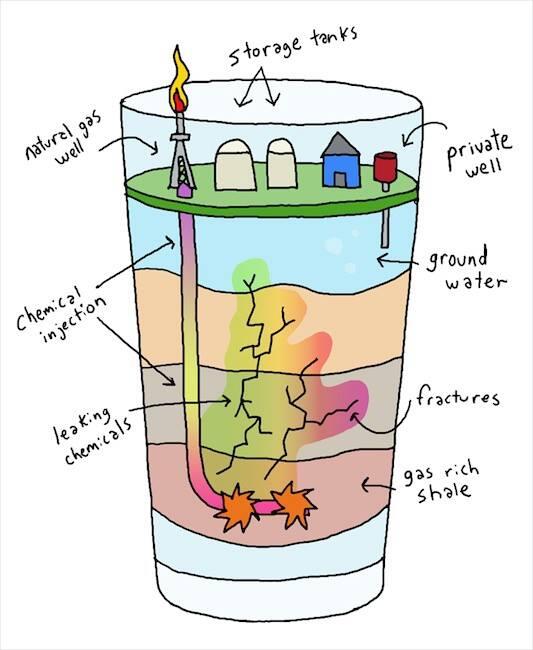
It would be nice if either the media or the protestors at Balcombe made some attempt to discuss the actual science behind fracking, but that seems a forlorn hope. The best I could come up with from the latter is this picture, offered by someone who thinks that anyone in possession of a set of crayons is qualified as a geologist:

BR-KG0SCAAAkSIu

In the interest of balance, here is a link to a blog post on fracking in the USA, the first paragraph of which reads:

For some time now, proponents of the controversial practice of hydraulic fracturing or “fracking” have claimed there was little or no evidence of real risk to groundwater. But as the classic saying goes: “the absence of evidence is not evidence of absence” of a problem. And the evidence that fracking can contaminate groundwater and drinking water wells is growing stronger with every new study.

I encourage you to read it, but if you do please carry on to the comments where you will see detailed counter-arguments.

I do not have a strong opinion either way on fracking. I’d prefer to make a decision as a result of an informed debate based on evidence, but there are clearly people who don’t want that to happen and are instead intent on scaremongering to suit their own ends. It seems to me that the legitimate concerns of sensible people have yet again been hijacked by the small but vociferous mob of “against everything” anarchists who see protest as an end in itself. It’s all so depressingly puerile. There’s no fracking going on in Balcombe anyway!

Why does the Green movement – and the left generally for that matter – have to be so comprehensively anti-scientific? As long as it remains that way it will never be taken seriously.

Trivial Hirsute

Posted in Beards, Biographical with tags , , , , on August 18, 2013 by telescoper

There’s been a lot going on in the world of beards recently. There’s the  Daily Fail story about how “hipster beards” are threatening the razor industry.  I don’t think it will be long before they run a story about the effect of facial hair on house prices. Then of course there’s the fuss about Jeremy Paxman’s appearance on Newsnight with a beard, which unleashed a storm of pogonophobia. Looking on the bright side, this served to generate some very positive publicity for the Beard Liberation Front, regular updated from which you can find on Keith Flett’s Blog.

Of course the Beard Liberation Front is essentially light-hearted in nature, but it does underline some rather serious points about the society we live in. First, is the obvious one. With so much terrible news going on in the world, who cares whether the presenter has a beard or not? In other words, it’s symptomatic of the superficiality of our celebrity-obsessed culture.

But there’s more than that. On the rare occasions I’ve been involved in media work I overheard many conversations about how such-and-such a scientist was no go for television because he had a beard. Why should that be? I think part of the answer can be found in Howard Jacobson’s piece in Saturday’s Independent: in that beards generally make their wearers look older. Nowadays, that, by definition ,means “unsuitable for TV”. You may have wisdom and gravitas, but if you don’t look like you belong in a boy band you’re just a beardy-weirdy and therefore out of contention.

Incidentally, I was of course clean-shaven when I had a few brief encounters with television, but my big chance for fame and fortune lapsed when I did a screen-test for the BBC, only to be told that I “lacked gravitas”. I doubt if a beard would have helped.

Back to my point.  I think I’ve established that bPogonophobia clearly has a significant overlap with ageism. Moreover, because it’s about jumping to conclusions about people based on their appearance  it also overlaps with racial prejudice. Men with beards are of not of course a persecuted minority, which is why the Beard Liberation Front can afford to engage in so much humorous self-parody, but it still succeeds in holding up a mirror to other, more sinister, forms of discrimination.

As for myself, I have no aspiration to become a hipster. I am far too old for that anyway. But I have always hated the chore of shaving in the mornings (and again later if I have to go out in the evening). I have frequently gone as far as growing a goatee beard, only to get rid of it because I didn’t like it much. The first time I grew a full beard was last summer. It wasn’t planned, but a consequence of a fairly long period of ill-health during a large part of which, for various reasons, I was unable to shave. When I began to recover, I shaved off the growth not so much because I disliked the beard in itself, but because it was an unwelcome reminder of what I’d been through. I wanted a fresh start. Having avoided any major recurrence this summer, I decided to have a go at growing a full beard again and am quite pleased with the result. At least it’s more convincing than Paxman’s.

Although not as grey, it has turned out rather similar in style to that of Ernest Hemingway as he is seen in this famous photograph by Yousuf Karsh:

yousufKarsh-ErnstHemingway-large

I have to admit, though, that the opinions of others are mixed. The best comment I got was from a work colleague who said that she liked my beard very much, only to add, with immaculate timing, “because it covers half of your face”. I guess I’ll just have to hope that Beard Power eventually carries me through to wider acceptance.

PS. For the physicists among my readers here is an old post of mine about the role of beards in the development of thermodynamics.

Sippie Wallace

Posted in Jazz with tags , , , , on August 17, 2013 by telescoper

I’ve been meaning to post this fabulous old record for a while but for some reason never got around to it. Until know. This is the great Sippie Wallace  who sings and plays piano in the company of Johnny Dodds (clarinet), Honore Dutrey (trombone) and Natty Dominique (cornet), on a 78rpm disc made in 1929 for the Victor label.

Sippie Wallace was born Beulah Thomas on 1st November 1896; she died on her 88th birthday in 1986. Between 1926 and 1929 she made around 40 records for the Okeh label in Chicago and may have made this record while she was still under contract with them. That reminds me of the famous story about Louis Armstrong who performed on some records for another label while on a supposedly exclusive contract with Okeh; he was hauled up in front of the manager at the Okeh label and accused of playing on these other tracks.  Of course it was him – his playing was instantly recognizable – but Satchmo is always alleged to have said “It wasn’t me, boss, but I won’t do it again”. ..

As was the case with Bessie Smith, most of Sippie Wallace’s repertoire was a bit on the raunchy side and this is no exception, but, boy, could she sing the blues. This wonderful performance is entitled I’m a Mighty Tight Woman….