Author Archive

Driving Test

Posted in Cute Problems with tags on May 16, 2012 by telescoper

I’m currently stuck in the office while my third year students are tackling an exam I set. I have to wait by the telephone in case there’s a problem with the paper that I have to sort out.

As a quick diversion I thought I’d give my blog readers a little test of their own. Try this little poser:

EPSRC Blues

Posted in Science Politics with tags , , , , , on May 15, 2012 by telescoper

I woke up this morning to find via Twitter an interesting blog post about a demonstration in London against the policies of the Engineering and Physical Sciences Research Council (EPSRC).

For those of you not up with the ins and outs of the UK science funding regime, EPSRC is the agency that funds the more mainstream areas of physics (as well as chemistry, engineering and some mathematics) while the more exotic bits (particle physics, nuclear physics and astronomy) are the responsibility of the Science and Technology Facilities Council (STFC). The current protest seems to be lead by a number of eminent chemists, including Prof. Sir Harry Kroto, Prof. Sir John Cadogan and Prof. Anthony Barrett.

Almost five years ago – was it really so long? – owing to a mixture of funding cuts and incompetent management, STFC was born into a financial crisis that made many of us doing astronomy and particle physics wish that we also were protected by the friendly hands of EPSRC rather than left out in the cold as we felt we were at STFC. Things have slowly improved at STFC, which now has an executive team that actually seems to listen to its community as well as speaking the language that Whitehall wants to hear. Funding is still tight, but STFC is a noticeably happier ship now than it was it first launched.

In the meantime, any envy we might have had about our colleagues in, e.g., condensed matter physics being safer in the EPSRC stable has now well and truly evaporated. Their strategy, “Shaping Capability“, expressed in dreadful management-speak, involves the imposition of arbitrary priorities such as the restriction of fellowship applications to certain areas chosen by The Management. Worse, its new funding rules attempt to target funding at commercially-driven research. Dark clouds are gathering in the “blue skies” under which UK science has hitherto flourished.

The unresponsive top-down character of EPSRC has strengthened under the leadership of David Delpy who must have been made in the same factory as Keith Mason, former Chief Executive of STFC, whose diplomatic skills were similarly remarkable by their absence.

For some reason, this reminds me of the following quote from Smiley’s People

In my time, Peter Guillam, I’ve seen Whitehall skirts go up and come down again. I’ve listened to all the excellent argument for doing nothing, and reaped the consequent frightful harvest. I’ve watched people hop up and down and call it progress. I’ve seen good men go to the wall and the idiots get promoted with a dazzling regularity.

I’ve argued before that I think EPSRC’s approach is fundamentally wrong. When taxpayers’ money used is used to generate immediate commercial returns, it ends up in the pockets of entrepreneurs when the research succeeds and, if it doesn’t, the grant has effectively been wasted. Commercial Impact should not be a factor in awarding public funding, because it is perfectly suited as a criterion for attracting private funding. This is why we have a national fiscal policy: the only justification for levying taxation is to fund projects which will not yield short-term economic returns. There is no reason to spend public money on commercial projects: we need to justify pure research by a non-economic valuation.

This morning EPSRC have issued a press release calling upon scientists to work together ahead of the forthcoming comprehensive spending review. It doesn’t mention the demonstration, or other manifestations of unrest within the EPSRC community, but instead re-asserts the need for its so-called strategy, with a clear message not to rock the boat ahead of the next Comprehensive Spending Review.

I’ve heard that argument many times in the context of STFC during its crisis period. I firmly believe that rocking the boat in that case helped it get off the rocks. It remains to be seen whether the EPSRC protest, which is currently rather small, will gather enough momentum to make a difference. It all depends on what fraction of EPSRC scientists have actually signed up to the Delpy Agenda. Is the new campaign representative of the views of the EPSRC community? No doubt many research groups will be prospering under the new regime, at least in the short term. Time alone will tell what the long-term impact of short-termism will be.

Rigid Body Sings

Posted in Poetry, The Universe and Stuff with tags , , , , on May 14, 2012 by telescoper

Gin a body meet a body
Flyin’ thro the air,
Gin a body hit a body,
Will it fly? And where?

Ilka impact has its measure
Ne’er a’ ane hae I
Yet a’ the lads they measure me,
Or, at least, they try.

Gin a body meet a body
Altogether free,
How they travel afterwards
We do not always see.

Ilka problem has its method
By analytics high;
For me, I ken na ane o’ them,
But what the waur am I?

by James Clerk Maxwell (1831-1879)

P.S. This poet is of course much better known as a physicist, but this is a nice little parody of Robert Burns’ Comin’ through the Rye in authentic Scots.

Bayes’ Theorem and the Search for Supersymmetry

Posted in The Universe and Stuff with tags , , , , on May 13, 2012 by telescoper

Interesting comments about Bayes’ theorem and the prospects for detecting supersymmetry at the Large Hadron Collider. This piece explains how a non-detection isn’t always “absence of evidence” but can indeed by “evidence of absence”. It’s also worth reading the comments if you’re wondering whether what people say about Lubos Motl is actually true…

Phi G's avatarviXra log

Here’s a puzzle. There are three cups upside down on a table. You friend tells you that a pea is hidden under one of them. Based on past experience you estimate that there is a 90% probability that this is true. You turn over two cups and don’t find the pea. What is the probability now that there is a pea underneath? You may want to think about this before reading on.

Naively you might think that two-thirds of the parameter space has been eliminated, so the probability has gone from 90% to 30%, but this is quite wrong. You can use Bayes Theorem to get the correct answer but let me give you a more intuitive frequentist answer. The situation can be models by imagining that there are thirty initial possibilities with equal probability. Nine of them have a pea under the first cup, nine more under the second and nine more under the third…

View original post 880 more words

Crossword Look-alikes

Posted in Crosswords with tags , , , on May 13, 2012 by telescoper

I wonder if anyone else has noticed the remarkable similarity between this clue, by Paul, in yesterdays Guardian Prize Crossword (No. 25634)

Foolishly cash lost in ’em? (4,8)

and this one in Everyman No. 3423 which appeared in today’s Observer:

One-armed bandits – lost cash in ’em, stupidly (4,8)

I wonder if, by any chance, they might be related?

More interestingly, the clue by Paul is a nice example of an “&lit” clue whereas the Everyman one has the traditional definition + cryptic parts. In an &lit clue two different readings of the clue give the definition and cryptic allusion. In this one the word “foolishly” is an anagram indicator (acting on the subsequent  letters); the surface reading (“literally what it says”) defines something you might lose money in foolishly. This kind of clue often ends with a “?” or even a “!” to suggest something a bit sneaky is going on so a bit more lateral thinking than usual may be required.  The second clue has the same anagram (indicated by “stupidly”) but this is preceded by a straightforward definition of the answer so has no “?” at the end.

I’m not going to give the answer, but it’s quite an easy one so I assume the penny has dropped.

The Train and the River

Posted in Biographical, Books, Talks and Reviews with tags , , , on May 12, 2012 by telescoper

Well, here I am back in Cardiff after my little trip to Merseyside. The weather behaved itself and so did the trains in both directions, so it was quite a pleasant travelling experience. In fact, going there yesterday I managed to make a technically impossible connection at Crewe, owing to the train from Cardiff being a minute or two early and the train to Liverpool being a minute late.

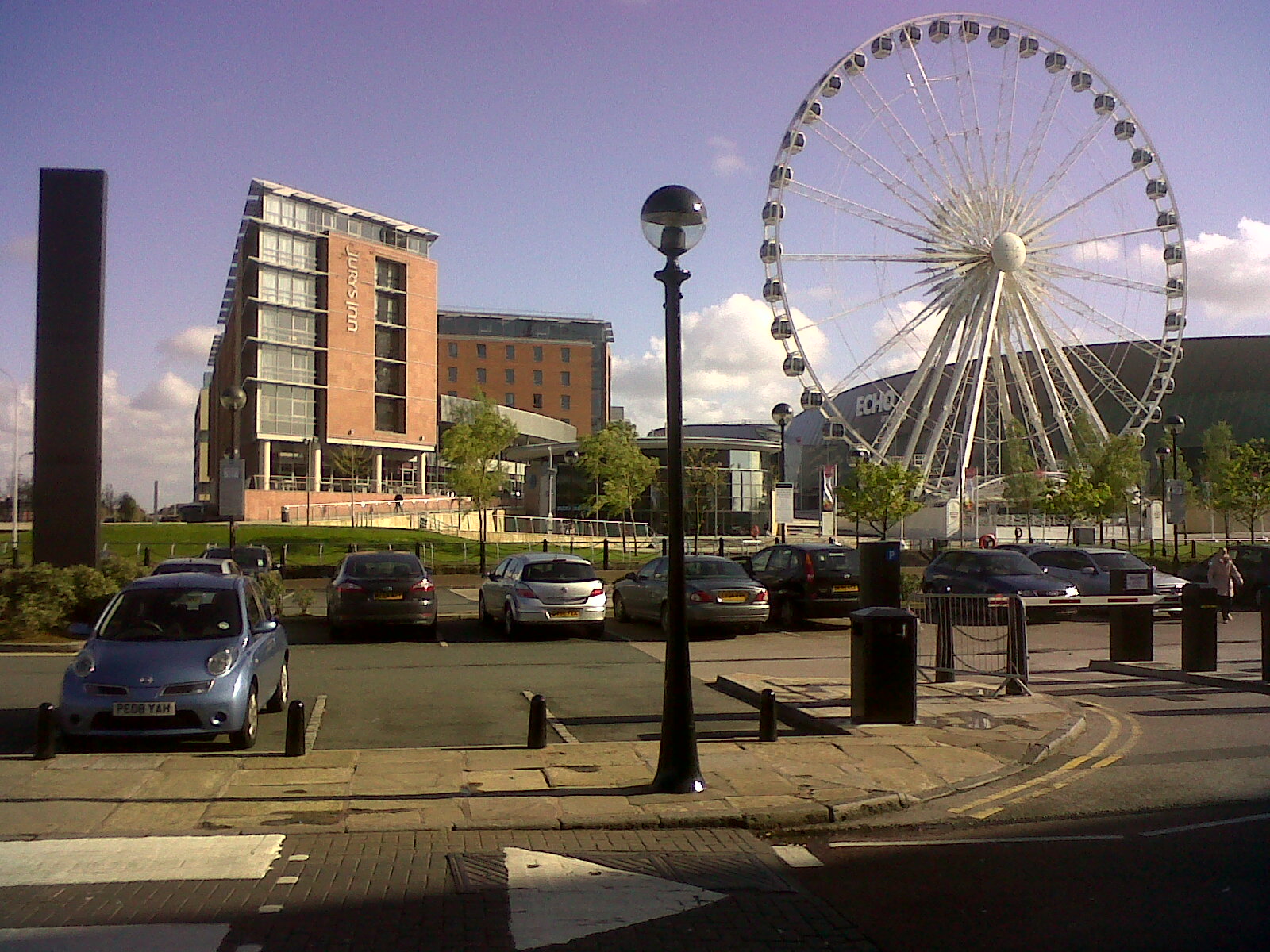
I stayed last night at the Jury’s Inn at Albert Dock, shown on the left here. There’s a sort of Ferris Wheel thing next to it. These contraptions seem to be popping up all over the place. Next thing you know there’ll be one in London! The hotel was of its type, generic but reasonably comfortable. Brings back memories of STFC panel meeting; the Jury’s Inn there is a standard place to stay in Swindon when sentenced to hard labour. Unfortunately the one I stayed in was booked up by multiple stag and hen parties and was ridiculously noisy all night. I didn’t really get any sleep until well after 4am. Grump.

Anyway, last night we had a very nice dinner at the Clove Hitch restaurant/bistro (which I definitely recommend) preceded by a pint at the famous Philharmonic Pub. Thanks to Phil and Sue for looking after us so nicely.

My talk opened the proceedings at the Merseyside Astronomy Day, which was held at Spaceport on the Birkenhead side of the Mersey. Here’s a view of Liverpool’s impressive skyline taken from there, with a nice sailing barge on the Mersey.

The small auditorium – usually used for Planetarium shows – was pretty full and I think my talk went quite well, although it’s not really for me to say. They did actually record everything so if I can get hold of a copy I might post it. Anyway, after my turn there was a fascinating lecture by Prof. Peter Read of Oxford University about the atmospheres of Jupiter and Saturn.

After a quick lunch we used Liverpool’s excellent public transport to zip back to Liverpool Lime Street and I had a relaxing and punctual journey back to Cardiff, albeit with no miracle change at Crewe this time. Dozing on the train I quite startled to wake up near Shrewsbury to find a vintage steam locomotive in sight:

No doubt there’ll be someone out there in internetshire who will tell me all about this train through the comments box but for now I’m going to make some dinner and take it easy as I’m rather knackered.

Merseyside Astronomy Day

Posted in Books, Talks and Reviews, The Universe and Stuff with tags , , , , on May 11, 2012 by telescoper

I’m just about to head by train off up to Merseyside (which, for those of you unfamiliar with the facts of British geography, is in the Midlands). The reason for this trip is that I’m due to give a talk tomorrow morning (Saturday 12th May) at Merseyside Astronomy Day, the 7th such event. It promises to be a MAD occasion.

My lecture, entitled The Cosmic Web, is an updated version of a talk I’ve given a number of times now; it will focus on the large scale structure of the Universe and the ideas that physicists are weaving together to explain how it came to be the way it is. Over the last few decades astronomers have revealed that our cosmos is not only vast in scale – at least 14 billion light years in radius – but also exceedingly complex, with galaxies and clusters of galaxies linked together in immense chains and sheets, surrounding giant voids of empty space. Cosmologists have developed theoretical explanations for its origin that involve such exotic concepts as ‘dark matter’ and ‘cosmic inflation’, producing a cosmic web of ideas that is in some ways as rich and fascinating as the Universe itself.

Anyway, I’m travelling to Liverpool this afternoon so I can meet the organizers for dinner this evening and stay overnight because there won’t be time to get there by train from Cardiff tomorrow morning. It’s not all that far from Cardiff to Liverpool as the crow flies, but unfortunately I’m not going by crow by train. I am nevertheless looking forward to seeing the venue, Spaceport, which I’ve never seen before.

If perchance any readers of this blog are planning to attend MAD VII please feel free to say hello. No doubt you will also tell me off for referring to Liverpool as the Midlands…

Ars Nova Copenhagen

Posted in Music with tags , , , , , , , , , on May 11, 2012 by telescoper

Yesterday being the day of my last revision lecture I decided to mark the end of the teaching year last night by going to a concert which was part of a series belonging to the 2012 Vale of Glamorgan Music Festival and was held in All Saints’ Church, Penarth. I would like to have been to more of these performances, but unfortunately it’s the busiest period of the academic year and I just couldn’t spare the time.

I made a special effort to make sure I could get to last night’s concert by the choir  Ars Nova Copenhagen partly because of their illustrious reputation as choral singers but also because the programme featured music by Danish composer Per Nørgård, whose music I have only just discovered. Ars Nova Copenhagen consists of twelve singers of extraordinary individual ability and wonderful collective cohesion under the direction of Søren Kinch Hansen. Last night’s performance was truly marvellous.

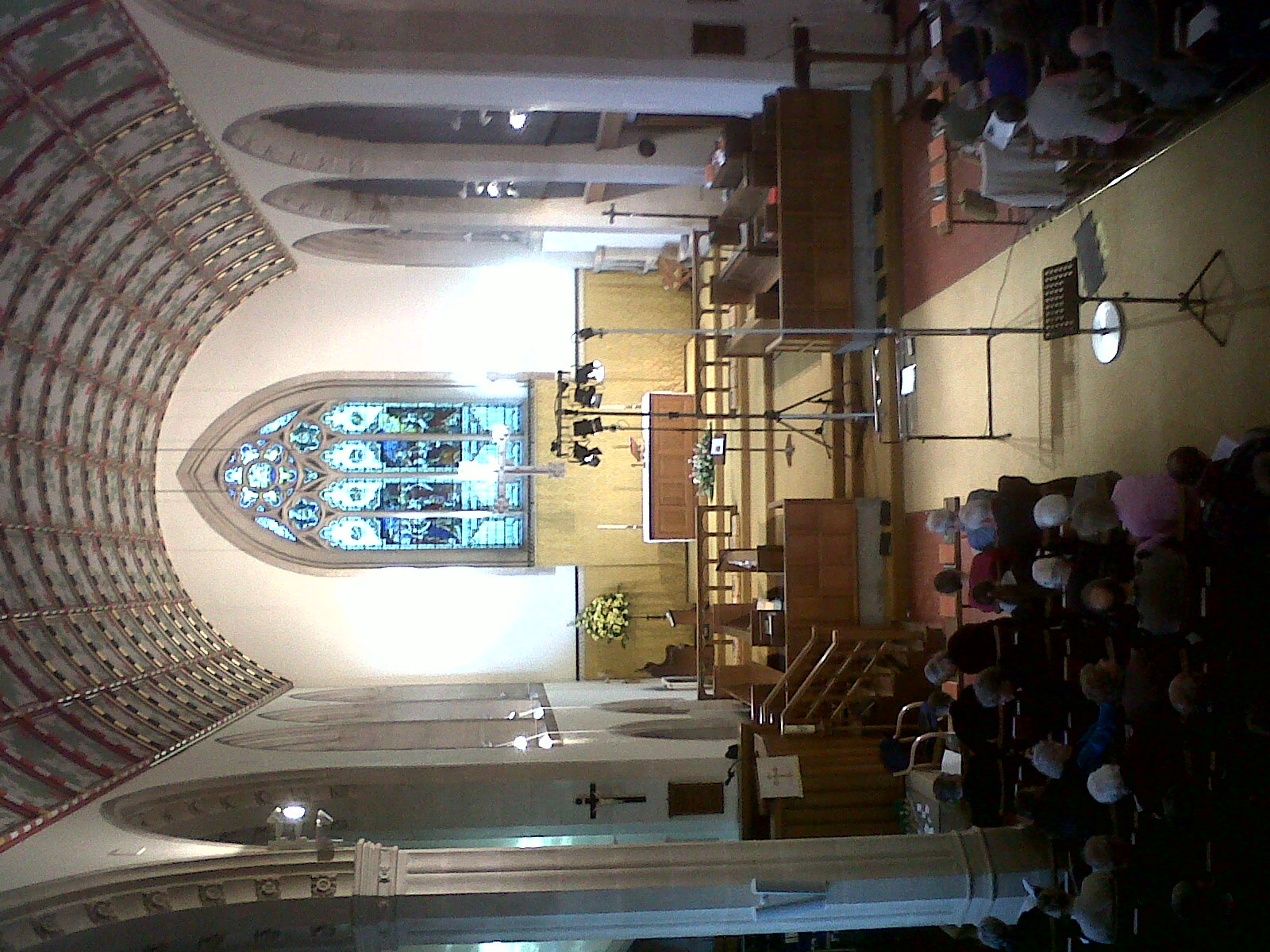
To the left you can see a picture of the venue, just before the concert started; we had seats in the gallery giving an excellent view of the whole performance. The choir made full use of this space, sometimes dividing into groups and standing in different parts of the church. I’m not all that familiar with the terminology of church architecture, but that includes just in front of the sanctuary (where the altar is), in the choir, and in the aisles either side of the central one. Incidentally, I have been told on more than one occasion that the central passageway through the nave is not, as is often stated the aisle; the aisles are the smaller parallel passageways to either of the nave. I’m sure someone will correct me if I’m wrong!

Anyway, the programme consisted of a mixture of sacred and secular music (some of the latter actually rather profane), starting with a longish  piece by Pelle Gudmundsen-Holmgreen which had the choir not only singing but also tweeting like birds and doing animal impressions. I was initially unsettled by this, but pretty soon decided that I liked it.

There then followed three pieces by the great Estonian composer Arvo Pärt – all of which were lovely, but I particularly enjoyed the piece called Morning Star – and then three beautiful pieces by Per Nørgård bringing the first half of the concert to a close.

Somewhat surprisingly for a concert in a church, there followed an interval at which we had a glass of wine. Then there was a second half which had a rather different, rather eclectic flavour. It started with two new works commissioned especially for this Festival, by Peter Bannister and Gavin Bryars, the latter being a moving setting of Psalm 141. A subset of the male voices of the choir then performed a piece by minimalist composer Steve Reich. Finally we heard a fascinating work by Anne Boyd called As I crossed the bridge of dreams which was bore the hallmarks of an oriental influence.

All in all, it was a fascinating and adventurous evening of music, by a wonderful and versatile group of vocal artists, helped by the intimate yet rich acoustic of All Saints’ Church.

You can’t beat live music. What with the various concert venues and the Opera here in Cardiff there are so many opportunities to hear the real thing that my CD collection is steadily gathering dust.

Muggles

Posted in Jazz with tags , on May 10, 2012 by telescoper

A bit fed up today, and too tired to post anything substantive, so I thought I’d cheer myself up this lunchtime the old-fashioned way with a bit of Louis Armstrong. This was recorded in 1928 by Satchmo with the later incarnation of the Hot Five, which naturally numbered six people in total. The title, Muggles, has nothing to with Harry Potter but is a slang word popular in 1920s Chicago that refers to a certain smoking material of an illicit nature, to which Mr Armstrong was rather partial all his life and which no doubt contributed to the relaxed atmosphere pervading this recording session..


Dielectric Breakdown

Posted in The Universe and Stuff with tags , , on May 9, 2012 by telescoper

This is the season when our  second-year students are picking the projects they want to do in their third year, as are those third-year students intending to carry on for Year 4 of the MPhys programme. I’ve been chatting to quite a few students about this particular project so thought I’d do a quick post here.


One of the third-year projects I’ve got in the current catalogue for next year concerns a computer model of dielectric breakdown based on the idea of diffusion-limited aggregation. This is  a neat model that allows the students to simulate pretty patterns like the one shown on the left.

The mathematics of it was first presented in Niemeyer, L., Pietronero, L., Wiesmann, H., “Fractal dimension of dielectric breakdown,” Physical Review Letters 52 (1984), 1033-1036.

Dielectric breakdown happens when a sufficiently large voltage is applied across a material that doesn’t normally conduct electricity, the classic example being a lightning strike. Here’s another example, which I find particularly electrifying…

Classical physics can be fun, you know!