A comment on my earlier post about the Science is Vital rally on 9th October included this video of the occasion. Actually it’s more a series of stills than a proper video, but if you look very closely around 39 seconds in you’ll see me lurking among the ill-disciplined rabble well-behaved demonstrators seeking to overthrow the state argue the case for science and bring about the collapse of global capitalism and try to dissuade the Treasury from huge cuts to the budget for research.
Author Archive
Science is Vital – the Video
Posted in Finance, Politics, Science Politics with tags Science is Vital on October 18, 2010 by telescoperAstronomy Look-alikes, No. 42
Posted in Astronomy Lookalikes with tags Paul O'Grady, Warrick Couch on October 18, 2010 by telescoperHas anyone else noticed that Warrick Couch seems to be turning into Paul O’Grady? Still, it could have been worse. At least Lily Savage has now retired…

Paul O'Grady

Warrick Couch
Cardiff Half-Marathon
Posted in Bute Park with tags Bute Park, Cardiff Half-Marathon on October 17, 2010 by telescoperJust back from a walk in the park to watch the runners in this year’s Cardiff Half-Marathon. Quite a few people I know from the School of Physics & Astronomy – both staff and students – were participating so I was hoping to catch sight of them as they passed by. I nearly missed the event because of my own incompetence – I knew the route had changed since last year, but was still under the impression that it went along Cathedral Road. I was wrong. The route actually loops back inside Bute Park rather than down the main road outside, so I had to walk a bit further than anticipated to see the runners.
It was a beautiful bright morning for it, if a bit on the chilly side, and Bute Park was looking lovely in the autumn sunshine. I imagine the start, down in Cardiff Bay near the sea, must have been distinctly cold at 9am! Interestingly, the route this year also involved a section over the Cardiff Bay Barrage which must also be a bit “bracing” in October. The path the runners followed in Bute Park is relatively narrow at the spot I found, about 5 miles into the race, and the participants were consequently rather bunched. That, and the fact that they were moving rather quickly, made it difficult for me to pick out people I recognized let alone take a picture of them. I did see a few familiar faces, but alas couldn’t get any decent photographs.
Well done, everyone who completed the race, especially those who raised money for charity by doing so. Hats off to you all!
Here are a few random snaps I took while I was there.
I used to run quite a lot when I was younger (half-marathons and even a few full marathons), but I’ve had to give it up because of the condition of my knees. Watching these events makes me feel a mixture of jealousy and frustration, to such an extent that I’m sorely tempted to have a go at a half-marathon one last time, even if they have to bring me home in an ambulance…
The Father of Fractals
Posted in The Universe and Stuff with tags Benoit Mandelbrot, Fractals on October 16, 2010 by telescoperJust a brief post to pass on the sad news of the death at the age of 86 of Benoit Mandelbrot. Mandelbrot is credited with having invented the term fractal to describe objects that possess the property of self-similarity and which have structure on arbitrarily small scales. In his marvellous book, The Fractal Geometry of Nature, Mandelbrot explored the use of fractals to describe natural objects and phenomena as diverse as clouds, mountain ranges, lightning bolts, coastlines, snow flakes, plants, and animal coloration patterns. His ideas found application across the whole spectrum of physics and astrophysics including, controversially, cosmology. Fractal images, such as the one below of the Mandelbrot set, also found their way into popular culture; I had a poster of one on my bedroom wall when I was a student and kept it for many years thereafter.
![]()
I came across Mandelbrot’s book in the public library and found it truly inspirational, so much so that he became a scientific hero of mine. I was therefore thrilled at the prospect of meeting him when I myself had become a scientist and had the chance to go to a conference, in Paris, at which he was speaking. Unfortunately, I was deeply disappointed by his lecture, which was truly awful, and his personal manner, which I found less than congenial. Nevertheless, there’s no denying his immense contributions to mathematics and science nor his wider impact on culture and society. Another one of the greats has left us.
Thatcher’s Final Victory?
Posted in History, Politics, Science Politics with tags Comprehensive Spending Review, Golgafrincham, Margaret Thatcher, Winter of Discontent on October 16, 2010 by telescoperNext Wednesday (20th October) we will hear the outcome of the Comprehensive Spending Review, and what it means for the scale of the cuts to UK public spending in each of the government departments. After that the detailed breakdown of cuts within each Ministry will gradually be revealed. Some news has already leaked out, of course. The Browne Report published last week almost certainly heralds huge cuts in the state subsidy to the UK University sector, with the cost of Higher Education consequently shifting from the taxpayer to the student. On top of that, and despite the best efforts of the Science is Vital campaign, it seems highly likely that there will be a steep decrease in investment in scientific research – both through the Research Councils and through the research component of Higher Education funding. On the other hand, the defence budget appears to have been spared the worst of the hatchet, with the Trident nuclear submarine programme set to go ahead (with a price tag around £25 billion) and two new aircraft carriers to be built at a cost of £5.5 billion (although it is not clear there will actually be any aircraft to operate from them).
Obviously, knowledge and learning are less important to the future of this country than the ability to fight pointless wars against invented enemies. Morover, we already spend more than most competitor economies on defence as a fraction of GDP, and less on universities and science. How did we end up with such distorted priorities?
On top of these cuts we have to contend with a draconian cap on immigration. New restrictions on visas for non-EU citizens will make it much harder for British universities to recruit overseas students and staff. The new rules give exemptions only to those coming to the UK to take up highly paid jobs, such as professional footballers. Postdoctoral researchers and university lecturers don’t get paid enough to register as economically relevant, so many fewer will be able to enter this country. While these restrictions may satisfy xenophobic Daily Mail readers, they promise to damage the University sector almost as much as the funding cuts, as a significant fraction of the best staff in UK science departments are from outside the EU (including the two winners of the 2010 Nobel Prize for Physics).
All this sounds depressingly familiar to those of us who lived through the various Thatcher governments and their successors. In fact, looking at the following graph (which I nicked from Andy Lawrence’s blog, but which comes from a document produced by the Royal Society) you’ll see the steady reduction in science investment under previous Conservative governments

I know I’m not alone in interpreting these cuts as not being about the need to secure the country’s finances. The UK’s public debt as a fraction of GDP is rising, of course, and something needs to be done about it. But this graph shows the actual situation:

Serious? Yes, but not sufficient to justify the carnage we’re about to experience.
What is going on is that the parlous state of the UK’s finances is being used as a pretext to resume the Thatcherite attack on the welfare state through a campaign of privatisations and closures so that wealthy Tory voters can get richer at the expense of ordinary working people.
No doubt there will be people reading this who really think that cutting back state expenditure is a good thing, and even I agree with that to some extent. However, there is a part of Thatcher’s legacy that is actually the root of the problem and it represents a fundamental inconsistency of the Thatcher project. Unless it is tackled, the cut-and-burn route will not lead to a sustainable economy, but will take this country into inexorable decline.
The nub of the matter is the Invasion of the Bean Counters into every aspect of public life. The breakdown of trust between government and the public sector that ushered in Margaret Thatcher’s victory in the 1979 General Election has led to a huge increase in red tape involved in the assessment, regulation and general suffocation of public services. As the Thatcher project continued through John Major’s, and, yes, Tony Blair and Gordon Brown’s governments (Blair was undoubtedly a Thatcherite) any rises in public spending went not into providing better services but in a vast and unwieldly machinery of regulation. Now it matters less whether the public sector does things well. What matters is that they tick the boxes imposed by civil service mandarins. This mentality has led to a proliferation of overpaid administrators in the National Health Service, schools are hamstrung by the rigid constraints of the National Curriculum, the Police spend more time filling in forms than they do investigating crime, and the number of staff employed in university administration has increased at the expense of teaching and learning.
You might say that this is all the fault of New Labour, but I don’t think that’s right; the suffocation of the UK’s public sector began with Thatcher and it began as a direct result of the Winter of Discontent (a re-run of which seems eminently possible). The reason why a succession of right-wing governments have failed to get a grip on public spending is that they’ve all been run by control freaks and have pumped money into wasteful self-serving bureaucracies.
Britain has turned into a version of Golgafrincham, with the “useless third” now in the position of wielding the axe over those few remaining things in the UK which are actually pretty good.
Apparently, Margaret Thatcher is not in very good health and may not live much longer. I won’t mourn her passing. In Thatcher’s time in office, this country took giant steps towards becoming a police state. She encouraged xenophobia and intolerance, and spawned the generation of small-minded money-grabbing lizards who now occupy the Government benches. As Britain turns into a wilderness of cashable things once more, it looks like she might be set for her final victory.
Tower of Song
Posted in Music with tags Leonard Cohen, Tower of Song on October 16, 2010 by telescoper
Well my friends are gone and my hair is grey
I ache in the places where I used to play
And I’m crazy for love but I’m not coming on
I’m just paying my rent every day
In the Tower of Song
I said to Hank Williams: how lonely does it get?
Hank Williams hasn’t answered yet
But I hear him coughing all night long
A hundred floors above me
In the Tower of Song
I was born like this, I had no choice
I was born with the gift of a golden voice
And twenty-seven angels from the great beyond
They tied me to this table right here
In the Tower of Song
So you can stick your little pins in that voodoo doll
I’m very sorry, baby, doesn’t look like me at all
I’m standing by the window where the light is strong
Ah they don’t let a woman kill you
Not in the Tower of Song
Now you can say that I’ve grown bitter but of this you may be sure
The rich have got their channels in the bedrooms of the poor
And theres a mighty judgement coming, but I may be wrong
You see, you hear these funny voices
In the Tower of Song
I see you standing on the other side
I don’t know how the river got so wide
I loved you baby, way back when
And all the bridges are burning that we might have crossed
But I feel so close to everything that we lost
Well never have to lose it again
Now I bid you farewell, I dont know when Ill be back
There moving us tomorrow to that tower down the track
But you’ll be hearing from me baby, long after I’m gone
I’ll be speaking to you sweetly
From a window in the Tower of Song
Yeah my friends are gone and my hair is grey
I ache in the places where I used to play
And I’m crazy for love but Im not coming on
I’m just paying my rent every day
Oh in the Tower of Song
Has your MP signed EDM 767?
Posted in Politics, Science Politics with tags Early Day Motion, Science is Vital on October 15, 2010 by telescoperOne of the interesting curiosities of the British parliamentary system is the Early Day Motion (EDM), which is a brief motion to be debated at an unspecified date in the future. Few of them ever get debated and they remain open for signature throughout a parliamentary session.
Early Day Motion 767 relates to the Science is Vital Campaign. It was tabled on 16th September 2010 and the text is as follows:
That this House notes the UK’s proud history of excellence in science and engineering, whereby it produces over 10 per cent. of global scientific output with just one per cent. of global population; believes that continued investment in research is vital in order to meet the technological and social challenges of the 21st century, and to continue to attract high-tech industries to invest in the UK; further believes that large cuts to science funding are a false economy, due to evidence that research investment fuels economic growth; further notes the increased investment in science by the UK’s international competitors, such as the USA, France and Germany; further believes that investment in research and development is vital to help rebalancethe economy towards hi-tech manufacturing and away from over-reliance on financial services; recognises the work of the Science is Vital coalition and the Campaign for Science and Engineering in arguing that the UK should seek to retain its role as a world leader in these fields; and calls on the Government to safeguard the UK’s scientific excellence by providing a research investment strategy which builds on the success of UK science and engineering.
(The rules require that at EDM be a single sentence, but often, as in this case, the sentences are somewhat lengthy.)
It was tabled by Julian Hippert, and has so far attracted 81 signatures, which is good going for such things. The following MPs have signed EDM 767.
Is yours among them?
If not, I think you know what to do….
UPDATE: The following 11 have signed since yesterday:
Meale, Alan
Brake, Tom
Brooke, Annette
Brown, Russell
Dowd, Jim
Main, Anne
O’Donnell, Fiona
Blomfield, Paul
Sarwar, Anas
Vaz, Valerie
Dakin, Nic
STFC Budget 2010-11
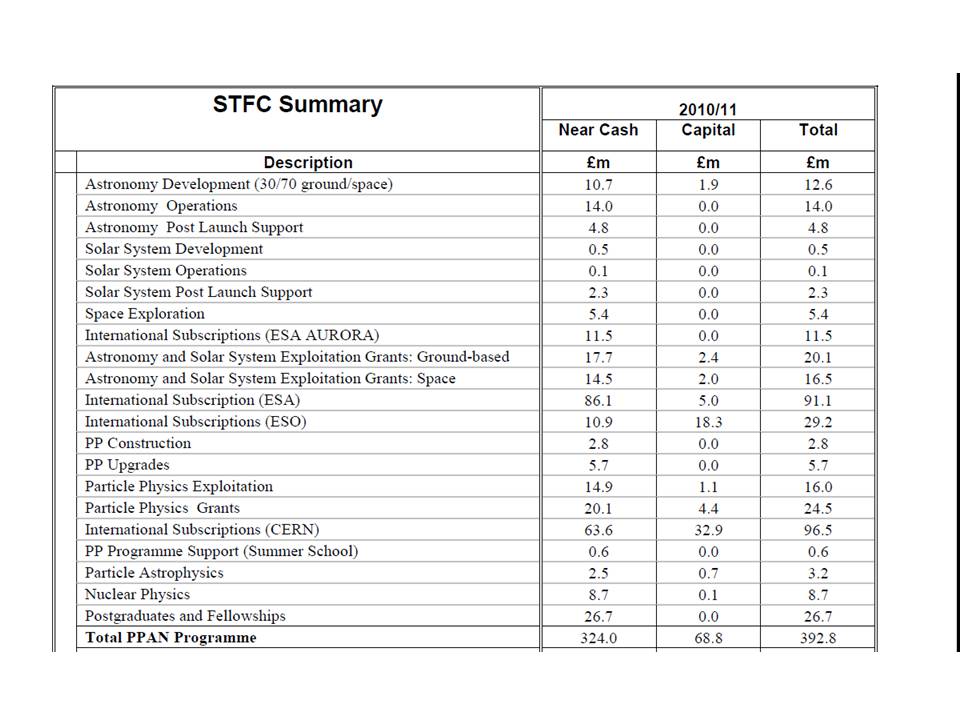
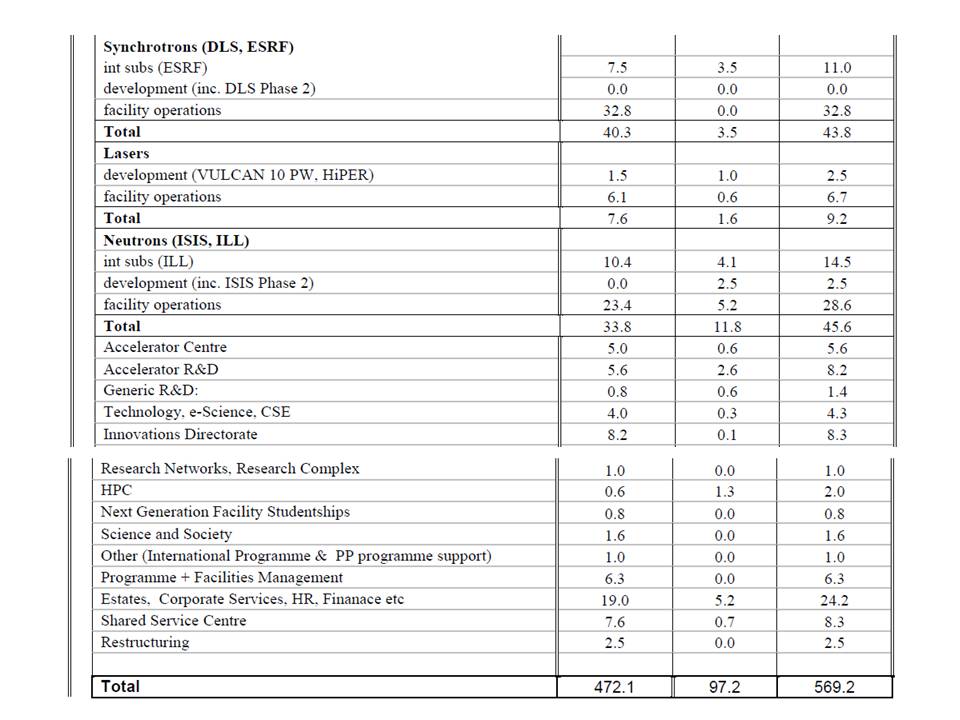
Posted in Finance, Science Politics with tags astronomy, Particle Physics, STFC on October 14, 2010 by telescoperJust a quick post to point out that the Science and Technology Facilities Council have released a reasonably complete breakdown of their current budget. I’m sure many readers working in astronomy and particle physics will find it interesting reading, though others will probably find it incredibly boring.
Here it is, for easy reference, in bits, generated by a clumsy cut-and-paste-technique wholly unbefitting the hi-tech nature of STFC, starting with the PPAN Programme:
and now the rest
For those of you not up with the accounting lingo, “near cash” means assets investments and other things that could in principle be exchanged for cash in a relatively short period of time.
These are, of course, the figures before the impending cuts take place….
There’s a much more legible version of the whole thing here.
The Normal Heart (reblog)
Posted in Uncategorized on October 14, 2010 by telescoperI thought I’d re-post this poem by WH Auden which I put up about a year ago on the anniversary of the outbreak of World War 2. We’re in a different kind of struggle now, but his words are no less apt for that.
via In the Dark
The Browne Stuff
Posted in Education, Finance, Politics with tags Browne Report, Higher Education, Universities on October 13, 2010 by telescoperI’m basically in purdah this week, shuttling to and fro between Cardiff and Swindon on the business of the STFC Astronomy Grants Panel. However, I couldn’t resist a brief early morning post about yesterday’s news about the report on higher education funding by Lord Browne. I haven’t had time to read the report in full, so won’t comment in detail on it, but a few things did strike me from what I’ve picked up from the media. Perhaps others will add their views through the comments box.
- For a start it’s quite amusing how far wide of the mark most of the rumour-mongering about the report’s recommendations has been. In fact the proposals are far more radical than had been touted.
- The suggestion of lifting the cap on fees entirely, and allowing universities to decide how much to charge for tuition, will delight the so-called “elite” universities, but will alarm those (like me) who worry about the impact on students from poorer backgrounds. Most difficult, however, as far as I’m concerned will be the impact on middle-grade universities who won’t know where to pitch themselves in the free market that such a move would create. We know that Oxbridge will be able to get away with charging pretty much whatever they like, and many of the former polytechnics will clearly go for the budget end of the market, but in between there will be tricky decisions to make.
- The increased fee is to be offset by a cut of a whopping 80% (from £3.5bn to £0.8bn) in the teaching grant to English universities. A cut of this scale may well mean that some courses do not receive any direct contribution from the taxpayer at all (the so-called “unit of resouce”). If this goes ahead it will undoubtedly lead to course closures across the country. Although I would oppose a blanket cut of this scale, I’m not against the idea of withdrawing support from Mickey Mouse courses and concentrating it on important subjects.
- It seems likely, and indeed there are already signs, that full implementation of the Browne proposals will be politically difficult for the ConDem coalition. In fact, unless some of the recommendations are diluted, this may well lead to a full-scale revolt. We’ll have to wait and see.
- Vince Cable has endorsed the report, despite his own party’s previous opposition to raising tuition fees. Any resisual respect I had for him is going down the plughole very rapidly indeed.
- Finally, I’ll just point out that, even if they are fully implemented, the draconian cuts to English higher education funding are not necessarily going to be replicated here in Wales (or in Scotland or Northern Ireland). The Welsh Assembly has issued a statement on the Browne report, but clearly doesn’t know what to do about it. If they make good decisions now, Welsh universities could prosper by bucking the English trend, but if they get it wrong….
Anyway, that’s all for this am. Got a train to catch!