Apologies to Professor Brian Cox, but I couldn’t resist this! I think it’s hilarious…
A word of warning: it contains colourful language, so please be sure to watch it after the watershed. And if you can’t find water, lava will do just as well.
Apologies to Professor Brian Cox, but I couldn’t resist this! I think it’s hilarious…
A word of warning: it contains colourful language, so please be sure to watch it after the watershed. And if you can’t find water, lava will do just as well.
Well, I’ve spent the evening working as well as following an important night’s football. My team – Newcastle United – were playing their promotion rivals Nottingham Forest at St James’ Park (in Newcastle). Going into the game Newcastle were at the top of the Championship, 10 points clear of third-placed Nottingham Forest with a game in hand. With 80 points from 38 games, and only 8 remaining to play, a win would virtually guarantee that Forest (on 70 points after 39 games) couldn’t catch them and Newcastle would therefore be in one of the top two positions guaranteeing them a return to the Premiership next season.
Although this was apparently a commanding position, I’ve been a Newcastle supporter for too long to take anything for granted; they’ve demonstrated their ability to throw away apparently unassailable leads far too often for me to feel complacent. Fortunately, they didn’t let me down. Two second-half goals (from Shola Ameobi and Jose Enrique) saw them win 2-0. Now 13 points clear of third place (with Forest only having 6 games to play), they are on the brink of automatic promotion. Mathematically they now need 6 points from 7 games to be sure, but they could seal it on Saturday away against bottom club Peterborough, if Nottingham Forest lose against Bristol City.
I confess that I get badly affected by nerves when following games on the radio or TV. I’d much rather be there in the flesh, but sadly that’s impractical. When the final whistle went tonight I was enormously relieved and more than a little bit elated, despite the heavy cold I’ve got at the moment.
Anyway, I thought it called for a bit of musical celebration. Newcastle United’s nickname is The Magpies, so I thought I’d offer the overture from Gioachino Rossini‘s Opera La Gazza Ladra (The Thieving Magpie). It’s not the greatest opera, but the overture is superb. Apparently Rossini had to be locked in his room and forced to write it as the deadline for the first performance approached. If that’s true, the pressure had a positive effect on him because what he produced is a cracker.
This performance is tremendously virtuosic – as you’d expect from the Vienna Philharmonic – especially in the accelerando part at the end, which is wonderfully exhilirating.
I’ve only known a few professional classical musicians at a personal level, but all of them, when asked, said that the composer whose music they most enjoyed playing was Rossini. I was always surprised to hear that, but listening to this piece I can certainly understand them. It’s got to be great fun playing this…
P.S. Another thing worth mentioning is that the current owner of Newcastle United Football Club bears more than a passing resemblance to Rossini!


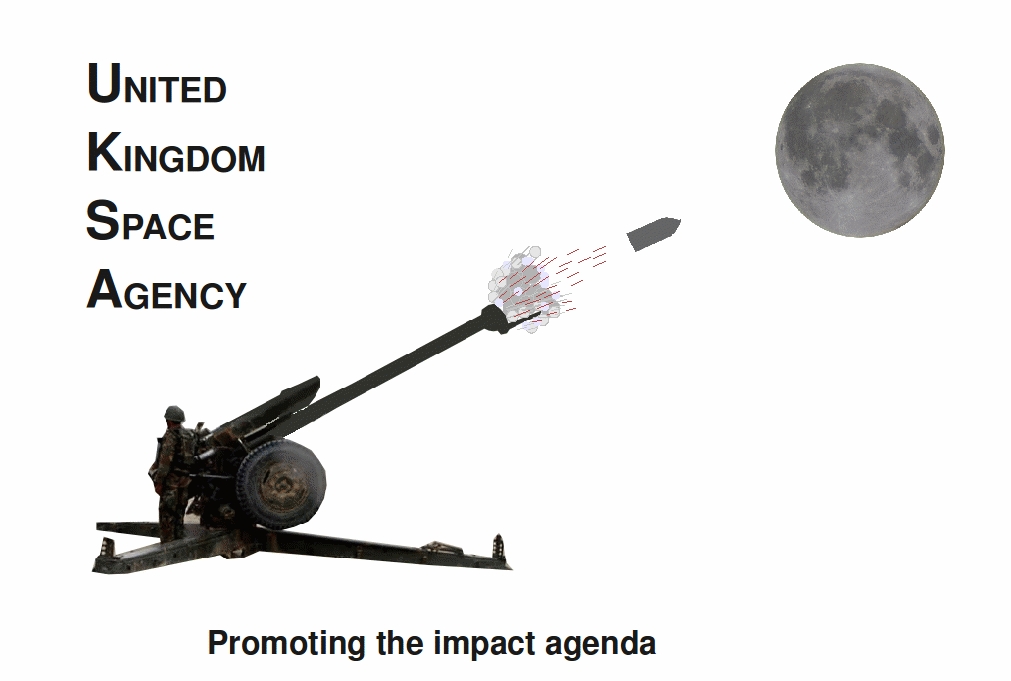
As you all know, this past week saw the launch of the new UK Space Agency amid much fuss and fanfares. This occasion allowed the government to trumpet the creation of the new organization as a success story in the media and thus draw attention away from the continuing devastation visited on scientific research in astronomy and space science in the United Kingdom.
I’m not the only one to have expressed reservations about the quality of the new outfit’s logo which, though clearly intended to present a thrusting, dynamic, reach-for-the-skies image, ends up looking more like something from Dad’s Army. Apparently it cost £10,000 – surprisingly cheap by the standards of graphic designers these days – which perhaps explains why it isn’t very good, although even expensive ones can be rubbish too.
In order to improve the public profile of the fledgling organisation, and out of my own deep sense of public spiritedness, I’ve decided, at no expense to the taxpayer, to commission my own alternative logo by a highly skilled graphic designer of my acquaintance. I’m proud to be able to unveil it here. I think it conveys more accurately the nature of the new agency.

The broad coloured swathe represents the red tape involved in creating yet another new quango and reorganising everything else that relates to it. This leads initially to a period of increased paperwork presenting the appearance of greater activity until, shortly after the next election, everyone realises it is achieving nothing at all, its funds are cut (along with everything else), and, overwhelmed by the weight of its own bureaucracy, it comes crashing back to Earth.
Badges featuring the new logo can be purchased from me, at the modest price of £74.99 each.
This week we received the not-altogether-unexpected news that the budgets of Welsh universities will be cut next year. The Higher Education Funding Council for Wales (HEFCW) has announced its detailed allocations for 2010-11 and all but one institution will receive a cash cut. Cardiff University faces a cash cut of 1.74%. Lampeter is the exception, but it gets a cash increase of only 0.32%. After taking inflation into account, even they get a real terms decrease. So it’s real cuts across the board for Welsh Higher Education, with a total of about £30 million in funding taken away.
In fact, it appears that the total amount of money available to HEFCW for next year is level in cash terms compared to last year. The total amount it has distributed in recurrent grants has, however, decreased by about 2% on last year. As far as I understand it, the discrepancy between the income and expenditure is partly explained by the diversion of some funds into a new Strategic Implementation Fund(SIF) to enable HEFCW to meet the goals outlined in the Welsh Assembly Government (WAG) document stating its vision for Higher Education, entitled For our Future. Some elements of SIF are included with the current allocation, but other’s are not, hence the cash cuts seen here.In future, a larger proportion of the budget will move from recurrent, formula-based funding towards initiatives more closely aligned with the WAGs or, more likely, wasted on window-dressing and increased bureaucracy.
We’ll have to see what the impact of the new SIF arrangements will be in the longer term. In the short-term, however, the cuts (though obviously regrettable) are by no means a shock and will probably appear entirely insignificant after the General Election and the real cuts start, probably more like 20% than 2%…
The situation in Wales contrasts with Scotland where the Higher Education has grown by 1% for 2010/11. Some Scottish universities, such as Edinburgh with a cash increase of 2.2%, have done pretty well. A small number of others, such as Stirling have been cut by 3.3% in cash terms.
Allocations for English universities were announced by HEFCE last week. There the situation is more mixed, partly to do with HEFCE rejigging its formula for research funding to concentrate it even more than last time (something that HEFCW – wisely, in my view – decided not to do..). It seems about half the 130 institutions in HEFCE’s remit get a cash increase, although when inflation is factored in the number with a real increase is much smaller. Among the universities with big cash cuts are Reading (-7.7%) and the London School of Economics (-6.3%).
As far as I understand the situation, these figures don’t include the fines for over-recruitment recently demanded by Lord Mandelson and may not take into account cuts in capital allowances, so things may be a lot worse than they appear at first sight.
However, to complicate things a bit more, this week’s budget announced new funding for Science Technology Engineering and Mathematics (STEM) subjects, corresponding to an increase in numbers of about 20,000.This is only for England, as Higher Education in Wales and Scotland is not part of the remit of the Westminster government. One advantage of this for those of us in Wales is that we can’t be affected by pre-election tinkering in the same way England can.
I’m sure the news of new funding is very welcome to my colleagues across the border, but it does look to me like a bit of sticking plaster that looks likely to fall off after polling day.
Anyway, it looks to me like these results are going exactly with the form book. Scotland has always valued Higher Education more strongly than England, and Wales has usually trailed along in third place. The real struggle hasn’t yet started, however, and we have to wait anxiously to see how hard the axe will fall once the election is over.
We haven’t had any Wordsworth for a while, so here’s possibly his greatest poem. It was
Composed A Few Miles Above Tintern Abbey,
On Revisiting The Banks Of The Wye During A Tour. July 13, 1798
I’m ashamed to admit that although it’s only 30 miles or so from Cardiff, and I’ve lived here nearly three years now, I still haven’t visited Tintern Abbey. That doesn’t stop me thinking this is deeply evocative of the place.
FIVE years have past; five summers, with the length
Of five long winters! and again I hear
These waters, rolling from their mountain-springs
With a soft inland murmur.–Once again
Do I behold these steep and lofty cliffs,
That on a wild secluded scene impress
Thoughts of more deep seclusion; and connect
The landscape with the quiet of the sky.
The day is come when I again repose
Here, under this dark sycamore, and view 10
These plots of cottage-ground, these orchard-tufts,
Which at this season, with their unripe fruits,
Are clad in one green hue, and lose themselves
‘Mid groves and copses. Once again I see
These hedge-rows, hardly hedge-rows, little lines
Of sportive wood run wild: these pastoral farms,
Green to the very door; and wreaths of smoke
Sent up, in silence, from among the trees!
With some uncertain notice, as might seem
Of vagrant dwellers in the houseless woods, 20
Or of some Hermit’s cave, where by his fire
The Hermit sits alone.
These beauteous forms,
Through a long absence, have not been to me
As is a landscape to a blind man’s eye:
But oft, in lonely rooms, and ‘mid the din
Of towns and cities, I have owed to them
In hours of weariness, sensations sweet,
Felt in the blood, and felt along the heart;
And passing even into my purer mind,
With tranquil restoration:–feelings too 30
Of unremembered pleasure: such, perhaps,
As have no slight or trivial influence
On that best portion of a good man’s life,
His little, nameless, unremembered, acts
Of kindness and of love. Nor less, I trust,
To them I may have owed another gift,
Of aspect more sublime; that blessed mood,
In which the burthen of the mystery,
In which the heavy and the weary weight
Of all this unintelligible world, 40
Is lightened:–that serene and blessed mood,
In which the affections gently lead us on,–
Until, the breath of this corporeal frame
And even the motion of our human blood
Almost suspended, we are laid asleep
In body, and become a living soul:
While with an eye made quiet by the power
Of harmony, and the deep power of joy,
We see into the life of things.
If this
Be but a vain belief, yet, oh! how oft– 50
In darkness and amid the many shapes
Of joyless daylight; when the fretful stir
Unprofitable, and the fever of the world,
Have hung upon the beatings of my heart–
How oft, in spirit, have I turned to thee,
O sylvan Wye! thou wanderer thro’ the woods,
How often has my spirit turned to thee!
And now, with gleams of half-extinguished thought,
With many recognitions dim and faint,
And somewhat of a sad perplexity, 60
The picture of the mind revives again:
While here I stand, not only with the sense
Of present pleasure, but with pleasing thoughts
That in this moment there is life and food
For future years. And so I dare to hope,
Though changed, no doubt, from what I was when first
I came among these hills; when like a roe
I bounded o’er the mountains, by the sides
Of the deep rivers, and the lonely streams,
Wherever nature led: more like a man 70
Flying from something that he dreads, than one
Who sought the thing he loved. For nature then
(The coarser pleasures of my boyish days,
And their glad animal movements all gone by)
To me was all in all.–I cannot paint
What then I was. The sounding cataract
Haunted me like a passion: the tall rock,
The mountain, and the deep and gloomy wood,
Their colours and their forms, were then to me
An appetite; a feeling and a love, 80
That had no need of a remoter charm,
By thought supplied, nor any interest
Unborrowed from the eye.–That time is past,
And all its aching joys are now no more,
And all its dizzy raptures. Not for this
Faint I, nor mourn nor murmur, other gifts
Have followed; for such loss, I would believe,
Abundant recompence. For I have learned
To look on nature, not as in the hour
Of thoughtless youth; but hearing oftentimes 90
The still, sad music of humanity,
Nor harsh nor grating, though of ample power
To chasten and subdue. And I have felt
A presence that disturbs me with the joy
Of elevated thoughts; a sense sublime
Of something far more deeply interfused,
Whose dwelling is the light of setting suns,
And the round ocean and the living air,
And the blue sky, and in the mind of man;
A motion and a spirit, that impels 100
All thinking things, all objects of all thought,
And rolls through all things. Therefore am I still
A lover of the meadows and the woods,
And mountains; and of all that we behold
From this green earth; of all the mighty world
Of eye, and ear,–both what they half create,
And what perceive; well pleased to recognise
In nature and the language of the sense,
The anchor of my purest thoughts, the nurse,
The guide, the guardian of my heart, and soul 110
Of all my moral being.
Nor perchance,
If I were not thus taught, should I the more
Suffer my genial spirits to decay:
For thou art with me here upon the banks
Of this fair river; thou my dearest Friend,
My dear, dear Friend; and in thy voice I catch
The language of my former heart, and read
My former pleasures in the shooting lights
Of thy wild eyes. Oh! yet a little while
May I behold in thee what I was once, 120
My dear, dear Sister! and this prayer I make,
Knowing that Nature never did betray
The heart that loved her; ’tis her privilege,
Through all the years of this our life, to lead
From joy to joy: for she can so inform
The mind that is within us, so impress
With quietness and beauty, and so feed
With lofty thoughts, that neither evil tongues,
Rash judgments, nor the sneers of selfish men,
Nor greetings where no kindness is, nor all 130
The dreary intercourse of daily life,
Shall e’er prevail against us, or disturb
Our cheerful faith, that all which we behold
Is full of blessings. Therefore let the moon
Shine on thee in thy solitary walk;
And let the misty mountain-winds be free
To blow against thee: and, in after years,
When these wild ecstasies shall be matured
Into a sober pleasure; when thy mind
Shall be a mansion for all lovely forms, 140
Thy memory be as a dwelling-place
For all sweet sounds and harmonies; oh! then,
If solitude, or fear, or pain, or grief,
Should be thy portion, with what healing thoughts
Of tender joy wilt thou remember me,
And these my exhortations! Nor, perchance–
If I should be where I no more can hear
Thy voice, nor catch from thy wild eyes these gleams
Of past existence–wilt thou then forget
That on the banks of this delightful stream 150
We stood together; and that I, so long
A worshipper of Nature, hither came
Unwearied in that service: rather say
With warmer love–oh! with far deeper zeal
Of holier love. Nor wilt thou then forget,
That after many wanderings, many years
Of absence, these steep woods and lofty cliffs,
And this green pastoral landscape, were to me
More dear, both for themselves and for thy sake!
So it doesn’t have anything to do with astronomy or cosmology, except for the “unintelligible world” (line 40) of STFC…
I’m indebted to a colleague (Annabel Cartwright) for sending me this (coincidentally topical) sample question, illustrating the quality of a modern British school science examination.
Since it’s now clear that there is no room for science in the new era of the UK Space Agency, I suppose we should get used to the removal of science from other things too. Starting with science exams.
This question is taken from a GCSE Physics examination.
Some people think that governments spend too much money on space research.
Which ONE of the following statements is true?
Apparently one (and only one) answer is correct. Any offers?
 So here we are then. The United Kingdom has its own brand new Space Agency, courtesy of Lords Mandelson and Drayson (or Peter and Paul as they’re known to their fans). It was launched today at a glitzy do in Westminster attended by everyone who’s anyone in space science, which obviously doesn’t include me. There’s even a new logo.
According to the BBC, the new agency will be “muscular”, but I’m not really sure what that means. Perhaps brains might be more useful than brawn in this context (unless it’s Werner Von, geddit?) In fact I’m not at all sure what the new agency is about at all. The UK is already part of the European Space Agency (ESA) and a big slice of the new agency’s budget will presumably be eaten up by the ESA subscription. Much of what we do in space exploration and astronomy is dictated by decisions at the ESA level so I don’t think the new UK Agency will have much impact on that. On the other hand, the only current UK space agency is the British National Space Centre (BNSC), which is an organisation notable only for its irrelevance. I’m not even sure whether it exists at all as anything other than a logo and an accommodation address above a chip shop in Swindon.
It’s somewhat easier to see what the new UK Space Agency isn’t about. The accompanying press release doesn’t mention astronomy at all, so it’s clearly not going to help us lowly scientists who would like to use space observatories to do interesting science. It seems that it is primarily aimed at commercial space activities, and the science bit will continue to be managed mismanaged by the Science and Technology Facilities Council.
I’ve got nothing against the commercial exploitation of space, in principle, although it did provoke my feeble attempt at an Italian joke in the title of this post. The French, Germans and Italians spend much more than we do and this is obviously an area of great potential growth. I don’t object to the government using public money to help the space sector grow, either. In principle. The problem is that in these tough times the money has to be taken from somewhere else in the budget. Many of us were still hoping that the government might intervene to reverse the awful cuts we’ve suffered in physics and astronomy recently, but hiving space science off into a separate pot will probably make life even tougher for those of us left with the rump of STFC. I fear it means even less money in future going into fundamental science, and our decline is therefore set to accelerate even further.
There have always been tensions within the astronomy and space science community. Space exploration has scored many recent triumphs – such as the joint ESA-NASA Cassini-Huygens probe – but there are always difficult questions about the scientific value for money involved in sending things pottering around our backyard in the solar system compared to, e.g., building observatories (either in space or on the ground) that can see things across the other side of the Universe. It’s difficult to see what the implications of the new agency are for this, but it seems likelyto me that increasing amounts of public money will go on exploration at the expense of observation. I’m biased, of course, but I think there’s a lot more interesting science in the distant universe than there is nearby. In fact there’s more of everything further away than there is nearby! We may end up killing off ground-based astronomy in order to put a British flag on the Moon. That would be very sad.
But maybe this is too pessimistic. We don’t know yet how things will be divvied up between the new agency and the old STFC. Will there be any science in UK Space, or will it be entirely commercial? Perhaps new missions and experiments will be funded through that route while exploitation continues to be (under)funded by STFC?
Or maybe, since the new agency comes into existence on 1st April 2010, it’s all just an elaborate joke?
And while I’m being facetious, I wonder how many of you are thinking that the new logo looks like it was taken from the opening credits of Dad’s Army? I wonder if that choice was awfully wise, Captain Mainwaring?
STFC Chief Executive Keith Mason is very keen on the new outfit and is looking forward to working with it. I know what Private Frazer would have said. We’re doomed.
PS. Andy Lawrence was there, and invites you to pump him in the debriefing room over at the e-astronomer.
PPS. The new agency has now got a wikipedia page. It says there that the space agency will take over responsibility for space technology and instrumentation funding from other research councils. Presumably exploitation of space missions will either remain the responsibility of STFC or there won’t be any at all, which may amount to the same thing.
Yesterday evening I chanced upon a blog post by James Randi. I guess quite a few of my readers won’t have heard of him, but he’s a really interesting character. His real name is Randall James Hamilton Zwinge and he was born in Toronto. He is a professional magician (i.e. a conjuror) who is now 81 years old, and who has spent most of the last three decades debunking psychics and exposing fraudulent claims of the paranormal. Those of you out there who remember the 1970s will remember the “paranormalist” Uri Geller being a household name for his numerous TV appearances bending spoons, stopping clocks and generally exhibiting supernatural powers. Randi exposed these as simple conjuring tricks, and got himself sued for his trouble.
Here’s a fairly lengthy clip in which James Randi talks about the Geller case and other examples of quackery:
There’s an interesting connection between the Uri Geller phenomenon and physics. In the 1970s, when Geller was at the height of his popularity, a physicist called John G. Taylor took great interest in him and the things that he appeared to be able to do. Professor of applied mathematics at King’s College, London, Taylor was (and remains) a very distinguished scientist and was the first to take the paranormal phenomena displayed by Geller seriously. When Uri Geller visited Britain in 1974, Taylor conducted scientific tests of Geller’s feats of metal bending using all the paraphernalia of modern science, including a Geiger counter. Taylor also experimented with some of the children and adults who claimed to manifest psychic abilities after seeing Uri Geller’s appearances on British television programs. Taylor’s interest in such phenomena was not only in its scientific validation, but also in investigation of the way in which such phenomena take place and the nature of the forces involved. He suggested the phenomena may be some low-frequency electromagnetic effect generated by human beings.
Through the 1970s Taylor was regarded as fully endorsing the paranormal metal bending of Uri Geller, but gradually has made more guarded statements; then in 1980 he largely retracted his support for Geller’s paranormal talents. In 1974 he wrote
The Geller effect—of metal-bending—is clearly not brought about by fraud. It is so exceptional it presents a crucial challenge to modern science and could even destroy the latter if no explanation became available.
Taylor then spent three years of careful investigation of such phenomena as psychokinesis, metal bending, and dowsing, but could not discover any reasonable scientific explanation or validation that satisfied him. He was particularly concerned to establish whether there is an electromagnetic basis for such phenomena. After failing to find this he did not believe that there was any other explanation that would suffice. Most of his experiments under laboratory conditions were negative; this left him in a skeptical position regarding the validity of claimed phenomena.
In contrast to the endorsement in his first book, Superminds, he published a paper expressing his doubts in a paper in Nature (November 2, 1978) titled “Can Electromagnetism Account for Extra-sensory Phenomena?” He followed this with his book Science and the Supernatural (1980) in which he expressed complete skepticism about every aspect of the paranormal. In his final chapter he stated:
We have searched for the supernatural and not found it. In the main, only poor experimentation [including his own], shoddy theory, and human gullibility have been encountered.
Taylor’s investigation of the Geller effect is interesting because it shows that physics doesn’t have all the answers all the time, particularly not when the phenomena in question involve people. Physics research proceeds by assuming that Nature is not playing tricks, and that what can be measured must represent some sort of truth. This faith can be easily exploited by a charlatan. James Randi always argued that scientists aren’t the right people to detect tricks performed by people. This is best left to tricksters. There’s no reason to believe that a theoretical physicist – no matter how brilliant – can spot the way a clever deception is carried out. The best person to see that is a magician, someone like James Randi. Set a thief to catch a thief, and all that.
Anyway, you’re probably wondering what it was about James Randi’s blog post yesterday that caught my eye. Well, at the age of 81, James Randi has finally revealed to the public that he is gay. I feel a bit sad that it’s taken him so long to step out of the closet, but it is a very personal decision and no rebuke is intended. He’s lived long enough to remember times when being open was a much tougher option than it is now. Judging by the messages of support on his blog, I’m sure it’s a decision he won’t regret.
Good for you, James Randi!
PS. I noticed that the badastronomy blog has also covered this story, and generated over 100 comments in the process!

 In the Dark