I wonder if anyone else has noticed the similarity between Ray Sharples of Durham University and erstwhile Geordie Messiah Kevin Keegan? They sound similar too!
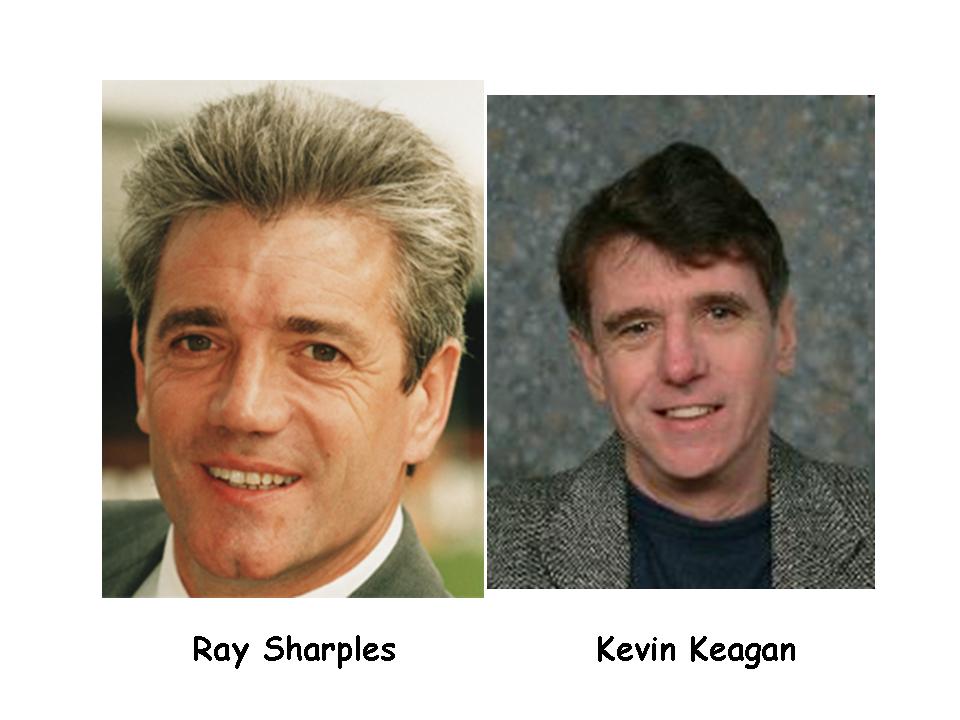
I wonder if anyone else has noticed the similarity between Ray Sharples of Durham University and erstwhile Geordie Messiah Kevin Keegan? They sound similar too!
It’s been a couple of weeks since the Astronomy group in the School of Physics & Astronomy at Cardiff University was informed of the result of its recent application to the Science and Technology Facilities Council (STFC) for a continuation of its rolling grant. I haven’t been able to post anything about it because it has led to some difficult personal situations and we didn’t want anyone to hear about it other than face to face from relevant members of the department.
In case you weren’t aware, a rolling grant covers a 5-year but a group holding one has to apply for renewal every three years at which point the programme of research is reviewed by a panel of experts. If this review is positive a new 5-year grant is awarded and the two years remaining on the old grant or cancelled. In the case of a negative review, however, there is two years’ grace until the funding is terminated, giving the applicants the chance to try again next time.
At least that’s what used to happen.
The previous Cardiff Astronomy roller supported 6 postdoctoral research assistants (PDRAs) as well as providing other funds for travel, equipment, infrastructure and other staff time. This time we requested an increase, primarily in order to enable us to exploit the wonderful data coming from the Herschel observatory. I joined Cardiff after the last review so I wasn’t included in the existing funding package. However, I did succeed in getting a standard grant in last year’s grant round which provides support for a 3-year period. This time, I applied to have this grant subsumed into the rolling programme when it completes in 2012. I requested an extension to the 3-years to tide this over until the next rolling grant and bring me into phase with the rest of the group.
That was the idea, anyway. STFC is extremely short of money, so despite what we felt was a strong case for supporting our Herschel work we weren’t particularly optimistic of a good outcome, especially since additional cuts to research grants were announced last December. In fact the rolling grant application went in last year, but the process is extremely lengthy. Three of us had to go to Swindon last October to present the case to the grants panel. The panel had apparently completed its work by December, but when new cuts were announced they had to revisit their decisions. That’s why we were only informed at the end of February of the level of support that we would get from April 1st this year.
In fact we received two announcements, one detailing what we would have got had the panel’s original recommendations been followed, then another showing the result of the additional 15% cut decided in December. In the first we were cut from 6 PDRAs to 5, but in the second an additional position was cut leaving us with 4 surviving from the previous grant. Moreover, STFC has basically abandoned the rolling grant concept entirely, and refused us permission to let the previous grant roll out. We had no choice but to accept the new grant, which means that we have insufficient funds from 1st April 2010 to honour contracts already issued to two scientists. Not a pleasant situation to be presented with. We’ve managed to find a way of coping to the extent that nobody will be made redundant in the short-term, but it’s still a time of great uncertainty for those involved.
For my own part, the circumstances are a bit better. The panel did award me an extension of my grant to enable me to merge my research with the rest of the programme by the next review date. They also – unexpectedly, I must admit – gave me a small uplift in my existing funding. I’ll be OK, at least for another 3 years.
Overall, we’re disappointed. The outcome wasn’t as good as we’d hoped but, then again, it wasn’t as bad as we’d feared. Taking into account the standard grant I hold, we’ve gone down from 7 PDRAs to 5. I’ve heard rumours of much more drastic cuts elsewhere, and I’m sure other departments are feeling the pain much more than we are right now. I don’t have a clear picture of what has happened nationally, so I’d be grateful for any information people might be prepared to divulge through the comments box as long as you don’t betray any confidences!
The whole business of securing grant funding can be deeply frustrating, and sometimes the decisions seem bewildering. However, I’ve been on these panels before and I know how hard it is, so I’m never tempted to whinge. In fact, I’m going to be joining the panel again for this round. Not that I’m looking forward to it very much!
However, I can’t resist ending with a comment about the current management of STFC. It really seems quite absurd to be cutting grant funding at precisely the time that Herschel and Planck are starting to deliver huge quantities of exquisite data. I say that as a scientist of course, not a civil servant. However, the prevailing mentality at STFC – instigated by the Treasury – seems to be that science part of their remit is much less important than the technology and the facilities. Although the Science Minister Lord Drayson recently announced a proposal that purports to fix some of STFC’s difficulties, this seems more than likely to keep grant funding at a miserably low level for the indefinite future. The STFC management’s readiness to rewrite the rules governing rolling grants, cut funding at absurdly short notice, and raid the grant budget in order to solve problems elsewhere has convinced me that there will be no improvement until there are people at the top that recognize that it’s science that matters, that science is done by people, and that the way to manage those people is not to treat them the way they are doing now.
Especially if they want people to provide free advice to their panels…
Just time to post a couple of poems today, both of them to do with the month of March. I posted my absolute favourite poem about March around this time last year.
This is one by A.E. Housman, and is taken from his collection A Shropshire Lad.
The sun at noon to higher air,
Unharnessing the silver Pair
That late before his chariot swam,
Rides on the gold wool of the Ram.
So braver notes the storm-cock sings
To start the rusted wheel of things,
And brutes in field and brutes in pen
Leap that the world goes round again.
The boys are up the woods with day
To fetch the daffodils away,
And home at noonday from the hills
They bring no dearth of daffodils.
Afield for palms the girls repair,
And sure enough the palms are there,
And each will find by hedge or pond
Her waving silver-tufted wand.
In farm and field through all the shire
The eye beholds the heart’s desire;
Ah, let not only mine be vain,
For lovers should be loved again.
And the second is by Emily Dickinson
Dear March, come in!
How glad I am!
I looked for you before.
Put down your hat–
You must have walked–
How out of breath you are!
Dear March, how are you?
And the rest?
Did you leave Nature well?
Oh, March, come right upstairs with me,
I have so much to tell!
I got your letter, and the birds’;
The maples never knew
That you were coming,–I declare,
How red their faces grew!
But, March, forgive me–
And all those hills
You left for me to hue;
There was no purple suitable,
You took it all with you.
Who knocks? That April!
Lock the door!
I will not be pursued!
He stayed away a year, to call
When I am occupied.
But trifles look so trivial
As soon as you have come,
That blame is just as dear as praise
And praise as mere as blame.
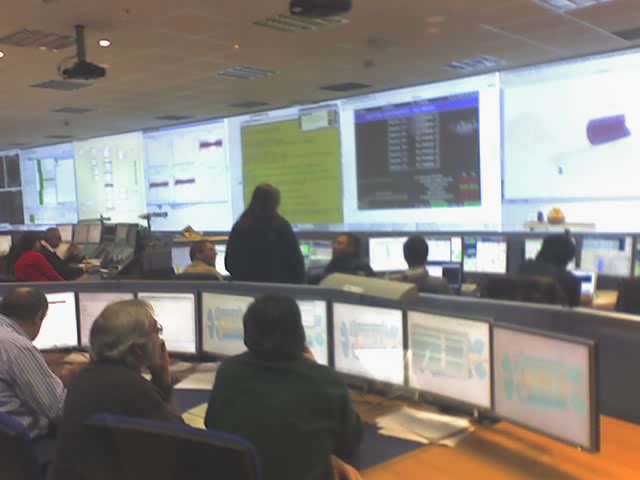
I just remembered that while I was at CERN last week I took a few crummy pics with my phone, so I thought I’d stick them on here.
This first one is actually of the control room of the ATLAS experiment, but it looked to me rather like the inside of a betting shop.
These two were taken in the facility where they test the magnets for the Large Hadron Collider. Each section of superconducting thingummyjig is about 10 metres long; the whole thing is 27km long so that’s a lot of sections! Although the magnets carry a huge current – 10,000 Amps – since they’re superconducting they have no resistance and therefore dissipate no power. However, they have to be kept at liquid helium temperatures, which does require quite a lot of power.

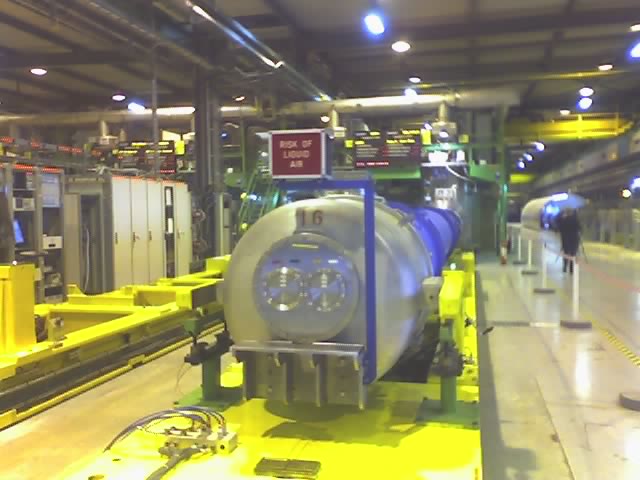
I like the sign on the second one: RISK OF LIQUID AIR.
Finally, here’s the most important one. While I am away Columbo is looked after by a lady called Helen who sends me daily updates. Here is Columbo in a characteristic pose.
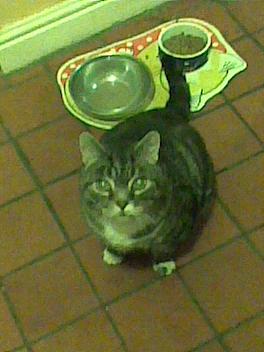
Feed me. Feed me NOW!
I’ve been so busy over the last couple of weeks that I almost forgot that the current run of Tosca at Welsh National Opera was about to come to an end without me having seen it. Nightmare. I suddenly remembered on Thursday that yesterday’s performance was the last one in Cardiff, but I managed to get tickets just in the nick of time. Unsurprisingly, there was a packed house in the Wales Millennium Centre last night; we were treated to an evening of jealousy and murder set to gorgeous music by Giacomo Puccini.
Tosca is an opera in three acts (which means two intervals, glug glug..). It’s basically a melodrama, and is set in Rome in 1800. Each act takes place in a very specific location within the eternal city. Act I is in the Church of Sant’Andrea della Valle, Act II in the Palazzo Farnese, and the final denouement of Act III takes place among the battlements at the top of the Castel Sant’ Angelo overlooking the Tiber. The setting is so specific to time and place that it resists being monkeyed about with, done in modern dress, staged in a chip shop or whatever. Thankfully, Michael Blakemore’s production (of which this is a revival) is very firmly of the period and location required. As a longstanding opera bore, I have to admit that I have been on a Tosca pilgrimage and have visited all three locations in Rome. The scenery used in last night’s performance isn’t exactly as the real locations but it definitely evokes them very well.
(Incidentally, there was a famous reconstruction of Tosca made in 1992 in which all the action was staged at the true location. You can find an example from Act III here.)
Floria Tosca (Elisabete Matos) is a celebrated opera singer who is in love with an artist (and political radical) by the name of Mario Cavaradossi (Geraint Dodd), who helps to hide an escaped political prisoner while working on a painting in Act I. The odious Baron Scarpia (Robert Hayward), chief of police, comes looking for the convict and decides to catch Tosca and Cavaradossi too. He lusts after Tosca and hates Cavaradossi. In Act II, we find Scarpia at home eating dinner for one while Cavaradossi is being tortured in order to find out the location of the escapee. Tosca turns up to plead for his life, but she hasn’t bargained with the true depths of Scarpia’s depravity. He wants to have his way with her, and to put pressure on he lets her listen to the sound of her lover being tortured. She finally consents, in return for Scarpia’s promise to let Cavaradossi go and grant free passage to the two of them. This he seems to do, but while she is waiting for him to write the letter of conduct she sees a knife. Instead of letting Scarpia defile her, she grabs it and stabs him to death. Act III begins with Cavaradossi facing execution, sure he is about to die. Tosca is convinced that this is just a charade and that Scarpia ordered them to pretend to shoot Cavaradossi so he wouldn’t look like he was being merciful, which would be out of character. The firing squad fire and Cavaradossi falls. But it was no fake. He is dead. Tosca is distraught and bewildered. Shouts offstage reveal that the police have found Scarpia’s body and that Tosca must have murdered him. To avoid capture she hurls herself from the battlements. Her last words are “O Scarpia, avanti a Dio!” – I’ll meet you before God, Scarpia.
The opera wasn’t particularly well received when it was first performed in 1900, being famously described by one critic as “a shabby little shocker”. I think the secret of its success is twofold. First and foremost the music is wonderful throughout. Of course there are the great arias: Vissi d’arte, Vissi d’amore sung by Tosca in Act II and E Lucevan le Stelle from Act III, sung by Cavaradossi; but even apart from those tremendous set-pieces, Puccini uses the music to draw out the psychology of the characters. And that leads to the second point. Each of the three principals could have been very two-dimensional. Cavaradossi the good guy. Scarpia the bad guy. Tosca the love interest. But all the characters have real credibility and depth. Cavaradossi is brave and generous, but he succumbs to despair before his death. No superhero this, just a man. Scarpia is a nasty piece of work all right, but at times he is pathetic and vulnerable. He is monstrous, but one is left with the impression that something made him monstrous. And then there’s Tosca, proud and jealous, loving but at the same time capable of violence and spite. They’re all so real. I guess that’s why this type of opera is called Verismo!
The orchestra and cast were excellent. Elisabete Matos has a fine voice for the role, and also managed to spit venom at Scarpia in authentic fashion. Geraint Dodd sang wonderfully, I thought. E Lucevan le Stelle is done so often that it’s difficult to make it fresh but his rendition was overwhelmingly emotional. Best of all, Robert Hayward has a dark baritone voice that gave Scarpia a tremendous sense of power and danger.
The only problem with the performance was right at the end. Elisabete Matos didn’t appear on cue for her curtain call. I was baffled. Eventually she appeared on stage, helped by a member of the backstage team. She looked very unwell and was clutching her ribs. I think she must have landed badly after her fall from the battlements. I hope she’s not badly hurt.
Whoever was responsible for health and safety might be for the firing squad themselves.
I’m glad it’s the end of the week. It’s been ridiculously busy. It didn’t help that I was already exhausted before it started, after a hectic three days in Geneva. Part of the reason for being so heavily occupied is that my teaching duties have just doubled. I teach the second half of a module called Nuclear and Particle Physics, and I’ve just taken over for the second half of the semester to cover the part about particle physics. I started my set of 11 lectures with one about natural units, which is a lot of fun because it usually divides the class into two opposing camps.
About half the students think natural units are crazy, and the other half think they’re great. I’m in the second camp. The motivation is straightforward: particle physics combines quantum theory, which involves Planck’s constant
with special relativity, which involves the speed of light

Using everyday SI units (metres, seconds and kilograms) to deal with quantities that are either ridiculously small or ridiculously large doesn’t make any sense but, more importantly, the SI units don’t really reflect the physics very clearly.
In natural units we take these two constants to be equal to unity, so they don’t appear in any formulae:
For example, the energy invariant in special relativity is usually written
This is where the most famous equation in physics
comes from. However, the equivalence between mass and energy (and also momentum) is much more clearly expressed in the natural units system:
None of those tiresome factors of 
Velocities are, of course, always expressed as a fraction of 
In quantum theory we find energy 


As an extra bonus we can dispense with the clumsy way that electromagnetism is handled in the SI system by noting that
is dimensionless. In the SI system the coulomb force between two electrons is 


The dimensionless quantity 
Some people – including emeritus professors of observational astronomy – object to natural units because they hide the units that things are expressed in. They don’t actually. What they do is express things in units that are better geared to the physics. In any case, if you want to convert back to SI units you can always do so straightforwardly with a little bit of dimensional analysis. This is necessary if you have to talk to engineers and the like, perhaps so they can build you a particle accelerator, but in the more elevated company of particle physicists you should definitely follow proper etiquette and keep your units natural.
The long awaited announcement of Lord Drayson‘s review of the structure of the Science & Technology Facilities Council (STFC) has finally appeared together with parallel announcements by STFC and RCUK. There’s already been a lot of reaction on Twitter about this, and it has also reached the BBC News.
There’s actually not much in the announcement that’s particularly surprising. The plan is to insulate STFC from the effects of currency fluctuations on its subscription commitments to international organizations, and also to share the cost of large domestic facilities across the whole science programme rather than just STFC on its own. In the shorter term (i.e. 2010-11) STFC will continue to receive some help to deal with the uncontrollable external pressures on its budget.
In the longer term it is anticipated that the subscription to the European Space Agency will move to a new UK Space Agency anyway.
These moves are all good news, and will probably help STFC to reach some level of stability. I am certainly grateful to Lord Drayson for getting involved in this process. It will be a while before we find out how it will work out in practice, but at least it’s a start.
The big problem I see is that STFC may well reach “stability”, but the position of equilibrium looks likely to be one with a very low level of grant funding for astronomy and particle physics. Perhaps I’m being excessively cynical, but it still looks to me like this financial crisis was deliberately engineered in order to squeeze fundamental research by 25%. That has now been achieved, so the grey men of the Treasury can now remove the straitjacket. I don’t see any signal that our grants will return to a sustainable level, however, so the astronomy community will probably continue to wither away. The Drayson review may staunched the flow of blood, but the patient will remain dangerously ill unless additional measures are taken. (Too many metaphors, Ed.)
Which brings me to a final point. Having a sensible management structure for STFC isn’t the same as having a sensible STFC management. I know I’m not the only astronomer in the UK to have lost all confidence in the current Chief Executive, Keith Mason. As long as he remains in charge I’m suspicious that any structural modifications will amount to no more than window-dressing and astronomy and particle physics will continue to be neglected in favour of technology-driven projects.
We might – just might – have stopped going backwards, but in order to start going forwards we need a new leader.
PS. For the best compilation of sources on the STFC crisis, see Paul Crowther’s pages here.
It’s been a while so I thought I’d try this one. It’s not at all unusual for my former colleague and cosmologist extraordinaire Professor Bernard Carr to be mistaken for the popular television celebrity Mr Noel Edmonds. I wonder if by any chance they might be related?

Mr Noel Edmonds

Professor Bernard Carr
I can’t believe it. It’s an outrage. My world has fallen apart. Everything I used to believe in now stands in ruins.The unthinkable has happened. The Conservative Party has had a good idea.
Actually several.
This is from the Guardian’s coverage of the story:
A Conservative government would immediately overhaul the national curriculum in English, maths and science – and hand control of A-level exam content to universities and academic experts to end “political control” , the shadow education secretary, Michael Gove, said today.
Every child would get the chance to study all three science subjects – physics, chemistry and biology – separately at GCSE and there would be a return to disciplines such as geometry and algebra in tests for 11-year-olds.
The Tories would abolish the Qualifications and Curriculum Development Agency (QCDA), the quango in charge of curriculum design, and benchmark the exams sat by children in England against those taken by young people across the world.
Outlining his plan in a speech to the annual conference of the Advisory Committee for Mathematics Education (Acme), Gove suggested that calculus be restored to A-level physics, and statistical concepts such as randomness and prediction – which have been key to understanding the financial crisis – be part of the GCSE curriculum for the brightest students.
“We will make a radical change to the way in which A-levels are designed,” Gove said. “We must ensure that A-levels are protected from devaluation at the hands of politicians. The institutions with the greatest interest in maintaining standards at A-level are those which receive A-level students – our universities.
“The individuals with the keenest interest in ensuring A-levels require the depth of knowledge necessary to flourish at university are our teaching academics. So we will take control of the A-level syllabus and question-setting process out of the hands of bureaucrats and instead empower universities, exam boards, learned societies and bodies like Acme.”
The national curriculum would be reformed to specify core knowledge “based on global evidence for what children can and should learn at different ages”, with changes to be introduced from September 2011.
Science would be divided into the disciplines of physics, chemistry and biology, rather than the hybrid headings currently used, which include “chemical and material behaviour” and “the environment, earth and universe”.
“When we reconstruct the national curriculum, we will ensure that it is built around a basic entitlement to study each of these scientific disciplines in a proper, rigorous fashion,” Gove said.
“We will ensure that each of the three basic sciences takes its place within the curriculum, in significantly greater depth and greater detail than now. Studying what has now become known as triple science should not be an elite activity but a basic curriculum entitlement.”
There isn’t much in this that I would disagree with. The only thing that makes me nervous is that abolishing the QCDA and handing over curriculum control to Universities may simply be a cost-cutting measure. I can see a strong possibility that we might have to take on this duty for free at a time when we’re threatened with big cuts in our research and teaching funds.
I’d also say that I think we’d be better off scrapping A-levels entirely – they’re damaged beyond repair, in my view. “Benchmarking” could be achieved quite easily by making British students take the International Baccalaureate.
These things aside, I would strongly endorse the statement that a proper science education should be an entitlement not a privilege. People might sneer at the reintroduction of geometry into the syllabus but I think it’s an excellent idea. Too much education these days consists of the rote-learning of snack thoughts in bit-sized factoid pieces. Too little involves nurturing brains to exploit their full potential to do things other than act as memory devices. Education is there to help people learn to apply rigorous logical thinking as well as exercising its creative problem-solving powers. Doing classical Euclidean geometry is a wonderful way to develop the idea of a mathematical proof and, in my view, cutting it out of the school syllabus was a very retrograde step and one that should be reversed as soon as possible.
We’ve been going backwards in science education for far too long. Educationalists have convinced our schools that today’s students are not sufficiently intelligent to do science or mathematics and must instead be content to reproduce it. That’s an insult to the intelligence of the younger generation and it means Universities have to do a great deal of remedial teaching before they can get on and do things properly.
I’m no Conservative, but there’s no doubt in my mind that New Labour lost the plot a long time ago so I think the Tory plans are to be applauded.
Not that I’m going to vote for them.


 In the Dark