Author Archive

The Known Universe

Posted in The Universe and Stuff with tags on December 20, 2009 by telescoper

It’s the last Sunday before Christmas and it’s still very cold here in Cardiff, although so far at least we’ve escaped the snow. I’ve been putting my feet up, watching the football (Newcastle 2 Middlesborough 0) and doing the Christmas crosswords in the newspapers and magazines (haven’t finished Azed yet, it’s a toughie). Anyway, I don’t want to let this self-indulgence stop me from posting something so how about this marvellous little video produced by the American Museum of Natural History. It’s already been posted on a few other blogs, but hopefully a few of you won’t have seen it. Enjoy!

Dark Squib

Posted in Bad Statistics, Science Politics, The Universe and Stuff with tags , on December 19, 2009 by telescoper

After today’s lengthy pre-Christmas traipse around Cardiff in the freezing cold, I don’t think I can summon up the energy for a lengthy post today. However, today’s cryogenic temperatures did manage to remind me that I hadn’t closed the book on a previous story about rumours of a laboratory detection of dark matter by the experiment known as CDMS. The main rumour – that there was going to be a paper in Nature reporting the definite detection of dark matter particles – turned out to be false, but there was a bit of truth after all, in that they did put out a paper yesterday (18th December, the date that the original rumour suggested their paper would come out).  There’s also an executive summary of the results here.

It turns out that the experiment has seen two events that might, just might, be the Weakly Interacting Massive Particles (WIMPs) that are most theorists favoured candidate for cold dark matter. However, they might also be due to background events generated by other stray particles getting into the works. It’s impossible to tell at this stage whether the signal is real or not. Based on the sort of naive  frequentist statistical treatment of the data that for some reason is what particle physicists seem to prefer, there’s a 23% chance of their signal being background rather than dark matter. In other words, it’s about a one-sigma detection. In fact, if you factor in the possibility of a systematic error in the background counts – these are very difficult things to calibrate precisely – then the significance of the result decreases even further. And if you do it all properly, in a Bayesian way with an appropriate prior then the most probable result is no detection. Andrew Jaffe gives some details on his blog.

There is no universally accepted criterion for what constitutes a definite detection, but I’ve been told recently by the editor of Nature himself that if it’s less than 3-sigma (a probability of about 1% of it arising) then they’re unlikely to publish it. If it’s 2-sigma (5%) then it’s interesting, but not conclusive, but at 1-sigma it’s not worth writing home about never mind writing a press release.

I should  add that none of their results has yet been subject to peer review either. I can only guess that CDMS must be undergoing a funding review pretty soon and wanted to use the media to show it was producing the goods. I can’t say I’m impressed with these antics, and I doubt if the reviewers will be either.

Unfortunately, the fact that this is all so inconclusive from a scientific point of view hasn’t stopped various organs getting hold of the wrong end of the stick and starting to beat about the bush with it. New Scientist‘s Twitter feed screamed

Clear signal of dark matter detected in Minnesota!

although the article itself was a bit better informed. The Guardian ran a particularly poor story,  impressive only in the way it crammed so many misconceptions into such a short piece.

This episode takes me back to a theme I’ve touched on many times on this blog, which is that scientific results are very rarely black-and-white and they have to be treated carefully in appropriate probabilistic terms. Unfortunately, the media and the public have a great deal of difficulty understanding the subtleties of this and what gets across in the public domain can be either garbled or downright misleading. Most often in science the correct answer isn’t “true” or “false” but somewhere in between.

Of course, with more measurements, better statistics and stronger control of systematics this CDMS result may well turn into a significant detection. If it does then it will be a great scientific breakthrough and they’ll have my congratulations straight away, tempered with a certain amount of sadness that there will be no UK competitors in the race owing to our recent savage funding cuts. But we’re not there yet. So far, it’s just a definite maybe.

Herschel Delivers the Goods

Posted in The Universe and Stuff with tags , , , on December 18, 2009 by telescoper

It’s a bit lower key than I’d hoped because of Wednesday’s catastrophic announcements, but some of the first science results from Herschel are now available online. I’ve taken most of the following text from our own Herschel Outreach site here at Cardiff University.

Herschel scientists are currently meeting in Madrid to present the results from the Science Demonstration Phase of the Herschel mission. This is the phase of the mission where the satellite and its instruments are stretched to their full capabilities. A number of results involving the SPIRE instrument and astronomers from the UK have been presented. Professor Matt Griffin, SPIRE Principal Investigator, said

The Herschel Science Demonstration meeting is what the SPIRE team has been looking forward to since the start of the project more than a decade ago, and the results being presented are even better than we dared hope before launch. Not only are the observatory and the instrument working very well, but it is already clear that in this unexplored region of the spectrum, the Universe is even more interesting than we thought.

As well as the images presented below, more scientific results are being presented at the meeting in Madrid, some of which will be shown here in due course. I’ll just show you a quick taster of a couple of the things Cardiff astronomers are looking at.

A region of the Virgo cluster as seen in optical light by Sloan Digital Sky Survey (left) and in far-infrared by SPIRE 250m image Image credit: SDSS (left), ESA/Herschel/HeViCS Key Project (right)

Above is a region of the Virgo cluster, a large cluster of galaxies around 50 million light-years from our galaxy. The left panel shows a region containing four galaxies in optical light, from the Sloan Digital Sky Survey, while the right panel shows the region as seen by SPIRE at 250mm. The galaxies in the Virgo cluster are kept together by their mutual gravitational attraction. However, the galaxies do move relative to each other, and when they pass close to each other they can pull gas and dust into clumps and streams which stretch between the galaxies. Dr Jonathan Davies, of Cardiff University, and Principle Investigator of the Herschel Virgo Cluster Survey, for which this image was taken, commented that “far-infrared observations such as this give us an unprecedented insight into the behaviour of gas and dust in galaxy clusters, and further observations should yield some very exciting results”. The area of emission above the galaxy NGC4435 is very faint as seen in optical light, but much brighter in the far-infrared as measured by SPIRE. Also notable from this region is the relative brightness of the galaxies NGC4406 and NGC4402. NGC4406 is a giant elliptical galaxy, and so very bright in the optical, but is almost invisible in the far-infrared. This shows that it has already used up the majority of its gas and dust in forming the stars.

SPIRE image of the GOODS-North region. Image credit: ESA/Herschel/HerMES Key Project

On the left is shown an area of sky called the “Great Observatory Origins Deep Survey” (GOODS), which has been observed by many telescopes at a range of wavelengths, and now by SPIRE in the far-infrared. It is an area of sky devoid of foreground objects, such as stars within our Galaxy, or any other nearby galaxies, and is a little larger than the area of the full moon as observed from Earth. The image is made from the three SPIRE bands, with red, green and blue corresponding to 500µm, 350µm and 250µm respectively. Every fuzzy blob in this image is a very distant galaxy, seen as they were 3—10 billion years ago when the star formation was very widely spread throughout the Universe. Dr Seb Oliver, of University of Sussex and PI of the HERMES survey for which this image was taken, said

Seeing such stunning images after just 14 hours of observations gives us high expectations for the full length observations over much larger regions of the Universe. This will give us a much clearer idea of how star formation has progressed throughout the history of the Universe.” The redder objects are either more distant, as the expansion of the Universe has stretched, the light more since it was emitted by the galaxy, or much cooler than the bluer galaxies. This is the first time much of the Cosmic Infrared Background, discovered in the 1990s, has been resolved into the individual galaxies. Studying these galaxies at this early stage of the Universe will allow astronomers to test their models of star and galaxy formation.

I’d add that although this is probably the least photogenic of the images just released, it’s the sort of thing that fascinates those of us of a statistical persuasion because it’s such a challenge to wring as much science as possible from data that test the limits of the instrument’s capabilities. However it takes a great deal of time and detailed analysis to do justice to the quantity and quality of the data that’s coming in from Herschel. If our grants  get cut then we’ll find it very difficult to deliver this science in a timely fashion, and that would be a ridiculous state of affairs given the investment that’s already gone in to building this marvellous observatory.

Space Anomaly

Posted in Science Politics, The Universe and Stuff with tags , , on December 17, 2009 by telescoper

After yesterday’s marathon, I’m not planning today to post another lengthy item about the STFC prioritisation exercise which is now public. However, a number of people have asked me about an apparent anomaly in the rankings and, despite the hostile reception I received on the e-astronomer when I posted a comment there, I’ve decided to mention it briefly here in an attempt to explain what looks at first sight like a very strange state of affairs.

BepiColombo (no relation) is a Mercury Orbiter mission by the European Space Agency (ESA). It was selected as a result of a lengthy Europe-wide process. The UK space science community showed relatively little interest in the mission, but it had sufficient support elsewhere to avoid being cancelled about three years ago. So it was picked for the programme, and is now scheduled for launch in 2014. It will take about 6 years to reach Mercury and will take data for a year or two after that.

As is the case with these big ESA “cornerstone” missions, participating countries are called upon to bid to build instruments to fly on the spacecraft. Although this requires an additional investment from the funding agencies (in this case STFC) beyond the annual subscription, this is essentially the only way of securing a science return for UK Plc on the ESA subscription. The UK is in fact involved in two instruments on BepiColombo, a magnetometer and an X-ray spectrometer, although it is the second of these that has the main funding commitment from STFC. Roughly speaking, STFC has commissioned UK scientists and given them funds to build a UK part of BepiColumbo.

I’ll remark here that I always thought the most interesting thing about Mercury is its magnetic field – it’s quite surprising even that it has one – so given the chance I’d prefer to have seen the UK getting more involved in that. But what do I know? I’m just a physicist…

Anyway, in the UK’s recent prioritisation exercise, BepiColombo was graded 1 on a scale of 1 (low) to 5 (high), reflecting the relatively low interest in this mission among UK space scientists. Many projects rated 3 were cancelled, and even those rated 4 and 5 are going to have their funds cut by 15 to 20% so it looks very strange to have BepiColombo retained in the final programme, especially if you’re working on an alpha-3 project that’s just been canned.

However, it’s all a bit more complicated than that. While the UK itself wasn’t particularly interested in this mission, it did attract strong support in the rest of Europe. The UK signed up to the whole ESA menu and was thus obliged to go along with it; a la carte was not an option. ESA decides its programme, with UK input, but we do not have a veto. STFC (and previously PPARC) entered into various agreements, including a Memorandum of Understanding, from which it would be disastrous to back out.

I don’t know how much BepiColombo is costing STFC, but it’s likely to run into millions. That money could have supported other things in the astronomy programme, including postdoctoral grants. But before you jump to the conclusion that astronomy has been stitched up, remember that the ESA subscription has also opened up new areas of research through missions such as Planck and Herschel. These are a boon to our research, but the privilege of being allowed to participate in them comes at the price of having to support things the UK astronomy community is less keen on. In this particular example the politics of the situation and the need to fulfil our obligations within ESA have trumped the scientific judgement of the UK community.

To put this another way, would you want to scrap UK participation in this mission if it also meant binning our involvement in Herschel, Planck, JWST and all the rest.

I’m not advocating we scrap BepiColombo any more than we should scrap any of the other primary elements of the ESA programme. However, I do think that the nature of this balancing act should be more widely known. Otherwise, as things stood, it just looks like some vested interest has taken the funds from more deserving causes in order to promote a pet project. I hope I’ve made it clear that did not happen and that STFC had no choice but to fund BepiColombo.

I think it helps to get these things out in the open, in apparent contrast to some colleagues in the space lobby who seem to prefer to silence debate rather than engage with it. It’s no wonder people get suspicious when that’s the attitude shown by those in positions of responsibility on STFC committees.

If I’ve said anything unfair or unreasonable here please feel free to comment, as long as you can refrain from gratuitous abuse…

Poem for the Day

Posted in Poetry with tags , , on December 17, 2009 by telescoper

October, 1803 

These times strike monied worldlings with dismay:
Even rich men, brave by nature, taint the air
With words of apprehension and despair:
While tens of thousands, thinking on the affray,
Men unto whom sufficient for the day
And minds not stinted or untilled are given,
Sound, healthy, children of the God of heaven,
Are cheerful as the rising sun in May.
What do we gather hence but firmer faith
That every gift of noble origin
Is breathed upon by Hope’s perpetual breath;
That virtue and the faculties within
Are vital,–and that riches are akin
To fear, to change, to cowardice, and death?

(by William Wordsworth).

Day of Reckoning

Posted in Science Politics, The Universe and Stuff with tags , , , , , on December 16, 2009 by telescoper

10.45am. I came in this morning determined to get on with some work to distract my attention from the looming announcement of budget cuts from the Science & Technology Facilities Council (STFC). I was up nearly all night worrying about the future, especially for the current generation of postdocs whose careers I’m pretty sure are going to sacrificed in large numbers to balance the books. It reminded me a bit about a poem I posted a while ago: I could not sleep for thinking of the Sky STFC.

Anyway, I’ve spent over an hour trying to write one paragraph of the paper I’m trying to finish and I can’t settle so I thought I’d start a post, with the intention of updating it as the day goes on, the picture gets a bit clearer, and I become increasingly suicidal.

The actual announcement of the result of the prioritisation exercise will appear this afternoon on the STFC website here under the heading

STFC: Investing in the Future

Who said these guys don’t have a sense of humour? What’s underneath is currently completely blank. Hang on, they might have put the result up early in that case…

Most of the blogs and tweets I follow – at least those emanating from this side of the Atlantic – are about this today, so if you’d like to keep up here are some useful links:

Paul Crowther at Sheffield has kept up with all the ongoings and downturnings at STFC and you can expect him to understand it better and quicker than the rest of us  here.

There’s a very good (and nearly anonymous) post about all this on the blog To Left of Centre.

The e-astronomer (Andy Lawrence at the ROE)  has written about this and a lot of important people have commented on it.

Rob Simpson, a PhD student here in Cardiff,  is probably expressing the fears of many younger researchers as is Sarah Kendrew who gives a postdoc perspective.

There’s a list of things astronomical that are probably about to eat the dirt at this website. My bet is that everything on their list will go, plus more. The reason is that most of the things at the bottom of the prioritisation exercise are actually fairly cheap, so just closing a few won’t plug the gap. As a colleague of mine said the other day, “It’s a big shit sandwich, and we all have to take a bite.”

11.15am. If the phrase “going forward” appears anywhere on the STFC announcement page, then I won’t be responsible for my actions…

11.50am. WICKET! Prince c Collingwood b Swann 45. Oh sorry. Wrong blog.

12.08pm. Incoming transatlantic link from the Starving Economist, from whose page I’ve pulled the following comment:

So I’d almost forgotten that other countries are out there, facing the Great Recession as well, and making really stupid decisions in the face of it. IMHO one example of blatant incompetence in an economic sense is being perpetrated by none other than the UK. We kind of look up to them, don’t we? It’s the accent or something. But they are busy tossing some of their world-renowned science, and much of their past investment in such, out the door rather than restructure some of their government funding. Talk about inertia. Their astronomy program appears to be particularly hard-hit. Interesting way to close 2009, the International Year of Astronomy.

I couldn’t agree more. It also reminded that I haven’t made enough of the irony that this is indeed the International Year of Astronomy. For a lot of people it will be the last year they’ll be doing astronomy.

12.25pm. Meanwhile, our man in Madrid, Matt Griffin has been wowing the audience with some of the new results from Herschel. I hope to be able to post a few of them later when the official workshop results go live.

12.45pm. STFC operatives have been phoning project leaders this morning to tell them the bad news. Our head of school, Walter Gear, has got his phone call telling him that our attempt to resurrect Clover will not be funded. Disappointing, but not entirely unexpected…

13.15pm. It’s tea-time in sunny  South Africa (with the home side at 159-4) but here in Blighty it’s the long dark lunch break of the soul, waiting for news of the inevitable.

13.30pm. Half an hour to go. Most of the astronomers in the department have now left to travel to Madrid for the big workshop starting tomorrow. They tell me the new results probably won’t be available for public consumption until Friday (18th December). Nothing to sugar the pill, then.

13.55pm. I’m not often right, but I was wrong again. I’ve just noticed that there is already an ESA press release that includes this stunning image of a star-forming region in the constellation of Aquila made using both PACS and SPIRE observations. This is just a first look at part of an extended survey of stellar nurseries that Herschel will be undertaking over the forthcoming months.

14.00pm. And there were are, right on cue. Here is the announcement. As expected, there is a ridiculous attempt to put a positive spin on it all, but you will find immediately, sigh, another 10% cut in research grants to universities (on top of the 25% we already had) to reduce the amount of “exploitation”, plus 25% cuts in the number of PhD students and fellowships “mirroring the overall reduction in the programme”. I read that as meaning that STFC wants, in the long term, about 25% of the astronomers in the UK to go somewhere else and, preferably,  never come back.

I’ll post more when I’ve read the details.

14.10pm. So here’s a quick summary of what projects will be funded in (ground-based) astronomy:

Advanced LIGO, JCMT (to 2012), Gemini (until end 2012), ING (to 2012), KMOS, VISTA, Dark Energy Survey, E-ELT R&D, SKA R&D, SuperWASP, e-Merlin, Zeplin III; Total cost of £87m over 5 years

(the big surprise to me in there is  e-Merlin, which I thought would get the chop) and what won’t

Auger, Inverse Square Law, ROSA, ALMA regional centre, JIVE, Liverpool Telescope, UKIRT. Additional reduction imposed on ongoing projects of £16m. Total savings of £29m over 5 years

And on the space side we have the lucky ones:

Aurora, GAIA, Herschel, JWST-MIRI, LISA Pathfinder, Rosetta, Planck, ExoMars, Hinode, Cosmic Vision, Solar Orbiter, Stereo, Swift, Bepi-Colombo; Total cost of £114m over 5 years

and the losers

Cassini, Cluster, SOHO, Venus Express, XMM. Additional reduction imposed on ongoing projects of £28m. Total Savings of £42m over 5 years

Note that both Aurora and Bepi-Colombo were both rated very low on scientific grounds but have been retained in the programme, presumably for political reasons.

However, the big downside for everyone is the cut in university grants for “exploitation” that I mentioned above. STFC wants to have lots of expensive facilities, but doesn’t want to fund the modest among of staff needed to actually get science out of them. The stupidity of this decision is made even more depressing by its inevitability.

Even the top-rated projects are getting cuts to their funding. It just shows how little thinking is going on about the actual science that STCF is supposed to be supporting. Isn’t it a more sensible strategy to do a few things well, rather than a lot of things poorly? It’s a mess.

14.38pm. From a Cardiff perspective this is nowhere near as bad as it could have been, but is still pretty dire. The primary activities for our current astronomy programme, Herschel and Planck, are both very high in the priority list and the relativity group is relieved to see ground-based gravitational wave research, including Advanced LIGO, at the highest priority. Moreover, it looks like what I feared most of all – an immediate clawback of existing grants with consequent immediate redundancies – is not going to happen, owing to what appears to be a last-minute injection of funds from RCUK. We’re still looking at cash cuts though, and we’re vulnerable because so much of our research income comes from STFC.

14.43pm. Not on the STFC webpage, but it appears that they are not going to support LOFAR-UK either.

15.05pm. If you want to read the full outcome of the prioritisation exercise, in terms of a batting order of projects, you can download it here. It includes a recommendation that the top funded (alpha-5) projects should get a 15% cut and those at the next leveldown (alpha-4) should get a 20% cut. However, things will probably turn out worse than that because those cuts were suggested on the basis that only those projects would be funded at all. As it turns out, some alpha-3 projects have made it through also, so the cuts to the higher-rated projects must be larger to compensate. Mustn’t they?

15.24pm. I note that STFC have decided to carry on their programme of outreach activities:

Ongoing support for public outreach and science communication, through continuance of our award schemes and Fellowships, and public engagement and communications, helping to ensure new generations of children are enthused and inspired by science, and encouraged to continue study in science, technology, engineering and mathematics (STEM) subjects.

..so we can kick them in the teeth when they’ve just started a scientific career.

15.30pm. Press release, from Unelected Minister for Science and Innovation, Strategic Defence Acquisition Reform, and Formula 1 Car Racing,  Lord  Drayson of Twitter.  I quote:

… it has become clear to me that there are real tensions in having international science projects, large scientific facilities and UK grant giving roles within a single Research Council. It leads to grants being squeezed by increases in costs of the large international projects which are not solely within their control.   I will work urgently with Professor Sterling, the STFC and the wider research community to find a better solution by the end of February 2010.

Is there a possibility that a light has gone on somewhere to the effect that something must be done to stop STFC killing University research? I hope so. If he can pull something out of the fire before March 2010, though, I’d be very impressed.

16.07pm. I may be clutching at straws here, but it is interesting to join the dots between Lord Drayon’s comment above and the following excerpt from the STFC announcement

discussions would be held in coming months with national and international partners, including universities, departments and project teams, on implementation of the investment strategy. This will include discussions with EPSRC and the University funding councils on the impact of these measures on physics departments in universities.

I doubt if EPSRC is going to come running to the rescue without a great deal of encouragement. However, taken together with the comment above by Lord Drayson, there’s at least a hint of a possibility that a way to protect grants might be found. Calling them “research” rather than “exploitation” grants would be a start…

16.18pm. Press statements from Jocelyn Bell-Burnell, President of the Institute of Physics here and Andy Fabian, President of the Royal Astronomical Society here.

17.08pm. I think that’s enough for the day. It hasn’t been good, but the nightmare scenario was that my own research grant would be terminated immediately and I’d have to break the news to my PDRA. At least that didn’t happen, not yet anyway. I suppose we should be thankful for small mercies. But I’m exhausted after sleeping so badly last night, so I think I’ll close this for now. Keep your comments coming if there’s anything significant I missed…

19.45pm Before I settle down with my gramophone records for the evening, I just thought I’d remind anyone not sufficiently depressed at the state of STFC that the drastic cuts announced today do not take account of whatever share of the £600 million “efficiency savings” announced in the budget has been allocated to them. It may look bad now, but it’s probably going to get worse. On that cheery note, I’m going to have a drink and listen to Mahler.

Sad Streets

Posted in Biographical with tags , , , on December 15, 2009 by telescoper

I noticed yesterday that an old post of mine about my childhood in Benwell, Newcastle upon Tyne, was attracting some interest. It’s one of the interesting things about running a blog that, quite often, an old post you thought was dead seems to get someone’s attention who sends it  on to some others and then, all of a sudden, it’s getting dozens of readers. I’m not sure who or what was having a look at this particular one, but it did spur me on to try to dispel my hangover after the staff Christmas lunch by having a look around the web to see if anything new had turned up since I last posted about Benwell.

At first I was delighted to find this photograph, taken sometime in the sixties,  showing the old trolley bus terminus at Delaval Road. This view is eastwards, looking along Benwell Lane towards Newcastle itself. The road going south towards the river (to the right) is Delaval Road and the complicated system of wires overhead enabled the electrically powered trolley buses to turn around and head back into town. These buses were phased out when I was little, but I remember them quite clearly, especially the rather comical palaver involved in trying to keep them attached to the wires.

To the left of the picture you can see a wall with trees behind. This marked the southern end of a small wood (“The Spinney”) inside which was the small cottage we lived in. The road behind the camera, the continuation of Benwell lane, is Whickham View.

It was nice to see this picture. It made me all nostalgic. Benwell was never actually Belgravia, of course. It wasn’t at all a wealthy neighbourhood and parts of it were quite rough, but my childhood there was pretty happy and there was a real sense of community to the place, helped by the presence of lots of little shops and good transport links.

Now look at essentially the same view, taken in 2009.

Superficially, the area hasn’t changed that much but all the shops are boarded up and all the houses abandoned. Even the road itself is in a state of disrepair. In fact, all the once busy streets leading down towards the Tyne to the south of Benwell Lane are now quite deserted and the whole area scheduled for demolition. You can see many more pictures of this depressing scene here.

I moved away from Newcastle in 1982 when I went to University. I therefore missed the terrible effect that the recession of the 1980s had on the streets I had grown up in. It also had a direct effect on my father, who separated from my mother when I was about 12. He ran a small business selling educational supplies (paper, pens, art materials etc) to schools and pre-school playgroups. Most of it was wholesale but he also ran a small shop which, at first, was on Benwell Lane. In fact it was one of the two shops you can see by the light blue car in the first picture, although this snap was taken a while before he took it over. I think it was a cake shop before that.

After some modest success he moved just along the road a bit to slightly larger premises on the corner of Whickham View and Delaval Road, i.e. just to the right of where the camera is positioned on the opposite side of the road to the greengrocers.  He lived in a flat above this new shop, which formerly sold wool and was run by an old lady called Mrs Ludgate.

As time went on and the recession bit harder, the social and material fabric of Benwell gradually deteriorated. There were increasingly frequent burglaries and car thefts. It became a no-go zone at night. His  business started to fail and debts began to mount. The stress of watching the neighbourhood falling apart and coping with the constant threat of break-ins at the shop and his flat eventually got too much for him. He packed everything he could into his van and fled to the South coast to live with his sister in Weymouth, leaving the dilapidated shop and all his debts behind. I’m sure there’s a similar story behind all the other empty shops in Benwell.

Looking at these bleak photographs of the deserted streets and houses of my youth filled me with sadness, not least because they seem like portents of the future of British science. In ten years time will we all be poring over pictures of abandoned observatories and research labs?

Interesting Times

Posted in Biographical, Science Politics, The Universe and Stuff with tags , , , on December 14, 2009 by telescoper

The next few days promise to be extremely interesting, although there is more than a hint of the Chinese Curse in that statement! Today is the day of our annual departmental Christmas Lunch. That’s not itself the subject of any kind of curse, but if last year’s is anything to go by it may take several days to recover from it. I’m preparing myself for it mentality as I write.

Tomorrow, however, 15th December, is the date of the next meeting of the Council of the Science and Technology Facilities Council. On their agenda is the programme of cuts that is proposed as a result of the recent prioritisation exercises initiated to try to find a way out of their ongoing funding crisis. This programme has been through various committees before reaching the Council and, if the Council accepts it, the plans will be unveiled at a press conference on Wednesday 16th (at 2pm) and those about to die will be informed immediately. I’ll try to post a summary on here as soon as I get the facts.

I don’t have any particular inside information who is going to get the chop, but rumour suggests that there will be cuts right across the board. I think it’s going to be very grim news indeed, especially because there is an additional £600 million of savings to be found over the next few years on top of the current shortfall. It’s bound to be a terrible Christmas for those about to find out their contracts are being axed, and no happy New Years for a while either.

I’m not privy to the Council discussions or to the recommendations that have been passed to them so it’s not my place to say what they should do. However, in the unlikely event that anyone from STFC Council is reading this, I hope he/she at least bears in mind that it is not – or at least it shouldn’t be – the job of the Council simply to rubber stamp everything that is passed before it. I wonder, though, if the current Council has the guts to pass a vote of no confidence in the STFC Executive? I doubt it, because there’s been no reason to have confidence in them for the past two years and no such motion has been carried.

Ironically, later in the week there’s going to be a big jamboree in Madrid, at which the initial results of the Science Demonstration Phase of Herschel will be announced. Quite a few of the Cardiff crowd are going along and will be presenting some of the wonderful things that they’ve been working on for the past few weeks. I’ve seen quite a lot of the data from the SPIRE instrument and it’s truly amazing. At least there’s some (infrared) light among the darkness. However, it’s all covered by an ESA press embargo until Wednesday…

War Games

Posted in Biographical, History with tags , , , , , on December 13, 2009 by telescoper

It’s strange how esoteric facts – dates, numbers, names or whatever – can stay with you for years despite your best efforts to forget them. I have a notoriously bad memory for most things. I struggle to remember my own phone number, for example.  However, today’s date, it seems, will be stuck in my rather chaotic mental filing system forever although it probably remains obscure for most readers of this blog. In fact, 13th December 2009 is the 70th anniversary of  the Battle of the River Plate which took place on December 13th 1939.

You’re probably wondering why I remember this so well, so I have to go into confessional mode to explain. When I was a youngster, about 11 or 12, for some reason I developed a complete fascination for naval history. I don’t really know how this happened because there’s no seafaring tradition in my family and I wasn’t brought up near the sea either. The first manifestation of this interest was that I borrowed every book I could find in the local library on the subject of naval warfare. I then moved onto the idea of actually recreating famous battles using die-cast models, a very large table (or more often  a floor) and printed tables of hit probabilities. I spent hours engrossed in this type of thing, after school, until the interest faded or, in other words, I grew out of it.

I think I found naval battles absorbing for a number of reasons. First was that it was easier to see them as a kind of game than with hand-to-hand combat, the thought of which always unsettled me. A battle fought at a distance of many miles,  in which one never really sees one’s enemy, seemed to me a less personal and more abstract kind of thing. Another thing was that the pace was very slow: the large range and relatively slow speed of surface warships meant that an engagement would unfold over many hours, and it was possible to recreate it more or less in real time.

Since the Battle of the River Plate involved a small number of ships, it was a set piece I fought several times (as both British and German captain) against various schoolmates. The most interesting thing I learned through all these re-runs was that, whoever was in charge on whichever side, the result of all our games was always a German victory. I think it’s this that makes me remember it all so well, because what really happened way back in 1939 was remarkably different. So, with my apologies for turning back into a teenage anorak, let me give you a quick account of what happened and why it was all so fascinating to me.

The Admiral Graf Spee was a German warship that was sent to the South Atlantic at the outbreak of World War II in order to sink allied merchant shipping. The Treaty of Versailles that ended  World War I had forbidden Germany from building really big warships, such as battleships, but the Graf Spee packed a much more powerful punch than most ships of its relatively small size. Technically a heavy cruiser, the Graf Spee quickly acquired the more accurate nickname of pocket battleship because she was heavily armoured, fast, and with a powerful main armament of  six 11-inch guns, more than a match for any of the Royal Navy’s  own heavy cruisers.

Under  the captaincy of  Hans Langsdorff, the Graf Spee was initially very successful in sinking  nine merchantships in the Indian Ocean and off the coast of South Africa. Langsdorff, however, was absolutely scrupulous in his behaviour towards the crews of the ships he sank, taking pains to rescue all the crews and ensuring that no lives were lost. Merchant seamen held on the Graf Spee were unstinting in their respect for this most chivalrous and kindly man.

The Graf Spee was enjoying such success that, back home in Blighty, the Admiralty decided to assemble ships into eight separate forces to look for her.  Sensing that things might get a bit hot around the African coast, Langsdorff disappeared into the deep ocean and headed across to the other side of the Atlantic to seek rich pickings in the main shipping lane leading from the ports of Buenos Aires and Montevideo. One of the British hunting groups – Force G – had anticipated this move.

Commanded by Commodore Henry Harwood, Force G consisted of two light cruisers of the Leander class, HMS Ajax (Harwood was on board this ship, which was captained by Charles Woodhouse) and HMS Achilles (captained by Edward Parry, from the New Zealand division of the Royal Navy) and one heavy cruiser HMS Exeter, captained by Frederick “Hooky” Bell. Although Harwood had the numerical advantage, his ships were severely outgunned:  there were only 8-inch guns on the Exeter and 6-inch guns on the Ajax and Achilles. He knew that if they came upon the Graf Spee they would certainly have a fight on their hands, but he knew he had to attack and he prepared the best plan he could think of.

Early in the morning of 13th December 1939 the Graf Spee appeared on the horizon to the North of Force G, and the British ships took to their action stations. Harwood’s battle plan was to separate his forces and engage from two sides in an attempt to split the Graf Spee‘s main armament. He also knew that Graf Spee‘s guns had much longer range than any of his ships as well as firing much larger shells. He had to close quickly in order to have any hope of scoring a hit with his lighter guns. The British ships were only lightly armoured and could not absorb heavy shells from their opponent without being seriously damaged, so this was a very risky strategy, but it was a gamble he felt he had to take.

In our childish after-school wargames, in fact, the Graf Spee always won. All you have to do as commander of the German ship is keep your distance. The British cruisers have an edge in speed, but not by an enormous factor. As long as you manoeuvre in such a way as to keep them at reasonable distance, the accuracy of your long-range gunnery will see you through. Like a boxer with a longer reach than your opponent, you keep out of trouble and score with straight jabs instead of mixing it up at close range.

However, on the bridge of the Graf Spee, Langsdorff made a couple of serious mistakes. The first was not entirely his fault. His lookouts had misidentified the British ships as one light cruiser and two destroyers. Langsdorff jumped to the conclusion that the ships he could see were actually convoy escort vessels and that, beyond the horizon behind them to the south, would be a collection of merchant ships that would be entirely at his mercy once he had disposed of their relatively light protection. He therefore gave the order to increase speed and close with the oncoming ships. A few minutes later he was told of the initial error of identification, but although these were clearly not convoy escorts he still couldn’t believe that such lightly armed ships would come charging at him the way these ones were.

This is when Langsdorff  made his real blunder. Realising that these were warships that were actually looking for him, rather than just escorting unarmed merchantmen, he decided that the only reason they would engage him now – when they were clearly outgunned – was that they were trying to push him out towards the bigger ships he thought would be to the north. He had received intelligence that British battlegroup (Force H), containing the battlecruiser Renown  and the aircraft carrier Ark Royal, might be sailing south to find him, as they had  been spotted leaving harbour in Gibraltar some days earlier. Langsdorff therefore continued to close, his error giving the British a chance to fight at close range. It was an opportunity they did not expect to come their way, and they did their best to take advantage of it. However, the Graf Spee was still the strong favourite to win the battle because of her superior firepower and protective armour.

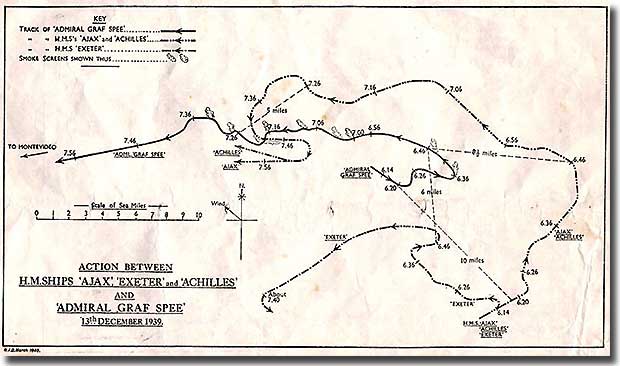
What happened thereafter is shown in the map below, taken from the official Admiralty report into the battle. You can see that Harwood attacked from the south, with Exeter initially turning to port while Ajax and Achilles turned starboard. Langsdorff realised the main threat came from Exeter so he concentrated all his main guns on her, leaving his secondary 5.9 inch guns to engage the two lighter cruisers as they used their superior speed to attack from the other side.

The accuracy of the Graf Spee‘s gunnery soon had Exeter in all sorts of trouble: three out of four main gun turrets were out of action, and the other was being aimed by a gunnery officer standing on the roof with binoculars as the control systems were all shot to pieces; the bridge had been hit, killing most of the officers and knocking out the steering controls, so that for the rest of the battle Exeter was navigated using a small compass taken from one of the ship’s boats; she was also listing about 7 degrees and taking in water. In all, Exeter took seven direct hits from 11-inch shells and 61 of her crew were killed. It was a grim situation but, in the middle of all this, she did manage to score a direct hit on the Graf Spee which didn’t appear at first to be critical but which, it later emerged, was another  stroke of luck for the British.

RiverPlateBattleChart
Realising that Exeter could not go on taking such heavy punishment, and with his own ships too far away to inflict any real damage on their target, Harwood decided to throw caution to the winds, charging repeatedly with Ajax and Achilles to almost suicidally close range to fire torpedoes, and then turning side on to fire full broadsides at the Graf Spee. Although they only inflicted superficial damage, and didn’t by any means emerge unscathed themselves, they did succeed in putting Langsdorff off  his stroke. While Graf Spee switched her attention to the Ajax and Achilles, Exeter used the  breathing space given to her by the courageous action of her sister ships to retire, heavily damaged, under the cover of a smokescreen, southwards to the Falkland Islands for emergency repairs.

Harwood knew he could not carry on the battle with only two ships, so he fell back, expecting the Graf Spee to come after him scenting victory. However, to his surprise, Langsdorff had apparently decided not to finish off the two ligher vessels – nor had he made sure of the Exeter – but instead was steaming due West towards the estuary of River Plate and the port of Montevideo, in neutral Uruguay. The British  fell back and shadowed him, wondering what on earth he was up to.

The reason for Langsdorff’s strange actions seems to be the 8-inch shell hit from the Exeter, which had put the Graf Spee‘s fuel systems out of action. This meant that she only had a few hours fuel left and if she didn’t make it into harbour for repairs then she would be a sitting duck. There were no friendly ports within range, so there was no alternative but to head for the nearest neutral one, which was Montevideo.

The following morning  (14th December 1939) found the Admiral Graf Spee at anchor in Montevideo. The naval battle was over, but another fascinating episode was just starting. The Hague Convention allowed warships to effect repairs in neutral harbours, but only those  that improved their seaworthiness not their fighting efficiency. The British knew that if the Graf Spee came out of harbour she could brush aside force waiting outside in the Estuary. The Ajax and Achilles had been joined by HMS Cumberland, a similar ship to Exeter, but the odds were against them being able to cope. The larger warships of Force H were in fact on their way but would take days to get there.

The British therefore launched an elaborate deception scheme. Unencrypted messages were sent (accidentally on purpose) suggesting battleships were arriving, false  requisitions for aviation fuel for the Ark Royal‘s aircraft were tendered. Phoney wireless traffic filled the Uruguayan airwaves and the notoriously leaky telephone system in Montevideo was used as a highly effective rumour mill. The three British ships outside the harbour busied themselves with making as much smoke as they could to give the impression that a large number of ships were gathering close to the shore.

The Germans were entirely deceived and were convinced that the Graf Spee was cornered by a huge fleet of British warships. Langsdorff took stock. He had used up most of his ammunition in the preceding battle and only had enough left for about 20 minutes action. He had to follow the obligations of international treaties and leave port by 17th December otherwise his ship would be interned. He had been ordered that the latter was not acceptable. He made his decision.

On the appointed date, the Graf Spee slipped out of harbour and proceeded slowly along the Estuary watched by a huge crowd wondering what was going to happen. It appeared that much of the crew had remained behind, suggesting that there might be a skeleton crew onboard preparing to fight one last suicidal battle. Suddenly she stopped. A small launch was seen to leave. A few minutes later a series of enormous explosions ripped the ship apart. Langsdorff had decided to avoid any further loss of life and also avoid the ship falling into enemy hands by deliberately scuttling her. The Admiral Graf Spee sank in the deepest part of the channel, where she remains to this day.

I’m aware of a growing sense of guilt at reliving my childhood fascination with this episode through this blog post. Coming back to it as an adult, however, I am painfully aware of the things I didn’t think about at all when I was much younger. The reality isn’t a game, of course. Over a hundred brave men died in the Battle of the River Plate – 36 on board the Graf Spee and 72 on the British ships (most on HMS Exeter) and one, Captain Langsdorff, committed suicide (on 19th December 1939, by shooting himself in the head while wrapped in the flag of the German Navy).

In fact the character that most exemplifies the sense of tragedy surrounding this story is Hans Langsdorff. An experienced naval officer who served at the Battle of Jutland in 1917 and, by all accounts, a decent and humane man, I see him as someone compelled to fight by a sense of duty rather than anything else. He certainly had no ill-will towards his enemies, and spoke with great admiration of the courage shown by his adversaries. He clearly had no taste for the indiscriminate sinking of defenceless merchant vessels which was what he had been called upon to do.   He may not have been particulrly effective as a tactical commander during the battle, but his errors largely arose from him being supplied with incorrect information.

It should also be noted that, at the funeral of the German sailors who had died in the Battle of the River Plate, Langsdorff gave the traditional German military salute, in contrast to all other officers present who gave the Nazi straight-arm version.

Tate Collection | Gordon’s Makes Us Drunk by Gilbert & George

Posted in Art with tags on December 11, 2009 by telescoper

I don’t know about you, but I think this is brilliant….

Vodpod videos no longer available.

more about “Tate Collection | Gordon’s Makes Us D…“, posted with vodpod