Author Archive

Hubble Flash

Posted in The Universe and Stuff with tags , , , , , on September 9, 2009 by telescoper

Just a quick post to point out that brand new “Early Release” images have just appeared following the recent refurbishment of the Hubble Space Telescope.

You can read the accompanying press release here, so I’ll just post this brief description:

These four images are among the first observations made by the new Wide Field Camera 3 aboard the upgraded NASA Hubble Space Telescope.

The image at top left shows NGC 6302, a butterfly-shaped nebula surrounding a dying star. At top right is a picture of a clash among members of a galactic grouping called Stephan’s Quintet. The image at bottom left gives viewers a panoramic portrait of a colorful assortment of 100,000 stars residing in the crowded core of Omega Centauri, a giant globular cluster. At bottom right, an eerie pillar of star birth in the Carina Nebula rises from a sea of greenish-colored clouds.

My own favourite has to be Stephan’s Quintet, but they all look pretty fantastic.

Also Sprach Zarathustra

Posted in Biographical, Music, Poetry with tags , , , , on September 8, 2009 by telescoper

Today is the 60th anniversary of the death of the great composer Richard Strauss in 1949. I’ve already used up the music which is probably the most appropriate for this occasion, so I thought I’d mark it instead with a clip from the work that is probably most familiar to my likely readership, Also Sprach Zarathustra, as used in the closing stages of Stanley Kubrick’s masterpiece 2001: A Space Odyssey.

This little clip is from the final stages of the film, though the music itself is from the opening segment of the Strauss work, the part that represents the Sunrise.

For people of my age, this music is inextricably linked not only with the film, but also with the TV coverage of the moon landings that happened about the same time as its release, about 40 years ago, and for which it also provided the theme music. I don’t know which came first. I’d love to be able to say that these events are behind what made me become an astrophysicist but, as I’ve explained before, the truth is somewhat different.

Anyway, the theme of transfiguration and rebirth depicted in the movie  seems to me to be one more closely related to Strauss’ earlier work Tod und Verklärung,  and it always makes me think of the following lines from East Coker, the second of the Four Quartets by TS Eliot:

Old men ought to be explorers
Here or there does not matter
We must be still and still moving
Into another intensity
For a further union, a deeper communion
Through the dark cold and the empty desolation,
The wave cry, the wind cry, the vast waters
Of the petrel and the porpoise. In my end is my beginning.

Cosmic Haiku

Posted in Poetry, The Universe and Stuff with tags , , , on September 6, 2009 by telescoper

I haven’t had much time to post today and will probably be too busy next week for anything too substantial, so I thought I’d resort to a bit of audience participation. How about a few Haiku on themes connected to astronomy, cosmology or physics?

Don’t be worried about making the style of your contributions too authentic, just make sure they are 17 syllables in total, and split into three lines of 5, 7 and 5 syllables respectively.

Here’s a few of my own to give you an idea!

Quantum Gravity:
The troublesome double-act
Of Little and Large

Gravity’s waves are
Traceless; which does not mean they
Can never be found

The Big Bang wasn’t
So big, at least not when you
Think in decibels.

Cosmological
Constant and Dark Energy
Are vacuous names

Microwave Background
Photons remember a time
When they were hotter

Isotropic and
Homogeneous metric?
Robertson-Walker

Galaxies evolve
In a complicated way
We don’t understand

Acceleration:
Type Ia Supernovae
Gave us the first clue

Cosmic Inflation
Could have stretched the Universe
And made it flatter

Astrophysicist
Is what I’m told is my Job
Title. Whatever.

Contributions welcome via the comments box. The best one gets a chance to win Bully’s star prize.

Game Theory

Posted in Bad Statistics, Books, Talks and Reviews, The Universe and Stuff with tags , , , on September 5, 2009 by telescoper

Nowadays gambling is generally looked down on as something shady and disreputable, not to be discussed in polite company, or even to be banned altogether. However, the  formulation of the basic laws of probability was almost exclusively inspired by their potential application to games of chance. Once established, these laws found a much wide range of applications in scientific contexts, including my own field of astronomy. I thought I’d illustrate this connection with a couple of examples. You may think that I’m just trying to make excuses for the fact that I also enjoy the odd bet every now and then!

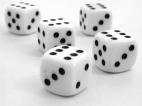
Gambling in various forms has been around for millennia. Sumerian and Assyrian archaeological sites are littered with examples of a certain type of bone, called the astragalus (or talus bone). This is found just above the heel and its shape (in sheep and deer at any rate) is such that when it is tossed in the air it can land in any one of four possible orientations. It can therefore be used to generate “random” outcomes and is in many ways the forerunner of modern six-sided dice. The astragalus is known to have been used for gambling games as early as 3600 BC.

images

Unlike modern dice, which appeared around 2000BC, the astragalus is not symmetrical, giving a different probability of it landing in each orientation. It is not thought that there was a mathematical understanding of how to calculate odds in games involving this object or its more symmetrical successors.

Games of chance also appear to have been commonplace in the time of Christ – Roman soldiers are supposed to have drawn lots at the crucifixion, for example – but there is no evidence of any really formalised understanding of the laws of probability at this time.

Playing cards emerged in China sometime during the tenth century BC and were available in western europe by the 14th Century. This is an interesting development because playing cards can be used for games such as contract Bridge which involve a great deal of pure skill as well as an element of randomness. Perhaps it is this aspect that finally got serious intellectuals (i.e. physicists) excited about probability theory.

The first book on probability that I am aware of was by Gerolamo Cardano. His Liber de Ludo Aleae ( Book on Games of Chance) was published in 1663, but it was written more than a century earlier than this date.  Probability theory really got going in 1654 with a famous correspondence between the two famous mathematicians Blaise Pascal and Pierre de Fermat, sparked off by a gambling addict by the name of Antoine Gombaud, who went by the name of the “Chevalier de Méré” (although he wasn’t actually a nobleman of any sort). The Chevalier de Méré had played a lot of dice games in his time and, although he didn’t have a rigorous mathematical theory of how they worked, he nevertheless felt he had an intuitive  “feel” for what was a good bet and what wasn’t. In particular, he had done very well financially by betting at even money that he would roll at least one six in four rolls of a standard die.

It’s quite an easy matter to use the rules of probability to see why he was successful with this game. The odds  that a single roll of a fair die yields a six is 1/6. The probability that it does not yield a six is therefore 5/6. The probability that four independent rolls produce no sixes at all is (the probability that the first roll is not a six) times (the probability that the second roll is not a six) times (the probability that the third roll is not a six) times (the probability that the fourth roll is not a six). Each of the probabilities involved in this multiplication is 5/6, so the result is (5/6)4 which is 625/1296. But this is the probability of losing. The probability of winning is 1-625/1296 = 671/1296=0.5177, significantly higher than 50%. Sinceyou’re more likely to win than lose, it’s a good bet.

So successful had this game been for de Méré that nobody would bet against him any more, and he had to think of another bet to offer. Using his “feel” for the dice, he reckoned that betting on one or more double-six in twenty-four rolls of a pair of dice at even money should also be a winner. Unfortunately for him, he started to lose heavily on this game and in desperation wrote to his friend Pascal to ask why. This set Pascal wondering, and he in turn started a correspondence about it with Fermat.

This strange turn of events led not only to the beginnings of a general formulation of probability theory, but also to the binomial distribution and the beautiful mathematical construction now known as Pascal’s Triangle.

The full story of this is recounted in the fascinating book shown above, but the immediate upshot for de Méré was that he abandoned this particular game.

To see why, just consider each throw of a pair of dice as a single “event”. There are 36 possible events corresponding to six possible outcomes on each of the dice (6×6=36). The probability of getting a double six in such an event is 1/36 because only one of the 36 events corresponds to two sixes. The probability of not getting a double six is therefore 35/36. The probability that a set of 24 independent fair throws of a pair of dice produces no double-sixes at all is therefore 35/36 multiplied by itself 24 times, or (35/36)24. This is 0.5086, which is slightly higher than 50%. The probability that at least one double-six occurs is therefore 1-0.5086, or 0.4914. Our Chevalier has a less than 50% chance of winning, so an even money bet is not a good idea, unless he plans to use this scheme as a tax dodge.

Both Fermat and Pascal had made important contributions to many diverse aspects of scientific thought in addition to pure mathematics, including physics, the first real astronomer to contribute to the development of probability in the context of gambling was Christiaan Huygens, the man who discovered the rings of Saturn in 1655. Two years after his famous astronomical discovery, he published a book called Calculating in Games of Chance, which introduced the concept of expectation. However, the development of the statistical theory underlying  games and gambling came  with the publication in 1713 of Jakob Bernouilli’s wonderful treatise entitled Ars Conjectandi which did a great deal to establish the general mathematical theory of probability and statistics.

The Inductive Detective

Posted in Bad Statistics, Literature, The Universe and Stuff with tags , , , , , , , on September 4, 2009 by telescoper

I was watching an old episode of Sherlock Holmes last night – from the classic  Granada TV series featuring Jeremy Brett’s brilliant (and splendidly camp) portrayal of the eponymous detective. One of the  things that fascinates me about these and other detective stories is how often they use the word “deduction” to describe the logical methods involved in solving a crime.

As a matter of fact, what Holmes generally uses is not really deduction at all, but inference (a process which is predominantly inductive).

In deductive reasoning, one tries to tease out the logical consequences of a premise; the resulting conclusions are, generally speaking, more specific than the premise. “If these are the general rules, what are the consequences for this particular situation?” is the kind of question one can answer using deduction.

The kind of reasoning of reasoning Holmes employs, however, is essentially opposite to this. The  question being answered is of the form: “From a particular set of observations, what can we infer about the more general circumstances that relating to them?”. The following example from a Study in Scarlet is exactly of this type:

From a drop of water a logician could infer the possibility of an Atlantic or a Niagara without having seen or heard of one or the other.

The word “possibility” makes it clear that no certainty is attached to the actual existence of either the Atlantic or Niagara, but the implication is that observations of (and perhaps experiments on) a single water drop could allow one to infer sufficient of the general properties of water in order to use them to deduce the possible existence of other phenomena. The fundamental process is inductive rather than deductive, although deductions do play a role once general rules have been established.

In the example quoted there is  an inductive step between the water drop and the general physical and chemical properties of water and then a deductive step that shows that these laws could describe the Atlantic Ocean. Deduction involves going from theoretical axioms to observations whereas induction  is the reverse process.

I’m probably labouring this distinction, but the main point of doing so is that a great deal of science is fundamentally inferential and, as a consequence, it entails dealing with inferences (or guesses or conjectures) that are inherently uncertain as to their application to real facts. Dealing with these uncertain aspects requires a more general kind of logic than the  simple Boolean form employed in deductive reasoning. This side of the scientific method is sadly neglected in most approaches to science education.

In physics, the attitude is usually to establish the rules (“the laws of physics”) as axioms (though perhaps giving some experimental justification). Students are then taught to solve problems which generally involve working out particular consequences of these laws. This is all deductive. I’ve got nothing against this as it is what a great deal of theoretical research in physics is actually like, it forms an essential part of the training of an physicist.

However, one of the aims of physics – especially fundamental physics – is to try to establish what the laws of nature actually are from observations of particular outcomes. It would be simplistic to say that this was entirely inductive in character. Sometimes deduction plays an important role in scientific discoveries. For example,  Albert Einstein deduced his Special Theory of Relativity from a postulate that the speed of light was constant for all observers in uniform relative motion. However, the motivation for this entire chain of reasoning arose from previous studies of eletromagnetism which involved a complicated interplay between experiment and theory that eventually led to Maxwell’s equations. Deduction and induction are both involved at some level in a kind of dialectical relationship.

The synthesis of the two approaches requires an evaluation of the evidence the data provides concerning the different theories. This evidence is rarely conclusive, so  a wider range of logical possibilities than “true” or “false” needs to be accommodated. Fortunately, there is a quantitative and logically rigorous way of doing this. It is called Bayesian probability. In this way of reasoning,  the probability (a number between 0 and 1 attached to a hypothesis, model, or anything that can be described as a logical proposition of some sort) represents the extent to which a given set of data supports the given hypothesis.  The calculus of probabilities only reduces to Boolean algebra when the probabilities of all hypothesese involved are either unity (certainly true) or zero (certainly false). In between “true” and “false” there are varying degrees of “uncertain” represented by a number between 0 and 1, i.e. the probability.

Overlooking the importance of inductive reasoning has led to numerous pathological developments that have hindered the growth of science. One example is the widespread and remarkably naive devotion that many scientists have towards the philosophy of the anti-inductivist Karl Popper; his doctrine of falsifiability has led to an unhealthy neglect of  an essential fact of probabilistic reasoning, namely that data can make theories more probable. More generally, the rise of the empiricist philosophical tradition that stems from David Hume (another anti-inductivist) spawned the frequentist conception of probability, with its regrettable legacy of confusion and irrationality.

My own field of cosmology provides the largest-scale illustration of this process in action. Theorists make postulates about the contents of the Universe and the laws that describe it and try to calculate what measurable consequences their ideas might have. Observers make measurements as best they can, but these are inevitably restricted in number and accuracy by technical considerations. Over the years, theoretical cosmologists deductively explored the possible ways Einstein’s General Theory of Relativity could be applied to the cosmos at large. Eventually a family of theoretical models was constructed, each of which could, in principle, describe a universe with the same basic properties as ours. But determining which, if any, of these models applied to the real thing required more detailed data.  For example, observations of the properties of individual galaxies led to the inferred presence of cosmologically important quantities of  dark matter. Inference also played a key role in establishing the existence of dark energy as a major part of the overall energy budget of the Universe. The result is now that we have now arrived at a standard model of cosmology which accounts pretty well for most relevant data.

Nothing is certain, of course, and this model may well turn out to be flawed in important ways. All the best detective stories have twists in which the favoured theory turns out to be wrong. But although the puzzle isn’t exactly solved, we’ve got good reasons for thinking we’re nearer to at least some of the answers than we were 20 years ago.

I think Sherlock Holmes would have approved.

Flame Academy

Posted in Biographical, The Universe and Stuff with tags , , , , , , , on September 2, 2009 by telescoper

I heard on the radio this morning from that nice Mr Cowan that today is the anniversary of the start of the Great Fire of London which burned for four days in 1666. That provides for a bit of delayed synchronicity with yesterday’s post about the dreadful fires in the outskirts of Los Angeles and a similar conflagration in Athens (which now thankfully appears to be under control).

Fires are of course terrifying phenomena, and it must be among most people’s nightmares to be caught in one. The cambridge physicist Steve Gull experienced this at first hand when his boat exploded and caught fire recently. I’ll take this opportunity to wish him a speedy recovery from his injuries.

But frightening as such happenings are, a flame (the visible, light emitting part of a fire) can also be a very beautiful and fascinating spectacle. Flames are stable long-lived phenomena involving combustion in which a “fuel”, often some kind of hydrocarbon, reacts with an oxidizing element which, in the case of natural wildfires at any rate, is usually oxygen. However, along the way, many intermediate radicals are generated and the self-sustaining nature of the flame is maintained by intricate reaction kinetics.

The shape and colour of a flame is determined not just by its temperature but also, in a complicated way, by diffusion, convection and gravity. In a diffusion flame, the fuel and the oxidizing agent diffuse into each other and the rate of diffusion consequently limits the rate at which the flame spreads. Usually combustion takes place only at the edge of the flame: the interior contains unburnt fuel. A candle flame is usually relatively quiescent because the flow of material in it is predominantly laminar. However, at higher speeds you can find turbulent flames, like in the picture below!

Sometimes convection carries some of the combustion products away from the source of the flame. In a candle flame, for example, incomplete combustion forms soot particles which are convected upwards and then incandesce inside the flame giving it a yellow colour. Gravity limits the motion of heavier products away from the source. In a microgravity environment, flames look very different!

All this stuff about flames also gives me the opportunity to mention the great Russian physicist Yakov Borisovich Zel’dovich. To us cosmologists he is best known for his work on the large-scale structure of the Universe, but he only started to work on that subject relatively late in his career during the 1960s.  He in fact began his career as a physical chemist and arguably his greatest contribution to science was that he developed the first completely physically based theory of flame propagation (together with Frank-Kamenetskii). No doubt he used insights gained from this work, together with his studies of detonation and shock waves, in the Soviet nuclear bomb programme in which he was a central figure.

But one thing even Zel’dovich couldn’t explain is why fires are such fascinating things to look at. I remember years ago having a fire in my back garden to get rid of garden rubbish. The more it burned the more things  I wanted to throw on it,  to see how well they would burn rather than to get rid of them. I ended up spending hours finding things to burn, building up a huge inferno, before finally retiring indoors, blackened with soot.

I let the fire die down, but it smouldered for three days.

Mountains of Fire

Posted in Uncategorized with tags , on September 1, 2009 by telescoper

I found this stunning (and terrifying) image over on Cosmic Variance, where you can read the full story of the wildfires near Los Angeles that are threatening, amongst other things, the historic Mount Wilson Observatory.

The Normal Heart

Posted in Poetry with tags , , on September 1, 2009 by telescoper

It’s now exactly 70 years since the start of World War Two, as it was on this date in 1939 that Germany invaded Poland. On hearing the news, WH Auden composed this poem. Although the poet himself grew to dislike it, it became one of his most famous poems and has many resonances still in today’s world.

September 1st, 1939

I sit in one of the dives
On Fifty-second Street
Uncertain and afraid
As the clever hopes expire
Of a low dishonest decade:
Waves of anger and fear
Circulate over the bright
And darkened lands of the earth,
Obsessing our private lives;
The unmentionable odour of death
Offends the September night.

Accurate scholarship can
Unearth the whole offence
From Luther until now
That has driven a culture mad,
Find what occurred at Linz,
What huge imago made
A psychopathic god:
I and the public know
What all schoolchildren learn,
Those to whom evil is done
Do evil in return.

Exiled Thucydides knew
All that a speech can say
About Democracy,
And what dictators do,
The elderly rubbish they talk
To an apathetic grave;
Analysed all in his book,
The enlightenment driven away,
The habit-forming pain,
Mismanagement and grief:
We must suffer them all again.

Into this neutral air
Where blind skyscrapers use
Their full height to proclaim
The strength of Collective Man,
Each language pours its vain
Competitive excuse:
But who can live for long
In an euphoric dream;
Out of the mirror they stare,
Imperialism’s face
And the international wrong.

Faces along the bar
Cling to their average day:
The lights must never go out,
The music must always play,
All the conventions conspire
To make this fort assume
The furniture of home;
Lest we should see where we are,
Lost in a haunted wood,
Children afraid of the night
Who have never been happy or good.

The windiest militant trash
Important Persons shout
Is not so crude as our wish:
What mad Nijinsky wrote
About Diaghilev
Is true of the normal heart;
For the error bred in the bone
Of each woman and each man
Craves what it cannot have,
Not universal love
But to be loved alone.

From the conservative dark
Into the ethical life
The dense commuters come,
Repeating their morning vow;
‘I will be true to the wife,
I’ll concentrate more on my work,’
And helpless governors wake
To resume their compulsory game:
Who can release them now,
Who can reach the dead,
Who can speak for the dumb?

All I have is a voice
To undo the folded lie,
The romantic lie in the brain
Of the sensual man-in-the-street
And the lie of Authority
Whose buildings grope the sky:
There is no such thing as the State
And no one exists alone;
Hunger allows no choice
To the citizen or the police;
We must love one another or die.

Defenseless under the night
Our world in stupor lies;
Yet, dotted everywhere,
Ironic points of light
Flash out wherever the Just
Exchange their messages:
May I, composed like them
Of Eros and of dust,
Beleaguered by the same
Negation and despair,
Show an affirming flame.

Simpson’s Paradox

Posted in Bad Statistics with tags , , on August 30, 2009 by telescoper

 I haven’t put anything in the Bad Statistics  file for a while, so I thought I’d put this interesting little example up for your perusal.

Although my own field of modern cosmology requires a great deal of complicated statistical reasoning, cosmologists have it relatively easy because there is not much chance that any errors we make will actually end up harming anyone. Speculations about the Anthropic Principle or Theories of Everything are sometimes  reported in the mass media but, if they are, and are garbled, the resulting confusion is unlikely to be fatal. The same can not be said of the field of medical statistics. I can think of scores of examples where poor statistical reasoning has been responsible for shambles in the domain of public health.

Here’s an example of how a relatively simple statistical test can lead to total confusion. In this version, it is known as Simpson’s Paradox.

 A standard thing to do in a medical trial is to take a set of patients suffering from some condition and divide them into two groups. One group is given a treatment (T) and the other group is given a placebo; this latter group is called the control and I will denote it T* (no treatment).

To make things specific suppose we have 100 patients, of whom 50 are actively treated and 50 form the control.  Suppose that at the end of the trial for the treatment, patients can be classified as recovered (“R”) or not recovered (“R*”).  Consider the following outcome, displayed in a contingency table:


  R R* Total Recovery
T 20 30 50 40%
T* 16 34 50 32%
Totals 36 64 100  


 Clearly the recovery rate for those actively treated (40%) exceeds that for the control group, so the treatment seems at first sight to produce some benefit.

 Now let us divide the group into older and younger patients: the young group Y contains those under 50 years old (carefully defined so that I would belong to it) and Y* is those over 50.

 The following results are obtained for the young patients.


  R R* Total Recovery
T 19 21 40 47.5%
T* 5 5 10 50%
Totals 24 26 50  

The older group returns the following data: 

  R R* Total Recovery
T 1 9 10 10%
T* 11 29 40 27.5%
Totals 12 38 50  

 For each of the two groups separately, the recovery rate for the control exceeds that of the treated patients. The placebo works better than the treatment for the young and the old separately, but for the population as a whole the treatment seems to work better than the placebo!

This seems very confusing, and just think how many medical reports in newspapers contain results of this type: drinking red wine is good for you, eating meat is bad for you, and so on. What has gone wrong?

 The key to this paradox is to note that many more of the younger patients are actually in the treatment group than in the non-treatment group, while the situation is reversed for the older patients. The result is to confuse the effect of the treatment with a perfectly possible dependence of recovery on the age of the recipient. In essence this is a badly designed trial, but there is no doubting that it is a subtle effect and not one that most people could understand without a great deal of careful explanation which it is unlikely to get in the pages of a newspaper.

Happy Birthday Bird!

Posted in Jazz with tags , , , , , , on August 29, 2009 by telescoper

I was listening to Jazz Record Requests on BBC Radio 3 this afternoon, which reminded me that today is the 89th anniversary of the birth of the great Charlie Parker, who was known to his friends as “Bird”. Looking for something to celebrate with, I was delighted to find on Youtube this version of the classic bebop tune Anthropology, which appeared on another blog post of mine about Bud Powell (who also plays on this track). This clip (inevitably without video I’m afraid) is in fact taken from the first ever Charlie Parker LP I bought when I was about 15 and which I still have. Sadly, it has never been released on CD so I’m very glad I held onto the LP for so long.

No information is provided on Youtube, but referring to the sleeve note reveals that the track was recorded from a radio broadcast live from  Birdland in New York City on March 31st 1951 using a primitive disc recording machine by an amateur recording buff called Boris Rose. The sound quality isn’t great, but he deserves much greater recognition for capturing this and so many other classic performances and preserving them for posterity.

The personnels consist of Charlie Parker (alto saxophone), Dizzy Gillespie (trumpet), Bud Powell (piano), Tommy Potter (bass) and Roy Haynes (drums).

Here’s what the sleevenote (written by Gary Giddens) says about this track:

“Anthropology is an “I Got Rhythm” variation which originally appeared, in a slightly different form, as “Thriving on a Riff” on Parker’s first session as leader. The tempo is insanely fast; the performance is stunning. Bird has plenty of ideas in his first chorus, but he builds the second and third around a succession of quotations: “Tenderly”, “High Society”, “Temptation.” Gillespie’s second chorus is especially fine – only Fats Navarro had comparable control among the trumpeters who worked with Bird. His blazing high notes tend to set his lyrical phrases in bold relief. Bud, the ultimate bop pianist (and much more), jumps in for two note-gobbling choruses: no quotes, though, it’s all Powell. The four bar exchanges that follow demonstrate Hayne’s precision.

Spot on, but words aren’t really enough to describe this scintillating music, so listen!