Author Archive

Critical Theory

Posted in Art, Music, Science Politics with tags , , , , , on August 18, 2009 by telescoper

Critics say the stangest things.

How about this, from James William Davidson, music critic of The Times from 1846:

He has certainly written a few good songs, but what then? Has not every composer that ever composed written a few good songs? And out of the thousand and one with which he deluged the musical world, it would, indeed, be hard if some half-dozen were not tolerable. And when that is said, all is said that can justly be said of Schubert.

Or this, by Louis Spohr, written in 1860 about Beethoven’s Ninth (“Choral”) Symphony

The fourth movement is, in my opinion, so monstrous and tasteless and, in it’s grasp of Schiller’s Ode, so trivial that I cannot understand how a genius like Beethoven could have written it.

No less an authority than  Grove’s Dictionary of Music and Musicians (Fifth Edition) had this to say about Rachmaninov

Technically he was highly gifted, but also severely limited. His music is well constructed and effective, but monotonous in texture, which consists in essence mainly of artificial and gushing tunes…The enormous popular success some few of Rachmaninov’s works had in his lifetime is not likely to last and musicians regarded it with much favour.

And finally, Lawrence Gillman wrote this in the New York Tribune of February 13 1924 concerning George Gershwin’s Rhapsody in Blue:

How trite and feeble and conventional the tunes are; how sentimental and vapid the harmonic treatment, under its disguise of fussy and futile counterpoint! Weep over the lifelessness of the melody and harmony, so derivative, so stale, so inexpressive.

I think I’ve made my point. We all make errors of judgement and music critics are certainly no exception. The same no doubt goes for literary and art critics too. In fact,  I’m sure it would be quite easy to dig up laughably inappropriate comments made by reviewers across the entire spectrum of artistic endeavour. Who’s to say these comments are wrong anyway? They’re just opinions. I can’t understand anyone who thinks so little  of Schubert, but then an awful lot of people like to listen what sounds to me to be complete dross. There even appear to be some people who disagree with the opinions I expressed yesterday!

What puzzles me most about the critics is not that they make “mistakes” like these – they’re only human after all – but why they exist in the first place. It seems extraordinary to me that there is a class of people who don’t do anything creative themselves  but devote their working lives to criticising what is done by others. Who should care what they think? Everyone is entitled to an opinion, of course, but what is it about a critic that implies we should listen to their opinion more than anyone else?

(Actually, to be precise, Louis Spohr was also a composer but I defy you to recall any of his works…)

Part of the idea is that by reading the notices produced by a critic the paying public can decide whether to go to the performance, read the book or listen to the record. However, the correlation between what is critically acclaimed and what is actually good (or even popular) is tenuous at best. It seems to me that, especially nowadays with so much opinion available on the internet, word of mouth (or web) is a much better guide than what some geezer writes in The Times. Indeed, the   Opera reviews published in the papers are so frustratingly contrary to my own opinion that I don’t  bother to read them until after the performance, perhaps even after I’ve written my own little review on here.  Not that I would mind being a newspaper critic myself. The chance not only to get into the Opera for free but also to get paid for spouting on about afterwards sounds like a cushy number to me. Not that I’m likely to be asked.

In science,  we don’t have legions of professional critics, but reviews of various kinds are nevertheless essential to the way science moves forward. Applications for funding are usually reviewed by others working in the field and only those graded at the very highest level are awarded money.  The powers-that-be are increasingly trying to impose political criteria on this process, but it remains a fact that peer review is the crucial part of the process. It’s not just the input that is assessed either. Papers submitted to learned journals are reviewed by (usually anonymous)  referees, who often require substantial changes to be made the work can be accepted for publication.

We have no choice but to react to these critics if we want to function as scientists. Indeed, we probably pay much more attention to them than artists do of critics in their particular fields. That’s not to say that these referees don’t make mistakes either. I’ve certainly made bad decisions myself in that role,  although they were all made in good faith. I’ve also received comments that I thought were unfair or unjustifiable, but at least I knew they were coming from someone who was a working scientist.

I suspect that the use of peer review in assessing grant applications will remain in place for a some considerable time. I can’t think of an alternative, anyway. I’d much rather have a rich patron so I didn’t have to bother writing proposals all the time, but that’s not the way it works in either art or science these days.

However, it does seem to me that the role of referees in the publication process is bound to become redundant in the very near future. Technology now makes it easy to place electronic publications on an archive where they can be accessed freely. Good papers will attract attention anyway, just as they would if they were in refereed journals. Errors will be found. Results will be debated. Papers will be revised. The quality mark of a journal’s endorsement is no longer needed if the scientific community can form its own judgement, and neither are the monstrously expensive fees charged to institutes for journal subscriptions.

Music 101

Posted in Biographical, Music with tags , , , , , , , , , , on August 17, 2009 by telescoper

Regular readers of this blog will know that I’m a very laid-back kind of guy, unlikely to take an irrational dislike to anything or anyone and in possession of an easy-going and tolerant nature not disposed to any form of grumpiness.

However, I’ve decided to celebrate the fact that I’ve finished marking all my resit examinations by letting my hair down a bit and giving you a list of my musical pet hates. The title is an allusion to  George Orwell’s 1984, wherein Room 101 was a personalised torture chamber containing a prisoner’s own worst nightmare. Here I’ve confined myself to music. I was going to include rap but, as I said, I’ve decided to confine myself to music.

Brass Bands. I don’t mind brass bands – particularly colliery bands and the Salvation Army band – at Christmas or for singing hymns to, but I’ve put them on my list for the excruciating brass-band arrangements of classical or jazz that make my skin crawl. You wouldn’t want to play Jimi Hendrix on the banjo, and you shouldn’t let a brass band play Wagner.

Elvis Presley. His music was largely nicked from much more talented black musicians, and his inferior versions became popular simply because he was white and (when he was young) good-looking. He wasn’t even average as a singer. During his later years he became a monument to extreme self-indulgence and dreadful Las Vegas Kitsch, a bloated laughing-stock in a sequinned jumpsuit. I like a lot of Rock’n’Roll, but Elvis was the pits.

Brahms & Liszt . Where the majestic journey of the Germanic romantic tradition veered off into a tedious cul-de-sac. Turgid and impenetrable on the one hand, flowery and overwrought on the other. But what about Brahms’ German Requiem? I’m with George Bernard Shaw, who said that it was a work to be “patiently borne only by a corpse”. When invited to hear the work for a second time, he declined. “There are are some sacrifices which should not be demanded twice from any man; and one of them is listening to Brahms’ Reqiuem.” I could have added Schumann to this too, but then I would have lost the reference to Cockney rhyming slang.

Period Instruments My heart always sinks when I pick up a CD of a much-loved piece only to read the dreaded words “played on period instruments”. Read “played on inferior instruments (and probably out of tune too)”. Why on Earth would anyone prefer the buttock-clenchingly awful scraping sound made by a baroque cello or viola da gamba to a proper instrument? And as for the so-called “natural trumpet”, words fail me.

I’ve added this from Anton, which makes the point better than I could!

periodinstruments

Barbershop Quartets Close-harmony singing can be wonderful to listen to – I’m a great admirer of Welsh male voice choirs, for example. However, the whining fake joviality of a Barbershop quartet is quite unendurable. Cut my throat with a razor rather than make me listen to one!

The Four Seasons I’m prepared to accept that Antonio Vivaldi might have written a reasonably competent piece of music in The Four Seasons. After all, he wrote so many little concerti that he’d be expected to come up with one half-decent one just by chance. The problem is that I’ve heard it so many times, in lifts, shops and, worst of all, at the other end of a telephone call centre line – and usually in very badly played versions – that I think I’ll commit murder the next time I hear it. And don’t get me started on Nigel Kennedy either.

Pan Pipes I dream of the day when it is possible to walk along a British high street without my ears being assaulted by faux Andean tootling to the accompaniment of overamplified muzak. Those guys may dress like Incas but they’ve probably never been closer to South America than Weston-super-mare. And do they think people can’t tell they’re miming?

Hector Berlioz Revoltingly overblown bombastic nonsense from a man whose ego exceeded his talent by as large a factor as you can find. My music teacher at School loved Berlioz, with the result that his vacuous splurgy ramblings were inflicted on me and my classmates lesson after lesson. The normally generous Giuseppe Verdi said that Berlioz “was a poor, sick fellow, full of fury against the world at large, bitter and spiteful.” Perhaps he couldn’t come to terms with his own mediocrity.

Folk Singers I like a lot of folk music, but don’t like English folk singers,  especially those that sing in a made-up west country accent and stick their fingers in their ears as they do so. If we have to listen to their irritating nasal droning, then at least they should have the courtesy to unblock their ears and suffer with the rest of us.

Harpsichords I could have included these under “period instruments”, but I think they deserve to be singled out for special mention. There might have been an excuse for playing a harpsichord in the days before the pianoforte was invented, but they should now all be destroyed to save us from the hideous plinky-plonky jingly-jangly noise they make. “Like two skeletons copulating on a tin roof” was how Sir Thomas Beecham described them, and who am I to disagree? Nothing was ever written for the harpsichord that didn’t sound better when played on the piano.

So there you are. That’s my list. If you feel like relieving a bit of stress feel free to add your own via the comments box. But please keep your contributions as measured and reasonable as mine.

The Cold Spot

Posted in Cosmic Anomalies, The Universe and Stuff with tags , , , , on August 16, 2009 by telescoper

Musing yesterday about the rapidly approaching restart of the academic year reminded me that I really ought to get on and finish the bunch of papers sitting on my desk and on various computers. I’ve also got a book to finish before October so I’d better get cracking with that too.

More importantly, however, it reminded me to congratulate my PhD student Rockhee Sung who has just had her first paper published (in the journal Classical and Quantum Gravity). The paper is available online here and it’s free to download for a month even if you don’t have a personal or institutional subscription to the journal.

The idea of this paper came a while ago but it has taken us a long time to get everything in place to start writing it up. In the meantime other papers have been written on the subject, but Rockhee and I have done this our own way – or rather she has, as she put most of the hard work into actually doing the calculations.

About four years ago, during the course of careful statistical analysis of data from the Wilkinson Microwave Anisotropy Probe (WMAP), a group based in Santander (Spain) published a paper drawing attention to the existence of an anomalous “Cold Spot” in the data. This phenomenon has now acquired its own Wikipedia entry (here), so I won’t repeat all the details except to say that it is about 5° across and that it is colder than one would expect if the temperature fluctuations are Gaussian, as is predicted in the simplest models of the early Universe involving cosmological inflation. The spot is to the bottom right, and is marked with an arrow on the picture below.

It’s worth digressing a little here to explain that a fluctuating field of course contains both hot spots and cold spots. Because there CMB temperature fluctuations comprise a wide range of wavelengths there are also spots on different scales. Assessing the statistical significance of a single isolated feature like the cold spot is not particularly easy. Based on the brute force method of simulating skies according to the Gaussian hypothesis and then repeating the approach that led to the original discovery, the result is that around 1% of Gaussian CMB skies have a cold spot as cold as that observed in the real data. Before the non-Bayesians among you get too excited, I’ll remind you that this means that the probability of a Cold spot given the standard model is about 1%, i.e. P(Cold Spot | Standard Model)=0.01. This is NOT the same as saying that the probability of the standard model being correct is 0.01…

A probability of 1% is an in-between kind of level: not too small to be decisive, and not too large to be instantly dismissed as just being a chance fluctuation. My personal opinion is that the Cold Spot is an interesting feature that deserves to be investigated further, but is not something that in itself should cause anyone to doubt the standard model. I include it among the list of cosmological anomalies that I’ve blogged about before (for example, here, here and here). I find them interesting but don’t lose sleep worrying that the standard model is about to fall to pieces. Not yet, anyway.

Not all theorists are as level-headed as me, however, and within weeks of the discovery of the cold spot suggestions were already being put forward as to how it could be “explained” theoretically. Some of these are described in the Wikipedia entry, so I won’t rehash the list. However, one suggestion not included there was the idea that the anomalous cold spot might be there because the Universe were not isotropic, i.e. if the Cosmological Principle were violated.

Way back when I was a lad doing my own PhD, my supervisor John Barrow had been interested in globally anisotropic (but nevertheless homogeneous) cosmologies. These are models in which any observer sees different things in different directions, but the pattern seen by observers in different places is always the same. I never worked on these at the time – they seemed a bit too esoteric even for me – but I remembered bits and pieces about them from conversations.

A complete classification of all the space-times  possessing this property was completed over a hundred years ago (before General Relativity was invented) by the Italian mathematician Luigi Bianchi, and cosmological models based on them are called the Bianchi models.

This isn’t the place to go into detail about the Bianchi models: the classification is based on the mathematical properties of Lie groups, which would take me ages to explain. However, it is worth pointing out that only five Bianchi types actually contain the cosmologically principled Friedmann-Lemaître-Robertson-Walker universe as a special case: I, V, VII0 ,VIIh and IX. If you really want to know what the classes are you’ll have to look them up! Since we know our Universe is very close to being homogeneous and isotropic, it seems reasonable to look at those models capable of describing small departures from that case so the above list provides a useful subset of the models to explore.

Rockhee’s PhD project was to explore  the patterns of cosmic microwave background  fluctuations that can arise in that set of Bianchi cosmologies, not just in the temperature (which had been done before) but also in polarization (which hadn’t). I’ve already posted some of the temperature patterns Rockhee computed here.

The reason for extending wanting to extend this work to include polarization was the following. The microwave background radiation is partly linearly polarized because of the way radiation is scattered by electrons. If an electron is immersed in a radiation bath which is isotropic there is no net polarization, but if the radiation field is anisotrpic – in particular if it varies on an angular scale of 90º (i.e. a quadrupole) – then the scattered radiation will be partly polarized. In the standard cosmology the variations in the radiation field are random fluctuations so each electron “sees” a different quadupole. The net polarization field is therefore produced incoherently, by adding stochastic contributions. In  a  Bianchi model the situation is different. Each electron in this case sees the same quadupole. The polarization pattern produced is therefore coherent. Not only do anisotropic universes produce characteristic radiation patterns, they also produce a corresponding pattern in polarization.

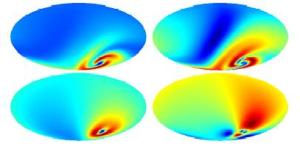
So what does this all have to do with the Cold Spot? Well, in anisotropic spaces that are also curved, it is possible for light rays to get focussed in such a way that the entire pattern of flucuations present at least-scattering winds up concentrated in a small patch of the sky as seen by a late-time observer. for this to happen the space has to be negatively curved. Only two of the Bianchi types can do this, as there are only two that are both near-FLRW and negatively curved: V and VIIh. Both of these models could, in principle, therefore produce a cold spot by geometrical, rather than stochastic means. In the little figure below, taken from our paper, you can see examples of Bianchi VIIh (top) and Bianchi V (bottom) showing the temperature (left) and polarization (right) in each case. We’ve oriented the model to put the cold spot in approximately the right location as the observed one.


cold


The point is that there is a pretty heavy price to be paid for producing the cold spot in this way: an enormous, coherent signal in the polarized radiation field.

As often happens in such situations, somebody else had the idea to investigate these models and we were scooped to a large extent by Andrew Pontzen and Anthony Challinor from Cambridge, who recently published a paper showing that the polarization produced in these models is already excluded by experimental upper limits. They concentrated on the Bianchi VIIh case, as this appears to have a more general structure than V and it was the model first advocated as an explanation of the cold spot. In this model the combined effect of vorticity and shear introduces a swirly pattern into the radiation field that you can see clearly in the top two panels of the figure as well as focussing it into a small patch. Bianchi V doesn’t produce the same kind of pattern either in temperature or polarization: it looks more like a simple quadrupole squeezed into a small part of the sky. A particularly interesting aspect of this is that the Bianchi VIIh case clearly has a definite “handedness” while the Bianchi V one doesn’t.

The moral of all this is that the polarization of the cosmic microwave background provides key additional information that could prove decisive in eliminating (or perhaps even confirming) models of the Universe more exotic than the standard one. That’s one of the areas in which  we expect Planck to produce the goods!

In the meantime Rockhee and I will be submitting a couple of much larger papers in due course, one containing a wider discussion of the possible pattern morphologies that can be produced in these models, and another about their detailed statistical properties.

Da Capo

Posted in Biographical with tags , , on August 15, 2009 by telescoper

Last week was a most momentous week, a milestone in the continuing advance of my professional career. I have tasted power. Capo di Tutti Capi!

But only for three days.

Actually it wasn’t that great. All I had to do one sign one form, with the costings for a search grant for one of our physics professors. There was nothing to it. I didn’t even have to read it, and a pen was provided too.

The point is that almost everyone was away last week and, although I was off Monday and Tuesday touring with my folks, for the latter part of the week I was designated Head of School (in the absence of the actual Head, the Deputy Head, the Director of Undergraduate Studies, and the School Manager..). I’m clearly quite a long way down the line of inheritance.

One of the reasons everyone is taking their leave now is that the A-level results are due in next week and quite a few folks will have to be back for that, to deal with next academic year’s undergraduate admissions procedures. I’m not involved directly in this process but it’s very important for the School of course.

I always think the admissions system for Universities (UCAS) is very strange. If you were going to set up a system from scratch you certainly wouldn’t have made it the way it is. Universities are given quotas of students by the government (via the funding Councils) and this is passed on to each department as a recruitment target. The departments organize interviews, open days, and all the rest of the paraphernalia of admissions practice. They then make offers to selected students in terms of A-level grades. The students, for their part, do this for several universities, getting several offers, from which they accept one as their first-choice “Firm” offer and another, usually lower, as a second-choice  “Insurance”  offer. The students then wait for their A-level results to see if they get into either of their selected departments.

Although each department has a fixed target number to recruit, it is impossible to know exactly how many will make the grades that are offered. Departments generally make more offers than they have places because some will not make the grades. However, if the success rate is higher than expected (or, as the government would put it,  if educational standards continue to rise) the department has to take too many students in. If not enough students make their grades, near- misses might be accepted but generally it’s difficult to make up a shortfall at this late stage except by going into Clearing, a pool of applicants who didn’t make it into either of their two choices.

According to today’s Guardian, the government’s recent decision to put the brakes on university expansion, combined with an increased number of applicants for university places generated by the economic recession, means that many students are unlikely to get a place at all this year.

In physics nationally there has been a substantial increase in the number of applicants over the past few years, and my own department at Cardiff University is set to meet its quota quite comfortably and is unlikely to take any students from clearing. Applications are buoyant here, at least partly because Cardiff is such an interesting place to live and offers such a vibrant social scene for students. We’re also in a special position because we get many applications from prospective students inside Wales who want to remain here to study. Cardiff University is one of only three insitutions in Wales that offer physics degrees (Aberystwyth and Swansea being the other two).

We would like to be able to increase the number of students we recruit in order to finance expansion of our staff numbers, but given the freeze on funded places from the government we would have to take quota from other departments to do so. Whether the University will allow us to do this is not at all clear, although there are departments that struggle to fill their existing quotas. Whatever happens in future years, I hope there aren’t too many disappointments in store for prospective students next week when their A-level results land on their doormat.

Anyway, the fact that we’ve reached this time of year reminds me that the start of the new academic year is not far off, and the cycle of academic life is soon to start again.  Once more, from the top!

Upon Nothing

Posted in Poetry, The Universe and Stuff with tags , , on August 15, 2009 by telescoper

I used to live in Wilmot Street in Bethnal Green, in the East End of London. I’d been resident there quite a while before I realised that the street was named after John Wilmot, Earl of Rochester, one of the great metaphysical poets, who lived from 1647 to 1680 (although I doubt he ever lived in Bethnal Green).

John Wilmot was a lifelong atheist, bon viveur and generally dissolute individual who famously converted to Christianity on his deathbed, causing much debate about whether he actually meant it.

Much of Wilmot’s literary output is actually quite crude (and often pornographic). However, first published in 1679, Upon Nothing is  certainly among the cleverest of his works and is possibly the most important poem he wrote. It’s clearly a satire  on John Milton‘s Paradise Lost (especially Book II). Starting out with a dig at the vanity of man’s attempts to solve the problem of existence, it moves into a more general lampoon of fashion victims, pompous politicians and self-important persons generally.

Updated by a few hundred years, this poem could equally be applied to the programme of quantum cosmology advocated by, e.g. Alexander Vilenkin which tries to explain the existence of the Universe by quantum tunneling  ex nihilo.  I always have a problem understanding how the equations of quantum mechanics could exist, as it were, in advance of the material they try to describe. I suppose the point is that there’s really no such thing as nothing, but then I’m no metaphysicist…

Upon Nothing

Nothing, thou elder brother even to shade,
That hadst a being ere the world was made,
And (well fixed) art alone of ending not afraid.

Ere time and place were, time and place were not,
When primitive Nothing Something straight begot,
Then all proceeded from the great united—What?

Something, the general attribute of all,
Severed from thee, its sole original,
Into thy boundless self must undistinguished fall.

Yet Something did thy mighty power command,
And from thy fruitful emptiness’s hand,
Snatched men, beasts, birds, fire, air, and land.

Matter, the wickedest offspring of thy race,
By Form assisted, flew from thy embrace,
And rebel Light obscured thy reverend dusky face.

With Form and Matter, Time and Place did join,
Body, thy foe, with these did leagues combine
To spoil thy peaceful realm, and ruin all thy line.

But turncoat Time assists the foe in vain,
And, bribed by thee, assists thy short-lived reign,
And to thy hungry womb drives back thy slaves again.

Though mysteries are barred from laic eyes,
And the Divine alone with warrant pries
Into thy bosom, where thy truth in private lies,

Yet this of thee the wise may freely say,
Thou from the virtuous nothing takest away,
And to be part of thee the wicked wisely pray.

Great Negative, how vainly would the wise
Inquire, define, distinguish, teach, devise?
Didst thou not stand to point their dull philosophies.

Is, or is not, the two great ends of Fate,
And true or false, the subject of debate,
That perfects, or destroys, the vast designs of Fate,

When they have racked the politician’s breast,
Within thy bosom most securely rest,
And, when reduced to thee, are least unsafe and best.

But Nothing, why does Something still permit
That sacred monarchs should at council sit
With persons highly thought at best for nothing fit?

Whist weighty Something modestly abstains
From princes’ coffers, and from statesmen’s brains,
And Nothing there like stately Nothing reigns,

Nothing, who dwellest with fools in grave disguise,
For whom they reverend shapes and forms devise,
Lawn sleeves, and furs, and gowns, when they like thee look wise.

French truth, Dutch prowess, British policy,
Hibernian learning, Scotch civility,
Spaniard’s dispatch, Dane’s wit are mainly seen in thee.

The great man’s gratitude to his best friend,
King’s promises, whore’s vows, towards thee they bend,
Flow swiftly to thee, and in thee never end.

Incidentally, the first use of the word metaphysical to describe the particular “poetic style, characterized by wit, syntactic complexity, and the use of elaborate and intricate schemes of imagery to express abstract ideas and emotional states” was in 1693, by John Dryden who clearly meant it to be pejorative. Those whose philosophical inclination is in the direction of positivism would look down on the more orthodox meaning of the word metaphysical, i.e. meaning “of or relating to the  branch of philosophy that deals with the first principles of things or reality, including questions about being, substance, time and space, causation, change, and identity”. Dryden, however, was alluding to another meaning, now quite rare but prevalent in the 17th Century, that has something to do with magical or supernatural things beyond the bounds of respectable thought. Thomas More used the word “metaphysical” to attack William Tyndale for translating the Bible into English, for example.

You can find other examples of  metaphysical poetry in the collection I blogged about here.

Along the bent and Devon-facing seashore

Posted in Biographical with tags , , , , on August 14, 2009 by telescoper

I’ve been off for a few days because my folks have been visiting from Newcastle. The good weather (on Tuesday, at least) gave us the opportunity to go for a drive around the Gower peninsula to the west of Swansea, seeing  some of the sights. I don’t think I’m very good at travelogues, but here are a few memories of the trip.

Along the north coast first: Penclawdd, Crofty and Llanrhidian. Weobley Castle stands decaying and forlorn, overlooking a salt marsh grazed by sheep and horses. In the distance, over the estuary, a nondescript town. Through binoculars I see they’re building a new Asda. What was there 700 years ago when they built the Castle?

Rossili Bay, at the western end of the peninsula. Beaches and dunes under cliffs. Caravans as far as the eye can see. Impatient surfers waiting in wet-suits for the tide to come in. Don’t they check the tide tables? The smell of Fish and Chips fails to lure us.

We drive south. White cottages shining bright in the sunshine, then down steep hills into cool dark tunnels formed by trees either side of the narrow roads, their leaves meeting overhead. I wonder what it’s like down here when it’s raining: the road must turn into a torrent. Then up on top again. Bright sunshine, a small airport and more caravans.

Driving south we come again to the jagged coast and see  Devon  along the horizon in front of us. I’m surprised it is so clear, as it must be at least 30 miles away. It’s dark and solid, a featureless granite wall. It reminds me of Dylan Thomas Reminiscences of Childhood ..

There was another world where with my friends I used to dawdle on half holidays along the bent and Devon-facing seashore…

I had always thought he just knew that Devon was there, not that he had actually seen it. I decide I like the word “dawdle”.

Port Eynon, at the southernmost tip of the Gower. A small beach between two headlands with a larger beach to one side. Fish and Chips and hot tea offer themselves. This time we accept. Inside the café (“The Captain’s Table”) an old newspaper in a frame on the wall tells stories of smuggling and wreck sales. Another, dated 1916, says that three lifeboat men had drowned while trying to rescue a ship that had foundered off the headland where the derelict oyster pans lie.

The sand dunes behind the beach are covered in wild flowers and they are covered in turn with vividly coloured beetles and butterflies. The tide is still out and it’s too far to walk over the rocks to get to the sea to have a paddle.  It’s not difficult to imagine a boat coming to grief in this place. There are flags all over warning about the dangers of the current. It must be a desolate place in the winter.

I think about retirement.

We pass a church with a memorial to the brave men who lost their lives that day in 1916. The lifeboat station was moved in 1919 because the place was too dangerous. Stopping to read the inscription, I’m almost run over on the narrow road by a big van carrying surfers and their gear. I wonder why they’re in such a hurry when the tide is out.

We try to avoid getting snarled up in traffic in Swansea on the way home. We fail.

As an afterthought, we head for The Mumbles, park the car and walk. Ambling along the curved promenade in the evening sunshine, a large and lumpy lady waddles towards us with sweat running down  pale pink arms;  her voluminous black dress conceals a hefty bosom that makes me think of two sacks of Tyne coal. It turns out The Mumbles is named after the French Mamelles – meaning breasts – although it takes its name from the shape of two small islands off Mumbles Head rather than from some distant ancestor of the lady I’ve just seen.

The long promenade sweeps along the side of Swansea bay to the pier and a lighthouse. The tide is still out. It seems miles to the sea, over nasty rocks that look like cinder. No beach. On the esplanade dozens of boats lie stranded, like befuddled whales that have run aground to their doom.

Dogs carry sticks and people carry ice-creams.

It’s evening now and I wonder why the tide seems to have been out everywhere we’ve been since morning.

On the inland side of the Mumbles there is a hotch-potch of closed-down pubs  and up-market bistros, next door to one another, an amusement hall and, next to it, tennis courts. The inevitable Fish and Chips. Nearer the pier  there’s an open-air Café called Verdi’s. It’s packed and doing a roaring trade in ice-creams. The waiters are very handsome but I’m not convinced they are Italian. A man sings “Just one Cornetto” and laughs loudly, but nobody else does.

Back to the car, through the centre of Swansea, and then home in less than an hour. Pimms and Lemonade in the garden before going to the pub for dinner.

A Degree of Value

Posted in Science Politics with tags , , , on August 7, 2009 by telescoper

Many column-inches have been devoted in the newspapers this week to the issue of University education, after provocative remarks by Phil Willis to the effect that the uncertainty over the “value” of degrees meant the system was descending into farce. Willis is the Chair of the Parliamentary Committee on Innovation, Universities, Science and Skills, which has just produced a highly critical report about the (lack of) regulation of teaching standards in UK Universities.

The Times Higher responded yesterday with an editorial accusing Universities of complacency over the issue of standards, and also ran a piece in which the Chief of the Quality Assurance Agency (QAA) tried to answer some of the criticisms of his outfit contained in the report.

There’s been a great deal of discussion over on the e-astronomer about this issue, and much of what I would say has already been said over there ,so I won’t say it all  here as well. However, there are a few points that I’d like to note.

First, most of the press coverage of this story has focussed on the fact that Universities are now awarding more first-class degrees than they used to.  Actually, the number has almost doubled within a decade. Degrees must be getting easier in order for this to the case, the argument goes. The government strenuously denies charges of dumbing down when A-level results get better every year but has a go at Universities when the same thing happens. So there’s a charge of hypocrisy for a start. However, I think the real reason for grade creep at both A-level and degree stages is that the current education system places a ridiculously high emphasis on compartmentalised learning and assessment methods that allow the students to succeed by cramming and question-spotting without any real knowledge. This has happened at Maths and Physics A-level with a particularly negative effect, and is beginning to happen in Universities too through the enforced modularisation of the curriculum that happened in the 1990s. The way to maintain and improve standards, at least in science education, is to reduce the amount of examination and make the examinations less predictable. The answer is not to entangle Universities in the clutches of a beefed up QAA.

I don’t know if the “standard” of a degree in Physics is lower now than it was ten years ago, nor even what it means to say that is the case. I certainly do think, however, that some of the papers I’m involved with now as a setter or a marker are harder in some ways than the ones I sat when I was a student about 25 years ago. I’m also conscious that I didn’t have to work to support myself most of the time when I was studying. What has changed a lot – and I hope the current generation of students believe this, because I really believe it’s true – is that Universities now put a huge amount of extra effort into teaching than they did when I was a student.

I want to make it clear that I do certainly do not think that present-day students are not as clever or as industrious as previous generations and are  just playing the system. One piece of evidence refutes that view very easily. In the questionnaires we give to students, they very often give the strongest signals of appreciation to courses they consider hard than to those they consider easy. I don’t think students don’t like dumbing down any more than staff do. They just want things to be done fairly.

I should add that I also think, within Physics, that academic standards are roughly comparable at the present time from University to University in the UK. I mean, in Physics at any rate, I honestly do believe that a First from Cardiff is worth the same as a First from Cambridge. I’ve been an external (or internal) examiner at several institutes over the last decade (including Cambridge) and, although their curricula vary a bit, I’m convinced that the academics try very hard to maintain the level of difficulty while at the same time being fair to the students by providing much more help than they used to. Many physicists, however, accept that forcing their syllabus into little modular boxes has made this circle very difficult to square.

I can’t speak for other subjects, of course. Is a first class degree in Media Studies from Nottingham Trent University worth as much (or indeed as little) as one from the University of Glamorgan? Perhaps. Perhaps not. Who knows?

However, it’s not really the issue of grades in itself that worried me most. Contained in the report is a scary section that claims that the link between “teaching quality” and research is “weak at best”. If, it says, it is essential for undergraduate teaching to be delivered within a strong research environment then research funding should be spread around. If not, then it should be concentrated.

The argument contained in the report is a masterpiece of non sequitur. Where is the evidence that research benefits from being carried out in a smaller number of departments? And if you deny a connection between teaching and research, whyshould the higher education funding agencies be involved in funding research anyway? And the evidence is always going to be “weak” when you talk about such ill-defined concepts. What does “teaching quality” mean? How do you measure it? The QAA doesn’t know and neither do I.

 The problem underpinning this issue is that, in 1992, the (Conservative) government allowed the polytechnics to become universities. The various research assessment exercises were introduced because, prior to 1992, all Universities received research funding in proportion to their undergraduate numbers. It was assumed, you see, that a University did teaching and research. However, the new Universities (or old Polytechnics) didn’t always have research activities in the areas they were teaching, and there wasn’t enough money to fund all 120+ new Universities on the pre-1992 basis. Thus the idea was conceived to concentrate this element of research funding (called QR) in those departments that were actually doing research. That’s not unreasonable, but as bureaucracies always do, the system of research assessment has become self-serving. Sufficient  concentration was actually achieved a decade ago, but we still have to endure pointless reshuffling exercises every few years.

The big changes of 1992  left Physics in a special position. The number of Physics (or Physics & Astronomy) departments in the UK entered into the last Research Assessment Exercise was only 42. About two-thirds of UK universities do not have research activity in this area. Very few Polytechnics either taught Physics to undergraduates or did research in Physics and very few started such programmes when they became Universities.  Why? Because there is absolutely no way you can teach a modern Physics degree outside a research department. It would be impossible to keep up to date, impossible to provide appropriate projects, and impossible to retain quality  staff to do the teaching because they would clearly want to be doing physics as well as teaching it. In Physics the link between teaching and research is not “weak”. The pre-1992 situation demonstrates how crucial it really is.

I can’t speak for other subjects, but I suspect much of this applies across all disciplines. That’s why I think a University in which students are taught by people who are not doing research in the field they are teaching just shouldn’t be called a University. By definition.

The Polytechnics had much to offer this country, but their contribution was largely lost when they became second-rate Universities. But of course you’ll never find a politician who will admit that it was a mistake.

Dark August

Posted in Poetry with tags on August 7, 2009 by telescoper

So much rain, so much life like the swollen sky
of this black August. My sister, the sun,
broods in her yellow room and won’t come out.

Everything goes to hell; the mountains fume
like a kettle, rivers overrun; still,
she will not rise and turn off the rain.

She is in her room, fondling old things,
my poems, turning her album. Even if thunder falls
like a crash of plates from the sky,

she does not come out.
Don’t you know I love you but am hopeless
at fixing the rain ? But I am learning slowly

to love the dark days, the steaming hills,
the air with gossiping mosquitoes,
and to sip the medicine of bitterness,

so that when you emerge, my sister,
parting the beads of the rain,
with your forehead of flowers and eyes of forgiveness,

all will not be as it was, but it will be true
(you see they will not let me love
as I want), because, my sister, then

I would have learnt to love black days like bright ones,
The black rain, the white hills, when once
I loved only my happiness and you.

by Derek Walcott.

The Axle of Elvis

Posted in Cosmic Anomalies, The Universe and Stuff with tags , , , , , , on August 6, 2009 by telescoper

An interesting paper on the arXiv yesterday gave me a prod to expand a little on one of the cosmic anomalies I’ve blogged about before.

Before explaining what this is all about, let me just briefly introduce a bit of lingo. The pattern of variations fluctuations in the temperature of the cosmic microwave background (CMB) across the sky, such as is revealed by the Wilkinson Microwave Anisotropy Probe (WMAP), is usually presented in terms of the behaviour of its spherical harmonic components. The temperature as a function of position is represented as a superposition of spherical harmonic modes labelled by two numbers, the degree l and the order m. The degree basically sets the characteristic angular scale of the mode (large  scales have low l, and small scales have high l). For example the dipole mode has l=1 and it corresponds to variation across the sky on a scale of 180 degrees; the quadrupole (l=2) has a scale of 90 degrees, and so on. For a fixed l the order m runs from -l to +l and each order represents a particular pattern with that given scale.

The spherical harmonic coefficients that tell you how much of each mode is present in the signal are generally  complex numbers having real and imaginary parts or, equivalently, an amplitude and a phase.  The exception to this are the modes with m=0, the zonal modes, which have no azimuthal variation: they vary only with latitude, not longitude. These have no imaginary part so don’t really have a phase. For the other modes, the phase controls the variation with azimuthal angle around the axis of the chosen coordinate system, which in the case of the CMB is usually taken to be the Galactic one.

In the simplest versions of cosmic inflation, each of the spherical harmonic modes should be statistically independent and randomly distributed in both amplitude and phase. What this really means is that the harmonic modes are in a state of maximum statistical disorder or entropy. This property also guarantees that the temperature fluctuations over the sky should be described by  a Gaussian distribution.

That was perhaps a bit technical but the key idea is that if you decompose the overall pattern of fluctuations into its spherical harmonic components the individual mode patterns should look completely different. The quadrupole and octopole, for example, shouldn’t line up in any particular way.

Evidence that this wasn’t the case started to emerge when WMAP released its first set of data in 2003 with indications of an alignment between the modes of low degree. In their  analysis, Kate Land and Joao Magueijo dubbed this feature The Axis of Evil; the name has stuck.They concluded that there was a statistically significant alignment (at 99.9% confidence) between the multipoles of low degree (l=2 and 3), meaning that the measured alignment is only expected to arise by chance in one in a thousand simulated skies. More recently, further investigation of this effect using subsequent releases of data from the WMAP experiment and a more detailed treatment of the analysis (including its stability with respect to Galactic cuts) suggested that the result is not quite as robust as had originally been claimed. .

Here are the low-l modes of the WMAP data so you see what we’re talking about. The top row of the picture contains the modes for l=2 (quadrupole) and l=3 (octopole) and the bottom shows l=4 and l=5.


The two small red blobs mark the two ends of the preferred axis of each mode. The orientation of this axis is consistent across all the modes shown but the statistical significance is much stronger for the ones with lower l.

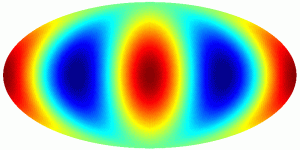
It’s probably worth mentioning a couple of neglected aspects of this phenomenon. One is that the observed quadrupole and octopole appear not only to be aligned with each other but also appear to be dominated by sectoral orders, i.e those with m=l. These are the modes which are, in a sense, opposite to the zonal modes in that they vary only with longitude and not with latitude. Here’s what the sectoral mode of the quadrupole looks like:

map22

Changing the phase of this mode would result in the pattern moving to the left or right, i.e. changing its origin, but wouldn’t change the orientation. Which brings me to the other remarkable thing, namely that the two lowest modes also have  correlated phases. The blue patch to the right of Galactic centre is in the same place for both these modes. You can see the same feature in the full-resolution map (which involves modes up to l~700 or so):

I don’t know whether there is really anything anomalous about the low degree multipoles, but I hope this is a question that Planck (with its extra sensitivity, better frequency coverage and different experimental strategy) will hopefully shed some light on. It could be some sort of artifact of the measurement process or it could be an indication of something beyond the standard cosmology. It could also just be a fluke. Or even the result of an over-active imagination, like seeing Elvis in your local Tesco.

On its own I don’t think this is going to overthrow the standard model of cosmology. Introducing extra parameters to a model in order to explain a result with a likelihood that is only marginally low in a simpler model does not make sense, at least not to a proper Bayesian who knows about model selection…

However, it is worth mentioning that the Axis of Evil isn’t the only cosmic anomaly to have been reported. If an explanation is found with relatively few parameters that can account for all of these curiosities in one fell swoop then it would stand a good chance of convincing us all that there is more to the Universe than we thought. And that would be fun.

Go Galaxy!

Posted in Uncategorized with tags on August 5, 2009 by telescoper

This morning I was looking through my copy of the popular monthly periodical British Naturism (which I buy for the Spot-the-Ball competition).

In the magazine I found an advertisement with the slogan

If you can’t go naked, go Galaxy!

The immediate thing that sprang to mind was that I didn’t think I’d ever seen Galaxy used as an adjective before. However, this is advertising so the usual rules of grammar don’t apply. The next question was whether it might have something to do with astronomy. It doesn’t.

Galaxy is the strangest range of clothing you’ve ever seen. Essentially it contains bathing costumes that are almost transparent, enabling the Sun’s rays to pass through the material. At the same time a kind of disruptive pattern camouflage (available in a choice of designs) printed on the meshlike material makes the items appear opaque to prying eyes. Here’s an example

shortnn

This combination allows the wearer to acquire a suntan in his or her private places but the swirling patterns confuse the observer’s eye to the extent that he/she doesn’t realise that the wearer’s personal credentials are actually in full view. Perhaps this is an example of Moiré is less?

Having been swimming au naturel on many occasions, I would say the best part of it is the freedom you feel in having your private parts unconstrained. The downside is the exposure of sensitive areas to the harsh rays of the Sun. It seems to me that in this sense the Galaxy range offers the worst possible combination of being hindered as well as burnt. Still, they do offer an option to those people who are too shy to go nude on a beach and who want to get an all over tan without using one of those horrendous ultra-violet tanning machines that look like a fluorescent coffin or slapping  orange dye all over themselves.

I’m not sure how effective these things are at concealing the relevant appendages, so maybe I’ll buy a pair and see. Perhaps I could run an undergraduate project to investigate their optical properties?