Author Archive

On the Third Day..

Posted in Cricket with tags , , on July 19, 2009 by telescoper

Following on from my previous posts (here and here) about the First Ashes Test in Cardiff, I can’t help adding a quick post about my visit to Lord’s yesterday (Saturday) to see the third day’s play at the Second Ashes Test.

The circumstances of the day’s play were a bit different to those at Cardiff, to say the least. On the first day England had batted first, starting in great style but then surrending some silly wickets. At the end of day 1 England were 364-6 with Strauss unbeaten on 161, the total score not being dissimilar to that on the first day at Cardiff. On day 2 Strauss was out almost immediately and it looked like it was going to be a disappointing day for England. But the last pair added 47 runs and England got to 425 all out. When the Austalians batted, however, England took control of the game, reducing them to 156-8 by the end of Day 2. I don’t know what got into the Ozzies on Friday but most of them lost their wickets to daft shots rather than good bowling. Perhaps it was nerves.

I arrived at Lord’s on Saturday morning, about 9.15. I have been to Lord’s a few times before but not recently and never as the guest of a member of the MCC (Anton). I joined the lengthy queue for member’s guests but made it into the ground in good time to find seats in the Warner Stand (next to the Pavilion) and then have a look around the cricket museum (where the Ashes themselves are on display).

It was a considerably posher occasion than Cardiff, with MCC ties, blazers and other paraphernalia on display. Picnic hampers were in evidence around the enclosure and  champagne corks popped at regularly intervals. I contented myself, however, with lager and a bacon butty from the bar behind the stand.

Before the start of play the talk around the crowd was all about knocking over the last two Australian batsmen quickly and then enforcing the follow on. (If the team batting second doesn’t get within 200 runs of the team batting first then they can be required to bat again by the captain of the other team, which is called “following on”.) As it happened the tailenders clung on doggedly and it looked for a while they would close in on the 225 runs needed to avoid the follow-on. However, the last two wickets did eventually fall for a total of 215, leaving a deficit of 210 runs. England could have asked Australia to bat again but, to the consternation of most of the crowd, the England captain Andrew Strauss declined to enforce the follow-on.

There are pros and cons making a team follow on. One of the pros is that it maintains the momentum of the bowling performance. One of the cons is that the bowlers have already bowled an entire innings and have to do the same again almost immediately. They might be a bit tired, which could hand the advantage to the batting side if they can avoid losing early wickets. If the Australian batsmen had scored well after following on then England might also have needed to bat last on a pitch that may have started to break up. Batting last in a Test match is usually quite difficult.

I think Strauss is quite a cautious man and I think he decided that Australia’s strong batting display at Cardiff was enough evidence of ability for him not to want to risk them posting a huge second-innings score. England’s brittle second-innings batting performance at Cardiff provided further reason for not wanting to get into a run chase.

Strauss obviously wants to win the game but he also won’t want to lose it from this position. Test cricket isn’t just win-or-lose: there is also a third possibility, a draw (like at Cardiff). Often the biggest chance of winning a game is to give the side batting last a target that they might try to chase in risky fashion and get bowled out. However, if the batting side are good they might actually get the runs.  Too big a target and they won’t be tempted to go for it, too small and they might well reach it. Maximizing the probability of winning does not miminize the probability of losing in this situation. If England simply didn’t want to lose they would bat out time, accumulate a huge total and give Australia insufficient time to make the runs. England might still win in such a strategy but a draw becomes much more probable.

It was clearly Strauss’ judgement was that England needed more runs but he wanted to get them quickly enough to declare and try to force a result in the two remaining days. The England batsmen came out just before lunch to try to push on to a huge lead. They started very brightly but unfortunately both openers Strauss and Cook were out shortly after lunch. There then followed a very turgid couple of hours when Pietersen and Bopara struggled to score runs. Pietersen, usually a prolific hitter, apeared to be struggling with his Achilles injury while Bopara is clearly out of touch at this level. Both batsmen scratched around unconvincingly for most of the session and then got themselves out.

At 174-4 it was looking like another collapse might be on the cards and the Australians might have to chase a total under about 400, which appeared to me to be eminently achievable with two full days play available after Saturday. However, Collingwood and (especially) Prior batted superbly well together taking the score to 260-5 and then Flintoff and Collingwood carried it onto 311 before Collingwood was out.

Many members of the crowd were screaming for a declaration now, but the weather intervened. It had been getting very dark for some time and finally started raining about 6.30. The umpires called off play for the day with England at 311-6, a lead of 521 with two days left to play, a good position to be in by any standards.

Unless the weather turns very bad over the next two days then it seems to me a draw is a very unlikely possibility now. If England declare overnight and Australia can bat for two days they will score enough runs to win the game, but in doing so they will have to surpass by some margin the highest ever total reached in the last innings to win a Test match. Frankly, if they can do that they deserve to win! On the other hand, England have plenty of time to bowl them out even if a  bit is lost to the weather. I actually think Strauss’ decision to bat again was probably a good one and I think he should carry on batting tomorrow to get another 100 runs or so. There will still be time to bowl out the Ozzies, but the chance of them scoring enough to win the game is smaller.

I left the ground and walked to Paddington to get the train back to Cardiff and was home by 10pm. A very satisfactory day.

Postscript. I just looked at the scorecard of today’s play (Sunday) before posting this. England declared their innings closed on 311-6 and Australia went into bat this morning. At lunch they were 76-2. The odds are in favour of England winning, but Ponting is still in. It’s nicely poised.

Everyone’s Gone to the Moon

Posted in Uncategorized with tags , , , , on July 16, 2009 by telescoper

Since the media have been banging on about it all week, as have various other bloggers, I suppose I should at least mention that today (16th July 2009) is the fortieth anniversary of the launch of NASA’s  Apollo 11 mission which put the first man on the Moon. I’m reliably informed that the picture on the left shows the second man on the Moon, Buzz Aldrin, although I don’t think the costume gives much clue to the identity of the wearer.

My response to the media furore  is muted because I’m decidedly ambivalent about the whole business of manned space exploration. I’m not going to be churlish and say that all the Apollo missions did was provide America with a much-needed propaganda victory during the Cold War. I think it’s true that putting a man on the Moon was a great achievement in terms of ingenuity and organization. It’s  probably also true that it inspired many people to go into science who otherwise wouldn’t have done so. I’d even say that the sight of Earth from the Moon marked the beginning of a new age of awareness of the fragility of our own existence on our home planet and, perhaps even a step towards our coming-of-age as a species.

The reason I am ambivalent, however, is that the scientific returns from the Apollo missions were entirely negligible, at least in terms of value for money,  partly because the Apollo missions weren’t really designed to do science in the first place and partly because the Moon just isn’t very interesting…

Mankind hasn’t returned to the Moon since the Apollo series came to an end. That’s not a matter for regret, just a reflection of the fact that there isn’t much to be found there. In those forty years  astronomy and space science have moved on immeasurably through spaceborne observatories and unmanned probes. We have learned far more about the Universe  those ways than could ever be achieved by sending a few people to collect rocks from a dull piece of rubble in our backyard. In the process, the Universe has grown in size relative to the scale possible to reach by human engineering projects. The last forty years has shown us that, in retrospect, going to the Moon wasn’t really all that impressive compared to what we can find out by remote means.

Unfortunately there appears to be an increasingly vocal lobby in favour of diverting funds from fundamental science into manned space exploration, much of it aimed at the goal of putting a person on Mars.  This has not yet resulted in a commitment by the United Kingdom government to join in manned space exploration, but it is worrying that the Chief Executive of the Science & Technology Facilities Council is a failed astronaut who I fear sees this as an attractive option. Even more worryingly, Science Minister Lord Drayson seems to be keen too. It’s up to  scientists to present the case to government for maintaining investment in fundamental science and against having the budget plundered to play Star Trek.

The European Space Agency‘s Aurora programme is intended to culminate with a manned trip to Mars, at an overall cost of over £30 billion. One of the arguments I hear over and over again in favour of this programme is that it will inspire young people to take up science, especially physics. Well, maybe. But people can’t become scientists unless they have the opportunity to learn science at School and there is a drastic shortage of physics teachers these days. What’s the point of being inspired if you can’t get the education anyway? You could train an awful  lot of school teachers for  a small fraction of the Aurora budget.  And what’s the point of inspiring people to take up astronomy and space science when you’re also busy slashing the budget for research and ending the careers of those excellent scientists we’ve already got?

So by all means let’s celebrate the marvellous achievements of 1969, but let’s move on and not pretend that there is any good scientific reason for repeating them.

Oratorio

Posted in Biographical, The Universe and Stuff with tags , , on July 16, 2009 by telescoper

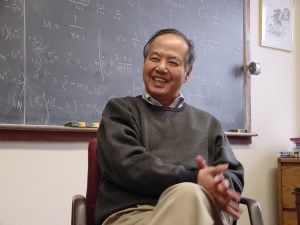
T.D.1.jpg_copyBlogging about graduation ceremonies yesterday, I was reminded that a few years ago I had to deliver an oration on behalf of a very famous physicist who was awarded an honorary doctorate at the University of Nottingham. The recipient was TD Lee (shown left) who, together with CN Yang, won the Nobel Prize for Physics in 1957 for his work on parity violation. I thought you might find it interesting to  read the text of the oration, which I just found on my laptop this morning:

PROFESSOR TSUNG-DAO LEE

ORATION DELIVERED BY PROFESSOR PETER COLES

ON MONDAY 17 JULY 2006

Chancellor, Vice-Chancellor, Ladies and Gentlemen, it is both a pleasure and a privilege to present Professor Tsung-Dao Lee for the award of an honorary degree.  Professor Lee is a distinguished theoretical physicist whose work over many years has been characterized, in the words of Dr J Robert Oppenheimer, by “a remarkable freshness, versatility and style.”

Tsung-Dao Lee was born in Shanghai and educated at Suzhou University Middle School in Shanghai.  Fleeing the Japanese invasion, he left Shanghai in 1941.  His education was interrupted by war.  In 1945 he entered the National Southwest University in Kunming as a sophomore.  He was soon recognized as an outstanding young scientist and in 1946 was awarded a Chinese Government Scholarship enabling him to start a PhD in Physics under Professor Enrico Fermi at the University of Chicago.  He gained his doctorate in physics in 1950 with a thesis on the Hydrogen Content of White Dwarf Stars, and subsequently served as a research associate at the Yerkes Astronomical Observatory of the University of Chicago in Williams Bay, Wisconsin.

Astronomy is a science that concerns the very large, but it was in the physics of the very small that Professor Lee was to do his most famous work.  After one year as a research associate and lecturer at the University of California in Berkeley, he became a fellow of the Institute of Advanced Study in Princeton and, in 1953, he accepted an assistant professorship position at Columbia University in New York.  Two and a half years later, he became the youngest full professor in the history of Columbia University.  During this time he often collaborated with Chen Ning Yang whom he had known as a fellow student in Chicago.  In 1956 they co-authored a paper whose impact was both immediate and profound.  Only a year later, Lee and Yang were jointly awarded the Nobel Prize in Physics.  Professor Lee was thirty-one at the time and was the second youngest scientist ever to receive this distinction.  (The youngest was Sir Lawrence Bragg who shared the Physics Prize with his father in 1915, at the age of twenty-five.)

It is usually difficult to explain the ideas of theoretical physics to non-experts.  The mathematical language is inaccessible to those without specialist training.  But some of the greatest achievements in this field are so bold and so original that they appear, at least with hindsight, to be astonishingly simple.  The work of Lee and Yang on parity violation in elementary particle interactions is an outstanding example.

Subatomic particles interact with each other in very complicated ways.  In high energy collisions, particles can be scattered, destroyed or transformed into other particles.  But governing these changes are universal rules involving things that never change.  The existence of these conservation laws is a manifestation of the symmetries possessed by the mathematical theory of particle interactions.

Lee and Yang focussed on a particular attribute called parity, which relates to the “handedness” of a particle and symmetry with respect to mirror reflections.  Physicists had previously assumed that the laws of nature do not distinguish between left- and right-handed states: a left-handed object when seen in a mirror should be indistinguishable from a right-handed one.  This symmetry suggests that parity should be conserved in particle interactions, as it is in many other physical processes.  Unfortunately this chain of thought led to a puzzling deadlock in our understanding of the so-called weak nuclear interaction.  Lee and Yang made the revolutionary suggestion that parity is not conserved in weak interactions and consequently that the laws of nature must have a built-in handedness.  A year later their theory was tested experimentally and found to be correct.  Their penetrating insight led to a radical overhaul of the theory of weak interactions and to many further discoveries.  Physicists around the world said “Of course!  Why didn’t I think of that?”

This classic “Eureka moment” happened half a century ago, but Professor Lee has since made a host of equally distinguished contributions to fields as diverse as astrophysics, statistical mechanics, field theory and turbulence.  He was made Enrico Fermi Professor at Columbia in 1964 and University Professor there in 1984.  With typical energy and enthusiasm he took up the post of director of the RIKEN Research Center at Brookhaven National Laboratories in 1998.  He has played a prominent role in the advancement of science in China, including roles as director of physics institutes in Beijing and Zhejiang.

Professor Lee has received numerous awards and honours from around the world, including the Albert Einstein Award in Science, the Bude Medal, the Galileo Galilei Medal, the Order of Merit, Grande Ufficiale of Italy, the Science for Peace Prize, the China National-International Cooperation Award, the New York City Science Award, the Pope Joannes Paulis Medal, Il Ministero dell’Interno Medal of the Government of Italy and the New York Academy of Sciences Award.  His recognition even extends beyond this world, for in 1997 Small Planet 3443 was named in his honour.

Chancellor, Vice-Chancellor, to you and to the whole congregation I present Professor Tsung-Dao Lee as eminently worthy to receive the degree of Doctor of Science, honoris causa.

Graduandi Graduati

Posted in Biographical with tags , , , on July 15, 2009 by telescoper

Today was the day of the graduation ceremony for Cardiff  University‘s School of Physics & Astronomy, which took place in the fine surroundings of St David’s Hall. It’s a proud day for the students and their parents so, before anything else, let me offer my congratulations to all those who graduated today. Congratulations and well done to you all!

I put on my robes in the Green Room and was in the academic staff procession at the beginning and end of the ceremony. I also sat on stage during the conferment of degrees and the speech by the University’s President, Lord Kinnock. Some of the proceedings were conducted in Welsh – including the actual degree award – but it was comprehensible enough for all foreigners (even the English) to follow what was going on.

Graduation ceremonies are funny things. With all their costumes and weird traditions, they do seem a bit absurd. On the other hand, even in these modern times, we live with all kinds of  rituals and I don’t see why we shouldn’t celebrate academic achievement in this way.

Graduation is a grammatical phenomenon too. The word “graduation” is derived from the latin word gradus meaning a step, from which was eventually made the mediaeval latin verb graduare, meaning to take a degree. The past participle  of this is formed via the supine graduatus, hence the English noun “graduate” (i.e. one who has taken a degree). The word graduand, on the other hand, which is used before and during the ceremony to describe those about to graduate is from the  gerundive form graduandus meaning “to be graduated”. What really happens, therefore, is that students swap their gerundives for participles, although I suspect most participants don’t think of it in quite those terms…

The academic procession is quite colourful because staff wear the gown appropriate to their highest degree. Colours and styles vary greatly from one University to another even within the United Kingdom, and there are even more variations on show when schools contain staff who got their degrees abroad. Since I got my doctorate from the University of Sussex, which was created in the 1960s, the academic garb I have to wear on these occasions  is actually quite modern-looking. With its raised collar, red ribbons and capped shoulders it’s also more than a little bit camp. It often brings  a few comments when I’m in the procession, but I usually reply by saying I bought the outfit at Ann Summers.

Graduation of course isn’t just about education. It’s also a rite of passage on the way to adulthood and independence, so the presence of the parents at the ceremony adds another emotional dimension to the goings-on. Although everyone is rightly proud of the achievement – either their own in the case of the graduands or that of others in the case of the guests – there’s also a bit of sadness to go with the goodbyes. The new graduates were invited back to the School for a reception after this morning’s ceremony, along with parents and friends. That provided a more informal opportunity to say goodbye. Some, of course, are continuing their studies either at Cardiff or elsewhere so I’ll be seeing at least some of them again.

Although this was my first attendance at the Cardiff University graduation, I’ve been to  graduation ceremonies at several universities as a staff member. They differ in detail but largely follow the same basic format. Compared to others I’ve been at, the Cardiff version is very friendly and rather informal. For one thing, the Vice-Chancellor actually shakes hands with all the graduands as they cross the stage. At Nottingham University, for example, where I was before moving here, the V-C just sat there reading a book and occasionally nodded as they trooped across in front of him.

The venue for Cardiff’s graduation is also right in the city centre, so all day you can find students in their regalia wandering through the town (sometimes with their doting parents in tow). I like this a lot because it gives the University a much greater sense of belonging to the city than is the case when everything happens on a campus miles out of town.

The most remarkable thing  I noticed in the ceremony was not to do with Physics & Astronomy, but with Cardiff’s School of Psychology which is much larger and in which at least 90% of the graduates were female. In our School the proportions aren’t exactly reversed but are about 75% male to 25% female.

I’ve also been through two graduations on the other side of the fence, as it were. My first degree came from Cambridge so I had to participate in the even more archaic ceremony for that institution. The whole thing is done in Latin there (or was when I graduated) and involves each graduand holding a finger held out by their College’s Praelector and then kneeling down in front of the presiding dignitary, who is either the Vice-Chancellor ot the Chancellor. I can’t remember which. It’s also worth mentioning that although I did Natural Sciences (specialising in Theoretical Physics), the degree I got was Bachelor of Arts. Other than that, and the fact that the graduands walk to the Senate House from their College through the streets of Cambridge,  I don’t remember much about actual ceremony.

I was very nervous for my first graduation. The reason was that my parents had divorced some years before and my Mum had re-married. My Dad wouldn’t speak to her or her second husband. Immediately after the ceremony there was a garden party at my college, Magdalene, at which the two parts of my family occupied positions at opposite corners of the lawn and I scuttled between them trying to keep everyone happy. It was like that for the rest of the day and I have to say it was very stressful.

A few years later I got my doctorate (actually DPhil) from the University of Sussex. The ceremony in that case was in the Brighton Centre on the seafront. It was pretty much the same deal again with the warring factions, but I enjoyed the whole day a lot more that time. And I got the gown.

For the Cosmonauts

Posted in Poetry, The Universe and Stuff with tags , on July 15, 2009 by telescoper

Last week I bought a copy of Moonrise, a collection of poems by Meirion Jordan. He was born in Swansea and read Mathematics at Somerville College, Oxford. His poems, which often deal with themes inspired by science, are sometimes witty or satirical and sometimes simply a bit wild.  They’re also beautifully composed, with a very natural structure and playful use of language.

I wanted to give his book a bit of a plug so here he is on Youtube reading For the Cosmonauts, which one of two pieces comprising the Epilogue to his book.  This is the text

I, Yuri Gagarin, having not seen God,
wake now to the scrollwork of a body,
to my own white fibres leafing into the bone:
know that beyond this dome of rain there is
only the nothing where the soul sweers
out its parallax like a distant star and truth
brightens to X, to gamma, through a metal sail.

So I return to you, cramming your pockets
with the atmosphere and the evening news,
fumbling for gardens in the moon’s shadow,
in its waterfalls of silence. I wish for you
familiar towns, their piers and amusement arcades
unpeopled at dusk, the unicorn tumbling by
on china hooves behind the high walls
of parks, among congregating lamps.

May you find Earth rising there, between
your steepled hands. May your voyages
end. May you have a cold unfurling
of limbs each morning, when I am fallen
out of the world.

Here is the poet himself reading it

You can order the book directly from the publisher by clicking on the link above.

The Thermodynamics of Beards

Posted in Beards, The Universe and Stuff with tags , , , , , , , on July 14, 2009 by telescoper

When I was an undergraduate studying physics, my physics supervisor (who happens to be a regular contributor to the comments on this blog) introduced me to thermodynamics by explaining that Ludwig Boltzmann committed suicide in 1906, as did Paul Ehrenfest in 1933. Now it was my turn to study what had driven them both to take their own lives.

I didn’t think this was the kind of introduction likely to inspire a joyful curiosity in the subject, but it probably wasn’t the reason why I found the subject as difficult as I did. I thought it was a hard subject because it seemed to me to possess arbitrary rules that didn’t emerge from a simpler underlying principle, but simply had to be memorized. Lurking somewhere under it was obviously something statistical, but what it was or how it worked was never made clear. I was frequently told that the best thing to do was just memorize all the different examples given and not try to understand where it all came from. I tried doing this but, partly because I have a very poor memory, I didn’t so very well in the final examination on this topic. I was prejudiced against it for years afterwards.

Actually, now I have grown to like thermodynamics as a subject and have read quite a bit about its historical development. The field of thermodynamics is usually presented to students as a neat and tidy system of axioms and definitions. The resulting laws are written in the language of idealised gases, perfect mechanical devices and reversible equilibrium paths but, despite this, have many applications in realistic practical situations. What is particularly interesting about these laws is that it took a very long time indeed to establish them even at this macroscopic level. The deeper understanding of their origin in the microphysics of atoms and molecules took even longer and was an even more difficult journey.   I thought it might be  fun to celebrate  the tangled history of this fascinating subject, at least for a little while.  Unlike quantum physics and relativity, thermodynamics is not regarded as a very “glamorous” part of science by the general public, but it did occupy the minds of the greatest physicists of the nineteenth century, and I think the story deserves to be better appreciated. I don’t have space to give a complete account, so I apologize in advance for the omissions.

I thought it would also be fun to show pictures of the principal characters. As you’ll see, after  a very clean-shaven start, the history of thermodynamics is dominated by a succession of rather splendid beards…

I’ll start the story with Nicolas Léonard Sadi Carnot (left), who  was born in 1796. His family background was, to say the least, unusual. His father Lasare was known as the “Organizer of Victory” for the Revolutionary Army in 1794 and subsequently became Napoleon’s minister of war. Against all expectations he quit politics in 1807 and became a mathematician. Sadi had a brother, by the splendid name of Hippolyte, who was also a politician and whose son became president of France. Sadi himself was educated partly by his father and partly at the Ecole Polytecnhique. He served in the army as an engineer and was eventually promoted to Captain. He left the army in 1828, only to die of cholera in 1832 during an epidemic in Paris.

Carnot’s work on the theory of “heat engines” was astonishingly original and eventually had enormous impact, essentially creating the new science of thermodynamics, but he only published one paper before his untimely death and it attracted little attention during his lifetime. Reflections on the Motive Power of Fire appeared in 1824, but its importance was not really recognized until 1849, when it was read by William Thomson (later Lord Kelvin) who, together Rudolf Clausius, made it more widely known.

In the late 18th century, Britain was in the grip of an industrial revolution largely generated by the use of steam power. These engines had been invented by the pragmatic British, but the theory by which they worked was pretty much non-existent. Carnot realised that steam-driven devices in use at the time were horrendously inefficient. As a nationalist, he hoped that by thinking about the underlying principles of heat and energy he might be able to give his native France a competitive edge over perfidious Albion. He thought about the problem of heat engines in the most general terms possible, even questioning whether there might be an alternative to steam as the best possible “working substance”. Despite the fact that he employed many outdated concepts, including the so-called caloric theory of heat, Carnot’s paper was full of brilliant insights. In particular he considered the behaviour of an idealized friction-free engine in which the working substance moves from a heat source to a heat sink in a series of small equilibrium steps so that the entire process is reversible. The changes of pressure and volume involved in such a process are now known as a Carnot cycle.

By remarkably clear reasoning, Carnot was able to prove a famous theorem that the efficiency of such a cycle depends only on the temperature Tin of the heat source and the temperature Tout. He showed that the maximum fraction of the heat available to be used to do mechanical work is independent of the working substance and is equal to (Tin-Tout)/Tout; this is called Carnot’s theorem. Carnot’s results were probably considered too abstract to be of any use to engineers, but they contain ideas that are linked with the First Law of Thermodynamics, and they eventually led Clausius and Thomson independently to the statement of the Second Law discussed below.

James Prescott Joule (right) was growing up in a wealthy brewing family. He was born in 1818 and was educated at home by none other than John Dalton. He became interested in science and soon started doing experiments in a laboratory near the family brewery. He was a skilful practical physicist and was able to measure the heat and temperature changes involved in various situations. Between 1837 and 1847 he established the basic principle that heat and other forms of energy (such as mechanical work) were equivalent and that, when all forms are included, energy is conserved. Joule measured the amount of mechanical work required to produce a given amount of heat in 1843, by studying the heat released in water by the rotation of paddles powered by falling weights. The SI unit of energy is named in his honour.

William Thomson, 1st Baron Kelvin of Largs, was born in 1824 and came to dominate British physics throughout the second half of the 19th  century. He was extremely prolific, writing over 600 research papers and several books. No-one since has managed to range so widely and so successfully across the realm of natural sciences. He was also unusually generous with his ideas (perhaps because he had so many), and in giving credit to other scientists, such as Carnot.  He wasn’t entirely enlightened, however: he was a vigorous opponent of the admission of women to the  University.

Kelvin worked on many theoretical aspects of physics, but was also extremely practical. He directed the first successful transatlantic cable telegraph project, and his house in Glasgow was one of the first to be lit by electricity. Unusually among physicists he became wealthy through his scientific work. One can dream.

One of the keys to Kelvin’s impact on science in Britain was that immediately after graduating from Cambridge in 1845 he went to work in Paris for a year. This opened his eyes to the much more sophisticated mathematical approaches being used by physicists on the continent. British physics, especially at Cambridge, had been held back by an excessive reverence for the work of Newton and the rather cumbersome form of calculus (called “fluxions”) it had inherited from him. Much of Kelvin’s work on theoretical topics used the modern calculus which had been developed in mainland Europe. More specifically, it was during this trip to Paris that he heard of the paper by Carnot, although it took him another three years to get his hands on a copy. When he returned from Paris in 1846, the young William Thomson became Professor of Natural Philosophy at Glasgow University, a post he held for an astonishing 53 years.

Initially inspired by Carnot’s work, Kelvin became one of the most important figures in the development of the theory of heat. In 1848 he proposed an absolute scale of temperature now known as the Kelvin or thermodynamic scale, which practically corresponds with the Celsius scale except with an offset such that the triple point of water, at zero degrees Celsius, is at 273.16 Kelvin.  He also worked with Joule on experiments concerning heat flow.

At around the same time as Kelvin, another prominent character in the story of thermodynamics was playing his part. Rudolf Clausius (right) was born in 1822. His father was a Prussian pastor and owner of a small school that the young Rudolf attended. He later went to university in Berlin to study history, but switched to science. He was constantly short of money, which meant that it took him quite a long time to graduate but he eventually ended up as a professor of physics, first in Zürich and then later in Wurzburg and Bonn. During the Franco-Prussian war, he and his students set up a volunteer ambulance service and during the course of its operations, Rudolf Clausius was badly wounded.

By the 1850s, thanks largely to the efforts of Kelvin, Carnot’s work was widely recognized throughout Europe. Carnot had correctly realised that in a steam engine, heat “moves” as the steam descends from a higher temperature to a lower one. He, however, envisaged that this heat moved through the engine intact.  On the other hand, the work of Joule had established The First law of Thermodynamics, which states that heat is actually lost in this process, or more precisely heat is converted into mechanical work. Clausius was troubled by the apparent conflict between the views of Carnot and Joule, but eventually realised that they could be reconciled if one could assume that heat does not pass spontaneously from a colder to a hotter body. This was the original statement of what has become known as the Second Law of Thermodynamics.  The following year, Kelvin came up with a different expression of essentially the same law.  Clausius further developed the idea that heat must tend to dissipate and in 1865 he introduced the term “entropy”  as a measure of the amount of heat gained or lost by a body divided by its absolute temperature. An equivalent statement of the Second Law is that the entropy of an isolated system can never decrease: it can only either increase or remain constant. This principle was intensely controversial at the time, but Kelvin and Maxwell fought vigorously in its defence, and it was eventually accepted into the canon of Natural Law.

So far in this brief historical diversion, I have focussed on thermodynamics at a macroscopic level, in the form that eventually emerged as the laws of thermodynamics presented in the previous section. During roughly the same period, however, a parallel story was unfolding that revolved around explaining the macroscopic behaviour of matter in terms of the behaviour of its microscopic components. The goal of this programme was to understand quantitative measures such as temperature and pressure in terms of related quantities describing individual atoms or molecules. I’ll end this bit of history with a brief description of three of the most important contributors to this strand.

James_clerk_maxwell

James Clerk Maxwell (above) was probably the greatest physicist of the nineteenth century, and although he is most celebrated for his phenomenal work on the unified theory of electricity and magnetism, he was also a great pioneer in the kinetic theory of gases, He was born in 1831 and went to school at the Edinburgh academy, which was a difficult experience for him because he had a country accent and invariably wore home-made clothes that made him stand out among the privileged town-dwellers who formed the bulk of the school population. Aged 15, he invented a method of drawing curves using string and drawing pins as a kind of generalization of the well-known technique of drawing an ellipse. This work was published in the Proceedings of the Royal Society of Edinburgh in 1846, a year before Maxwell went to University. After a spell at Edinburgh he went to Cambridge in 1850; while there he won the prestigious Smith’s prize in 1854. He subsequently obtained a post in Aberdeen at Marischal College where he married the principal’s daughter, but was then made redundant. In 1860 he moved to London but when his father died in 1865 he resigned his post at King’s college and became a gentleman farmer doing scientific research in his spare time. In 1874 he was persuaded to move to Cambridge as the first Cavendish Professor of Experimental Physics, charged with the responsibility of setting up the now-famous Cavendish laboratory. He contracted cancer five years later and died, aged 48, in 1879.

Maxwell’s contributions to the kinetic theory of gases began by building on the idea, originally due to Daniel Bernoulli, that a gas consists of molecules in constant motion colliding with each other and with the walls of whatever container is holding it. Rudolf Clausius had already realised that although the gas molecules travel very fast, gases diffuse into each other only very slowly. He deduced, correctly, that molecules must only travel a very short distance between collisions. From about 1860, Maxwell started to work on the application of statistical methods to this general picture. He worked out the probability distribution of molecular velocities in a gas in equilibrium at a given temperature; Boltzmann (see below) independently derived the same result. Maxwell showed how the distribution depends on temperature and also proved that heat must be stored in a gas in the form of kinetic energy of the molecules, thus establishing a microscopic version of the first law of thermodynamics. He went on to explain a host of experimental properties such as viscosity, diffusion and thermal conductivity using this theory.

Maxwell was lucky that he was able to make profound intellectual discoveries without apparently suffering from significant mental strain. Unfortunately, the same could not be said of Ludwig Eduard Boltzmann, who was born in 1844 and grew up in the Austrian towns of Linz and Wels, where his father was employed as a tax officer. He received his doctorate from the University of Vienna in 1866 and subsequently held a series of professorial appointments at Graz, Vienna, Munich and Leipzig. Throughout his life he suffered from bouts of depression which worsened when he was subjected to sustained attack from the Vienna school of positivist philosophers, who derided the idea that physical phenomena could be explained in terms of atoms. Despite this antagonism, he taught many students who went on to become very distinguished and he also had a very wide circle of friends. In the end, though, the lack of acceptance of his work got him so depressed that he committed suicide in 1906. Max Planck arranged for his gravestone to be marked with “S=klogW”, which is now known as Boltzmann’s law; the constant k is called Boltzmann’s constant.
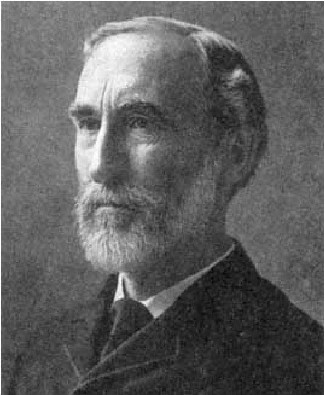
The final member of the cast of characters in this story is Josiah Willard Gibbs (left). He born in 1839 and received his doctorate from Yale University in 1863, gaining only the second PhD ever to be awarded in the USA.  After touring Europe for a while he returned to Yale in 1871 to become a professor, but he received no salary for the first nine years of this appointment. The university rules at that time only allowed salaries to be paid to staff in need of money; having independent means, Gibbs was apparently not entitled to a salary. Gibbs was a famously terrible teacher and few students could make any sense of his lectures (not a rare occurence amongst those trying to learn thermodynamics). His research papers are written in a very obscure style which makes it easy to believe he found it difficult to express himself in the lecture theatre. Gibbs actually founded the field of chemical thermodynamics, but few chemists understood his work while he was still alive. His great contribution to statistical mechanics was likewise poorly understood. It was only in the 1890s when his works were translated into German that his achievements became more widely recognised. Both Planck and Einstein held him in very high regard, but even they found his work difficult to understand. He died in 1903.

So there you are. The only one who didn’t have a beard was French and called Sadi. ’nuff said.

Vintage Bird

Posted in Jazz with tags , , , on July 14, 2009 by telescoper

I’ve gone  far too long without posting something by the great alto saxophonist Charlie Parker (“Bird”), undoubtedly one of the most influential musicians of the twentieth century. Together with trumpeter Dizzy Gillespie, Bird effectively created a  revolution in Jazz after the end of World War II in the form of a new style called bebop.

Like many Jazz legends, Charlie Parker died young as a result of chronic alcoholism and, especially in his case, drug addiction. He became hooked on heroin when he was a teenager and when he couldn’t get heroin he used anything else he could. The result was a body ravaged by abuse and a career frequently interrupted by illness. When he died, at the age of 35, the doctor who signed his death certificate estimated his age as “about 60”.

I remember, as a teenager,  finding a Charlie Parker LP  in a second-hand record shop and buying it for 50p. When I got home I put it straight on the record player and couldn’t believe my ears when I heard the staggering virtuosity of his playing. I just didn’t realise the alto sax could be played the way he played it. I’ve been a devout Charlie Parker fan ever since, although most of recorded output is quite difficult to get your hands on. In fact, the first record I bought as an LP has never been released on CD, which I think is a scandal.

Many people I know can’t really stand any Jazz that’s stylistically dated after about 1940. I have never really understood this attitude.  To my mind the two tracks I’ve picked here, recorded in 1948, sound as fresh and exciting to me now as they did when I first heard them 30 years ago. They also seem to me firmly rooted in a wonderful tradition of music-making that reaches back to Louis Armstrong and King Oliver and forward to the likes of John Coltrane, Eric Dolphy and Ornette Coleman. Anyway, I’m not going to preach. I love this music and it’s up to you whether you agree or not.

Parker’s ideas didn’t just remain within jazz, and bebop had a huge cultural influence on post-war America. It never became as popular as pre-war Jazz,  but had a devoted following on both sides of the Atlantic and breathed new creative life into a form that was in danger of becoming stale and commercialized.

The first piece  is called Ah Leu Cha and – as far as I’m aware – it is the only tune Bird ever wrote that involves any kind of counterpoint (provided by a very young Miles Davis on trumpet). The second track is a majestic solo blues called Parker’s Mood which demonstrates his deep understanding of and appreciation of the traditional 12-bar blues format.

The Great Escape

Posted in Cricket, Uncategorized with tags , , on July 12, 2009 by telescoper

Just a little postscript to my blog post about the cricket at Cardiff. After Australia ran away to 674-6 and had England at 20-2 last night before the rain came down after the tea interval, it looked odds-on for an Australian victory. That impression was strengthened by the feeble batting of  England’s leading batsmen this morning. The rain that had been forecast also failed to materialize, so  England were staring at defeat with the score at 70-5 at one stage.

This afternoon one England batsman, Paul Collingwood, did show some mettle and the tailenders who had played brightly on Day 2 demonstrated much greater resilience than their teammates had this morning. Nevertheless, when Collingwood was out later on, it still looked like Australia would win. Eventually it came down to the last pair, the bowlers Monty Panesar and James Anderson, to cling on, bat out time and attempt to salvage an unlikely draw from almost certain defeat. Monty in particular defended like his soul depended on it and together the two tail-enders saw England to safety. Great stuff.

I absolutely love it when things like this happen. There’s something very “Dad’s Army” about bowlers having to save the day with the bat. Backs to the wall and all that. I have to admit I was completely gripped by the drama of the last hour or so of play and so nervous I was shaking as I watched. One mistake and the match would be lost. Runs didn’t matter, just survival. Fielders all around the bat. The crowd applauding every delivery that was kept out. Only cricket can produce that stomach-churning intensity. At the end of the time allocated for play, England were 252-9, just 13 runs ahead. Australia just hadn’t managed to get that last one out. The defiant rearguard action had held off everything that was thrown at them. England may have needed two innings to reach the score that Australia obtained in one, but that doesn’t matter. Match drawn.

If you want to know how a game can go on for five days and still end in a draw, this is how. And bloody marvellous it is too!

England have their work cut out to improve enough to compete over the rest of the five-match series for the Ashes, but at least this escape has denied the Australians the massive psychological boost the expected  big victory would have given them. I know it’s a draw, but there’s no doubting which team will be happier tonight.

And I’m really happy that the First Ashes Test at Cardiff turned out to be such a memorable one!

Advanced Fellowships

Posted in Science Politics with tags , , , on July 11, 2009 by telescoper

This is just a quick Newsflash that UK Astronomers will be  interested in (and depressed by). My attention was drawn to it yesterday by Frazer Pearce of Nottingham.

The Science and Technology Facilities Council (STFC) has decided in its finite wisdom to cut in half the number of Advanced Fellowships (AFs) it awards each year, that is from 12 to 6, that number to cover all of Astronomy and Particle Physics.

These fellowships are awarded to researchers who do not have a permanent position but wish to pursue research, and are designed to further the careers of individuals with outstanding potential. They last 5 years – longer than the usual 2-3 year postdoctoral positions and have been for many a scientist an important stepping-stone to an academic career. A very large fraction of my colleagues who have permanent positions were awarded one of these fellowships when they were run by PPARC (including Frazer), as was I myself but, being an Oldie, mine was even pre-PPARC so was in fact given by SERC. Of course the fact that they gave me one doesn’t itself serve as much of a recommendation for continuing them, but it is worth drawing attention to the huge amount of  high quality research done in the UK by holders of these Fellowships.

A number of people have expressed to me their shock at this decision but it doesn’t surprise me at all. For one thing, it’s an open secret that STFC considers the academic community in these areas to be too large so the last thing it wants is more people getting permanent jobs through the AF route.  In any case, STFC’s prime concern is with facilities, not with scientific research.

Who needs half a dozen top class scientists when you can have Moonlite instead?

Ashes Ground

Posted in Cricket, Uncategorized with tags , , on July 11, 2009 by telescoper

Any of you who follow cricket will know that this is a very special time for the game and for the city of Cardiff. The First Test in the summer’s Ashes series against Australia is being played here. It’s the first time a test match has ever been played in Cardiff’s splendid ground at Sophia Gardens and to have an Ashes test as the inaugural fixture is a tremendous boost for the city. It’s actually a very good venue for Test cricket, being so close to the city centre and I hope this will be the first of many matches to be played here in Cardiff.

Owing to my general state of disorganization I didn’t manage to get a ticket when they first went on sale. Thinking I’d missed out I agreed to go and give a talk in Cambridge on the first day of the Test (Wednesday 8th July 2009). However,  a second load of tickets went on sale  a few weeks ago and I manage to get a couple for Thursday’s play (9th July). I was joined for the day by my regular contributor and old friend Anton.

The SWALEC stadium at Sophia Gardens, Cardiff (left) is actually just a short walk from my house in Pontcanna. The daily crowd of around 15,000 has caused a bit of congestion in the area but we got to our seats without any bother at all.


It’s actually quite a small ground, and our seats were right at the front of the Really Welsh Pavilion (which is the far side of the ground as seen in the picture), so we were close to where the players emerged onto the field. The outfield was extremely green with fairly lush grass on it and weather quite nice, with a mixture of broken cloud and sunshine.

England had won the toss and batted first on Wednesday, picking two spinners (Swann and Panesar), presumably in the belief that this was a slow wicket that would be increasingly helpful to the spinners as time wore on and the pitch began to break up a little. After some alarms and rash shots, and the unfortunate loss of two wickets right at the end of the day, England had batted their way to 336 for the loss of 7 wickets.

There having been no track record of Test cricket at Cardiff it was difficult to know whether this was a reasonable score or not. I had been away all day on Wednesday so hadn’t seen any of the play. By all accounts the pitch had played rather slow but was otherwise fairly good for batting. All England’s specialist batsmen were out so it wasn’t clear what kind of total they would reach with their remaining three wickets, but the tail wagged quite enjoyably and they added another 99 runs in the morning session until Swann ran out of partners and was left unbeaten on 47 with a little time to go before lunch.

So far, so good from an England point of view. However, from the point of view of their chances of winning the game it all started to go wrong as soon as the Ozzies went in to bat. The openers scored quite freely off the first few overs from England’s bowlers and went into lunch at 39-0.

For the rest  rest of the day, the England bowlers struggled to make any impression at all on the skilful and determined Australian batsmen. Flintoff accounted for the opener Hughes during a hostile spell of bowling in which he regularly exceed 90 mph and also dropped a very difficult caught-and-bowled chance. However, that only brought the Australian captain, Ricky Ponting, into bat which he did quite beautifully. He made no mistakes at all in his innings and played no rash shots, but by the end of play both he and Katich had reached centuries and Australia were 249-1.

Apart from Hughes’ wicket and Flintoff’s dropped return chance the only other time England were close to nabbing a wicket was a shout for LBW from Swann which was close but, I thought,  a bit high. Swann bowled very economically but without any real danger. Panesar was unimpressive, as where the other England seamers Broad and Anderson. It wasn’t that they bowled badly or were wayward, it just seemed that there was nothing in the pitch to help them and, of course, they were up against extremely good batting.

I wouldn’t say that this was the best day’s cricket I’ve ever seen – not by a long way – and I know that it’s a game that’s too slow for the taste of a lot of people anyway. There were, however, times – especially when Flintoff was bowling – where the atmosphere turned into something that you only get in cricket. As he pounded in over afer over with very few runs being scored and the batsmen defending stoutly, the action on the field became just the surface manifestation of a deep inner struggle between batsmen and bowler.  Who would win this battle of wills? The  stress could be felt all round the ground and one sensed that whoever came through that passage of play would have scored an important psychological victory. Undoubtedly the Australians came out of it stronger for having weathered everything England could throw at them. I find this kind of attritional cricket absolutely absorbing to watch, but I know many people who don’t get it.

Later on, after the match,  the England pace bowlers expressed their mystification that the ball simply wouldn’t swing. I was surprised too. I have no idea of the physics behind what makes a cricket ball swing but, empirically, it seems to correlate with the presence of cloud and humidity in the air. Both of these were present on Thursday but at no point did the ball curve, even for Anderson who is an accomplished swing bowler. This probably accounted for the ease with which the England tail had batted earlier in the morning.

Anyway, although I would definitely have preferred to see England skittle out the Australians, I did at least have the chance to watch a master batsman at work. I have to say I found it fascinating. Although there wasn’t a great deal of strokeplay – they didn’t really dominate the bowling – they ground their way to centuries in a very resolute fashion. There were very few boundaries scored, partly because of the very slow outfield.

Another reason I enjoyed the day was that our block of seats had its own resident comedian, a character called Chris who was found of shouting comments not only about the cricket but to anyone having the nerve to come into the stand during play.

Early on in the day this chap sitting behind us decided to amuse the crowd by shouting out clues from the Times crossword to see if anyone could get them. I got the first one straight away (the answer was METHODIST: IST was German for “is” and “Method” was clued by a reference to Stanislawski but I don’t remember the clue exactly).  Like a fool, shouted the answer back to him. I  became a target for him for the rest of the day’s play.

After several hours of his banter, I have to admit being a bit fed up with him but at least the crossword clues were fun.I don’t remember many of  them, but did get “Car held at murder location” (CATHEDRAL, i.e. anagram of car held at and reference to Murder in the Cathedral by TS Eliot) and “Rehabilitation of ailing animal” (NILGAI, anagram of ailing, is an Indian antelope). Eventually he came down, gave me the newspaper, and challenged me to finish the whole thing. I did so, and sent it back through the crowd, even getting a round of applause from them as I did so. I had become a minor celebrity providing a bit of distraction from Australia’s success. We may not have been doing well in the cricket, but at least I wasn’t letting the side down when it came to crosswords. Chris argued for a bit with some of my answers – he didn’t think TSETSE was a word, for example – but I think I convinced him I was right.

When play finished shortly after 6pm we left the ground to walk into town for something to eat. The path to the little bridge over the Taff was very crowded. Australian and England supporters mingled and, at one point, someone behind me shouted “Hey look, it’s Peter the crossword guy!”. Fame at last.

I didn’t have tickets for Friday but set out for work rather late. As I walked down Cathedral Road, crowds were turning up for Day 3. I nearly died when someone across the road shouted “Peter! Done the crossword yet?” I was quite impressed to be remembered, but hope my new found celebrity status disappears as quickly as it arose.

POSTSCRIPT: Australia batted throughout Day 3 to pass England’s total of 435 all out and had reached 479-5 despite losing some time to rain. The forecast for today (Saturday) was for rain, but it has so far refused to materialize and the Ozzies have powered on to 577-5 at lunch. It’s now a game that England can’t win. It is very overcast and still looks like some time will be lost to rain, so a draw is the likeliest result as long as England don’t fold pathetically in their second innings. Not that they haven’t done that before…