Author Archive

Days of Wine and Roses

Posted in Jazz, Poetry with tags , , , on June 15, 2009 by telescoper

Today I finished all my exam marking, and decided to celebrate by drinking a glass or two of wine while I sat in my garden. The lovely roses that have recently been in bloom are already starting to fade and drop their petals. For obvious reasons, this reminded me of this little poem by Ernest Dowson.

The title is Vitae Summa Brevis Spem Nos Vetat Incohare Longam, which I translate from my half-remembered schoolboy Latin as something like “the brief span of Life forbids us from conceiving an enduring hope”. It’s a quotation from one of the Odes of Horace (Book I, Ode 4, line 15).

They are not long, the weeping and the laughter,
Love and desire and hate:
I think they have no portion in us after
We pass the gate.

They are not long, the days of wine and roses:
Out of a misty dream
Our path emerges for a while, then closes
Within a dream.

The phrase “days of wine and roses” became the title of an excellent film dealing with the effects of alcoholism on family life, for which Henry Mancini wrote a song with the same title that went on to become a Jazz standard. Here is a lovely version played live by the great Bill Evans (who featured in another recent post of mine).

In the rather melancholy spirit of this post, I’ll add that Bill Evans died in 1980 just about a month after this performance.

Telescope Wars

Posted in Science Politics, The Universe and Stuff with tags , , , on June 13, 2009 by telescoper

Over the last few months the Science and Technology Facilities Council has been setting up a review of its ground-based astronomy programme. The panel conducting the review has produced a consultation document, and is asking for input via an online questionnaire. There will also be a (rather short) public meeting in London on July 9th. The consultation period closes on July 31st.

Reviews of this kind would be necessary in the best of times in order to establish long-term scientific priorities and try to align the provision of facilities with those strategic objectives. Unfortunately, we don’t live in the best of times so the backdrop to the current review is a shrinking pot of money available for “traditional” ground-based astronomy and the consequent need to target planned programmes for the chop.

Andy and Sarah have already blogged about this -and they both know a lot more than me about ground-based astronomy – so I won’t try to cover the same ground as them. I would however, like to make a  couple of points.

The review has to help STFC strike a balance between current facilities and projects for the future. The largest elements of the current ground-based programme include the subscription to ESO (including associated costs for ALMA, which amounts to over £200 Million), the twin 8m telescopes known as Gemini (North and South, about £60 Million), E-Merlin (about £24 Million), UKIRT and JCMT (about £34 Million); figures represent costs over the next 10 years or so. The two biggest projects that the UK would like to get involved in are a European Extremely Large Telescope (E-ELT), an optical telescope currently aimed to be about 42m in diameter, and the Square Kilometre Array, a futuristic radio telescope. Each of these would cost the UK over £100 Million over the next decade.

The consultation document puts it quite succintly:

It would be unrealistic to imagine that in 2020 the UK would have a large stake in large facilities like E-ELT and SKA, and would also retain all its current ground-based facilities. It is always hard to forego a workhorse facility that has supported an active and successful science programme, in order to start construction of some future facility many years hence. But our bid for the capital costs for E-ELT and/or SKA would not be credible if we do not show that we are willing to do this.


I agree that it maintaining the current programme as well as acquiring an interest in both E-ELT and SKA is completely implausible. The more relevant question though is how deep we have to cut the ongoing astronomy programme in order to afford either of these, or whether we can do that at all. It seems quite likely to me that future funding of the ground-based programme is likely to suffer drastically, both because of cuts to the overall STFC grant that appear inevitable in the next comprehensive spending review and also the current STFC leadership’s bias in favour of space technology at the expense of science. On the latter point, it is worth noting that it is specifically the ground-based astronomy programme that is being lined up against the wall here; space-based projects of negligible scientific value, such as Moonlite and BEPI-Columbo are not to going be weighed in the same balance. At the very least, future involvement in a next-generation X-ray telescope  should certainly have been in the mixer with other observatory-type facilities on the ground. I fear that the STFC Executive sees the current UK ground-based programme as significantly too large, and would like to squeeze it all into the box marked ESO. I would like to be able to sound more optimisitic, but I think that the most likely outcome of this review is therefore that the only current facilities that will survive into the medium term will be those provided through ESO  membership. JCMT and UKIRT are nearing the end of their useful life anyway, but the writing is definitely on the wall for both Gemini and E-Merlin. Not that it hasn’t been before now…

If this the way things go, then the remaining issue is whether we can afford to be involved in both E-ELT and  SKA, which seems to me to be most unlikely. If we have to pick one, which should it be? That is clearly going to be the topic of much debate. In the spirit of the drive for rationalisation I touched on above, it may well be that we don’t do anything at all outside the ESO umbrella. In that case the United Kingdom ends up with a ground-based astronomy programme consisting of the ESO facilities plus a share in the E-ELT (itself an ESO proposal). I think this would be a tragedy because  I find the scientific case for SKA much stronger than that for E-ELT; it would have been a closer call if the ELT were still the 100m optical telescope as originally proposed many years ago (and which I used to call the FLT). I’m sure many will disagree for legitimate scientific reasons (rather than the desire to play “mine’s bigger than yours” with the Americans, who are currently developing a 30m telescope).

I’m sure there will also be many astronomers who would rather have neither SKA nor E-ELT if it means losing access to the suite of smaller telescopes that continue to produce many interesting scientific results. If it came to a vote I’m not sure what the result would be, which is why I want to encourage anyone who has any input to fill in the questionnaire!

A final little wrinkle on this question is the following. Suppose STFC decides  not to support future involvement in SKA – I hope this isn’t the way things turn out, but in our dire financial circumstances it might be – does this make continued funding for E-Merlin more likely or less likely? Answers on a postcard (or even via the comments box)..

In the Dark

Posted in Jazz with tags , , on June 13, 2009 by telescoper

A while ago I posted an item about Bix Beiderbecke during which I mentioned that, as well as being a star trumpeter,  he had also written a suite of four pieces for solo piano. I just found out that about a month ago somebody posted this lovely version of one of them on Youtube. It’s called – you guessed it – In the Dark.

This version is by Dick Hyman, and I think it’s lovely. This is my official theme tune from now on!

Potato Head Blues

Posted in Biographical, Jazz with tags , , on June 12, 2009 by telescoper

I’ve just spent several hours ploughing through yet more examination scripts – first year ones, not needed before the finals Examination Board. By way of a bit of refreshment I thought I’d listen to this, and enjoyed it so much I thought I’d share it on here.

At one point in the film Manhattan, the character played by Woody Allen makes a list of the things that make life worth living. This record is one of them. Potato Head Blues was recorded on May 10th 1927 in the Okeh Studios in Chicago by Louis Armstrong and the Hot Seven. It’s not actually a blues, but we won’t quibble about that because whatever it is not it is definitely a timeless Jazz masterpiece.

The other members of the band are Johnny Dodds (clarinet, heard to good effect in the solo before Louis Armstrong), Johnny’s brother Warren “Baby” Dodds (drums), Louis Armstrong’s first wife Lil Armstrong (née Hardin, piano), Johnny St Cyr (banjo), Pete Briggs (brass bass or tuba) and John Thomas on trombone. But the star of the performance is, of course, Satchmo himself, who was at the absolute peak of his powers when this record was made. If you have any doubts about what a musical genius he was, go straight to the point (at about 1:50) where he launches into his famous stop-time solo chorus which is just breathtaking in its power and inventiveness. Built from a succession of dazzling impromptu phrases, it explodes into a joyous climax which is beautifully sustained into the final ensemble chorus that follows.  Enjoy!

Examination Matters

Posted in Biographical, Education with tags , , on June 10, 2009 by telescoper

I made it safely back to Blighty last night and have spent the day catching up on a few things. I wasn’t really planning to post anything today, but after looking through the comments on my previous item I thought it was probably a good idea to move on!

My trip to Copenhagen was carefully timed to miss the mammoth examiners’ meeting that took place yesterday in the Cardiff School of Physics & Astronomy, at which decisions were made about the degree classes of the graduating students. Final results have to be confirmed by the University but, following a longstanding tradition, provisional pass lists went up on the boards immediately after the meeting.

When I came in this morning I was delighted to hear that the meeting went off fairly smoothly and also delighted to see the pass lists had very good news for many of the students I know quite well personally. Particular congratulations to all the students who got First Class Honours, some of whom will be taking another step on the academic treadmill and going on to do PhDs here and there. I’m not really sorry I missed the examiners’ meeting, but I am sorry I wasn’t here to congratulate the soon-to-be-graduates in person.

I remember that when I finished my degree and got the result I didn’t actually feel much euphoria, only exhaustion. When I was younger, exams were always times of enormous stress for me. I guess that’s because, when I first went to School, I was very far behind everyone else and, as one of the “slow” kids, I was almost thrown in the educational wastebin. I gradually caught up but for a long time felt that I was still regarded as a bit of a dunderhead so, to prove I wasn’t a fake,  to myself as much as anyone else, I worked very hard at all the examinations I had to take. It was only when I got to University that I realised all the stress wasn’t worth it. It’s nice to pass but you shouldn’t become obsessed with grades and certificates. Examinations seem to have an almost overwhelming significance when they’re the only thing on your horizon, but years later you will look back on them as being of very little real importance (regardless of whether you did well or not).

My feelings about examinations agree pretty much with William Wordsworth, who studied at the same University as me, as expressed in this quotation from The Prelude:

Of College labours, of the Lecturer’s room
All studded round, as thick as chairs could stand,
With loyal students, faithful to their books,
Half-and-half idlers, hardy recusants,
And honest dunces–of important days,
Examinations, when the man was weighed
As in a balance! of excessive hopes,
Tremblings withal and commendable fears,
Small jealousies, and triumphs good or bad–
Let others that know more speak as they know.
Such glory was but little sought by me,
And little won.

It seems to me a great a pity that our system of education – both at School and University – places such a great emphasis on examination and assessment, to the detriment of real learning. The biggest bane of physics education is the way modular degrees have been implemented. Don’t get me wrong. I’m not opposed to modularisation in principle. I just think the way we teach modules in British university fails to develop any understanding of the interconnection between different aspects of the subject. That’s an educational disaster because what is most exciting and compelling about physics is its essential unity. Splitting it into little boxes, taught on their own with no relationship to the other boxes, provides us with no scope to nurture the kind of lateral thinking that is key to the way physicists attempt to solve problems. The small size of each module makes the syllabus very “bitty” and fragmented. No sooner have you started to explore something at a proper level than the module is over. More advanced modules, following perhaps the following year, have to recap a large fraction of the earlier modules so there isn’t time to go as deep as one would like even over the whole curriculum.

Our students take 120 “credits” in a year, split into two semesters. These are usually split into 10-credit modules with an examination at the end of each semester. Laboratories and other continuously-assessed work does not involve a written examination, but the system means that a typical  student will have 5 written examination papers in January and another 5 in May. Each paper is two hours.

These factors mean that the ratio of assessment to education has risen sharply over the last decades with the undeniable result that academic standards have fallen in physics. The system encourages students to think of modules as little bit-sized bits of education to be consumed and then forgotten. Instead of learning to rely on their brains to solve problems, students tend to approach learning by memorising chunks of their notes and regurgitating them in the exam. I find it very sad when students ask me what derivations they should memorize to prepare for examinations. A brain is much more than a memory device. What we should be doing is giving students the confidence to think for themselves.

You can contrast this diet of examinations with the regime when I was an undergraduate. My entire degree result was based on six three-hour written examinations taken at the end of my final year, rather than something like 30 examinations taken over 3 years. Moreover, my finals were all in a three-day period. Morning and afternoon exams for three consecutive days is an ordeal I wouldn’t wish on anyone so I’m not saying the old days were better, but I do think we’ve gone far too far to the opposite extreme. The one good thing about the system I went through was that there was no possibility of passing examinations on memory alone. Since they were so close together there was no way of mugging up anything in between them. I only got through  by figuring things out in the exam room.

I don’t want to denigrate the success of our high achievers. They have taken the course we have given them and done extremely well. They deserve admiration and praise. What I’m saying is that I don’t think the education we provide does justice to their talents. That’s our fault, not theirs…

Notes from the North

Posted in Biographical, The Universe and Stuff with tags , , on June 8, 2009 by telescoper

Just time for a quick post today. I’m in Copenhagen for a short meeting entitled “Cosmology and Astroparticle Physics from the LHC to Planck“. The meeting only lasts today and tomorrow morning, but it’s been a lot of fun so far and has offered me the chance to chat with a lot of people I don’t often get the chance to talk to.

I suppose the only thing from the meeting I really want to mention in this short post is the  current status of Planck, which is currently about a million km from Earth. Both instruments (the High Frequency Instrument HFI and Low Frequency Instrument LFI) are still performing fine and the satellite,  having now been injected into its rather large orbit around L2, is  cooling down to its operating temperature. So far so good. There will be more tests at the beginning of July, after which it will start its real business of scanning the sky to make maps of the primordial temperature  fluctuations.

Today I gave my (usual) talk about cosmic anomalies (which I’ve blogged about before), but there were also interesting talks about possible interpretation of the positron excess observed in the direction of the Galactic Centre,  on a model of anisotropic dark energy  and a wacky contribution by Igor Novikov about semi-traversible wormholes.

Meanwhile, over lunch and dinner the various European participants of the meeting mulled over the results from the elections to the European parliament which completed yesterday.

The results generally showed a move to the right across Europe. In the United Kingdom this also happened, as the Labour Party’s share of the vote collapsed to just under 16%. I’m not going to shed any tears for them, but I am shamed to admit that my country will now be represented in the European Parliament by two members of the British National Party – a bunch of neo-Nazi thugs who are doing the best they can for their own ends to exploit peoples’ discontent with the mainstream parties. Fortunately their share of the vote (about 6%, on a very low turnout) remained relatively small and was, in fact, less than that of the Green Party. Nevertheless with the 65th anniversary of D-Day only a few days ago, it is depressing that so many people have forgotten the sacrifices that previous generations made to save this country from exactly that  kind of fascist. I hope this disaster is not repeated at the next general election. This kind of monstrosity makes the arcane world of cosmology suddenly seem so irrelevant.

Returning to Lognormality

Posted in Biographical, Science Politics, The Universe and Stuff with tags , , , on June 7, 2009 by telescoper

I’m off later today for a short trip to Copenhagen, a place I always enjoy visiting. I particularly remember a very nice time I had there back in 1990 when I was invited by Bernard Jones, who used to work at the Niels Bohr Institute.  I stayed there several weeks over the May/June period which is the best time of year  for Denmark; it’s sufficiently far North that the summer days are very long, and when it’s light until almost midnight it’s very tempting to spend a lot of time out late at night.

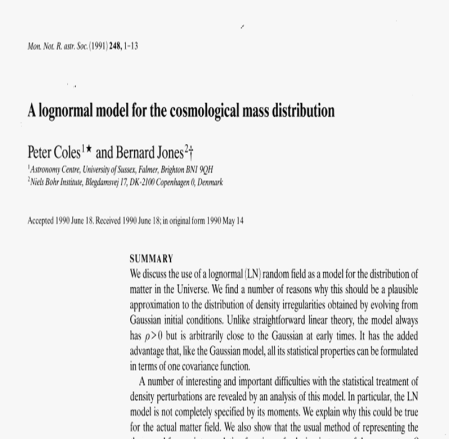
As well as being great fun, that little visit also produced my most-cited paper. I’ve never been very good at grabbing citations – I’m more likely to fall off bandwagons rather than jump onto them – but this little paper seems to keep getting citations. It hasn’t got that many by the standards of some papers, but it’s carried on being referred to for almost twenty years, which I’m quite proud of; you can see the citations per year statistics are fairly flat. The model we proposed turned out to be extremely useful in a range of situations, hence the long half-life.

nph-ref_history

I don’t think this is my best paper, but it’s definitely the one I had most fun working on. I remember we had the idea of doing something with lognormal distributions over coffee one day,  and just a few weeks later the paper was  finished. In some ways it’s the most simple-minded paper I’ve ever written – and that’s up against some pretty stiff competition – but there you go.

Picture1

The lognormal seemed an interesting idea to explore because it applies to non-linear processes in much the same way as the normal distribution does to linear ones. What I mean is that if you have a quantity Y which is the sum of n independent effects, Y=X1+X2+…+Xn, then the distribution of Y tends to be normal by virtue of the Central Limit Theorem regardless of what the distribution of the Xi is  If, however, the process is multiplicative so  Y=X1×X2×…×Xn then since log Y = log X1 + log X2 + …+log Xn then the Central Limit Theorem tends to make log Y normal, which is what the lognormal distribution means.

The lognormal is a good distribution for things produced by multiplicative processes, such as hierarchical fragmentation or coagulation processes: the distribution of sizes of the pebbles on Brighton beach  is quite a good example. It also crops up quite often in the theory of turbulence.

I;ll mention one other thing  about this distribution, just because it’s fun. The lognormal distribution is an example of a distribution that’s not completely determined by knowledge of its moments. Most people assume that if you know all the moments of a distribution then that has to specify the distribution uniquely, but it ain’t necessarily so.

If you’re wondering why I mentioned citations, it’s because it looks like they’re going to play a big part in the Research Excellence Framework, yet another new bureaucratical exercise to attempt to measure the quality of research done in UK universities. Unfortunately, using citations isn’t straightforward. Different disciplines have hugely different citation rates, for one thing. Should one count self-citations?. Also how do you aportion citations to multi-author papers? Suppose a paper with a thousand citations has 25 authors. Does each of them get the thousand citations, or should each get 1000/25? Or, put it another way, how does a single-author paper with 100 citations compare to a 50 author paper with 101?

Or perhaps the REF should use the logarithm of the number of citations instead?

Lulu

Posted in Biographical, Opera with tags , , , on June 6, 2009 by telescoper

On Thursday (4th June) I went to the first night of the Royal Opera’s new production of Lulu, an Opera by Alban Berg. I was planning to blog about this yesterday but after the Opera my birthday celebrations descended into drunken chaos and I ended up getting back very late to Cardiff yesterday; I had to catch up a number of things so I didn’t have time. After the performance and dinner in a nearby restaurant we sat out on Joao’s roofgarden in Notting Hill drinking until the sun started to come up. That part is a bit of blur, but judging by the scale of my hangover yesterday it must have been good. Anyway, I’ve now recovered enough write something about the Opera.

Before Thursday I hadn’t seen Lulu in a live performance, although I do have it on DVD so I knew a bit about it. Berg was a student of Arnold Schoenberg, but he developed his own take on the twelve-tone techniques developed by his mentor. Not everyone finds  serialist music easy to enjoy, but I think if you’re going to have a go at it this Opera is one of the best places to start. I think the score for Lulu is completely wonderful: it’s constantly changing texture, sometimes lushly romantic (with a big  nod in the direction of Mahler in Act I), sometimes bleak and jagged. Sometimes there is no music at all and the singers use a stylised method of vocalisation in between speaking and singing (called Sprechstimme). This  is used only sparingly in Lulu, but it is wonderfully effective dramatically when it is.

The Orchestra of the Royal Opera House, conducted by Antonio Pappano, were absolutely fantastic throughout the performance. I’m no musician but I reckon this music must be extremely difficult to play, especially in the brass section, but they played with great passion as well as flawless precision. They really brought Berg’s music to life, and invested it with a vitality that positively glowed throughout the performance. With playing like this, it was easy to understand why Berg is such an influential composer: you can hear in this Opera the ideas behind many Hollywood movie scores, for example.

So what about the Opera itself? The play revolves around the character of Lulu, an enigmatic figure who is at times innocent and vulnerable and at others cynical and manipulative. Her personality is only revealed to us through her interactions with men, all of which end in disaster. Lulu’s first husband has a heart attack and dies; her second commits suicide. She then shoots another man and is imprisoned but eventually escapes. By the end of the opera, many years later on, she has wound up in London and is living in poverty working as a prostitute. She dies at the hands of Jack the Ripper.

The structure of the Opera is like a mirror, with Lulu’s reversal of fortunes happening after an intermezzo in the middle of Act 2, at the centre of which there is a remarkable musical palindrome (shown above). Before this her role in the drama is to drive the men around her into obsession, madness and death, although she never appears to understand why she has this effect on them. After the dramatic fulcrum of the piece she becomes more and more of a victim. The reason for this is not some great change in her own psychological make-up but just that she is getting older and  losing her looks. No longer sexually desirable, she has lost the only way of controlling the men in her life. From this point on, her decline is inexorable and death inevitable.

The new production is quite unlike the recording I have on DVD in that the staging is resolutely minimal. There is no set, just an occasional translucent screen, the costumes are modern and colours are monochrome. Lulu is dressed at one point  in a black cocktail dress very like that worn by Audrey Hepburn in Breakfast at Tiffany’s. This might have been a deliberate reference to the parallels between Lulu and Holly Golightly (at least in Truman Capote’s novella, which is a much darker concoction than the film based on it); soprano Agneta Eichenholz bears more than a passing resemblance to Audrey Hepburn too. Her slender build -unusual for an opera singer with such a powerful voice – allowed her to play Lulu’s vulnerable aspects very well.

Against a sparse backdrop  the characters emerge as series of grotesques, which – at least in principle – is not a bad way of  presenting this Opera. Set in such a way it appears as a piece of absurdist theatre which is definitely part of what it represents. There are two problems, however.

One is that the sets give very little clue as to the location of the drama: I wouldn’t have known that the last scene was meant to be Victorian London unless I’d seen it before, so Jack the Ripper’s appearance must have been very  confusing to those who hadn’t picked up on that. Lulu is also meant to be a lot older in the last Act, but no attempt is made to age her in this production.  The libretto makes repeated reference to a painting of her, and it serves at the end to remind her of her age, but no portrait ever appears; I found that a bizarre omission.

The other problem is that there are strong links between the story of Lulu and the Grand Guignol  genre of horror plays, with their  opulently macabre  stagings and exaggeratedly gory endings. Throwing all those connections  away robs the Opera of all of its schlock value and, with that, a great deal of the irony needed to make this blackest of black comedies work the way it should. The killing of Lulu in fact happens off stage in this production which makes the ending very tame. I wouldn’t want to go over-the-top in depicting the horror of Lulu’s death – I wanted to see an Opera, not a snuff movie – but the audience should be shocked by the brutality of her final moments; these are the key to what the Opera is about. Perhaps the director was concerned not to let the drama descend into mere titillation. There’s always a danger of crossing the line into vulgar pornography in depicting explicit sexuality and violence, but I think this production is too afraid of taking risks. This opera should feel more dangerous than this setting allows it to be. Ypu’re not meant to feel comfortable about this Opera.

Although limited by the stylized nature of the production, the principals were good. Agneta Eichenholz’s is a  desensitized creature, damaged by abuse and inhabiting a moral vacuum. Her detachment in the face of the death and destruction around her is perfectly judged. She sang beautifully for the most part but – possibly because of first night nerves – her voice came apart on a couple of high notes early on. Other characters worth mentioning are Michael Volle who was outstanding as Dr Schön and Philip Langridge in the dual role of the Prince and the Marquis.

This morning I read Andrew Clements’ review in the Guardian which I thought was a bit harsh: only two stars doesn’t really do justice to a fascinating evening. I would have  given three stars for the quality of the music alone. Personally, I could have listened to the whole thing in a concert performance and still enjoyed it. But having decided to go for a full staging,  it seems to me a bit perverse to have stripped  it down so drastically. Clements claimed he was “bored” by what happened on stage. I certainly wasn’t, but I did find myself more perplexed by the production than by the moral ambivalence of the story itself, so I’d have to say it didn’t really do justice to an Opera which I still think of as masterpiece.

Day of Days

Posted in Biographical with tags , on June 4, 2009 by telescoper

Well, here we are then.

Another birthday.

Actually, this one has been great (so far) and I’m looking forward to the rest of the day. Although it coulded over yesterday evening leading me to think our sunny spell was over, today I awoke to bright sunshine again and it’s stayed the same all morning. The garden looks unkempt but is at least full of flowers and smells, and I had my breakfast outside again before toddling off down to the polling station in St Catharine’s Church Hall to cast my vote in the Elections for the European parliament.

We won’t get the results of that election until Sunday because different European countries are voting on different days and the results are only announced when all polls are closed. I’ll be in Copenhagen on Sunday so will have to catch up on the news from there. Other parts of the United Kingdom are also voting for their local Councils too, and those results will be out tomorrow.

I’m not an expert political analyst but it seems to me these elections could go one of two ways: either the major political parties get a complete drubbing or the population is so disgusted with the political establishment that they don’t turn out at all. When I went to my polling station it was completely deserted apart from the two ladies keeping track of the ballot papers. On the basis of that observation, it could be that apathy will carry the day.

Incidentally, I’m very old-fashioned about voting. I don’t agree at all with the trend of encouraging on-line or postal voting. I think it’s part of one’s civic duty to cast a vote and that means getting off your arse and putting a cross on a bit of paper. It gives a sense of participation to vote in person and most excuses for not doing so just amount to  laziness. There are polling stations all over the place, they open from the early morning until late at night, and it only takes a minute or so to vote.  So get out there and do your bit.

Now I have time to do mark a few more examinations before having a shower and getting ready to get on the train to London. As a birthday treat, organized by Joao Magueijo, a bunch of us are off to the posh seats at Covent Garden to see the opening night of the Royal Opera‘s new production of Alban Berg‘s Lulu, which I’ll review when I get back tomorrow.

ps. A package arrived in the post on Tuesday from my Mum with my usual birthday gift. It turned out to be a raincoat – usually a useful thing for someone living in Wales – but on a sweltering day it seemed a bit comical. No doubt I’ll get a chance to wear it before too long…

Honey, Suck My Nose

Posted in Jazz with tags , on June 3, 2009 by telescoper

I got home this evening to find that the honeysuckle along one side of my garden had burst into flower and was filling the air with beautiful scents.  Unfortunately, it looks like our little heatwave is on the wane so I might not be able to sit outside in the balmy air enjoying the aromas for much longer. It’s nice they chose to open out today though; it was like a birthday present that arrived a day early.

I think Tennyson would have approved:

Come into the garden, Maud,
     For the black bat, night, has flown,
Come into the garden, Maud,
     I am here at the gate alone ;
And the woodbine spices are wafted abroad,
     And the musk of the rose is blown.
 

I already mentioned yesterday that I have beautiful roses in full bloom on the other side of the garden, so I just couldn’t resist posting a version of the Jazz standard Honeysuckle Rose. This one is by the great Errol Garner, who I posted about not long ago, and features one of his characteristically offbeat introductions followed by his usual delightful improvisation.