Archive for the Biographical Category

Memories of Clem Avery

Posted in Biographical, Jazz with tags on December 19, 2016 by telescoper

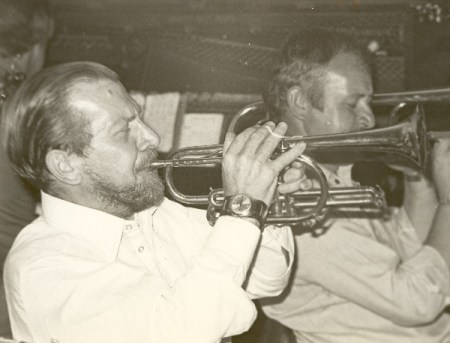
All the talk about trumpets last week reminded me of an old family friend by the name of Clem Avery. There’s a very nice tribute to Clem on a website run by guitarist Roly Veitch (whence I got the photographs).
clem1

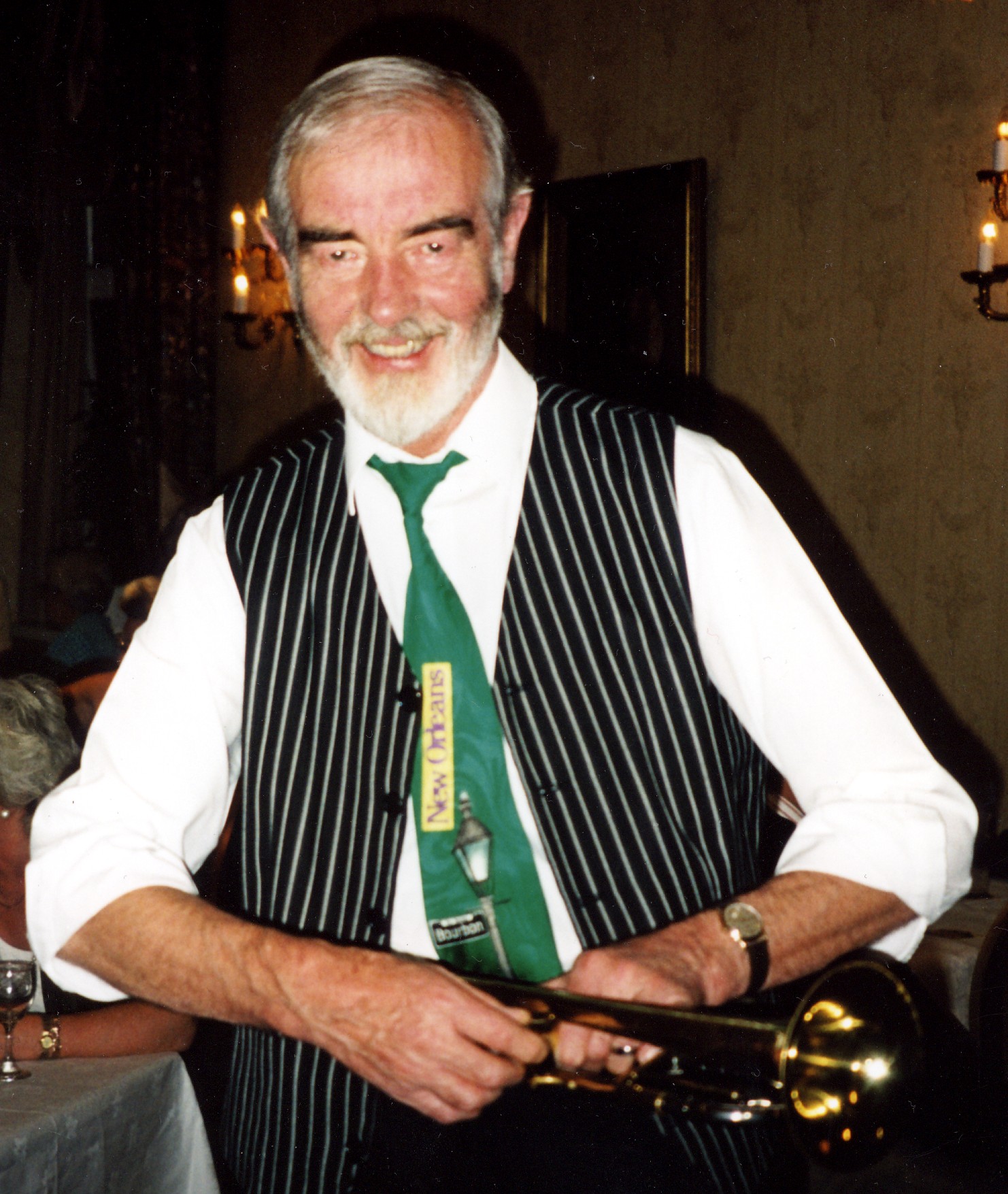
Clem Avery (1933-2008)

Clem, who passed away in November 2008, was a very close friend of my father  who died just a year earlier in 2007.  They had known each other since at least the early 60s and had played music together on many occasions (Clem on trumpet and, in later years, bass and my father on drums). That they remained good friends for such a long time is a bit surprising since at one point Clem actually sacked my Dad from his band for being too heavy-handed on the cymbals. Having heard my father play on a few occasions I think Clem probably had a point. But Clem wasn’t the sort of person you could really fall out with for long, and their friendship survived this musical falling-out.

We did try to get Clem to come to my Dad’s funeral but he couldn’t make it. I think it was because he was already suffering from the cancer that would eventually take him.

Roly’s web tribute mentions a long-term residency at the Golden Lion pub in Winlaton during the 70s and 80s in which my Dad (real name Alan) is mentioned under his nickname “Chas”. I heard the band play there on a couple of occasions and they were really good, the presence of Roly Veitch’s (electric) jazz guitar giving them a refreshingly different sound to many other traditional bands.  

I can’t add much to Roly’s piece other than to endorse what he wrote about Clem. Firstly that he was a very accomplished musician who had a far better technique than many much more famous trumpeters. His style was very firmly based on that of Bunk Johnson, though he appreciated good music of many other kinds. As well as playing the jazz that he loved, he also worked as a music teacher and, from time to time, as a session musician. I even saw him on The Tube once (the TV programme, not the London Underground)! When he played trumpet his eyebrows had a tendency to move up and down in coordination. When they were at maximum elevation he looked a lot like Stan Laurel (at least in younger years before he grew a beard). Here is an old picture that makes that comparison a bit easier to imagine:

clem51

What I remember most about Clem, however, was just that he was an extraordinarily nice man. He was tall and rather thin with a thoughtful disposition, a  wonderfully laid back attitude to life and a fine dry sense of humour. He was very knowledgeable about many things besides music too. I often sat talking with him in my Dad’s shop in Benwell (where Clem worked on a part-time basis for a while). History (especially local history) was a speciality of his and he was never short of stories to tell.

A New Head for the Old School

Posted in Biographical, Education with tags , , on December 13, 2016 by telescoper

Just a brief post to pass on the news (which I just heard this morning) that the University of Sussex has now formally announced that Professor Philip Harris will be taking over as Head of the School of Mathematical and Physical Sciences at the University of Sussex, the position I held until this summer.

I worked a lot with Philip during the time I was at Sussex as he was Head of the Department of Physics & Astronomy for part of that period. I’m sure he’ll do a great job and I wish him – and indeed the whole School – all the very best for the future!

Incidentally, the news item announcing Philip’s appointment contains the following snippet:

Both departments are ranked first in the UK for graduate prospects in the Times and Sunday Times University Guide 2017 (Destinations of Leavers from Higher Education Survey, 2015-16), with 100% of Mathematics BSc students being in work or further study within six months.

I wasn’t aware of this interesting news before today, and I’m sure it will provide a boost to the School’s efforts in the currently rather challenging student recruitment market. Of course Philip Harris can now take credit for anything good that happens to the School, whereas if anything goes wrong he can always blame it on the old Head of School!


Nobel Prize Memories

Posted in Biographical with tags , , on December 10, 2016 by telescoper

Ye Olde Facebooke has reminded me that  on 10th December 2006, ie exactly ten years ago today, I was in the lovely city of Stockholm for that year’s Nobel Prize celebrations.

I was bit taken aback when I got the invitation from the Nobel Foundation, partly because I didn’t expect to be invited in the first place and partly because there wasn’t and never has been a ‘Mrs Peter Coles’:

image

In the absence of an actual Mrs Coles I went with a colleague from the University of Nottingham, where I was working at the time.

As guests of the Nobel Foundation, we  attended the award ceremony but also the sumptuous banquet afterwards (both of which are traditionally held on a Sunday 10th December):

image

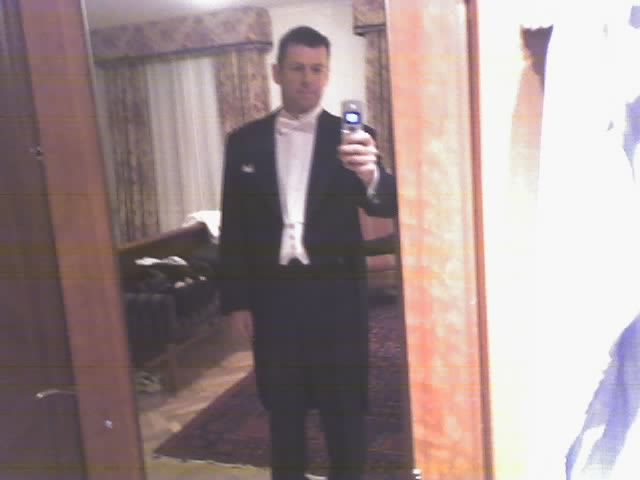
I found this old selfie taken as I was trying on the gear for the occasion in the room we were given in Stockholm’s very swanky Grand Hotel:
image

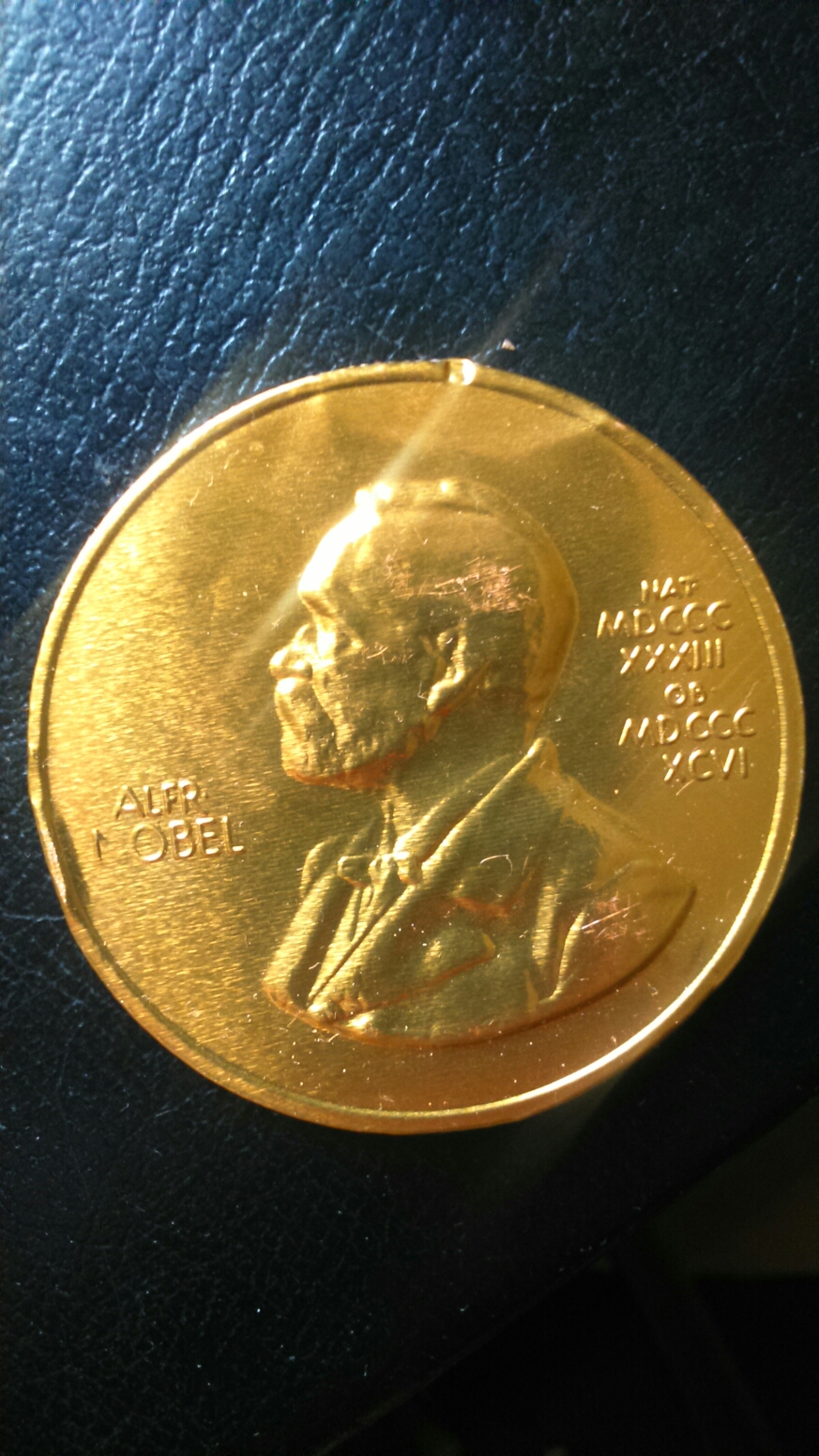
They even gave us each a Nobel Prize of our own, though only made of chocolate!
image

I’ve kept quite a lot of souvenirs from that weekend because I knew it would be a once-in-a-lifetime experience, but looking at them thus morning it just struck me what a lot has happened in the decade since. I had no inkling at the time of the Nobel celebrations that I would be moving to Cardiff the following summer (2007) nor that I would move to Sussex and back to Cardiff.

I wonder what the next ten years will bring?

1st Annual Robert Grosseteste Lecture in Astrophysics/Cosmology

Posted in Biographical, Books, Talks and Reviews on November 29, 2016 by telescoper

A few years ago I blogged about the fact that the University of Lincoln was setting up a new School of Mathematics and Physics. Well, now they’re up and running and they’ve invited me to give the first in a new series of annual public lectures!

Andrei Zvelindovsky's avatarMaths & Physics News

cosmic-web-sm

The Cosmic Web

a public lecture by

Professor Peter Coles

School of Physics and Astronomy, Cardiff University

Thursday 23 February 2017 at 6 pm

Stephen Langton Building (former EMMTEC) Lecture Theatre, Brayford Pool Campus, University of Lincoln

Eventbrite - Annual Robert Grosseteste Lecture in Astrophysics/Cosmology

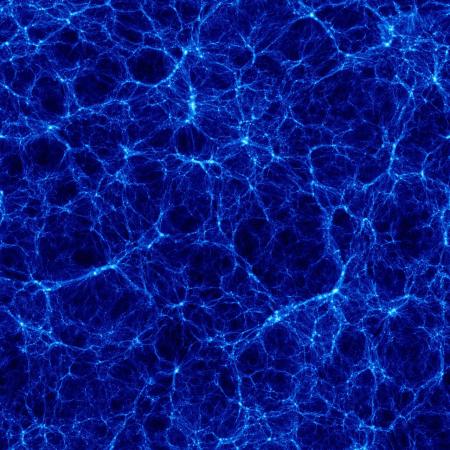
coles_2The lecture will focus on the large-scale structure of the Universe and the ideas that physicists are weaving together to explain how it came to be the way it is. Over the last few decades, astronomers have revealed that our cosmos is not only vast in scale – at least 14 billion light years in radius – but also exceedingly complex, with galaxies and clusters of galaxies linked together in immense chains and sheets, surrounding giant voids of (apparently) empty space. Cosmologists have developed theoretical explanations for its origin that involve such exotic concepts as ‘dark matter’, ‘dark energy’ and ‘cosmic inflation’, producing a cosmic web of ideas that is, in some ways, as…

View original post 7 more words

Changing Patterns of Work

Posted in Biographical, Mental Health with tags on November 28, 2016 by telescoper

I read an interesting piece in yesterday’s Observer about a number of people who have decided to switch careers, or at least change the pattern of their working life, relatively late in life. Unlike the cases described in the article, I haven’t had the nerve to try an entirely new kind of job – at least not yet! – but I did feel the article in question had some relevance to my own decision, made a few months ago, to resign from my previous post as Head of the School of Mathematical and Physical Sciences at the University of Sussex and move back to Cardiff.

I’m not going to go into all the reasons for stepping down, but one of them is I wanted to establish a better work-life balance. Fortunately, I never sold my little house in Cardiff and had also paid off the mortgage on that property some years ago, so returning to live there full-time was relatively straightforward and meant reducing my outgoings considerably.  I was therefore more than happy to accept the offer of a position here on a 50% salary. In other words, I am officially a part-time member of staff. I’m planning to use the other 50% to pursue some other interests, such as writing a couple of books and running the Open Journal of Astrophysics, but generally just taking more time off the treadmill of academic life.

Another thing I ought to mention is that my current position is fixed-term, for three years only. The earliest I’ll be able to retire is when I am  55, which is still a couple of years away. Whether I do go then depends on a number of things, including how difficult the University funding environment becomes as a result of loss of EU income and the proposed large reduction in numbers of overseas students.  If things become really tight I think it’s important for people of my age to make way so that the younger generation have a better chance. Perhaps I won’t retire at that time anyway. Perhaps I’ll follow the example of the folk in the Observer piece and start a new career as something completely different!

Having said that I’m a part-time member of staff, I have to also admit that I’m finding it quite difficult actually working part-time. This is largely because the University’s calendar of business continues at a full-time rate. Some of the jobs I’ve been asked to do in my new role – specifically designing a couple of  new postgraduate courses – had to be completed quite soon after I arrived, something I had not realized when I accepted the position here! However, now that those deadlines have been met I can hopefully settle down to a regular pattern of work, involving a bit of teaching and research in the School of Physics & Astronomy and helping get the Data Innovation Research Institute off the ground. When things have settled into a steady state I think I’ll start filling in time sheets – not for anyone else’s use, but for my own records. I can manage comfortably on a part-time salary, but I draw the line at unpaid overtime.

On the other hand, it’s always difficult to draw the line when you’re an academic. We’re basically paid to think and most of us don’t stop doing that even during our time off..

R.I.P. John M Stewart (1943-2016)

Posted in Biographical, Education, The Universe and Stuff with tags , , , on November 23, 2016 by telescoper

john-stewartI was very sad this morning to hear of the death of distinguished mathematical physicist Dr John M. Stewart (left). Apart from a few years in Munich in the 1970s John Stewart spent most of his working life in Cambridge, having studied there as an undergraduate and postgraduate and then returning from his spell at the Max Planck Institute to the Department of Applied Mathematics and Theoretical Physics for forty years.

John’s research mostly concerned relativistic fluid dynamics. Indeed, he was one of the pioneers of numerical relativity in the United Kingdom, and he applied his knowledge to a number of problems in early Universe cosmology and structure formation. I think it is fair to say that he wasn’t the most prolific researcher in terms of publications, which is perhaps why he only got promoted to Senior Lecturer in 2000 and never made it to a Chair, retiring as Reader in Gravitational Physics in 2010. However, his work was always of a very high technical standard and presented with great clarity and he was held in a very high regard by those who knew him and worked with him.

The tributes paid to John Stewart by King’s College (of which he was a Life Fellow) here and his colleagues in the Centre for Theoretical Cosmology here give a detailed account of his research achievements, so I refer you to them for more information about that aspect of his career.

I just wanted to add a personal note not about John Stewart’s research, but about something else mentioned in the obituaries linked to above: his teaching. I was fortunate enough to have him as a lecturer when I was studying Natural Sciences at Cambridge during the early 1980s. In the second year (Part IB) I specialised in Physics and Mathematics, and John taught part of the Mathematics syllabus. He was an absolutely superb teacher. For a start he was superbly well organized and had clearly thought very deeply about how best to present some quite difficult material. But it wasn’t just that. He projected a very engaging personality, with nice touches of humour, that made him easy to listen. His lectures were also very well paced for taking notes. In fact he was one of the few lecturers I had whose material I didn’t have to transcribe into a neat form from rough notes.

I have kept all the notes from that course for over thirty years. Here are a couple of pages as an example:

wp-1479909754508.jpeg

Anyone who has ever seen my handwriting will know that this is about as neat as I ever get!

When I was called upon to teach similar material at Cardiff and Sussex I drew on them heavily, so anyone who has learned anything from me about complex analysis, contour integration, Green’s functions and a host of other things actually owes a huge debt to John Stewart. Anything they didn’t understand was of course my fault, not his..

I also remember that John came to Queen Mary to give a seminar when I worked there in the early 90s as a postdoc. I was still a bit in awe of him because of my experience of him in Cambridge. His talk was about a method for handling the evolution of cosmological matter perturbations based on an approach based on the Hamilton-Jacobi formalism. His visit was timely, as I’d been struggling to understand the papers that had been coming out at the time on this topic. In the bar after his talk I plucked up the courage to explain to him what it was that I was struggling to understand. He saw immediately where I was going wrong and put me right on my misconceptions straight away, plucking a simple illustrative example apparently out of thin air. I was deeply impressed, not only by his ability to identify the issue but also with his friendly and helpful demeanour.

Rest in Peace, Dr John M. Stewart (1943-2016).

Magnets, Data Science and the Intelligent Pig

Posted in Biographical, The Universe and Stuff with tags , , , , , on November 18, 2016 by telescoper

The other day I was talking to some colleagues in the pub (as one does). At one point the subject of conversation turned to the pressure we academics are under these days to collaborate more with the world of industry and commerce. That’s one of the things that the Cardiff University Data Innovation Research Institute – which currently pays half my wages  – is supposed to do, but there was general consternation when I mentioned that I have in the past spent quite a long time working in industry. I am, after all, Professor of Theoretical Astrophysics. Of what possible interest could that be to industry?

My time in industry was spent at one of the research stations of British Gas, called the On-Line Inspection Centre (“OLIC”) which was situated in Cramlington, Northumberland. I started work there in 1981, just after I’d finished my A-levels and the Cambridge Entrance Examination and I worked there for about 9 months, before leaving to start my undergraduate course in 1982. At that time British Gas was still state-owned, and one of the consequences of that was that I had to sign the Official Secrets Act when I joined the staff. Among other things that forbade me from making “unauthorized disclosures” of what I was working on for thirty years. I feel comfortable discussing that work now, partly because the thirty years passed some time ago and partly because OLIC no longer exists. I’m not sure exactly what happened to it, but I presume it got flogged off on the cheap when British Gas was privatized during the Thatcher regime.

The main activity of the On-Line Inspection Centre was developing and exploiting techniques for inspecting gas pipelines for various forms of faults. The UK’s gas transmission network comprises thousands of kilometres of pipelines, made from steel in sections joined together by seam welds. I always thought of it as like a road network: the motorways which were made of 36″ diameter pipes; the A-roads were of smaller, 24″, diameter; and the minor roads were generally made of 12″ pipes. It’s interesting that despite the many failings of my memory now that I’ve reached middle age, I can still remember the names of some of the routes: “Huddersfield to Hopton Top” and “Seabank to Frampton Cotterell” spring immediately to mind.

Anyway, as part of the Mathematics Group at OLIC my job was to work on algorithms to analyse data from various magnetic inspection vehicles. These vehicles – known as “pigs” – were of different sizes to fit snugly  in the various pipes. The term “pig” had originally been applied to simple devices used to clean the gunk from inside of a pipe. They were just put in one end of the line and  gas pressure would push them all the way to the other end, often tens of kilometres away. The pipeline could thus be cleaned without taking it out of service.

This basic idea was modified to produce the much more sophisticated “intelligent pig” which produced the data I worked on. You can read much more about this here. This looked very similar to the cleaning pig, but had a complicated assembly of magnets and sensors, shown schematically here:

pig

The two sets  of magnets are connected to the pipe wall by steel brushes to maintain good contact. The magnetic field applied by the front set of magnets is contained within the pipe wall forms a kind of circuit with the rear set as shown, unless there is a variation in the thickness of the material. In that case magnetic flux leaks out and is detected by the sensors. The magnets and sensors are deployed in rings to cover the whole circumference of the pipe. A 24″ diameter pig would have 240 sensors, each recorded as a separate channel on the vehicle.

The actual system is fairly complicated so some of the work was experimental. Sections of pipe were made with defects of various sizes machined into them. The pig would then be pulled through these sections and the signals studied to build up an understanding of how the magnetic field would respond in different situations.

The actual pig (which could be several metres long and weighing a couple of tonnes) looks like this:

pig2

I always thought they looked a bit like spacecraft.

The pig usually travels at something like walking pace along the pipeline, and the sampling rate of the sensors was such that a reading would be taken every few millimetres. That sampling rate was necessary because corrosion pits as small as 1cm across could be dangerous.  The larger vehicles had “on-board thresholding” so that recordings of quiescent sections were discarded. Even so pipe surfaces (especially those of smaller bore) could be uneven for various reasons to do with their production rather than the effects of corrosion. Moreover, every few metres there would be a circumferential seam weld where two sections of pipe were joined together; these features would produce a large signal on all channels which the thresholding algorithm did not suppress.  The net result was that a lot of data had to be stored on the vehicle. When I say “a lot”, I mean for that time. A full run might produce about 5 × 107 readings. That seems like nothing now, but it was “Big Data” in those days!

So how was all this data processed back at the station? You probably won’t believe this, but it was printed out on Versatec printers in the form of a chart recording for each channel. Operators then identified funny-looking signals by eye and we then pulled down the data from tape and had a further look, usually comparing the patterns visually with those obtained from “pull-through” experiments.

Among the things I worked on was an algorithm to recognize seam weld signals automatically. That was quite easy actually – because it just requires looking for simultaneous activity on all channels – although it had to be made robust enough to deal with the odd dead channel and other instrumental glitches. This algorithm proved to be useful because sometimes the on-board telemetry would go wrong and we had to locate the pig by counting the number of welds it had passed since the start of the run.

A far more difficult challenge was dealing with data from 12″ diameter pipe. These are manufactured in a way that’s completely different from that used to make pipes of larger diameter, which are made of rolled steel. The 12″ pipes were made from a solid plug of molten steel, the centre of which is bored out by a device that rotates as it goes along. The effect of this is that it imposes a peculiar form of variation on the pipe wall, in the form of a spirally modulated “noise”. Annoyingly, the pitch and amplitude of the spiral varied from one section of pipe to another. After many failed attempts, the group finally came up with an algorithm that used the weld detector as a starting point to establish the vehicle had entered a new section of pipe. It then used data from the start of each section to estimate the parameters of the spiral pattern for that section, and then applied a filter to remove it from the rest of the section. It wasn’t particularly elegant, but it certainly cleaned up the data massively and made it much easier to spot significant features.

You might ask why I’ve written at such length about this when it’s got nothing to do with my current research (or indeed, anything else I’ve done since I graduated from Cambridge in 1985). One reason is that, although I didn’t know it at the time, my time at OLIC was going to prepare me very well for when I started my PhD. That was the case because all the programming I did used VAX computers, which turned out to be the computers used by STARLINK.  When I started my life as a research student I was already fluent in the command language (DCL) as well as the database software DATATRIEVE, which was a great advantage. Another reason is that working in this environment I had to learn to make my code (which, incidentally, was all in Fortran-77) conform to various very strict standards. I didn’t like some of the things we were forced to do, but I was shouted at sufficiently often that I gave up and did what I was told. I have never been particularly good at doing that in general, but in the context of software it is a lesson I’m glad I learned. Above all, though, I think working outside academia gave me a different perspective on research.  As academics were are very lucky to be able- at least some of the time – to choose our own research problems, but I believe that in the long run it can be very for your intellectual development to do something completely different every now and then.

We’re currently discussing a scheme whereby Physics and Astrophysics research students can interrupt their PhD for up to 6 months to undertake a (paid) work placement outside academia. I suspect many graduate students will not be keen on this, as they’ll see it as a distraction from their PhD topic, but I think it has many potential advantages as I hope I’ve explained.


Why I’m wearing a poppy again

Posted in Biographical, History with tags , , on November 2, 2016 by telescoper

Once again we’re coming up to Remembrance Sunday, an occasion to remember those who have given their lives in conflicts past and present. This is always held on the second Sunday in November in the United Kingdom, which means that this year it is on 13th November, so that it is close to the date of anniversary of the armistice that formally ended the First World War, which happened on 11th November 1918. Another way to commemorate this  is the observance of two minutes’ silence at 11am on 11th November itself. I plan to do that, next Friday  (which is the 11th November). I’ve kept my calendar free at 11 am precisely for that purpose.

Then there  is the wearing of a poppy. The poppy appeal raises money for veterans and their families, but the wearing of these little red paper flowers is something that not everyone feels comfortable with. Some people think that to wear a poppy is to celebrate militarism or even Britain’s imperialist past. I don’t see it that way at all. In fact, if someone asked me to wear a badge to support Britain’s participation in the invasion of Iraq, I’d certainly refuse.

I wrote about my reaction to the horror and futility of war some time ago, so I’ll try not to repeat myself except to say that, to me, the poppy is not about celebrating war or military prowess or imperialism, it’s simply about remembering those who died. In fact, one of the main reasons the paraphernalia of  Remembrance Day observances (the Poppy, the Cenotaph, the Tomb of the Unknown Soldier, etc) were set up in the first place was to remind not just people but also governments of the devastation caused by World War One. That’s why the Remembrance Day ceremonial laying of wreaths takes place in Whitehall, right at the heart of government. The ritual  was specifically intended to be a warning to the politicians who had brought the conflict about not to allow it to happen again.

As a young lefty student I grappled with the implications of the poppy appeal. The Peace Pledge Union produces white poppies, as an overtly anti-war symbol of remembrance. For a time I wore a white poppy but, although I am against war, I don’t think a policy of non-violence would have helped much against Hitler’s Nazi regime and therefore can’t really call myself an out-and-out  pacifist. One year I wore both white and red poppies, but since then I’ve decided to stick with a red one.

Of course many in the Establishment would like the poppy to turn into a symbol of obedience, a kind of alternative national flag. Some people choose not to wear it precisely because it has that implication. The sight of some hypocritical warmongers wearing the poppy at the Cenotaph on these occasions sickens me, but their betrayal does not make me want to stop wearing it myself. Neither does the fact that so many seem to be so contemptuous of the great strides that have been made over the past decades to try to construct a Europe defined by peaceful cooperation rather than by narrow-minded nationalism and conflict. The parallels between Britain in 2016 and Germany in 1933 seem to me to be frighteningly real,  and I fear very much for the future if we carry on in the direction we seem to be taking. All I can say is that I’m glad I’m not young.

People have  a wide range of views about the poppy and its meaning. There is no “right” answer – every person’s attitude is shaped by a number of factors, not least by whether or not they have lost a loved one in any form of armed conflict.  Some of us wear wear a poppy, some don’t. It’s a matter of choice. The fact that we have a choice is important in itself. I would probably refuse to wear a poppy myself if someone tried to make it compulsory.

Some poppy sellers use the slogan  Wear Your Poppy With Pride, but the original meaning  is much better expressed by the original, Lest We Forget. I’m not sure I wear mine with pride at all, in fact. What I feel is really more like shame, at the wastefulness and stupidity of armed conflict. I count myself incredibly lucky that I have never had to live through anything like that, not only because I’ve had a relatively peaceful and comfortable life, but also because I have never been tested in the way previous generations were. I wear the poppy to acknowledge their bravery and to recognize my own good fortune.  When I stand for the two minutes silence I remember those all who fell fighting on all sides of all wars, and  fallen civilians too.

When the newsreader Jon Snow decided not to wear a poppy on TV, there were angry complaints. I’m sure he didn’t mean disrespect to the cause but disliked the pressure being put on him to conform. I can see his point. It has to be voluntary if it is to mean anything at all.  But in the end I agree with Euan Ferguson’s piece in the Observer a few years ago:

I don’t like pressure being put on people to conform. Orthodoxy and fear are always to be regretted and today’s society is over-condemnatory, swift to its manufactured outrage. But this change seems to have come from below, not been ordered by bullies: the daily reports of life and death in the forces, of the danger other 20-year-olds daily find themselves facing. And is the symbolism of the poppy being degraded as it is customised? No. You can’t do much to the fabulous simplicity of this symbol. And the poppy doesn’t preach: it’s not about “right” or “wrong” wars, but about brave dead soldiers. And the message was, never, Remember in the way we tell you to remember. It is, simply, Lest We Forget.

So, yes. I am wearing a poppy again this year. You can decide to wear one if you wish. You can also decide not to.  It’s entirely up to you.  That’s the whole point really. It’s called Freedom.

Lest we forget.

Hallowe’en Again…

Posted in Biographical, Music with tags , , , on October 31, 2016 by telescoper

It’s Hallowe’en again, and although I feel I should concoct something appropriate, I really don’t have time. I’ve decided therefore to recycle a couple of items I’ve previously posted on this lamentable occasion.

We never had Halloween when I was a kid. I mean it existed. People mentioned it. There were programmes on the telly. But we never celebrated it. At least not in my house, when I was a kid. It just wasn’t thought of as a big occasion. Or, worse, it was “American” (meaning that it was tacky, synthetic and commercialized).

So there were no Halloween parties, no costumes, no horror masks, no pumpkins and definitely no trick-or-treat when I was a lad.

Having never done trick-or-treat myself as a child, I never really had any clue what it was about until relatively recently. I’d always assumed “Trick or Treat?” was a rhetorical question or merely a greeting like “How do you do?”.

In fact my first direct experience of this peculiar custom  didn’t happen until I was in my mid-thirties and had moved to a suburban house in Beeston, just outside Nottingham. I was sitting at home one October 31st, watching the TV and – probably, though I can’t remember for sure – drinking a glass of wine, when the front door bell rang. I didn’t really want to, but I got up and answered it.

When I opened the door, I saw in front of me two small girls in witches’ costumes. Behind them, near my front gate, was an adult guardian, presumably a parent, keeping a watchful eye on them.

“Trick or Treat?” the two girls shouted. Trying my best to get into the spirit but not knowing what I was actually supposed to do, I answered “Great! I’d like a treat please”.

They stared at me as if I was mad, turned round and retreated towards their minder who was clearly making a mental note to avoid this house in future. Off they went and I, embarrassed at being exposed as a social inadequate, retired to my house in shame.

Ever since then I’ve tried to ensure that I never again have to endure such Halloween horrors. Every October 31st, when nightfall comes, I switch off the TV, radio and lights and sit soundlessly in the dark so the trick-or-treaters think there’s nobody home.

That way I can be sure I won’t be made to feel uncomfortable.

Anyway, despite my own  reservations about Hallowe’en, I’ve decided to resurrect the following little video which seems to be appropriate for the occasion. It’s made of bits of old horror B-movies but the music – by Bobby “Boris” Pickett and the Crypt-kickers is actually the second single I ever bought, way back in 1973…

Travelling and Examining

Posted in Biographical, Uncategorized on October 27, 2016 by telescoper

Just time for  a quick post as I’m having a very busy couple of days, including two PhD examinations in consecutive days, one at UCL today and another at Cambridge tomorrow. I don’t why I agreed to this crazy schedule,  but there we are.

This morning I travelled from Cardiff to London in good time for a 2pm kickoff. The Astrophysics group at University College London is not in its usual near Gower Street in Bloomsbury but has been displaced pending refurbishment to a disused warehouse behind Euston station. Everyone – from PhD students to Professors – is in one ginormous open-plan office, even bigger than the one I have in Cardiff!

Anyway the viva went fine (about three hours) and we raised a glass or two of Prosecco to the new Dr Saadeh.

After that I walked to King’s Cross to get the train to Cambridge. The train was very overcrowded so I had to stand all the way. It also ran very slowly and arrived 15 minutes late. Apart from that it was all fine.

So now I find myself at the very posh Møller Centre in the ground of Churchill College where I am staying the night. It’s just a stones throw from the Kavli Centre, where tomorrow’s exam will take place.

And so to bed.