Archive for the Biographical Category

Farewell to the HOSG!

Posted in Biographical on July 8, 2016 by telescoper

As the date of my departure from the University of Sussex approaches, I find myself doing various things here for the last time. Last night’s valedictory event was a dinner at Pelham House in Lewes with some of the other Heads of School at the University of Sussex. There are 12 Schools altogether (including Brighton & Sussex Medical School, which belongs both to the University of Sussex and the nearby University of Brighton). The Heads of these Schools form a group, imaginatively called the Heads of Schools Group (or HOSG for short).

The Heads of School meet on a regular basis to discuss matters of mutual interest (and, more importantly to share juicy gossip). Once a term they meet for a dinner too, and the latest those events was last night.

As it happens two other Heads of School are stepping down at roughly the same time as me: Tom Healy (English) and Brian Hudson (Education and Social Work), so last night’s dinner was a leaving do of a sort, in which the nearly departed (including myself) were given gifts and made short speeches. More importantly, we had a sumptuous meal, excellent conversation in the very pleasant setting of the “Panelled Room”.

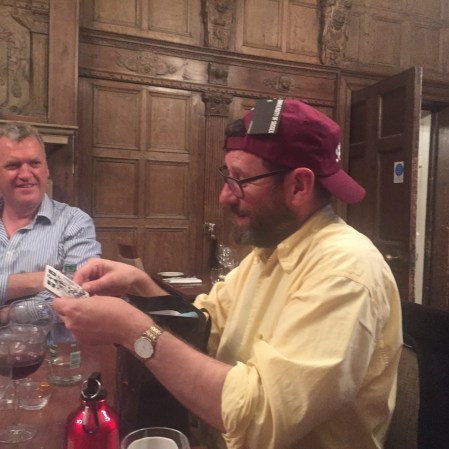
Here’s a picture of me unwrapping my gifts. The charming hat, which I am wearing in what I am told is the correct style, is one of the presents I got. That’s Tom Ormerod in the background.

IMG_7901

I won’t miss the administrative side of my current job and am looking forward to concentrating a bit more on the things I think I’m better at, i.e. teaching and research, but I will miss the chance to converse with academics from different fields and find out what happens on the other side of various disciplinary boundaries. A few weeks ago, for example, I was the independent Chair of an interview panel for lecturers in drama for the School of English, an opportunity that came my way because of my position as a Head of School. It was great fun, and I’m very glad that a couple of very good appointments were made.

More generally, it’s always been a pleasure to see things from the perspective of other academic fields through the Head of School’s group. Many of the difficulties we face are common to all disciplines, but sometimes changes in policy or process have a disproportionate effect on some subjects. When the HOSG has had to come together to support one another it has always done so, and long may that collegiate spirit continue.

I’d like therefore to end this piece by saying a very public “thank you” to Diane Mynors (Engineering & Informatics) who is currently Head of the Heads of Schools Group (Capo di Tutti Capi) for organizing last night’s dinner and to all those who came for making it such a pleasant evening.

I’d also like to thank all the Heads of School by name for being such great colleagues over the years: Tom Healy (English); Brian Hudson (ESW); Laurence Pearl (Life Sciences); Tom Ormerod (Psychology), Andrea Cornwall (Global Studies); Tim Jordan (Media Film & Music); Steven McGuire (Business, Management and Economics); Diane Mynors (Engineering and Informatics); Clive Webb (History, Art History & Philosophy); Andrew Sanders (Law, Politics and Sociology); and Malcolm Reed (BSMS).

Best wishes to you all for the future!


Winding Down?

Posted in Biographical on July 7, 2016 by telescoper

I’m not getting much time to blog these days because there’s so much to finish off before I step down from my position as Head of School for Mathematical and Physical Sciences at the University of Sussex.

Today I chaired my last Progression and Award Board. This is the meeting at which we check examination results against the criteria for awarding a degree (for graduating students) or students to progress to the next stage of their course (if they are continuing). Today’s was for students taught postgraduate programmes in Mathematics, Physics and Astronomy. In previous weeks I’ve done two other PABs: one for UG graduating students (Years 3 and 4) and another for progressing students (Years 1 and 2). That’s in addition to doing a similar job as external examiner at the University of Cambridge. Which reminds me, I need to write a report for that…

On top of that I’ve had three solid days of interviews for faculty positions in Mathematics and Statistics which are part of a strategic plan that involves expanding and diversifying the research and teaching in Mathematics, to go alongside similar expansion and diversification in Mathematics.

Oh, and this afternoon I have to chair my last meeting of the MPS Executive Group.

I’m glad I’ll be leaving the School when it’s doing well, with record student numbers, increasing faculty numbers, higher than ever research grant income and good league table positions for its two Departments. On the other hand, I have had enough of the enormous administrative workload and have no regrets about stepping down. I’ve tried my hand at management. I think I’ve done some good things here, and am definitely leaving the School in a better position than when I arrived. But it’s definitely time for me to move on.

I was at South Kensington Technical Imperial College on Monday to do a PhD Examination. After the viva someone asked me if I was enjoying “winding down” before my departure on 31st July. In fact it’s been even more intense than usual over the last few weeks. I’ve lost track of the number of times I’ve heard sentences that begin with the words “Before you go, can you just….”.

I’ll get a bit of a break next week to do focus a bit on science, as I’m off to a meeting in Ghent (Belgium) on Maximum Entropy and Bayesian Methods, known as MaxEnt for short.

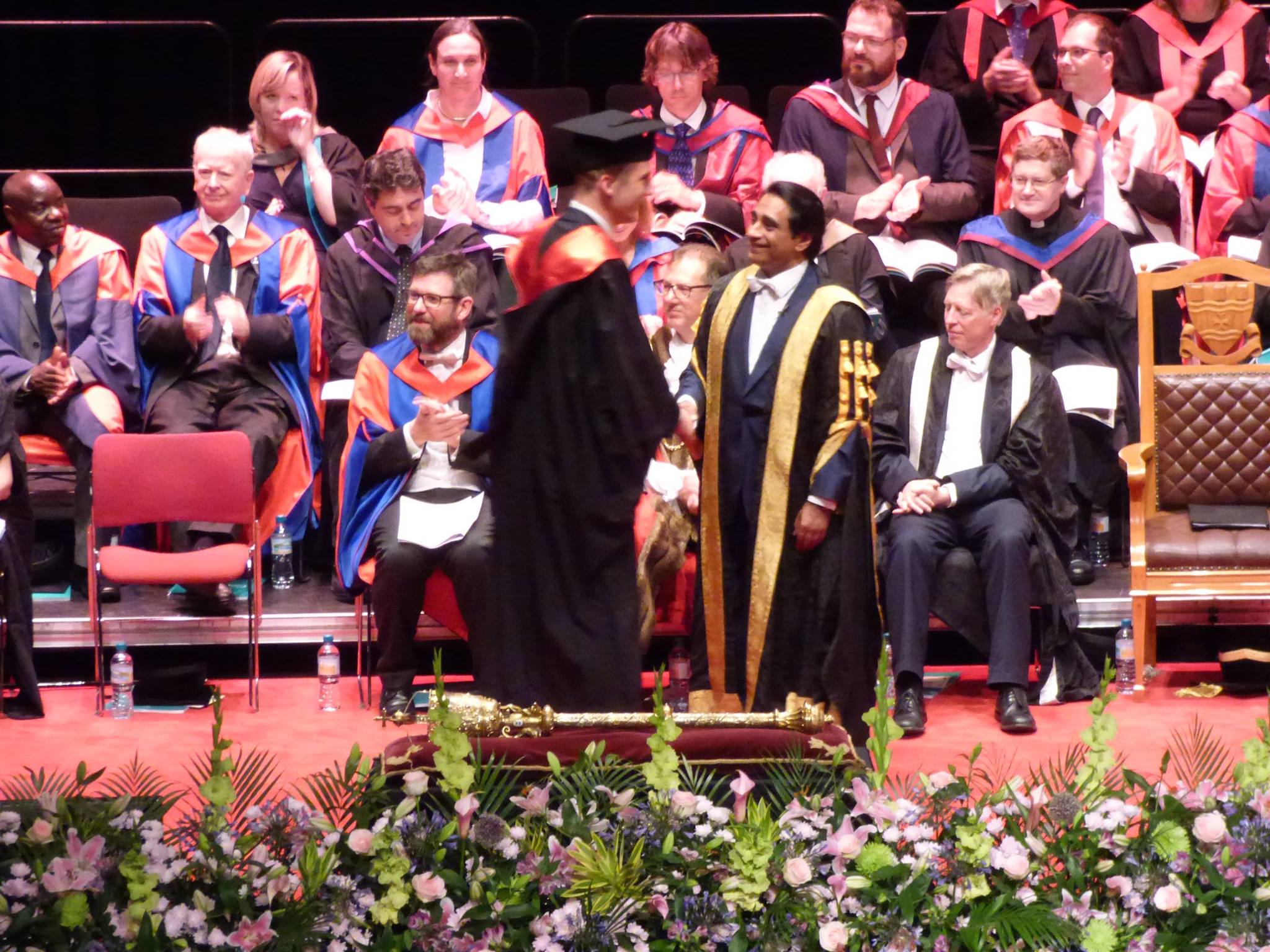
When I get back my last main responsibility will be the Graduation Ceremony for Mathematical and Physical Sciences on 19th July. After that I may finally get “to wind down” a bit!


P.S. Another Exit

Posted in Biographical, The Universe and Stuff on June 24, 2016 by telescoper

The news about yesterday’s vote to take the United Kingdom out of the European Union reminded me that I haven’t yet mentioned on this blog that I’ll shortly be making an exit of my own although it is completely unconnected with and far less important than the EU referendum! Hopefully this will answer a comment on a poem I recently posted

I will be stepping down as Head of the School of Mathematical and Physical Sciences (MPS) and leaving the University of Sussex at the end of July. I made this decision some time ago and it was annnounced publicly by the University of Sussex in May, but at that time I was busy marking examinations and doing other stuff and I never got around to mentioning it on here.

I do not propose to go into detail about the reasons for my resignation, which are a mixture of personal and professional. Suffice to say I have found the many burdens and frustrations of my current job just too onerous to manage and therefore concluded that it’s better for all concerned if I leave and make way for someone better suited to the position.

I will be taking a short career break for health reasons, and returning to the  School of Physics and Astronomy at Cardiff University, to continue my research in astrophysics and cosmology in connection with the new Data Innovation Research Institute.

My appointment in 2013 was for a 5-year term, so I am leaving after three and a half years. MPS is in a very good position, with record student numbers and research income. I would not have decided to leave if I thought my departure would in any way jeopardise the progress that has been made over the last few years or the plans already in place for the next few years.

I’d like to take this opportunity to thank everyone I’ve worked with at Sussex for being such great colleagues and wish them all the very best for the future.


Referendum Day

Posted in Biographical, Politics on June 23, 2016 by telescoper

Today has been a very eventful day. First I was up at 6am to get to my local polling station in order to cast my vote in the EU Referendum  as soon as the doors opened. I then had to get up to campus and spent all day from 9am until now interviewing for a Lectureship in Probability and Statistics. In between there have been thunderstorms, torrential rain, and flooding. Also, after checking the bookies’ odds on the Referendum result, I decided to place an insurance bet on Leave of £100 at 10/1 against. Given the closeness of the opinion polls I think those odds are far too long.

I’m far too tired to stay up and follow the results coming in, but tomorrow morning I’ll wake up to find that the UK will remain in the European Union or that I’m £1000 richer.

Anyway, for those of you out there who still haven’t voted – perhaps because of the inclement weather – there’s still three hours to get to it!

keep-calm-and-vote-remain-2

Why I think the United Kingdom should remain in the European Union

Posted in Biographical, History, Politics on June 19, 2016 by telescoper

These last few weeks have been absurdly busy, and even without Thursday’s referendum, next week promises to be even busier. I will, however, definitely make time to vote and I urge you to do the same, whichever way you feel inclined to cast your ballot.

A number of my friends and colleagues have been posting on social media about why they plan to vote for one side or the other, or in some cases already have voted ( by postal ballot), so I thought I’d do the same today. I don’t suppose my ramblings will change anyone’s mind, and that’s not the reason for posting this anyway. It’s just a personal opinion, that’s all. It’s fine if yours is different. I have friends who disagree strongly with what I’m going to say, but we’re still friends. There’s no reason to think that will change whichever way the vote goes, although I am deeply worried about what damage the campaign has done to British political culture (which was deeply flawed before it started).

Let me start with a bit of biography that might explain why I see things the way I do. I was born in Wallsend on Tyneside in 1963. My parents were both born just before World War 2 started also in the area where I was born. Of my four grandparents, one was born in England, one in Northern Ireland, one in Scotland, and one in Wales. I always smile when I get to right my nationality on a form, because I put “United Kingdom”. Of course being born in England makes me English too, but I find that less defining than “UK” or even “Geordie”. To be honest, my ancestry means that  I generally find the whole concept of nationality fundamentally silly. I find nationalism silly too, except for those occasions – regrettably frequent – when nationalism takes on the guise of xenophobia.  Then it is much more sinister. That is happening now in the United Kingdom, a point I will return to later.

I don’t come from a wealthy background. Holidays abroad were an unaffordable luxury when I was a kid. In fact, the only members of my immediately family ever to venture abroad before I did for the first time (in 1986) were my grandfather’s brother (who died at Arnhem in 1944), his cousin (who died at the Salerno landings in 1943), and my uncle Richard who crossed the Rhine with the British Army in 1945 and was stationed in the devastated city of Hamburg for the duration of his National Service; he at least survived the War.

I had the good fortune to be born during a time of peace and relative prosperity, and have experienced immense good fortune in my life. I got a scholarship to go to a very good school and thence won a place at Cambridge University, where I did well enough to go onto a PhD here at the University of Sussex. Thirty years ago last summer, when I was 23, I went abroad for the very first time – to a cosmology conference in Cargèse, in Corsica. Since then I’ve had the opportunity to travel widely in Europe and beyond, meeting and working with some wonderful people. What little sense of nationality I started with has diminished steadily with time, and I now have no difficulty at all in adding another label to my identity: European. I’m British and I’m European. And proud to be  both. That statement alone has led to me being called a “traitor”, such are the depths to which this wretched referendum campaign has sunk. Fortunately I an nowhere near sufficiently important or prominent for anyone to assassinate.

The United Kingdom joined the European Economic Community (as it was then called) in 1973, when I was ten years old. The EEC morphed into the EU in 1993, but in some form or another it has been a fact for all of my adult life. There is no question in my mind that Britain’s membership has been has been very good for Britain and for the other member states. We pay a subscription to the modern EU that amounts to around 0.5% of our public spending and for that we get preferential access to a free market that gives us around ten times as much back in trade and inward investment.

My career in science gives a perspective on this too. The UK is a member of the European Southern Observatory (ESO), the European Organization for Nuclear Research (CERN) and the European Space Agency (ESA), all of which have been stunningly successful. None of these are actually European Union organizations. ESO and CERN were founded in the 1950s and ESA in the 1970s, all before the EU formally came into existence. But they do serve as models for why the EU is such a good thing in a wider sense than the science that they do. Members of ESO, CERN and ESA pay a subscription which amounts to a pooling of resources into a pot far bigger than any individual country could manage. Each organization is run by a council that makes collective decisions on where and what to invest. The UK has a strong influence on those decisions. By being a member it has a seat at the table and a voice in the discussions. The net result is that each of these organizations is much more than the sum of its parts.

fat cut

That model that works so well for ESO, CERN and ESA is basically the model for the European Union. Even when they’re not lying about the cost of membership as the official Vote Leave campaign consistently does, people tend to talk in a very short-sighted way about the amount we pay and how much we get back. That’s the wrong way to look at it. The point is that, just as with scientific organizations,  the EU is more than the sum of its parts. Pooling some resources and doing things collectively does, for certain things, give a value way beyond the relatively small amount we invest. But remember that we only pool 0.5% of our public funds in this way. It’s an astonishingly good deal. And, what’s more, it’s mutually beneficial. The UK benefits and the other EU member states benefit too. It’s not “us” versus “them”, it’s “we”.

Now I know that BrExit advocates will say. “You profit from EU grants! You’ve been bought off by the EU! You’ve a vested interest!” I’ve been attacked on social media repeatedly for having the temerity to argue that EU membership is as good for science as it is for everything else. But the fact of the matter is that the accusation is completely false. My own research is wholly funded from UK sources. I don’t have any EU funding at all. Even if I had I’d still have a right to express my opinion, but I don’t. I haven’t been “bought off” by anyone. I’ve thought about the issues and come to my own conclusion. You can do that in a free country.

The EU is by no means perfect. I think it could be made more accountable, more democratic. I understand those concerns, but I do feel that they’re hard to justify coming from one of the least democratic countries in Europe. We have an entirely unelected House of Lords, and a House of Commons that has delivered an overall majority to a party with a minority share of the popular vote. Pot calling the kettle black?

I think the economic, educational, cultural and societal benefits of EU membership have been discussed widely in the referendum campaign so I won’t repeat them here. I’ll just say that I think the benefits are immense, and the risk to this country if they are lost is huge.

But there is one reason over and above all this why I shall be voting to Remain in the EU. For this I will quote note other than Boris Johnson, who wrote just two years ago in his biography of Winston Churchill:

It was his (Churchill’s) idea to bring those countries together, to bind them together so indissolubly that they could never go to war again – and who can deny, today, that this idea has been a spectacular success? Together with Nato the European Community, now Union, has helped to deliver a period of peace and prosperity for its people as long as any since the days of the Antonine emperors.

I won’t comment on why Boris Johnson has changed his mind, but I agree with that statement. It brings me back to the bit of personal family history with which I started this post. I have been lucky enough to live in the period of “peace and prosperity” described in that quote. I am sorry my grandfathers’ generation was not so lucky. I don’t have any children of my own, but  I categorically refuse to take any step that would risk any future generation having to endure the same horrors.

And then there’s this.

Nazi_UKIP

The top left image shows  a poster produced by the UK Independence Party. The other three are taken from a Nazi propaganda film of the 1930s. The historical parallels are obvious and not accidental. This is indeed “Breaking Point” indeed. It’s the point the BrExit campaign descended into the gutter.

Of course I’m not saying that all those who want the UK to Leave the EU are fascists. Far from it. Many – indeed the majority – are reasonable, civilised people. But like it or not, if you vote Leave you’re voting the way the far right want you to vote. I for one will not take a single step in that direction. Fascism only needs a foot in the door. I fear that the domestic political consequences of BrExit will give it far more than that. Once they get hold of it, we’ll never get our country back.

One final point. On Thursday I will definitely vote for the United Kingdom to remain in the EU. However, Article 50 of the Lisbon Treaty allows any member state to leave the European Union, and sets a protocol for how this can be achieved. This demonstrates that the UK has sovereignty over its own affairs, thus defeating one of the central arguments of the Leave campaign.


To Cambridge Again

Posted in Biographical, Education with tags , , , on June 13, 2016 by telescoper

The annual cycle of academic life brings me once again to my duties as External Examiner for Physics at the famous Midlands University called Cambridge, so I’m getting ready to take the train there. Here’s a picture of the Cavendish laboratory where I’ll be working for the next three days:

bragg_building_110309

It hasn’t changed much since I was an undergraduate there (I graduated 31 years ago), but the area around it has certainly been heavily developed in the intervening years.

Anyway, I’d better be going. Toodle-pip!

Flaming June Again

Posted in Art, Biographical, Bute Park, History with tags , , , , on June 10, 2016 by telescoper

Since we’re in the middle of a modest heatwave I thought “Flaming June” would be a good title for a blog post. Until a few years ago I always thought that “Flaming June” was some sort of folk expression or quotation from a poem, but it is instead the title of this Pre-Raphaelite painting by Frederic Leighton of a lady wearing what looks like a dress made out of old curtains. Apparently the oleander branch seen in the upper right symbolizes the fragile link between sleep and death. It looks to me like she must be attending a lecture…

But I’m rambling. This has been an exhausting week, probably because I a few days off last week and have come back to one of the busiest periods of the academic year. The examination period is over so there are scripts to mark,  examiners’ meetings, class lists and the like, all parts of the arcane business of academic life. In fact I’ll be spending the first three days of next week in Cambridge where I’m External Examiner for Physics, and I have a lot to do here before I go.

In between all the meetings I had to attend yesterday I noticed that it was the 9th of June, a date of enormous cultural significance for those of us born on Tyneside, as Geordie Ridley’s famous music hall song The Blaydon Races begins “I went to Blaydon Races, ’twas on the 9th of June… The original Blaydon Races were horse races and site of the course is long since gone, but the name has recently been resurrected as a road race involving people on foot rather than on horseback. Incidentally, the usual “Whit Week” holiday in late May or early June is still referred to on Tyneside as “Race Week”.

All this reminded me of the occasion – over twenty years ago – when I entered the Great North Run for the first time. Nowadays this race – the biggest mass participation half-marathon race in the world, with 50,000 competitors – is run in September, but in those days it was held in June. As it happened, there was also a heatwave the first time I did it. I remember lining up at 9.30 on a Sunday morning on the start grid (I was number eleven thousand and something) while the stewards went round pleading with all the participants to take plenty of water as they went around as it was going to be very hot indeed and they didn’t want people suffering from dehydration.

In those days I was quite a keen long-distance runner and was fairly fit. I wasn’t that concerned about the heat but took the advice to heart and determined to stop at all the water stations on the way from Newcastle to South Shields. When we started I also took care not to go off too fast over the first mile or so, which is basically all downhill from the Town Moor to the Tyne Bridge. Not that you could go fast anyway, as the track was so crowded with runners.

I remember the wonderful feeling as we emerged onto the Tyne Bridge and took in the splendid view of the bridges along the river. When we got to Gateshead the crowds were out in large numbers cheering everyone on and I felt completely elated. The first water station was near Gateshead athletics stadium, and I took a drink there as I did at the next, and the next. After Gateshead the route heads towards the Felling bypass at about 4-5 miles and then the runners can see a long climb in front of them. A large thermometer showed the temperature on the road to be about 45 Celsius. Fortunately the people living in houses either side of the road were out in their front gardens offering encouragement and sometimes had their hoses out to shower people as they went past. At one point there was a fire engine that had made an impromptu fountain by the side of the road too.

Unfortunately, as I near the ten mile mark I started to feel a bit strange. I had never actually taken on water while I was running before this race; I never felt the need for it when on training runs. My stomach wasn’t used to the water sloshing around while I was running. I felt quite sick by the time we got to the top of the climb but when I saw the sea and felt its breath on my face I cheered up and descended the steep downward slope towards the seafront near Marsden Rock.

There’s a good mile and a half along the seafront to the finish, however, and I was definitely struggling really badly by then. I could see the finish line but it felt like it wasn’t getting any closer. I slowed to a crawl but kept going, finally reaching the grandstand where a large crowd shouted encouragement. I must have looked dreadful because I heard several people shouting out my number along with “keep going, son”  and “you’re nearly there”.

Eventually I got to the finish line but the feeder lanes were quite busy then – I was finishing at about the peak  time of about 1hr 50 – so I was forced to slow right down because of the people in front of me.

As I crossed the line, I stopped running and was immediately overcome with nausea. I bent over, hands on my knees and emptied the contents of my stomach – mainly water – all over the grass. I felt absolutely dreadful but, after a quick check from the St John Ambulance crew who were on hand, I recovered and found my folks who were nearby. After we got home and I had a shower I felt fine.

About a week later, when I had returned to my flat in London a letter arrived for me. I opened it up and found a small passport-sized photograph, with the caption “YOUR MOMENT OF TRIUMPH”. It turns out there was an automatic camera near the finishing line that snapped everyone crossing it along with a shot of the digital clock showing their finishing time. The idea is that you could order a blow-up of the picture for £25 to put on your wall.

In my case, though, the picture showed not a moment of splendid athletic achievement, but a bedraggled creature puking uncontrollably while those around him looked on in disgust. I didn’t order the blow-up of my throw-up.

Over the years I did the Great North Run a number of times – six or seven, I don’t remember exactly – and a few marathons too, but the strain of running on the roads around London gradually told on my knees and I had to stop because of recurrent pain and swelling. Eventually, a few years ago I surrendered to the inevitable and had arthroscopic surgery to sort out the damage to my knee joints. That seems to have fixed the problem, but my running days are over.


R.I.P. John David Jackson (1925-2016)

Posted in Biographical, The Universe and Stuff with tags , on May 23, 2016 by telescoper

Yet again I have to pass on some very sad news. Physicist John David Jackson, best known for his classic textbook Classical Electrodynamics, has passed away at the age of 91. I’m sure I speak for many physicists when I say that Classical Electrodynamics was not only an essential part of my physics education but also a constant companion throughout the rest of my career. I have consulted my copy regularly over the last thirty years. I was often frustrated that when I found the topic I was looking for in the index, it referred to a problem (usually a difficult one) rather than a solution, but there’s no question it made me a better physicist.

Jackson

Rest in peace, John David Jackson (1925-2016).

The McGurk Effect – Do you always hear what you think you hear?

Posted in Biographical, The Universe and Stuff with tags , , , , on May 19, 2016 by telescoper

I saw this clip for the first time yesterday during a training session about unconscious bias. The context then was a discussion of how we make quick decisions about things (and people) relying on contextual associations of which we are often entirely unaware. The clip illustrates how difficult it is to overrule some things your brain does automatically even when you know they are wrong.

Related to this is something I’ve noticed in a slightly different setting. Not having a TV set I do sometimes watch DVDs on my laptop, but the screen is quite small and, for a person of my advanced years, rather difficult to view comfortably for a long period. A while ago I started plugging my laptop into a monitor instead. When I do that I usually put the laptop well out of the way, which means moving the relatively small loudspeaker out of the line of sight between myself and the screen. It is however immediately noticeable that the sound immediately seems to be coming from the screen rather than the speaker. I guess this is yet another example of the visual overruling the auditory which it does in the McGurk effect.

Oh, and I just remembered this, which I heard a while ago at a public talk given by Simon Singh. I guess many of you will have come across it before, but there’s no harm in repeating it. I don’t know why it popped into my head at this particular moment, but perhaps it’s because I’ve been reading some stuff about how my colleagues in gravitational wave research use templates to try to detect specific patterns in noisy data. The method involves cross-correlating a simulated signal against the data until a match is obtained; the problem is often how to assess the probability of a “chance” coincidence correctly and thus avoid spurious detections. The following might perhaps be a useful warning that unless you do this carefully, you only get out what you put in!

This is an excerpt from the classic track Stairway to Heaven, by the popular beat combo Led Zeppelin, played backwards. I suggest that you listen to it once without looking at the words on the video, and then again with the words in front of you. If you haven’t heard/seen it before, I think you’ll find it surprising…


The Thermal Syndicate

Posted in Biographical, History with tags , , , on May 16, 2016 by telescoper

image

I found the above map of the Tyne via the Tyne & Wear Archives on Twitter. It dates from the 1960s, and it caught my attention because it shows the area where I was born, between Walker and Wallsend.

I remember  the Shipyards very well, especially the famous Neptune Yard of Swan Hunter. In the early 70s the huge ESSO Northumberland loomed above the terraced streets like a monster but now shipbuilding has all but vanished. So have most of the other industries lining the river, for that matter.

The other thing this map jogged my memory about was the Thermal Syndicate building. This was the site of a glassworks and the source of large quantities of silver sand, which my Dad used to buy and sell on to schools and playgroups as part of his educational supplies business, before it went under in the 1980s. The name always intrigued me as it made me imagine it was run by gangsters pushing winter underwear.