Archive for the Biographical Category

Out of Power

Posted in Biographical with tags , , on June 1, 2014 by telescoper

I had quite a few things to do on campus today before jetting off on a short trip tomorrow. I hoped to finish them in time for a decent blog post before heading home for tea and the Beelzebub crossword. Unfortunately when I got to the University just after 1pm I found the building in darkness. It turns out that the power went off about 10am. A little investigation revealed that all the buildings North-South Road (that’s the part of the Sussex University campus where all the science buildings are located) had a complete power outage due to a probably probably due to a fault in the high-voltage supply onto campus. Engineers had been called out as soon as the fault was reported but, not being qualified to work on such equipment themselves, power wasn’t restored until just after 4pm with the arrival of a specialist crew.

One thing worth saying about this is that the School of Mathematical and Physical Sciences does have an emergency response procedure for such eventualities and since as Head of School I’m officially a “responsible person” I had to make a judgement as to whether there was a serious threat to safety. If there had been, I would have had to execute the plan, contact all the relevant personnel, and order people out of the building. I decided that there wasn’t so just informed the students who were in the building what the situation was and that they could stay if they wanted. The emergency lighting was working and there was no immediate danger of anything nasty happening.

I went for a stroll around campus to see the extent of the outage. The only sign of life nearby was the sound from the emergency generators in the Shawcross building which kicked in to keep the main campus servers up and running. The PC room at the front of the building was deserted. Presumably the students who usually work there at weekends had found an alternative location, or were just outside enjoying the sunshine until the systems started up again, and any staff in attendance were presumably working on the backup systems in the bowels of the building.

No computers were working in our building either of course so some decided to work in the Library, which is on the other side of campus and wasn’t affected by the power cut. After checking out with the campus services what was going on I decided to stay until the fault was rectified just in case there were any problems. Some of our physicists had experiments running over the weekend and one or two came in to check that there was no serious harm done to their gear. There may be some faults to deal with tomorrow morning, but by then I’ll be elsewhere!

Such things as power cuts are inconvenient but they remind us how dependent we have become on electricity, especially for running computers. Fortunately this happened on a Sunday so there wasn’t much happening on campus, but a huge amount of our activities rely on digital devices of one form or another and it would have been much worse had it happened on a week day. The worst thing as far as I’m concerned, however, is that with no computer to work on I was deprived of displacement activities and was forced to start marking the scripts from Theoretical Physics examination…

Beards, Shorts & Sandals Code for 2014 Season

Posted in Beards, Biographical on June 1, 2014 by telescoper

The Beard, Shorts and Sandals season is officially open and I’ve been observing the relevant guidelines rigorously today…

kmflett's avatarKmflett's Blog

Beard Liberation Front

Communique 1st June

‘BEARDS, SHORTS & SANDALS’ CODE FOR 2014 SEASON

The Beard Liberation Front, the informal network of beard wearers, has said that as June starts it is issuing a reminder about the code for the 2014 Beards, Shorts and Sandals season which runs until the end of August.

Adherence to the guidelines is important if the beard wearer is to safely wear shorts and sandals in public during the summer months

2014 Code

1] Shorts and sandals may be worn after midday until 8pm at the discretion of the wearer.

2] Where sandals are worn the wearing of socks is discouraged but not forbidden

3] If socks are not worn toenails must be neat, trimmed, clean and fungus free

4] Shorts should ideally be around knee length to provide a balanced image with the beard

5] Shorts should be of conservative design and colour…

View original post 112 more words

Examination Times

Posted in Biographical, Education with tags , , , , , on May 19, 2014 by telescoper

After a gloriously sunny weekend, it’s now a gloriously sunny Monday. There always seems to be good weather when students are revising for, or actually taking, their examinations. It’s Mother Nature’s special torture. The bus I was on this morning went past a large crowd of students waiting outside the Sports Hall in the bright sunshine for some examination or other.  The sight did remind me that I usually post something about examinations at this time of year, so here’s a lazy rehash of my previous offerings on the subject.

My feelings about examinations agree pretty much with those of  William Wordsworth, who studied at the same University as me, as expressed in this quotation from The Prelude:

Of College labours, of the Lecturer’s room
All studded round, as thick as chairs could stand,
With loyal students, faithful to their books,
Half-and-half idlers, hardy recusants,
And honest dunces–of important days,
Examinations, when the man was weighed
As in a balance! of excessive hopes,
Tremblings withal and commendable fears,
Small jealousies, and triumphs good or bad–
Let others that know more speak as they know.
Such glory was but little sought by me,
And little won.

It seems to me a great a pity that our system of education – both at School and University – places such a great emphasis on examination and assessment to the detriment of real learning. On previous occasions, before I moved to the University of Sussex, I’ve bemoaned the role that modularisation has played in this process, especially in my own discipline of physics.

Don’t get me wrong. I’m not opposed to modularisation in principle. I just think the way modules are used in many British universities fails to develop any understanding of the interconnection between different aspects of the subject. That’s an educational disaster because what is most exciting and compelling about physics is its essential unity. Splitting it into little boxes, taught on their own with no relationship to the other boxes, provides us with no scope to nurture the kind of lateral thinking that is key to the way physicists attempt to solve problems. The small size of many module makes the syllabus very “bitty” and fragmented. No sooner have you started to explore something at a proper level than the module is over. More advanced modules, following perhaps the following year, have to recap a large fraction of the earlier modules so there isn’t time to go as deep as one would like even over the whole curriculum.

In most UK universities (including Sussex), tudents take 120 “credits” in a year, split into two semesters. In many institutions, these are split into 10-credit modules with an examination at the end of each semester; there are two semesters per year. Laboratories, projects, and other continuously-assessed work do not involve a written examination, so the system means that a typical  student will have 5 written examination papers in January and another 5 in May. Each paper is usually of two hours’ duration.

Such an arrangement means a heavy ratio of assessment to education, one that has risen sharply over the last decades,  with the undeniable result that academic standards in physics have fallen across the sector. The system encourages students to think of modules as little bit-sized bits of education to be consumed and then forgotten. Instead of learning to rely on their brains to solve problems, students tend to approach learning by memorising chunks of their notes and regurgitating them in the exam. I find it very sad when students ask me what derivations they should memorize to prepare for examinations. A brain is so much more than a memory device. What we should be doing is giving students the confidence to think for themselves and use their intellect to its full potential rather than encouraging rote learning.

You can contrast this diet of examinations with the regime when I was an undergraduate. My entire degree result was based on six three-hour written examinations taken at the end of my final year, rather than something like 30 examinations taken over 3 years. Moreover, my finals were all in a three-day period. Morning and afternoon exams for three consecutive days is an ordeal I wouldn’t wish on anyone so I’m not saying the old days were better, but I do think we’ve gone far too far to the opposite extreme. The one good thing about the system I went through was that there was no possibility of passing examinations on memory alone. Since they were so close together there was no way of mugging up anything in between them. I only got through  by figuring things out in the exam room.

I think the system we have here at the University of Sussex is much better than I’ve experienced elsewhere. For a start the basic module size is 15 credits. This means that students are usually only doing four things in parallel, and they consequently have fewer examinations, especially since they also take laboratory classes and other modules which don’t have a set examination at the end. There’s also a sizeable continuously assessed component (30%) for most modules so it doesn’t all rest on one paper. Unusually compared with the rest of the University, Physics students don’t have many examinations in the January mid-year examination period either. Although there’s still in my view too much emphasis on assessment and too little on the joy of finding things out, it’s much less pronounced than elsewhere. Maybe that’s one of the reasons why the Department of Physics & Astronomy does so consistently well in the National Student Survey?

We also have modules called Skills in Physics which focus on developing the problem-solving skills I mentioned above; these are taught through a mixture of lectures and small-group tutorials. I don’t know what the students think of these sessions, but I always enjoy them because the problems set for each session are generally a bit wacky, some of them being very testing. In fact I’d say that I’m very impressed at the technical level of the modules in the Department of Physics & Astronomy generally. I’ve been teaching Green’s Functions, Conformal Transformations and the Calculus of Variations to second-year students this semester. Those topics weren’t on the syllabus at all in my previous institution!

Anyway, my Theoretical Physics paper is next week (on 28th May) so I’ll find out if the students managed to learn anything despite having such a lousy lecturer. Which reminds me, I must get the rest of their revision notes onto the Study Direct website…

RAS Council and after..

Posted in Biographical, Science Politics on May 9, 2014 by telescoper

Just time for a brief post as it’s quite late and I’ve just got back to Brighton after a day out in London. I’ve been too busy to blog until now.

Today was the last day of my year-long stint as an elected Member of the Council of the Royal Astronomical Society; the final Council meeting of the Society’s year is on the day of the Annual General Meeting at which new Council members and other Officers are elected. On this occasion the President, David Southwood, had also reached the end of his term so at the end of the AGM he stood down and was replaced by his successor, Martin Barstow.

There was quite a lot to discuss during today’s Council Meeting in advance of the AGM, but in the end we got through the business and it and the AGM went off quite smoothly.

There then followed the announcement of a major initiative Council has been working on (of which more anon) and a short but very interesting talk about BICEP2 by Stephen Feeney of Imperial College. Thereafter it was dinner at the Athenaeum with RAS Club.

All in all, a busy but pretty productive day. I’ll miss the days out of the office on RAS business, but I suppose the overall reduction in workload is not a bad thing! It just remains for me to wish the new members of Council well in their future endeavours.

On the way in to Burlington House I noticed the enclosed poster for an exhibition of “Renaissance Impressions” at the Royal Academy. I’m not sure of the identity of the bearded chap who is the subject of that particular impression. I’m no historian, but I think Karl Marx came after the Renaissance..

On the Buses in Brighton and Cardiff

Posted in Biographical, Politics with tags , , , on May 2, 2014 by telescoper

Recently there was an Emergency General Meeting of the University of Sussex Student Union to discuss rises in bus fares in Brighton & Hove. I was a bit surprised at this because, although the prices charged by the Brighton & Hove Bus Company did go up on 13th April, they seemed to me to be quite cheap, at least given the general cost of living in Brighton. I should add that I use the bus every day to travel to and from work.

Caroline Lucas (MP for Brighton Pavilion) chipped in to say that the fare rise justified Green Party policy of taking buses back under the control of local councils. Given the disastrous management of Brighton & Hove’s  Recycling and Refuse operation by Mrs Lucas’ colleagues in Brighton & Hove Council, I think the least said about that idea the better.

Anyway, out of interest, I decided to check the relative prices of bus tickets in Brighton & Hove relative to the city in which I used to live, Cardiff. That’s of interest for two reasons: (a) the general cost of living in Cardiff is very much lower than it is in Brighton (as someone who’s just moved here I can vouch for this); and (b) Cardiff Bus (or, if you prefer Bws Caerdydd) is one of the very few bus services in the United Kingdom was never privatised. While most local bus operations were taken over by private operators during the Thatcher era, but Cardiff Bus remains entirely owned and managed by Cardiff City Council.

It is very difficult to do a like-for-like comparison of fares, because Brighton & Hove Bus covers a much larger area (including Eastbourne, which is 22 miles from Brighton) and many discounted tickets offer unlimited travel within that. Also, the fare to Falmer from Brighton is most relevant for students and it’s not obvious what to compare that with in Cardiff. Since the distance from Brighton to Falmer is about 5 miles, but Cardiff University is right in the city centre, I’ve included a fare from Cardiff to Barry (also about 5 miles) for comparison as that’s the nearest fare I could find; the time for each journey is about 20 minutes.

Fare Type Brighton Cardiff
Short Hop £1.80 £1.80
~5 miles from City £2.00 £2.50
Day Rider (bought on bus) £4.70 £4.90
Day Rider (phone or card) £4.10 £4.70
7 Day Saver £18 £19
1 Month Saver £66 £66
Annual Saver £510 £485

I’ve only included the full adult fare here; discounted tickets for students are available in both cities. In fact the annual saver ticket for students in Brighton is £365. I use a 3-month saver which costs me £168, which I regard as very good value for money; the cost of this ticket for a student is only £90, which is a bargain!

Clearly, then, despite the recent price rises, Brighton & Hove Bus Fares are actually if anything cheaper than Cardiff, at least when you take into account the much bigger area covered by the saver tickets.

I should also mention that Brighton’s bus drivers give change for tickets bought on the bus whereas Cardiff’s demand the exact fare only…

I think I’ve made my point. I also checked Nottingham’s bus fares (as I’ve also lived there). A comparison is more difficult in this case because of the different fare structure, but as far as I can tell it’s broadly in line with Brighton.


The Trouble With Brighton’s Roads..

Posted in Biographical, Brighton, Politics with tags , , , , on April 26, 2014 by telescoper

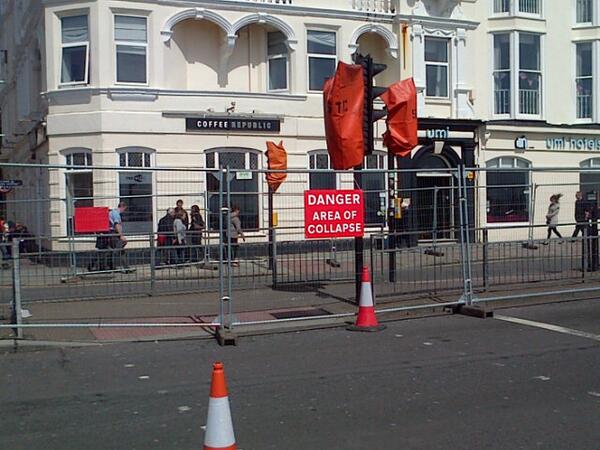
I travelled back to Brighton yesterday after taking a short break in Wales over Easter. To occupy myself on the train journey back I was, as usual, messing about on Twitter as a result of which I discovered that the main road along Brighton’s seafront had been closed. The reason for this – and the ensuing traffic chaos in the City Centre – was that the main A259 had partially collapsed. My heart sank at the thought of the problems I might have getting home from the station, but in fact by the time I got there – just after seven in the evening – the worst of the congestion seemed to have cleared and I got a bus home without any difficulty or delay.

When I walked past the spot earlier today I found that it wasn’t as dramatic as I’d been led to believe:

Hole_in_Road

There isn’t actually a hole as such, just a couple of very wonky pavements either side of a section of road that’s in a very poor state of repair. In that respect it’s no different from most of Brighton’s streets.

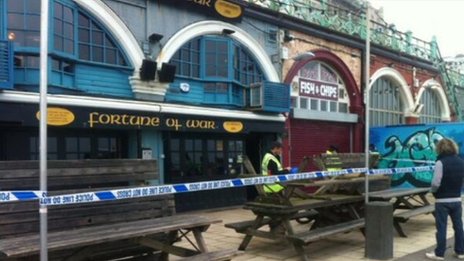
If you don’t know the area concerned, just at the bottom of West Street, you won’t know that this section of the A259 (King’s Road) runs above the a series of arched underground structures occupied by various shops and pubs. In fact the collapse happened inside a pub called the Fortune of War, when some workmen discovered several tons of rubble had fallen down from the roof above. Fortunately, no-one was hurt.

This is the view at beach level; the King’s Road runs above the pub, behind the iron railings at the top of the picture.

The Fortune of War Pub (Credit: BBC)

The Fortune of War Pub (Credit: BBC)

One lane of the A259 is currently closed and a contraflow is in operation. Given that it is at the best of times a very busy road this, and the diversions that have been placed elsewhere to ease traffic on it, is set to cause congestion for some time to come, probably several weeks.

The problem is obviously that the structures underneath the road were never designed to carry the weight of traffic that they are now expected to support. Brighton and Hove Council have been spending money on extensive roadworks elsewhere in the City but seem to have been reluctant to perform reinforcing work on this crucial route. There’s already a political row brewing about this.

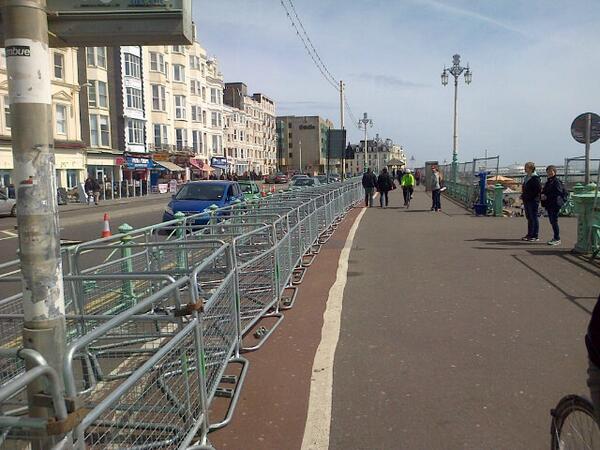
Here’s another picture of the seafront:

EDL_route

The barricades you see are nothing to do with with subsidence, but are there for tomorrow’s “March for England”, the annual attempt by the gang of Neo-Nazi thugs called the EDL to stir up trouble in Brighton. Presumably the fences are intended to separate the EDL from human beings. The collapsed road was to have been part of the route, but presumably alternative arrangements have been made. I would have preferred the road closure to have been used as an excuse to cancel the march altogether actually. I’d rather have no road at all than one filled with such creatures.

I’m very worried about tomorrow. I despise the EDL, but I strongly believe that the best way to deal with people like that is to make sure you don’t give them what they want. They’re clearly coming to Brighton for a fight, so the best approach is to exercise restraint. Unfortunately, there are extremists on the other side of the political spectrum who want a fight just as much as the EDL do. It’s all rather pathetic, if you ask me. Anyway, I’ll be avoiding any aggro by heading up to campus in the morning and catching up on some of the things I’ve missed while I’ve been away over the last week or so…


Bearded Bishop Brentwood welcomed but too late for Beard of Spring poll

Posted in Beards, Biographical, Football, Politics on April 15, 2014 by telescoper

I’m still way behind John Brayford (who he?), but there’s definitely signs of a bounce! The Deadline is 19th April. Vote for me!


kmflett's avatarKmflett's Blog

Beard Liberation Front
PRESS RELEASE 14th April
Contact Keith Flett 07803 167266
Bearded Bishop Brentwood welcomed but too late for Spring Beard poll

The Beard Liberation Front, the informal network of beard wearers that campaigns against beardism, has welcomed the news that the Pope on Monday appointed Fr Alan Williams FM as the Bishop of Brentwood but say that his appointment is too late for inclusion on the Beard of Spring 2014 poll which concludes on Friday.

The campaigners say that they are certain that the distinguished Bishop will feature in future

The big issue in the days left for voting is whether current leader Sheffield United footballer John Brayford did enough in his team’s defeat to Hull in Sunday’s FA Cup semi-final to take the title or whether challengers such as cosmologist Peter Coles and Editor of the I Paper Olly Duff can catch him

The Beard of Spring…

View original post 136 more words

Awards and Rewards

Posted in Beards, Biographical, Education, The Universe and Stuff with tags , , on April 14, 2014 by telescoper

A surge in the polls for footballer John Brayford of Sheffield United (in the Midlands) has left my dreams of the coveted title of Beard of Spring in ruins. I’m still in second place, but with the leader on 83.7% I think I’ll shortly be writing my concession speech…

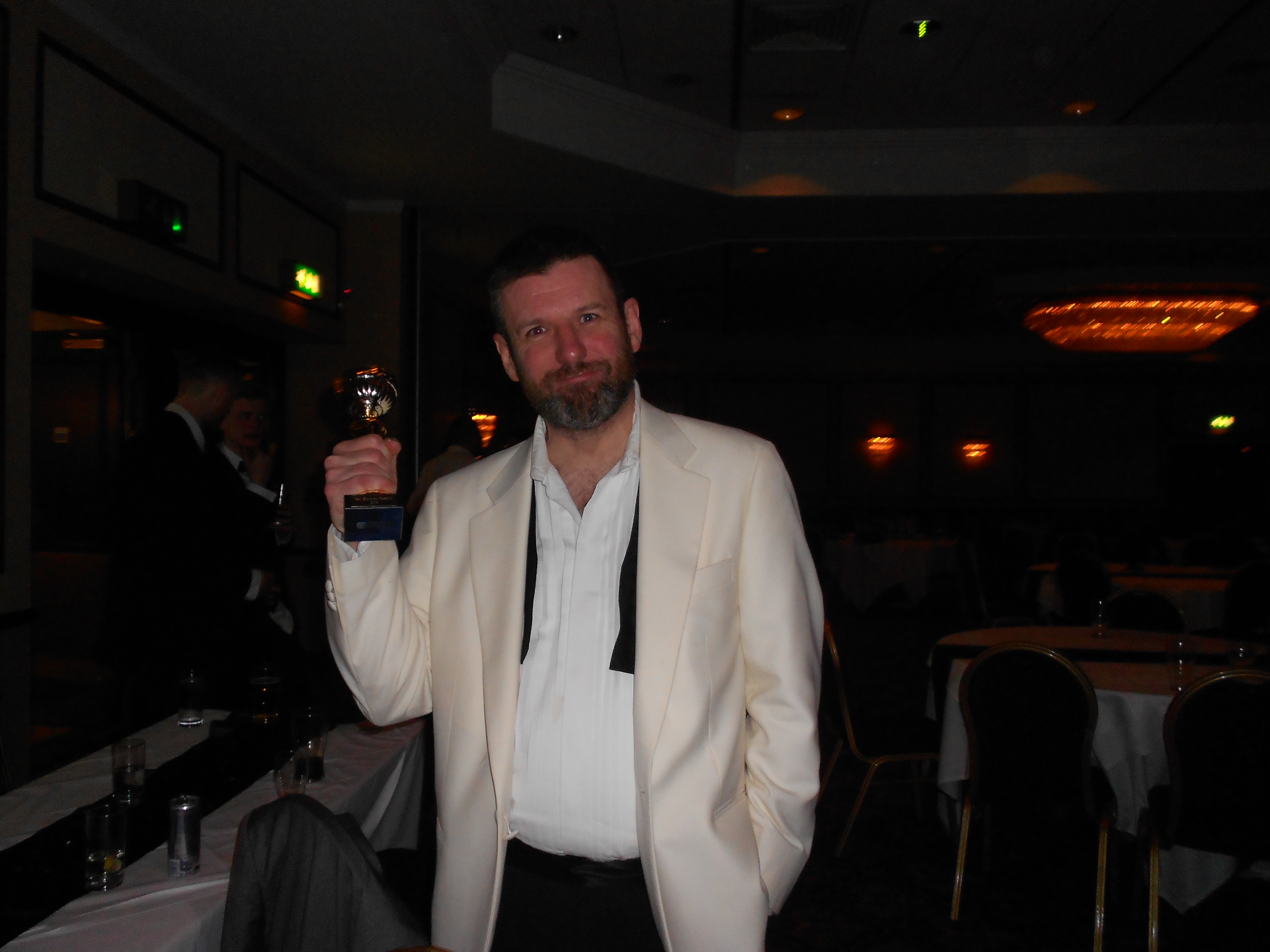
Fortunately, however my disappointment at fading into oblivion in one competition has been more than adequately offset by joy at being awarded a Prize by students from the Department of Physics & Astronomy at the University of Sussex. You could have knocked me down with a feather (had I not been seated) when they announced my name as winner of the award for Best Expressed Research. Here’s the trophy:

award

I’m assuming that it’s solid gold, although it’s surprisingly light to carry. I’m not sure where I should store it until next year when presumably it will be handed onto someone else. It did occur to me to send it up to Newcastle United. At least that way they will have something to put in their trophy cabinet…

DSCN1446

Anyway, I’d like to thank everyone who voted for me, although I’m still not at all sure what “Best Expressed Research” actually means nor do I know what I did in particular to deserve the award. Not that any of that really matters. It’s honour enough to be working in a Department that’s part of a School where there’s such a wonderful friendly and cooperative atmosphere between staff and students. I’ve worked in some good physics departments in my time, but the Department of Sussex is completely unique both for the level of support it offers students and the fact that so many of the undergraduates are so highly motivated. Maybe that’s at least partly because there is such a close link between our teaching and research across the Department. Some people think – and some universities would have them think – that research-led teaching only happens in Russell Group institutions. In reality there’s plenty of evidence that, at least in Physics, Sussex does research-led teaching better than any of the Russell group.

Amid all the administrative jobs I have to do these days the opportunity to do a bit of teaching every now and then is the only chance I have of staying even approximately sane. I’m not sure how many other Heads of School at Sussex University do teaching – I’m told my predecessor in the School of Mathematical and Physical Sciences didn’t do any – but the day I have to stop teaching is the day I’ll retire. Teaching students who want to learn is much more than mere waged labour – it’s one of the most rewarding ways there is of spending your time.

Odds, Ends and Admissions

Posted in Biographical, Education on April 12, 2014 by telescoper

Term has ended at last. These 12-week teaching terms we have at Sussex are quite exhausting, but we got there in the end. In fact, I much prefer doing all the teaching in one block like that instead of having to split it in order to accommodate the Easter holiday which happens when Easter is earlier in the year. It’s tiring, but worth it.

Teaching actually finished yesterday, but today we had yet another UCAS Applicant Visit Day on the Sussex University campus, with both Departments in my School (i.e. Mathematics and Physics & Astronomy) in action.  It’s been quite a nice day actually, which is no doubt part of the reason why today has been very busy. There’s only one more such visit day left – at the very end of April – and then we can sit back and wait until August, when the A-level results come out, to find out how many students we will be welcoming into the first year next year.

I’ve had other reasons for being especially tired over the last couple of days. On Thursday night we had the Sussex University Mathematics Society Annual staff-student ball, a very pleasant affair held in the splendid Hilton Metropole Hotel on Brighton’s seafront. I had planned to leave at a respectable hour as I had to work on Friday (yesterday), but ended up getting home well after 2am.

On Friday afternoon I went up to London for the regular Monthly Open Meeting of the Royal Astronomical Society followed by dinner with the RAS Club, which was very pleasant but I didn’t get back to Brighton until after eleven. I was quite pleased that a bus arrived at the Station almost as soon as I reached the stop. About half-way home a lady got on the bus who was clearly in a tired and emotional state. As often seems to happen this person sat next to me. She proceeded to ask me if I’d like her to sing. I politely declined but she started anyway so I had an unwanted “musical” accompaniment for the rest of my journey. I wouldn’t have minded so much, but she had a terrible voice.

Then this morning I had to get up pretty early to get up to campus for our Applicant Visit Day – not that it was much of a chore to do so because I always enjoy these occasions and it was a lovely morning anyway.

It’s not quite over, though, because tonight is the Annual Physics & Astronomy Ball. It is quite disconcerting to have two Balls squeezed together in such close proximity, but when I took over as Head of School last year I decided that I should either go to both Balls, or neither. Naturally I chose the first option. It’s a tough job but somebody has to do it. I think I’ll need to give my liver a rest for a few days afterwards, though.

Now the plan is to have an afternoon nap before tonight’s event. There’s a football match kicking off at the Amex stadium at 3pm, though, so traffic is likely to be heavy until then so I’m killing time writing this meandering blog post until getting the bus back to my flat.

I’ve just got a few more days at work until I take a break for ~10 days. I haven’t decided yet, but I think I might take a break from blogging then too. But I’ll be back tomorrow on campus to try to make sure I finish all the things I’m supposed to do before I take my holiday.


Death and Other Inconveniences

Posted in Biographical, Brighton with tags , , , on April 7, 2014 by telescoper

It would be an exaggeration to say that this has been a good day. It started in Cardiff when I got to the Central Station and discovered that my train was late. It was only 12 minutes late, in fact, which isn’t at all unsurprising for Late Western. Nevertheless I was a bit annoyed that the 12 minutes turned into 20 minutes and that the Train Manager never once offered an explanation or apology on the entire journey into Paddington.

I did eventually find out the reason for the initial delay via Twitter. Earlier there had been a “person hit by a train”. My irritation turned to deep sadness, at hearing yet again that coded message indicating a death by suicide.

Sitting on the train I remembered seeing fallen cherry blossom in Bute Park. The morning rain had brought it down. That would provide a much more poetic excuse for late running than the usual “leaves on the line”, a poignant reminder of our mortality and all that. I didn’t realize how apt that would turn out to be.

After arriving into Paddington I took the tube to Victoria and had only a short wait for a train to Brighton. All went well until we reached Gatwick Airport at which point we were held at a signal for some time. The train manager then announced that the train would be diverted via Lewes and would therefore be late. The reason? Unbelievably, another “person hit by a train”, this time near Hassocks. Two in one day. Grim.

The train reached Lewes but didn’t stop at a platform but up a branch line some distance from the station. The driver changed ends and we went through Lewes station again without stopping, this time on the branch line to Brighton. We then passed Falmer (my intended destination) without stopping too.

Soon we arrived in Brighton, and I had to get another, stopping, train back to Falmer. I got on the next one, which sat for 20 minutes without moving. Diversion of all the mainline trains onto the Lewes line was causing congestion. As time ticked away I was starting to worry I would miss my 5pm lecture. I decided to give up on the train, left the station and proceeded to take the Number 25 bus to Falmer from the nearest stop.

That turned out not to be a wise move. The bus managed to travel a few hundred yards only before the driver announced that the Lewes Road had been closed by the Police owing to an “incident” at the gyratory system beside Sainsbury’s. We sat on the bus for a while just south of the area that had been cordoned off and then the driver told us the inevitable news that the bus was terminating and we all had to get off.

The main bus garage lies on the Lewes Road just north of the gyratory system, so I thought there was a chance some buses might be operating the other side of the blockage. I went to investigate.

As I skirted round the police cordon I counted at least ten police cars scattered about, along with two large vans. Armed officers were swarming around, and some were on the top of the Sainsbury’s building. There was also a uniformed officer with a loud hailer. Apparently someone, apparently armed, was inside one of the nearby flats. I didn’t hang about to find out more.

There were no buses northbound that I could see, and by now it was pouring with rain. I couldn’t see any possibility of getting to campus with my luggage, so decided to give up and go to my flat. By now my phone battery was nearly flat so all I could so was leave quick messages on Twitter and Facebook, before it croaked, to say
I was cancelling my lecture.

As I write the incident at Lewes road appears to be continuing, but at least nobody seems to have been seriously hurt.

I’m of course very disappointed at having had to miss a lecture, and some other things I wanted to do this afternoon but the three events that impinged on my journey are of far greater consequence for the people affected than my own inconvenience. It’s no doubt been a rougher day than I can possibly imagine for a great many people today.