Archive for the Biographical Category

For the sake of a seminar..

Posted in Biographical, Books, Talks and Reviews, The Universe and Stuff with tags , , , on January 17, 2014 by telescoper

Just a quick post while I drink my morning coffee. Yesterday afternoon I gave a seminar here in the Kobayashi-Maskawa Institute at Nagoya University. It was actually at 5pm; I almost made a mistake when I saw it on the the high-tech digital display screen shown here (see top right) because I thought that 16 meant 1600 hours:

IMG-20140116-00264

Although I’ve got used to the time difference pretty well, I am still struggling to work out what day it is. The 16 stands for 16th January of course…

Anyway, it seemed to go fairly well and was pretty well attended by the students and postdocs as well as faculty. The lecture theatre was extremely well equipped with AV equipment and I got distracted quite often playing with the various gadgets. Also there were two projector screens, side by side, so the audience got my slides in stereo, so to speak.

In case you’re interested, here are the slides from my talk – complete with artistic flourishes:

For the cosmologists among you, the main protagonists here are Naoshi Sugiyama, who has a joint appointment here and at the Kavli Institute in Tokyo, Takahiko Matsubara, and Chiaki Hikage. The latter was a postdoc working with me at Nottingham and Cardiff; he then worked in Princeton before returning to Japan; Chiaki has been my host during my stay here.

After my talk, and a question-and-answer session, the staff treated me to dinner. We had some discussion about where to go during which I mentioned that I’d seen a place called Hamakin, which claimed to be a Japanese-Italian restaurant:

640x640_rect_21510962

I wasn’t convinced by the concept but it turned out that, although it was a new place, Takahiko had been there before and thought it was very good. We ended up there and, much to my surprise, it was excellent. It was a lot more Japanese than Italian, I have to say, but we did try an interesting take on pizza with cod roe as part of the topping. They had an English menu, with some curious choices of English words. I wasn’t really tempted by “Economic Steak”, and “Cod Ovum” suggested, by use of the Latin singular of “egg”, an extremely small portion. I still don’t know what “pastured chicken” is, either.

As a special treat some sake from a bamboo container was served for me in a bamboo cup; the bamboo is supposed to make it taste nicer but I wasn’t able to discern a difference between the special sake and normal sake. I clearly don’t have a sufficiently cultivated palate. Apologies for the pun in the title of the post too!

Today, Friday, is the last working day of my visit so I’d better get on and finish what I’m here to do because there’s another seminar this afternoon which I’d like to attend. Tomorrow, if I can get myself organized, I might take a trip on the bullet train for a day’s sightseeing in Kyoto, which I am told is a must-see city.

Toodle-pip!

Living in the Vortices of Infinity

Posted in Biographical, Literature, The Universe and Stuff with tags , , , , on January 16, 2014 by telescoper

As a boyhood fan of influential American horror writer Howard Phillips Lovecraft (known to his friends as “H.P.”), I was dismayed to discover some time ago a poem which revealed his obnoxiously racist attitudes. I always find it difficult knowing what to do when someone whose artistic work you admire turns out to have a dark side to his or her personality. It’s always hard to separate the creation from the creator. In the case of H.P. Lovecraft I’ve maintained an interest in him and his work, I suppose in an attempt to find some redeeming features.

Anyway, in Lovecraft’s Selected Letters, I came across a passage which is reminiscent of the following quotation from an interview with physicist Steven Weinberg:

I believe that there is no point in the universe that can be discovered by the methods of science. I believe that what we have found so far, an impersonal universe in which it is not particularly directed toward human beings is what we are going to continue to find. And that when we find the ultimate laws of nature they will have a chilling, cold impersonal quality about them.

I don’t think this means [however] there’s no point to life. Usually the remark is quoted just as it stands. But if anyone read the next paragraph, they would see that I went on to say that if there is no point in the universe that we discover by the methods of science, there is a point that we can give the universe by the way we live, by loving each other, by discovering things about nature, by creating works of art. And that — in a way, although we are not the stars in a cosmic drama, if the only drama we’re starring in is one that we are making up as we go along, it is not entirely ignoble that faced with this unloving, impersonal universe we make a little island of warmth and love and science and art for ourselves. That’s not an entirely despicable role for us to play.

This is the passage in Lovecraft’s Selected Letters

As you are aware, I have never been able to soothe myself with the sugary delusions of religion; for these things stand convicted of the utmost absurdity in light of modern scientific knowledge. With Nietzsche, I have been forced to confess that mankind as a whole has no goal or purpose whatsoever, but is a mere superfluous speck in the unfathomable vortices of infinity and eternity. Accordingly, I have hardly been able to experience anything which one could call real happiness; or to take as vital an interest in human affairs as can one who still retains the hallucination of a “great purpose” in the general plan of terrestrial life. … However, I have never permitted these circumstances to react upon my daily life; for it is obvious that although I have “nothing to live for”, I certainly have just as much as any other of the insignificant bacteria called human beings. I have thus been content to observe the phenomena about me with something like objective interest, and to feel a certain tranquillity which comes from perfect acceptance of my place as an inconsequential atom. In ceasing to care about most things, I have likewise ceased to suffer in many ways. There is a real restfulness in the scientific conviction that nothing matters very much; that the only legitimate aim of humanity is to minimise acute suffering for the majority, and to derive whatever satisfaction is derivable from the exercise of the mind in the pursuit of truth (from Letter to Reinhardt Kleiner  (14 September 1919), in Selected Letters I, 1911-1924 edited by August Derleth and Donald Wandrei, pp. 86-87).

I think my own philosophy of life is some sort of juxtaposition of these two…

Home-thoughts from Abroad

Posted in Biographical with tags , , , on January 15, 2014 by telescoper

So here I am, about half-way through my trip to Japan and more-or-less getting the hang of life here. I have to admit that when I was a bit apprehensive ahead of my arrival because various friends back home had warned me that everyday things, particularly food, would be quite difficult to get used to in such a different culture; one even advised me to put plenty of sachets of Cup-a-Soup in my luggage in case I couldn’t find anything edible. As it turns out I’ve taken to the food rather well. First night here we had a traditional meal with various forms of Sashimi, which I liked very much indeed. At the weekend I went to a different kind of traditional eating-place and ate a hearty and very filling lunch of roast pork. The staff and other diners at this second place were quite surprised to see a European person there; they were impeccably polite, but clearly found it hilarious to see a middle-aged man struggling so much with his chopsticks. It occurred to me that they probably thought that only a barbarian could be such a messy eater. The food, however, was delicious.

Being conspicuous is something I’ve had to get used to. Although Nagoya is quite a large city, it’s not really a prime tourist location and there are not many Europeans to be found. There are numerous shops and eating places on the Nagoya University campus in which the clientele is overwhelmingly local; I always feel that I stick out like a sore thumb when I walk in. I can’t read a word of Japanese either, which means I have to point at the menu and hope that there are no options because that would require a question to be asked and answered. Today at lunch in one of the University Dining Halls I didn’t know how to answer a question and ended up with a side order of chips by default. They probably assumed that’s what I wanted, but in fact I’d have been happy trying something a little more exotic.

People don’t seem to eat any kind of dessert here, at either lunch or dinner. There are several pleasant coffee bars that serve good quality coffee near us, and there’s also a Starbucks. Also, people never tip in restaurants: you pay at the door on the way out, rather than at the table.

Supermarkets are interesting too. Most products have only Japanese writing on them so guesswork is often involved in figuring out the ingredients. Only rarely is there any English writing. Sometimes there’s a picture, but it doesn’t always help. I bought a bag of crisps the other day but had no idea what flavour they would be. After eating them I still haven’t a clue. Tasty though.

A small convenience store near the department sells pastries and the like so that’s what I’m having for breakfast these days. There’s a small water boiler in my room so I can make tea or (instant) coffee there; green tea is provided in the room. I bought some allegedly English (“black”) tea in a supermarket the other day, but sadly it turned out to be revolting. Perhaps I’ll bring it home with me and give it to someone I don’t like.

Generally food is pretty cheap: you can get a substantial meal in a reasonable restaurant for less than the equivalent of £10; items in supermarkets where I’ve been able to make a comparison are about 2/3 of the price you would pay in Britain. Come to think of it that’s probably less to do with Japan being cheap and more to do with Britain being expensive.

yukata

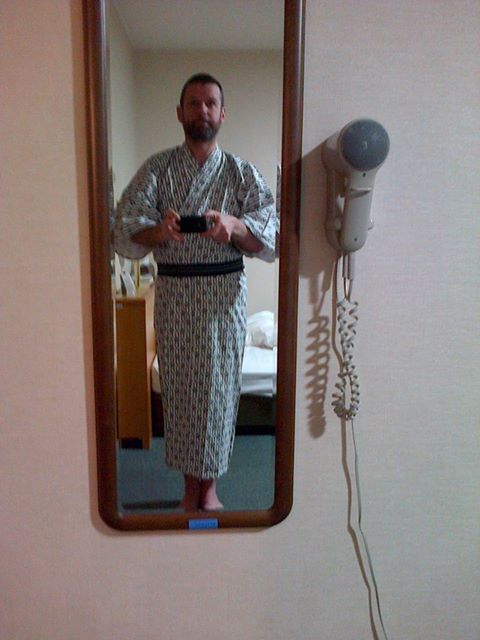
Selfie, with Yukata

Among the items provided in my room is a Yukata, a simple cotton robe with wide sleeves worn with an obi (belt). I decided to try mine on and the result is shown on the left. Unfortunately I broke the symmetry incorrectly: one is supposed to wrap the left side over the right, whereas I did it right over left. The way I did it is apparently the way a body is dressed for burial. At least it looks right correct in the mirror.

Incidentally, the Japanese also drive on the right side of the road, ie the left.

The Yukata is extremely comfortable, and is often worn outdoors during the summer months or so I’m told. It’s too chilly in Nagoya at this time of year to go out wearing one, but it’s fine for indoors.
And before you ask, that’s not a telephone by the mirror but a hair-dryer…

During the days I’ve been busy getting on with work as well as talking a very great deal with some of the Doctoral and Masters students here at the Kobayashi-Maskawa Institute about their work. I think they relished the chance to practice speaking English as much as to get my input into the science. Anyway, the topics are very wide-ranging: higher-order perturbations to the Boltzmann Equation, analysis of Hα galaxy surveys, weak lensing in modified gravity theories, primordial magnetic fields, luminous red galaxies in clusters, analysis of 21cm surveys, etc.


A strange thought struck me walking to the office this morning. To me Japan is a foreign culture and I can’t speak a word of the language but, despite all that, I find it much easier to imagine living here than, say, America (where I can at least speak a similar language to the locals).  I’m not sure that this makes sense in terms of an explanation, but Japan seems to be a country that probably makes a lot of sense once you come to terms with it. I’m not saying that I want to move here, just that I feel a lot less alien here than I expected, and a lot less alien than I do in places much closer to home.

A Summer of Undergraduate Physics Research

Posted in Biographical, Education, The Universe and Stuff with tags , , , , on January 14, 2014 by telescoper

I was compiling a bibliography for a new paper yesterday and noticed that a paper published in December 2013 cited one I wrote in 2005 with Andrew Stannard while I was working at the University of Nottingham; the rarity of anyone actually referring to any of my papers caught my attention. I include the abstract of the Stannard-Coles paper here for reference:

We investigate the properties of the (complex) coefficients obtained in a spherical harmonic representation of temperature maps of the cosmic microwave background (CMB). We study the effect of the coefficient phase only, as well as the combined effects of phase and amplitude. The method used to check for anomalies is to construct a `random walk’ trajectory in the complex plane where the step length and direction are given by the amplitude and phase (respectively) of the harmonic coefficient. If the fluctuations comprise a homogeneous and isotropic Gaussian random field on the sky, the path so obtained should be a classical `Rayleigh flight’ with very well known statistical properties. We illustrate the use of this random-walk representation by using the net walk length as a test statistic, and apply the method to the coefficients obtained from a Wilkinson Microwave Anisotropy Probe (WMAP) preliminary sky temperature map.

This seems like ancient history now, particularly with regard to the use of “preliminary” WMAP data, but it was only just over 8 years ago. I never imagined during the time that we were working on this paper that I’d be moving twice! By contrast, Andrew Stannard remained in Nottingham, doing a PhD there and is now employed as a Research Fellow, although he switched fields after the project and moved into nanoscience.

Anyway, I wasn’t posting this so I could take a trip down memory lane. I thought I’d post it in order to point out that this paper actually came about as an undergraduate research project that Andrew did under my supervision during the summer of 2005, funded by a Mary Cannell Summer Studentship. Mary Cannell was the author of a book about the life of George Green (the famous mathematician who came from Nottingham); she passed away in 2000 leaving some money to the School of Physics & Astronomy to fund summer research placements for undergraduates. If I recall correctly, we completed the analysis and wrote the paper during the summer of 2005, submitting it in August and having it accepted in September. If only it were always so straightforward! Since publication it has garnered 15 citations according to the ADS website; not exactly earth-shattering, but respectable enough, especially given the background. I think it may get a few more in the next few years because the quality of data from Planck may now be good enough to actually detect the features we were looking for all those years ago!

It’s worth mentioning that in the School of Physics and Astronomy at the University of Sussex we have a degree programme in which students receive a stipend to cover living expenses during a summer vacation placement with one of the research groups each and every year of their studies. This is in addition to the usual lectures and laboratory work of the standard  course. This involves many more students than was the case back in Nottingham in 2005, but since I’ve only been at the University of Sussex for  a year I don’t know how many such placements have led to actual publications.

Does anyone know of any really important papers out there that came from undergraduate research projects? If so, please let me know through the comments box..

The Flowers of January

Posted in Art, Biographical, History with tags , , , , on January 12, 2014 by telescoper

Today’s tourist itinerary  took me first to the Tokugawa Art Museum, which contains family treasures from the Owari Tokugawa family, one of the families from which the Shogun was chosen during the Edo period (which lasted from 1603 until 1867 and is sometimes called the Tokugawa period). The collection is magnificent, comprising arms and armour of the elite Samurai warriors as well as art, garments, furniture, and household objects of the period, all made to a standard befitting a Japanese noble family. The highlight for me was the wonderful display of maps and books illustrated with exquisite ink drawings. What struck me most is how stable was the general form of artistic expression in the period covered by the museum, in contrast with what you would find in a European collection over a similar timescale. Japan was very much a closed country during the Edo period  and consequently did not experience foreign influences on its culture in the same way as Britain did in the 17th-19th centuries.

The Tokugawa Art Museum is adjacent to the Tokugawaen, a formal Japanese garden originally built in 1695. January is probably not the best time to visit this place – the numerous cherry trees must look beautiful when covered in blossom – but I was quite surprised to see a significant number of flowering plants even at this time of year.

I’m no botanical expert but these look like Camellias to me:

SAMSUNG DIGITAL CAMERA

SAMSUNG DIGITAL CAMERA

These are Peonies:
SAMSUNG DIGITAL CAMERA

Some of the trees are still wrapped in their winter bamboo coats for protection from the frost:

SAMSUNG DIGITAL CAMERA
The lake contains an impressive collection of multi-coloured carp

SAMSUNG DIGITAL CAMERA

The Tokugawaen is worth a visit even in the off-season, but I really must find an excuse to come back in April or May when the cherry blossom will be out and, according to the literature handed out to visitors, thousands of Peonies will be in bloom all around the lake. That must look amazing!

Anyway, after that I travelled across town to visit the famous Atsuta Shrine, a holy place for the Shinto religion:

SAMSUNG DIGITAL CAMERA

Light was fading and I was already feeling a bit tired, but I did the necessary ritual ablutions, and had a quick look around. Visitors are allowed to make a wish after throwing a coin in the appropriate place, then bowing and clapping twice. I wished for a beer, and lo and behold on the way home I found a bar in which my wish was granted!

Out and about in Nagoya

Posted in Biographical, History with tags , , , , on January 11, 2014 by telescoper

I spent an enjoyable morning wandering about Nagoya, so I thought I’d post a few pictures before settling down to do some work (which is, after all, what I’m here for…)

First off, here’s the place I am officially visiting. This is the central building of the Graduate School of Science and Engineering, the top two floors of which comprise the Kobayashi-Maskawa Institute, which covers particle physics and astrophysics.

SAMSUNG DIGITAL CAMERA

I’ll be giving a talk there next week, in fact. I’m staying on the campus about 5 minutes’ walk away from this building in a pleasant guest room in the Green Salon Higashiyama which is not green and is not a hairdresser’s shop.

The nearest Metro station is a very short walk from the Department building and the first thing I discovered when I entered was surprising evidence that the Japanese have an interest in cricket:

SAMSUNG DIGITAL CAMERA

Given that I posted a picture of the place before embarking on my travels I decided to visit Nagoya Castle. This enormous complex of buildings and fortifications was constructed in the early 17th Century, but a visit by American B29 bombers on 18th May 1945 dropping thousands of incendiary bombs destroyed everything except the massive stone walls; the other buildings were made of wood and would have burned easily in such an attack. At the time the Castle was being used as an army base, so it was inevitable that it would be a target.

The perimeter of the Castle is defined by massive stone walls surround by a wide moat. Similar stone fortifications surround the central buildings and the only approach to the centre of the Castle by water is surrounded on both sides by similarly formidable structures from which missiles would no doubt rain down on unwelcome visitors. The central buildings are also ringed by a deep ditch which was clearly designed to be flooded when necessary; today there are deer grazing at the bottom of it.

The two main keeps or donjons of the castle have been reconstructed and now house very interesting museums containing not only military artefacts but also lovely screen prints and pieces of furniture from the Edo period, during which the castle was constructed.

Here are a few pictures just to prove that I was there!

One of the smaller buildings inside the perimeter of the Castle:

SAMSUNG DIGITAL CAMERA

Approaching the main keep:

SAMSUNG DIGITAL CAMERA

Entrance to the main keep:

SAMSUNG DIGITAL CAMERA

Main keep, with walls and ditch..

SAMSUNG DIGITAL CAMERA

This is the view from the gallery at the top…
SAMSUNG DIGITAL CAMERA

From Nagoya

Posted in Biographical with tags , , , on January 10, 2014 by telescoper

So, my first ever trip to Japan has started pretty well. The flight via Frankfurt arrived on schedule and I arrived with all the luggage I was supposed to have too! I didn’t get any sleep on the long flight from Frankfurt to Nagoya, but then I never seem to manage to drop off on aircraft. I was quite jealous of the lady next to me, actually, as she slept soundly for most of the journey.

Here I am, then. It’s mid-afternoon local time but ridiculously early morning on my body clock. Travelling West to East is always more difficult, I think. Going the other way you can usually sleep off the jet lag pretty quickly, but going East-West and arriving in the morning (local time) means you’ve basically lost a night’s sleep. On a trip to Shanghai years ago I was in a similar situation, arriving at the airport in mid-morning to be met with a welcoming committee and taken to a very big lunch (complete with beer). When this was over, around 3.30 in the afternoon, my hosts suggested that I must be tired and took me to my hotel. No sooner had I unpacked my bags and put my feet up than I fell sound asleep; I didn’t wake up until midnight. So it was that I remained completely out of kilter with the time zones. It took most of my stay in China to get adjusted. I thus learned the hard way that if you want to deal successfully with the problem of jetlag then you have to stay awake as long as possible on the day you arrive…

I must seem like a complete wimp to those observational astronomers who not only go jet-setting around the world but also climb up and down mountains to get to observatories perched on their summit as well as working all night rather than day once they’ve got there.  How they manage to cope with all that and remain (relatively) compos mentis when they arrive back at their day job is beyond me.

Anyway, despite lack of sleep the flight wasn’t too bad. I was impressed by the collection of classical music and jazz available on the in-flight entertainment system offered by Lufthansa, and there were even some decent movies on offer. I managed to see the first of Peter Jackson’s Hobbit movies, which I quite enjoyed though I found some of the set-pieces far too drawn out. I also watched, for the first time in ages, Kubrick’s 2001: A Space Odyssey

First impression of Nagoya is that it’s basically an industrial city. My hosts tell me that the city was very heavily bombed during WW2 because of the important factories in the area. The campus at Nagoya University where I’m staying is fairly small but facilities seem pretty good. I’m looking forward to doing a bit of exploring at the weekend, when hopefully I’ll find some interesting historical buildings!

I was a bit worried about how well I would manage without being able to speak (or read) any Japanese. There are challenges, but the excellent Metro system is actually quite well signposted in English so I’m not anticipating too many problems sightseeing. Buying food might be another matter!

Better draw this rambling post to a close. Hopefully my brain will be up to writing something more substantial tomorrow..

On my travels…

Posted in Biographical with tags on January 9, 2014 by telescoper

Hopefully by the time this post is published I’ll be in mid-air. I may be offline for a while but home to resume my blogging activities when I reach my destination.

If you’d like a bit of a clue as to where I’m going, here’s a local landmark…

Mystery Image

A Long Day’s Journey into Brighton

Posted in Biographical on January 3, 2014 by telescoper

Just time for a quick post before I have my Ovaltine. I travelled back to Brighton today by train from Cardiff, where I’d spent a few days either side of New Year.

The journey back to Brighton was a bit of a struggle, courtesy of heavy overnight rain and a later, more mysterious, problem with “lightning damaging equipment” – which must be an impressive piece of kit! Anyway, trains could only move at a crawl between Cardiff and Newport while a temporary signalling system was in place, ie a man standing on a ladder waving a flag. I think he’s still there as I write this.

An hour after leaving Cardiff the train made it to Newport (a distance of about 15 miles) and then gave up. We all got out and waited another half an hour for a train to London Paddington.

After that it all went reasonably well, and I got to London Victoria a mere four and a half hours after leaving my Cardiff residence. I was relieved to see a Brighton train due to leave at 19.36 which I got on, but since it was only four carriages long it was packed. I managed to find a seat in the section marked “Priority” which, naturally, applies to me.

Anyway I got back to the flat about 9pm, so the journey was six hours door-to-door. Not too bad, really, given the inclement weather, though I can’t help wondering why our railway network is so terribly vulnerable to the effects of rain? It’s not exactly a rare occurrence in Britain, is it?

Could we not divert just a small fraction of the money spent on glitzy new stations towards better flood protection and/or more robust signalling equipment?

Anyway, back to work tomorrow – much to do before next week when I’ll be travelling again, a tad further this time..

A Brief History of Portland Place, Brighton

Posted in Biographical, Brighton on December 23, 2013 by telescoper

Tidying up the flat before my Christmas travels, I found a little piece of paper in a drawer with the following potted history of Portland Place.

The development of Portland Place commenced around 1824, when Major Villeroy Russell commissioned Charles Augustus Busby as architect for the design of the street and houses. There was a most unfortunate incident on the night of 12th September 1825, during the building of the street, when the principal house caught fire and was totally destroyed. As it was not insured, Major Russell had to bear the estimated £12,000 loss himself. The first occupant moved into Number 11 in 1827 but the buildings to replace the one destroyed by fire were not completed until 1829. Building work continued in the street until almost up to the 1850s, so the dates of individual buildings may vary considerably.

That all explains why this street lacks the homogeneity of style possessed by some its grander neighbours, though the houses are still looking pretty good for their age!