Archive for the Biographical Category

An Integral Appendix

Posted in Biographical, Cute Problems, The Universe and Stuff with tags , , , , , , on August 7, 2013 by telescoper

After the conference dinner at the Ripples in the Cosmos meeting in Durham I attended recently, a group of us adjourned to the Castle bar for a drink or several. I ended up chatting to one of the locals, Richard Bower, mainly on the subject of beards. I suppose you could call it a chinwag. Only later on did  we get onto the subject of a paper we had both worked on a while ago. It was with some alarm that I later realized that the paper concerned was actually published twenty years ago. Sigh. Where did all that time go?

Anyway, Richard and I both remembered having a great time working on that paper which turned out to be a nice one, although it didn’t exactly set the world on fire in terms of citations. This paper was written before the standard “concordance” (LCDM) cosmology was firmly established and theorists were groping around for ways of reconciling observations of the CMB from the COBE satellite with large-scale structure in the galaxy distribution as well as the properties of individual galaxies. The (then) standard model (CDM with no Lambda) struggled to satisfy the observational constraints, so in typical theorists fashion we tried to think of a way to rescue it. The idea we came up with was “cooperative galaxy formation”, as explained in the abstract:

We consider a model in which galaxy formation occurs at high peaks of the mass density field, as in the standard picture for biased galaxy formation, but is further enhanced by the presence of nearby galaxies. This modification is accomplished by assuming the threshold for galaxy formation to be modulated by large-scale density fluctuations rather than to be spatially invariant. We show that even a weak modulation can produce significant large-scale clustering. In a universe dominated by cold dark matter, a 2 percent – 3 percent modulation on a scale exceeding 10/h Mpc produces enough additional clustering to fit the angular correlation function of the APM galaxy survey. We discuss several astrophysical mechanisms for which there are observational indications that cooperative effects could occur on the scale required.

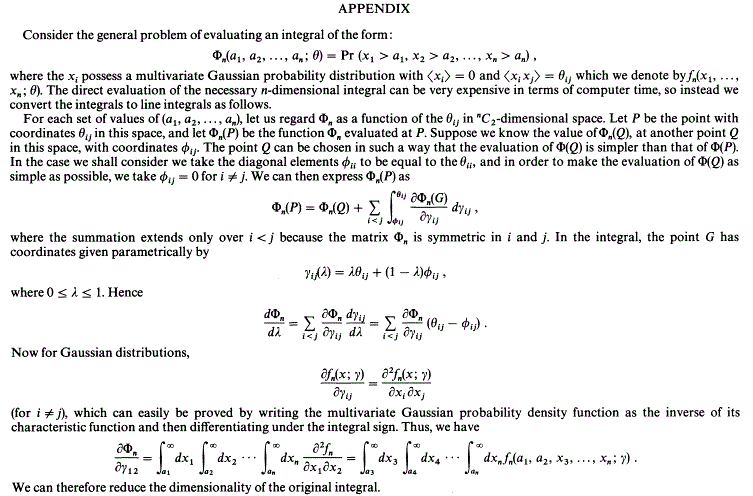
I have to say that Richard did most of the actual work on this paper, though all four authors did spend a lot of time discussing whether the idea was viable in principle and, if so, how we should implement it mathematically. In the end, my contribution was pretty much limited to the Appendix, which you can click to make it larger if you’re interested.
t2png

As is often the case in work of this kind, everything boiled down to evaluating numerically a rather nasty integral. Coincidentally, I’d come across a similar problem in a totally different context a few years previously when I was working on my thesis and therefore just happened to know the neat trick described in the paper.

Two things struck me looking back on this after being reminded of it over that beer. One is that a typical modern laptop is powerful enough to evaluate the original integral without undue difficulty, so if this paper had been written nowadays we wouldn’t have bothered trying anything clever; my Appendix would probably not have been written. The other thing is that I sometimes hear colleagues bemoaning physics students’ lack of mathematical “problem-solving” ability, claiming that if students haven’t seen the problem before they don’t know what to do. The problem with that complaint is that it ignores the fact that many problems are the same as things you’ve solved before, if only you look at them in the right way. Problem solving is never going to be entirely about “pattern-matching” – some imagination and/or initiative is going to required sometimes- but you’d be surprised how many apparently intractable problems can be teased into a form to which standard methods can be applied. Don’t take this advice too far, though. There’s an old saying that goes “To a man who’s only got a hammer, everything looks like a nail”. But the first rule for solving “unseen” problems has to be to check whether you might in fact already have seen them…

Beard Facts

Posted in Beards, Biographical with tags on August 6, 2013 by telescoper

I received this very enlightening infographic via @Albertthegoat on Twitter and thought I’d share it here:

BQ7ijNQCAAASK0v

…but shouldn’t it be “instinctively”?

The Road to Edinburgh

Posted in Biographical with tags , on July 29, 2013 by telescoper

And so, after a pleasantly relaxing weekend in Newcastle after the end of last week’s conference in Durham, the latest leg of my little UK tour finds me in the fine city of Edinburgh. I originally intended to travel by train, but my folks offered to drive me here instead. Unfortunately the weather wasn’t all that great:

IMG-20130729-00156

It took a bit longer to get here than I’d hoped, which left me feeling a bit guilty that they had to turn right around and go back (after a spot of refreshment near the hotel) while I had a short nap in the cosy B&B kindly booked for me by the Royal Observatory. Anyway, I have quite a bit of work to do this evening and tomorrow. After that I’ll be flying back to Gatwick and thence to Brighton, where I’ve got even more to catch up on. There’s no rest for the Head of School…

No more ripples?

Posted in Biographical, The Universe and Stuff with tags , , , on July 27, 2013 by telescoper

Well, that’s the Ripples in the Cosmos meeting in Durham over and done with, and I’m back in Newcastle for a few days before moving on to Edinburgh next week. I’m not sure I’ll be able to blog much over the next few days because my internet connectivity will be a bit limited.

Anyway, the meeting was very exciting, as you can tell from the picture showing me (with the beard) and Brian Schmidt (with the Nobel Prize):

IMG_20130725_144131

Yesterday it was my job to round off the meeting with some concluding remarks leading into a panel discussion. I have to admit that although the programme for the conference was clearly designed in order to generate provoke discussion, I was a little disappointed that so few people said anything controversial. I’ve long held that there are too many cosmologists willing to believe too much, and this was further evidence that the scepticism that is a necessary part of a healthy science has been replaced by widespread conformity, especially among the young; when I was a lad the students and postdocs were a lot more vocal at meetings than they are now. Perhaps this is characteristic of a change in culture of cosmology? To get a job nowadays it’s virtually essential to climb onto one of the big bandwagon projects, and to keep your place you have to toe the party line, refrain from rocking the boat, not speak out of turn, and avoid making ripples (That’s enough metaphors. Ed).

Anyway, I think there are still a great many things in modern cosmology we don’t understand at all, and I think a few more of the older generation should show the way by questioning things in public. In fact only got asked to do the concluding remarks because Jim Peebles was unable to come to the meeting. Jim’s an immensely distinguished physicist who has probably done more than any other living person to develop the standard cosmology, but he’s also never been afraid to play devil’s advocate. We need more like him, willing to articulate the doubts that too many of us feel the need to suppress.

It’s amazing how much progress we have made in cosmology over the last few decades, but we shouldn’t use that as an excuse to get complacent. Cosmology is about the biggest questions in science. That alone makes it an exciting subject to work in. It’s an adventure. And the last thing you want on an adventure is for the journey to be too comfortable.

The Mysterious Mr Ripples

Posted in Biographical, The Universe and Stuff with tags , , on July 24, 2013 by telescoper

So here I am in the fine city of Durham, in the North Midlands, for a meeting entitled Ripples in the Cosmos. I travelled by plane from Gatwick to Newcastle on Sunday afternoon, and got there eventually – after a two-hour delay caused by the aircraft we were meant to fly on having a technical problem and needing to be replaced by another. Anyway, I spent Sunday with my folks. Thinking it was only going to be a half-hour drive to Durham, we left early on Monday morning so I’d be in time to chair the first session.

Unfortunately, major roadworks on A1 intervened and we got stuck in traffic near the Metro Centre in Gateshead. Fortunately, various people at the conference caught my Twitter updates and a deputy was arranged. I got there about 30 minutes late and I took over after the coffee break.

300px-Yard2
After the day’s conference I wandered up to Durham Caste (left), where I had a room booked for the week. However, when I got there they had no record of my reservation. The porter was very helpful and let me connect to my email to check, and I retrieved the confirmation of my booking. In exasperation, I looked through the papers he had relating to room bookings, and found one in the name of “Mr Ripples”. Not even “Professor Ripples”, mark you.


The mysterious Mr Ripples not having appeared to claim his room I surmised that the similarity of his name to the title of the conference might indicate that perhaps some administrative error might have been made. The porter agreed, changed the name from Mr Ripples to Professor Coles and gave me a key.

Anyway, Durham Castle is a rather splendid place to stay.  Breakfast is to be had in grand surroundings complete with walls decorated with suits of armour, swords and other historical weapons. This environment, together with the continuing warm weather, as well of course as the excellent conference talks, has made this very enjoyable week so far.  Apart from the nagging doubt that Mr Ripples could suddenly turn up and demand his room, the only problem is the ringing of bells all through the night.

The conference dinner is this evening, and it’s in the Great Hall of Durham Castle so I won’t have far to stagger home to bed…

Equal Marriage!

Posted in Biographical, Politics with tags , on July 15, 2013 by telescoper

BPOdpF3CcAAfr5C

I just heard that the Equal Marriage Bill has now passed its Third Reading in the House of Lords – without a vote – and now just requires the Royal Assent to become the Equal Marriage Act, allowing couples of the same sex the right to marry.

I find this quite an amazing thing. When I came to the University of Sussex as a graduate student in 1985, Brighton was one of the most gay-friendly cities in the UK, if not the world. However, the veneer of tolerance was often very thin. Homophobic prejudice was still commonplace, and it was by no means uncommon for that to turn into violence, as I know to my own cost. The Local Government Act of 1988 included Section 28, which enshrined anti-gay attitudes in law. I would never have imagined at that time that, just 25 years later, a law would be passed allowing people of the same sex to marry. It still seems barely comprehensible that attitudes can have changed so much in the second half of my lifetime. Equality in marriage doesn’t mean equality in everything, of course, and prejudice obviously hasn’t vanished entirely, but it’s a start.

It’s probably all come a bit too late for me to get married. I think I’m destined to remain forever an ineligible bachelor,  but I hope at least I’ll get invited to quite a few weddings in the near future. There’s quite a lot of catching up to do…

Lectured Out

Posted in Biographical, Education with tags , , , , , on July 10, 2013 by telescoper

Just time for a quick post today because I’m quite knackered. Both my lectures for the Summer School I’m attending were this morning, and each was 90 minutes long – though there was a 30 minute coffee break between the two. The students therefore had to out up with me droning on most of the morning so were probably sick of the sight of me by lunchtime although they were quite polite about it. MOst of the participants went off on an excursion after lunch, but I decided to stay behind and take a siesta. I’m definitely too old for hiking in this heat.

The conference organizers told me that ninety minute lectures are apparently quite normal in Germany. I’m not sure why. I don’t think students can concentrate for that length of time, and it’s a definite strain on the lecturer too. I find even an hour lecture quite tiring, actually, but that’s more the effect of expending nervous energy walking backwards and forwards trying frantically to tell if anyone is understanding what I’m talking about. I usually enjoy lecturing actually, but it’s definitely stressful at the time. Now that I’m Head of School I won’t get to do as much teaching in the future as I did in the past. I suppose I’ll miss that “contact” with students, but I don’t think their education will suffer at all as a consequence of not being taught by me!

This is graduation week at the University of Sussex; finalists from the School of Mathematical and Physical Sciences actually graduate tomorrow. In normal circumstances I would be there to read out the names as the graduands parade across the stage, but I committed to attend this Summer School long before I’d even been appointed to my job as Head of MPS so felt I shouldn’t leave the organizers in the lurch. The Deputy Head of School will therefore do the honours at tomorrow’s ceremony. I haven’t been there long enough to get to know the graduating class very well, so it’s quite fitting that he’s looking after them on the big day. In other words, I don’t think I’ll be missed. I also see that final year students from the School of Physics & Astronomy at Cardiff University will be graduating next Monday (15th July). I’ve known some of them for almost four years so feel a bit sad that I left before they finished, but I’m sure I won’t be missed on that occasion either. I bet most of them have already forgotten I was ever there!

Anyway, on the off chance that any graduating students from either Sussex or Cardiff happen to read this, I hope you enjoy the graduation ceremony and associated celebrations and wish you well as you embark on the next stage of life’s journey.

Germany Calling…

Posted in Biographical, Books, Talks and Reviews, The Universe and Stuff with tags , , , , on July 7, 2013 by telescoper

Just a quick post to break radio silence and announce my arrival in the picturesque town of Bad Honnef, spa town in Germany near Bonn in the Rhein-Sieg district of North Rhine-Westphalia. We’re right on the banks of the Rhine actually, and there are some fine views of castles and hills to be had all round.

To get here I took my life in my hands and flew with a German budget airline called Germanwings from Heathrow to nearby Bonn-Cologne airport. I mean it’s near to Bad Honnef, not to Heathrow. Apart from the fact that I had to queue for an hour at check-in because the staff apparently didn’t know how to operate the computer system, and the flight was delayed leaving because it was delayed on the way in, it wasn’t actually too bad; we arrived only about 25 minutes late and I was able to have a few beers and some food when I arrived at my destination.

The reason for this expedition is that I’m giving two lectures at the Deutschen Physikalischen Gesellschaft (henceforth DPG) Summer School on Inflation and the CMB. The list of other speakers is very impressive so I assume that some form of administrative error is responsible for my invitation, and especially for the fact that I’ve got to give two lectures while everyone else is just giving one…

Anyway, it’s lovely weather here – although a little on the toasty side for my cold English blood – and I hope to get the chance to take a few pictures as well as some updates from the meeting. I also hope to find out why this place is called Bad Honnef. I know I’ve only been here a few hours, but it seems to me that, as Honnefs go, it’s really not bad at all…

Prudential Negligence

Posted in Biographical, Finance with tags , , on July 4, 2013 by telescoper

It’s been a long day, but before heading home I thought I’d do a quick post to update what looks like turning into quite a saga. Not long ago I blogged about a surprise letter of condolence I received about my father’s death. It was a surprise because my Dad died nearly six years ago…

The letter I referred to above actually came from the Annuities Department of the Prudential. I didn’t name them in my previous post because I didn’t want to rock the boat, and in any case I couldn’t remember the Pru being among the list of companies I wrote to after the funeral all that time ago. In between my previous post and now I had the chance to go through my old correspondence and establish that I did, in fact, write to the Prudential soon after my father passed away. To confirm this, a few days ago I received another letter from them admitting that they received my letter in 2007 and failed to act on it. I hadn’t pursued the matter at the time, probably because I thought they would just stop the small annuity he was apparently receiving from them and that would be that. In fact it turns out some money is owed (and has been owing all this time) to my Dad’s estate and nobody at Prudential bothered to do anything about it until now. I’m not impressed.

Naturally I’m a bit cheesed off with this, as I now have to do a number of things (like getting a copy of my father’s death certificate) in order to claim the residual funds. I’ll also be expecting quite substantial compensation for the gross negligence Prudential have shown too.

However, the main reason for posting about this episode is that it doesn’t exactly inspire me with confidence about the workings of the Prudential. That’s worth bearing in mind by any academics who have taken out Additional Voluntary Contributions (AVCs) to the Universities Superannuation Scheme (USS) in order to plan for early retirement or to make up for missing years’ contributions. You see, the USS voluntary contribution scheme is in fact managed by Prudential…

Slow Progress for Female Physics Professors

Posted in Biographical, The Universe and Stuff with tags , , , , on July 1, 2013 by telescoper

One of the more pleasant jobs I have to do these days is to congratulate staff in the School of Mathematical and Physical Sciences at the University of Sussex when they get promoted, whether it be to Senior Lecturer, Reader or Professor. There has been quite a crop of promotions at all levels in the School recently, owing to the excellent contributions made by so many people to teaching, research and other aspects of the work we do.

One of the successful promotion candidates in the latest round was the Head of our Experimental Particle Physics group, Antonella de Santo, whose promotion to Professor of Physics makes her the first ever female Professor of Physics at the University of Sussex. I’m rather embarrassed to admit that, actually, as the University has existed for 51 years, but at least I can say better late then never!

Anyway, Antonella’s well-deserved success prompted me to look into the statistics of female physics & astronomy professors. I’ve already posted about how the proportion of female undergraduates studying physics as been stuck at around the 20% mark for a decade despite strenuous efforts to widen participation. A recent (2012) study by the Institute of Physics contains a wealth of statistical information about staff in Physics departments, which I encourage people to read if they’re interested in the overall issue with equality and diversity in physics. Here I’ll just pull out the figure (based on a 2010 survey) that out of a total of 650 Professors of Physics (and/or Astronomy) in the UK, just 5.5% were female. At that date about 20 physics departments had no female professors at all; that would have included Sussex, of course.

Another University, Liverpool, also recently appointed its first female Professor of Physics in the person of Tara Shears, another particle physicist. The current  Head of the  Department of Physics at Imperial Collge is Joanna Haigh, (who I thought was the first to occupy such a position until corrected by the comment below) so there are signs that career prospects are improving for female physicists, but progress is painfully slow. The first ever female Professor of Physics in the United Kingdom was Daphne Jackson, a nuclear physicist, who took up her Chair at the University of Surrey way back in 1971. It’s interesting to note that when Daphne Jackson studied physics as an undergraduate at Imperial College she was one of only two women among the 88 undergraduates in her year.

I don’t personally think that there’s a significant gender bias when it comes to the consideration of promotion cases at the University of Sussex (or at any other institution I’ve worked at), but there’s plenty of anecdotal evidence that women are much more reluctant than men to put themselves forward for consideration at any level. I hope that recent successes in MPS, such as Antonella’s Professorship and Readerships for astronomer Kathy Romer and mathematician Vanessa Styles, will provide the necessary encouragement.