Archive for the Biographical Category

Old School

Posted in Biographical, Education with tags , , on June 29, 2011 by telescoper

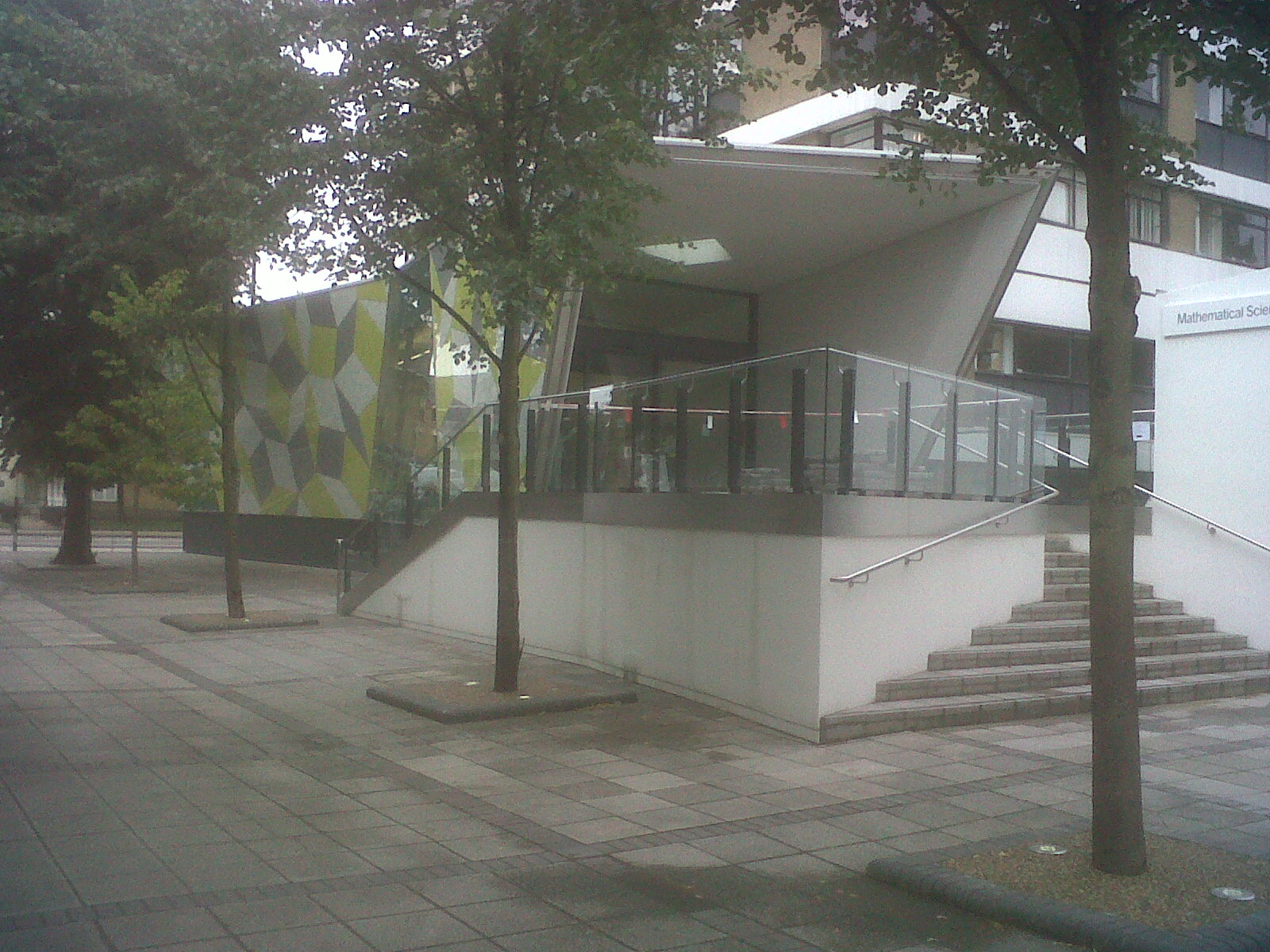
Yesterday was a busy day, involving me travelling to London in order to carry out my duties as external examiner for the MSc in Astrophysics in the School of Mathematical Sciences at Queen Mary, University of London. Every time I go to my old stomping ground on Mile End Road,  the East End something seems to have changed, whether in the college or in the environs. This time was no exception, as they’ve finally finished the new entrance to the Mathematical Sciences Building:

You can’t see it all that well, but it’s decorated with Penrose Tiling (although it’s not specified who did the grouting). Inside there’s a spacious new foyer area – devoid of any possible teaching use, but probably a nice area for students to gather informally. Inside has a sort of 1960s retro feel, with bright yellow plastic floors and modernist soft furnishings. Austin Powers would probably feel at home there. The large lecture theatre has also been comprehensively refurbished and looks very nice, although its capacity has been reduced. Less emphasis on teaching facilities, more on “the student experience” I suppose.

I used to work at Queen Mary, in the Astronomy Unit; in this very building, in fact. I can’t help being a bit cynical about the new front entrance. There are so many other things wrong with the building – grubby concrete exterior, badly fitting windows and lavatories that don’t work, to name but a few – that I can’t really understand what made someone decide that what it really needed was a new garish plastic foyer. It’s up to Queen Mary to decide where to spend its money, of course, but I think it’s strange.

Other, bigger, news about the Astronomy Unit which I learned yesterday is that this summer, at long last, it’s moving from the School of Mathematical Sciences to merge with the Physics department in order to form a new School of Physics & Astronomy. In fact, when I was there there were astronomers in Physics (mainly instrumental and observational) and in Mathematical Sciences (mainly theoretical, including myself). Some years ago most of the instrumentation people moved from the School of Physics here to Cardiff, where they are still. The remaining astronomers moved to Mathematical Sciences. Now they’re moving back to Physics along with those currently in Maths. Oh what a tangled web.

For the time being the Astronomy Unit will stay in their existing offices but will eventually move in with Physics once that building is refurbished. I guess the main thing that will change immediately is that various astronomers will have new letterheads and will have to start teaching physics courses instead of mathematics.

Feelings about the move among the staff appear to be rather mixed, but I wish them well in their new School and with their plans to build up Physics & Astronomy in the future.

Louco

Posted in Biographical, Music with tags , on June 12, 2011 by telescoper

I’ve been saving this remarkable old record for a rainy day, and since it’s been tipping down all morning I think it’s time to share it.

Just a few months after I moved to my house in bit of Cardiff called Pontcanna I went with a friend to a little Portuguese restaurant just around the corner. The food was pretty cheap, fairly simple, but very tasty. The staff were friendly but extremely disorganized, taking ages to produce the food even though the place wasn’t at all busy. They also had some Portuguese fado music playing while we waited. I normally don’t like music in restaurants because even if the music’s worth listening to – which it usually isn’t – you can’t hear it properly anyway over the chatter and sound of knives on plates. In this case, however, towards the end of the meal,  I heard, for the very first time, a record featuring an agonized voice – as much haunted as haunting – which immediately sent cold shivers down my spine. I asked the waitress who was singing on the record we were listening to, and she told me it was the great Alfredo Marceneiro.

I’m not going to pretend to be any kind of an expert on fado, although I have at least heard of Amália Rodrigues (the greatest female fado performer of the classic era), and am a big fan of her wonderful modern counterpart Mariza. I hadn’t known until that night in the restaurant that there were any male fado singers at all. However, Alfredo Marceneiro’s career spanned a half a century, from the mid 1920s, and he has been an immense influence on younger generations of musicians since then. His compositions have also become part of the standard  repertoire. I suppose you could say that Alfredo Marceneiro is to fado what Robert Johnson is to the blues.

Fado is very much a Portuguese genre and I suppose it’s difficult to “get” if you’re not brought up with the tradition or even the language. I barely know a word of Portuguese myself, and have no idea what the words of the following song actually mean. I think it’s a testament to the power of the music that the actual words don’t seem to matter all that much when you can sing out of your very soul like this man could.

I’m afraid the Youtube version of this track is a bit truncated, but I’m putting it up anyway because it’s exactly the recording I heard that night three years ago. I think it’s a riveting performance, by an extraordinary artist who is celebrated in his own country, but who in my opinion deserves much wider recognition.

P.S. I know that the title “Louco” means “Crazy” in Portuguese, but   I’d be very grateful if someone could supply a translation of the rest of the song…..

P.P.S. I went back to the restaurant about six months after the time I mention in the post, but it had changed name and ownership. It’s now cleaner, but has much less character and no music. I haven’t returned.

Auditorium A

Posted in Biographical, Books, Talks and Reviews with tags , , , , , on June 8, 2011 by telescoper

Just back from a splendidly wine-laden workshop dinner, I thought I’d do a quick post. My talk was moved to this morning, instead of the scheduled slot in the afternoon I think it went OK considering that, in the spirit of a small informal workshop, I talked mainly about work in progess…

That’s the whiteboard in my office in Cardiff, by the way, not my talk this morning. Auditorium A has good old-fashioned blackboards.

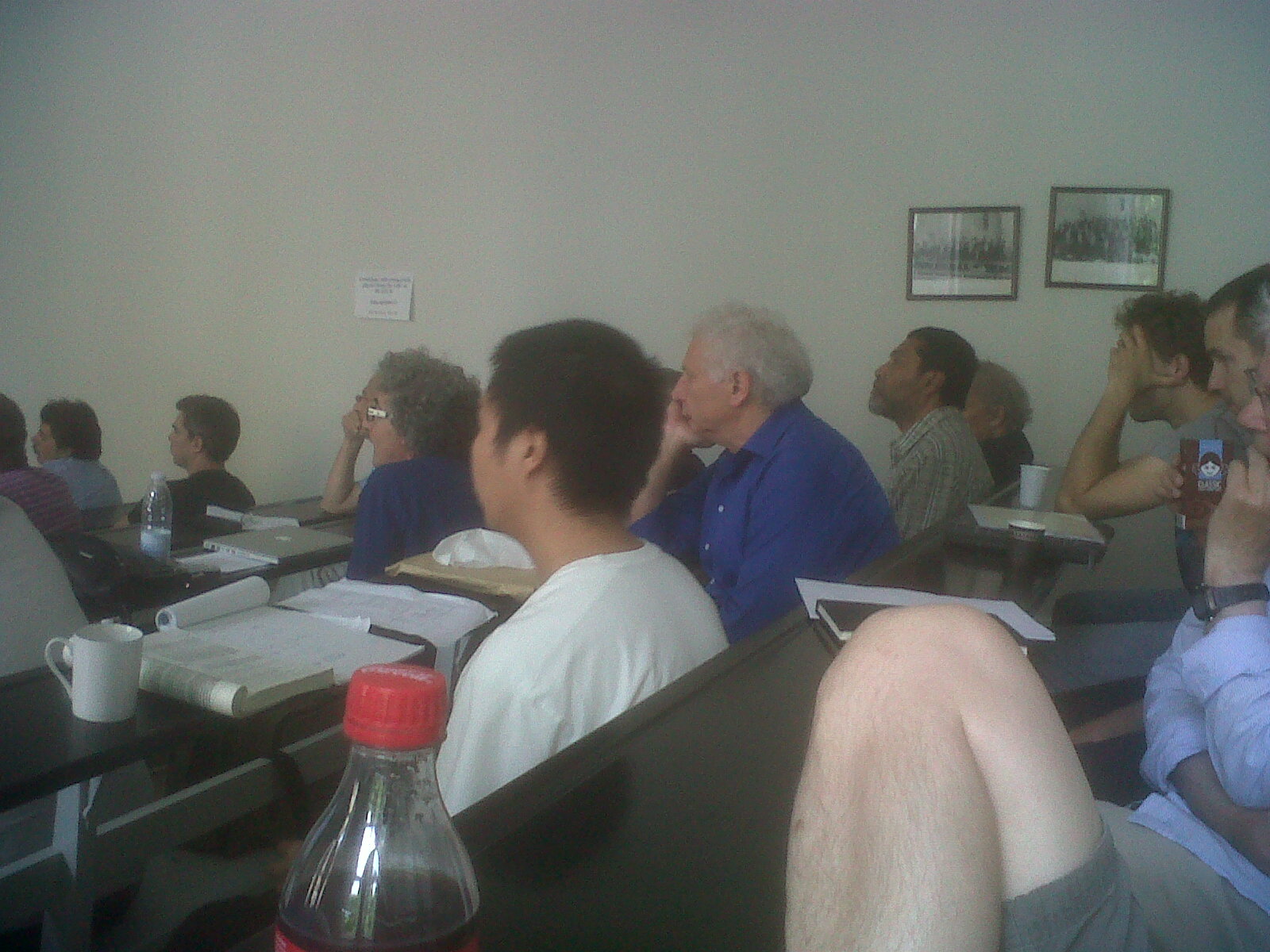
An advantage of speaking in the morning was that after it was over I was able to relax with a beer at lunchtime, but in the warm weather that made it rather difficult to stay on the ball afterwards. I’ve lost track of the amount of time I’ve spent sitting (or even speaking) in the famous Auditorium A of the Niels Bohr Institute over the years, actually, but I don’t think I’ve ever taken a picture there, so here’s one.

On the extreme left you can see our genial host Pavel Naselsky; in the centre left with blue shirt and grey hair, pretending not to be asleep, is Leonid Grishchuk; beside him to the right is Subir Sarkar and next to him,  more-or-less hidden from view, is Holger Bech Nielsen who travelled backwards in time especially to attend the workshop. The knee in the foreground remains unattributed.

Here is an “official” workshop photograph, taken while the participants were looking a bit more awake, but before quite a few had made it back from lunch..

The Happiest Place on Earth

Posted in Biographical with tags , on June 7, 2011 by telescoper

Here I am in wonderful Copenhagen. I arrived yesterday afternoon in lovely sunny weather, found my hotel, and then went for an evening stroll. It was so hot, in fact, that I was forced to sit outside drinking cold beer instead of preparing my talk, but then I’m not on until Thursday so there’s still time. Later on, the weather broke in spectacular fashion with a huge thunderstorm brewing up over the city. I sat and watched the son et lumière show out of the hotel window into the early hours, savouring the gorgeous earthy smell that comes with summer rain.

As I’ve mentioned before, Copenhagen is one of my favourite places. I was first invited here while I was a PhD student twenty-odd years ago and have been back at least once a year ever since. Of course, in the summer, especially in June when the days are longest, the city is particularly fine, but I actually like it here all year round. Of course it’s a bit dark and a bit cold in the winter months, but snow doesn’t make things fall apart here like it does in Britain, and Copenhagen takes on an austere beauty at that time of year which endows it with a unique sense of place. And, best of all, the harsh winter seems to make people embrace the summer even more joyfully. It was lovely to see people out enjoying themselves last night in the sunshine without a hint of the violence that blights Britain’s town centres after a day like this. Above all, though, Denmark is just such a civilised place. It’s a very egalitarian society, with excellent public services, virtually no poverty, a strong sense of its own identity, and a robust democracy.

After an early breakfast in my hotel (the slightly odd but very comfortable Hotel 9 Små Hjem where I’ve stayed a number of times in the past), I found this clip on Youtube.

I find it very amusing for a number of reasons. One is the supposition that happiness goes with sunny weather, which I find laughably superficial. I’d hate to live anywhere where the weather was the same every day, even if it were warm. The reporter also seems bemused that Canada appears higher in the table than the USA. It’s no surprise to me: given the choice, I’d much rather live in Canada than America!
Above all, the snide incredulity about “cold, dreary, unspectacular” Denmark is a truly excellent self-parody. It may be cold – sometimes – but, as Billy Connolly once said, “there’s no such thing as bad weather, just the wrong clothes”. But there’s certainly nothing dreary about Denmark – it has a vibrant culture and a long and fascinating history. It may be “unspectacular”, if by that you mean that it’s not gaudy or pompous or ostentatious. Modesty is a sadly underrated virtue.

I’m not a fan of league tables – and I dread to think what bizarre methodology produced the one referred to in the clip – but as a seasoned visitor it actually comes as no suprise to me that the Danes are in the Premier division for happiness. The point is that happiness isn’t about external things such as the weather. Nor is it about showing off. It’s a frame of mind. The Danes seem to understand that better than most.

P.S. I love Victor Borge! And what’s wrong with herring sandwiches?

From Time to Time

Posted in Biographical, The Universe and Stuff with tags , , on June 5, 2011 by telescoper

It having been my birthday yesterday, and very nice it was too, thank you for asking, I’m filled this morning with thoughts about the passage of time. It’s strange how working in education imposes a cycle on your life: admissions, teaching, exams, graduation ceremonies, summer recess, and so on. The main thing that breaks this pattern of recurrence is when students finish their finals and leave for the big wide world. Since I moved to Cardiff in 2007, the 4th year students who have just finished their examinations are the first cohort that I’ve seen through their whole degree programme at Cardiff University, and it will be great to see them all get their degrees next month in St David’s Hall, but it will be yet another reminder of the passage of the years.

Not that I’m one to get depressed about such things. I’ve taken surprisingly well to middle age and gracefully (?) surrendered the things of youth some time ago. However, time is such a mysterious thing it’s hard not to think about its passing every now and then.

This time last year I was in Copenhagen for a small cosmology workshop. There’ll be a repeat performance next week too, so I’ll be off to Denmark for a few days. In fact I bought my ticket some time ago, but realised only on Friday that it was next week, and not the week after, so have had to rearrange a few things rather hastily. The advancing years have obviously addled my brain.

Anyway, all this talk about time and cycles gives me some sort of excuse to post the following video from the ESO Very Large Telescope in Chile. The photography is wonderful. Pity about the music, though. Spoils it a bit if you ask me…

Public Attitudes to Science

Posted in Biographical, Science Politics with tags , , , , on May 10, 2011 by telescoper

Another quick bit of news to catch up on concerns the publication (on May 2nd) of a study by Ipsos MORI into Public Attitudes to Science. I have a special interest in this study because in fact I took part in it, in the role of a sort of science observer at the session held in Cardiff, which I blogged about in November 2010.

The study was not based on a particularly large sample – only 2103 people – but the results are quite interesting (and perhaps surprising). You can download the full report here, including a mention of yours truly on page 121, but it’s worth mentioning a few of the headline results for those of you who haven’t the energy to read the entire document. For example,

  • 82%  thought that “science is such a big part of our lives that we should all take an interest”
  • 88% thought that scientists “make a valuable contribution to society”
  • 82% thought that scientists “want to make life better for the average person”

On the other hand

  • 51% thought  they see and hear too little information about science
  • 56%  do not feel well informed about scientific research and developments
  • 66% think that scientists should listen more to what ordinary people think.

These last three numbers compare unfavourably with corresponding figures from an earlier survey done in 2008. I’m not sure whether the results are surprising or not, but the results were considered sufficiently important for a Press Release from the Department for Business Industry and Skills (BIS) along with a response from RCUK which make interesting reading. Minister David Willetts is quoted as saying

Science, technology, engineering and maths are vital to economic growth. It’s encouraging that people are increasingly interested in research and new developments. However, more disappointingly, at the same time they feel less informed. People want more information and to engage with these subjects in a way that’s relevant to them. That’s a very clear message which Government has an important role in responding to.

The RCUK statement includes the following

RCUK is committed to working with researchers to encourage them to engage the public with their work. Along with the other UK funders of research, RCUK has underlined this commitment by putting in place the Concordat for Engaging the Public with Research. The Concordat aims to create a greater focus on and help embed public engagement with research across all disciplines in the higher education and research sectors. By establishing an ongoing dialogue between the research community and the public, society can benefit more fully from the outputs of research. A copy of the Concordat is available here.

While it’s good to see a high-level endorsement of the importance of outreach and public engagement, it remains to be seen how well this message propagates to individual departments and research groups, not all of which take these activities as seriously as they should in terms of rewarding staff taking part in them.

I also think that part of the difficulty lies not with scientists, but with the mass media who  seem reluctant to accept that there is a significant demand for in-depth  science coverage, e.g. on television.

Share/Bookmark

Across the Universe

Posted in Biographical, Music with tags , , , , , on May 9, 2011 by telescoper

My first day back at the office for a while meant loads of forms, a revision lecture, and lots of time chatting with students about project choices for next year. I hope I convinced them all that I’m a terrible project supervisor and they really should pick someone else’s projects…

Anyway the upshot of all this is that I’m fair knackered, so in lieu of my usual meandering posts I’ll offer you a musical treat, one that’s quite different from the usual fare I serve up on this blog. Quite a few people pull my leg about my old-fashioned musical tastes, but I’m notpretending to be young and trendy by posting this piece. After all, the vocal artist, Brian Molko, lead singer of the popular beat combo Placebo,  is himself nearly forty and therefore nearly the same age as me. Oh well, perhaps not. Anyway, I found out about this recording, made last summer, from a friend and thought I’d post it because of its vaguely cosmic title and, well, other reasons.

The song Across the Universe was penned by John Lennon and appeared on the Beatles’ final album Let it Be. The appearance of the Sanskrit phrase “jai guru veda om” dates it to the time when the Beatles were dabbling with transcendental meditation; it involves a greeting to guru dev (a.k.a. Brahmananda Saraswati) as well as the mystic symbol om used as a mantra.

It’s impossible to translate “om” properly – that’s the whole point of a mantra, I guess – but one meaning attributed to it is a kind of primordial vibration. I’m tempted to suggest that it means the acoustic oscillations that created the temperature variations in the cosmic microwave background and seeded the formation of the large-scale structure of the Universe, but I won’t.

There’s a bonus second song in this clip, a cover version of Ne Me Quitte Pas by Jacques Brel, a singer and songwriter who should be on everybody’s list of famous Belgians, as indeed should Brian Molko as he was born in Belgium. That might be why he got to perform in the unlikely setting of the European Parliament in Brussels at event called I♥EU. I suspect there weren’t many UKIP members there…

Share/Bookmark

What a difference a day makes

Posted in Biographical with tags , , on May 8, 2011 by telescoper

My body clock is having a bit of struggle adjusting to Welsh Summer Time so I thought I’d confront my insomnia by posting the following story….

One summer morning in 2005 I rose early and left my house – I was living in Nottingham then – and took a train to London. I was quite excited. I was going to be interviewed later that day for a programme in the BBC TV series Horizon called The Hawking Paradox. The filming was to take place inside the Café de Paris near Piccadilly Circus, for the simple reason that it wasn’t used during the daytime, and would therefore be both quiet and cheap to hire. I was keen not to be late so I got a train that was due to arrive at St Pancras Station in London at about 9.30am.

On the train I dealt with a few bits of correspondence, filling in forms and writing out cheques to pay bills, so had a couple of  items of mail to post when I got to London. The train was on time, and it was a fine morning, so I decided to walk from the station down through Soho to the location of the shoot.

I crossed Euston Road and walked down towards Bloomsbury. Spying  a bright red Royal Mail postbox across the road  in Tavistock Square, I waited for a bus to go past, crossed the road and popped my letters into the box. I looked at my watch to see if I had time for coffee on the way to Piccadilly. It was exactly 9.45am, on July 6th 2005.

I enjoyed the filming, although it took quite a long time – as these things do. Breaking for lunch in a local pizzeria, we were surrounded by a hubbub of excitement when news broke that London had been awarded the right to stage the 2012 Olympics. We finished the filming and I headed back to Nottingham on the train. All-in-all it had been a very pleasant day.

Last week the inquest into the terrorist attacks on London delivered its long awaited verdict into the terrible events of 7th July 2005, the day after my trip. Here is a picture of the postbox in Tavistock Square taken on 7/7/2005. The bomb that tore the roof off the bus and killed 13 people went off at 9.47am, almost exactly 24 hours after I had been in precisely the same spot. Spooky.

Share/Bookmark

Returning

Posted in Biographical, Politics with tags , , , , on May 7, 2011 by telescoper

Well chaps and chapesses, I’m back to base after a very enjoyable break in foreign climes. I won’t bore you with interminable holiday snaps and the like, however. Suffice to say that, although it was good to get away from it all for a bit, it’s also nice to be back to Blighty. I’ve got quite a few things to catch up with on at home, at work, and on the blog, and I’ll try to return to fairly frequent postings now that I’m home.

I thought I’d start with one of the big events that happened while I was away. Not the Royal Wedding, which I successfully avoided completely although I only narrowly escaped seeing some of it on an outdoor  big screen (which I had assumed would be showing some form of sporting contest). Not the killing of Osama Bin Laden, either. Nor even the AV referendum, which went the way I expected. No, I think the first thing I should comment on is the result of the elections to the National  Assembly for Wales which I followed, as best I could, by Twitter and on the net via my Blackberry while I was away. I wasn’t helped by the fact that North Wales decided not even to start counting votes until the morning after Polling Day, thus holding up the final results by half a day. Perhaps that’s because the count was done in Llandudnno, where people generally go to bed about 10pm?

This was the first Senedd election I have had the opportunity to vote in, even though I had to do it postally. For the Welsh Assembly elections, each voter gets two votes. One is cast just as in a General Election, i.e. by picking one candidate for one’s own consituency – in my case Cardiff West. This is a safe Labour seat, previously held by former First Minister Rhodri Morgan, and it was no surprise to see the Labour candidate romp home with an increased majority. Of the 60 members of the Welsh Assembly, 40 are elected directly through constituency votes like this.

Incidentally, one of the other candidates in this constituency was Neil McEvoy, standing for Plaid Cymru. McEvoy is currently deputy leader of Cardiff City Council (which is run by a coalition of LibDems and Plaid Cymru councillors) and is an enthusiastic champion of the building of a major road into Bute Park for use by heavy lorries. It might have been better for the people of Cardiff – especially those who appreciate its wonderful green spaces – had Councillor McEvoy been elevated to the Senedd, because that would prevent him doing further damage on behalf of the Council. In the end, though, he trailed in third place in the Welsh Assembly poll so will presumably remain on the Council.

Meanwhile, back at the polls. Voters in the Welsh Assembly elections get another regional vote in addition to their constituency vote, which they can cast for a  closed party list. There are 5 regions in Wales, each of which elects 4 members to the Assembly taking its full complement to 60. The so-called Additional Member system uses the d’Hondt divisor formula to allocate regional AMs in accordance with the following algorithm:

  1. Party list votes are totalled from each of the constituencies making up the region.
  2. These totals are then divided by the number of constituency seats each party has won – plus one.
  3. The party with the highest resulting total elects one Additional Member.
  4. That party’s divisor is then increased by one (because of its victory)
  5.  Step 2 is repeated with the updated number of seats.; again, the highest resulting total wins a seat.
  6. The process is then repeated until all Additional Members are elected.

The aim of the system is to compensate parties which pile up lots votes in constituencies but fail to win many seats there. Under the d’Hondt system, they are much more likely to gain additional regional members. Conversely, parties which do well in constituency elections will do less well in the top-up seats. The idea is that the final outcome is much more proportional than it would be based on constituency votes alone. It’s not perfect, of course. Welsh Labour won precisely 50% of the seats in the Senedd, but with considerably less than 50% of the popular vote.

This system probably sounds quite complicated – especially considering the difficulty many people seem to have had understanding the Alternative Vote, which is much simpler! – but it is actually fairly straightforward to operate. It does, however produce a few unexpected consequences.

In the 2011 Welsh Assembly elections the constituency vote held up very well for the Conservative Party. This was probably helped by a relatively low turnout of just over 40%, because ensuring the core Tory voters turned out for the poll was probably all the campaign strategists needed to do. However, the unexpected success of the Conservatives in the constituency vote led to one notable casualty when the additional members were calculated. The Conservative leader in the Welsh Assembly, a regional member, Nick Bourne, found himself a victim of the party’s own success: he lost his seat, and the Tories now need a new leader.

In summary, Welsh Labour did pretty well, returning 30 out of the total of 60 Assembly Members, up 4 on the last election. The Conservatives, somewhat surprisingly, were up 2 on 14. It was a bad night for Plaid Cymru, who lost four members to end on 11. The Liberal Democrats did poorly in the constituency vote, losing all but one of their seats, but picked up 4 regional members courtesy of d’Hondt. No other parties won any seats.

What happens next? Labour could try to form a minority administration on their own, but it seems more likely that they will try to find a coalition partner. The previous administration involved a combination of Labour and Plaid Cymru, but the latter did so badly in these elections that they may decide that they don’t want to play anymore. That would make the LibDems favourites, although they might be considered a bit toxic after their poor showing elsewhere in the UK. We’ll just have to wait and see what emerges from the discussions (which have presumably already started). I’ll be following it all with particular interest because, amongst other things, there might be important implications for Higher Education in Wales if Labour go it alone or the LibDems replace Plaid in the governing coalition.

There were, of course, elections going on last week throughout the United Kingdom. I haven’t got time to comment on all the results, but fortunately I found this interesting and informative summary of the situation Nationwide

Share/Bookmark

Gravity and Grace

Posted in Biographical, The Universe and Stuff with tags , , , , , on April 26, 2011 by telescoper

This morning I came across the following quotation, which is translated from the book Le Pesanteur et la Grace (i.e. “Gravity and Grace“), written in 1947 by French philosopher Simone Weil:

Science today must search for a source of inspiration higher than itself or it must perish.

Science offers only three points of interest: 1. technical applications; 2. as a game of chess; 3. as a way to God.

I’m not sure I agree with what is written, and in any case the options don’t seem to me to be mutually exclusive, but a number of things did strike me reading it.

For a start, and for what it’s worth, I do think science has value within itself, so I’m at odds a bit with the initial premise. On the other hand, science is a human activity and it therefore doesn’t stand apart from other thing humans are interested in.

Then there is the extent to which we now all have to pretend that pretty much the only point of interest in science is “1. technical applications”. I don’t believe that’s true, actually, and I’m worried that by continually saying that it is, scientists might be sowing the seeds of their own destruction.

And then there’s “the game of chess”. I’m actually hopeless at chess, but I understand this as representing some form of abstract mental challenge.  If that’s what it does mean, then I’d agree that’s probably what got me interested in science. I’ve always been pathologically interested in puzzles. When I look at galaxies and stars, I don’t tend to gaze at them in awe at their enormity or beauty, I just tend to wonder how they work and what they’re made of. I don’t really mind people having a sense of awe, of course, but there’s a danger that if we take that too far we end up being over-awed which might make us shy away from the biggest questions. To me the Universe is just a great big puzzle, though it’s actually rather a tough one. I’m still stuck on 1 across, in fact…

Finally, we have science as “a way to God”. I find it quite interesting that a Christian philosopher could present science as that, especially when so many of my atheistic colleagues regard science and religion as polar opposites. It seems likely to me that anyone who studies science primarily as a means of finding God is probably in for a disappointment. I’m reminded of a quote  from Thomas à Kempis I learned at school:

The humble knowledge of thyself is a surer way to God than the deepest search after science.

But that’s not to say that science and religion are incompatible with each other. I think they’re basically orthogonal, although in an abstract space with an extremely complicated geometry…

One of the interesting things about working in cosmology is that the big questions are very big indeed, which may be the reason why cosmologists tend to have strong views on matters of religion (and metaphysics in a general sense).  Just take the Templeton Prize, for example. The arguments about this year’s award to Lord (Martin) Rees are still simmering on, but it’s worth remembering that many recent winners of this prize, including John Barrow (my PhD supervisor, in fact) and  George Ellis (former collaborator of mine), are most noted for their work in cosmology. Both are religious: John Barrow is a member of the United Reformed Church, and George Ellis is a Quaker. Martin Rees is an atheist. But their religious views are not in conflict with their research. All are outstanding scientists.

I’ve been thinking a lot over the Easter holiday about religion and science. It’s partly the Templeton prize saga, partly the occasion of Easter itself, and partly the fact that I’ve been reading even more of the poems of R.S. Thomas. In case you didn’t know I was brought up in the (Anglican) Christian tradition, attended Sunday School, sang in the local Church Choir, and was confirmed in the Church of England. When I went to seconday school – the Royal Grammar School, Newcastle – I joined the Christian Union and remained in it for 3-4 years.

Although  I was immersed in Christianity – the Christian Union was vigorously Evangelical – it didn’t really stick and eventually all melted away.   I don’t really remember precisely what it was then that made me turn away from religion, although the sins of the flesh might have had something to do with it…

However, although I became an atheist I’ve never been a particularly devout one. The only thing that I’m really sure about is that I don’t know the answers. Does that make me an agnostic rather than an atheist? I don’t know. Perhaps I could just describe myself as a non-believer? That wouldn’t do either, because we all have to believe in some things in order to function at all. Even science starts with unprovable axioms.

A career in cosmology has given me the opportunity to think about many Big Questions. Why does the Universe have laws? Why is there something rather than nothing? And so on. I’m not much of a philosopher, though, and  I don’t have the answers. I do, however, refuse to take the easy way out by denying that the questions have meaning. Of course it’s not entirely satisfactory having to answer “I don’t know”, but I don’t agree with those of my atheist colleagues who think religion is an easy way out. I’m sure that a thinking Christian has just as many difficult issues to grapple with as a thinking atheist. Not thinking at all is the only really easy way out.

A few years ago I spoke at an interesting meeting in Cambridge entitled God or Multiverse? In fact there’s a picture below of the panel discussion at the end -I’m second from the right:

I thought it was an interesting dialogue, but I have to say that, if anything, it strengthened my non-belief. Prof. Keith Ward argued that the primary motivation for belief in God was the existence of “Good”. I have to admit that I find the Universe as a whole amoral and although humans have done good from time to time they have done evil in at least equal measure. The vast majority of people on this Earth live in poverty, many of them in abject misery. Good is a bad word to describe this state of affairs.

I just can’t accept the idea of a God that is interested in the Universe at the level of human beings. We’re so insignificant on the scale of the cosmos, that it seems very arrogant to me to suppose that it’s really got much to do with us. We appeared somehow, miraculously perhaps, but could disappear just as easily. I doubt the Universe would miss us much.

But I might be wrong.

Share/Bookmark