Archive for the Biographical Category

The Song of the Lyre Bird

Posted in Biographical, Science Politics, The Universe and Stuff with tags , , , , , , , on June 25, 2010 by telescoper

I’ve wanted to post this little clip for some time, just because it’s so marvellous.

I wonder what you felt as you watched it?  What went through your mind? Amusement? Fascination?  I’ll tell you how it was for me when I first saw it.  I marvelled.

Seeing the extraordinary behaviour of this incredible creature filled me with a sense of wonder. But I also began to wonder in another sense too. How did the Lyre Bird evolve its bizarre strategy? How does it learn to be such an accurate mimic? How does it produce such a fascinating variety of sounds? How can there be an evolutionary advantage in luring a potential mate to the sound of foresters and a chainsaw?

The Lyre Bird deploys its resources in such an elaborate and expensive way that you might be inclined to mock it, if all it does is draw females to “look at its plumes”.  I can think of quite a few blokes who adopt not-too-dissimilar strategies, if truth be told. But if you could ask a Lyre Bird it would probably answer that it does this because that’s what it does. The song defines the bird. That’s its nature.

I was moved to post the clip in response to a characteristically snide and ill-informed piece by Simon Jenkins in yesterday’s Guardian. Jenkins indulges in an anti-science rant every now and again. Sometimes he has a point, in fact. But yesterday’s article was just puerile. Perhaps he had a bad experience of science at school and never got over it.

I suppose I can understand why some people are cynical about scientists stepping into the public eye to proselytise about science. After all, it’s also quite easy to come up with examples of  scientists who have made mistakes. Sadly, there are also cases of outright dishonesty. Science is no good because scientists are fallible. But scientists are people, no better and no worse than the rest. To err is human and all that.  We shouldn’t expect scientists to be superhuman any more than we should believe the occasional megalomaniac who says they are.

To many people fundamental physics is a just a load of incomprehensible gibberish, the Large Hadron Collider a monstrous waste of money, and astronomy of no greater value to the world than astrology. Any scientist trying to communicate science to the public must be trying to hoodwink them, to rob them of the schools and hospitals that their taxes should be building and sacrifice their hard-earned income on the altar of yet another phoney religion.

And now the BBC is participating in this con-trick by actually broadcasting popular programmes about science that have generated huge and appreciative audiences. Simon Jenkins obviously feels threatened by it. He’s probably not alone.

I don’t  have anything like the public profile of the target of Jenkins’ vitriol, Lord Rees, but I try to do my share of science communication. I give public lectures from time to time and write popular articles, whenever I’m asked. I also answer science questions by email from the general public, and some of the pieces I post on here receive a reasonably wide distribution too.

Why do I (and most of my colleagues) do all this sort of stuff? Is it because we’re after your money?  Actually, no it isn’t. Not directly, anyway.

I do all this stuff because, after 25 years as a scientist, I still have a sense of wonder about the universe. I want to share that as much as I can with others. Moreover,  I’ve been lucky enough to find a career that allows me to get paid for indulging my scientific curiosity and I’m fully aware that it’s Joe Public that pays for me to do it. I’m happy they do so, and happier still that people will turn up on a rainy night to hear me talk about cosmology or astrophysics. I do this because I love doing science, and want other people to love it  too.

Scientists are wont to play the utilitarian card when asked about why the public should fund fundamental research. Lord Rees did this in his Reith Lectures, in fact. Physics has given us countless spin-offs – TV sets, digital computers,  the internet, you name it – that have created wealth for UK plc out of all proportion to the modest investment it has received. If you think the British government spends too much on science, then perhaps you could try to find the excessive sum on this picture.

Yes, the LHC is expensive but the cost was shared by a large number of countries and was spread over a long time. The financial burden to the UK now amounts to the cost of a cup of coffee per year for each taxpayer in the country. I’d compare this wonderful exercise in friendly international cooperation with the billions we’re about to waste on the Trident nuclear weapons programme which is being built on the assumption that international relations must involve mutual hatred.

This is the sort of argument that gets politicians interested, but scientists must be wary of it. If particle physics is good because it has spin-offs that can be applied in, e.g. medicine, then why not just give the money to medical research?

I’m not often put in situations where I have to answer questions like why we should spend money on astronomy or particle physics but, when I am, I always feel uncomfortable wheeling out the economic impact argument. Not because I don’t believe it’s true, but because I don’t think it’s the real reason for doing science. I know the following argument won’t cut any ice in the Treasury, but it’s what I really think as a scientist (and a human being).

What makes humans different from other animals? What defines us? I don’t know what the full answer to that is, or even if it has a single answer, but I’d say one of the things that we do is ask questions and try to answer them. Science isn’t the only way we do this. There are many complementary modes of enquiry of which the scientific method is just one. Generally speaking, though, we’re curious creatures.

I think the state should support science but I also think it should support the fine arts, literature, humanities and the rest, for their own sake. Because they’re things we do. They  make us human. Without them we’re just like any other animal that consumes and reproduces.

So the real reason why the government should support science is the song of the Lyre Bird.  No, I don’t mean as an elaborate mating ritual. I don’t think physics will help you pull the birds. What I mean is that even in this materialistic, money-obsessed world we still haven’t lost the  need to wonder, for the joy it brings and for the way it stimulates our minds; science doesn’t inhibit wonder, as Jenkins argues,  it sparks it.

Now, anyone want to see my plumes?

Mozart and Mahler, Unfinished

Posted in Biographical, Music with tags , , , , on June 11, 2010 by telescoper

I’ve spent most of today trying (and failing) to complete what’s left of my examination marking. Now I’ll have to finish it during the weekend, because I stopped this evening in order to catch a concert by the BBC National Orchestra (and, for the latter part) Chorus, of Wales at the splendid St David’s Hall here in Cardiff. It was broadcast live on BBC Radio 3, in fact, so if you happened to listen in at 7pm this evening then I was among the applauds. The programme was introduced by Catherine Bott, whose voice I’ve heard many times on the radio but have never actually seen before in the flesh, so to speak. There she was on stage doing the intro, as large as life. And that’s really quite large, I can tell you.

The concert featured two uncompleted works. First we had a piece completely new to me, which was intended to be the first movement of  Gustav Mahler‘s 10th Symphony.The composer died a hundred years ago in 1910 having only just started this work.  I’ve never heard this music before and it both fascinated and surprised me. It’s quintessentially Mahler in many ways, but it’s a strange opening for a symphony because it’s a very long Adagio movement (lasting about 30 minutes). I wonder how long the entire symphony would have been if Mahler had finished it? And how would it have developed?

I thought the single movement we heard was extraordinarily beautiful but then ever since I was introduced to Mahler I’ve been a complete devotee. In fact, I  think if I could listen to Mahler all day I probably wouldn’t bother thinking about anything else at all.  Thank you, John.

After the interval we heard the Mozart Requiem, with  four excellent soloists and a choir added to the orchestra. Mozart only really finished two sections of this work, and we heard the standard completion of the rest of it done by Süssmayr. I don’t think anybody knows for sure exactly what was done by Mozart and what wasn’t, but the opening section is so spine-tinglingly marvellous it just has to be authentic Mozart. On the other hand, the sections for four voices don’t seem to have the magic that Mozart managed to conjure up in his operas so perhaps they aren’t of the same provenance. There’ll always be a mystery about this work, and I guess that will always be among its fascinations. In any case, even a little Mozart will always go a very long way.

Just over £20  for seats so close that I could read the score of the first Cello too. And people ask me why I moved to Cardiff!

Signs of the Times

Posted in Biographical, Science Politics, The Universe and Stuff with tags , , , on June 5, 2010 by telescoper

Well, I’m back from sunny Copenhagen to a very muggy Cardiff. I arrived by train just as this afternoon’s rugby match between Wales and South Africa finished so I got caught up in the crowds and had to follow a lengthy diversion to get home. I was a bit tetchy with the heat and feeling a bit tired, but feel a bit mellower now after a nice shower. Apparently it was a cracking game, with Wales losing narrowly to the Springboks in the end. I missed it all.

Not feeling like doing anything more energetic blogwise, I thought I’d just put up a few pictures of the trip before making dinner. I heard while I was in Copenhagen that there are plans to relocate the historic Niels Bohr Institute to new accommodation nearby. I’m very attached to the old place and I think it will be a terrible shame if the original buildings are flogged off or bulldozed. I believe that’s not going to happen but I’m not sure what their fate is going to be. Anyway, I asked one of the locals, Tamara Davis, to take a picture in front of the sign outside the old NORDITA  building, looking grumpy, to show my disapproval. I think she caught the mood perfectly.

Actually, Tamara isn’t really a local because she’s Australian, but she spends a couple of months a year in Denmark at the Dark Cosmology Centre, which is about ten minutes’ walk from the Niels Bohr Institute. I sat next to her at the conference dinner and found out that she’s also an international quality Ultimate Frisbee player. I wish I could pretend I knew what that was, but it sounds impressive. The fact that she’s training for a major event at the moment meant that she wasn’t drinking much wine so, being a gentleman, I drank the surplus on her behalf.

I wonder if there’s such a sport as Penultimate Frisbee?

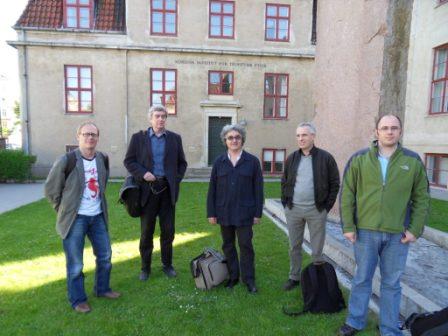
Here’s another picture in front of the same building, featuring some folks from the workshop.

From left they are Dominik Schwarz (Bielefeld, Germany), Anthony Lasenby (Cambridge, UK), Carlo Burigana (Bologna, Italy),  Sabino Matarrese (Padova, Italy) and Paolo Natoli (Rome, Italy).

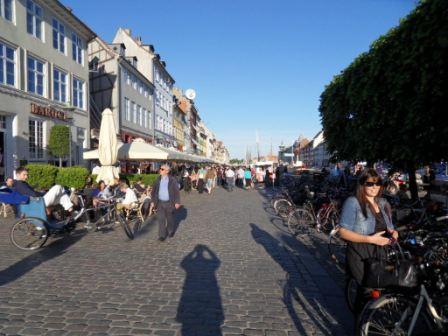
Last one shows the view in the evening sun looking down towards the picturesque old harbour area, called Nyhavn. I took this in anticipation of a nice cold beer among the crowds of people out enjoying themselves in the lovely weather. I wasn’t disappointed!

The Meaning of Inflation

Posted in Biographical, The Universe and Stuff with tags , , on June 4, 2010 by telescoper

Our little meeting here in Copenhagen is more-or-less over and I’ve now got a free day to enjoy my birthday. It’s a lovely sunny morning and I’m looking forward to being a tourist. Yesterday we had a busy day of talks and discussions followed by a pleasant dinner in a nearby restaurant. One of the good things about small informal meetings like this is that you really get the chance to ask proper questions and have a meaningful dialogue, although sometimes things get a bit heated – especially when people like Leonid Grishchuk are present!

Leonid’s talk yesterday contained various polemical statements about cosmic inflation involving words like “bullshit” and “nonsense”. In the subsequent discussion the question arose as to what, precisely, the word inflation means.

In a nutshell, cosmic inflation is the name given to a short period of rapidly accelerating expansion in the very early Universe that caused it to expand by an enormous factor and also laid down a spectrum of fluctuations through quantum-mechanical processes.  Inflation is a part of the standard “Big Bang” cosmological model, and there is a great deal of circumstantial evidence for it having happened and it’s a very elegant theory. I think it’s safe to say that there isn’t definitive proof but it’s certainly a thriving industry associated with its many versions.

However, the point is that there are many variants of the basic inflationary universe scenario – involving different fields, energy scales and so on – and, although they share some common features, they also differ dramatically from one to the other. What, it was asked, are the essential elements of inflation and what bits are just the trimmings?

In order to contribute meaningfully to the discussion I called upon the assistance of the Oxford English Dictionary to see how it defines inflation. The result was unexpectedly hilarious. Here are the first four definitions as they appear in the OED’s online edition:

  1. The action of inflating or distending with air or gas
  2. The condition of being inflated with air or gas, or being distended or swollen as if with air
  3. The condition of being puffed up with vanity, pride or baseless notions
  4. The quality of language or style when it is swollen with big or pompous words; turgidity, bombast

I was quite surprised that definitions to do with economics only appear further down the list, but cosmology’s position even lower down wasn’t unexpected.   However, the leading entries are brilliant, especially definition number 3, which I think is hilarious. I’ll never be able to mention inflation again without thinking of that!

I fear I may have given Leonid quite a bit of ammunition for future anti-inflation rants although if he uses the phrase “baseless notions” in future talks he should perhaps also be careful  to steer clear of “bombast”…

Water and Energy

Posted in Biographical, Science Politics, The Universe and Stuff with tags , , , , , on May 25, 2010 by telescoper

I’ve refrained from blogging about the fraught history of my attempts to have a new  gas boiler installed in my house. Today, however, at last I have finally succeed in getting a state-of-the-art high-efficiency condensing contraption fit for the 21st Century, which will hopefully save me a few bob in gas bills over the winter but, more importantly, actually produce hot water for more than a minute or so without switching itself off.

The chaps that did the job for me actually had to test all the radiators too, which meant switching them all up to maximum. It wasn’t quite as hot today as it was yesterday but nevertheless the inside of the house was like a Turkish bath for a while. I therefore sat outside in the Sun for a bit waiting for them to get finished and tidy everything up.

While I was sitting there I got thinking about sustainable energy and so on, and was reminded of a comment Martin Rees made in his Reith Lecture not long ago. Wanting to sound positive about renewable energy he referred to the prospect of generating significant tidal power using a Severn Barrage. Given the local relevance to Cardiff – one of the main ideas is a barrage right across the Severn Estuary from Cardiff to Weston-super-Mare -so he presumably thought he was on safe ground mentioning it. In fact there was a lot of uneasy shuffling in seats at that point and the question session at the end generated some tersely sceptical comments. Many locals are not at all happy about the possible environmental impact of the Severn Barrage. That, and the cost – probably in excess of £20 billion – has to be set against the fact that such a barrage could in principle generate 2GW average power from an entirely renewable source. This would reduce our dependence on fossil fuels and increase our energy security too. The resources probably aren’t available right now given the parlous state of the public finances, but I’m glad that the Welsh Assembly Government is backing serious study of the various options. It may be that it won’t be long before we’re forced to think about it anyway. The Wikipedia page on the various proposals for a Severn Barrage is very comprehensive, so I won’t rehearse the arguments here. In any case, I’m no engineer and can’t comment on the specifics of the technology required to construct, e.g., a tidal-stream generator. However, I have to say that I find the idea pretty compelling, provided ways can be found to mitigate its environmental impact.

For a start it’s instructive to look at turbine-generated power. Wind turbines  are cropping up around the British isles, either individually or in wind farms. A  typical wind turbine can generate about 1MW in favourable weather conditions, but it needs an awful lot of them to produce anything like the power of a conventional power station. They’re also relatively unpredictable so can’t be relied upon on their own for continuous power generation. The power P available from a wind turbine is given roughly by

P \simeq \frac{1}{2} \epsilon \rho A v^3

where v is the wind speed, A is the area of the turbine, \rho is the density of air, which is about 1.2 kg per cubic metre, and \epsilon is the efficiency with which the turbine converts the kinetic energy of the air into useable electricity.
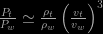
The same formula would apply to a turbine placed in water, immediately showing the advantage of tidal power.  For comparable efficiencies and sizes the ratio of power generated in a tidal-stream turbine to a wind turbine would be

\frac{P_{t}}{P_{w}}\simeq \frac{\rho_{t}}{\rho_{w}} \left( \frac{v_{t}}{v_{w}}\right)^{3}

The speed of the water in a tidal stream can be comparable to the airspeed in a moderate wind, in which case the term in brackets doesn’t matter and it’s just the ratio of the densities of water and air that counts, and that’s a large number! Of course wind speed can sometimes be larger than the fastest tidal current, but wind turbines don’t work efficiently in such conditions and in any case it isn’t the v which provides the killer factor. The density of sea water is about 1025 kg per cubic metre, a thousand times greater than that of air. To get the same energy output from air as from a tidal stream you would need to have winds blowing steadily ten times the velocity of the stream, which would be about 80 knots for the Severn. More than breezy!

Not all proposals for the Severn Barrage involve tidal stream turbines. Some exploit the gravitational potential energy rather than the kinetic energy of the water by exploiting the vertical rise and fall during a tidal cycle rather than the horizontal flow. The energy to be exploited in, for example, a tidal basin of area A  would go as

E \simeq \frac{1}{2} \epsilon A\rho gh^{2}

where h is the vertical tidal range, about 8 metres for the Severn Estuary, and g is the acceleration due to gravity. The average power generated would be found by dividing this amount of energy by 12 hours, the time between successive high tides. It remains to be seen whether tidal basin or lagoon based on this principle emerges as competitive.
Another thing that struck me doodling these things on the back of an envelope in the garden is that this sort of thing is what we should be getting physics students to think about. I’m quite ashamed to admit that we don’t…

Cricket in the Park

Posted in Biographical, Bute Park, Cricket with tags , , , on May 24, 2010 by telescoper

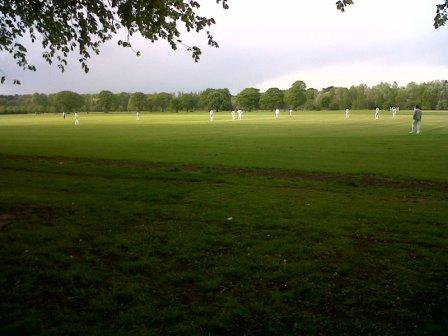
I was walking home a couple of weeks ago and noticed that there were several cricket matches going on in the Park, just over the road from my house in Cardiff. I stopped to watch a few overs, taking one or two experimental pictures with my phone, and was quite impressed at the standard of play. Two distinctly lively quick bowlers were causing the batsmen quite a few problems, though they were not just blocking  but also taking every available opportunity to score. It was attritional, but absorbing stuff.

The use of these fields for cricket was interrupted in 2008 when the National Eisteddfod was held here in Cardiff, on this very spot. It tipped down with rain for the entire week and the fields turned to mud. It has taken the best part of two years for Cardiff City Council to repair the damage and get everything back to working order so that the many local clubs that use the fields here could resume their sporting activities. Of course they had nowhere to play for all that time, thanks to the fools at the Council who totally underestimated the time it would take, not to mention the amount it would cost. You can see in the foreground that some of the grass is still in need of attention.

Just a few hundred yards to the South (right in the picture) lies Sophia Gardens, and the SWALEC stadium home to Glamorgan Cricket Club, currently at the top of the Second Division of the County Championship. I hope the good weather stays with us long enough that I can actually get to see a decent amount of cricket once term finally finishes.

Incidentally, the view is roughly eastwards.  The River Taff flows from left to right, concealed by the trees which are part of the landscaping performed by Capability Brown. They don’t show up too well in the photo, but they were clearly carefully chosen to provide a variety of colour and texture, especially in the changing light of the spring sunshine.  Also hidden  is a weir (Blackweir), where the Dock Feeder Canal is taken off the river to supply water to the docks at Cardiff Bay, and a small bridge. On the far side of the river is Bute Park and, further South, Cardiff Castle.

I may not have a very big garden, but it’s lovely having this beautiful park just a short walk from the house. I hope the Council learn their lesson and stop buggering about with it.

The Remorseful Day

Posted in Biographical, Poetry with tags , , , on May 17, 2010 by telescoper

Not for the first time, I’m going to make an admission that will no doubt expose me to public ridicule. I can’t watch the last episode of the TV series Inspector Morse (The Remorseful Day) without bursting into tears at the end when it is revealed that the eponymous detective has died. Not that it comes as a surprise – the story has plenty of scenes that make it clear that Morse knows his days are numbered. Take this one, for example, wonderfully acted by John Thaw who was himself very ill while this episode was being filmed; he died in 2002.

The poignant quotation is from a poem by A. E. Housman. Here’s the poem in its entirety.

 Yonder see the morning blink:
The sun is up, and up must I,
To wash and dress and eat and drink
And look at things and talk and think
And work, and God knows why.

Oh often have I washed and dressed
And what’s to show for all my pain?
Let me lie abed and rest:
Ten thousand times I’ve done my best
And all’s to do again.

How clear, how lovely bright,
How beautiful to sight
Those beams of morning play;
How heaven laughs out with glee
Where, like a bird set free,
Up from the eastern sea
Soars the delightful day.

To-day I shall be strong,
No more shall yield to wrong,
Shall squander life no more;
Days lost, I know not how,
I shall retrieve them now;
Now I shall keep the vow
I never kept before.

Ensanguining the skies
How heavily it dies
Into the west away;
Past touch and sight and sound
Not further to be found,
How hopeless under ground
Falls the remorseful day.

When Morse talks about Wagner in the clip, you know this is a man coming to terms with his own mortality. It even makes me feel a bit guilty for not being all that keen on Wagner myself. Perhaps I should persevere too. In that respect, as well as many others, I’m rather more like Lewis than Morse, although I do share the Chief Inspector’s love of crossword puzzles.

I watched this episode when it was first broadcast in 2000 and cried at the end then. I’ve seen it many times since, including a late-night repeat last saturday night, and it’s always had the same effect. The very first episode, The Dead of Jericho, was screened way back in 1987 and I’d enjoyed the series right from the word go. Morse became like an old friend to me over the following twenty-odd years and it’s never easy saying goodbye to people you’ve grown accustomed to for a long time.

Should I be embarrassed about crying whenever Inspector Morse dies? Perhaps.  But I’m not.

Polling Day

Posted in Biographical, Politics with tags , , on May 6, 2010 by telescoper

At last we’ve reached General Election day and I’ve just been to cast my vote following the guidance I passed on a few days ago. I was going to go this morning but I had a meeting at 9.15am to go to (which went on until 1pm, in fact) and I didn’t get up in time to visit the polling station, even though it’s in a Church Hall only a few hundred yards from my house. When I eventually got there just after 7pm it was still quite busy and I had to queue to get my ballot paper. It was very different during last year’s European elections, where the turnout is always pretty low. I don’t know what the turnout is like this time, but I hope it’s good. I don’t think there’s really any excuse for not voting.

I’ve already explained why I’m not as caught up in the campaigning this time as I have been in previous years, so I doubt if I’ll stay up late to watch the results come in. Polls don’t close until 10pm and until then there’s a blackout of press coverage relating to the vote so there’s nothing to follow until quite late at night, when I’m usually tucked up in bed with my cocoa.  The latest opinion polls suggest that the Conservative Party will get the biggest share of the vote, but it’s not clear if they’ll win a majority of the seats. Nor should they, in fact, even if they get as high a share as the polls suggest (37%) then that’s still far less than the number that didn’t vote for them. Labour and LibDems are together worth about 55%. The likelihood therefore is a hung parliament, at which point we’ll probably find all parties agreeing with each other to the implement massive spending cuts they’ve been carefully keeping from the electorate. It will still be interesting to see how the horse-trading works out over the next few days, but after three weeks of phoney war we’ll soon have to face up to reality. I’m not really looking forward to that.

Anyway, a comment by Keith Ashman on an item I posted a few days ago reminded me that no less than 13 years ago I was actually in Lawrence, Kansas, on polling day. Don’t ask me why. I’d arranged a postal vote, but had to watch the proceedings from afar on the TV. In fact, Keith and his partner decided to hold a party that night in their house and I went along to drink beer while the results came in. Watching a British election from the midwest USA is a bit strange, but it’s improved by the fact that the polls close in the UK at what is early evening Kansas-time and it’s all pretty much over by midnight.

That election I was swept up in the euphoria generated by the prospect of a New Labour government with its slogan “Things can only get better”. When they won a landslide majority we celebrated in grand style, singing Jerusalem in Keith’s back garden and then tottered not too soberly to a tattoo parlour to have a red rose put on my arm.

We had a great time that night, and the good vibes continued after I returned to London from my short stay at the University of Kansas. It didn’t take long, however, for my enthusiasm to wane. Instead of doing the really radical things their large majority would have allowed, they basically pratted about for four years. I’m not saying they didn’t do any good things, but they were so keen to tie everyone up in red tape that the good ideas often came to nothing except frustration. Then of course Blair took us into Iraq and I vowed never again to vote for the Labour Party until it renounced that decision, which I haven’t.

But I’ve still got the red rose tattoo.

Nuit St George

Posted in Biographical with tags , on April 24, 2010 by telescoper

Still feeling a bit fragile after the Chaos Ball last night, which by itself probably indicates that it was good fun. We started out at Peter Hargrave’s penthouse flat, which is in the same block I lived in for a while before I managed to buy my house in Cardiff. My flat was much smaller and on the first floor, but Pete’s is high enough to command a majestic view of the hills to the north, and in yesterday’s lovely late evening sunshine we could even see as far as Newport, to the east, although seeing Newport wasn’t something I was particularly yearning to do.

A cocktail or two later and we were on our way to the venue just down the road at the Mercure Holland House Hotel. We got there too late for the bubbly that had been laid on to welcome the guests, as it  had all been guzzled by the students in next to no time. Still, there was plenty of wine at the tables, so there wasn’t a problem. It wasn’t Nuits St Georges, incidentally, which is a fine wine-growing region of Burgundy. I picked the title because the ball  was on St George’s Night…

The food turned out to well-presented and very tasty too.  During the meal we had musical accompaniment from a saxophone quartet and afterwards a DJ plied us with music of a more contemporary nature. It was a bit too contemporary for my tastes, in fact, and I didn’t find much I wanted to dance to. A bit of Abba would have suited me better, but then it was all aimed at the students rather than the few old fogeys on the staff who came along. Not being inspired by the  terpsichorean muse I spent the rest of the evening chatting and drinking in the bar, as well as getting in the way of various peoples’ photographs.

My famous white dinner jacket attracted some comments but fortunately didn’t attract any of the tomato soup I had for a starter. I must say everyone looked  glamorous in their posh frocks and I think people were generally having a good time and were enjoying the chance to dress up.

Most of the younger crowd headed off to a club in town to carry on the evening, and I was toying with the idea of going along but it was getting close to midnight and I was in danger of turning into a pumpkin so I climbed into a comfortable taxi and went home to crash out. I’m far too old for all that sort of carrying on.

After debauched evenings like this I usually wake up the following morning to a vague recollection that I did or said something embarrassing, which usually turns out to have been the case. This morning I just had a headache. That doesn’t mean I didn’t disgrace myself again, but if I did I don’t remember how. Senility has its advantages.

On behalf of everyone who was there and had a good time I’d like to thank Harriet and Alice for doing such a grand job organizing it!

P.S. You can find another account of the night’s proceedings on Ed’s blog.

The Day’s Events

Posted in Biographical with tags , , , on April 21, 2010 by telescoper

Just a quick post today, because I’m worn out. Today was Cardiff University’s Open Day – not the small-scale one’s we have from time to time in the School of Physics & Astronomy, but a full-blown university-wide affair. The School is in the Queen’s Buildings, which are a little way to the East from the splendid civic buildings in the Cathays Park district of the city centre that constitute the core of the University. Naturally the organizers tend to concentrate on showing off it’s finer buildings, so many activities are centred on the posher parts, and often we don’t get that many visitors in our building especially if it’s raining and visitors don’t fancy the 15 minute walk. Today, however it was gloriously sunny and even the Physics department was packed with visitors, prospective students and their parents.

I’d agreed some time ago to give a public talk as part of the School’s activities, which meant that this morning I had a tutorial, an undergraduate lecture and a public lecture all one after the other. I was very surprised when I got to the venue for my open day talk to find it was absolutely full, with standing room only. By lunchtime I was already knackered, although the public talk was a lot of fun and the audience were very attentive and friendly. Some of them even laughed at my jokes. I got lots of questions at the end, which I always enjoy, although I was flagging by then after talking more-or-less continually for three hours.

This afternoon it was someone else’s turn to do the talking. It was the occasion of the PhD examination of Rob Simpson (orbitingfrog) for which I was Chair. Cardiff is unusual in having a Chair for PhD oral exams, as well as internal and external examiners. The Chair acts as a kind of umpire, making sure the rules are followed, but doesn’t play a very active role other than that. In fact I had the chance to chip in here and there – chiefly on matters of statistics – but also managed to get the Guardian crossword done.

I won’t talk about the substance of the examination, but it suffices to say that the examiners recommended that he be awarded the PhD subject to some corrections being made to his thesis. No doubt he’s out on the town celebrating as I type. Well done, Rob!

I got away just in time to go an collect my Tuxedo from the dry cleaners on the way home. It being good weather I thought I’d wear it for Friday’s annual Chaos Ball. I don’t know how widespread this usage is, but in Britain I’ve always thought the word Tuxedo refers to the white (or cream)  alternative to a traditional dinner jacket. That’s what I meant, anyway. I bought mine years ago in an Oxfam shop in Nottingham and hardly ever wear it, but it’s nice to push the boat out every now and again. Although it was bought second-hand about 8 years ago it still looks quite posh. Apart from the bullet hole in the back you would never have guessed it had been worn before…