Archive for the Biographical Category

Blackbird has Spoken

Posted in Biographical, Poetry with tags , , , on February 25, 2009 by telescoper

Over the last few days we’ve been having something approximating springtime here in Cardiff. It has been sunny and quite warm, my garden has started to come to life, and the crocuses have appeared in Bute Park. It’s also getting to the time when I won’t feel guilty for walking home in daylight. Soon I’ll even be able to walk home through Bute Park, which closes when it gets dark, currently at 5.15.

I hope this all continues into a pleasant spring and summer, without the heavy continuous rain we had last year. I’m not betting on it though.

However, the clement weather has given me one headache recently. With sunrise happening a bit earlier and the good weather giving the local wildlife something to shout about, the dawn chorus has been waking me up around 4am.

Or, actually, it’s not so much a chorus as a solo. A very loud blackbird has taken to sitting right next to my bedroom window and singing at the top of its voice.

I’m very fond of blackbirds. Once while I was in the garden in my old house in Beeston, a blackbird flew onto a fence post about a yard away from me and sat there looking at me as I stood with a spade in my hand. I looked back. We looked at each other for ages, the blackbird turning its head every now and again so as to peer at me with a different eye. I slowly raised my arm and extended a palm. To my absolute delight the bird hopped onto my open hand. It stayed there only a minute or so, probably until it realised my fingers weren’t actually big fat worms like it thought. For that moment, though, I felt a bit like a latter-day St Francis of Assisi.

Blackbirds have a very attractive song, but this one seems particularly loud and he certainly does go on a bit. For about a week now I’ve been unable to get back to sleep after being woken by this critter, and instead got up and had a cup of tea while he says what he has to say. Columbo finds his song quite interesting too, although the bird is always out of reach…

Years ago, I used to suffer very badly from insomnia so being awake at 4am is not an unfamiliar experience to me, although it’s much nicer to be woken by birdsong than to be unable to sleep in the first place. This all reminded me of a devastatingly brilliant poem called Aubade and written by Philip Larkin that was published in the Times Literary Supplement in 1977. This is one of the last poems written by Larkin, and is undoubtedly one of the greatest.

Written by a jazz-loving bachelor who drank too much, someone not unlike myself in some respects, I found it uncanningly accurate in its depiction of the bleak thoughts that tend to engulf you when you’re alone and awake in the silence before dawn. But I can assure you the mood is a whole lot lighter when you have a blackbird (and a cat) for company!

I work all day, and get half drunk at night.
Waking at four to soundless dark, I stare.
In time the curtain edges will grow light.
Till then I see what’s really always there:
Unresting death, a whole day nearer now,
Making all thought impossible but how
And where and when I shall myself die.
Arid interrogation: yet the dread
Of dying, and being dead,
Flashes afresh to hold and horrify.

The mind blanks at the glare. Not in remorse
– The good not used, the love not given, time
Torn off unused – nor wretchedly because
An only life can take so long to climb
Clear of its wrong beginnings, and may never:
But at the total emptiness forever,
The sure extinction that we travel to
And shall be lost in always. Not to be here,
Not to be anywhere,
And soon; nothing more terrible, nothing more true.

This is a special way of being afraid
No trick dispels. Religion used to try,
That vast moth-eaten musical brocade
Created to pretend we never die,
And specious stuff that says no rational being
Can fear a thing it cannot feel, not seeing
that this is what we fear – no sight, no sound,
No touch or taste or smell, nothing to think with,
Nothing to love or link with,
The anaesthetic from which none come round.

And so it stays just on the edge of vision,
A small unfocused blur, a standing chill
That slows each impulse down to indecision
Most things may never happen: this one will,
And realisation of it rages out
In furnace fear when we are caught without
People or drink. Courage is no good:
It means not scaring others. Being brave
Lets no-one off the grave.
Death is no different whined at than withstood.

Slowly light strengthens, and the room takes shape.
It stands plain as a wardrobe, what we know,
Have always known, know that we can’t escape
Yet can’t accept. One side will have to go.
Meanwhile telephones crouch, getting ready to ring
In locked-up offices, and all the uncaring
Intricate rented world begins to rouse.
The sky is white as clay, with no sun.
Work has to be done.
Postmen like doctors go from house to house.

Little Bits of History

Posted in Biographical, Jazz with tags , , , , on January 28, 2009 by telescoper

I noticed this morning that I’ve passed a bit of a milestone on here. I’ve actually reached my 100th post. That probably means I’ve been spending way too much time blogging but, undaunted, here I go again.

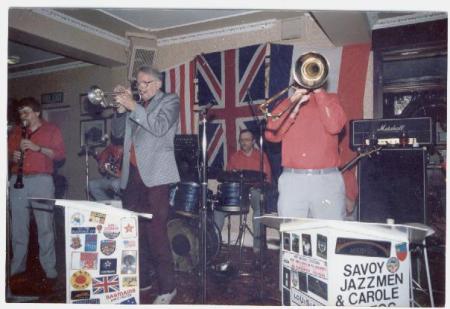
Ages ago (or it seems like ages ago) I posted an item about Humphrey Lyttelton and during the course of it I mentioned that my Dad had played the drums with Humph some years ago. I did mention in that post that I would put up a picture as soon as I found it, which I have now done. Here it is, taken probably somewhere around 1990.

humph_dad_2

I’m not entirely sure of the venue. I always thought this session took place in the Corner House in Newcastle but on closer inspection it doesn’t really look like it in this photograph so I wouldn’t bet on my memory being right.  It’s not a great photograph, but that’s definitely my  Dad (Alan Coles) on the drums. I don’t know the other personnel, but you do get a  proper impression of how tall Humph was (he’s on trumpet, of course) .

Humph of course had his own band but many jazz venues (including the Corner House) preferred to invite soloists only to come and play with the house band. The main reason I think was that it was cheaper that way. And of course the local musicians loved it because they got to play with their heros. My Dad idolized Humphrey Lyttelton but when he finally got to play with him he was extremely nervous and didn’t particularly enjoy the evening.

Semi-professional bands like the Savoy Band shown here couldn’t afford fancy band uniforms or outfits so for some reason they all seem to settle on cheap red nylon shirts, as shown in the picture. I don’t know why because they’re not at all pleasant to wear if you’re going to be sweaty. But these shirts reminded me of a story that I’ve bored people with over many years. When I was  little (in the  70s) there was a similar band in Newcastle called the Phoenix Jazz Band. They also wore horrible red nylon shirts for gigs, except for their young bass player (a guy called Gordon) who refused to do so. This uppity young student teacher turned up for gigs in a black-and-yellow hooped jersey so he looked rather like a bumble-bee or a wasp. The rest of the band called him, rather sarcastically, Sting. He soon went on to other things but the name stuck.

My dad always claimed that Sting had played the double bass in our garage – when I lived in Benwell village. I don’t remember having seen him though, and I might well have been having my leg pulled. Actually it wasn’t a garage anyway, more of a big wooden shed where he kept his drums and lots of other junk.

Anyway, I don’t know if I’ve mentioned this but I did for a while have dreams of becoming a Jazz musician myself. I wanted to be a saxophonist but my Dad persuaded me that I should learn to play the clarinet first and it would be easy then to switch to sax. I don’t think it was very good advice because they’re quite different instruments to play, but I rather think he had pushed the clarinet because he wanted me to play traditional Jazz rather than modern stuff.

I found that I had quite a good ear for music and a pretty good sense of rhythm so I mastered the rudiments fairly quickly but never got much further than that. I even got as far as sitting in with some bands, but never became a full-time member of one.

Sitting in with one of these traditional Jazz bands  is a very informal business. Usually the repertoire consists of standard tunes that everyone knows and there are no real arrangements as such. The trumpet usually plays the lead for a chorus or two, with impromptu clarinet and trombone alongside, then there’s a sequence of solos (usually a couple of choruses for each player, unless you really get into it and the leader shouts “take another!”), and then you play out to the end. Other than that you make it up as you go along.

But there is one notable exception to this, a number called High Society. This probably began as a Mardi Gras parade tune but later on came to be played as an up-tempo flag-waver. Almost every Jazz band, however, plays it the same way. It starts with a sort-of call to arms with drum rolls and a few phrases on the horns a bit like a fanfare before moving into tempo and it has quite a few scored passages that are played straight (i.e. without improvisation). When it breaks eventually into the solos there is an unwritten rule that the clarinet soloist plays a standard set-piece solo obbligato, at least for one chorus, after which it’s back to the more normal improvised solo.

I don’t know how this became such a strong tradition but you can check it out yourself. There are dozens of versions of High Society played by different Jazz bands and the clarinettist will always play the same basic notes. There’s a classic recording by Jelly Roll Morton on which there are two clarinettists (Albert Nicholas and Sidney Bechet) who both play the original licks, one after the other.

The story I heard was that this solo (as well as possibly the tune itself) was written by a man called Alphonse Picou who was born in 1878 and played with the first real Jazz band in New Orleans, which was led by the legendary figure of Buddy Bolden, the first great jazz trumpeter. Bolden died in 1931 but no recordings by him have ever come to light because he stopped playing before 1910 and spent most of the rest of his life in mental institutions. It is said that Buddy Bolden’s band did make a cylinder recording, but this grail-like object has never been found.

High Society is such a well known tune and is such fun to play that it is very often part of after-hours Jam sessions at clubs like the Corner House where I did once actually play the  Alphonse Picou solo from memory (or at least some sort of approximation to it), having heard it so many times on different records.

Last weekend, when I was playing around on Youtube, I chanced upon a bit of film of New Orleans Jam Session from 1958. It was looking back down a very long tunnel into ancient history but you could have knocked me down with a feather when I saw, sitting down next to the piano at the left, the great man himself, Alphonse Picou. I never thought there would be a film of him, thinking that he was, like Buddy Bolden, an almost mythical figure.  I later found elsewhere, a clip from the same session of him playing his own famous solo! However, he was 80 years old and very frail at the time and he doesn’t actually play it that  well so I’ll spare his posthumous blushes (he died in 1961) by picking a rather better number from the same session.

The tune I’ve picked to put on here is called Mamie’s Blues.  They play it with that lovely lazily lilting beat that’s so typical of authentic New Orleans Jazz but is actually so difficult to get right.  And if it  wasn’t enough to see Alphonse Picou, there are several other legendary names too: Paul Barbarin (drums), George Lewis (clarinet) and Jim Robinson (trombone) amonst others. The session happened 50 years ago at which point these were all very old men and they’re all long gone now.This clip, to me, is every bit as important a piece of history as, say, an original score by Mozart.

They may all look like they’ve seen better days, but they certainly still knew how to play!

Professor Who?

Posted in Biographical, Music, Television, The Universe and Stuff with tags , , , , , on January 7, 2009 by telescoper

As a Professor of Astrophysics I am often asked “Why on Earth did you take up such a crazy subject?”

I guess many astronomers, physicists and other scientists have to answer this sort of question. For many of them there is probably a romantic reason, such as seeing the rings of Saturn or the majesty of the Milky Way on a dark night. Others will probably have been inspired by TV documentary series such as The Sky at Night, Carl Sagan’s Cosmos or even Horizon which, believe it or not, actually used to be quite good but which is nowadays uniformly dire. Or it could have been something a bit more mundane but no less stimulating such as a very good science teacher at school.

When I’m asked this question I’d love to be able to put my hand on my heart and give an answer of that sort but the truth is really quite a long way from those possibilities. The thing that probably did more than anything else to get me interested in science was a Science Fiction TV series or rather not exactly the series but the opening titles.

The first episode of Doctor Who was broadcast in the year of my birth, so I don’t remember it at all, but I do remember the astonishing effect the credits had on my imagination when I saw later episodes as a small child. Here are some tests for the sequence as it appeared in the very first series featuring William Hartnell as the first Doctor.

To a younger audience it probably all seems quite tame, but I think there’s a haunting, unearthly beauty to the shapes conjured up by Bernard Lodge. Having virtually no budget for graphics, he experimented in a darkened studio with an old-fashioned TV camera and a piece of black card with Doctor Who written on it in white. He created the spooky kaleidoscopic patterns you see by simply pointing the camera so it could see into its own monitor, thus producing a sort of electronic hall of mirrors.

What is so fascinating to me is how a relatively simple underlying concept could produce a rich assortment of patterns, particularly how they seem to take on an almost organic aspect as they merge and transform. I’ve continued to be struck by the idea that complexity could be produced by relatively simple natural laws which is one of the essential features of astrophysics and cosmology. As a practical demonstration of the universality of physics this sequence takes some beating.

As well as these strange and wonderful images, the titles also featured a pioneering piece of electronic music. Officially the composer was Ron Grainer, but he wasn’t very interested in the commission and simply scribbled the theme down and left it to the BBC to turn it into something useable. In stepped the wonderful Delia Derbyshire, unsung heroine of the BBC Radiophonic Workshop who, with only the crudest electronic equipment available, turned it into a little masterpiece. Ethereal yet propulsive, the original theme from Doctor Who is definitely one of my absolute favourite pieces of music and I’m glad to see that Delia Derbyshire is now receiving the acclaim she deserves from serious music critics.

It’s ironic that I’ve now moved to Cardiff where new programmes of Doctor Who and its spin-off, the anagrammatic Torchwood, are made. One of the great things about the early episodes of Doctor Who was that the technology simply didn’t exist to do very good special effects. The scripts were consequently very careful to let the viewers’ imagination do all the work. That’s what made it so good. I’m pleased that the more recent incarnations of this show also don’t go overboard on the visuals. Perhaps thats a conscious attempt to appeal to people who saw the old ones as well as those too young to have done so. It’s just a pity the modern opening title music is so bad…

Anyway, I still love Doctor Who after all these years. It must sound daft to say that it inspired me to take up astrophysics, but it’s truer than any other explanation I can think of. Of course the career path is slightly different from a Timelord, but only slightly.

At any rate I think The Doctor is overdue for promotion. How about Professor Who?

Mumbai Memories

Posted in Biographical with tags , , , on November 29, 2008 by telescoper

Like many of you I’ve been following the events in Mumbai over the last few days with a mixture of shock and horror. It’s terrible to see the levels of cruelty and inhumanity that people can descend to. I doubt if we’ll ever really know what this murderous gang thought they were going to achieve when they set out on their killing spree on Wednesday evening. I’d be surprised if any of them could actually articulate their reasons for being involved, any more than a typical British soldier could explain, if asked, what they thought they were achieving by their presence in Iraq.

It’s a matter of great shame that we have become relatively hardened to the news of deaths abroad. Practically every day we hear of killings of occupying troops, insurgents, or non-combatants in Iraq or Afghanistan but we pay them little attention now. The death toll in Mumbai is now at least 195, but this is just a tiny fraction of the number of lives lost around the globe. What hits us hardest in the west is when we can no longer keep such events at a safe distance in our minds but when they strike on familiar territory, such as was the case in the London bombings. Only then do we see the horror close-up and personal. But we shouldn’t forget that in small towns we’ve never heard of all around the world many others are crying too, and probably for just as little reason.

I suppose it was inevitable that the events in Mumbai would send me wandering down memory lane. I have actually been there twice but both visits were long ago when the city was still called Bombay. I was supposed to go to India this summer too, but complications involved in moving house meant that I couldn’t go. However, I did once eat in the Cafe Leopold that the terrorists attacked in such cowardly fashion on Wednesday and I have waited for a train in the old Bombay Victoria station (now Chhatrapati Shivaji Terminus). We shouldn’t need to rely on such connections to shake off the numbness that we feel when hearing about atrocities in other places, but that’s what it’s like to be a complacent westerner.

My first trip to India was in early 1994 and I passed through Bombay on my way to and from Pune. My flight from London to Bombay arrived at about three o’clock in the morning and I was greeted outside the immigration area by a young man holding a sign with my name on it who had my train tickets from Bombay to Pune. The train didn’t leave until 6.30am so he asked me what I wanted to do until then. I said I thought I would just go to the station if it was open and wait there. He looked surprised, but said that, yes, the station was open all night. He then offered me a lift in his car as he was heading home and would be going roughly in that direction.

When we got to Bombay Victoria I realised why he had been surprised. I had assumed the station would be fairly empty and I might be able to sleep on a bench or something. When I walked into the concourse it was jam-packed with people sleeping all over the floor. I wandered in sheepishly, the only westerner to be seen, and started to look for what platform my train would be leaving from. Immediately I was surrounded by beggars – women with small babies, cripples, people with gruesome scabs and sores – all pushing me around and pleading for money. Then a teenage boy tried to lift my walkman from my pocket and I started to feel not just uncomfortable but scared.

Pretty soon, though, an official from the State Railways saw my predicament and came to my rescue. Delivering numerous clips around ears he speedily liberated me from my oppressors, took me to into a small kiosk situated on the platform, and offered me a cup of tea. It had far too much sugar in it, but I drank it anyway. He asked me where I was going, and I told him. He was initially suspicious, I think, because the primary place westerners tended to visit in Pune those days was the Ashram run by Bhagwan Shree Rasjneesh where his disciplines were encouraged to participate in unrestricted sexual activities. When I told my friend from the railways that I actually going to visit IUCAA, which at that time was run by the famous Professor Narlikar, he beamed with relief. I think he wasn’t unique amongst Indians who thought that Rasjneesh was a fraud and his disciples gullible idiots.

It turned out that the train I was to take to Pune was actually already in the station but was being cleaned. Since they cleaned the first class compartments first, I was allowed to get on the train early, about 4.30, and immediately nodded off. I only woke up when the train pulled out of the station and started on its journey up towards the Deccan plateau.

I enjoyed the journey enormously, partly because the train was slow enough to allow me to take in all the sights, and partly because I was sharing a compartment with a very friendly Indian couple (a professor of engineering and his wife). They had done the customary thing in such cases which is to consult the list of passenger names posted on the platform before the train left the station. When I woke up, they greeted me by name and introduced themselves. It was a refreshing change from London, where it is apparently forbidden to talk to strangers on a train.

I stayed about a month in Pune working with a colleague, Varun Sahni, on a lengthy article for Physics Reports. When that was over I had been invited to visit the Tata Institute for Fundamental Research in Bombay for a few days on my way home, so I got the train back to Victoria. Arriving on time, I left the train to be confronted by a crowd of small boys who tried to convince me that there were no taxis but that they would arrange one for me for a price of 200 rupees. That was way over the odds for a taxi so I laughed and said no thanks.

Proceeding out of the station to the taxi rank, I realised that they had been telling the truth. All the taxis in Bombay were on strike that day. I started to panic. How am I going to get to TIFR? Then I remembered that I was to have asked the taxi driver for “Navy Nagar Bus Stop”, which is right next to the guest house I was supposed to stay in. This is actually not far from the scenes of terrorist atrocities, but nearer the southern end of the Colaba peninsula, marked with an A on the map

I thought that if there’s a bus stop there must be a bus. I found a policeman and asked him where the buses went from. He gave me very clear directions and told me I needed the Number 11. I found the stop without much difficulty, but then there was a hitch. The buses themselves were red double-decker Routemaster types just like those you could find in London. Unfortunately, though, the numbers were written in Marathi script which I couldn’t read. Only when a bus went past did I see that the arabic numerals “11” were written on the back. A few minutes later I was joined at the bus stop by an Indian guy so I asked him if he could tell me the numbers of the buses as they came into view. He asked me where I was going, so I told him and it turned out he was going there too. Sorted.

On the bus I sat with my luggage around me and the front of the lower saloon facing backwards. All the locals peered at me like I was an exhibit in a museum, but most of them smiled. A couple of stops into the journey an old man got on wearing a scruffy coat. He looked rather poorly and had some sort of skin condition. He sat facing me and started scratching himself through his coat. I started to feel quite uncomfortable because this performance went on for some time. Then he started to unbutton his coat as if he was going to take it off. It was then that I realised the cause of his discomfort as a chicken poked its head out.

The bus was quite slow and the journey quite long so, when I finally got to the TIFR guest house, it was quite late. When I found the building, I was pleased to see my host, a physicist called TP Singh, in the lobby talking on the phone. He had his back towards me and was in the middle of a heated conversation, so I waited until he had finished before introducing myself. After a few minutes he put the phone down and turned around, so I offered my handshake and said hello.

He had a look of complete confusion on his face which gradually gave way to relief. Peter! He shouted. How did you get here? I got the bus, was my answer. It turned out he had found out in the afternoon (when I had already left Pune) that there would be no taxis so he had sent the TIFR car and driver to meet me at the station. I hadn’t seen the driver amongst the crowds and wasn’t expecting to be met anyway. In those days I didn’t have a mobile phone so there was no way of warning me about it. After scouring the station, the driver had returned to TIFR and reported that I was missing. When I had arrived at the guest house, my host had actually been on the phone to the local police in order to report me lost.

It was during this short visit of three days or so before flying back to London that I behaved as a tourist although I was guided around by students and staff from TIFR so I wasn’t herded around like a sheep. I visited the Gateway to India (right next to the Taj Mahal Hotel, scene of one of the recent terrorist outrages), ate at the Cafe Leopold, and took a boat to Elephanta Island.

Mumbai (as it is now) is an enormous city in which extreme wealth and abject poverty can be found in close proximity and where religious tensions are never far away. Riots are fairly commonplace and there are powerful grievances between the different social groups and claims of police corruption. The sheer scale of the place means that no casual visitor can hope to understand what the place is really like. But my visit there left me with an impression of a city full of energy and determination in which there is much kindness to be found below its rather scary surface.

Lost in the City

Posted in Biographical, Poetry with tags , , on November 17, 2008 by telescoper

The second Friday of the month is the day of the regular “open” meeting of the Royal Astronomical Society (at 4pm) preceded by parallel discussion meetings on topics that vary from month to month. This month one of the sessions was organized in memory of Bernard Pagel, who died last year and whom I knew a little, so I decided to go to that.

I met Bernard Pagel when I started my DPhil at Sussex University in 1985. He taught one of the courses on the MSc Astronomy and we research students were required to attend his lectures. I have to say he wasn’t the best lecturer I’ve ever had; he always seemed unable to look at the class, which is a trait I find quite disconcerting. But he did reveal a wonderfully wicked sense of humour. When a visiting seminar speaker arrived late and after the seminar explained he had dozed off on the train and missed his stop, Bernard suggested that he must have been reading through his transparencies.

I left Sussex to move to London around about the time Bernard retired from his position at Sussex but he immediately took up a chair at NORDITA in Copenhagen where age restrictions were somewhat looser. I had been working for a while with Bernard Jones in Copenhagen so I next ran into Bernard Pagel when I visited there. I still found him a strange and rather distant man, but as often happens the ice was broken when a group of staff, students and visitors went to a nice concert in the Tivoli Concert Hall. If I remember correctly it was a Mozart violin concerto. Afterwards, Bernard let his guard down and talked in a much more relaxed way than I had known before and we became quite friendly thereafter. He was in fact a man with very wide interests outside his own sphere of eminence in astrophysical spectroscopy.

After the meeting was over, I went once more to the Athenaeum for dinner with the RAS Club. I was quite surprised when, after the meal, it was announced that I had written on my blog about my previous dinner there. I’m not convinced that everyone there knew what a blog actually is but maybe some of them have found their way here…

Although I got back home to Cardiff in good time on the last occasion I dined at the Club, I had already decided to go to the opera on Saturday night so didn’t have to rush off to make the last train. Walking back to Bloomsbury where I was staying on Friday and Saturday I suddenly realized that it as almost exactly ten years since I moved out of London to Nottingham. In fact I bought my house in Beeston on 13th November 1998 and commuted back to London for about a month, as my position in Nottingham didn’t start until 1st January 1999.

On Saturday morning I decided to behave like a tourist so I first went to the British Museum. I intended to see the new Babylon exhibition, but by the time I got there after a leisurely breakfast it had sold out for the day so I had to content myself with the permanent exhibits. I don’t think I ever went to the British Museum in all the time I lived in London, so it was interesting although I got completely lost.

I did get to see the Elgin Marbles but I still don’t know how to play. I also ended up in a room full of mummies, which is something I find quite distasteful. Although the mortal remains are incredibly old, they are still human bodies and I don’t like the way they are stuck in cases for people to gawp at. Call me sentimental but I think these should be returned to Egypt and laid to rest with some sort of dignity. I also think the Elgin Marbles should go back to Greece, but for different reasons. If we hand them back, we might actually get some votes in the Eurovision song contest for a change.

The rest of the day I wandered around a few of the dozens of bookshops that clutter the area between Charing Cross Road and Covent Garden, feeling all the time like a complete stranger to the city. So much has changed that it’s nearly impossible for me to believe that I ever actually lived there at all. In one shop I picked up a (very expensive) old book of poems by Shelley and found the following lines (written about Naples rather than London):

I stood within the city disinterred;
And heard the autumnal leaves like footfalls
Of spirits passing through the streets
;

I didn’t buy the book. My mood wasn’t helped by the gloomy light. Although it was quite warm for November, there was a curious purple tinge to the late afternoon which I found a bit unsettling.

On my way back I revisited an old tradition of mine of peering in through the window of one of the electrical goods shops on Tottenham Court Road to check the football results. When I was living in London I was usually out most of the day on weekends somewhere in the West End, so that was the only way to keep apprised of developments. Nowadays I don’t go out as much as I used to, so I find quieter ways of filling the gap between the end of Final Score and the start of Match of the Day that seems to me to symbolize middle age.

Then it was time to get to the Coliseum for the opera followed by supper with Joao and Kim at Belgo‘s where our table, ironically, was next to that of a dozen very raucous girls from Cardiff in town for a birthday celebration.

Bonfire of the Inanities

Posted in Biographical on November 2, 2008 by telescoper

Having survived the potential horrors of Halloween on Friday without so much as a knock at the door, last night I went to see the fireworks, organized by the local Round Table, in Bute Park, near my home in Cardiff. According to the website, this was to be “one of the largest firework events in the UK, with a spectacular display of pyrotechnics, a bonfire to behold, on-stage entertainment from a series of famous artists, as well as fun fair rides, food stalls and many other family attractions.”

I should have guessed that the “series of famous artists” would be a bunch of failed wannabes from TV talent shows like X-factor and that their primary purpose would be to delay the actual fireworks as long as possible while the audience stood in the pouring rain. The last of them – a dreadful brother-and-sister combination called Same Difference – spent less time singing than they did telling people how to download their new single from the net a whole day before it would be in the shops.

When the fireworks eventually started, quite a few of them seemed not to work properly. Perhaps they were wet through like the spectators were. If so, I now know the meaning of the phrase “a damp squib”. At least we got a good blast of Shirley Bassey by way of musical accompaniment, so it wasn’t all a disaster. After the last whizz-bang had whizzed and banged we trudged back through the muddy fields to Pontcanna where I cooked supper at home for a few friends.

The occasion for the fireworks is of course Guy Fawkes’ Night, which celebrates the Gunpowder Plot of 1605 which intended to blow up the Houses of Parliament. Guy Fawkes was supposed to light the blue touchpaper on that occasion and it has been a tradition to burn his effigy on the bonfire on the anniversary of the attempt, every November 5th, while letting off fireworks.

When I was young, this was the thing we celebrated rather than Halloween. Most families held their own bonfire in their garden and fireworks could easily be bought from local shops who stocked up at this time of year. Since we had the Spinney in front of our house, we had very big bonfires in Benwell which lots of other kids came to. The number of private bonfire parties has decreased markedly since then owing to safety concerns and they have largely been replaced by large scale organized celebrations, such as the one in Cardiff last night. The plus side of this is that you get better fireworks (generally speaking), but the downside is the perceived need to add unnecessary frills like the awful pop concert we had to endure. I think Cardiff City Council’s notorious Events Department probably played a part in adding the tackier embellishments to Bonfire Night in Bute Park.

The other drawback with municipal fireworks parties is that they have resulted in a drift away from November 5th itself to a date on the nearest weekend, such as last night’s Cardiff affair on November 1st. The problem with that is that there are other events scheduled for tonight (I can hear fireworks as I write) and there will no doubt be others on the proper night, next Wednesday. I think it’s better if there is one proper day where everything happens, rather than having it all spread out over practically a whole week. The Big Event loses its sparkle if it is broken up into little ones. And there are more occasions where we have fireworks nowadays too, including New Years Eve. In the old days we only had fireworks on Bonfire Night, so they were special. It’s also a particular problem for Columbo, who gets very frightened by fireworks if they are let off nearby. Instead of being a scaredy cat for just one night he has to cope for several.

Another tradition associated with November 5th also seems to have died completely. When I was a kid the thing to do was to make an effigy of Guy Fawkes (called a “Guy”) and parade him from door to door asking for “Penny for the Guy”. The idea was if you had an impressive effigy, people would give you money which you used to buy fireworks for the forthcoming party. Of course you were hoping for a bit more than a penny.

I suppose that this tradition has been displaced by the American import “Trick or Treat”, which I think is a shame. It’s true that many bonfire celebrations have an unpleasant anti-catholic undertone which is a reminder of the religious intolerance that blights much of British history. It may be an ugly history, but at least its ours. Next thing you know we won’t have Guy Fawkes’ Night at all; we’ll have to call it 5/11.

I remember one year spending ages making a really good Guy with a head made from papier mache and with plasticene for his eyes, nose and mouth. I was really proud of him, especially when he sat on top of the huge pile of wood that was going to form the bonfire. When it was lit – which happened before the fireworks started – the heat from the flames started to melt the plasticene features of the Guy.

The other kids rushed around in excitement as the adults sorted out the roman candles, catherine wheels and the rest of the soon-to-be-ignited pyrotechnics, but I stood transfixed, staring at the Guy. After a few minutes I started sobbing and ran to my mum in anguish as molten plasticene dripped from his eyes.

Guy Fawkes was crying.

In the Dark

Posted in Biographical with tags on October 30, 2008 by telescoper

We never had Halloween when I was a kid. I mean it existed. People mentioned it. There were programmes on the telly. But we never celebrated it. At least not in my house, when I was a kid. It just wasn’t thought of as a big occasion. Or, worse, it was “American” (meaning that it was tacky, synthetic and commercialised). So there were no parties, no costumes, no horror masks, no pumpkins and definitely no trick-or-treat.

Having never done trick-or-treat myself I never acquired any knowledge of what it was about. I assumed “Trick or Treat?” was a rhetorical question or merely a greeting like “How do you do?”. My first direct experience of it didn’t happen until I was in my mid-thirties and had moved to a suburban house in Beeston, just outside Nottingham. I was sitting at home one October 31st, watching the TV and – probably, though I can’t remember for sure – drinking a glass of wine, when the front door bell rang. I didn’t really want to, but I got up and answered it.

When I opened the door, I saw in front of me two small girls in witches’ costumes. Behind them, near my front gate, was an adult guardian, presumably a parent, keeping a watchful eye on them.

“Trick or Treat?” the two girls shouted. Trying my best to get into the spirit but not knowing what I was actually supposed to do, I answered “Great! I’d like a treat please”.

They stared at me as if I was mad, turned round and retreated towards their minder who was clearly making a mental note to avoid this house in future. Off they went and I, embarrassed at being exposed as a social inadequate, retired to my house in shame.

Ever since then I’ve tried to ensure that I never again have to endure such Halloween horrors. Every October 31st, when nightfall comes, I switch off the TV, radio and lights and sit soundlessly in the dark so the trick-or-treaters think there’s nobody home.

That way I can be sure I won’t be made to feel uncomfortable.

Overhead and down below

Posted in Biographical on October 28, 2008 by telescoper

I’ve just been catching up on a few of the posts on cosmic variance. Of course their blog is a complete swizz because there are several contributors, which is obviously cheating. However they do manage to cover a lot of ground and provoke a lot of discussion.

One recent theme which has extended over several posts concerns John McCain’s complaints about the cost of an “overhead projector” (about $3M) at the Adler Planetarium in Chicago. Of course this is no ordinary OHP, but a wonderful “Sky Theater” for which the price tag seems actually rather modest.

Of course I could complain about the spelling of “Theater” or the refusal to use the proper plural for planetarium but it would be completely unlike me to go on about such things. Instead, I thought I’d meditate on the theme of old-fashioned proper overheard projectors.

Most people use powerpoint for lectures and conference talks these days, but it’s not long ago that we all seemed to use transparencies (“viewgraphs”) to be placed on the OHP. I was relatively late to switch to powerpoint, but got the hang of it quite quickly having decided to do so. I have, however, resisted the temptation for annoying gimmicky animations and sounds in favour of a plainer minimalist style that draws appropriate attention to the extraordinary level of my verbal eloquence. *Cough*

Powerpoint also means that I’ll never have to suffer the embarrassment I once endured at an international conference (which shall remain nameless). Giving the first talk of the morning session, I turned up with a neat stack of transparencies that I’d carefully written out in my hotel room the night before the talk.

As the audience settled down and the chairperson introduced my talk, I took the first slide and placed it carefully on the glass top of the projector. For maximum impact, I didn’t switch on the light until I was ready to speak. My first slide had just the title of my talk and little else in the way of text or pictures. When I was sure everyone was paying attention, I hit the switch and the light came on. I knew this pause would ensure everyone would be looking. I turned around to glance at the screen and check it was all in focus.

Brightly illuminated, perfectly focussed, projected to an enormous size and plain for all to see, was a single shocking and inexplicable pubic hair.

A Friend of Dorothy

Posted in Biographical with tags , , on October 26, 2008 by telescoper

In my previous post about childhood memories of Benwell, one of the stones I left unturned was the story of our next door neighbour when we lived there. I was going to skip this because I feel quite guilty still, but on the grounds that it will probably be some form of catharsis I decided to write about it now.

In the other one of The Cottages I described in the previous post there lived an old lady, a spinster whose name was Dorothy Newton. She was already living there when we moved in next door and had, in fact, lived there for as long as she could remember. She had never married and had little experience of children, at least at the start. My first encounter with her wasn’t at all auspicious. I had accidentally kicked a football into her garden and without thinking about it at all, just went in and got it. As I picked it up I saw her looking out and, scared, I ran back to my house. Technically, I was trespassing and I assumed she was angry with me.

A bit later I had the chance to talk to her in her garden and she said she hadn’t minded, but that in future I should try not to trample her roses. I got to know her slowly and eventually started visiting her quite regularly. She became my “Aunty Dorothy”, although she obviously wasn’t actually a relative. This was before I started School so I would have been less than five years old. I’m told I called her something like “Ann Dorry” at that time because I couldn’t manage her full name.

Aunty Dorothy was an invalid, having suffered a fall on a trolley bus some years previously which resulted in permanent problems with both her legs. She got around on sticks at first and then, later on, needed to use a walking frame. If our house was basic, hers was downright primitive. At some point in the past (which she always referred to as “The Flood”) her roof had suffered a big leak and large amounts of water had got in and badly damaged half of her house. Since she never had money to repair it, the right-hand side of her cottage (out of shot in the picture in the previous post) was completely unusable. As she became more infirm she couldn’t manage the stairs and lived entirely from the ground floor room whose window you can see in the first photograph on my previous post. Her kitchen (which she called the “scullery”) was really Victorian in style, complete with old-fashioned walk-in pantry. And she too had an outside loo.

Life for Aunty Dorothy had, I think, always been tough and she lived a very humble existence but she had acquired an almost unimaginable sense of determination over the years as well as the ability to take huge amounts of pleasure from the small things in life. She had numerous accidents around the house – she was very prone to falls, and sometimes these left her lying for days on end before anyone found her – but she always recovered and carried on with her routine regardless. It took her ages to do even simple things but she never gave up and never complained.

As time went on she eventually found it impossible to leave the house, except for a spot of gardening, and lived an increasingly solitary life, apart from visits from the home help (whom she didn’t like at all) and the nurse who, amongst other things, helped her take a bath once a week.

When I started school a sort of routine developed. My mum and dad both worked at that time and weren’t home when school finished around 4pm. Since I had no distance to go to get home I would have to wait outside the house for one of them to return, so instead I called on Aunty Dorothy. We would sit and have tea (usually with jam or banana sandwiches). Sometimes we would watch the children’s TV programmes in black-and-white and sometimes we would just talk, until about 6pm when I would go next door to my own house. We had tea like that most days for about five years.

In the beginning I was, by any standards, an extremely backward child. I was very slow to learn to speak, which I didn’t even start to do do until I was three. I also had various physical problems, including a condition my mum always referred to as “spacky feet” which meant I had to visit an orthopaedic clinic from time to time. I’m not sure which particular deficiency was responsible, but it took me absolutely ages to learn to ride a bicycle. I think when I started School I was immediately earmarked as a likely basket-case from an educational point of view. In those days the slow kids didn’t really get much help; they sat at the back of the class and did raffia. I wonder how often these diagnoses turned out to be self-fulfilling, but I was definitely a misft from the start.

I think my parents might have mentioned to her that they were worried about my performance in school but whether or not they did, Aunty Dorothy started to take an active interest in my education. I didn’t realise it at the time but she did this in very clever ways. She started asking me to run errands for her to the local shops (which were very close). She would always send me for a single item and ask me to make sure I got the right change. I realise now that she basically invented these jobs to help me practice my arithmetic. I’m sure that myriad of little jobs, allied to the confidence that she obviously placed in me, helped me get over my difficulties with sums to the extent that, by the time I was 10, I even looked forward to Mr Martin’s mental arithmetic tests.

Aunty Dorothy was also keen on horse-racing, which she liked to watch on the telly. When I was a little older, she would sometimes ask me to work out the odds for her. I realised only later that she knew perfectly well how to work out what her winnings would be and this, like the little trips to the shops, was just a way of getting me to work things out myself. At the time, though, I was chuffed to feel I was helping.

Later on, when the dreaded decimalisation happened in the early 1970s she asked me to help with that, although this time I don’t think she was faking it. The pound was no longer 20 shillings, each containing 12 pence, but a simple 100 “new pence”. It may seem simple now but it was a difficult transition for the older generation. The old pound notes were still legal tender for a time, but some coins and rarer notes had to be swapped for the new versions, such as the ten-bob note (10 shillings) which was replaced by the 50p coin. The old shilling coin became the new 5p and the 2 bob was 10p, but there was no longer a place for the old threepenny bit or the sixpence (tanner). Aunty Dorothy once sent me to the post office with a couple of ten bob notes and brought her back the two coins, but she didn’t like them. Somehow you feel richer with paper money.

And then there was reading. I was very behind in developing my reading skills, just like everything else really, but here again Aunty Dorothy helped me enormously. Her eyesight wasn’t great but it wasn’t as bad as she pretended it was when she asked me to read carefully selected items from the Newcastle Evening Chronicle (which now has its own website) to her. On Sundays she got the Sunday Post, a Scottish newspaper which was quite popular on Tyneside in those days. It had a kid’s supplement which was really good, and I would avidly read the cartoons, especially Oor Wullie and The Broons, and do the puzzles.

After a time I had caught up with reading in class and eventually managed to read just about every book the School had to offer, including the Diaries of Samuel Pepys which were for some reason on the shelves in Class 2 and which I was allowed to borrow. I don’t think anyone had read them before so nobody, including the teachers, knew how rude they were. I had no idea at that time that less than ten years later I would be studying at Magdalene College Cambridge, site of the Pepys Library where the orignal diaries are kept as well as the rest of Pepys’ own collection of rare books.

Aunty Dorothy and I were close for many years, during which I underwent a transition from dimwit to high-flier (or at least the closest approximation to such a thing that Pendower School had ever produced). It wasn’t just her that helped me succeed academically – I also had many good teachers at Pendower School – but she certainly played an important part.

In due course my family moved from The Cottages to an ordinary semi-detached house (with an inside toilet) in Hodgkin Park Road but I carried on going to Pendower School, which was only half a mile away, and visiting my adopted Aunt as often as I could over the next few years even though I was no longer living right next door.

I remember during the time of the Miner’s Strike in 1974 when the country switched to a three day working week for a time, sitting in Dorothy’s house with only candles to light us, listening to her stories about the wartime blackout. She also told me that the strike was a good thing because it would probably bring down the hated Conservative government of Ted Heath. She was certainly right on that count.

I also remember that she had a peculiar suspicion about thunderstorms. If there was any sign of lightning in the area, she unplugged all the electrical equipment in the house and switched off all the lights. That much I think I can understand but, for reasons I never figure out, she also insisted on putting all metal objects (such as cutlery) away into drawers or covering them with a tablecloth if there wasn’t time to do that.

In 1974 I took the entrance examination at eleven-plus for the Royal Grammar School in Jesmond and was recommended by the Governors for the award of a scholarship. This was effectively a private school but the City Council paid the fees for a limited number of pupils who did well in the entrance examination. I therefore got a free place which is just as well since there’s no way my family could have afforded the fees. The following year, the new Labour government scrapped the arrangement and the School became fully independent but the Council agreed to carry on paying the fees for those students who were already there. I had got in by the skin of my teeth.

However, the RGS was (and is) in Jesmond, which is on the other side of the city to where I was living so I had to get the bus there and back every day, a journey that took over an hour in each direction. I also had lots of homework to do every night. The frequency of my visits to Aunty Dorothy decreased. Although I had promised to keep in touch with her as best as I could, I didn’t keep my word and after a year or so I stopped visiting her altogether.

I found out in 1978 that she had died in hospital after suffering yet another fall at her home from which this time she hadn’t recovered. I never had the chance to say goodbye and had never taken the time to tell her how grateful I was for all the help she had given me over the years.
Behind the Wall

Posted in Biographical with tags , , , on October 26, 2008 by telescoper

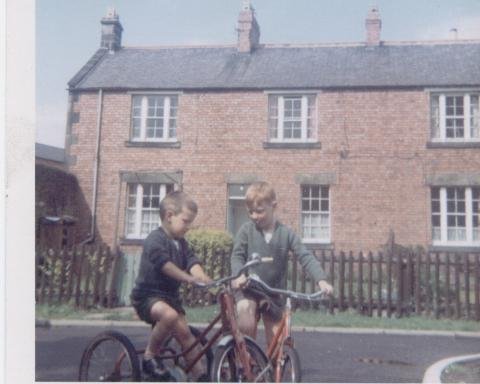
This photograph was taken in front of the little house in Benwell Village that I grew up in during the sixties. I’m on the left and my older brother Jeffrey is on the right. I don’t know when it was taken, but I was obviously just a young ‘un and it may actually have been before I started school. The house, as you can see, was quite small – basically two rooms on either side of each floor (each with one window) and with a kitchen at the back of the ground floor and a small bathroom upstairs. There was a similar house next door (of which you can see a part) and together these two were called “The Cottages”.

I wasn’t actually born in Benwell, which lies to the West of Newcastle upon Tyne, but in Walker which is to the East. However, we moved there when I was very young and all my earliest memories are from Benwell. Its name, incidentally, is derived from Hadrian’s Wall which ran from Wallsend (near to Walker) through the area covered by the modern city (which is built on the site where there has been a large town since mediaeval times), and west towards Carlisle. The whole area is littered with ruined forts, temples and mile stations and occasional pieces of the wall itself can be found between peoples’ gardens or next to modern roads; good examples include the fort at Condercum and the nearby temple which was right next to the wall itself. Benwell lies just to the south of the wall, hence its name which is a corruption of “Bynnewalle” meaning “behind the wall” and the oldest historical record of Benwell is from the 11th century, before the Norman conquest.

Our house was a strange place to grow up in primarily because of its location. Immediately behind The Cottages was Pendower School (Infants and Juniors) which I attended between the ages of 5 and 11. My trip to School in those days was about twenty yards, which made it quite difficult to think of excuses for being late. The other kids entered through the official gates on Pendower Way to the North or from Benwell Village itself to the West; I just had to turn left at the end of the garden and walk around the Cottages and I was there in the playground.

Pendower School was an austere, rather ugly,  building of Dickensian aspect but it was very well run by the Headmaster, Mr Brown, and had several very good teachers. I particularly remember Mrs Locke, Miss Stobbs and Mr Martin; the latter was a dapper fellow with a military moustache who was particularly good at drawing and painting as well as being hot on mental arithmetic, which we did every morning in class between 9 and 9.30 during my last year at Junior School. You know the sort of thing: “If it takes ten men three hours to fill a swimming pool with water using two buckets each, how long would it take two men each with one bucket?” This was Britain pre-decimalisation too, so we had to do mental arithmetic not only with pounds shillings and pence but also hundredweights, stones, pounds and ounces, gallons quarts and pints, rods poles and perches. Those were the days. Mr Brown the Headmaster didn’t take any classes but he insisted that we all did music and at assembly and during lunch he frequently played us classical music from an old gramophone. He particularly liked Purcell.

The School I attended (which had both boys and girls in it) shared its building with a school for older girls, but they were strictly separated from the youngsters, both inside and in the playground. There mustn’t have been enough space for the girls’ school so there were some outbuildings in the form of wooden huts at the edge of the playground, just to the right of The Cottages (from the viewpoint of the photograph). These were evidently for art lessons. I never went inside and was too small to look in through the windows, but they didn’t have very good drains and often the ground outside them was covered with brightly coloured mud resulting from botched attempts to dispose of paint that had ended up blocking up the pipes. The road our bikes are on in the picture was a sort of access road to allow deliveries to be made to these huts, but there were big metal gates (to the left) that were usually locked preventing access most of the time making this bit of road a good place to learn how to ride a bike, although I still hadn’t graduated from a tricycle when this picture was taken, for reasons that will become obvious later.

In front of The Cottages (i.e. behind the photographer’s position in the first picture) was a small wood called “The Spinney” which was enclosed on all sides by walls. In the slightly older picture to the right, which was taken from the garden looking south, you can see a little of the wood and some sheds that were later removed when the road was widened. This one was taken on my birthday, I think, but I don’t know which year it was.

Originally the two cottages were intended to house people who worked in a grand house at the south end of the Spinney which had been destroyed by fire some time before we moved in. The ruins of the house were still there for some time and they were the source of considerable fascination for me until eventually the council demolished what was left, carted the debris away and landscaped it over. That’s probably just as well as it was undoubtedly a dangerous place for a small child to be wandering about on his own.

The Spinney was probably about 100 yards square. The Cottages were in the northwest corner facing south, with Pendower School forming the rest of the northern edge, Benwell Lane to the south, where the entrance to the big house used to be, and Ferguson’s Lane as it passed through Benwell Village (past Block’s garage and the Hawthorn Inn) to the west. To the east was the former residence of the Bishop of Newcastle, another grand house called Benwell Towers, which, when I lived in Benwell, was being used a base for the Mine Rescue Unit, a specialist emergency service for the many coal mines that still operated in the area. Just a few years later all the mines were finished and Benwell Towers was flogged off to become a tacky nightclub. Since the house was supposed to have been haunted, the nightclub took the name of the ghost: The Silver Lady. This was all after we had moved away from the area.

So you will see that I lived in an unusual place when I was little: on the edge of the School playground, with my own private wood to play in, and with a haunted house only about 100 yards away!

On the far left of the original picture, which was taken facing north, you can see that there was a high wall running down the western side of the garden of our house. This carried on down the side of the house to the back where it formed the wall surrounding our back yard. There was both a door and a coalhole the size of a window in this wall, the one leading into the yard and the other to allow coal to be delivered directly from the street outside (Ferguson’s Lane) into the coalhouse, the place where it was stored. Coal provided the only heating in the house, including the hot water which was heated by a boiler behind the fires downstairs. There was no heating in the bedrooms at all and during the winter it was quite normal for there to be ice on the inside of our bedroom windows.

The backyard was also where our toilet was situated. Outside toilets (“netties”) are definitely a thing of the past but they weren’t at all unusual when and where I lived. There were only two problems with ours. One that there was no electric light so if you had to go at night it was necessary to take a paraffin lamp. The smell of paraffin always brings a memory of that back to me. I often think that if Marcel Proust had my background, A La Recherche de Temps Perdu wouldn’t have been full of that boring stuff about cakes. The other problem was the rats which frequented the area. The toilet door didn’t go all the way to the ground; there was a gap of an inch or so through which rats would sometimes poke their noses while you were on the bog, presumably attracted by the light. We kept a shovel in the loo to fetch down on the intruding rodents if they appeared. I never hit one, although I tried quite a few times. With the prospect of a rat appearing at any minute you didn’t hang around to do your business and were unlikely to need a laxative.

We had few of the comforts that people take for granted these days but my family wasn’t any worse off than any of those whose kids went to the same school as me. We always had enough food (as you can tell from the photograph), so we never thought of ourselves as being particularly poor. But it is true to say that our living conditions were pretty basic. We didn’t own the house, which I think was owned by the City Council (who also owned the Spinney), but our rent was very cheap because of the state it was in.

I go back to Newcastle from time to time, usually at Christmas. During one such visit I had the opportunity to pass through Benwell and look at where I used to live. Benwell is a grim place these days, devastated by crime and social disorder, which is depressing because I have such happy memories of the place. Even more traumatically, from a personal point of view, I realised that The Cottages, The Spinney and even Pendower School have all completely vanished.

The buildings were demolished and the little bit of woodland I used to play in ploughed up to make way for a new housing estate. The only thing that remains is a small piece of our wall, where the coalhole used to be, and behind which, forty years ago, a small boy sat, shovel in hand, hoping the rats would stay away.