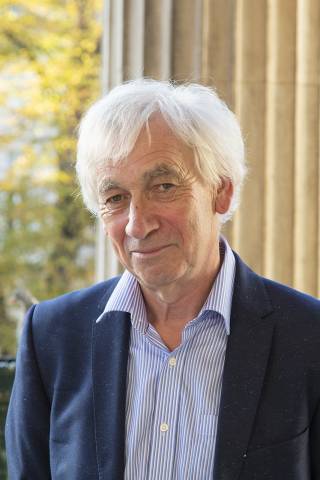
I’m delighted to be able to convey the news that the 2023 Gruber Prize for Cosmology has been awarded to Richard Ellis. Heartiest congratulations to him! The official announcement reads:
Over the past five decades Richard Ellis’s innovations have reimagined cosmology in fundamental ways. His observations have pushed the cosmic horizon—how far across the universe we can see—to a period close to the development of the first galaxies. Meanwhile the instruments he conceived, then shepherded through development and execution, have transformed myriad astronomical methodologies.
The Gruber Foundation is pleased to present the 2023 Cosmology Prize to Richard Ellis for his numerous contributions in the fields of galaxy evolution, the onset of cosmic dawn and reionization in the high redshift universe, and the detection of the earliest galaxies via the Hubble Ultra Deep Field study.
Richard Ellis has also driven several frontier instrumental developments in optical astronomy, especially the use of multi-object spectroscopy to study many galaxies in the same field of view. These included the “autofib” instrument, the “2dF” facility on the Anglo-Australian Telescope, which led to the discovery of baryon acoustic oscillations, the “LDSS” on the Herschel Telescope, which studied the redshifts of faint galaxies, and the “PFS” currently under commissioning on the Subaru Telescope to study dark matter and dark energy.
There’s a lot more information and biographical material in the full press release here.
If I can add just a couple of personal comments. Way back in 1985, when I was about to start my PhD DPhil, I attended an SERC summer school for new research students held in Durham. The lectures on Observational Cosmology at that school were delivered by Richard Ellis. I still have the notes, in fact. In many ways, this was my first encounter with modern cosmology. Quite few things have changed since then of course, but it was a formative experience. One thing I particularly remember is his discussion of the Hubble constant controversy:
You will see that there were two main estimates, one low and one high, both about three sigma away from the currently-favoured value of around 70. Plus ça change, plus c’est la même chose…
The second comment is that Richard was the external member on the panel that awarded me my first Chair position way back in 1998. Gosh. Was that really 25 years ago? Still, it goes to show that even an eminent scientist such as Richard can sometimes make an error of judgement!
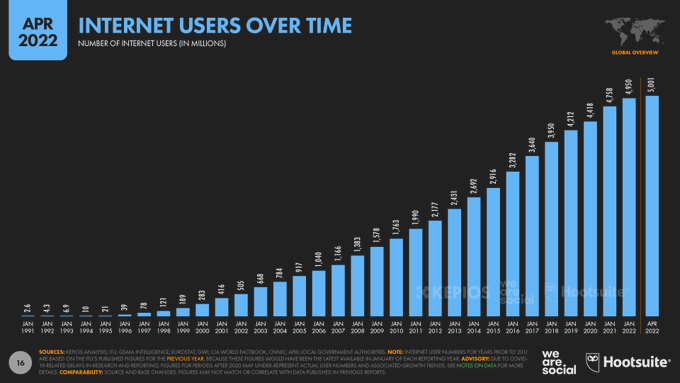
The above graphic, which comes from here, has been doing the rounds on social media and has been eliciting quite a few responses from people of my age or older, about when they started using the internet, so I couldn’t resist a comment or two.
My first experiences of anything like the modern internet was using the computers at the (now defunct) British Gas On Line Inspection Centre (OLIC) in Cramlington, Northumberland. I wrote about this here. That would have been in 1981, in between leaving school and starting University (which I did in 1982). I also went back to OLIC work in the summer holidays while still an undergraduate.
At OLIC did quite a lot of coding (on projects related to pattern recognition), most of which was on VAX computers (and also the odd PDP 11/45). Incidentally, when I later started as a research student in 1985 I was delighted to discover that the STARLINK system in use at Sussex and throughout the UK was also VAX-based because I was already fluent in the command language (DCL) as well as the database software DATATRIEVE. Another reason I am grateful for the experience I gained at OLIC is that, working in that environment, I had to learn to make my code (which, incidentally, was all in Fortran-77) conform to various very strict standards which is no doubt why I am a bit of a stickler when it comes to scripts written in my Computational Physics lab!
Anyway, the Vax computers in use in OLIC and in STARLINK were connected by a thing called DECnet. This allowed users to send emails to other machines. The format of email addresses was much simpler than in use today, being of the form “host::username“. One could send files that way too; the alternative, via, FTP was terribly unreliable. DECnet provided a fast method of communication, but did require the receiving system to be accessible when you tried to send and would fail if this were not the case. Later email protocols would keep trying to send messages if at first they did not succeed.
While working at OLIC, where the powers that be were paranoid about industrial espionage, sending things this way essentially required the sender to log into the receiver’s machine, which terrified the systems people and it was soon blocked. STARLINK allowed this, however, as did the U.S. Space Physics Analysis Network (US-SPAN), the European Space Physics Analysis Network (E-SPAN), and by 1989 there were 17,000 nodes worldwide.
Sending emails outside DECnet was a rigmarole, involving including SMTP% followed by the external address. Messages inevitably had lengthy headers indicating the circuitous taken to reach the destination and often took some time to reach their destination. I was regularly using email in 1985, and if that counts as internet usage, then I started way to the left of the start of the graphic.
I didn’t use the world wide web until later. I’m not sure when, but it must have been around 1991 or so. The arXiv in roughly the form it exists now started in 1993, but it had precursors in the form of an email distribution list and, later, FTP access. Initially, it was based at Los Alamos National Laboratory (LANL) with a mirror site in SISSA (Trieste) that was used by those of us in Europe. In the beginning, arXiv was quite a small-scale thing and it wasn’t that easy to upload full papers including figures. In fact the SISSA system was run from a single IBM 386 PC (called “Babbage”).
The astrophysics section of arXiv (astro-ph) started in April 1992. Although astrophysicists generally were quick to latch on to this new method of distributing preprints, it took me a little time to get onto arXiv: my first papers did not appear there until February 1993; my first publication was in 1986 so there are quite a few of my early papers that aren’t on arXiv at all. In 1993 I was working at Queen Mary & Westfield College (as it was then called). I was working a lot with collaborators based in Italy at the time and they decided to start posting our joint papers on arXiv. Without that impetus it would have taken me much longer to get to grips with it.
When my father passed away in 2007, the main music music played at his funeral was the hymn or spiritual (and of course Jazz standard) Just a Closer Walk with Thee. It’s a lovely old traditional tune that often plays a central role in New Orleans style funerals and is a melody that, at least for me, has a deep association with loss and bereavement. The recording that was played on that occasion was this one, made at the same session as the track I posted a few days ago, featuring the same personnel (including my Dad on the drums), but with vocals by a fine Jazz and Blues singer by the name of Annie Jenkins.
So it’s Maundy Thursday, i.e. the day before Good Friday, on which we are supposed to wash the feet of our disciples. Not having been issued with any disciples, I’ll have to give that bit a miss and just work as normal for the rest of today.
Tomorrow is a holiday, as is next Monday, Easter Monday. The rest of next week is a study break, a welcome pause before we embark on the rest of term.
There will still be three weeks of teaching before the end of the Semester when we return on 17th April, but I’ve actually done my last lecture in Computational Physics. I’ve taught them all the things they need for the rest of the module. When they get back students will be mainly working in groups on their mini-projects which are due in by 5th May. The other module I teach will carry on as usual until the end of term.
Anyway, the three weeks that have passed between the St Patrick’s Day study break and today have flown by, but at least I’ve kept up to date.
Yesterday I found out that I have been granted a sabbatical for half of next academic year. I had asked for a full year, but that wasn’t agreed, so I now have to decide whether to disappear from August 2023 to January 2024 or from February 2024 to July 2024. I’ve only got the Easter break to decide which option to take, so I’ll have to spend a bit of time trying to work out what to do. I had planned two different trips during a full-year sabbatical. I’ll probably have to drop one of them. I also made plans for my research students, which I’ll have to change. I’m sure I can work something out though.
My two biggest classes are in Semester 1 so I’d probably get more personal benefit from taking the first option, but it might be harder to find a replacement to teach these modules given the shorter notice. It will also be tricky to make the necessary arrangements with potential hosts elsewhere by August, which tends to motivate the second option. I’ll have to think about it.
The last time I had a sabbatical break was in 2005, when I was at the University of Nottingham. That also was just one semester. After an abortive attempt to get a J-1 visa so I could visit the University of California at Berkeley, I ended up going to Toronto, which was very nice, but instead of giving my teaching to someone else for the term I missed, it was just moved to the second semester so I had a double load when I returned. I hope nobody tries that trick this time!
At least this time there won’t be a problem with visas et cetera, as I intend to exploit the freedom of movement I have within the European Union…
I recently acquired – at negligible expense – the above second-hand copy of the anthology Nine Modern Poets. I got a copy because this book was one we we studied when I was at school back in the 1970s. The First Edition was published way back in 1966, and it was reprinted until the mid-1980s but has long been superseded as a school poetry text by other anthologies. It has been out of print for many years so I had to find a second-hand copy via the internet. I bought some other second-hand anthologies too, which I may share in due course.
Anyway, the Nine Modern Poets are: W.B. Yeats, Wilfred Owen, T.S Eliot, John Betjeman, W.H. Auden, R.S. Thomas, Dylan Thomas, Philip Larkin, and Ted Hughes. Yes, they are all male.
Looking back it’s surprising to see John Betjeman in there, I’d have swapped him for Sylvia Plath (though her first collection, Colossus was only published in 1960 and the second, Ariel, in 1965 so these might have been too late), but the reason I look back on this book with some fondness, indeed nostalgia, is that it was this collection that introduced me to the poetry of R.S. Thomas, and I am very grateful to it for that.
The newly enhanced version of this blog, improved at great expense, enables me to upload audio files. I thought I’d check out that facility by sharing this rendition of the tune Petite Fleur which was written in 1952 by the great Sidney Bechet but made famous by Monty Sunshine by a recording with Chris Barber’s band in 1959. The version here was performed in the 1990s in a little recording studio in Gateshead. Can you identify the clarinet player? (Hints: (i) it is not Sidney Bechet; (ii) nor is it Monty Sunshine; and (iii) it was my Dad playing the drums…)
A recent post about how much this blog may or may not be worth made me think about the fact that I’ve been writing this blog since September 2008 and for all that time I’ve used the very basic free version of WordPress. That version has quite a low limit on storage (1GB) but after all this time I’ve still only used 75% of that, so at the current rate of use it should last another 5 years or thereabouts. The downside of the free version however is the plethora of advertisements plasters all over the place as punishment for daring to use the free version. I don’t know if that bothers other readers as much as it bothers me, but it is a problem that is definitely become much worse recently.
Today, therefore, I decided to upgrade this site to a paid ‘plan’. Being a cheapskate I’ve gone for the minimum possible plan – called “Personal” – but it does increase my storage to 6GB, which is more than I’ll ever use, gives me a free email address, and removes all the ads from the site. This latter feature is the most important and I hope it makes for a more pleasant reading experience for my regular readers, Sid and Doris Bonkers.
I’d be grateful if readers could confirm that the advertisements no longer appear.
Another feature of the paid plan is that I can register a new domain name, which is telescoper.blog. My new email address is telescoper@telescoper.blog, so henceforth you can contact me there with matters relating to this blog (although I suppose I’ll get mainly spam…)
Apparently under the new arrangements I can also make podcasts, although I’m not sure I want to…
P.S. Don’t worry if you have bookmarked the address telescoper.wordpress.com, which will continue to work.
I was very sad to hear this morning of the death at the age of 67 of Paul O’Grady, who was best known (to me) in the form of Lily Savage, the best of the drag acts to be found in London when I lived there years ago. I remember seeing Lily Savage many times, including one memorable night at the old Drill Hall near Tottenham Court Road, which was a hilarious occasion enjoyed by everyone there (including a smattering of celebrities in the audience). The best bit of the best drag shows is always how the performer deals with hecklers. Paul O’Grady had a ready wit and a very acerbic tongue which made Lily Savage a must-see act. I wasn’t the only one to be surprised when Lily Savage got her own mainstream television show in the 90s, as much of her material was very “blue”, and I wondered how she would fare with the inevitable toning down of the material. The transition to Telly, however, turned out to be a great success.
Paul O’Grady “retired” Lily Savage some years ago, but still appeared on TV as himself to great popular acclaim. I never knew him personally but some old friends of mine from London got to know him very well, including going on holiday with Paul and his partner Andre (whom he married in 2017). They all said Paul was a lovely and friendly person and just as funny in private as he was on stage or on television. I send my condolences to his friends and family.
Drag has of course been around for centuries. Cross-dressing in the theatre, in film, and in opera, where it plays a central role in many plots especially in comedies. Who can forget the wonderful Alastair Sim in the St Trinian’s movies? More recently, Danny La Rue (who, incidentally, was born in Cork) was a regular performer on television in my youth and was for a time Britain’s highest paid entertainer.
But Paul O’Grady was a bit different. He successfully navigated a tricky journey to bring Lily Savage from the underground world of gay bars and clubs into the realm of popular culture at a time overshadowed by Section 28 and the AIDS crisis. Paul O’Grady was a powerful advocate for LGBTQ+ rights. His visibility and humour made the world a better place for many of us. His was a life well lived.
It is especially sad that Paul O’Grady’s death coincides with widespread and growing hostility to drag queens from far right bigots, who are intent on attacking anyone associated in any way with the LGBTQ+ community. The banning of drag shows – which has already happened in some States of the USA- is just part of this agenda; transphobia is another, as is the anti-migrant movement. It’s all about manufacturing hostility to distract attention away from the real problems of society. The list of targets is growing. Before long, any lifestyle perceived to be unconventional in any way will come under attack. The wave of bigotry sweeping across the world is intended to sweep diversity aside and leave in its wake a bleak landscape of dreary uniformity.
The career of Ireland’s own Rory O’Neill (aka Panti Bliss), who was a popular contestant on Dancing with the Stars, mirrors that of Paul O’Grady. I recently went to an event featuring Rory O’Neill. He had left Panti at home for the occasion but it was extremely interesting and enjoyable – and a bit sweary! – to hear him talk about his life and experiences, especially why he became an activist and how he started out as a drag performer. I have the same sort of admiration for Rory as I had for Paul. We need more like them.
I also have personal reasons for being grateful for drag queens. When I was a youngster (still at School) I occasionally visited a gay bar in Newcastle called the Courtyard. I was under age for drinking alcohol let alone anything else – the age of consent was 21 in those days – but I got a kick out of the attention I received and flirted outrageously with the much older clientele. I never took things further but never had to buy my own drinks, let’s put it that way.
Anyway, one evening I left the pub to get the bus home – the bus station was adjacent to the pub – but was immediately confronted by a young bloke who grabbed hold of me and asked if I was a “poof”. Before I could answer, a figure loomed up behind him and shouted “Leave him alone!”. My assailant let go of me and turned round to face my guardian angel, or rather guardian drag queen. No ordinary drag queen either. This one, at least in my memory, was enormous: about six foot six and built like a docker, but looking even taller because of the big hair and high heels. The yob laughed sneeringly, whereupon he received the immediate and very muscular response of a powerful right jab to the point of the chin, like something out of a boxing manual. His head snapped back and hit the glass wall of a bus shelter. Blood spurted from his mouth as he slumped to the ground.
I honestly thought he was dead, and so apparently did my rescuer who told me in no uncertain terms to get the hell away. Apart from everything else, the pub would have got into trouble if they’d known I had even been in there. Instead of waiting around in Marlborough Crescent, I ran to the next stop where I got a bus after a short wait.
When I got home I was frightened there would be something on the news about a violent death in the town centre, but that never happened. It turns out the “gentleman” concerned had bitten his tongue when the back of his head hit the bus shelter. It must have been painful, but not life-threatening. My sympathy remains limited. I stayed away from the pub after that.
I think there’s a moral to this story, but I’ll leave it up to you to decide what it is.
As a blogger I am often asked “What is the value of blogging?”. Until yesterday this was a question I couldn’t answer. Then I stumbled across a thing called SiteIndices where I found the answer, at least for this blog. Here is what SiteIndices says:
Obviously I’m delighted with the spectacular achievement of being in the top two million websites globally.
I was initially surprised that they had arrived at the value of $8,865 but I then realized that this is just based on the revenue it generates through advertising.
Of course the true value of this blog must also include the intrinsic worth of the scientific and cultural insights it offers, as well as the wit and wisdom displayed by its author. When those factors are included, the estimated worth would not be $8,885, but something substantially lower.
The Vernal Equinox, or Spring Equinox, (in the Northern hemisphere) takes place on Monday 20th March 2023, at 21.24 UTC (which is this evening at 9.24pm local Irish Time). I’m posting this 12 hours in advance of the big event to give you plenty of notice.
Many people regard the Vernal Equinox as the first day of spring; of course in the Southern hemisphere this is the Autumnal Equinox. The date of the Vernal Equinox is usually given as 21st March, but in fact it has only been on 21st March twice this century so far (2003 and 2007); it was on 20th March in 2008, has been on 20th March every spring from then until now, and will be until 2044 (when it will be on March 19th). This year, however, the Sun will already have set in Ireland before the Equinox, so sunrise tomorrow 21st March could reasonably be taken to be the first dawn of Spring.
People sometimes ask me how one can define the `equinox’ so precisely when surely it just refers to a day on which day and night are of equal length, implying that it’s a day not a specific time?
The answer is that the equinox is defined by a specific event, the event in question being when the plane defined by Earth’s equator passes through the centre of the Sun’s disk (or, if you prefer, when the centre of the Sun passes through the plane defined by Earth’s equator). Day and night are not necessarily exactly equal on the equinox, but they’re the closest they get. From now until the Autumnal Equinox, days in the Northern hemisphere will be longer than nights, and they’ll get longer until the Summer Solstice before beginning to shorten again.
Loughcrew (County Meath), near Newgrange, an ancient burial site and a traditional place to observe the sunrise at the Equinox
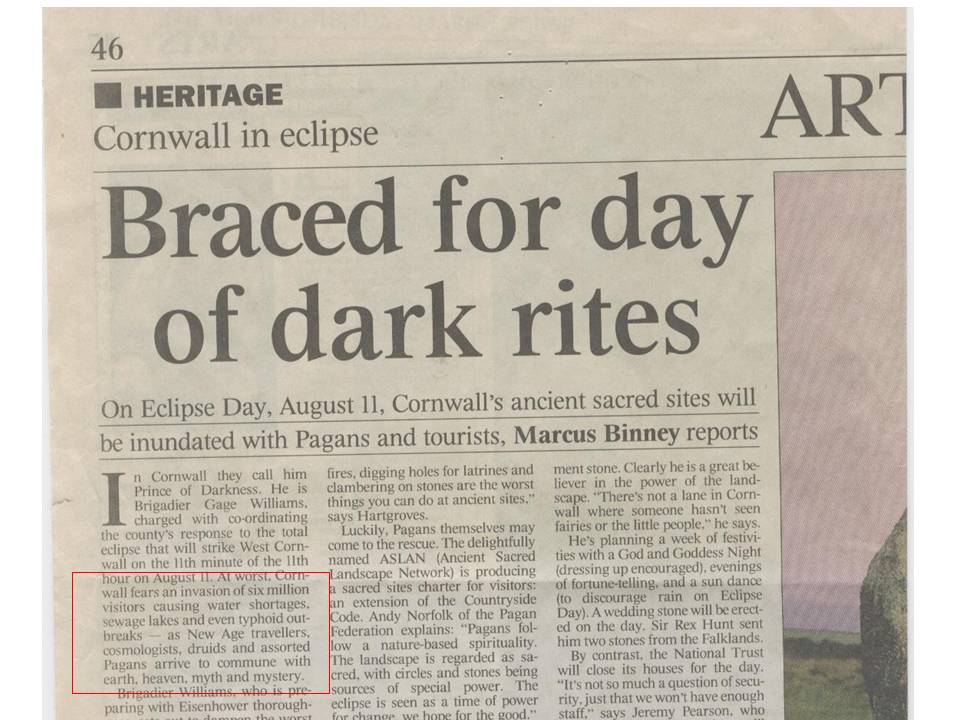
There’s usually a lot of neo-Pagan nonsense going around at the Solstices and Equinoxes, which reminded me of the following clipping related to an even more significant astronomical event, a total eclipse. I found it in The Times, in 1999, just before the total eclipse that was visible from parts of the United Kingdom on August 11th of that year. It was a feature about the concerns raised by certain residents of Cornwall about the possible effects of the sudden influx of visitors on the local community. Here is a scan of a big chunk of the story, which you probably can’t read…
.and here is a blow-up of the section shown in the red box, which places cosmologists such as myself in rather strange company:
In protest, I wrote a letter to the The Times saying that, as a cosmologist, I thought this piece was very insulting … to Druids. They didn’t publish it.
The views presented here are personal and not necessarily those of my employer (or anyone else for that matter).
Feel free to comment on any of the posts on this blog but comments may be moderated; anonymous comments and any considered by me to be vexatious and/or abusive and/or defamatory will not be accepted. I do not necessarily endorse, support, sanction, encourage, verify or agree with the opinions or statements of any information or other content in the comments on this site and do not in any way guarantee their accuracy or reliability.









 In the Dark