Archive for the Biographical Category

Covid-19 in Ireland – The Last Post

Posted in Biographical, Covid-19 with tags , , , on March 1, 2023 by telescoper

On February 29th 2020, Ireland identified its first case of the novel coronavirus, SARS CoV2, the virus that causes COVID-19. The World Health Organization declared the outbreak a pandemic on March 11th. On March 12th 2020 Schools and Colleges in Ireland were closed.

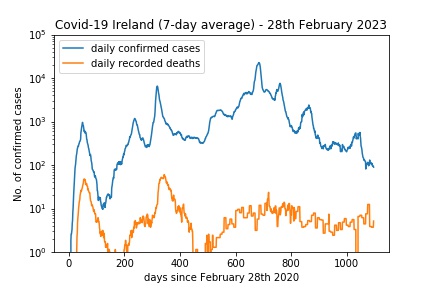
Since then, I have posted regular updates of the number of cases of COVID-19, initially daily and more recently weekly as the frequency of official announcements on the data hub decreased. The plotting the latest figures actually became a sort of ritual for me over this time and I even found mildly therapeutic.

Now, however, three full years have passed- can it really be three full years? – have since the (official) arrival of the pandemic in Ireland and, with the situation looking stable, I think it’s time to stop posting these updates. I made the decision to stop at the end of February 2023 unless something drastic happened to change my mind. Ironically, I just heard this morning that one of my colleagues has a new case of Covid-19 but that hasn’t changed my mind.  I hope this makes it clear that I don’t think the pandemic is over: there are many people still suffering from new infections and the effects of “Long Covid”. I just don’t see the need to continue my updates here.

I will leave the data online here in case anyone is interested in the numbers, but I won’t be posting any further updates.

So here are the final graphs from me.  The present 7-day moving average of new cases is just 89.6 per week, down from 103.0 last week and 36 deaths were recorded in the same period.


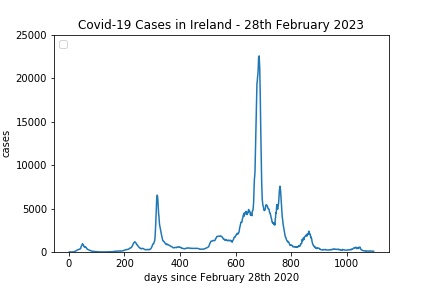
On a linear scale the cases look like this

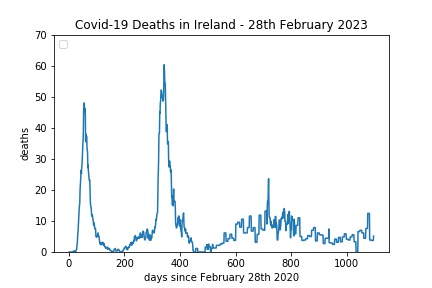
The numbers for deaths on a linear scale look like this

Early Morning Lectures

Posted in Biographical, Education, Maynooth on February 23, 2023 by telescoper

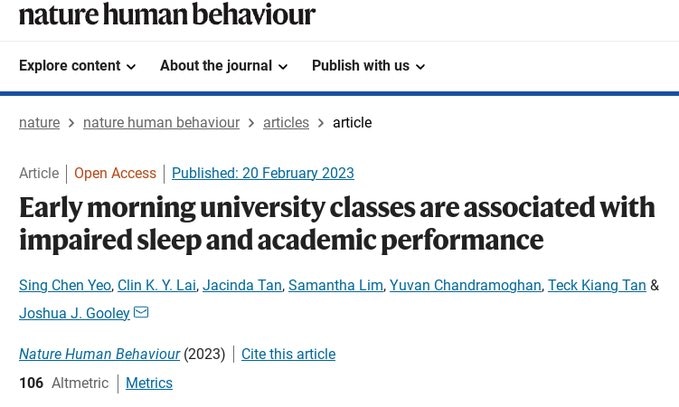
I saw this doing the rounds on Twitter the other day. I even made a little joke about it which went viral (by my standards) with over a million views and almost 2000 retweets:

There’s no accounting for taste.

Am I a meme now?

Anyway, I’m in the office quite early this morning ahead of my 9am Computational Physics lecture so thought I’d do a quick post. I realize that 9am is not early compared to practice in some institutions abroad where lectures can start at 7.30am or even earlier. Everything I say here is based on my own experience and is not claimed to be universal.

As a lecturer I don’t mind 9am lectures at all. I find itt’s nice to get something significant done before 10am as opposed to just trying to deal with emails. On the other hand, I live only about 20 minutes’ walk away from campus so I don’t have to get up especially early. As a matter of fact I get up at 7am on weekdays, so no real adjustment is necessary for a 9am start. If I had a two-hour commute it would no doubt be a different matter.

At conferences and so on, I don’t find myself sleeping in the morning sessions. I find the slots immediately after lunch the worst for staying awake. That’s the time we have our theoretical physics seminars at Maynooth, actually.

My own experiences of being an undergraduate student (at Cambridge) was that I had regular 9am lectures 6 days a week (Saturdays included) and didn’t mind those either. But Cambridge is relatively compact and, living in College, it didn’t take me long to get to the lecture theatres in town. I usually felt quite sharp at 9am, actually, probably less so later in the morning.

Of course the reality is different for many students, some of whom have lengthy journeys into campus on not-entirely reliable public transport, so find a 9am start a challenge (to say the least). It’s certainly not unknown for students to doze off, but I don’t mind that as long as they don’t snore too loudly. I try to break up these lectures with things for the students to do, and that sometimes wakes them up again. In terms of attendance it’s the early evening slots that are worse in my experience than early morning.

Anyway, here in Maynooth we teaching staff have no real say over timetabling so now I should head off to Hall C to set up.

UPDATE: I had a pretty full class but one student did doze (without snoring) for about 3 minutes.

Parnell Memorial

Posted in Biographical, History with tags , , , on February 19, 2023 by telescoper

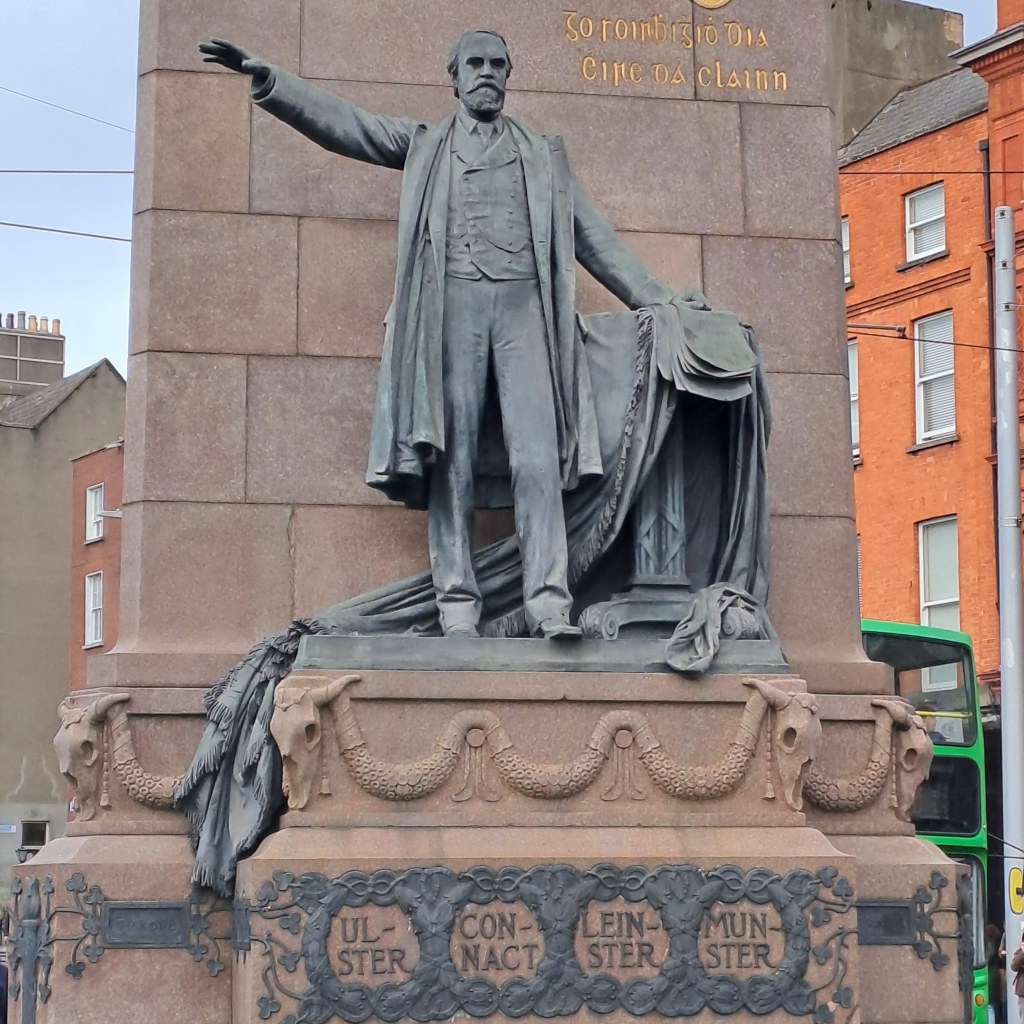
Yesterday’s march, which started near Parnell Square, passed by the Monument to 19th century Irish nationalist politician Charles Stewart Parnell on O’Connell Street in Dublin. I took the above picture on the way there, before the march.

I was an undergraduate student at Magdalene College, Cambridge, which just happens to be where  Charles Stewart Parnell studied, although I hasten to add that we weren’t contemporaries. There is an annual Parnell Lecture at Magdalene in his honour; an annual Coles lecture is yet to be established.

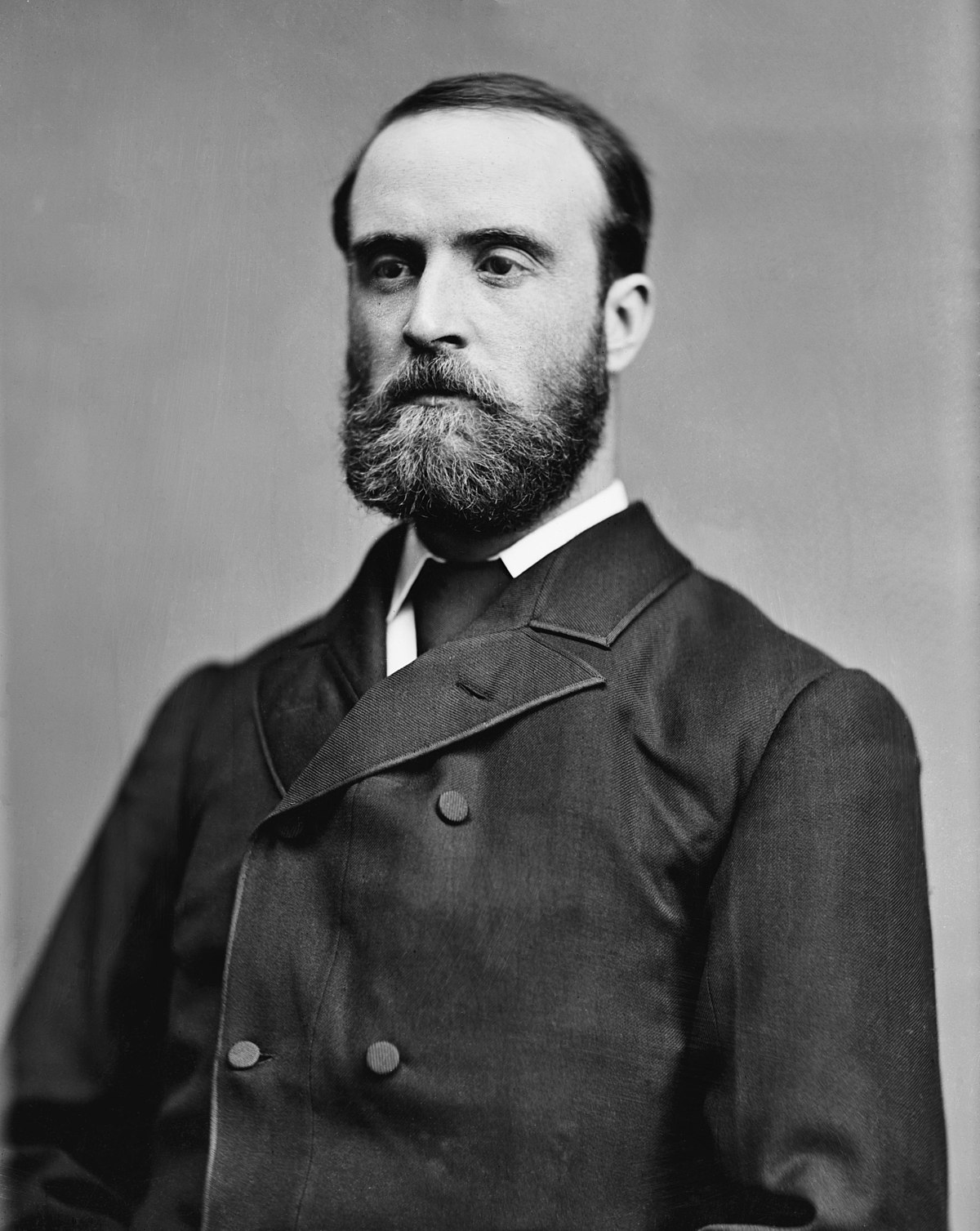
Parnell was reportedly one of the most charismatic, capable and influential Parliamentarians of his era. He led the Irish Parliamentary Party at the forefront of moves for Home Rule for Ireland. He also had a splendid beard:

His career was cut short by scandal in the form of an adulterous relationship with Kitty (Katherine) O’Shea, whom her husband divorced in 1889 naming Parnell in the case, and whom he married after the divorce. (Kitty, that is, not her husband.) They were not to enjoy life together for long, however, as Parnell died in 1891 of pneumonia in the arms of his wife at their home in Brighton (Hove, actually).

#IrelandForAll

Posted in Biographical, Politics on February 18, 2023 by telescoper

The day has come and I’ll shortly be getting on a train into Dublin to attend the above event in Parnell Square this afternoon. Somewhat annoyingly I’ve had a flare-up of my arthritis recently, but I think it’s important to stand up and be counted. There are rumours that “far-right agitators” (i.e. fascist thugs) are planning to disrupt the event, but if any of them have a go at me I’ll fend them off with my walking-stick!

Update: the journey to Dublin by train was uneventful except that a little boy sitting in the same carriage as me was very upset that it didn’t actually go “choo choo” like his Mam had told him it would.

Update: I’m back in Maynooth enjoying a nice cup of tea, after a very enjoyable day in Dublin. There were many more people on the march than I expected – upwards of 30,000 – which was great, but meant it was very crowded and difficult to take pictures of anything but backs of people.

We took a long while to get going because of the numbers, so I reached the end too late to hear some of the speakers and musicians at the rally. Some of us were still in O’Connell Street when the front of the march arrived at the Customs House. I’m very sorry I missed Christy Moore and Bernadette McAliskey, but the huge turnout was in itself more than adequate compensation.

I am also happy to report that the rumored far-right counter-protest failed to materialize so the whole event went off peacefully. The important thing now, as many of the speakers at the rally stressed, is to ensure that this is just the start.

You can find a report on the march here.

Three weeks in…

Posted in Biographical, Education, Maynooth on February 17, 2023 by telescoper

The first quarter of the second Semester at Maynooth University has flown by. I’ve now done three weeks of lectures and even conducted the first class test in the computer lab. It is from the correcting of these submissions that I am now taking a short break to compose this blog.

Amazingly, for the first time ever, there have been no major problems in the Computational Physics lab at all. In previous years, something has always gone wrong but not (so far) this time round. I’m sure our nice new digital display screen has also improved the experience for the students in that they can now actually see the instructions I give them!

I’m actually ahead of the game in my Advanced Electromagnetism module, having done 7 lectures in 3 weeks instead of the usual 6, because I used one of my tutorial slots to give an extra lecture, anticipating that I’d lose a lecture on Good Friday (7th April) as this is a national holiday in Ireland. The following week is a holiday here too. Three weeks from now we have the mid-term Study Break (13th-17th March, ending on St Patrick’s Day), so after the first six weeks of this Semester we get a little more time to relax.

Soon it will be time to write the examinations for Semester 2. I need to think up some questions for Advanced Electromagnetism and Computational Physics. Writing an examination takes the same time regardless of how many students are taking it, but when the class sizes are small it takes much less time to do the marking. There is a large component of continuous assessment in Computational Physics, which means more work for me through the term, but there are only 25 in the class so it’s not too bad. The class for Advanced Electromagnetism is even smaller, which should make my marking workload in June a bit less heavy than it was in January.

Today students were notified of their provisional Semester 1 examination results. I expect I’ll be talking to some of them next week to discuss their options in the light of the outcome. Final marks don’t get confirmed until the Summer, when we have a full meeting of the Examination Board together with the External Examiner. Marks don’t usually change but they can if the Board decides they should.

We often have a seminar on Friday afternoons but we don’t have one today which is why I’ve got time to write this post. Often I go to the National Concert Hall on Friday evenings but I’m not going this evening. I decided to have a quiet night in tonight, as I’ve got something important to do tomorrow. After I finish marking this first class test I think I’ll toddle off home.

Ives, Beethoven and Sibelius at the National Concert Hall

Posted in Biographical, Music with tags , , , , , , , on February 11, 2023 by telescoper

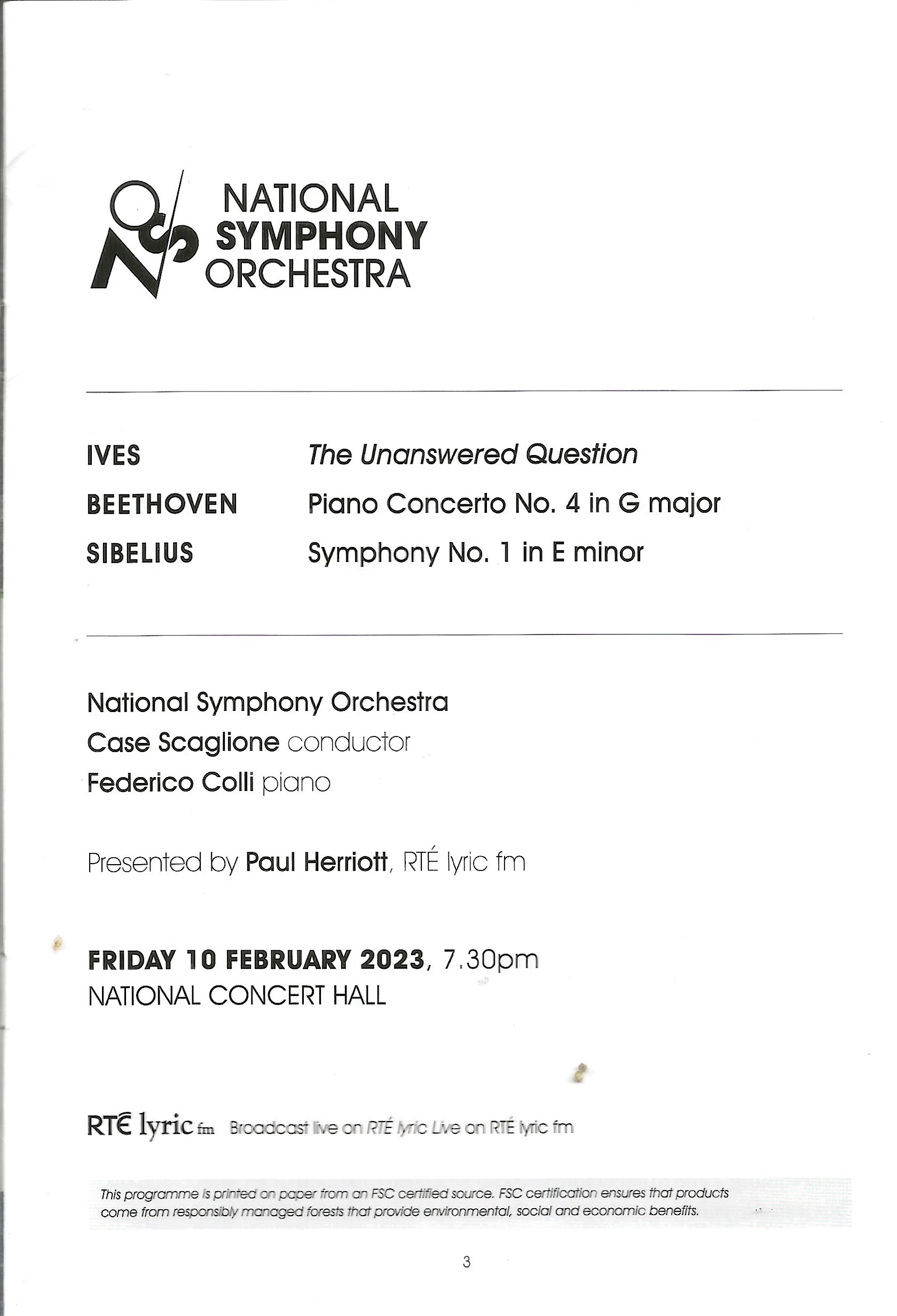
Last night’s concert by the National Symphony Orchestra at the National Concert Hall in Dublin was one that I’d been looking forward to for a long time. It didn’t disappoint! Congratulations to the National Symphony for yet another excellent concert, this time under the direction of guest conductor Case Scaglione.

The first half of the programme consisted of The Unanswered Question by Charles Ives and Beethoven’s Piano Concerto No. 4 with soloist Federico Colli. That’s an interesting juxtaposition, made even more interesting by the Beethoven piece was played directly after the Ives without a break for applause. I wondered what was up when Case Scaglione walked on stage with Federico Colli who took his seat at the piano at the start of the concert. There is no piano part in The Unanswered Question, so Colli sat quietly until the end of that piece and then went straight into the opening piano statement of the Beethoven. I wasn’t expecting this before the performance but it worked very well. The only problem is that I didn’t get the chance to applaud at the end of The Unanswered Question.

The Unanswered Question is one of my favourite works by Charles Ives (along with Three Places in New England), a composer whom I admire greatly. I wrote a piece about him some years ago, actually.  The Unanswered Question, was completed in 1908 (although it was revised later) and is subtitled “A Cosmic Landscape”. It’s a sort of meditation on the philosophical problem of existence. It comprises three different voices: muted strings playing notes from a G-Major triad (a rather “churchy” key, giving the flavour of a simple hymn). Then, played (in this performance) from the balcony behind the conductor, a solo trumpet poses the Question: a five note figure that is repeated with almost imperceptible variations several times during the work. The reply to the Question comes from the woodwinds, whose dissonant response is at first plaintive but then increasingly agitated and frustrated. Then the Question comes again without an answer, but the strings carry on quietly in G Major until everything goes quiet.

The Piano Concerto No. 4 by Ludwig van Beethoven is in G Major, so there is a continuity between the two pieces in terms of tonality, although of course the musical language is very different. It was composed in 1805/6, a hundred years before the Ives. It’s an audacious piece right from the start as it opens with unaccompanied piano. The second movement is a kind of dialogue between the orchestra and the piano, which at times sounds more like an argument as the orchestra makes a series of rather harsh statements with somewhat conciliatory responses from the piano. The last movement is a more conventional and jovial Rondo, by which time the solo trumpeter from the Ives piece had found her way back to the stage from the balcony. I’ve heard this movement several times played on its own on the radio.

Federico Colli cut a dashing figure in a grey suit and waistcoat with a high collar and a voluminous white cravat. He was well up to the demands of the piece, playing very expressively, tenderly at times and with virtuosic brilliance when called for.

After the wine break we returned for the majestic Symphony No. 1 by Jean Sibelius. This is one of the great symphonies and another favourite of mine – I have several different recordings of it and have heard it on the radio many times – but I had never heard it performed live in person before last night. The First Movement (initially Andante) opens with a theme played by solo clarinet. It then moves into allegro energico which was played very briskly in this performance (in contrast to some famous recordings which slow it down). The motif played by the clarinet at the start permeates the whole work, returning in different guises and endowing the composition with a strong sense of unity. It’s all shot through with great romantic tunes and has wonderful dynamics. In short, it’s a masterpiece. Not bad for a First Symphony!

Reflections on the St Brigid’s Day Holiday

Posted in Biographical, Education, Maynooth with tags , , on February 6, 2023 by telescoper

It’s Monday 6th February 2023, which means that today is a new experience for me: a Bank Holiday in February. This is taking place on the first Monday after Imbolc, a Gaelic festival marking the point halfway between the winter solstice and vernal equinox. The 1st day of February is also the Feast day of St Brigid of Kildare (c. 451-525), one of Ireland’s patron saints, along with Saints Patrick and Colm Cille. . From what I’ve read, St Brigid is an a sort of amalgamation of a pagan deity and an early Christian figure, part legend and part real person. One of her miraculous powers was the ability to change water into ale, which perhaps explains her enduring popularity among the Irish.

Anyway, it’s nice to have a day off even if it is just a week after the start of Semester Two, well before exhaustion sets in. Last week I started both my modules. I was particularly apprehensive about the first laboratory session for Computational Physics 1 on Thursday. In previous years the first session has always generated a lot of technical problems. This year we are running a new version of the operating system on our Linux cluster as well as a new version of Python. Students are issued with accounts specifically for use on this cluster and even logging for the first time and changing passwords has proved a challenge. I am now also using a digital display screen instead of the old data projector I used to have and which conked out last year.

This time, however, there were no significant problems at all in the Lab. Let’s hope the same is true for the Tuesday lab, which is a repeat but with a different (and slightly larger) group of students. In recognition of the likelihood of technical hitches I don’t usually aim to do very much in Lab 1, but this time I managed to cover quite a lot of material. By next week I’ll be starting to get the students to write bits of their own code. Thereafter it gets increasingly hands-on. There’s no efficient way to learn coding other than by doing it, so the sooner they get going with that the better.

I don’t actually have any lectures timetabled on Mondays this semester and, since the lab for tomorrow (Tuesday) is a repeat of last Thursday’s, I don’t have anything urgent to prepare. I’m therefore using the time off to do some Open Journal business – including publishing a paper – and, despite the cold, do a bit of gardening to prepare for Spring.

Mozart, Ravel and Danielle de Niese

Posted in Biographical, Music with tags , , , , , , , , on February 4, 2023 by telescoper

After last week’s magnificent concert I couldn’t miss another chance to see and hear Danielle de Niese in at the National Concert Hall in Dublin, again with the National Symphony Orchestra under the direction of Jaime Martin. It was another fascinating (and very full) programme.

For last week’s concert, the National Concert Hall was only about two-thirds full but this time it was packed. I think the glowing reviews of La Voix Humaine contributed to that, as did the round of media interviews Danielle de Niese has done since then contributed to the full house.

Danielle de Niese seems to like singing 20th century French music and the concert opened with Shéhérazade by Maurice Ravel. This is a cycle of three songs which are settings of poems inspired by The Arabian Nights written by the pseudonymous poet Tristan Klingsor: Asie, La flûte enchantée, and L’Indifférent. Ravel was a real master of orchestration, and he creates a succession of exotic textures to complement the vocal lines. It’s not a long piece -altogether the three songs last about 15 minutes – but it covers a vast territory. There’s more than a nod to Debussy in this work too.

After that Danielle de Niese went off stage to change her frock, which was lime green for the Ravel, while the orchestra played the overture to the singspiel Die Entführung aus dem Serail (The Abduction from the Seraglio) by Wolfgang Amadeus Mozart. I’ve actually reviwed the whole Opera (was that really 12 years ago?) and wrote then (about the plot):

It’s admittedly a bit thin, even by the standards of comic opera but, right from the fabulous overture, the music is lovely and there’s a great deal of good-humoured fun, 

The overture is great fun to listen to, and obviously also to play. Jaime Martin was beaming and bouncing up and down on the podium during the performance.

And then Danielle de Niese returned (this time in a lurid red dress) to sing another piece by Mozart. Exsultate, Jubilate is a piece for solo voice and orchestra usually described as a motet but technically really a cantata. There are three movements, marked Allegro, Andante and Allegro. It’s obviously a work,with a religious theme, and the central Andante movement does sound like it is sacred music, but the outer Allegro movements are very operatic, with demanding coloratura passages, especially in the final Hallelujah. I don’t usually associate such vocal acrobatics with religious music, but it’s certainly a very exuberant and joyful piece. Astonishingly, Mozart was just 17 years old when he wrote it.

That piece by Mozart presented very different challenges to the soloist, Danielle de Niese but she showed herself to be a very accomplished performer in this too. With that her two-week residence in Dublin came to an end. She was presented with a huge bouquet of flowers and a standing ovation before we headed off to the bar for the interval.

After the wine break the National Symphony Orchestra was joined by the National Symphony Chorus for complete performance of the music to the ballet Daphnis et Chloé by Maurice Ravel. As is the case with Stravinsky’s Firebird, music from this ballet is often played in the form of a suite or, in the case of this ballet, two suites, but I have to say the whole is much greater than the sum of the suites and this work has become one of my favourite pieces to hear live. It’s a gloriously sensual and dramatic work, again brilliantly orchestrated, full of vibrant colours and lush textures, and even more wonderful when accompanied by the wordless singing of the massed ranks of the National Symphony Chorus. The score lasts a good hour, but that time seemed to flash by in this performance which was extremely well received by a very appreciative audience.

This was a very full programme and I had to leave during the applause to make sure I got back to Pearse station in time to catch the train back to Maynooth. I’m not as quick on my pins as I used to be. I arrived at Pearse with about five minutes to spare only to find that the train was five minutes late so I didn’t have rushed.

I have to congratulate whoever is doing the programming for these NSO concerts at the NCH. The last few have been excellent, and next week’s recipe of Ives, Beethoven and Sibelius looks great too!

Imbolc – the Quickening of the Year

Posted in Biographical with tags , , on February 1, 2023 by telescoper

It is 1st February 2023, which means that today is Imbolc, a Gaelic festival marking the point halfway between the winter solstice and vernal equinox.  In the old pagan calendar, this day is regarded as the first day of spring, as it is roughly the time when the first spring lambs are born, daffodils etc start to appear, and the days get noticeably longer.  It corresponds to the Welsh Gŵyl Fair y Canhwyllau and is also sometimes called, rather beautifully, The Quickening of the Year.  It’s a time for rebirth and renewal after the darkness of winter. Walking by the canal on my way to work this morning, I passed a place where two swans have nested for many years. I noticed that last year’s cygnets – which I saw on Monday with their parents – now appear to have departed for pastures new. That is the way of things. It won’t be long until this year’s chicks appear.

In Ireland Imbolc is usually often referred to a Lá Fhéile Bríde,  St Brigid’s Day, after St Brigid of Kildare, whose feast day is 1st February.

In the Northern hemisphere, in astronomical terms, the solar year is defined by the two solstices (summer, around June 21st, and winter, around December 21st) and the equinoxes (spring, around March 21st, and Autumn, around September 21st). These four events divide the year into four roughly equal parts of about 13 weeks each.

If you divide each of these intervals in two you divide the year into eight pieces of six and a bit weeks each. The dates midway between the astronomical events mentioned above are the cross-quarter days, of which Imbolc is one. They are:

  • 1st February: Imbolc (Candlemas)
  • 1st May: Beltane (Mayday)
  • 1st August: Lughnasadh (Lammas)
  • 1st November: Samhain (All Saints Day)

The names I’ve added in italics are taken from the Celtic/neo-Pagan and, in parenthesis the Christian terms), for the cross-quarter daysThese timings are rough because the dates of the equinoxes and solstices vary from year to year. Imbolc is often taken to be the 2nd of February (Groundhog Day) and Samhain is sometimes taken to be October 31st, Halloween but hopefully you get the point that although the Pagan festivals have been appropriated by the Christian church, they have much older origins.

The last three of these also coincide closely with existing Bank Holidays in Ireland, though these are always on Mondays so may happen a few days away. Until this year, however, there wasn’t a holiday for Imbolc. Last year, however, the Government decided to create a new Bank Holiday that corrects this anomaly. The first such holiday is next Monday, 6th February, the new St Brigid’s Day holiday.  which also happens to be the first national holiday in Ireland to be named after a woman.


Incidentally, the Celts counted each day starting from sunset, so the Imbolc/St Brigid’s Day celebrations in County Kildare started last night, 31st January. Maynooth Castle – or at least the remains thereof – was illuminated last night, though I was not there to witness it.

As it also happens, today is my first Advanced Electromagnetism lecture of Semester 2 and also the 5th anniversary of the very first lecture I gave in Maynooth, on Computational Physics on 1st February 2018…

The Term Ahead

Posted in Biographical, Education, Maynooth with tags , , , , on January 29, 2023 by telescoper

It’s the day before the start of a new Semester in Maynooth. Last week we finished all due processes relating to the First Semester examinations and the provisional results will be uploaded to “The System” next week. They’re provisional at this stage because they’re not set in stone until the final meeting of the Examination Board. Obviously I can’t discuss the results here. I could comment here about how clunky the whole process is, including multiple downloads of spreadsheets and subsequent uploads somewhere else, but I won’t bother. Nobody seems to be interesting in fixing it. Perhaps by the time I retire “The System” will have been replaced by something that doesn’t waste an enormous amount of staff time. But I doubt it.

It’s a curiosity of the teaching allocation in the Department of Theoretical Physics that I do first-year and second-year modules (MP110 Mechanics and Special Relativity and MP201 Vector Calculus & Fourier Series) in Semester 1 while in Semester 2 it’s the third and fourth year students who have to put up with my ramblings.

The menu for this term involves MP354 Computational Physics 1, which entails just one hour of lectures per week but two two-hour lab sessions. Each student attends one of these sessions, so they get 3 contact hours per week but I have to look after both sessions. Our computer lab has a small cluster of Linux machines and, this term, a brand new display screen which I am looking forward to playing with. I’m also looking forward to seeing how the infamous ChatGPT copes with the Python coding exercises I give the students to do in class: I’ve only tried one so far, without much success. This is the first module I taught at Maynooth, back in 2018, so this will be the 6th time I’ve done it.

My other class is MP465 Advanced Electromagnetism, which I’m doing for the 3rd time now. This is a standard chalk-and-talk kind of module covering a well-established syllabus, and involving two lectures per week plus a tutorial. At least I’m teaching in a classroom rather than online like when I first did this module!

In 2020/21 (during the Pandemic restrictions) I did five modules as well as being Head of Department. At this time two academic staff departures left us severely short-staffed and struggling to deliver our programmes. My workload then was unmanageable and I asked to step down. I changed my mind when were eventually allowed to recruit two lecturers and saw out my three-year term to the end. I had better not repeat here what I think of the deliberate management decisions that left us reeling and had such negative effects on staff morale and on the education of students in the Department. I just hope the damage is not irreparable.

Although I am doing the same number of modules as last term, the number of contact hours I have to do is higher (8 versus 5) because of the labs and the fact that we don’t have tutors for 4th-year modules so lecturers have to do the tutorials themselves. Four modules a year is a much heavier teaching load than a Full Professor at a UK university would be expected to carry, but it seems normal in Ireland where the funding for sciences is far less than adequate. The impact on research productivity is obvious and is systemic. There are excellent physicists in Maynooth but they are given little time or other resources. It’s a big waste of potential. That’s another “System” that needs changing, but I see little appetite for change of the required sort at institutional level. It’s all about recruiting more and more students to be taught with fewer and fewer resources.

The impact of this on staff careers is severe: teaching loads are so heavy that it’s very difficult to reach the level of research productivity required for promotion. For myself, though, the next career step will be retirement so I don’t have to worry about promotion. Fortunately too, I enjoy teaching, so I’ll just get on with it. So I’ll stop writing and get on with preparing my first week of lectures and lab sessions!