Archive for the Biographical Category

Vaccination Machinations

Posted in Biographical, Covid-19 on April 30, 2021 by telescoper

As Ireland’s Covid-19 vaccination programme stumbles along, well behind schedule, the Irish Government keeps saying – despite all the evidence – that it will meet its target of 82% of the adult population have received a first dose by the end of June. Actually they say that “will either have received or been offered a dose” by then. This may end up with people registering for their shot and being counted if they are given a date to receive it some time later in the year.

As of Wednesday 28th April, 1,067,378 people have received their first dose in Ireland. That will have to increase to to over 3 million to reach the 82% target by the end of June. There is also the fact that only 419,655 have had their second dose so not all the shots delivered in the next two months will be first doses. Looking at the current rate of vaccination, which is around 35,000 per day – it does not seem at all likely to me that it will be possible to hit the target. The Government is claiming 450,000 doses per week in June, which seems not just optimistic but delusional. I hope I’m proved wrong.

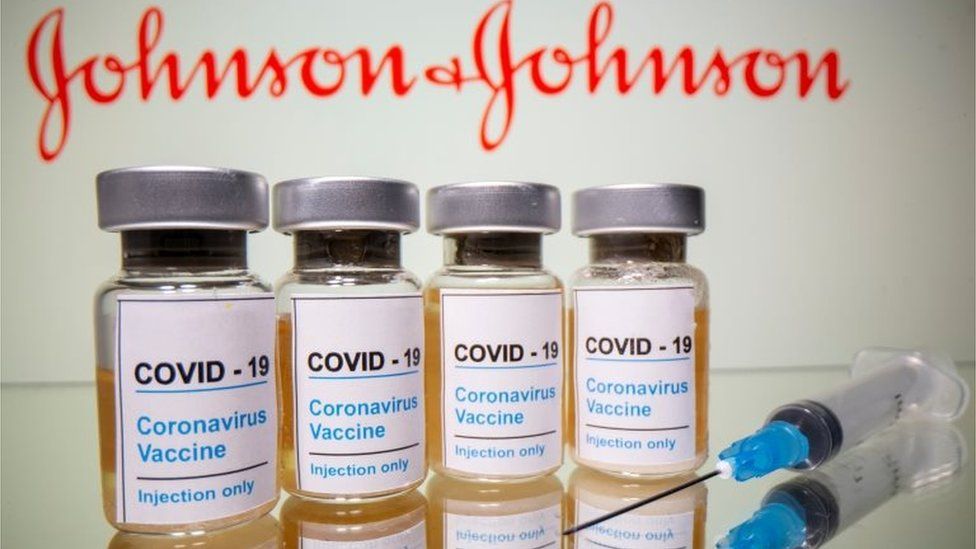
Recently the HSE recommended that two of the available vaccines – AstraZeneca and Johnson & Johnson – can only be given to the over-50s, which is the next cohort due to be allowed to register for vaccination (starting next week) and to which I happen to belong. If the Government is to reach its target it will have to use almost all the shots it receives in the next two months, including AZ and J&J. The problem this poses is: (1) the over 50s are next in line, according to the age-based priority system being implemented; and (2) most of the 600,000 J&J doses coming to Ireland won’t arrive until late June.  The number of people currently unvaccinated in the 50-59 age group is about 550,000. The obvious suggestion would therefore to be to make the over-50s wait for the J&J to arrive.

(Of course the over-50s also qualify for the AstraZeneca vaccine, but I won’t discuss that because the supply of that has been so unreliable that it would seem to me to be unwise to count on it for anything. There’s a strong case for just forgetting about AZ and giving the surplus doses to countries that need them more, e.g. India. I also wish the EU well in its legal case against AstraZeneca for multiple and egregious breaches of contract.)

Anyway, unless the advice on use of J&J is changed, the only way to use most of the J&J doses is on the fifty-somethings whose will have to be delayed in order to wait for the doses to arrive. If the decision is made to do this then I won’t be vaccinated until the end of June or later, even if the promised deliveries arrive on schedule. If J&J are as unreliable as AstraZeneca then I may not be vaccinated until much later. The upshot of this shot is that it is a single-shot, so recipients would count as fully vaccinated immediately.

This would also mean  Pfizer/BioNTech and Moderna doses sitting around unused, so there is a case for moving on to younger cohorts to use up these doses until the J&J doses arrive for us oldies. I expect to be able to register for my vaccine next week but it’s anyone’s guess when I’ll actually be able to get my jab. I have even toyed with the idea of going back to Cardiff to get my vaccination there…

I’m pretty much resigned at this stage to having to wait at least another two months to receive my jab, and for that to probably be the J&J vaccine, but the vaccination programme has changed umpteen times during the course of April and it could change again in May. We’ll see. We live in interesting times.


The Definitive Guide to Bird Identification

Posted in Biographical on April 28, 2021 by telescoper
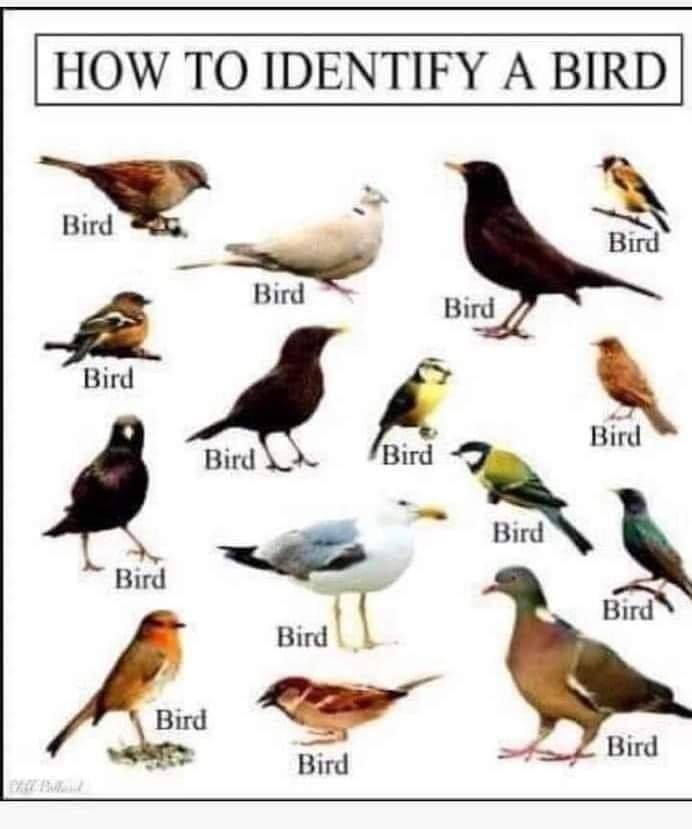
The Definitive Guide to Bird Identification

What with it being the penultimate week of teaching term, today has been full on so I haven’t time for a lengthy post. On very busy days like this I find it quite relaxing watching the birds in my little garden even just for a few minutes in between other things. Over the past few months I think I’ve become quite adept at identifying the various avian visitors so thought I’d share that expert knowledge free of charge with my vast readership via the above graphic.

The State of the Universe Talk

Posted in Biographical, Books, Talks and Reviews, Talks and Reviews, The Universe and Stuff on April 26, 2021 by telescoper

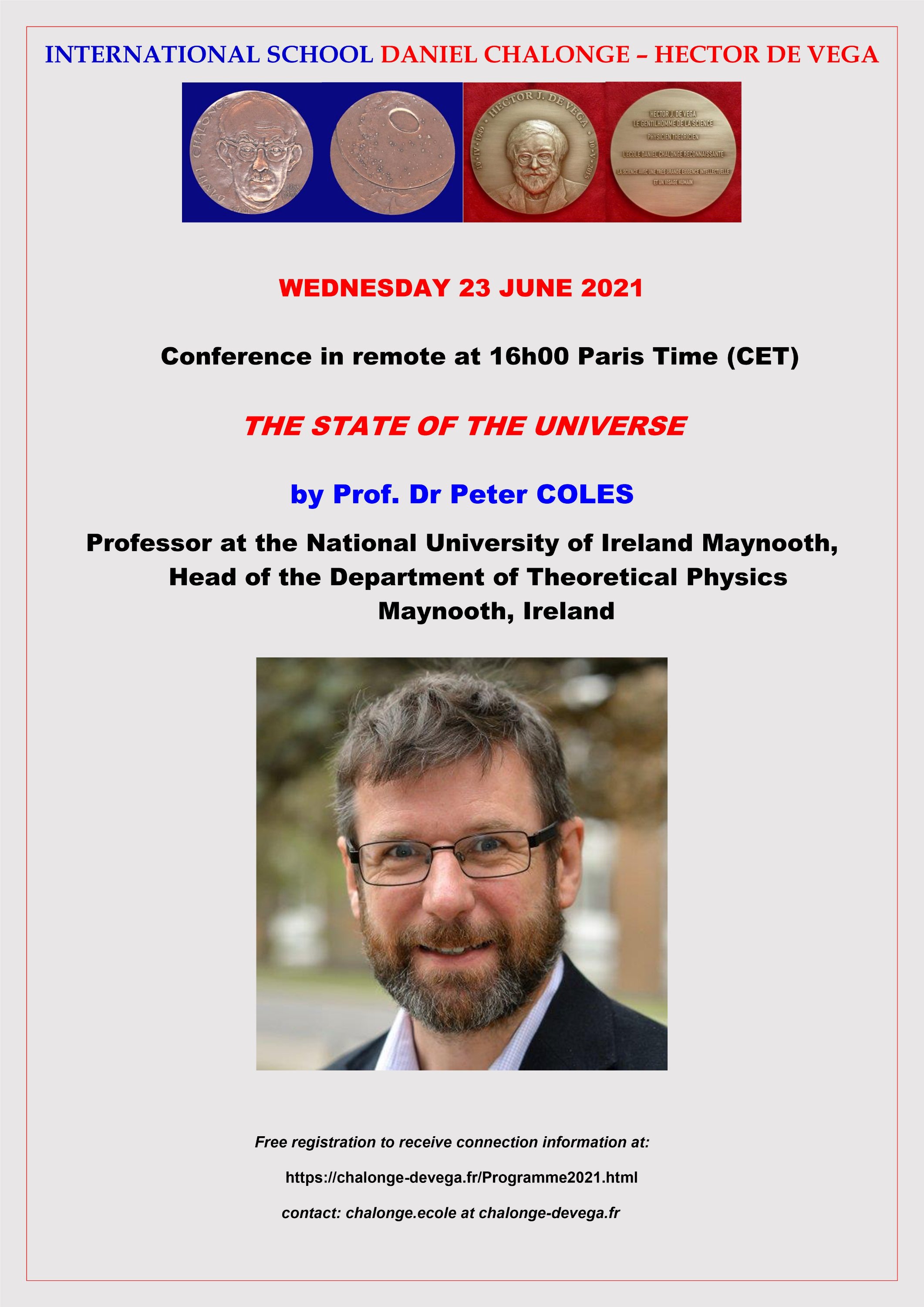
When I saw the calibre of the other speakers in the Chalonge – De Vega Series organized by Norma Sanchez- including a number of Nobel Laureates – it was with some trepidation that I accepted the invitation to give a Colloquium, but there we are. I’m on the list. If you want to attend the Colloquium (via Zoom) you can register for it here. This series was originally named after Daniel Chalonge but was renamed to honour Hector de Vega, who sadly passed away in 2015.

I used to get invited quite often to the famous Norma Sanchez Schools and Conferences in Paris and Sicily (both Erice and Palermo) but then, about a year ago. I was suddenly stopped receiving invitations. I gather that a number of other colleagues have also been abruptly “cancelled” over the years. Anyway it seems I’m back on the list, at least virtually, possibly owing to some form of administrative error.

I remember one year in Erice at the end of a talk I gave (in the OHP/Transparency era) Norma Sanchez, who was meant to be chairing the questions and discussion started writing on my transparencies, crossing out the word “theory” and replacing it with “model”. That event made quite an impression on the audience who thought it was hilarious and people who were there often remind me of it. Coincidentally, I thought of that event when I wrote Saturday’s post. Since the forthcoming colloquium is via Zoom I think I’ll be safe from any such intervention this time.

A First in Azed

Posted in Biographical, Crosswords with tags , , , , on April 25, 2021 by telescoper

I was roused from my Sunday-morning lie-in by the news that I had actually won First Prize in the latest Azed Competition. The best I’ve done previously was third place, and that was almost a decade ago!

As I’ve mentioned before, the monthly Azed Competition puzzle involves not only solving the Azed crossword but also supplying a cryptic clue for a word or phrase given only as a definition in the crossword. This competition is tough, partly because Azed is a stickler for syntactical soundness in submitted clues, and partly because many of the competitors are professional crossword setters.

I’ve struggled this year to find the time and the energy to make a decent attempt at the Azed competition, but the latest competition puzzle was published on Easter Sunday so I had Easter Monday to think about it. Solving the actual puzzle wasn’t too hard this time, which gave me plenty of time to work on the harder bit of composing a clue.

The target word was FILATORY (a machine for spinning thread). For some reason the first thing that popped into my mind was Greek Mythology, specifically the Moirai (Fates) who between them weave the tapestry of life, but one of whom, Clotho, spins the thread. I noticed that one can find the letters of TRIO in FILATORY leaving FAY+L. I looked up FAY in the One True Chambers Dictionary where I found that in its meaning as “fairy” is is derived from the Latin Fata. Even better. I just need to find a way of putting an L into the mix but as a standard abbreviation for “line” that wasn’t too hard.

My clue was

Fay trio with line in weaving? One spins thread.

The second part is the definition (a filatory spins thread) whereas the first part is the word play, FAY TRIO with L forms the basis of an anagram, with “weaving” as the anagram indicator (“anagrind”) instructing the solver to form an anagram.

I think the mythological connection between the two parts of the clue lays a false trail that disguises the definition a bit so I was quite pleased with this effort, thinking it might just get a VHC. I was very surprised to find it winning outright and am absolutely delighted!

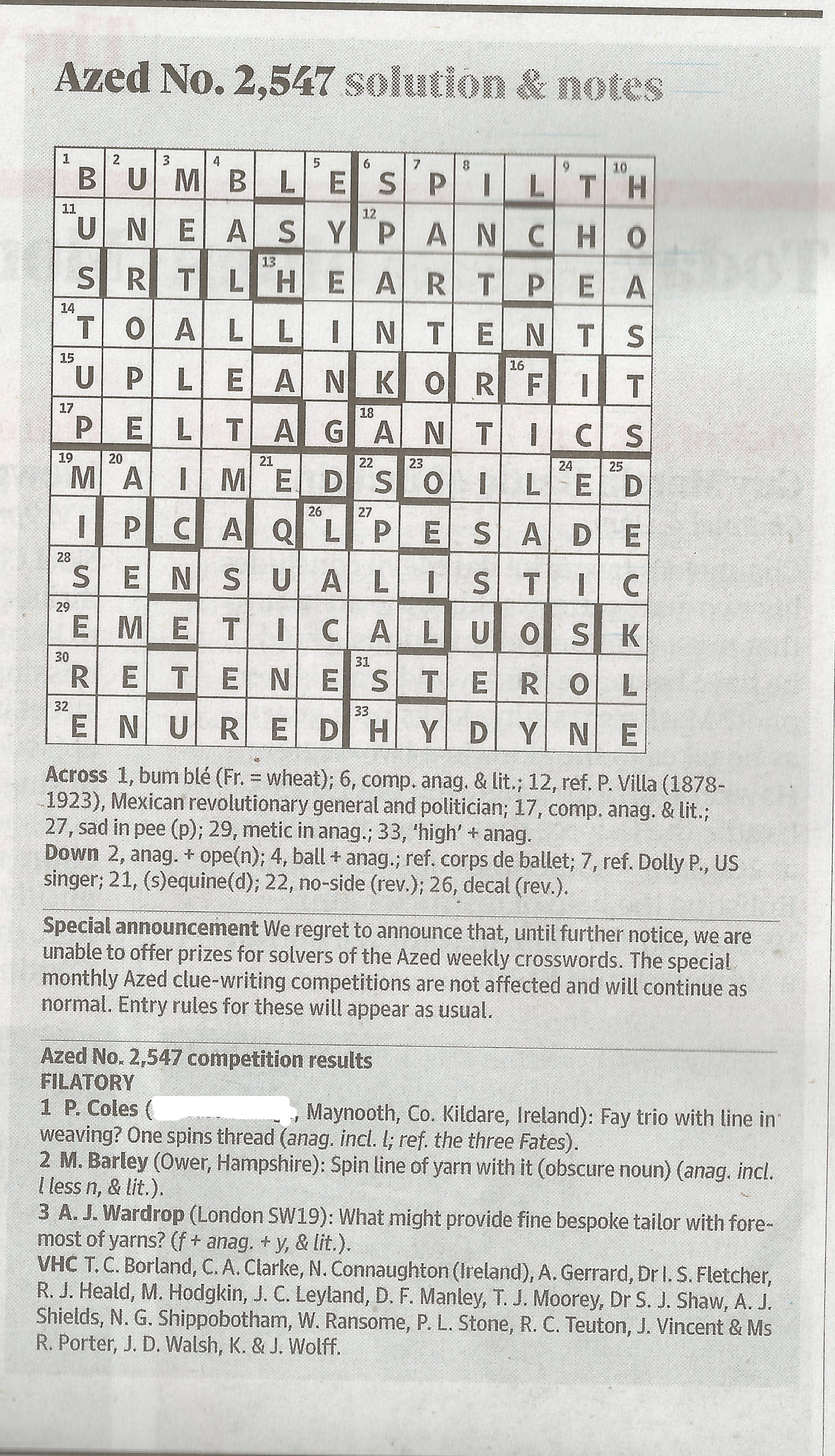
I’ve expunged the first line of my address from the scan for obvious reasons, though it is there in the newspaper. I presume it is there because the winner of the Azed Competition not only gets a prize in the form of book tokens but is also sent the Azed Instant Victor Verborum Cup to hold for a month before passing it on to the winner of the next competition, when the result of that is announced, in this case about a month from now. The next Competition puzzle is in next week’s Observer, published on May 2nd. The following day is a Bank Holiday in Ireland so I’ll be able to have a good go at that too.

Presumably the trophy will arrive in the post at some point. With the current state of the mail service between Ireland and the UK I only hope it arrives before I have to send it on to the next winner!

Backwards and Forwards in Science

Posted in Biographical, Maynooth, The Universe and Stuff on April 24, 2021 by telescoper

I spent a few hours today involved with our Open Day at Maynooth University, including – as I mentioned here – giving a presentation about Theoretical Physics to complement one about Experimental Physics followed by a couple of hours of Q&A. It was a bit of a shame to be cooped up inside on such a lovely Spring day but we had a lot of interesting questions and it was all quite enjoyable.

One of the things that I tried to stress in my talk is that while there theorists and experimentalists (or observers), real science is about the interplay between the two, which I’ve illustrated in the above diagram which I use sometimes when talking about cosmology though it applies to other disciplines.

We have theoretical models – normally including a set of free parameters which we don’t know how to fix a priori. What we can do though is calculate the consequences if we did know the values of these parameters. That forward calculation is represented by the upward arrow, using theory to predict the result of a measurement. The backward calculation (inverse reasoning) involves using the measurements to infer values for the free parameters; that’s represented by the downward arrow. There’s usually a considerable amount of back-and-forth between theory space and measurement space as scientific knowledge develops. If one version of a model doesn’t fit we can adjust its parameters until it does, then we might need new data to test this iteration. It is only when the theoretical slack is sufficiently tight and freedom to adjust parameters is eliminated or severely restricted can we really test a theoretical idea definitively.

In cosmology we have only a handful of free parameters and this process has worked pretty well in providing a model in which these parameters are tightly constrained by a host of observational results. This is the standard model and although there a “tensions”, most prominently concerning the Hubble Constant, the model has survived very well. The same situation holds for the standard model of particle physics, though there is tension concerning the muon magnetic moment that I blogged about here.

I’ve written quite a lot on this blog about the inverse reasoning step – partly because I think there are many people (even professional scientists) who don’t understand this part very well and partly because cosmology provides a good example of a model with elements that can’t be calculated from first principles.

It struck me this morning, however, in answering a question about the muon magnetic moment that we often tend to assume that the forward calculation is somehow trivial. In fact the theoretical calculation of (g-2) is nothing of the sort: it requires lengthy supercomputer computations before the theory can make a prediction and there is some doubt over whether the current values of the theoretically expected value of the muon dipole moment are correct within the model.

The same issue arises in cosmology. It is not at all easy to calculate, for example, detailed properties of galaxy clustering in a given cosmological model. The forward calculation here uses huge N-body experiments. This is why a very considerable part of the effort being expended in preparation for the European Space Agency’s Euclid mission is on the simulation side.

Both particle physics and cosmology – and no doubt other fields – are thus limited by how well we can do the forward calculation and that is not going to change very soon. Nevertheless it is the interplay between theory and measurement that has driven the progress so far, and it will continue to do so even if it is the case that the more progress we make the harder it gets to go further.

Questions of Wellbeing

Posted in Biographical, Education, Maynooth with tags , on April 21, 2021 by telescoper

I wonder if the wellbeing webinar will answer the most important questions:

  1. Should I laugh or cry at receiving this email?
  2. Are staff not allowed to have any wellbeing for the other 11 months of the year?
  3. You do know that we’ll all be supervising and marking exams in May, right?
  4. Is there any chance of the reduction in workload that would be be necessary for me to have the time to attend a webinar?
  5. When can I afford to take early retirement?*

*Sadly the answer to this appears to be is “not before you’re 60…”

The Remorseful Day

Posted in Biographical, Television with tags , , , on April 20, 2021 by telescoper

The final episode of Inspector Morse is on TV tonight, so I thought I’d reblog this post about it from over a decade ago.

According to the wordpress dashboard thingy that post has been viewed 44,412 times!

telescoper's avatarIn the Dark

Not for the first time, I’m going to make an admission that will no doubt expose me to public ridicule. I can’t watch the last episode of the TV series Inspector Morse (The Remorseful Day) without bursting into tears at the end when it is revealed that the eponymous detective has died. Not that it comes as a surprise – the story has plenty of scenes that make it clear that Morse knows his days are numbered. Take this one, for example, wonderfully acted by John Thaw who was himself very ill while this episode was being filmed; he died in 2002.

The poignant quotation is from a poem by A. E. Housman. Here’s the poem in its entirety.

 Yonder see the morning blink:
The sun is up, and up must I,
To wash and dress and eat and drink
And look at things and talk and think

View original post 313 more words

Devastating news from Cape Town

Posted in Biographical with tags , , , on April 18, 2021 by telescoper

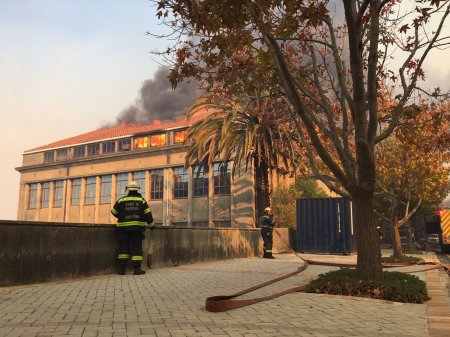
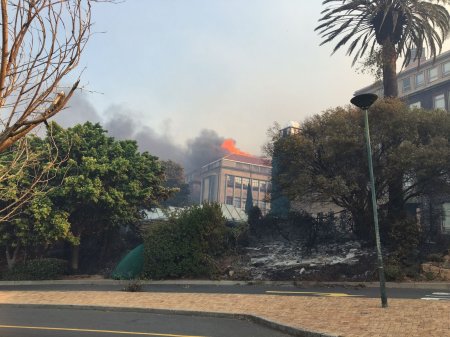
(Pictures from here.)

A devastating fire that seems to have started somewhere on Table Mountain has swept onto the upper campus of the University of Cape Town, even engulfing the splendid library (last picture; that’s the special collections part in flames).

It’s terrible to see a place you know go up in flames but at least the campus was evacuated before the fire reached it.

I’ve been to UCT several times, including a long visit in 1995 when I wrote a book with George Ellis. The last time was in 2012; see here. During those visits I was based in the Department of Applied Mathematics, which is on the Upper Campus. From what I’ve seen that building has been completely destroyed by the fire, which seems to be out of control.

I’ve not heard any reports of casualties – thank goodness – but it’s still devastating.

UPDATE: Here is an update on the situation in the Library

UPDATE: I’ve heard from George Ellis that the fires are now out: the Maths and Physics & Astronomy buildings have survived.

Gardener’s Question Time

Posted in Biographical, Maynooth on April 18, 2021 by telescoper

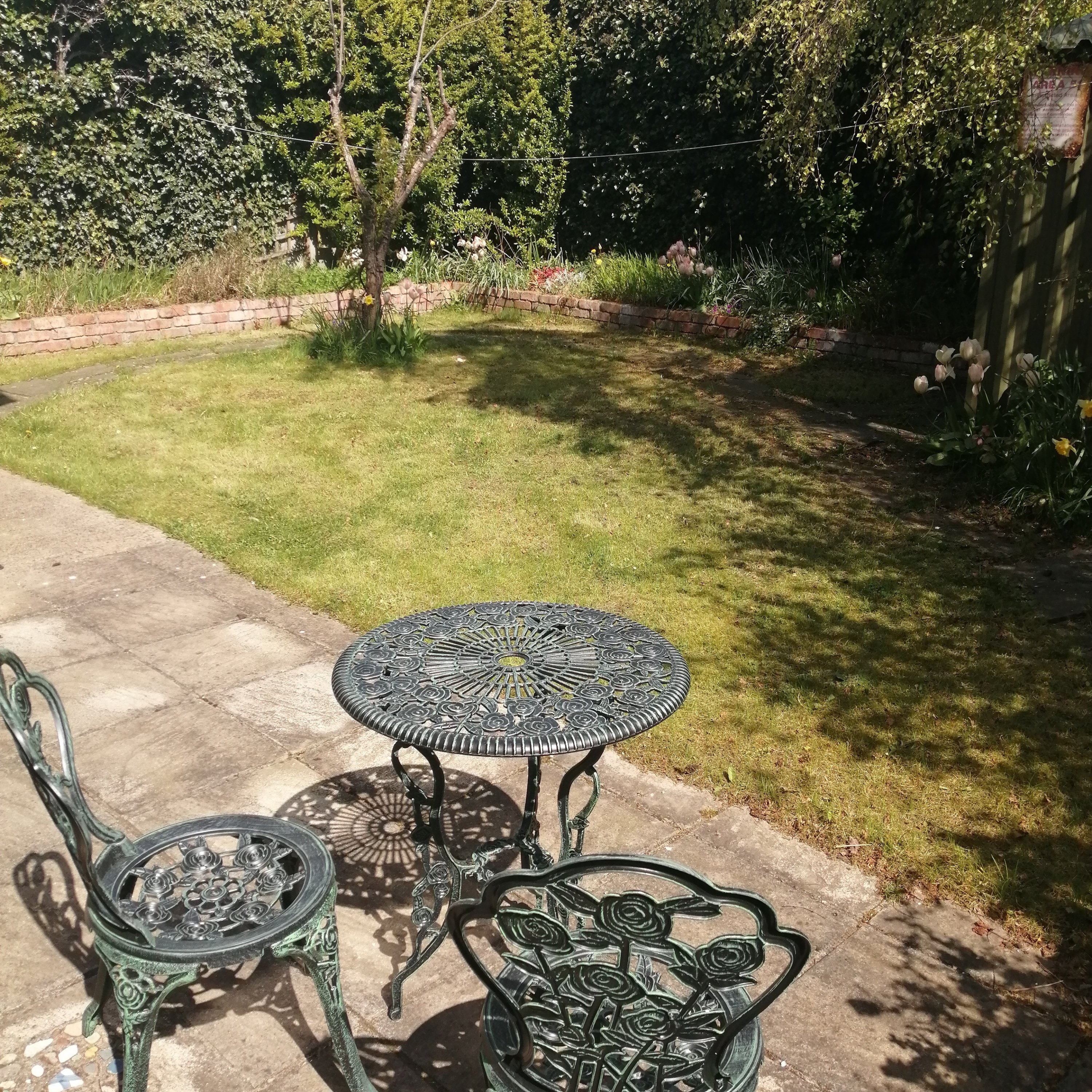
A spell of good weather last week meant that I was able at last to get out and mow the lawns to front and rear of my house. I had tried to do that a while ago but just as I was about to start a hailstorm came down and I abandoned the plan.

By the time I got round to actually mowing it the grass was quite long and still a bit damp which, combined with the poor quality of the old lawnmower I have, meant that I had to do a rough cut followed a couple of dry days later by a closer trim. The lawnmower, incidentally, was left behind in the shed by the previous owner of the house. I was slightly surprised to find that it works at all but I should get myself a new one.

I was joined on the first mow by a little robin who was no doubt on the lookout for bugs disturbed by the grass cutting. I was a bit worried I might accidentally hit the bird with the mower, but he (or she) was fearless, at one point jumping on my foot and pecking at my shoe laces, presumably thinking they were worms.

The rear garden is now looking a bit tidier.

This is a very secluded and quiet space, nice for having lunch al fresco which I did yesterday. The sound of the birdsong around was really delightful. I couldn’t see many birds but they were making a lot of noise wherever they were hiding!

Come to think of it they were probably warning each other about the human weirdo invading their territory. They will have eggs and/or chicks in their nests right now.

Anyway the above bush is in my rear garden, beside the wall next to the, seating area. Does anyone know what it is?

Answers through the comments box please!

Will we return to on-campus teaching next academic year?

Posted in Biographical, Covid-19, Education, Maynooth on April 17, 2021 by telescoper

As we approach the end of the 20/21 academic year during which most of our teaching has been online rather than face-to-face, a number of students have been asking me whether we will “get back to normal” next September for the start of next teaching year.

The answer I give to this is that I don’t know. It depends entirely on the progress of the battle against the Covid-19 pandemic and that has so far proved to be difficult to predict.

Over the last week, however, the news has made me lean very strongly towards a negative answer. I am now quite confident that there will be no (or at most minimal) in-person teaching at Irish universities in September 2021.

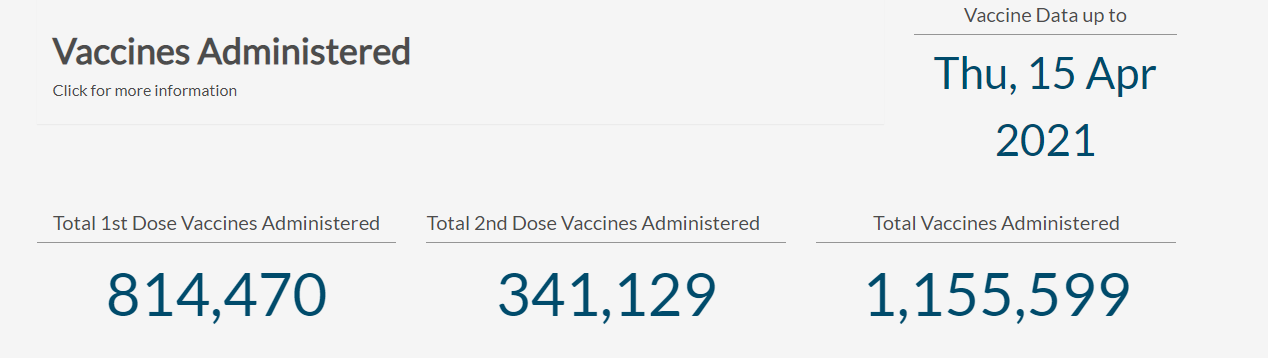
The reason I feel this is the shambolic state of Ireland’s vaccination programme. According to the updates page, as of 15th April, Ireland has administered 1,155,599 vaccine doses, including 814,470 first doses and 341,129 second doses. The figure for total doses on 1st April was 893,375. That means in the first two weeks of April just 262,224 doses have been given. The HSE’s target for April is 800,000 doses; to reach that the daily rate of dishing out vaccinations has to more than double in the second half of the month.

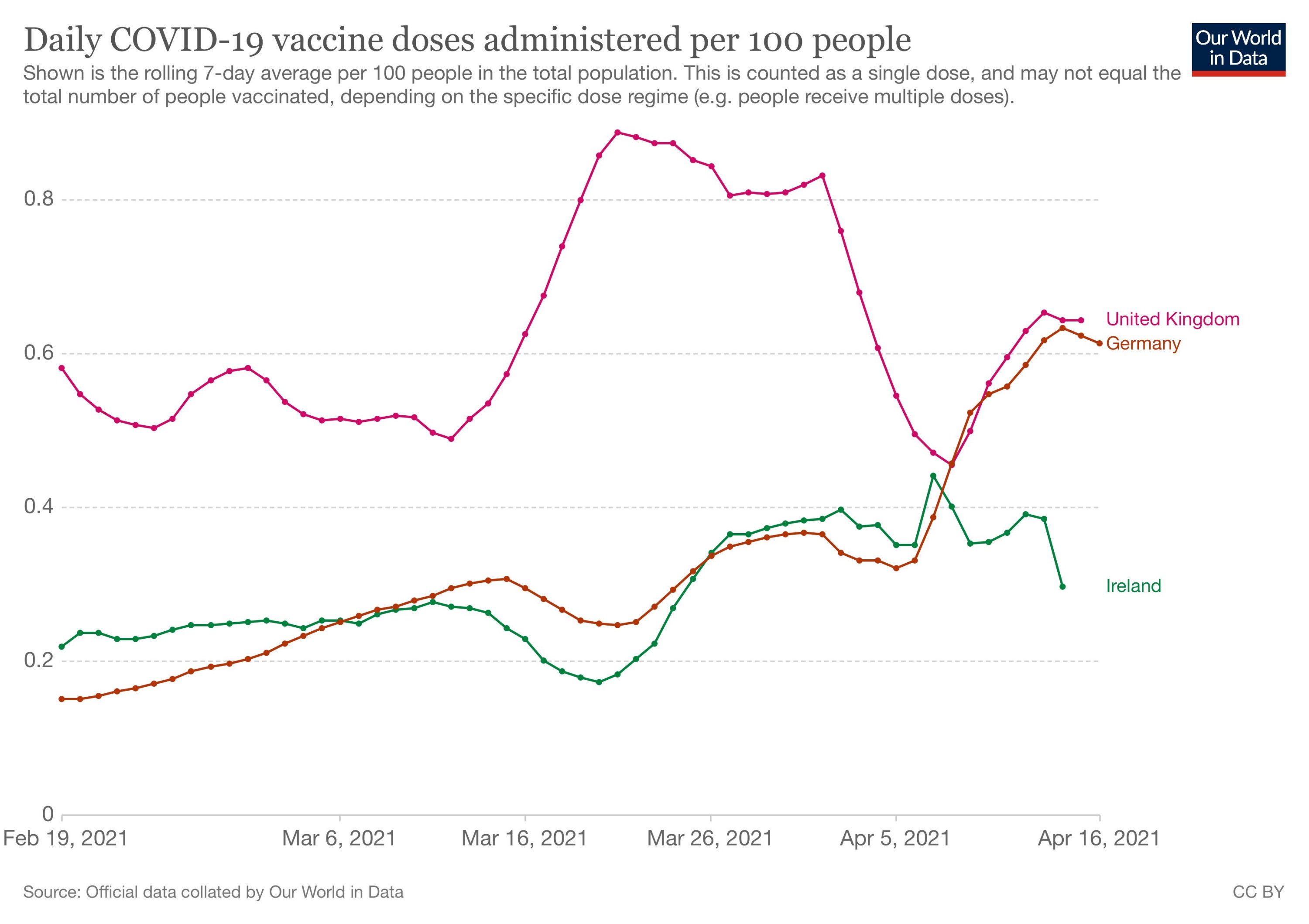
The slowness of the rollout is partly due to a pause in use of the AstraZeneca vaccine because of concerns about blood clots and a decision by Johnson & Johnson not to deliver its promised doses for similar reasons, leaving a shortfall in supply. But that’s not the only reason. If it were then the vaccination programme in Ireland would not be stalling at the same time as Germany’s has been accelerating.

There has been an absurd amount of dithering and disorganization in the Health Service Executive and at Ministerial level which, together with incoherent messaging, has led to administrative chaos.

The AstraZeneca vaccine will in future only be offered to those over the age of 60, with an impact on the timetable for other age cohorts. Last week the HSE announced that Irish people in the general population under the age of 60 will not get their first jab (presumably either Pfizer or Moderna) until June “at the earliest”. It seems – to say the least – unlikely that 80% of the population will receive a vaccine dose by the end of June (the official target) if they’re not going to start on the under-60s until the beginning of that month.

More recently it has been announced that the HSE is also considering changing the correct rollout programme yet again, this time moving people aged 18-30 up the batting order. (Currently the scheme for the general population is organized by age; those in the 65-69 cohort are currently registering.)

I can see the argument for doing that. Younger people tend to have a bigger cross-section for interaction, as it were, and therefore contribute more to the spread of the virus. Prioritizing them would therefore lower the rate of community transmission. On the other hand, moving younger people to a higher priority will have the effect of moving older people down it. But surely this should have been considered long before now?

If the decision is taken to do this people aged 30-50 will not get even their first dose until much later than they would under the current programme, possibly not until the autumn. The vaccination programme plays two roles: one is to protect individuals from serious illness and the other is to slow the transmission of the virus. The former approach means to prioritize the older cohorts while the second pushes in the opposite direction. It’s a difficult question and I think it’s sensible to consider moving younger adults up, though it’s not obvious to me that on balance it would be advantageous.

All of which brings me to the reason I think we won’t be doing on-campus teaching next year, at least for the first Semester. If students (who are mainly aged 18-30) are vaccinated first then most academic staff will probably not be vaccinated by September. If most academic staff are vaccinated by September then probably most students won’t be. Either way it doesn’t look good for a return to campus. I know for a fact that some Irish Universities are already planning for online teaching at the start of the 21/22 academic year. I don’t know what the plans are at my own institution.

I can’t speak for anyone other than myself, but there is I am not going to support a return to face-to-face teaching on campus unless and until a majority of staff and students have been vaccinated. And I am certainly not going to return to campus until I have had both jabs. I am in the 55-60 cohort and may therefore get my first shot in June and second doses by September (although, to be honest, I wouldn’t bet on either of those possibilities).

Of course there are much wider issues to be taken into consideration than what happens in third-level institutions so I’m not saying that this should be a main policy driver, but it’s important to be aware of the ramifications. In previous manifestations of the rollout programme, those involved in delivering education where in a high priority group, but they are no longer. In lowering the priority for vaccination teaching staff, the Government has to accept that it is lowering the priority for a return to campus in September.