Archive for the Biographical Category

Garden Variety

Posted in Biographical, Maynooth with tags , , , on October 10, 2020 by telescoper

The modest investment I made in bird feeders when I moved into my new house in Maynooth has paid a considerable dividend in terms of entertainment. As well as a number of starlings and sparrows, I have quite a variety of more exotic species. The other morning, while I was drinking my coffee while looking into the garden before leaving for work, I saw a robin, a great tit, a blue tit, a chaffinch, and (I think) a hedge warbler*. And that was all just in the space of 10 minutes or so.

The show was then brought to a sudden end by the arrival of two jackdaws who scared everything else off and then tried to wreck the nut feeder.

I went outside and chased them away. I have nothing against the jackdaws – they’re actually rather amusing – but I won’t have vandalism in my garden.

The hedge warbler (or dunnock or hedge sparrow, although it’s not a sparrow) is not particularly rare in Ireland but is extremely shy and never gives you a long time to look at it. I’m pretty sure the bird I saw was one, though it was gone in a flash.

The local robin, by contrast, is not shy. I see him very frequently. I think it’s male because of the very bright red of his chest colour; females of the species tend to have colours that look slightly washed out. Male or female this one is very well nourished. In fact it’s so plump as to be almost spherical.

Anyway, all these birds (including the jackdaws) are passerine species, defined by the shape of their feet: they all have three toes pointing forward and one pointing backwards. The order Passeriformes includes perching birds of all kinds, from sparrows and finches to crows and a lot more besides. In fact over half the known bird species belong to this order.

Thirty Years On

Posted in Biographical, LGBTQ+ with tags , on October 9, 2020 by telescoper

Every now and then I use this blog to mark a personal anniversary, but I’m a bit late with this one. It was on October 1st 1990 that I started work at what was then Queen Mary & Westfield College of the University of London on Mile End Road. Here’s my staff ID card which, for some reason, I have kept for over thirty years.

I was to work there until the end of 1998, after which I moved to Nottingham.

My position came about because I had applied unsuccessfully for a permanent lectureship at QMW, but this was a kind of consolation prize. I had strong personal reasons for wanting to move to London at that time and was very happy with the outcome. I only had two years’ postdoc experience at the time and wasn’t sufficiently experienced for a permanent job so wasn’t surprised that I didn’t get it. In fact it went to Mike Thompson, who sadly passed away a couple of years ago.

The job I moved for was a five year fixed-term position that was a mixture of a postdoctoral research fellowship and a temporary lectureship in the ratio 30:70 so I had a teaching load that was lighter than that of a lecturer but heavier than that of a postdoc. As the card indicates I was in the School of Mathematical Sciences and because my research interests including a statistical component, I mainly taught statistics. In fact, the first course I lectured was on Time Series Analysis, which was to a mixed class of mathematics and statistics students. A couple of years into this position I applied for and was awarded an Advanced Fellowship from the (then) Science & Engineering Research Council, which meant that QMW got me for nothing for 5 years and my reward for that was a permanent position at the end of the fellowship.

For some reason – probably because the terms of employment were a little complicated – I kept the correspondence about the job. In particular I note that my starting salary was a princely £14,148 per annum (including £1,767 london weighting). That’s about what a PhD student’s stipend is these days!

I look back on my time at Queen Mary with great fondness. I learnt a huge amount not only from my boss, Ian Roxburgh, who had managed to set up the job in the first place and was very clever at things like that thanks to his somewhat Machiavellian nature.

When I visited QMW to talk informally to Ian about the job, he asked me why I wanted to move to London. “Do you have a girlfriend here?” he inquired. I said “no”. “A boyfriend, then?” he responded. I wasn’t sure whether he meant it as a joke, and thought it was a bit inappropriate, but didn’t hesitate in saying “yes” in response. I wondered whether this would cause any issues but it didn’t. Being openly gay didn’t cause me any problems there at all, in fact.

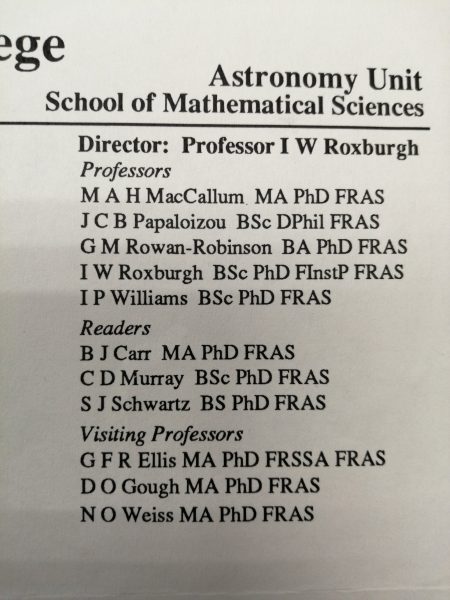
P. S. Here is the staff list on the letterhead of my appointment letter. An illustrious collection, though the gender balance could have been better. All by now have either retired or moved to other institutions, though I have stayed in touch with several of them through the RAS Club.

Lost and Found!

Posted in Biographical, Maynooth on October 5, 2020 by telescoper

Here’s another post that demonstrates that I’m getting even more absent-minded in my old age.

On Friday I lost my phone. I was pretty sure I had it with me when I went to work but couldn’t find it when I was getting ready to leave for home. I hadn’t actually used it while I was at work on Friday so I convinced myself that I’d left it at home. I was wrong.

I was a bit worried that the delivery people on Saturday might assume I wasn’t in when they couldn’t contact me by the number I gave them, but they did turn up and all was well.

As soon as I got back to work this morning, I tried to retrace all the steps I’d taken on Friday in the hope of finding the missing item, but without joy. Just before leaving the office to give my lecture at 11am, increasingly worried, I emailed security to ask if anyone had handed in a phone. It was I thought a last resort.

When I got back to the office I found to my great relief an emailed reply saying that a phone matching the description I’d given had indeed been handed into them. It had been found by a cleaner in the John Hume Building (in which I gave a lecture on Friday).

I went straight over to the security lodge and proved that it was my phone, which was easy because it has fingerprint recognition. When I’d done that I was asked to sign for it and was reunited with my phone (which was undamaged). As I turned to leave I asked where it had been found. The answer left me a bit. shocked. It was found in the lecture theatre I’d been teaching in… in the waste bin!

I gave a lecture on Friday in the John Hume building but can’t really understand how my phone ended up in the bin. I remember seeing a bin near the desk at the front, so I guess I must have accidentally knocked it off the bench while trying to set up the camera.

Above all though I realised just how lucky I had been. I reckon 99 times out of 100 the cleaner would have just emptied the bin without further thought. This time, though, perhaps because there was nothing else in the in it (as the lecture theatres are largely empty these days), the cleaner spotted it and did the right thing. Had the bin been full of other rubbish it would probably not have been seen.

Losing my phone would have been hugely inconvenient on top of all the other causes of stress these days so I’m very glad I’ve got it back.

All’s well that ends well.

Week Ending

Posted in Biographical, Covid-19, Maynooth on October 3, 2020 by telescoper

It’s the Saturday after a very tough week. At least I’ve got an excuse for lounging about at home because I’m waiting for a new bed to be delivered. Since I moved into my new house I’ve been sleeping in a single bed, in what will be the spare room, but when the bigger bed arrives I’ll be able to move into the main bedroom.

Last week was a tough one at work. Switching teaching online at short notice was only part of it. The building work that started late still isn’t finished so I’ve got more disruption from that to look forward to when I return to the Department on Monday.

I did at least get through the first week of online teaching. The newly installed Panopto system (which we used when I was in Cardiff) works very well, although the cameras are a bit limited. This system can webcast a lecture as well as recording it to be viewed later. I always assumed most students would watch the lectures after the event but as it turned out a majority actually viewed them live.

The sudden switch to online teaching was designed to restrict the number of students travelling to and from the University but nobody seems to have thought very much about those actually living on campus. In the case of Maynooth University that includes a sizeable fraction of first-year students whose first experience of university life is much poorer than in a normal year. I feel very sorry for this cohort but I suppose circumstances made this inevitable.

The official University line, as explained in an email (inevitably) sent out to Department Heads on Friday evening), is that teaching will be online at least until Study Week ( the week beginning 26th October). I think it’s overwhelmingly probable that we teach like this for the entire semester and there is a good chance that it will be the entire academic year. I think it would benefit us all, staff and students, if this decision were made now. There is no end in sight to Covid-19 and there is no point in pretending otherwise.

Update: the bed arrived this afternoon. It required “some self assembly”: though not on the scale of IKEA furniture that was quite hard work because the frame parts are very heavy. It’s done now though and I’m looking forward to sleeping in it tonight.

The Eyes to the Left

Posted in Biographical, Brighton, Mental Health with tags , , , , , , on October 1, 2020 by telescoper

One of the things I managed to squeeze in during these last hectic days was a visit to the optician. I hadn’t had my eyes tested since I lived in Brighton, probably more than five years ago, which is a bit long to leave it for one of my advanced years. Inevitably the test revealed that I needed new spectacles, though curiously one eye – the left – has changed much more than the other since my last test. My prescription has corrections for both astigmatism and myopia (short-sightedness) but these are both well corrected by varifocals, the type of glasses I have worn for some time. My new specs took just a week to arrive and I find reading much more comfortable wearing them than I did with my old ones.

I remember the first time I had to wear varifocals I found it quite difficult, especially looking down through the bottom half of the lens (which is where you are assumed to be looking when reading) as they make it difficult to judge the distance to the ground (or, more dangerously, exactly where the next stair is….). I found after a day or two I was used to the varying focus and now I think nothing of it.

Because it means that your eyes focus differently on horizontal and vertical lines, and that’s exactly how text is constructed, uncorrected astigmatism makes it difficult to read words and numbers at a distance. With varifocals you have to look through the top half of the lens, which is the bit that corrects the astigmatism, and move your point of view until you find the place where the optical performance is best. I’ve often found myself in the audience of a lecture moving my head in odd ways to try to find the best angle to read what’s on the screen. I hope it’s not too disconcerting for the speaker when I do that!

The most interesting bit of my visit to the optician however was that I had an optical coherence tomography scan which generate a three-dimensional picture of the back of the eyeball. I’ve never seen one of those before. Here’s an example (not me):

This type of scan can be used to diagnose things like glaucoma and diabetic retinopathy, neither of which I have. In my case though it did reveal a significant level of unevenness in the surface at the back of both eyes and some signs of swelling of or near the optic nerves. The optician showed me the scan and pointed out these abnormalities, but said that it wasn’t anything too worry too much about as he thought it was historical rather than progressive. He said the only time he’d seen anything like that was in the cases of people who had in the past had some form of trauma to the head (which can cause increased pressure inside and so damage the back of the eyes).

I’ve blogged before about the long term effects on my mental health of the beating I experienced in Brighton over thirty years ago, but this was the first time I’ve seen such clear evidence of the physical damage that I presume was caused by that event. In extreme cases I experience periods of exaggeratedly heightened awareness of things moving in my peripheral vision that I can’t keep track of, accompanied by auditory and visual hallucinations. I’m not an expert but it seems likely to me that what the scan revealed may play a role in these episodes. It doesn’t explain why they seem to be triggered by stress, though, so there must be other factors.

Over the years a number of people have remarked that I often have the blinds closed in my office during the day, and that as well as that as well as being varifocals the lenses I wear in my glasses are reaction lenses (i.e. they go dark in bright light). Avoiding bright light in such ways was suggested by an optician some years ago, who suspected I might have some form of retinal damage but couldn’t see anything definitive with the technology available then. It seems he was right!


Teaching Improvisation

Posted in Biographical, Education, Maynooth with tags , , , on September 29, 2020 by telescoper

The sudden switch of all our teaching online on Friday has necessitated a certain amount of improvisation. I had intended to do my introductory session on Mechanics and Special Relativity to first-year students as a kind of interactive workshop using the blackboard in Physics Hall. When we were told to move everything online I thought I’d just do yesterday’s session from my office which has quite a good blackboard and a setup I had already tested. Unfortunately however an office refurbishment project I was assured would be finished before the start of teaching but which has barely started meant that yesterday there was constant hammering and drilling in the Department. That made it impossible to do an online lecture (or do anything else) in my office. I knew there would be nobody in Physics Hall, though, so I did the lecture there to an empty room.

The camera provided in that room is fixed to a monitor at once side of the theatre and is therefore useless for capturing the blackboard, so I used my laptop camera plus a handy litter bin to raise it up. It wasn’t great but was better than nothing.

You might ask why I don’t do this from home. The answer to that is that I haven’t yet got an internet connection in the new house, so I can do online activities from there.

You might also ask why a refurbishment job, which could have been completed at any point during the summer when the building was empty, has only just started now we’ve started teaching again. If I had an answer I would tell you. I think the six people whose offices are currently unusable would like to know too, though at least they can work from home. It’s tough enough trying to keep everything together these days without this.

Fortunately today a colleague in the Department of Psychology found me a quiet place to work. It’s a small windowless cubicle normally used for experiments. At least it’s quiet. I think the next step will be a padded cell somewhere.

Memories of My First Paper

Posted in Biographical, The Universe and Stuff with tags , on September 28, 2020 by telescoper

The death of John Barrow reminded me of a post I did some years ago about my first ever publication, which was published on 15th September 1986 while I was doing my DPhil at Sussex under John’s supervision. I’m mentioning
it hereby way of a postscript to yesterday’s piece.

Here is the front page:

mnras_paper

This was before the days of arXiv so there isn’t a copy on the preprint server, but you can access the whole article here on NASA/ADS.

All right. I know it’s a shitty little paper. But you have to start somewhere!

I’m particularly sad that, looking back, it reads as if I meant to be very critical of the Kaiser (1984) paper that inspired it. I still think that was a brilliant paper because it was based on a very original idea that proved to be enormously influential. The only point I was really making was that a full calculation of the size of the effect Nick Kaiser had correctly identified was actually quite hard, and his simple approximation was of limited quantitative usefulness. The idea was most definitely right, however.

I was just a year into my PhD  DPhil when this paper came out, and it wasn’t actually on what was meant to be the subject of my thesis work (which was the cosmic microwave background), although the material was related.

This paper provides two excellent illustrations of what a good supervisor John was. I was a bit stuck with the project that John had assigned me and eventually admitted to him that I was having problems getting anywhere. I thought he’d assume I was useless and suggest that someone else should supervise me. But no. He said he realised it was a hard problem and sometimes it’s good to think about something else when you’re stuck. So he asked me to look at cluster clustering for a bit. I told him what I found and he said I should write this up as a paper, which I did. Most importantly however the trick I used in simplifying the calculations in this paper turned out to be applicable to the first problem, hotspots in the cosmic microwave background, which led a success in the project and to my second paper. We were both delighted that everything turned out well with that original project.

My original draft of this first paper had John Barrow’s name on it, but he removed his name from the draft (as well as making a huge number of improvements to the text). At the time I assumed that he took his name off because he didn’t want to be associated with such an insignificant paper, but I later realized he was just being generous. It was very good for me to have a sole-author paper very early on. I’ve taken that lesson to heart and have never insisted – unlike some supervisors – in putting my name on my students’ work.

R.I.P. John D Barrow (1952-2020)

Posted in Biographical, The Universe and Stuff with tags on September 27, 2020 by telescoper

My heart is filled with sorrow as I find myself having to pass on some very sad news. I have just heard of the death, yesterday, at the age of 67, of esteemed physicist, mathematician, author and polymath John Barrow. With his passing, one of cosmology’s brightest lights has gone out.

John Barrow was my thesis supervisor. Words can’t express how much I owe him for his advice and encouragement not only during my graduate studies but also throughout the 35 years that have elapsed since I started my career, as a research student at Sussex University.

John had an extraordinary mind that combined immense mathematical gifts with an encyclopedic knowledge of all kinds of literature and a wonderful flair for writing. He wrote dozens of books and a theatre play as well as hundreds of scientific articles. He was a whirlwind of ideas who had an uncanny knack of finding clever ways to crack previously unsolved problems. That he was happy to share these ideas with his students is a credit to his intellectual generosity. He inspired dozens of researchers early in their careers and continued to inspire them when they became not so young.

On a personal level, John was rather reserved and, despite his being a talented and confident public speaker, I always felt he was a rather shy person. He was a committed Christian and a regular churchgoer though he didn’t talk much about his private religious beliefs in the Department.

It is also interesting that, despite writing a number of superb popular books, giving public lectures and being a regular guest on radio programmes he steadfastly refused to appear on television. He just didn’t want to become a TV celebrity, though I suspect that if he did he would have been rather good at it.

Although I didn’t see as much of him in recent years as I would have liked, John was a member of the RAS Club which gave me the opportunity to see and talk to him fairly frequently. I always found him a very agreeable dining companion. We usually discussed sport on such occasions rather than science, actually. John was a talented middle-distance runner in his younger days and he gave me a lot of advice about training, etc, when I started running marathons. We also shared an interest in football – at which he was rather good, having had a trial for Chelsea Juniors – and we played together quite a few times in Sussex days. I remember him as a quality midfielder with a terrific engine, though he was not a natural goalscorer.

John also had a very dry and sometimes lugubrious sense of humour. I remember sending him a congratulatory email in 2003 when I found out he had been made a Fellow of the Royal Society. He replied thanking me but pointing out his joy at having been elected was tempered by the fact that the first official communication he got from Carlton House was a rather substantial bill for the subscription and a form on which to enter details to be used in an obituary.

It was through the RAS Club that I first heard, about a year ago that John was suffering from cancer. For a time he responded well to treatment but a few weeks ago I heard that his condition had deteriorated to the extent that only palliative care was possible. That news came as a shock as he always seemed so healthy and ageless that one imagined him to be indestructible. Today’s news was not unexpected but still distressing. The end came more quickly than we imagined but at least he was at home among his loved ones when he passed away.

I send heartfelt condolences to Elisabeth and the rest of John’s family, and friends and colleagues at Cambridge and elsewhere.

UPDATE: An obituary of John, written by Michael Rown-Robinson, is now available online on the Guardian website.

Rest in peace, Professor John D Barrow FRS (1952-2020).

The Autumnal Equinox 2020

Posted in Biographical, Maynooth, The Universe and Stuff with tags , , on September 22, 2020 by telescoper

So here we are then. The Autumnal Equinox (in the Northern hemisphere) takes place this afternoon at 14.31 Irish Time (13.31 UT).

Though  the term `equinox’  refers a situation in which day and night are of equal length which implies that it’s a day rather than a specific time, the equinox is more accurately defined by a specific event when the plane defined by Earth’s equator passes through the centre of the Sun’s disk (or, if you prefer, when the centre of the Sun passes through the plane defined by Earth’s equator). Day and night are not necessarily exactly equal on the equinox, but they’re the closest they get. From now on days in the Northern hemisphere will be shorter than nights and they’ll get shorter still until the Winter Solstice.

For many people the autumnal equinox is taken to be the end of summer, though there is a saying around these parts that `Summer is Summer to Michaelmas Day’ (September 29th). Looking back over the posts I’ve written at this time of year since I started blogging in 2008, it’s noticeable how many times we’ve had a window of good weather around the autumnal equinox. In Wales such a warm spell in late September is called Haf Bach Mihangel – “the little summer of St Michael”.

Here’s a sample excerpt from the post I wrote in 2008 on this:

The weather is unsettling. It’s warm, but somehow the warmth doesn’t quite fill the air; somewhere inside it there’s a chill that reminds you that autumn is not far away.

I find this kind of weather a bit spooky because it always takes me back to the time when I left home to go to University, as thousands of fledgling students are about to do this year in their turn.

It has been quite warm here in Maynooth recently too. Last night I mowed the lawn in the evening sunshine, which may well be the last time I do that until spring. The weather turned a bit colder overnight and the weather forecast suggests the little summer may be over.

Anyway, this is Welcome Week in Maynooth and, barring any sudden changes of plan, we’re due to start teaching on Monday 28th September. I’ve been keeping an eye on the registrations of students as they come in as well as starting to get my notes, problem sheets, recordings and other teaching materials together. I have to say that hasn’t been helped by the decision to install a new fire alarm system in the Science Building this week. I had to go home early because of the constant din of the sounders being tested.

I have to admit I’m very apprehensive about the forthcoming semester and beyond. It’s impossible to predict where we will be by the next equinox in March, or even by the Solstice in December. Covid-19 cases are increasing and it doesn’t seem that anyone has a clue how to stop the `second wave’ surging through the population this autumn. The September equinox is often said to to be the start of Astronomical Autumn. This year more than ever it seems to herald that Winter is coming.

Garden Birds

Posted in Biographical, Maynooth with tags , , , on September 20, 2020 by telescoper
A blue tit at the peanuts

The previous owner of my house left a bird feeder in the shed so I decided to see what sort of birds would come if I put it up. The feeder has quite a wide mesh so I bought a sack of peanuts, filled it up, and suspended from one of the trees.

Almost immediately a group of starlings arrived and took turns at pecking at the contents. I know that some starlings are resident all year round, but there is an annual influx of migratory birds around autumn. It seems a bit early for the continental starlings which usually start to turn up in October. Anyway, they seem ravenously hungry but are rather messy eaters and keep dropping bits on the ground.

The principal beneficiary of the starlings’ messiness is a robin, whose tactic is to wait underneath for peanuts from above. It does not seem keen to attempt the acrobatics needed to feed directly from the feeder. Sparrows do this too, but not when the robin is around as the robin chases them off; robins are feisty little critters. This one isn’t afraid to have a go at the much larger starlings if they descend to ground level.

There are at least two blue tits that visit the garden but they rarely get the chance to get at the peanuts before being scared off by yet more starlings. The picture above is an exception.

To help the smaller birds I bought a second feeder with a finer mesh that the starlings can’t get into this and filled it with mixed seed. The blue tits have this to themselves but obviously like the nuts too and will go to that feeder if there are no starlings.

Yesterday one of the many resident jackdaws tried the peanut feeder but failed in its mission as it was too big to hang on.

So far apart from those mentioned above I’ve also seen a chaffinch and a great tit but mainly it’s been blue tits and starlings. Of course I’m not in during the day so there might well be other species of garden visitor that I don’t see.

I’m thinking of getting a third feeder (for fat balls, etc) but I’m told that around here that will just mean a garden permanently full of rooks jackdaws and magpies. Any suggestions for alternative feeding mechanisms that might attract a wider variety of birdlife are welcome!