Archive for the Biographical Category

Midweek Flight to Dublin

Posted in Biographical, Cardiff, Maynooth on May 2, 2018 by telescoper

I’ve just arrived in Dublin after the last regular mid-week flight I’ll have to make from Cardiff because of teaching commitments. Last lecture of term in Maynooth tomorrow, and after that I can be more flexible about the travel.

I’ve generally avoided evening flights since the introduction of the summer schedules. Budget airlines such as FlyBe work on very tight schedules and delays tend to accumulate throughout the day, meaning that incoming planes needed to make evening flights are frequently very late. Sometimes they get so late the plane can’t fly because of restrictions on night flights, in which case they are cancelled. This is much less likely with an earlier flight in my experience.

So I took a chance this evening but as it happened there were no delays I got safely on the bus to Maynooth and got to my flight at a reasonable hour. The plane, by the way, was only about a quarter full.

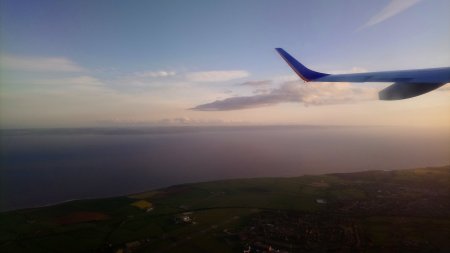
The picture was taken shortly after takeoff from Cardiff Airport, with South Wales underneath and Devon in the distance.

The Arithmetic of Relegation

Posted in Biographical, Sport with tags , , , on April 30, 2018 by telescoper

When I got back home after yesterday’s concert, I ate some dinner and settled down to have a look through the Sunday papers. Most of the news was as grim as expected, especially the ongoing fiasco of Brexit, and the scandal engulfing Home Secretary former Home Secretary Amber Rudd who obviously lied to Parliament on at least one occasion. Anyway, turning my attention to the Sports pages there was a write-up of Saturday’s disappointing home defeat for Newcastle United against bottom club West Bromwich Albion. I was gloomy enough to wonder whether Newcastle might actually still get relegated, so looked at the Premiership Table:

Neither West Brom (28 points) nor Stoke (30) can catch Newcastle with only two games to play, but Southampton can in principle get 41 points from here if they win all three games. It’s true that they have a worse goal difference but if Newcastle lost all their three remaining games, and Southampton won all theirs that would change. It therefore looks mathematically possible for Newcastle to be relegated.

However, I then glanced at the fixture list and found that Southampton have to play Swansea in one of their remaining matches. If Southampton win that fixture then the maximum number of points Swansea can get by the end of the competition is 39, so Newcastle can’t be relegated. If Southampton lose or it’s a draw then they can’t catch Newcastle.

I conclude, therefore, that Newcastle United are mathematically safe from relegation. Hooray!

But who will go down? I think West Brom and Stoke will probably get relegated, but I’m not sure about the third team. Huddersfield must be very nervous because their recent form has been poor and they have a very bad goal difference. The betting odds are interesting: BetFred are offering 200/1 on West Brom not being relegated and most bookies are about 8/1 on Stoke to stay up. PaddyPower are quoting 4/9 on Huddersfield and even money on Southampton to go down. If you want to bet on Brighton to get relegated your best odds are with BetVictor who are offering 50-1. Few bookies are quoting odds on West Brom to get relegated, so they obviously think that’s the likely outcome.

I expect these odds to change a lot after the next round of matches.

Project Work

Posted in Biographical, Education, mathematics with tags , , , , , on April 23, 2018 by telescoper

I’m progressively clearing out stuff from my office prior to the big move to Ireland. This lunchtime I opened one old box file and found my undergraduate project. This was quite an unusual thing at the time as I did Theoretical Physics in Part II (my final year) of Natural Sciences at Cambridge, which normally meant no project but an extra examination paper called Paper 5. As a member of a small minority of Theoretical Physics students who wanted to do theory projects, I was allowed to submit this in place of half of Paper 5…

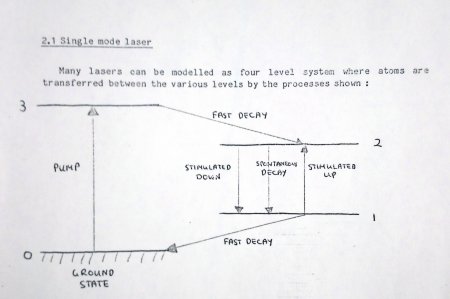
The problem was to write a computer program that could solve the equations describing the action of a laser, starting with the case of a single-mode laser as shown in the diagram below that I constructed using a sophisticated computer graphics package:

The above system is described by a set of six simultaneous first-order ordinary differential equations, which are of relatively simple form to look at but not so easy to solve numerically because the equations are stiff (i.e. they involve exponential decays or growths with very different time constants). I got around this by using a technique called Gear’s method. There wasn’t an internet in those days so I had to find out about the numerical approach by trawling through books in the library.

The code I wrote – in Fortran 77 – was run on a mainframe, and the terminal had no graphics capability so I had to check the results as a list of numbers before sending the results to a printer and wait for the output to be delivered some time later. Anyway, I got the code to work and ended up with a good mark that helped me get a place to do a PhD.

The sobering thought, though, is that I reckon a decent undergraduate physics student nowadays could probably do all the work I did for my project in a few hours using Python….

Cardiff Bound

Posted in Biographical, Cardiff, Maynooth with tags , , , on April 21, 2018 by telescoper

Just time for a quick post using the airport WIFI to fill some time before my flight leaves from Dublin Airport. Once again on a Saturday morning I was up at 5am to get the 6am bus here from Maynooth. The journey back to Cardiff is far from arduous, but I won’t be sorry when I won’t have to do it every week. Fortunately, term is coming to an end and after teaching finishes I won’t be dictated to by the timetables of Cardiff and Maynooth Universities. And after July I won’t have to do the trip at all!

This morning a large group – I believe the correct collective noun is a murder – of crows gathered to give the bus a sendoff. I did think of Hitchcock’s The Birds but the birds in this case were more interested in rummaging through the rubbish bin than attacking any of us waiting for the bus. Incidentally, it was the anniversary of Daphne Du Maurier’s death on 19th April; she wrote the short story on which that film was based.

Anyway, it’s a lovely sunny morning. Yesterday was a nice day too, both in terms of weather and other things. In the afternoon there was a staff barbecue and an awards ceremony at Maynooth University. There was a big crowd already there when I arrived, a bit late because I’d been at a seminar. Standing at the back I couldn’t really hear the speeches. I didn’t win any awards, of course, but I did get a glass of wine and a beefburger.

On my way home I bumped into the President, Philip Nolan, who is the equivalent of a Vice-Chancellor. To my surprise he mentioned a point I had raised in a recent Faculty meeting about the possibility of Maynooth signing up to the San Francisco Declaration on Research Assessment (DORA). To my even greater surprise he went on to say that this was going to be in the University’s strategic plan. Good news!

Anyway, I’d better make my way to the gate.  Have a nice day!


Pictures from Post-Planck Cosmology in Pune

Posted in Biographical, Books, Talks and Reviews, The Universe and Stuff with tags , , on April 20, 2018 by telescoper

Regular readers of this blog (Sid and Doris Bonkers) will know that last year I went to the Inter-University Centre for Astronomy and Astrophysics in Pune (India) for a conference on `Post-Planck Cosmology’. Well, I recently received a copy of the official conference photograph, which I thought I’d share:

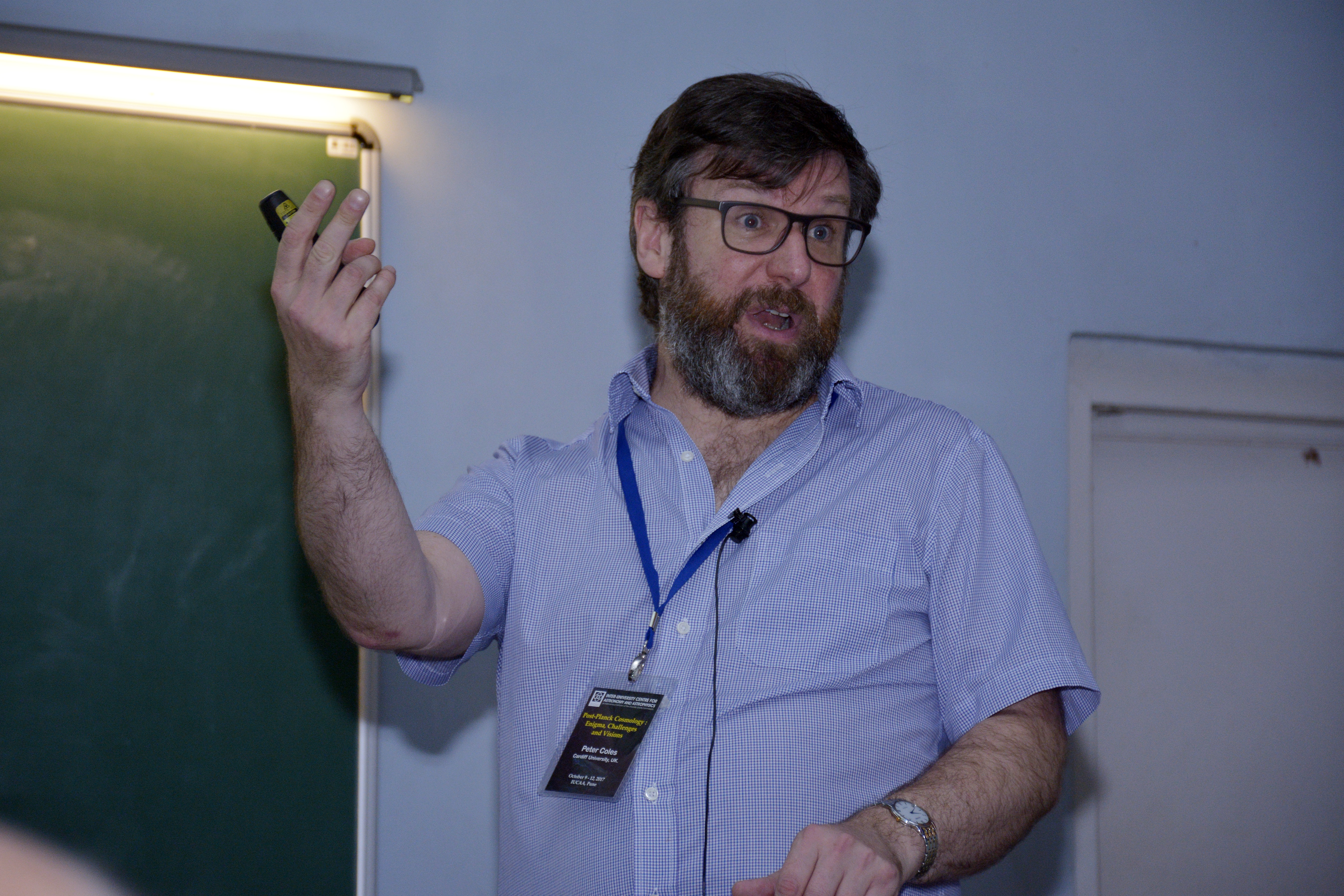
There is also an online collection of pictures taken during the talks, from which I have taken the liberty of extracting this picture of me during my talk:

I think this picture has a lot of potential for a caption competition, so please feel free to suggest captions through the comments block!

The Parnell Connection

Posted in Beards, Biographical, History with tags , , , , on April 19, 2018 by telescoper

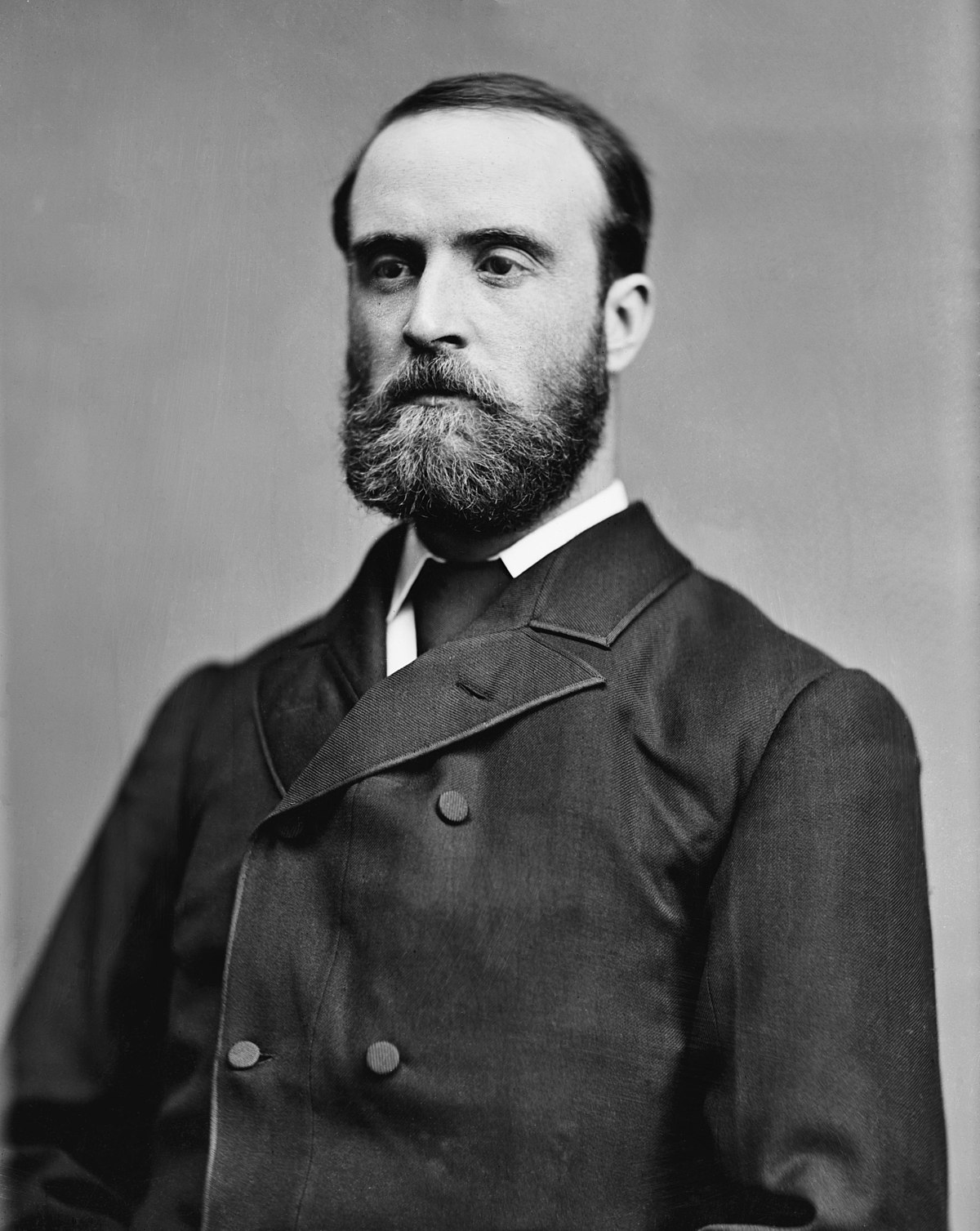
Charles Stewart Parnell (1846-1891)

Taking a short breather and a cup of coffee in between this morning’s lecture and a forthcoming computer lab session I thought I’d do a quick post following on from a comment on yesterday’s post about an O-level History paper.

I was an undergraduate student at Magdalene College, Cambridge, which just happens to be where 19th century Irish nationalist politician Charles Stewart Parnell (above) studied, although I hasten to add that we weren’t contemporaries. There is an annual Parnell Lecture at Magdalene in his honour; an annual Coles lecture is yet to be established. Parnell is widely remembered here in Ireland too, not least in place names: there is , for example, a handsome Georgian square in Dublin named after him.

Parnell was one of the most charismatic, capable and influential Parliamentarians of his era, and led the Irish Parliamentary Party at the forefront of moves for Home Rule for Ireland. He also had a splendid beard. His career was cut short by scandal in the form of an adulterous relationship with Kitty (Katherine) O’Shea, whom her husband divorced in 1889 naming Parnell in the case, and whom he married after the divorce. (Kitty, that is, not her husband.) They were not to enjoy life together for long, however, as Parnell died in 1891 of pneumonia in the arms of his wife in 1891 at their home in Brighton (Hove, actually).


An O-Level History Examination from 1979

Posted in Biographical, Education, History with tags , , , , on April 18, 2018 by telescoper

I have in the past posted a few examples of the O- and A-level examinations I took when I was at school. These have been mainly science and mathematics papers as those are relevant to the area of higher education in which I work, and I thought they might be of interest to students past and present.

A few people have emailed me recently to ask if I could share any other examinations, so here are the two History papers I took for O-level in June/July 1979. Can that really have been almost 40 years ago?

These were Papers 5 and 12 out of an unknown number of possible papers chosen by schools. My school taught us exclusively about British and European history from the mid-19th to early 20th centuries; you will observe that in both cases `history’ was deemed to have ended in 1914. It’s possible that some of the other papers paid more attention to the wider world.

I have no idea what modern GCSE history examinations look like, but I’d be interested in any comments from people who do about the style and content!

Cardiff to Dublin via Belfast

Posted in Biographical, Cardiff with tags , , , on April 11, 2018 by telescoper

I thought I write a brief post to arising from today’s travel difficulties, really just to make a record of the episode for posterity.

As last Wednesday I got up early this morning (4.30am) to get the 7am FlyBe flight from Cardiff to Dublin, due into Dublin at 8.05am. Having only hand luggage, as usual, I proceeded straight upstairs to the departure area only to find that the screen said the flight was cancelled, and directed passengers intending to travel on it back downstairs to the `Disruption Desk’ .

A long queue had already formed by the time I got there, but I got to the desk fairly quickly. The assistant explained that the cancellation was due to `staff sickness’ (i.e. they were short of a pilot) and the only option on offer was to fly to Belfast whence a bus would be provided to Dublin. The Belfast flight should have left at 6.15am but was being held for passengers to Dublin. I was also given a £5 refreshments voucher.

I thought a moment and then decided to accept this offer. I didn’t have any morning appointments today, but definitely had to get to Maynooth somehow by tomorrow morning as I have a lecture to deliver.

The plane left Cardiff about 7.15am and arrived in Belfast around 8.10am but when I emerged from the arrivals area there was no bus. In fact it took about 45 minutes to arrive, and we didn’t get going until about 8.55am. Many of the passengers were clearly nervous about missing connecting flights in Dublin, including a group of women planning onward travel to the USA, but the trip was fairly uneventful apart from the fact that the toilet was out of commission necessitating a stop so that people could use the facilities in a service station.

I can confirm that there is no visible border between Northern Ireland and the Republic on the road between Belfast and Dublin, although it does change name from A1 to M1 on the way. The distance between Belfast and Dublin by road is about 100 miles and it took just over two hours. I arrived at Terminal 1 of Dublin Airport at 11.05, almost exactly three hours late. I thought that wasn’t too bad a result given the chaos in Cardiff when I left but it was still a frustrating morning. I had to wait until 11.50 for the bus to Maynooth, where I finally arrived about 12.40.

I will of course be submitting a request for the compensation to which I am entitled for the delay, but above all I hope that those whose arrangements were even more seriously disrupted than mine managed to get to where they needed to go in the end.

Remembering Clover

Posted in Biographical, Science Politics, The Universe and Stuff with tags , , , , , , , on April 10, 2018 by telescoper

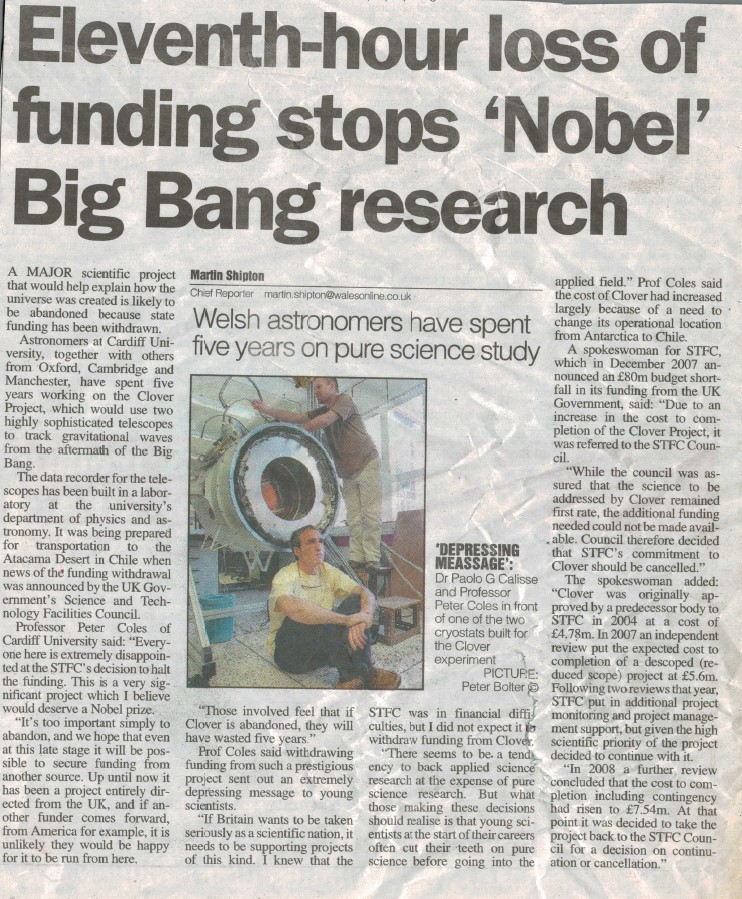
I was tidying up some papers in my desk yesterday and came across a clipping dated April 9th 2009, i.e. exactly nine years ago to the day. Amazed by this coincidence, I resolved to post it on here but was unable to work out how to use the new-fangled scanner in the Data Innovation Institute office so had to wait until I could get expert assistance this morning:
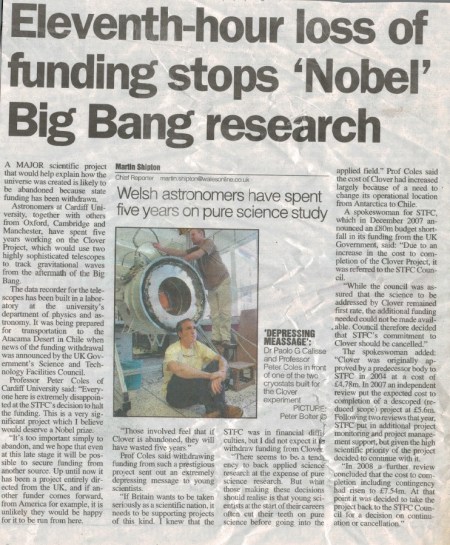
Sorry it’s a bit crumpled, but I guess that demonstrates the authenticity of its provenance.

The full story, as it appeared in the print edition of the Western Mail, can also be found online here. By the way it’s me on the stepladder, pretending to know something about astronomical instrumentation.

I wrote at some length about the background to the cancellation of the Clover experiment here. In a nutshell, however, Clover involved the Universities of Cardiff, Oxford, Cambridge and Manchester and was designed to detect the primordial B-mode signal from its vantage point in Chile. The chance to get involved in a high-profile cosmological experiment was one of the reasons I moved to Cardiff from Nottingham almost a decade ago, and I was looking forward to seeing the data arriving for analysis. Although I’m primarily a theorist, I have some experience in advanced statistical methods that might have been useful in analysing the output. It would have been fun blogging about it too.

Unfortunately, however, none of that happened. Because of its budget crisis, and despite the fact that it had already spent a large amount (£4.5M) on Clover, the Science and Technology Facilities Council (STFC) decided to withdraw the funding needed to complete it (£2.5M) and cancel the experiment. I was very disappointed, but that’s nothing compared to Paolo (shown in the picture) who lost his job as a result of the decision and took his considerable skills and knowledge abroad.

We will never know for sure, but if Clover had gone ahead it might well have detected the same signal found five years later by BICEP2, which was announced in 2014. Working at three different frequencies (95, 150 and 225GHz) Clover would have had a better capability than BICEP2 in distinguishing the primordial signal from contamination from Galactic dust emission (which, as we now know, is the dominant contribution to the BICEP2 result; see thread here), although that still wouldn’t have been easy because of sensitivity issues. As it turned out, the BICEP2 signal turned out to be a false alarm so, looking on the bright side, perhaps at least the members of the Clover team avoided making fools of themselves on TV!

P.S. Note also that I moved to Cardiff in mid-2007, so I had not spent 5 years working on the Clover project by the time it was cancelled as discussed in the newspaper article, but many of my Cardiff colleagues had.
Spring comes to Maynooth

Posted in Biographical, Cardiff, Maynooth with tags , , on April 5, 2018 by telescoper

After a good night’s sleep last night I was up early this morning to give my usual Thursday 9am lecture on Computational Physics. It was a bright sunny morning, though there was overnight frost and a distinct chill in the air, as I made my way to Physics Hall. Once there, for the first time this year, I had to close the blinds because the Sun was shining too bright for the projector screen. It has hitherto always been too gloomy outside for this to happen. The picture above (of St Joseph’s Square, on the South Campus) was taken as I left St Patrick’s House after a very nice lunch of roast lamb in Pugin Hall. By this time of day it was pleasantly warm.

Here’s a nice picture of the Library circulated by the Maynooth social media folk earlier today.

library

Anyway, this mornings’s lecture was an introduction numerical solutions of ordinary differential equations, beginning with Euler’s method applied to initial value problems. Further studies of this topic – which is very important for bidding computational physics – will take up the rest of the lectures as we explore the delights of, e.g. Runge-Kutta codes and boundary value problems. This morning’s lecture was followed this afternoon by a two-hour lab session in which the students had to write their own ODE solver.

Among the advantages (for me) of teaching this module is that I’m actually becoming reasonably competent at Python. At any rate I’ve difficult improved my ability to spot bugs in codes written by other people. In fact, it is traditional for the exam in this module to include a question that involves finding 10 mistakes in a piece of Python code. That’s a fun challenge, the only real problem for me being to write a bit of code with only 10 mistakes in it in the first place…

Talking of exams, the timetables for my two current employers are now out. Computational Physics in Maynooth is on Friday 11th May while Physics of the Early Universe in Cardiff is almost a fortnight later, on Thursday 24th May. The Easter recess is shorter here in Maynooth than in Cardiff, where lectures do not resume until April 16th (assuming the UCU strike does not continue), which is why the exams in Maynooth are earlier. I’m grateful there isn’t a clash. I should have ample time to mark the Maynooth ones before the Cardiff ones are due. After the first week or so of May I won’t have to teach in both institutions, so my somewhat hectic schedule should become a little more relaxed from then onwards.

I mentioned the UCU strike above in passing. The UCU leadership has decided that there will be an online ballot on whether to accept the `offer’ recently made by the management organisation UUK. The ballot will be open until April 13th. If the vote goes against acceptance then Cardiff staff will be back on strike from 16th April, and there will be further industrial action over the examination period. I can’t predict what the result of the ballot will be. Although the UCU leadership is recommending acceptance I don’t know anyone personally who intends to vote for it, but there’s a probably a big selection effect there! There is a distinct possibility that examinations will be badly disrupted not only in Cardiff but all over the UK. It’s a very sad state of affairs but all those on strike (and the majority of students) consider the UUK side to be to blame…