Archive for the Brighton Category
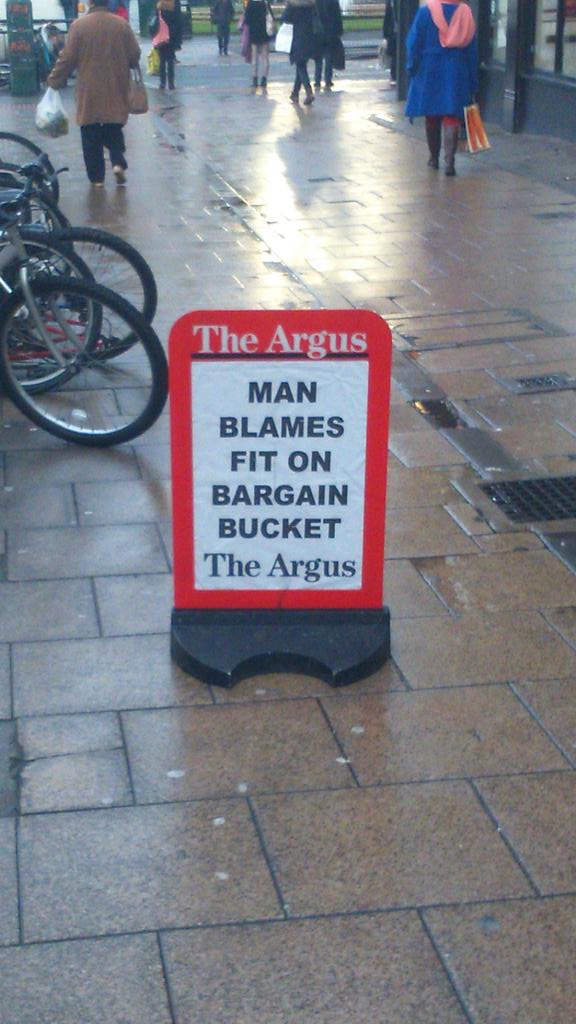
Bargain Bucket
Posted in Brighton with tags Brighton, Brighton Evening Argus, Headlines on January 9, 2015 by telescoperThe Vogue Gyratory: An Accident Awaiting to Happen
Posted in Brighton with tags Brighton, Brighton and Hove City Council, cycle paths, Roadworks, Vogue Gyratory on December 21, 2014 by telescoperMajor roadworks have been underway in Brighton, along the route that I take from the city centre to my workplace at the Falmer campus of the University of Sussex, for about four months from mid-August until just recently. These works are to do with “improvements” to the Vogue Gyratory system, a complex junction involving the main road between Brighton and Lewes (the A270/A27 Lewes Road) and three other roads: Bear Road, Hollingdean Road and Upper Lewes Road.
Here is a plan showing the effect of the work, which you can click on to enlarge:
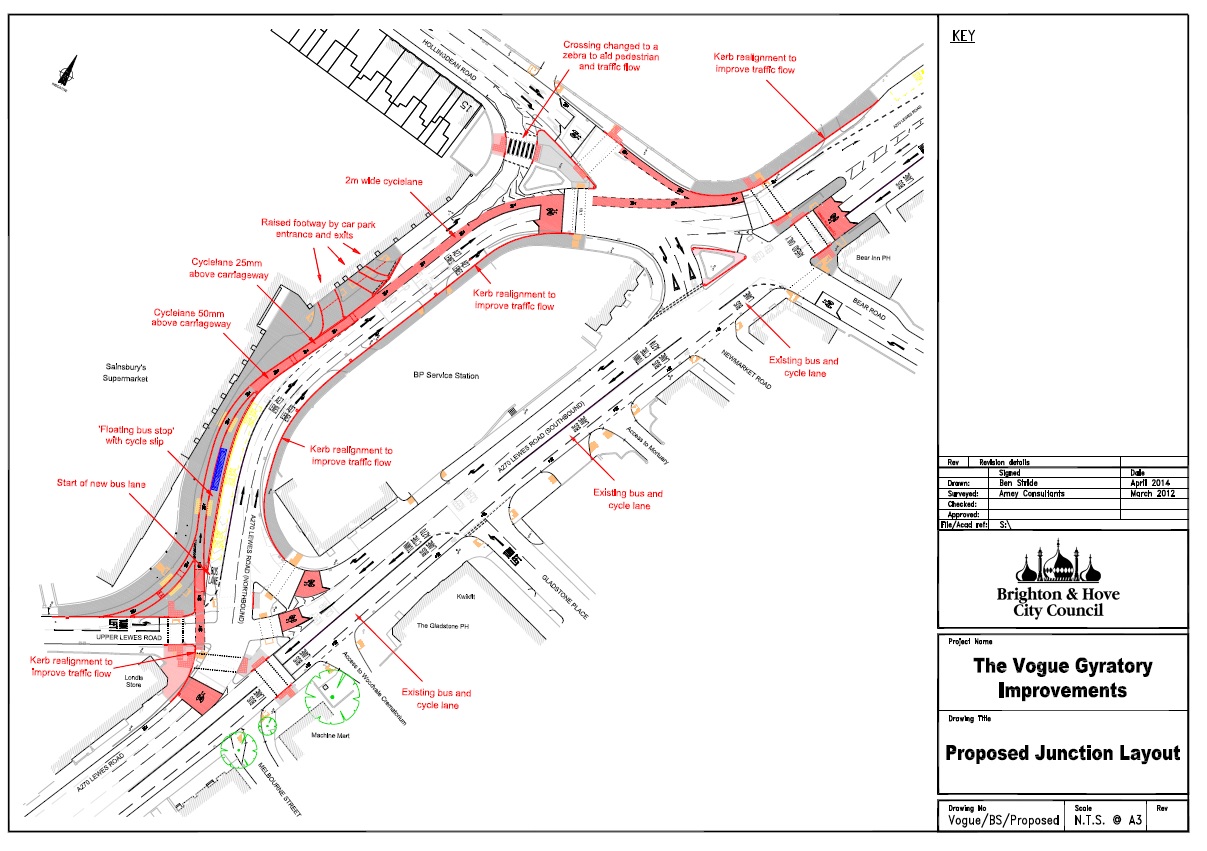
The aims of this scheme are apparently to improve traffic flow through the junction, and to make it safer for cyclists. The latter objective is addressed by changing the bus stop which was originally just outside Sainsbury’s (to the left of the plan) into a “floating” stop and putting a cycle lane behind it.
These floating bus stops have been deployed further up the Lewes Road to good effect; cycles pass behind the bus stop so there is no need for them to attempt to overtake buses which have stopped and no need for buses to wait for cyclists passing the stop before pulling in to pick up passengers. The only problem is that pedestrians have to cross the cycle laneto get to the bus stop, and they sometimes do so without paying sufficient attention. There has therefore been an occasional collision between people on foot and people on bikes. Nevertheless these floating stops have largely been successful and I think are a good idea from Brighton and Hove City Council. This is no doubt why they decided to apply the same principle to the bus stop in the Vogue Gyratory.
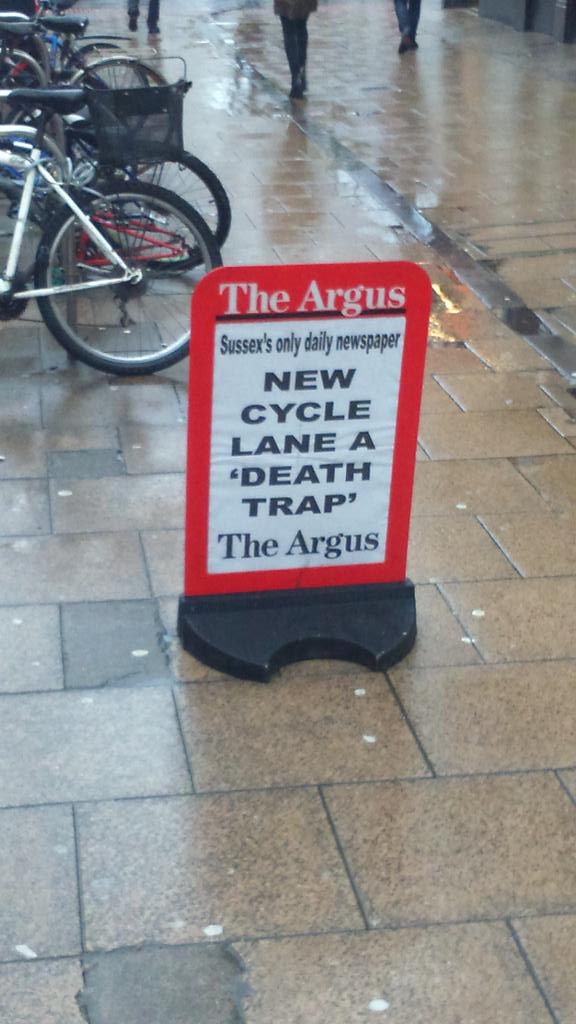
Unfortunately, the new scheme is not safer for cyclists at all. In fact it’s a death trap. Don’t take my word for it: on one day last week there were three accidents as a direct result of the changes and another just hours later. These incidents were all caused by the introduction of a hidden kerb at the edge of the cycle lane. All four victims fell off their bikes and could easily have been killed by motor traffic as a result.
The hidden kerb is clearly a piece of idiocy, but can perhaps be easily fixed. But there is a far greater danger lurking in the new system. Imagine you are in a car, entering the gyratory from the southern end (bottom left of the plan) and intending to exit up Hollingdean Road (near the top). If a bus has stopped at the floating bus stop it will completely hide the cycle lane and cyclists on it until the car has passed the stop. However, almost immediately after the stop a car wishing to take an exit left has to cross the, totally unprotected, cycle lane. There are no signs to warn motorists to beware of cyclists coming from their left, no barriers and no lights. This is what traffic planners call a “point of conflict” and the current design of the junction makes this a potentially lethal one, which is exacerbated by the “improved traffic flow” through through the junction, which means that cars often travel at quite high speeds along the main carriageway. A serious accident, possibly even a fatality is just a matter of time.
People have suggested that car drivers should know where cyclists are likely to be, but what about a driver who is using the junction for the first time? You can’t expect motorists to be psychic.
So what can be done? It’s hard to see how such a basic design flaw can be fixed without rebuilding the entire junction, but two immediate steps must be taken before somebody dies. The first is to reduce the speed limit for all vehicles through the junction to 5 mph. That may just give drivers the time to notice cyclists immediately to their left. The second is to introduce much more obvious warnings. The problem with the second of these is where to position the required signs. There’s no point placing them on the island forming the floating bus stop because they would be hidden too. Perhaps there could be overhead signs?
But the best advice I can give cyclists in the meantime is to follow the warning given by this lady on Twitter:
I drive left every day across new cycle path in front of Sainsbury’s at #voguegyratory. CAN’T SEE CYCLISTS! Scary. Horrendous. #Brighton
— Elizabeth Bangs (@ElizabethBangs) December 20, 2014
The disruption that the Vogue Gyratory roadworks have caused has been horrendous: four months of almost continuous gridlock and the time taken for my daily trip to work almost doubled. This is in itself shows a disgraceful failure of planning. The area is not primarily residential, so they should have worked at weekends and possibly even round-the-clock to mitigate the impact. I’ve been completely exasperated on a number of occasions as the bus I was on inched up the Lewes Road tailback only to enter the Gyratory and find no work at all going on. I don’t think there was a proper estimate of the disruption the works would cause nor was any reasonable plan made to mitigate it.
Now we find out that all this agony will have to be repeated in order to put right what should have been obvious to the planners, especially the failure to recognize the poor visibility of cyclists through the gyratory. There should really be a public inquiry about this fiasco, but I think that will only happen if there is a serious accident. If that does occur, then the relevant employees Brighton and Hove City Council should be facing charges of criminal negligence or even manslaughter.
Follow @telescoperCampus Christmas!
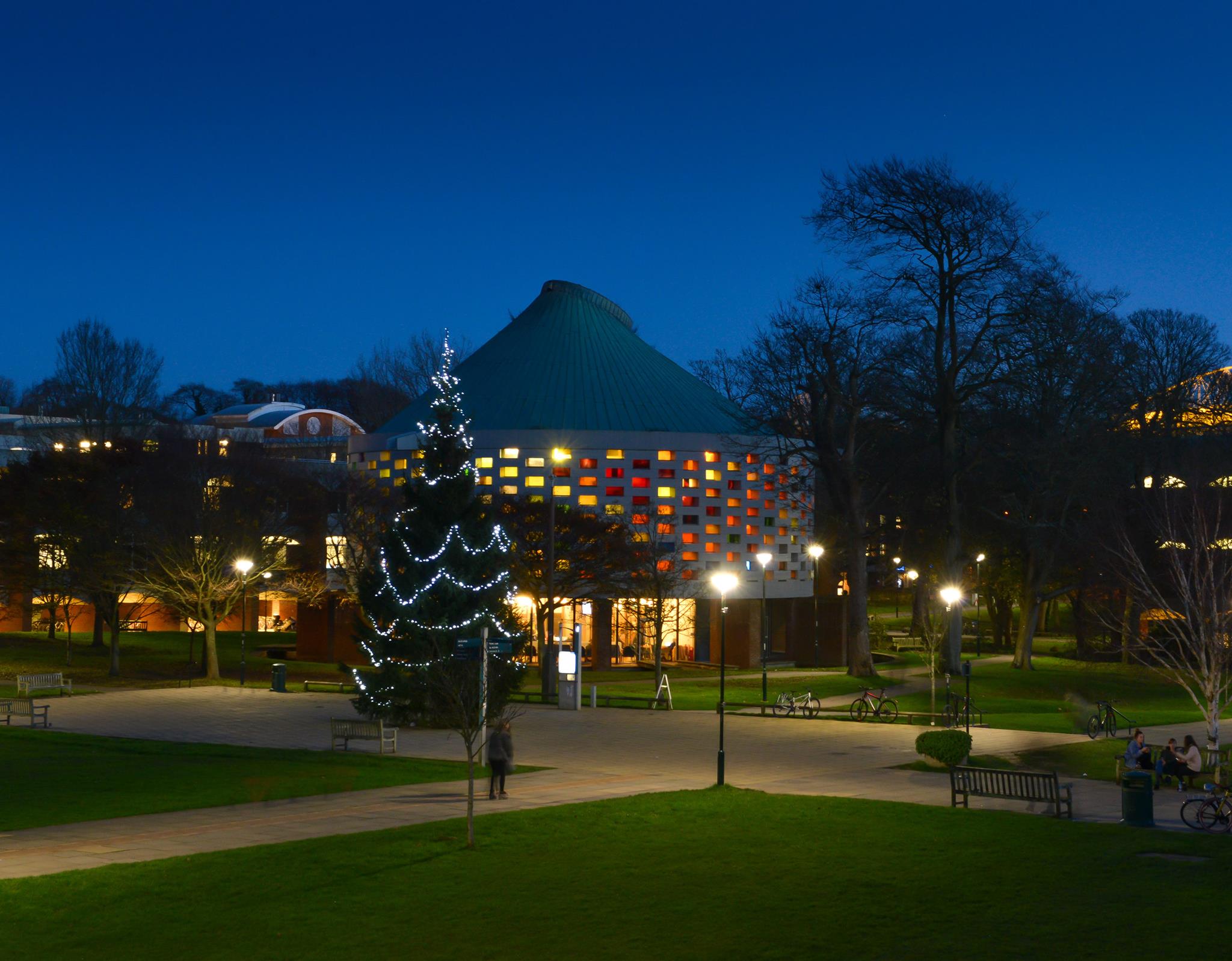
Posted in Brighton with tags Brighton, Falmer, Meeting House, University of Sussex on December 9, 2014 by telescoperNow that I’m back in Brighton I thought I’d share this very nice picture of the University of Sussex Campus at Falmer, complete with Christmas tree and decorations. I got the picture from the University’s facebook page. That’s the Meeting House you can see behind the tree, by the way..
Why Cosmology Isn’t Boring
Posted in Brighton, The Universe and Stuff with tags Brighton, Cosmology, Dark Energy Survey, Sussex on October 23, 2014 by telescoperAs promised yesterday, here’s a copy of the slides I used for my talk to the ~150 participants of the collaboration meeting of the Dark Energy Survey that’s going on here this week at Sussex. The title is a reaction to a statement I heard that recent developments in cosmology, especially from Planck, have established that we live in a “Maximally Boring Universe”. I the talk I tried to explain why I don’t think the standard cosmology is at all boring. In fact, I think it’s only now that we can start to ask the really interesting questions.
At various points along the way I stopped to sample opinions…

I did however notice that Josh Frieman (front left) seemed to vote in favour of all the possible options on all the questions. I think that’s taking the multiverse idea a bit too far..
Follow @telescoper
Sunday Diversions
Posted in Biographical, Brighton with tags First Great Western, National Rail, Southern Railways, trains on September 28, 2014 by telescoperRemind me never again to travel on a Sunday. Needing to get back for some important meetings tomorrow I set out from Cardiff this lunchtime leaving plenty of time for the journey. Just as well.
For a start, First Great Western trains were disrupted by “planned engineering work”. Not very well planned, obviously. The train I got on was to be diverted via Bath Spa, adding about an hour to the usual journey time. But that wasn’t the main cause of vexation.
When it arrived at a crowded platform at Cardiff Central, the 12.53 consisted of just seven coaches, three of which were First Class. To add to the chaos and consternation, Coach B, in which several people standing beside me had reserved seats, did not exist.
Not having a reservation in a real or imaginary coach, rather than stand for 3 hours I went and sat in any empty First Class carriage and when the guard arrived I paid the £15 upgrade to Weekend First, congratulating First Great Western on a cleverly-worked scam. Deliberately running a short train on a busy route to increase revenue this way is cynical and exploitative but that’s what it means to run a train company these days.
Anyway, the weather being quite nice when I arrived in Paddington I walked through Kensington Gardens and along the Serpentine before heading down to Victoria.
Stage two of my journey via Southern Railways turned out to be no better. More “planned engineering works” meant all Victoria to Brighton trains were diverted through Littlehampton. A replacement bus from Three Bridges was offered as an alternative “possibly a little quicker” but having no confidence at all that a bus would actually materialise I stayed on the train as it trundled through rural Sussex.
I got to Brighton Station around 7pm, about 6 hours after leaving Cardiff Central, but at least I got a bus straight away.
I hope the rest of the week isn’t as exasperating as today, but something tells me that it might be..
Follow @telescoperSolly’s Story
Posted in Biographical, Brighton, History, LGBTQ+ with tags Brighton, codeword: Cromwell, Home Guard, World War 2 on August 9, 2014 by telescoperI don’t know why I suddenly remembered a long-forgotten character I knew when I was in Brighton as a research student, but I thought I’d write a blog post so I don’t forget him again.
I moved to Brighton in late September 1985 to start my DPhil. I’d left it quite late looking for accommodation because I’d been working in Newcastle through the summer after my graduation. In the end I had to settle for a bedsit in Hove, quite a long way from central Brighton in a road called Goldstone Villas, not far from Brighton & Hove Albion’s old stadium, the Goldstone Ground.
Round the corner from my place was a pub – I’ve forgotten the name – which became my local. After a few visits there I became friendly with one of the regulars there, a man in his sixties who was known to everyone as Solly, short for Solomon. He was, as I soon came to realise, something of a local celebrity.
Solly was a tall man, always immaculately dressed, and (I would say) handsome for his years. He was also (quite obviously) gay and (also quite obviously) Jewish. He had a great sense of humour and was a wonderful raconteur, but at the same time very kindly and self-effacing; he was liked by everyone in the pub (which wasn’t a gay pub, by the way).
Like everyone else I took an immediate liking to Solly; I greatly enjoyed his company and we had dinner together quite a few times in addition to conversations in the pub. On one of these occasions he told me his life story, or at least some of it. It turns out he was of Anglo-Austrian extraction, with an English mother and an Austrian father, although he had no trace of an accent. He was born in Austria, but his parents sent him to live with relatives in England during the 1930s because they could see what was going to happen there as the power of Nazi Germany grew; he never saw either of them again.
Solly arrived in Brighton when he was about 11 and he was 17 when World War 2 broke out. He immediately tried to join up, but was refused because he was too young. When he reached 18 he tried again but was still refused. He went to London (at the height of the Blitz) to try enlisting there, but was also refused, possibly because of his German-sounding name (and also possibly because of his sexuality).
Having failed to join up he returned to Brighton in late summer 1940 and joined the Local Defence Volunteers (the “Home Guard”). Given his appearance in later life I imagine he would have looked at this time rather a lot like Private Pike from Dad’s Army.
I remember many of his hilarious stories of how shambolic the Home Guard actually was, as well as how they were largely engaged in helping the Police deal with crimes such as racketeering and looting, but there was one particular striking incident that has stuck in my memory.
On 7th September 1940 the War Office issued the following communique:
Message to all UK units: codeword CROMWELL. Home Defence forces to highest degree of readiness. Invasion of mainland UK expected at any time.
After being informed of this signal Solly and his comrades turned up to be issued with the equipment with which they were expected to stop the invasion. In his case it was an ancient pre-WW1 vintage rifle, three rounds of ammunition, and two improvised grenades. With these meagre supplies, they were supposed to hold their positions until reinforced, possibly for up to 7 days.
As they walked to their posts all the volunteers were certain that they had no chance and that none of them would survive the night. The talk was exclusively of the need to make all their shots count. If each man could kill at least one German before he himself was killed then the invasion might be thwarted. Solly certainly had no intention of allowing himself to be taken prisoner, as he knew all too well how he would be treated by the Nazis.
After an agonizing wait, and several false alarms, dawn broke. The Germans never came.
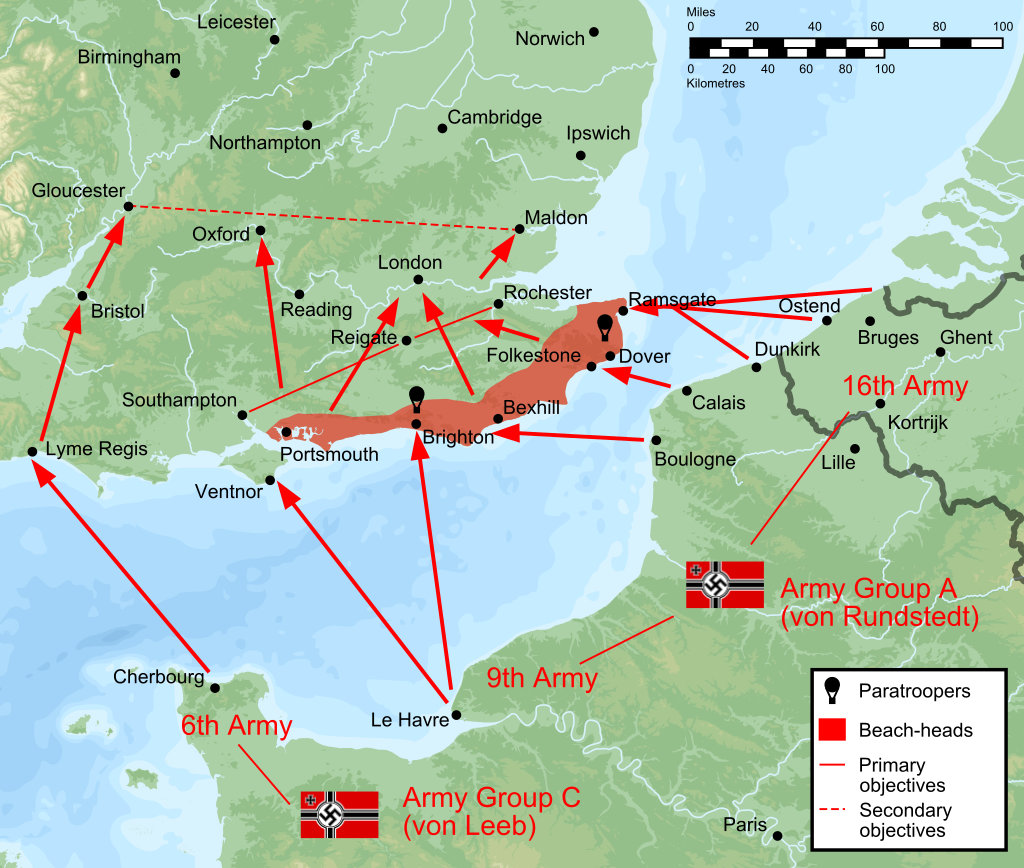
As it turns out, if they had come, Solly’s platoon would have been right in the front line: Operation Sealion (the planned invasion of England) involved the landing of paratroopers on the Downs just behind Brighton with the intention of securing the high ground behind the landings and the main road to London ahead of the invasion:
Solly did finally succeed in enlisting, but his good knowledge of the German language meant that he was given a desk job, translating documents and such, until the Normandy invasion when he finally got to fire a weapon in action, although he landed some weeks after the initial assault, when his unit was attacked south of Caen. He didn’t hit anyone.
Incidentally, the 70th anniversary of the D-Day landings passed in June 1944 but it’s worth noting that the German defensive lines were not really broken until August. In fact, on this day in 1944, British and Canadian forces were engaged in heavy fighting about 6 miles from Falaise, while the Americans were executing a wide encircling manoeuvre designed to surround and trap the German army.
Anyway, back to the 1980s. I didn’t stay long in the Hove bedsit and moved out early in 1986. About six months later I happened to be in the area so popped into the pub to see Solly. He wasn’t there; he had passed away suddenly of a heart attack in the Spring.
Follow @telescoperFrom Brighton Pride to Sussex Pride
Posted in Biographical, Brighton, LGBTQ+ with tags Brighton, Brighton Pride, discrimination, Equality and Diversity, Faggot, Harassment, homophobia, Stonewall, University of Sussex on July 31, 2014 by telescoperBrighton Pride is coming up this weekend. I heard some people on the train the other day saying that they didn’t think such events were needed any more because “gays have everything they need, especially in Brighton”. Although I was tempted, I didn’t interrupt, though I did disagree. Things have indeed changed a lot over the last twenty years, but they could easily change back if we get complacent and Brighton has its fair share of intolerance and bigotry still.
I was myself beaten up on Brighton’s seafront many years ago, during my previous existence at the University of Sussex as a PhD student and a postdoctoral researcher. There was no doubt why I was attacked: the four young men who surrounded me and punched and kicked me to the ground were shouting just one word over and over again, “faggot”. It’s still a word I hate to hear used, even if purportedly in jest. That event left me with deep psychological scars that contributed to a breakdown I had as recently as two years ago.
Thirty or so years after my encounter with the queerbashers, attitudes have definitely changed, and so has the law. Certain types of criminal offence are now officially recognized as hate crimes: the list treats sexual orientation as equivalent to race, gender, religious belief and disability in such matters. The Police are now obliged to treat these with due seriousness, and penalties for those found guilty of crimes exacerbated by homophobia are consequently more severe. All Police forces now have special units for dealing with them; here is an example.
These changes are mirrored in other aspects of life too. For example, employment law relating to discrimination or harassment in the workplace now puts sexual orientation on the same footing as race, gender, disability and religious belief. In many universities in the UK, staff have been required to attend training in Equality and Diversity matters not only to raise awareness of the legal framework under which we all have to work, but also to promote a sensitivity to these issues in order to improve the working environment for both staff and students. Now we have equal marriage too.
This training isn’t about over-zealous busybodies. Under the law, employers have a vicarious liability for the conduct of their staff with regard to harassment and discrimination. This means that a University can be sued if, for example, one of its employees commits harassment, and it can be shown that it did not make appropriate efforts to ensure its staff did not engage in such activities.
Of course not everyone approves of these changes. Some staff have refused point-blank to attend Equality and Diversity training, even though it’s compulsory. Others attend grudgingly, muttering about “political correctness gone mad”. You may think all this is a bit heavy handed, but I can tell you it makes a real difference to the lives of people who, without this legal protection, would be victimised, harassed or discriminated against. It is, also, the law.
I think the efforts that have been made to improve the legal situation have been (at least partly) responsible for the changes in society’s attitudes over the last twenty years, which have been extremely positive. I’m old enough to remember very different times. That’s not to say that there’s no bigotry any more. Even in this day and age, violent crimes against gay men are still disturbingly common and police attitudes not always helpful even though many police forces do now have Lesbian and Gay teams, something that was just unthinkable 25 years ago.
Although relatively few universities appear in the list of gay-friendly employers compiled by the campaigning organisation Stonewall, my experience generally, having worked in a number of UK universities (Sussex, Queen Mary, Nottingham and Cardiff), is that they are generally friendly and comfortable places for an openly gay person to work. So much so, in fact, that there’s no real need to make a big deal of one’s sexual identity. It doesn’t really have much to do with the way you do your work – certainly not if it’s astrophysics – and work-related social events are, as a rule, very inclusive.
However, even in the supposedly enlightened environment of a University there do remain islands of bigotry, and not just about gay or lesbian or bisexual or transgender staff. Sexism is a major problem, at least in science subjects, and will probably remain so until the gender balance improves, which it slowly doing, despite the actions of certain professors who actively block attempts to encourage more female applicants to permanent positions. Universities still do not seem to me to treat sexual orientation with the same seriousness as, say, race or gender discrimination. I’ve had plenty of experiences to back that up.
I recently took part in an interesting meeting involving various staff from the University of Sussex with a representative of Stonewall. The topic was how we could work with Stonewall to make it more gay-friendly. If I remember correctly, there are 78 UK Universities currently taking part in Stonewall’s programmes. It is a matter of some embarrassment to me that the University of Sussex is not among them. Perhaps the attitude is that because there is such a large and visible gay population in Brighton it’s not necessary for the University of Sussex to take any steps in this direction. I disagree, and am absolutely convinced that there are many Lesbian, Gay, Bisexual or Transgender members of the University of Sussex staff who would love to see some action taken to make their workplace just a little bit friendlier and more inclusive, even if that just amounts to acknowledging their existence. There is a visible and active LBGT student society on campus, but no such entity exists for staff – an absence that is truly glaring. I don’t even think the University has any idea what fraction of its staff identify themselves as LGBT.
No doubt there’ll be many members of the University of Sussex staff on the Pride Parade on Saturday and at the various parties being held around Brighton afterwards. Perhaps it’s time to start some sort of network so that for staff at the University of Sussex, Pride doesn’t just come once a year…?
If you’re interested in this idea please let me know, either through the comments box or by email.
Follow @telescoperThe Tempest in Musick
Posted in Brighton, Literature, Music with tags Brighton Dome, Brighton Festival, John Dryden, New London Consort, The Tempest, The Tempest in Musick, William Shakespeare, Willian Davenant on May 17, 2014 by telescoperI haven’t done a music review type of thing on this blog for some time, for the simple reason that I haven’t had the time to go to many live music events recently. However, this being Festival time in Brighton I felt I should make an extra-special effort to take a bit of time out to take in a bit of culture. All work and no play and all that.
Anyway, yesterday evening found me in the Concert Hall of the Brighton Dome for a performance entitled The Tempest in Musick by the New London Consort. The programme for the show featured all the music written for the 17th and early 18th century revivals of William Shakespeare’s play, The Tempest. That in itself tells an interesting story. In 1667, after the Restoration of the Monarchy, John Dryden and Willian Davenant put together an enlarged and adapted version of Shakespeare’s play with a host of new characters and numerous musical interludes and additions. This piece was later revised further aa number of times, each including even more music, a process which culminated in a semi-operatic version compiled by Thomas Shadwell in 1674. As if Shakespeare’s original tale were not exotic enough, these new versions had extra devils, Tritons, and Nereids along with spectacular stage effects and costumes. London audiences clearly wanted to let their hair down after the severe restrictions on popular entertainment imposed by Puritans during the Protectorate. The Shadwell version was the top show in London for over fifty years: it ran from 1674 until 1728, until it was eventually replaced in popularity by The Beggar’s Opera.
In the concert we heard most if not all of the music that survives from the multiple revivals and revisions of the Tempest, written by various composers over the period 1667 to 1712, including a setting of “Dear pretty youth” by Henry Purcell dated to 1695. There were two different versions of the most famous song from the original play, Full Fathom Five, sung by Ariel:
Full fathom five thy father lies;
Of his bones are coral made;
Those are pearls that were his eyes;
Nothing of him that doth fade,
But doth suffer a sea-change
Into something rich and strange.
Sea-nymphs hourly ring his knell:
Ding-dong.
Hark! now I hear them — Ding-dong, bell
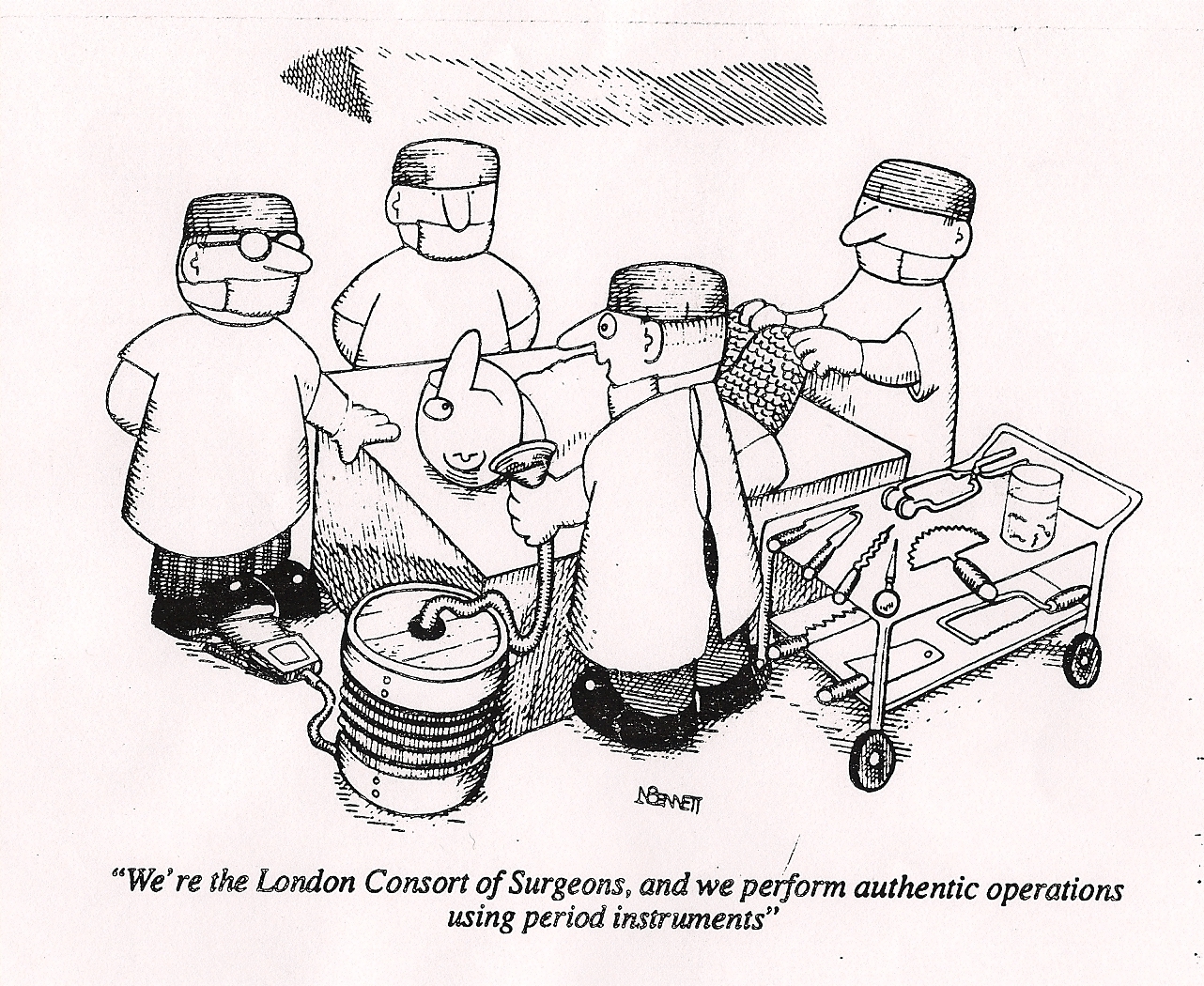
Of course the New London Consort play using period instruments, which gives me an excuse to post this again:
I’m not a fan of period instruments generally, but because of the historical interest in the music I thought I’d give it a go. I had grave misgivings when I saw that the musicians were to be directed by David Roblou from a harpsichord, but decided to grit my teeth and perservere instead of fleeing to the nearest pub.
As it happened, although it was good in parts, the concert basically just confirmed my prejudices. To start with, much of the music is very ordinary and the musicians for the most part failed to bring it to life. The strings, played without vibrato throughout and occasionally rather ragged to boot, didn’t produce much in the way of colour or dynamics; this way of playing also exposed their uncertain pitching. The recorders, a long way from the audience right at the back of the stage, found it difficult to project. They would have been much better off in a smaller venue, I think, especially because of the large gap between audience and stage left for standing customers (of whom there were very few). The dreaded harpsichord was barely audible too. Not that I’m complaining about that.
On the other hand there was some brilliant trumpet playing by Simon Munday on a period instrument. Also I think this is the first time I’ve ever heard a Serpent played and I really enjoyed hearing it. Apart from these highlights though I found the music rather undistinguished and the performance curiously flat.
The singing was much better: the three lovely female voices (Anna Dennis, Faye Newton and Penelope Appleyard) are worth mentioning and tenor Jorge Navarro-Colorado sang well and was a striking presence on stage during the occasional semi-staged pieces. I wasn’t that keen on any of the bass-baritones though.
I realise that there will probably be early music fans out there who would have loved last night’s performance. That’s fine of course. Les gouts et les couleurs ne se discutent pas.
Follow @telescoper
Ship Ahoy!
Posted in Brighton with tags Brighton, River Class Patrol Vessel, Royal Navy on April 29, 2014 by telescoperWhen I was on the way home yesterday evening I was a bit surprised to see a warship, apparently belonging to the Royal Navy, seemingly at anchor off Brighton beach:
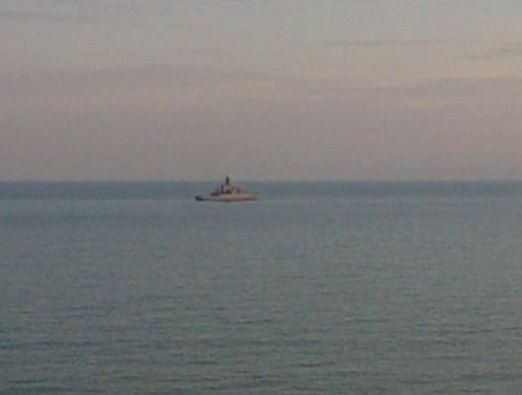
Sorry it’s not a very high resolution picture, but the vessel was some way off and I had to zoom on my phone camera to get anything at all. When I was at school I was in the Navy Section of the Combined Cadet Force (CCF) and could identify all types of Royal Navy vessels from their silhouettes. But that was a long time ago and my eyesight isn’t what it was. Neither is the Royal Navy for that matter; the fleet is not only much smaller now but also comprises very different types of ship. Gone are the Type 21 & 22 frigates and the Type 42 destroyers I would have had no problem picking out!
Judging by the size I thought it might be a frigate of some sort, but the shape didn’t fit any I could identify. Then the tall mast amidships made me think it was a Type 45 Destroyer, but it looked a bit small. Or had I judged the distance incorrectly? But no, there didn’t seem to be enough superstructure to the aft of the mast so it couldn’t be a Type 45.
Turning to Twitter for help, it was quickly identified as a River Class Patrol Vessel. What she was doing there, or indeed which ship it was, remains a mystery. Perhaps someone from the blogosphere can enlighten me?
Follow @telescoper
The Trouble With Brighton’s Roads..
Posted in Biographical, Brighton, Politics with tags A259, Brighton, EDL, March for England, Road Collapse on April 26, 2014 by telescoperI travelled back to Brighton yesterday after taking a short break in Wales over Easter. To occupy myself on the train journey back I was, as usual, messing about on Twitter as a result of which I discovered that the main road along Brighton’s seafront had been closed. The reason for this – and the ensuing traffic chaos in the City Centre – was that the main A259 had partially collapsed. My heart sank at the thought of the problems I might have getting home from the station, but in fact by the time I got there – just after seven in the evening – the worst of the congestion seemed to have cleared and I got a bus home without any difficulty or delay.
When I walked past the spot earlier today I found that it wasn’t as dramatic as I’d been led to believe:
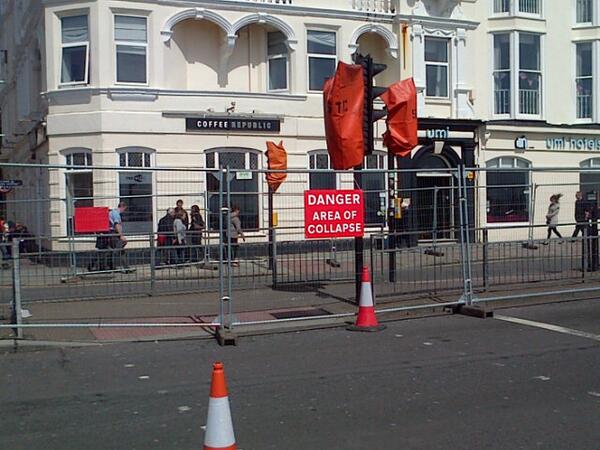
There isn’t actually a hole as such, just a couple of very wonky pavements either side of a section of road that’s in a very poor state of repair. In that respect it’s no different from most of Brighton’s streets.
If you don’t know the area concerned, just at the bottom of West Street, you won’t know that this section of the A259 (King’s Road) runs above the a series of arched underground structures occupied by various shops and pubs. In fact the collapse happened inside a pub called the Fortune of War, when some workmen discovered several tons of rubble had fallen down from the roof above. Fortunately, no-one was hurt.
This is the view at beach level; the King’s Road runs above the pub, behind the iron railings at the top of the picture.
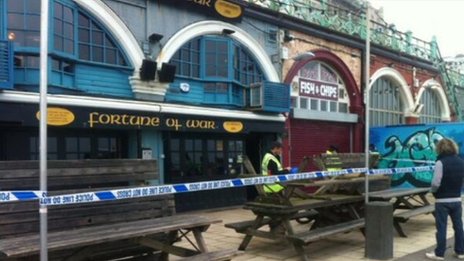
The Fortune of War Pub (Credit: BBC)
One lane of the A259 is currently closed and a contraflow is in operation. Given that it is at the best of times a very busy road this, and the diversions that have been placed elsewhere to ease traffic on it, is set to cause congestion for some time to come, probably several weeks.
The problem is obviously that the structures underneath the road were never designed to carry the weight of traffic that they are now expected to support. Brighton and Hove Council have been spending money on extensive roadworks elsewhere in the City but seem to have been reluctant to perform reinforcing work on this crucial route. There’s already a political row brewing about this.
Here’s another picture of the seafront:
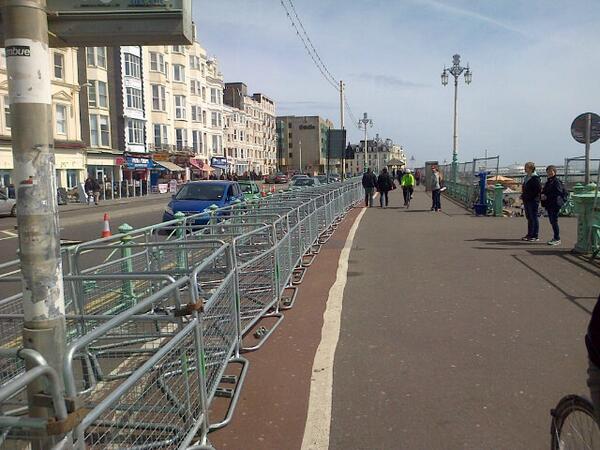
The barricades you see are nothing to do with with subsidence, but are there for tomorrow’s “March for England”, the annual attempt by the gang of Neo-Nazi thugs called the EDL to stir up trouble in Brighton. Presumably the fences are intended to separate the EDL from human beings. The collapsed road was to have been part of the route, but presumably alternative arrangements have been made. I would have preferred the road closure to have been used as an excuse to cancel the march altogether actually. I’d rather have no road at all than one filled with such creatures.
I’m very worried about tomorrow. I despise the EDL, but I strongly believe that the best way to deal with people like that is to make sure you don’t give them what they want. They’re clearly coming to Brighton for a fight, so the best approach is to exercise restraint. Unfortunately, there are extremists on the other side of the political spectrum who want a fight just as much as the EDL do. It’s all rather pathetic, if you ask me. Anyway, I’ll be avoiding any aggro by heading up to campus in the morning and catching up on some of the things I’ve missed while I’ve been away over the last week or so…
Follow @telescoper

 In the Dark