Archive for the Covid-19 Category

The Advent of Covid

Posted in Biographical, Covid-19, Maynooth on December 10, 2020 by telescoper

I witnessed this disturbing scene last night as I walked home through Courthouse Square in Maynooth. Look at them – not a single one wearing a mask!

Perhaps however they have formed a social bubble so we can forgive that, and the lack of social distancing?

Nevertheless I was confused as to what was going on until I worked it out. The child in the front has obviously fallen asleep with its head on a Frisbee and the others are waiting for it to wake up so they can get it back.

With this Mystery solved, continued my journey to Supervalu, where they were sadly out of Gold, Frankincense and Myrrh so I bought a bottle of wine instead.

Vaccination in Ireland

Posted in Covid-19 with tags , , , , , , , on December 5, 2020 by telescoper

A very interesting twitter thread from Dr Ronan Glynn (Ireland’s Deputy Chief Medical Officer) inspired me to write something in response to the very positive recent developments with regard to a SARS-CoV2 (Covid-19 vaccine). In Switzerland the regulator does not feel that there is enough data yet for approval to be granted yet, so I have some reservations about the fast-tracking of the process in the United Kingdom. Nevertheless there has to be a tradeoff between the risk of potential reactions or side-effects of a vaccination and the immediate danger to public health arising from Covid-19. As someone recently said to me on Twitter: “if you’re not going to fast-track during a global pandemic, when would you?”.

Here in Ireland it is likely that a vaccination programme will commence early in the New Year. To answer a question I posed a few weeks ago, priority will be given to front-line health care workers, especially those working in care homes, and the elderly. If all goes to plan there will be something like full vaccination of the population by September 2021.

I am not in a priority group so will have to wait a while for my jabs, but I will certainly take the vaccine as soon as it is available to me.

No doubt there are some people out there who for various reasons will refuse to be vaccinated. I doubt anything I say here will persuade them but it is I think valuable to look at the history of vaccination programmes in Ireland for various illnesses, which is what Dr Glynn’s thread does.

To give a few examples:

  • Smallpox. In 1863 vaccination against smallpox was made compulsory for all children born in Ireland. Deaths fell from 7,550 for the decade to 1880 to the last reported death from smallpox here in 1907. Smallpox was declared eradicated in 1979 – this one vaccine saved 100s of millions of lives globally.
  • Diptheria. Diphtheria was a very common cause of death among children until the 1940s – there were 318 deaths from it reported in Ireland  1938. With the introduction of a vaccine, the number of deaths fell year on year with 5 deaths in 1950; the last death notified from diphtheria was in 1967.
  • Poliomyelitis. In Ireland, polio infection (mainly affecting young children causing long term paralysis) became more common after 1920 with major epidemics during the 1940s & 1950s. A vaccine was introduced in 1957. The last reported case of polio here in Ireland 1984.
  • Measles. The number of cases of measles declined dramatically after introduction of measles vaccine in 1985, from 10,000 cases in 1985 to 201 cases in 1987.
  • Meningococcal Meningitis. In 1999, there were 536 cases of meningococcal meningitis in Ireland The meningitis C vaccine was introduced in 2000, with the meningitis B vaccine introduced in 2016. Cases of meningococcal meningitis have dropped more than 80% since these vaccines were introduced.

These are of course wonderful advances in public health, but none of them provided total relief immediately. It will be the same with Covid-19. The availability of a vaccine will not end the pandemic overnight, but at least it will enable us to plan for a phased return to normal.


While there is great cause for long-term optimism, there are still reasons to be anxious in the short term. There will be many months before a full vaccination programme is in place and in that time cases (and, sadly, deaths) could rise substantially. There is a real danger will think that it’s all over, that they can let down their guard and ignore social distancing.

Ireland is currently relaxing its Covid-19 restrictions for the Christmas period, but it is doing so from a level of over 260 new cases per day. The Coronavirus is currently circulating in the community at a far higher rate than it was in the summer and if it increases at a similar rate to August then we could be in for a huge surge. I fear that by the New Year we might be in real trouble again. It would be tragic if people lost their lives owing to complacency with safety so nearly in sight.


Another Week Ending

Posted in Biographical, Covid-19, Education, GAA, Maynooth, The Universe and Stuff on December 4, 2020 by telescoper

As this term staggers on I once again arrive at a weekend in a state of exhaustion. Still there are just two teaching weeks left for this term so soon it will be the Christmas break. At least there won’t be any teaching then, though there will be other things to do before the examinations start in January.

I’ve managed to keep a reasonable pace up in both sets of lectures. The last one due this term is for Vector Calculus and Fourier Series, on Friday 18th December, but I think I may be able to complete the module content on the Tuesday lecture which means the students will be able to have a bit more time to relax before Christmas or, alternatively, a bit more time for revision. I hope it’s the former, as I imagine the students are at least as tired as we staff are. This has been a difficult year for everyone.

At Maynooth University, lectures for Semester 2 start on February 1st 2020. That will give us a bit of time to see how the Covid-19 pandemic progresses before deciding exactly how we’re going to approach teaching. Other universities that resume earlier have less time to make this decisions. I fear that the number of cases may rise rapidly over the three weeks remaining before Christmas, even before the Christmas break itself, and we therefore might have to go fully online next term. What I don’t want to happen is what happened in September, namely that we made elaborate plans for lecture rotations and tutorial groups that were then ditched because the Coronavirus situation changed. That was quite demoralizing because it involved a great deal of effort that was wasted.

Being a Department of Theoretical Physics we don’t have the problems facing the more experimental subjects that require extensive laboratory classes which are difficult to do under social distancing. Next term however we do have Computational Physics, which has laboratory classes, so I’ll have to decide how much of that we can do in person and how much students will have to do online using their laptops. I hope we can return to full in-person lab sessions, but we can’t be that will be possible right now. In any case computer labs are far easier to run online that practical chemistry or physics labs, so I think we will be able to do a reasonable job whatever the circumstances.

For added fun, next term I’ll be teaching a new module; 4th Year Advanced Electromagnetism. Although there’s always a lot of work required to teach a module for the first time, I am actually looking forward to doing this one as there’s some interesting physics in it (especially relativistic electrodynamics). I may try to squeeze a bit of plasma physics in too. But will it be online or on campus, or a mixture of both? Time alone will tell.

Anyway I’m looking forward to this weekend being as stress-free as possible. There’s a good start tonight, as Newcastle’s game against Aston Villa has been postponed due to Covid-19 so no anxious looking at the score this evening. The rest of the weekend will be dominated, for me, by the two semi-finals of the All Ireland Gaelic Football Championship (Cavan versus Dublin tomorrow and Mayo versus Tipperary on Sunday). It seems to be written in the stars that the final should be Dublin versus Tipperary, the two teams that played on Bloody Sunday, but time will tell on that one too.

Update: Dublin did indeed comfortably beat Cavan on Saturday but Mayo beat Tipperary in a high scoring game in a foggy Croke Park on Sunday (Mayo 5-20 Tipperary 3-13). The final will therefore not be a rerun of the 1920 final.

That’s enough rambling. Have a good weekend.

Four Weeks To Go

Posted in Biographical, Covid-19, Education, Maynooth with tags , , , , , on November 23, 2020 by telescoper

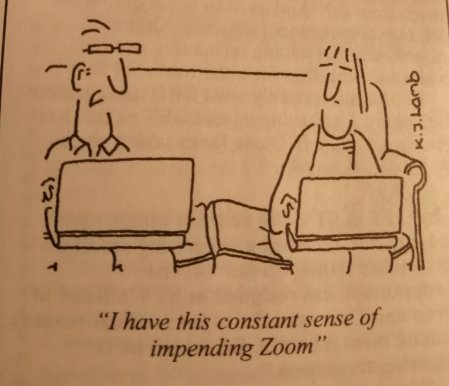
As I await another Zoom meeting I remembered this cartoon from last week’s Private Eye, which sums up the prevalent mood amongst academics these days (and no doubt people in other kinds of job too).

At the start of this morning’s Panopto lecture I realised that there are still 4 weeks left of this Semester before the Christmas break. I was a bit surprised by that as this term seems to have lasted a decade already. The time certainly hasn’t zoomed by. Still, at least I’ve more-or-less kept up with my planned schedule of lectures in both of my modules without slipping. I may even be able to finish lectures to my 2nd year Vector Calculus in time to do a bit of revision in the final week.

That’s not to say other things haven’t slipped. The greatly increased time for teaching needed to move everything online hasn’t left much time for research or anything else. I keep meaning to work in the evenings to deal with outstanding things but mostly I find once I’ve done the necessary admin and teaching stuff all I can do is sleep. It seems that I’ll have to work over Christmas to finish off the backlog. Given that I didn’t have a holiday this summer that’s not ideal, but it’s unlikely I’ll be going anywhere over the “festive” season owing to Coronavirus restrictions so I might as well make the best of it.

We don’t have much idea how things will work out next Semester. The politicians seem to be wanting universities to have more on-campus teaching in the New Year. They also want to end the current restrictions to end before Christmas. In fact the current regime is suppose to end on December 2nd, which is next week, and cases are still running around 400 per day. I don’t think they can do both of these and for the Covid-19 situation to remain under any semblance of control. I think the likeliest scenario is that cases surge over the next few weeks and the Christmas break and we have to go back into full restrictions in January or February.

There is however the prospect of a vaccine or vaccines being available fairly early next year so maybe the end of this is in sight. I really hope we can get back to campus normality at some point in 2021. I do feel very sad about the effect all these restrictions has been having on the students. It’s not just having to have remote lectures. I think having a lecturer in the same room is an advantage, but the loss of it is not the worst issue. We encourage our students to work with each other in their learning, and I’m sure students learn at least as much from each other as they do from the lecturer. Peer group learning is more difficult when your peers are sitting in separate locations most of the time.

Earlier today I found myself using the phrase “getting back to normal” in connection with plans for next teaching year. Then I realise that we staff know what we mean by “normal” but our first-year students don’t. I have a feeling that may might find it more difficult to adjust to the old normal than they did to the new one.

And in any case many of our students in all years did not take up accommodation in Maynooth at the start of this year because of the remote teaching. Even if we did on campus lectures or tutorials next term, I suspect many will stay at home anyway to avoid substantial cost of rented accommodation. We will therefore have to continue making material available online whatever happens.

Anyway, what may or may not happen next Semester is to a large extent out of my hands so I won’t be making any firm decisions on what approach I will be taking until much closer to the start of Semester 2 In the meantime the goal is to fight the exhaustion and try get through to the end of term in one piece.

Dreams, Planes and Automobiles

Posted in Biographical, Covid-19, Education, Maynooth, The Universe and Stuff with tags , , , , , on November 20, 2020 by telescoper

I’ve blogged before about the strange dreams that I’ve been having during this time of Covid-19 lockdowns, but last night I had a doozy. I’ve recently been doing some examples of Newtonian Mechanics problems for my first-year class: blocks sliding up and down planes attached by pulleys to other blocks by inextensible strings; you know the sort of thing.

Anyway, last night I had a dream in which I was giving a lecture about cars going up and down hills taking particular account of the effects of friction and air resistance. The lecture was in front of a camera and using a portable blackboard and chalk, but all that was set up outside in the middle of a main road with traffic whizzing along either side and in the presence of a strong gusty wind. I had to keep stopping to pick up my notes which had blown away, dodging cars as I went.

It would undoubtedly make for much more exciting lectures if I recorded them in such a situation, but I think I’d be contravening traffic regulations by setting up in the middle of the Straffan Road. On the other hand, I could buy myself a green screen and add all that digitally in post-production…

An Image for Autumn 2020

Posted in Biographical, Covid-19 on November 17, 2020 by telescoper

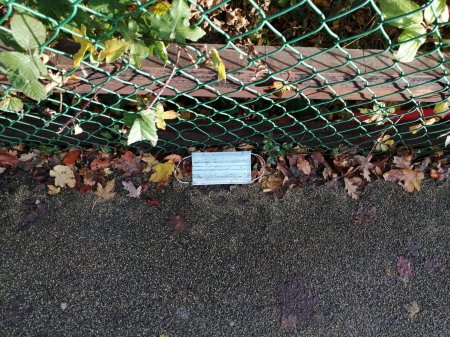
If there’s an image that sums up Autumn 2020 for me, this is it:

I can hardly go anywhere these days without seeing the disagreeable sight of a discarded face mask at some point. I wish people would take more care when disposing of these things!

Covid Questions for Ireland

Posted in Covid-19, Maynooth with tags , , on November 15, 2020 by telescoper

I’ve just done my daily update of Covid-19 numbers here and thought I’d show the latest figure:
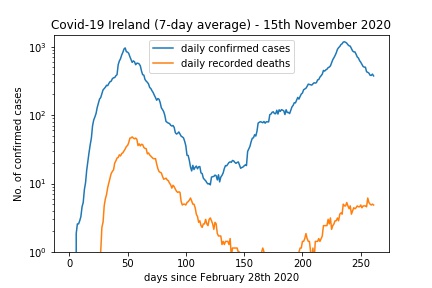
There are now 262 data points on these graphs. When I started doing the updates I thought it might carry on for two or three months -i t’s now been almost nine and there’s no end in sight.

As you can see the 7-day average of new cases has been falling steadily since entered the period of Level 5 restrictions that is now about half-way through. That, of course, is good news. The problem is that the rate of decrease is really quite slow. The number of new cases on each day for the last week (including today) were: 270, 270, 362, 395, 482, 456, and 378 (today). That is fairly flat, the steep downward trend of the previous week apparently faltering. As a rough guess I’d say that by the time we come out of the current period of restrictions (at the beginning of December) we’ll probably still be having over a hundred new cases per day.

I think that level is far too high for comfort, but the current government is probably going to find it difficult to resist the political pressure to exit the lockdown in time for Christmas. If that does happen, I can see another lockdown looming in January. My superiors at Maynooth University are talking about having on-campus teaching again next Semester, but I think that’s highly unlikely in the circumstances.

Things are even worse in Northern Ireland where the number of new cases announced today was 478. Daily cases have been running higher there than in the Republic for some time, despite the fact that the six counties of Northern Ireland have a population of just 1.9 million compared to the 4.9 million of the 26 counties  in the Republic.

That brings me to the issue of the Pfizer Covid-19 vaccine that everyone is getting excited about. Assuming that it passes the various tests needed for it to be approved, Ireland would get about 2 million doses from the stock procured by the European Union.  The population of Ireland is about 4.9 million, and each person would require two doses, which means that supply will only enable about 20% of the population to be vaccinated.

(Actually I don’t know whether the 2 million refers to people that can be vaccinated or individual doses, but even if it’s the former that still accounts for only 40% of the population.)

The question then is who should be prioritized? I think we’d all agree that all health care workers should be vaccinated ASAP but that’s only about 25,000 people (source). Who should get the other doses? Most people seem to be assuming that those at highest risk of mortality should be vaccinated, but there’s also a case to be argued that  it should it should be those groups within which the virus is most likely to spread that should get it, which is presumably the otherwise healthy population.

I don’t know the answer, but it will be interesting to see how this all develops. In any case as far as I can see it there’s very little prospect of high levels of population immunity being reached by this time next year. And that’s even if the vaccine is available soon, which is by no means clear will be the case. As a matter of fact I wouldn’t bet against me still having to do daily updates on Covid-19 statistics for most of next year.


Dare we hope?

Posted in Covid-19, Poetry, Politics with tags , , , , , on November 9, 2020 by telescoper

A short passage from Seamus Heaney’s verse play The Cure at Troy: A Version of Sophocles’ Philoctetes has been much quoted recently. It even ended the RTÉ News last night:

The passage begins

History says, Don’t hope
On this side of the grave.

Well, there’s an additional reason for hope this morning, in the announcement of good progress in the search for a vaccine against Covid-19. The two pharmaceutical companies involved are Pfizer (USA) and BioNTech SE (Germany). The reported efficacy of the vaccine tested so far is over 90%, which is far higher than experts have predicted. Now these are preliminary results, not yet properly reviewed, based on a sample of only 94 subjects, and I’m not sure what motivated the press release so early in the process. I’m given to understand that the type of vaccine concerned here would also be challenging to manufacture and distribute, but we’re due for some good news on the Coronavirus front so let’s be (cautiously) optimistic.

On top of that it seems that Ireland at least is turning the tide against the second wave, with new cases falling every day for over a week:

Dare we hope?

Standing Up for Online Lectures

Posted in Covid-19, Education, mathematics, Maynooth with tags , , , , on November 3, 2020 by telescoper

I have a break of an hour between my last lecture on Vector Calculus (during which I introduced and did some applications of Green’s Theorem) and my next one on Mechanics & Special Relativity (during which I’m doing projectile motion), so I thought I’d share a couple of thoughts about online teaching.

I started the term by doing my lectures in the form of webcasts live from lecture theatres but since we returned from the Study Break on Monday I’ve been doing them remotely from the comfort of my office at home, which is equipped with a blackboard (installed, I might add, at my own expense….)

I still do these teaching sessions “live”, though, rather than recording them all offline. I toyed with the idea of doing the latter but decided that the former works better for me. Not surprisingly I don’t get full attendance at the live sessions, but I do get around half the registered students. The others can watch the recordings at their own convenience. Perhaps those who do take the live webcasts appreciate the structure that a regular time gives to their study. Even if that’s not the reason for them, I certainly prefer working around a stable framework of teaching sessions.

“Why am I still using a blackboard?” I hear you ask. It’s not just because I’m an old fogey (although I am that). It’s because I’m used to pacing myself that way, using the physical effort of writing on the blackboard to slow myself down. I know some lecturers are delivering material on slides using, e.g., Powerpoint, but I have never felt comfortable using that medium for mathematical work. Aside from the temptation to go too fast, I think it encourages students to see the subject as a finished thing to be memorized rather than a process happening in front of them.

I did acquire some drawing tablets for staff to enable them to write mathematical work out, which is useful for short things like tutorial questions, but frankly they aren’t very good and I wouldn’t want to use them to give an hour long lecture.

In addition to these considerations, my decision to record videos in front of a blackboard was informed by something I’ve learnt about myself, namely that I find I am much more comfortable talking in this way when I’m standing up than sitting down. In particular, I find it far easier to communicate enthusiasm, make gestures, and generally produce a reasonable performance if I’m standing up. I know several colleagues who do theirs sitting down talking to a laptop camera, but I find that very difficult. Maybe I’m just weird. Who else prefers to do it standing up?

Track and Trace & Ligatures

Posted in Covid-19, History with tags , , , , on November 2, 2020 by telescoper

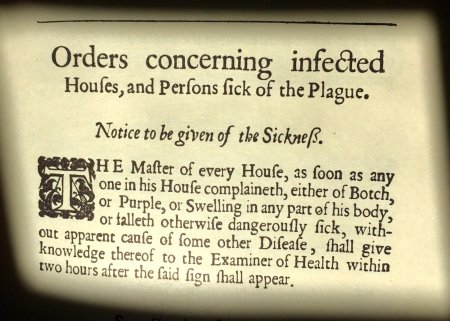
I was interested to see (on Twitter) the above example of track-and-trace from 1665, at the height of the Great Plague of London. I’m not sure how effective this notice was…

Other than its historical context, looking at this piece of text reveals some interesting things about how it was printed.

Note the liberal use of the symbol “ſ’”, for example. This character is sometimes called the “long s”*. There’s a full Wikipedia article on this and I have posted about it before which means there’s no point in repeating here, but I will just mention that the long s was used widely in manuscripts after the distinction arose better upper case and lower-case letters (which was around about the end of the 8th Century) wherein the lower-case form, the “short s” (i.e. s),  was used exclusively at the end of words or before an elision, and the long s everywhere else. It survived into the era of printing, not just in English but also in other languages including German. In fact “ſ” forms the left-hand element of the ligature “Eszett”, written  “ß”, of which the other part is “z”.

Note the use of a ligature that looks like the Eszett at the end of the word “Sickness”. This is not actually an Eszett but is instead a ligature formed from the long s and the short s. I haven’t seen many examples of this in old printed books but I’m by no means an expert in 17th Century orthography but I’m given to  understand this was used in fonts based on the Antiqua class of typefaces, typically used for printing Latin text. I suppose the piece above was produced by a printer used to that form of material. That doesn’t narrow it down much, though, as many scholarly works were published in Latin at that time.

The number of esses (both long and short, as well as capital “S” in “Sickness” and “Swelling”) is quite considerable given its brevity. The last sentence contains quite a tongue-twister too: “said sign shall”!

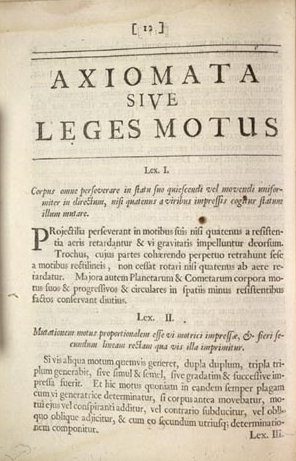
There is another ligature “ct” in the word “infected” in the heading. This is quite common in old printed works, especially in Latin.  Here is an example from Newton’s Principia; see the word “rectam” in the statement of the Second Law of Motion:

The combination “ct” is quite common in Latin, as is “ss”, as are many other digraphs, including “et” (the ligature for which gives the symbol &; “et” means “and” in Latin).

Ligatures were introduced in handwriting, partly to embellish the script and partly to save time. Joining two letters together is a way of eliminating a duplicate stroke of the pen and avoiding having to lift it from the paper. When printing presses were introduced, ligatures were found to make typesetting with movable type easier because one block would replace frequent combinations of letters. It also allows the compositor to reduce the spacing between the characters, saving paper and also making the text easier to read.

*Incidentally, for the mathematically inclined, the long s is also the original form of the integral sign, introduced to mathematics by Leibniz to stand for “summa” (sum), which he wrote “ſumma”.