Archive for the Cute Problems Category

An easy physics problem…

Posted in Cute Problems with tags , , , on May 26, 2011 by telescoper

Based on the popularity of something I posted last week, I thought some of you might find this little problem amusing. It’s from a Physics A-level paper I took in 1981. The examination comprised two papers in those days (and a practical exam); one paper had long questions, similar to the questions we set in university examinations these days, and the other was short questions in a multiple-choice format. This is one of the latter type, from the mechanics section.

And here is a poll in which you may select your answer:

Cute Physics Problem

Posted in Cute Problems, The Universe and Stuff with tags , on May 17, 2011 by telescoper

I heard this nice physics problem today so I thought I’d try it out on here. You will probably be able to find the answer on the net somewhere but please try to figure it out yourself before doing so!

There are two identical chambers, A and B containing identical metal balls which begin the experiment at the same temperature. Apart from the balls, each chamber is a perfect vacuum and has thermally conducting walls at a lower temperature than the ball it contains.

In A the ball is resting on the floor, which is made of material which is a perfect thermal insulator.

In B the ball is hanging from the ceiling by a piece of light inextensible string, not touching the floor. Both the string and the ceiling are also made of perfectly insulating material.

Which ball cools down faster?

Please put your answer through the poll here. When enough people have voted, I’ll tell you the answer…

Share/Bookmark

The Solution

Posted in Cute Problems with tags , , on February 24, 2010 by telescoper

A few days ago I posted a little puzzle about the resistance measured between two adjacent nodes in an infinite square grid made of of 1Ω resistors. There was a bit of discussion after the post that hinted at the solution but, since a few people have asked me about it, I thought I’d post a fuller answer here.

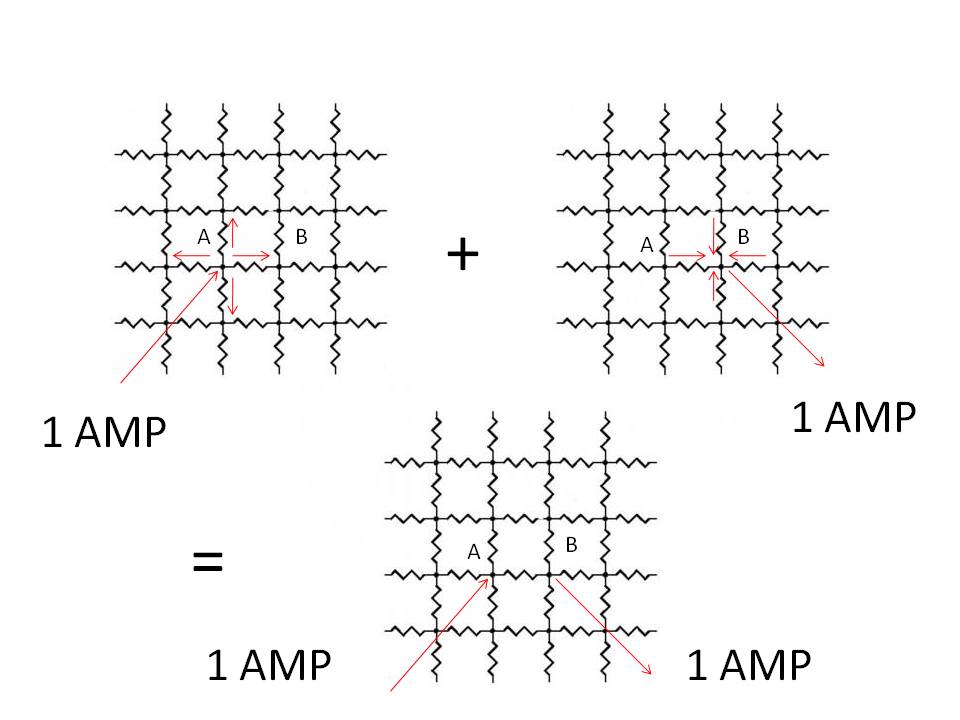
The quickest way I know to get the answer uses the Principle of Superposition, as illustrated in the following picture.

Consider two copies of the grid, both earthed at infinity. Imagine injecting a current of 1 Amp into the grid through a wire attached to node A as shown in the top left of the picture. The current will run to earth through the grid, but, by symmetry, it is obvious that 1/4 of the current entering the grid through A must travel through each of the 4 wires radiating out from it. Each of the wires leading out from A therefore carries 0.25 Amps in this solution.

Now, in the top right hand picture, forget about A, but attach a wire to B and pull out 1 Amp from the earth (at infinity). By a similar argument to the first diagram, 0.25 Amps must be flowing into B along each of the wires connected to it in the directions shown.

We now have two perfectly good solutions for currents flowing in resistive networks. The principle of superposition says that if we add the two solutions we also get a solution. Adding the two configurations above means that the resistor joining A to B must be carrying 0.5 Amp (0.25 from the first solution and 0.25 from the second, both in the same direction). But this is a 1Ω resistor so the Voltage across AB must be 0.5 V.

Now think of the whole mesh as being a black box in between the input wire and output wire. This black box has a current of 1 Amp flowing through it and the voltage dropped is 0.5 V. It’s resistance is therefore 0.5 Ω.

If anyone has a better solution than this, I’d like to see it!!

Talk, Nosh and Gridlock

Posted in Biographical, Books, Talks and Reviews, Cute Problems with tags , on February 18, 2010 by telescoper

I paid a flying visit yesterday to the beautiful city of Edinburgh in order to give a seminar at the Institute for Astronomy, which is situated with the historic Royal Observatory. I was there not long ago, in fact, to do a PhD examination but on this occasion all I had to was stand up in a lecture room and rabbit on for an hour or so. That part of it seemed to go reasonably well, in that no more than half the audience fell asleep while I wittered away.

The morning flight from Cardiff to Edinburgh was uneventful and got me there in time to chat with various people and have lunch before the talk. I elected not to rush straight from the seminar to the airport in order to return the same day, but stayed overnight giving some of  the locals the dubious pleasure of paying for my dinner and enduring my company during it, which they did with great patience. I’d like to thank Alan, John, Alina, Stefano and Brendan for rounding off such a nice day with such a pleasant evening.

In the restaurant we ended up setting each other little geometry problems drawn on napkins, to the palpable disdain of our waiter who clearly wanted us to leave.  However, since I had to get up at 5am the following morning (i.e. this morning) to get the flight back to Cardiff, we didn’t stay out too late. I got back to the B&B where I was billeted in good time to check last night’s football results  before retiring to grab some shut-eye. Newcastle United 4 Coventry City 1 was the result, so it was good news to end the day…

I had to get up at the ungodly hour of 5am in order to catch the flight at Edinburgh airport, but the return flight was right on time. This was fortunate because, not long after the plane landed, a blizzard descended on Cardiff. Snow has fallen intermittently all day. Although I’m a bit tired after getting up so early – hence the brevity of this post –  I’m relieved I managed to get back to work without any major travel hitches.

Anyway, my contribution to the little problem-setting session that took place between the plates and wine glasses was this one, which I was asked during the interview I had to undergo to get a place to study at Cambridge:

Consider an infinite square grid made as shown above from 1Ω resistors. What is the resistance between any two adjacent nodes of this network?

If you’re really interested, a general solution for the resistance between any two (not necessarily adjacent) nodes is given here but you should be able to get the answer for adjacent nodes by a much simpler line of reasoning!