Archive for the Cute Problems Category

The Crocodile Maths Challenge

Posted in Cute Problems, Education with tags , , , , on October 14, 2015 by telescoper

I’m indebted to an anonymous informant (John Peacock) for drawing my attention to a BBC Scotland story about an allegedly challenging examination question that appeared on a “Higher Maths” paper. For those of you not up with the Scottish examination system, “Highers” are taken in the penultimate year at school so are presumably roughly equivalent to the AS levels taken in England and Wales.

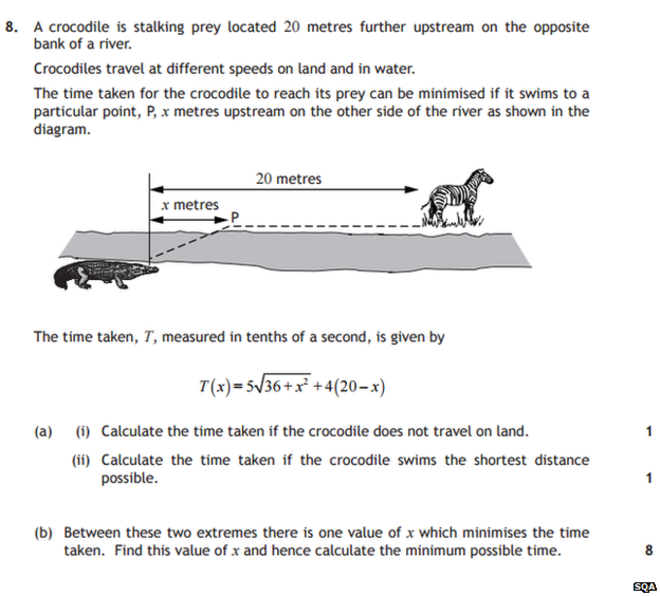
Anyway, here is the question that is supposed to have been so difficult. For the record, it’s Paper 2, Question 8 of the SQA examination 2015.

crocodile_questionCall me old-fashioned, but it doesn’t seem that difficult to me  but I never took Scottish Highers and there have been many changes in Mathematics education since I did my O and A-levels; here’s the O-level Mathematics paper I took in 1979, for example.  I wonder what my readers think? Comments through the box if you please.

Feel free to give it a go. If you get stuck here’s a worked solution!

Amplitude & Energy in Electromagnetic Waves

Posted in Cute Problems, The Universe and Stuff with tags , , , on September 22, 2015 by telescoper

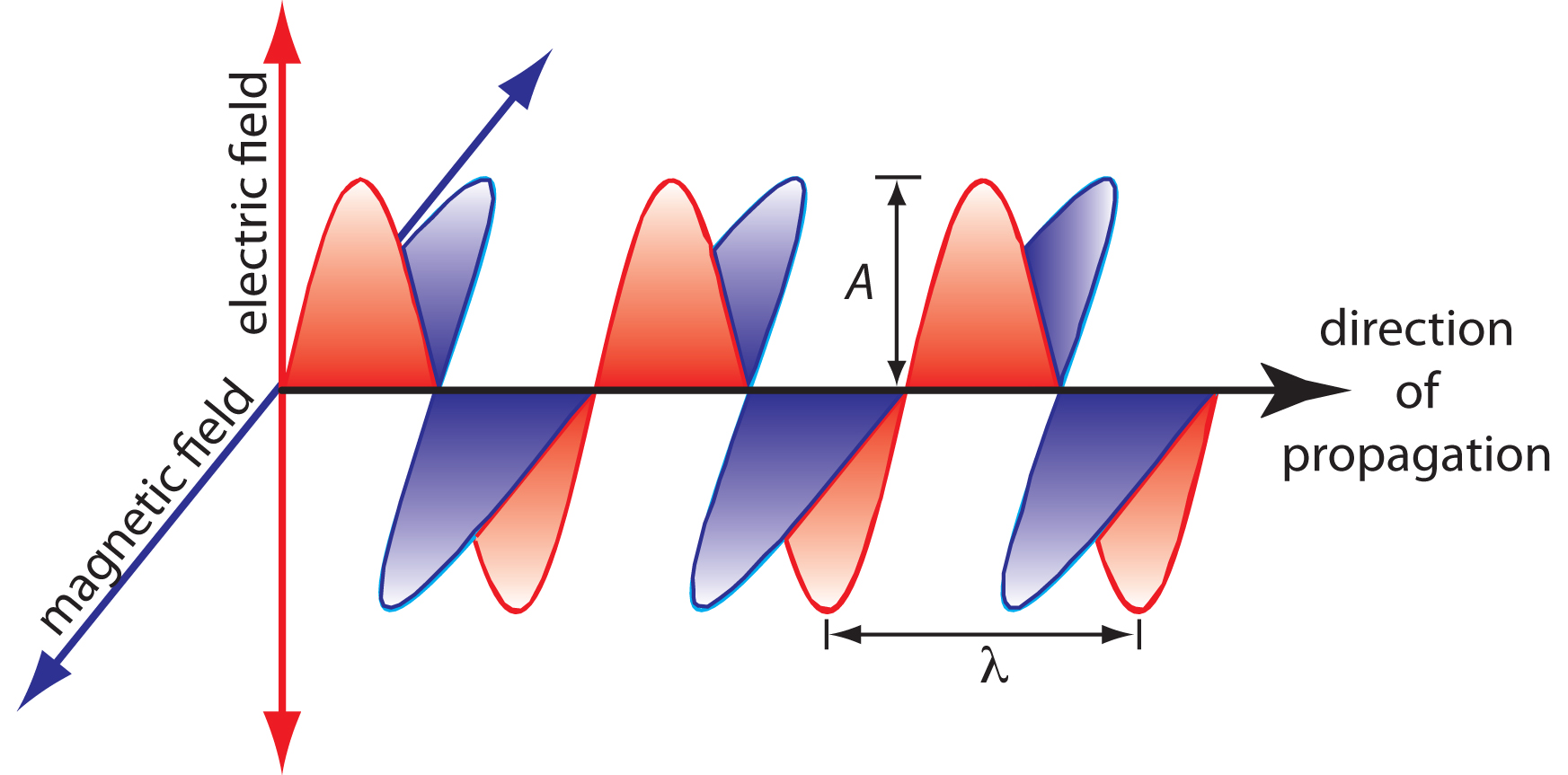
Here’s a little physics riddle. As you all know, electromagnetic radiation consists of oscillating electric and magnetic fields rather like this:

Figure10.1(Graphic stolen from here.) The polarization state of the wave is defined by the direction of the Electric field, in this case vertically upwards.

Now the energy carried by an electromagnetic wave of a given wavelength is proportional to the square of its amplitude, denoted in the Figure by A, so the energy is of the form kA2 in this case with k constant. Two separate electromagnetic waves with the same amplitude and wavelength would thus carry an energy = 2kA2.

But now consider what happens if you superpose two waves in phase, each having the same wavelength, polarization and amplitude to generate a single wave with amplitude 2A. The energy carried now is k(2A)2 = 4kA2, which is twice the value obtained for two separate waves.

Where does the extra energy come from?

Answers through the Comments Box please!

How to Solve Physics Problems

Posted in Cute Problems, Education with tags , , , , , , on September 18, 2015 by telescoper

It’s Friday afternoon at the end of Induction Week here at the University of Sussex. By way of preparation for lectures proper – which start next Monday – I gave a lecture today to all the new students in Physics during which I gave some tips about how to tackle physics problems, not only in terms of how to solve them but also how to present the answer in an appropriate way.
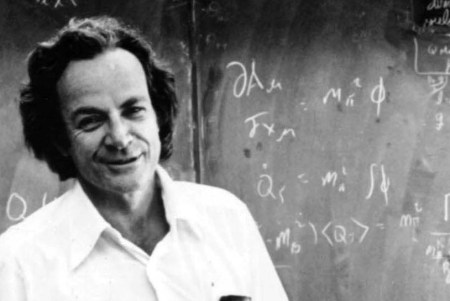
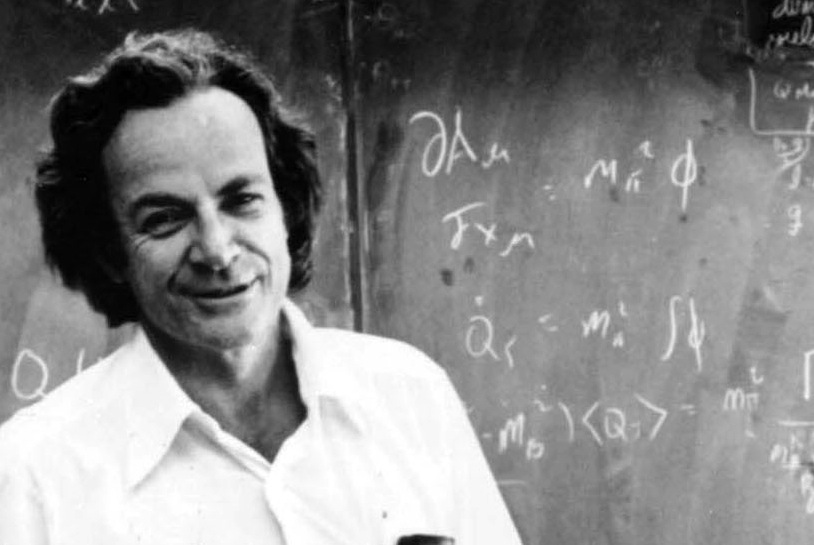
Richard-Feynman-cornellI began with Richard Feynman’s formula (the geezer in the above picture) for solving physics problems:

  1. Write down the problem.
  2. Think very hard.
  3. Write down the answer.

That may seem either arrogant or facetious, or just a bit of a joke, but that’s really just the middle bit. Feynman’s advice on points 1 and 3 is absolutely spot on and worth repeating many times to an audience of physics students.

I’m a throwback to an older style of school education when the approach to solving unseen mathematical or scientific problems was emphasized much more than it is now. Nowadays much more detailed instructions are given in School examinations than in my day, often to the extent that students  are only required to fill in blanks in a solution that has already been mapped out.

I find that many, particularly first-year, students struggle when confronted with a problem with nothing but a blank sheet of paper to write the solution on. The biggest problem we face in physics education, in my view, is not the lack of mathematical skill or background scientific knowledge needed to perform calculations, but a lack of experience of how to set the problem up in the first place and a consequent uncertainty about, or even fear of, how to start. I call this “blank paper syndrome”.

In this context, Feynman’s advice is the key to the first step of solving a problem. When I give tips to students I usually make the first step a bit more general, however. It’s important to read the question too. The key point is to write down the information given in the question and then try to think how it might be connected to the answer. To start with, define appropriate symbols and draw relevant diagrams. Also write down what you’re expected to prove or calculate and what physics might relate that to the information given.

The middle step is more difficult and often relies on flair or the ability to engage in lateral thinking, which some people do more easily than others, but that does not mean it can’t be nurtured.  The key part is to look at what you wrote down in the first step, and then apply your little grey cells to teasing out – with the aid of your physics knowledge – things that can lead you to the answer, perhaps via some intermediate quantities not given directly in the question. This is the part where some students get stuck and what one often finds is an impenetrable jumble of mathematical symbols  swirling around randomly on the page. The process of problem solving is not always linear. Sometimes it helps to work back a little from the answer you are expected to prove before you can return to the beginning and find a way forward.

Everyone gets stuck sometimes, but you can do yourself a big favour by at least putting some words in amongst the algebra to explain what it is you were attempting to do. That way, even if you get it wrong, you can be given some credit for having an idea of what direction you were thinking of travelling.

The last of Feynman’s steps  is also important. I lost count of the coursework attempts I marked this week in which the student got almost to the end, but didn’t finish with a clear statement of the answer to the question posed and just left a formula dangling.  Perhaps it’s because the students might have forgotten what they started out trying to do, but it seems very curious to me to get so far into a solution without making absolutely sure you score the points.  IHaving done all the hard work, you should learn to savour the finale in which you write “Therefore the answer is…” or “This proves the required result”. Scripts that don’t do this are like detective stories missing the last few pages in which the name of the murderer is finally revealed.

So, putting all these together, here are the three tips I gave to my undergraduate students this morning.

  1. Read the question! Some students give solutions to problems other than that which is posed. Make sure you read the question carefully. A good habit to get into is first to translate everything given in the question into mathematical form and define any variables you need right at the outset. Also drawing a diagram helps a lot in visualizing the situation, especially helping to elucidate any relevant symmetries.
  2. Remember to explain your reasoning when doing a mathematical solution. Sometimes it is very difficult to understand what students are trying to do from the maths alone, which makes it difficult to give partial credit if they are trying to the right thing but just make, e.g., a sign error.
  3.  Finish your solution appropriately by stating the answer clearly (and, where relevant, in correct units). Do not let your solution fizzle out – make sure the marker knows you have reached the end and that you have done what was requested. In other words, finish with a flourish!

There are other tips I might add – such as checking answers by doing the numerical parts at least twice on your calculator and thinking about whether the order-of-magnitude of the answer is physically reasonable – but these are minor compared to the overall strategy.

And another thing is not to be discouraged if you find physics problems difficult. Never give up without a fight. It’s only by trying difficult things that you can improve your ability by learning from your mistakes. It’s not the job of a physics lecturer to make physics seem easy but to encourage you to believe that you can do things that are difficult.

To illustrate the advice I’ve given I used this problem, which I leave as an exercise to the reader. It is a slightly amended version the first physics problem I was set as tutorial work when I began my undergraduate studies way back in 1982. I think it illustrates very well the points I have made above, and it doesn’t require any complicated mathematics – not even calculus! See how you get on…

problem

One Fine Conformal Transformation

Posted in Brighton, Cute Problems with tags , , , , , on March 25, 2015 by telescoper

It’s been a while since I posted a cute physics problem, so try this one for size. It is taken from a book of examples I was given in 1984 to illustrate a course on Physical Applications of Complex Variables I took during the a 4-week course I took in Long Vacation immediately prior to my third year as an undergraduate at Cambridge.  Students intending to specialise in Theoretical Physics in Part II of the Natural Sciences Tripos (as I was) had to do this course, which lasted about 10 days and was followed by a pretty tough test. Those who failed the test had to switch to Experimental Physics, and spend the rest of the summer programme doing laboratory work, while those who passed it carried on with further theoretical courses for the rest of the Long Vacation programme. I managed to get through, to find that what followed wasn’t anywhere near as tough as the first bit. I inferred that Physical Applications of Complex Variables was primarily there in order to separate the wheat from the chaff. It’s always been an issue with Theoretical Physics courses that they attract two sorts of student: one that likes mathematical work and really wants to do theory, and another that hates experimental physics slightly more than he/she hates everything else. This course, and especially the test after it, was intended to minimize the number of the second type getting into Part II Theoretical Physics.

Another piece of information that readers might find interesting is that the lecturer for Physical Applications of Complex Variables was a young Mark Birkinshaw, now William P. Coldrick Professor of Cosmology and Astrophysics at the University of Bristol.

As it happens, this term I have been teaching a module on Theoretical Physics to second-year undergraduates at the University of Sussex. This covers many of the topics I studied at Cambridge in the second year, including the calculus of variations, relativistic electrodynamics, Green’s functions and, of course, complex functions. In fact I’ve used some of the notes I took as an undergraduate, and have kept all these years, to prepare material for my own lectures. I am pretty adamant therefore that the academic level at which we’re teaching this material now is no lower than it was thirty years ago.

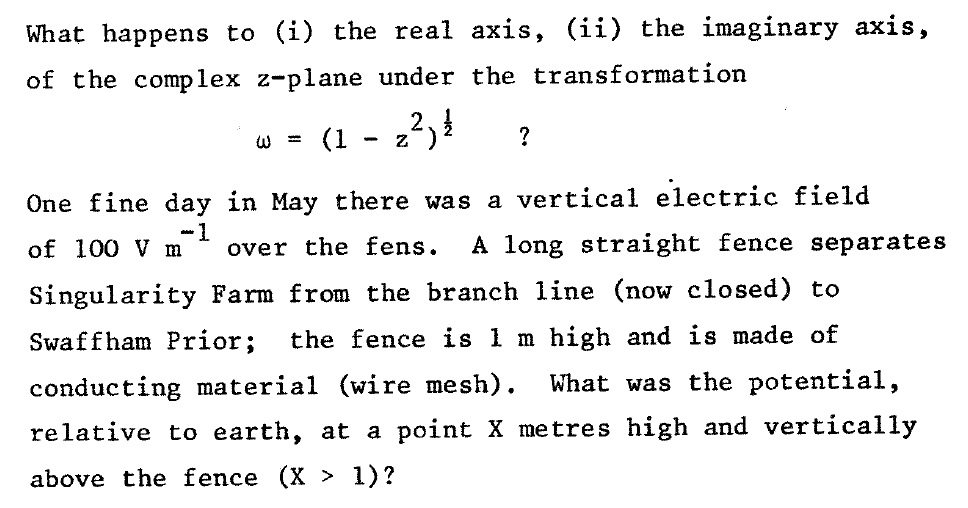
Anyway, here’s a typically eccentric problem from the workbook, from a set of problems chosen to illustrate applications of conformal transformations (which I’ve just finished teaching this term). See how you get on with it. The first correct answer submitted through the comments box gets a round of applaud.

conformal transformation


My Mathematical Valentines Message

Posted in Cute Problems with tags , on February 14, 2015 by telescoper

Here’s a little mathematical exercise with a Valentines theme:

Sketch the curve in the x-y plane described by the equation

\left(x^2 +y^2  + 2ay \right)^2 = 4a^2 \left( x^2 + y^2 \right)

for

x<3.

Geddit?

Answer: the equation is that of a cardioid:

cardioid-2

Puzzle Time: Playing With Matches

Posted in Cute Problems with tags , , on January 13, 2015 by telescoper

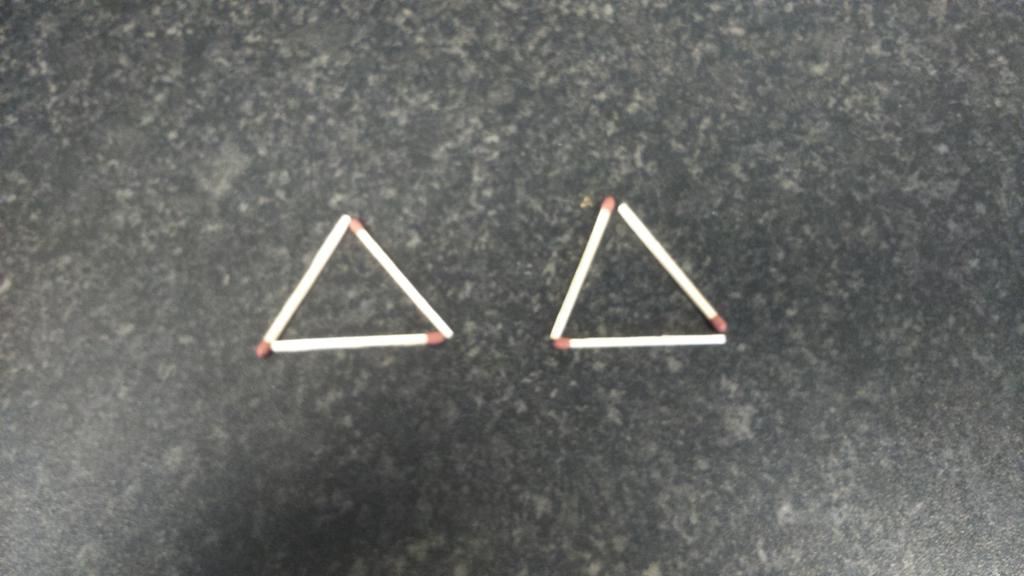
matchesPuzzle time! Move three (and only three) matches and position them to create just four, i.e four and only four,  (identical) triangles. No cutting the matches, either!

Click on to see the answer…

Continue reading

A Problem of Wires on the Rails

Posted in Cute Problems with tags , , , on October 5, 2014 by telescoper

It’s been a long time since I posted a cute physics problem so here’s one about magnetism for your edification and/or amusement.

Two long wires are laid flat on a pair of parallel rails perpendicular to the wires. The spacing d between the rails is large compared with x, the distance between the wires. Both wires and rails are made of material which has a resistance ρ per unit length. A magnetic flux density B is applied perpendicular to the rectangle formed by the rails and the wires. One wire is moved along the rails with uniform speed v while the other is held stationary. Derive a formula to show how the force on the stationary wire varies with x and use it to show that the force vanishes for a value of x approximately equal to μ0v/4πρ.

Give a physical interpretation of this result.

HINT: Think about the current induced in the wires…


A Keno Game Problem

Posted in Cute Problems with tags , , , , on July 25, 2014 by telescoper

It’s been a while since I posted anything in the Cute Problems category so, given that I’ve got an unexpected gap of half an hour today, I thought I’d return to one of my side interests, the mathematics and games and gambling.

There is a variety of gambling games called Keno games in which a player selects (or is given) a set of numbers, some or all of which the player hopes to match with numbers drawn without replacement from a larger set of numbers. A common example of this type of game is Bingo. These games mostly originate in the 19th Century when travelling carnivals and funfairs often involved booths in which customers could gamble in various ways; similar things happen today, though perhaps with more sophisticated games.

In modern Casino Keno (sometimes called Race Horse Keno) a player receives a card with the numbers from 1 to 80 marked on it. He or she then marks a selection between 1 and 15 numbers and indicates the amount of a proposed bet; if n numbers are marked then the game is called `n-spot Keno’. Obviously, in 1-spot Keno, only one number is marked. Twenty numbers are then drawn without replacement from a set comprising the integers 1 to 80, using some form of randomizing device. If an appropriate proportion of the marked numbers are in fact drawn the player gets a payoff calculated by the House. Below you can see the usual payoffs for 10-spot Keno:

tabke
If fewer than five of your numbers are drawn, you lose your £1 stake. The expected gain on a £1 bet can be calculated by working out the probability of each of the outcomes listed above multiplied by the corresponding payoff, adding these together and then subtracting the probability of losing your stake (which corresponds to a gain of -£1). If this overall expected gain is negative (which it will be for any competently run casino) then the expected loss is called the house edge. In other words, if you can expect to lose £X on a £1 bet then X is the house edge.

What is the house edge for 10-spot Keno?

Answers through the comments box please!

A Sticky Physics Problem

Posted in Cute Problems with tags , , on May 1, 2014 by telescoper

As I often do when I’m too busy to write anything strenuous I thought I’d post something from my back catalogue of physics problems. I don’t remember where this one comes from but I think you’ll find it interesting…

Oil of viscosity η and density ρ flows downhill in a flat shallow channel of width w which is sloped at an angle θ. The oil is everywhere of the same depth, d, where d<<w. The effect of viscosity on the side walls can be assumed to be negligible.

If x is a coordinate that represents the vertical position within the flow (i.e. x=0 at the bottom and x=d at the top), write down a differential equation for the velocity within the flow  v(x) as a function of x. Use physical arguments to derive appropriate boundary conditions at x=0 and x=d and use these to solve the equation, thereby determining an explicit form for v(x). Hence determine the volume flow rate in terms of η, ρ, θ, d and w as well as the acceleration due to gravity, g.

As usual, answers through the comments box please!


A Problem of Capacitors

Posted in Cute Problems, The Universe and Stuff with tags , , on April 3, 2014 by telescoper

Time for another entry in the Cute Problems  category. I’ve been teaching a course module  in theoretical physics this term so here’s one that my students should find a doddle…

A spherical capacitor consists of an outer conducting sphere of fixed radius b and a concentric inner conducting sphere whose radius a can be varied. The space between the spheres is filled with air which has a breakdown electric field strength E0. What are the greatest achievable values for (i) the potential difference between the spheres, and (ii) the electrostatic energy stored in the capacitor?

Answers via the comments box please.