Archive for the Cute Problems Category

A Spring Physics Problem

Posted in Cute Problems with tags , , , on March 9, 2014 by telescoper

It’s been a while since I posted anything in the Cute Problems  category, so since Spring is in the air I thought I’d post a physics problem which involves springing into the air…

Two identical fleas, each of which has mass m, sit at opposite ends of a straight uniform rigid hair of mass M, which is lying flat and at rest on a smooth frictionless table. If the two fleas make simultaneous jumps with the same speed and angle of take-off relative to the hair as they view it, under what circumstances can they change ends in one jump without colliding in mid air?

UPDATE Monday 10th March: No complete answers yet, so let’s try this slightly easier version:

Two identical fleas, each of which has mass m, sit at opposite ends of a straight uniform rigid hair of mass M, which is lying flat and at rest on a smooth frictionless table. Show that, by making simultaneous jumps with the same speed and angle of take-off relative to the hair as they view it, the two fleas can change ends without colliding in mid-air as long as 6m>M.

Answers via the comments box please..

Methods of Images

Posted in Biographical, Cute Problems, Education with tags , , , , on January 29, 2014 by telescoper

I’ve had a very busy day today including giving a lecture on Electrostatics and the Method of Images and, in an unrelated lunch-hour activity, filing my tax return (and paying the requisite bill). The latter was the most emotionally draining.

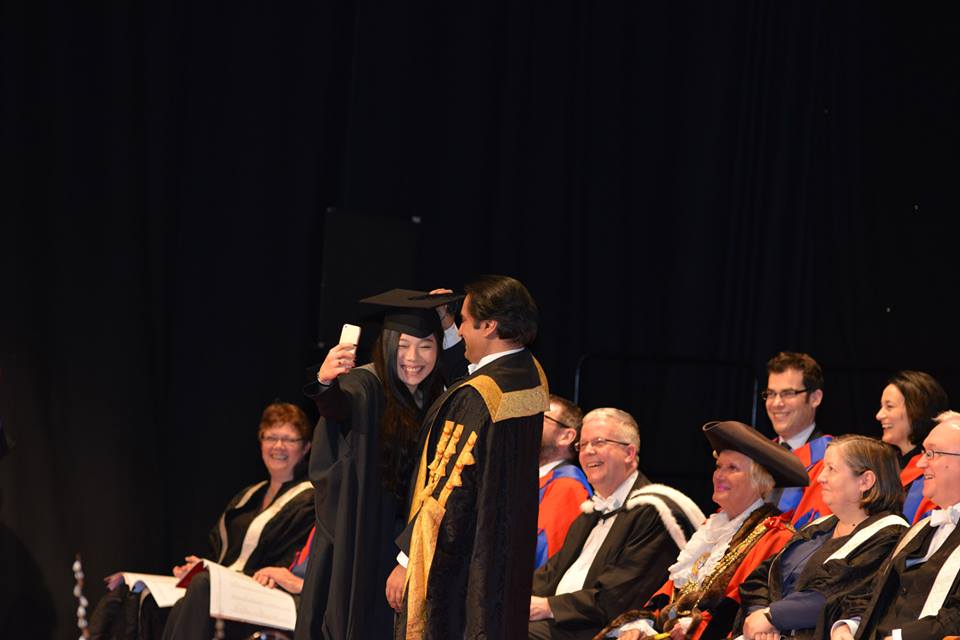
With no time for a proper post, I thought I’d give some examples of the images produced by yesterday’s graduands, including some who used a particular approach called the Method of Selfies. Unfortunately some of these are spoiled by having a strange bearded person in the background.

But first you might like to try the following example using the actual Method of Images:

Given two parallel, grounded, infinite conducting planes a distance a apart, we place a charge +q between the plates, a distance x from one of them. What is the force on the charge?

This is, in fact, from Griffiths, David J. (2007) Introduction to Electrodynamics, 3rd Edition; Prentice Hall – Problem 3.35.

Solutions via the comments box as usual, please.

And now here are some of the official pictures from yesterday

9

1

2

3

4

5

6

7

8

What’s the chance that you ever take the lead?

Posted in Cute Problems on January 25, 2014 by telescoper

Here’s one of an occasional series of cute problems, which I offer as a challenge for whiling away a wild and rainy Saturday afternoon..


You enter a competition which consists of a never-ending series of contests. The probability that you win any single contest is p, and the outcomes of the contests are independent of one another.

Let X be the probability that you ever take the lead in the competition. What is X in terms of p, for any value of p?

Solutions through the comments box please!

UPDATE: Since a correct answer has now been posted, here is my solution:

Consider the first contest: the probability that you win it is p and if you do you take the lead straight off.

If you lose the first one, with probability (1-p), you are down by 1. Now you must (a) make up the deficit and (b) go on to take the lead. Clearly the probability of (a) is just X (the same as getting ahead from a level start). The probability of (b) is also X.
Hence X=p+(1-p)X^2.

There are two solutions of this quadratic equation: X=1 and X=p/(1-p). But the answer must be a probability so cannot exceed unity. Hence if p>1/2 then X=1, in accord with intuition: in the long run you’d expect to lead sometime if p>1/2. If p<1/2 then the other solution is correct. The two solutions match at p=1/2.

Simples.

The Riddle of the Samurai Sword

Posted in Cute Problems with tags , on January 13, 2014 by telescoper

For some reason I just remembered a simple little puzzle I was told about ages ago, so I thought I’d try it out here.

On certain trains in Japan, passengers are not allowed to enter a compartment with any piece of luggage which is too long or too wide to be placed in the overhead racks; any parcel or package with dimensions larger than 60 cm × 80 cm is forbidden.  It is possible however to enter the carriage with a metre-long samurai sword.

How?

Answers through the comments box please…

A Perihelion Poser

Posted in Cute Problems, The Universe and Stuff with tags , , , on January 4, 2014 by telescoper

Today (January 4th) the Earth is at perihelion, ie its closest approach to the Sun. This may surprise folk in the Northern hemisphere who think that winter and summer are determined the Earth’s distance from the Sun…

Anyway, here’s an easy little question. The eccentricity of the Earth’s orbit is 0.017. Estimate the percentage difference in the flux of energy arriving at Earth from the Sun at the extremes of its orbit (ie at perihelion and aphelion). Is this difference likely to have any significant effect?

Answers through the comment box please..

An Astronomical Teaser

Posted in Cute Problems, The Universe and Stuff with tags , , , , on January 1, 2014 by telescoper

For those of you who feel up to a little brain-teaser after last night’s revels, try this little problem which involves the use of everybody’s favourite type of astronomical measurement, the magnitude system. Answers through the comment box please!

A binary star at a distance of 100 pc has such a small separation between its component stars that it is unresolved by a telescope. If the apparent visual magnitude of the combined image of the system is 10.5, and one star is known to have an absolute visual magnitude of 9.0, what is the absolute visual magnitude of the other star?

The Gambler’s Puzzle

Posted in Cute Problems, Literature with tags , , , on December 17, 2013 by telescoper

The following is a quotation from the short novel The Gambler by Fyodor Dostoyevsky:

I was a gambler myself; I realized it at that moment. My arms and legs were trembling and my head throbbed. It was, of course, a rare happening for zero to come up three times out of some ten or so; but there was nothing particularly astonishing about it. I had myself seen zero turn up three times running two days before, and on that occasion one of the players, zealously recording all the coups on a piece of paper, had remarked aloud that no earlier than the previous day that same zero had come out exactly once in twenty four hours.

The probability of obtaining a zero on a (fair) Roulette wheel of the European variety is 1/37. Assuming  that such a wheel is spun exactly 370 times in a day, determine the probability of obtaining at most one zero in twenty four hours as described in the quotation. Give your answer to three significant figures.

Answers through the comments box please!

Pseudospheres Corner..

Posted in Cute Problems with tags , , , , on November 28, 2013 by telescoper

I’m sure you have all seen a knitted pseudosphere, but this is a particularly fine collection made by the excellent Miss Lemon and briefly displayed in my office this morning.

IMG-20131128-00223

A pseudosphere is a space of negative curvature (whereas a sphere is one of constant positive curvature). There are various ways to realize a two-dimensional surface which has negative curvature everywhere; this knitted version is based on hyperbolic space. If you’re keen to have a go at making one yourself you can find some instructions here. I’m advised, though, that the better way to approach the task is to start out with a large circular ring onto which you cast about 400 stitches, gradually working your way in with fewer and fewer stitches (say 400,200,100,50 etc), which is much easier than working outwards as described in the link. The folds and crenellations are produced quite naturally as a consequence of tension in the wool.

Happy knitting!

A cute probability problem

Posted in Cute Problems with tags , , on October 20, 2013 by telescoper

I’ve got a lot to do today, so I’ll restrict myself to a very quick post in the series marked Cute Problems. This one is to do with probability.

Two people (A and B) play a game which involves a sequence of tosses of a coin. The coin is “fair” so that the probability of a Head (H) is 0.5, equal to the probability of a Tail (T). Successive tosses of the coin are independent.

The game ends when two successive tosses show either the sequence HT (in which case Player A wins) or the sequence TT (in which case Player B wins). If neither pairing is seen the coin is tossed again and again until either HT or TT is seen.

What is the probability that Player A wins?

Answers (with explanations please) through the comments box..

A New Theory of Electromagnetism?

Posted in Cute Problems, Education, The Universe and Stuff with tags , , on September 19, 2013 by telescoper

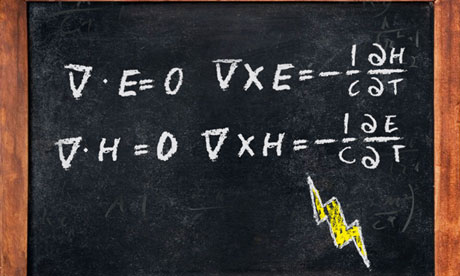
I was delighted to see an article by Alok Jha in the Observer on Sunday discussing Maxwell’s Equations, but my rapture was rapidly modified when I saw the image that accompanied the piece:

Maxwell's Equations

Since our new students are just settling into their courses in the Department of Physics & Astronomy here at the University of Sussex, I thought it would be fun to post this here and invite my readers (some of whom are students) to spot the deliberate mistake(s). More amusingly, how about offering suggestions as to what the Universe would be like if electromagnetism did indeed behave the way described by the alternative theory outlined in the Observer article.

Answers through the comment box please!