Archive for the Education Category
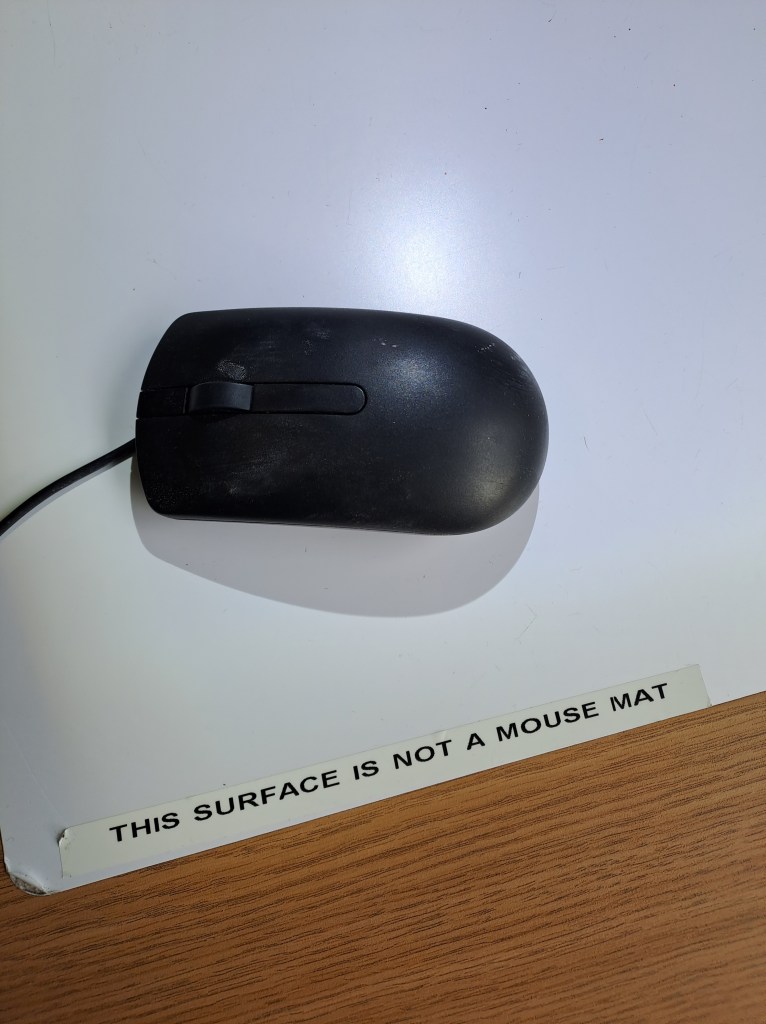
Ceci n’est pas un tapis de souris
Posted in Art, Education, Maynooth on April 7, 2023 by telescoper
Nine Modern Poets
Posted in Biographical, Education, Literature with tags Dylan Thomas, E.L. Black, John Betjeman, Nine Modern Poets, Philip Larkin, Poetry, R.S. Thomas, T.S. Eliot, Ted Hughes, W.B. Yeats, W.H. Auden, Wilfred Owen on April 5, 2023 by telescoperI recently acquired – at negligible expense – the above second-hand copy of the anthology Nine Modern Poets. I got a copy because this book was one we we studied when I was at school back in the 1970s. The First Edition was published way back in 1966, and it was reprinted until the mid-1980s but has long been superseded as a school poetry text by other anthologies. It has been out of print for many years so I had to find a second-hand copy via the internet. I bought some other second-hand anthologies too, which I may share in due course.
Anyway, the Nine Modern Poets are: W.B. Yeats, Wilfred Owen, T.S Eliot, John Betjeman, W.H. Auden, R.S. Thomas, Dylan Thomas, Philip Larkin, and Ted Hughes. Yes, they are all male.
Looking back it’s surprising to see John Betjeman in there, I’d have swapped him for Sylvia Plath (though her first collection, Colossus was only published in 1960 and the second, Ariel, in 1965 so these might have been too late), but the reason I look back on this book with some fondness, indeed nostalgia, is that it was this collection that introduced me to the poetry of R.S. Thomas, and I am very grateful to it for that.
Foirmlí agus Táblaí
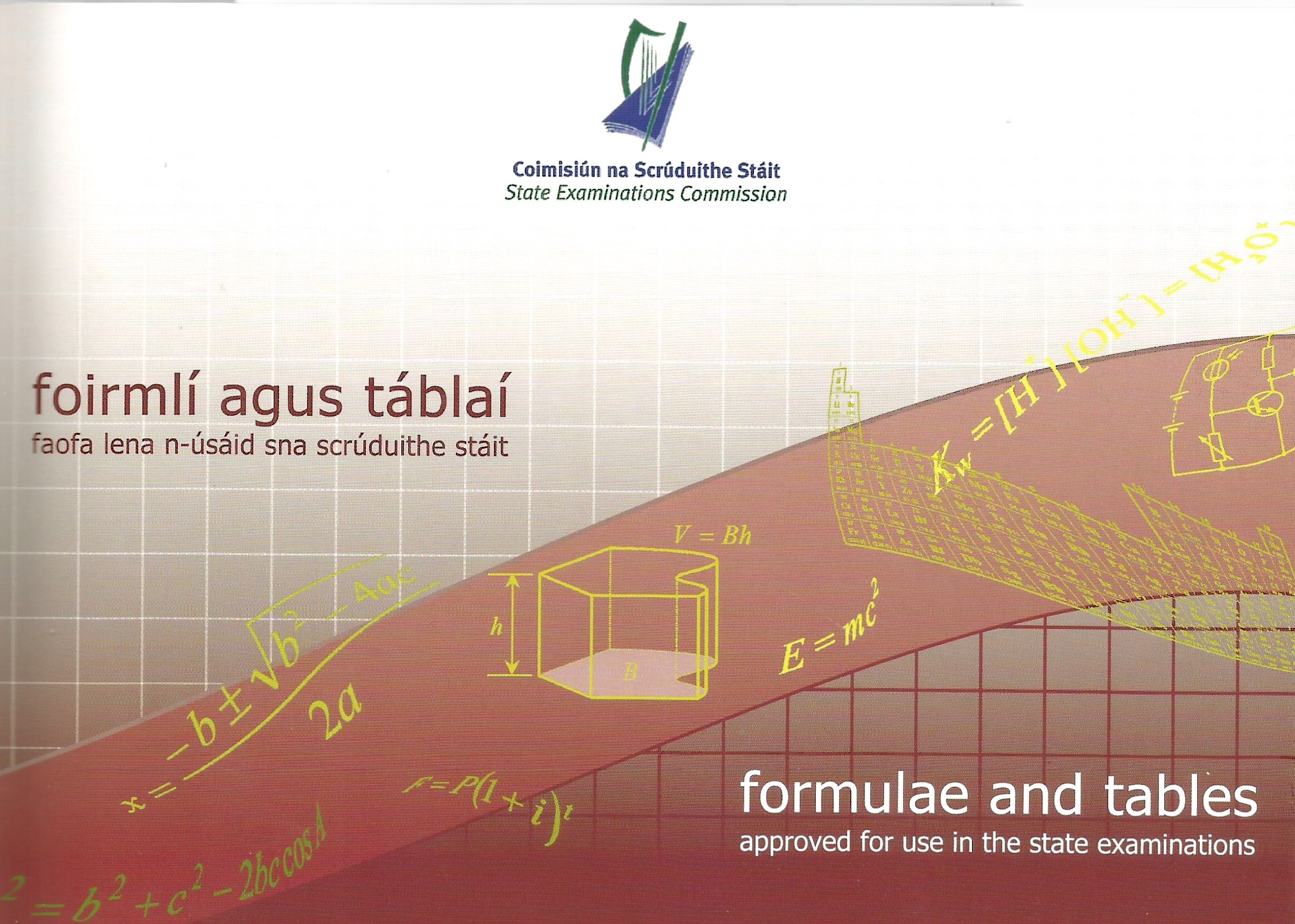
Posted in Education, Maynooth with tags Foirmlí agus Táblaí, Log Tables, mathematics on April 1, 2023 by telescoperI’ve written on here before about Log Tables but since I’ve recently acquired a set of my own I thought I’d celebrate by mentioning them again. This is what the term “Log Tables” refers to in Ireland:
This book is in regular use in schools and colleges throughout Ireland, but that the term is a shorthand for a booklet containing a general collection of mathematical formulae, scientific data and other bits of stuff that might come in useful to students. There are a lot more formulae than tables, but everyone has calculators now so those aren’t really necessary. There is no table of logarithms in the Log Tables, actually. I suppose much older versions did have more tables, but as these were phased out the name just stuck and they’re still called Log Tables.
The official book costs €4. I bought it in Maynooth’s excellent local independent bookshop. The man who served me knew exactly what I meant when I asked for Log Tables.
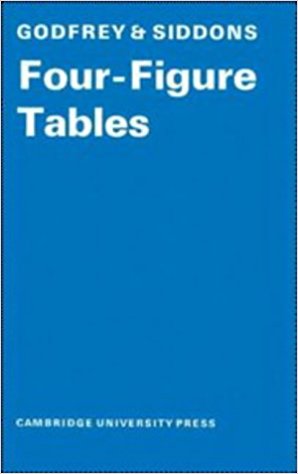
I’m old enough to remember actually using tables of logarithms (and other mathematical tables of such things as square roots and trigonometric functions, in the form of lists of numbers) extensively at school. These were provided in this book of four-figure tables (which you can now buy for 1p on Amazon, plus p&p).
As a historical note I’ll point out that I was in the first year at my school that progressed to calculators rather than slide rules (in the third year) so I was never taught how to use the former. My set of four-figure tables which was so heavily used that it was falling to bits anyway, never got much use after that and I threw it out when I went to university despite the fact that I’m a notorious hoarder.
Students in Theoretical Physics at Maynooth are allowed to ask for Log Tables in any formal examination. The formulae contained therein are elementary in terms of physics, so won’t help very much with more advanced examinations, but I have no problem with students consulting the Log Tables if their mind goes a bit blank. It seems to me that an examination shouldn’t be a memory test, and giving students the basic formulae as a starting point if anything allows the examiner to concentrate on testing what matters much more, i.e. the ability to formulate and solve a problem. The greatest challenge of science education at University level is, in my opinion, convincing students that their brain is much more than a memory device.
Here’s an example page that shows some elementary formulae for Mechanics with explanations as Gaeilge in English.
These formulae come up in Physics and/or Applied Mathematics at Leaving Certificate but we don’t require students taking Mechanics in the first year to have done either of those subjects so many students find pages such as this very helpful.
I was interested to learn that colleagues in the Department of Mathematics and Statistics here in Maynooth do not allow the use of Log Tables in examinations. I don’t know why.
Advanced Electromagnetism Theory Lecture Notes
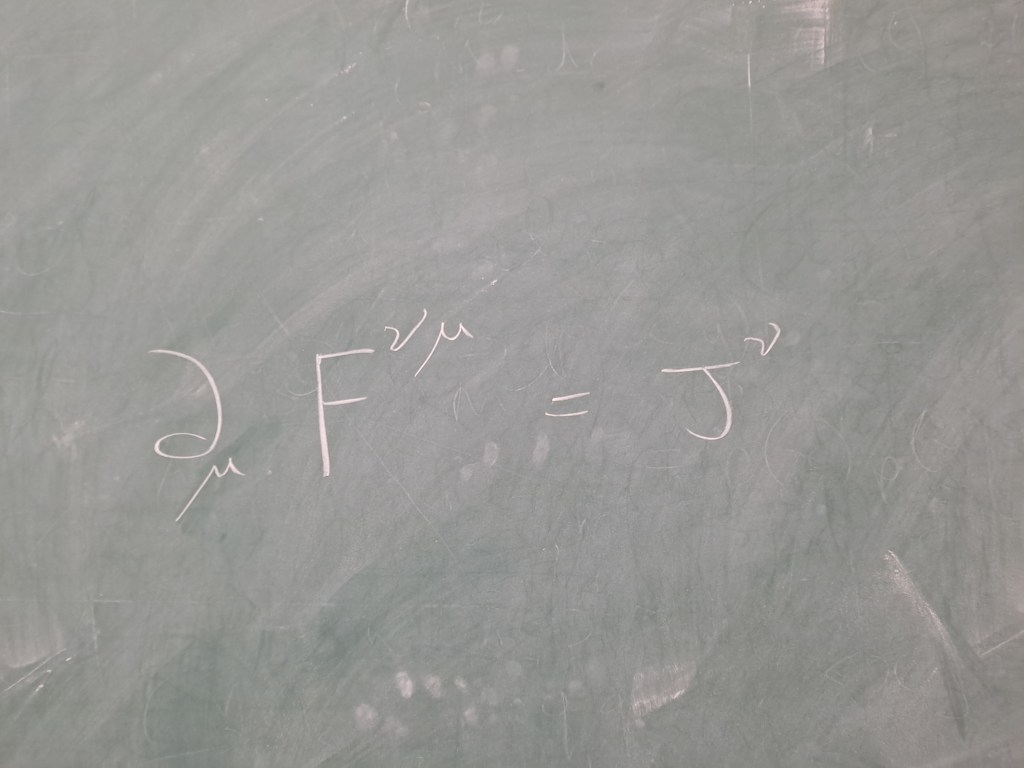
Posted in Education, Maynooth, The Universe and Stuff with tags Advanced Electromagnetism, Maxwell Tensor, Maxwell's Equations on March 31, 2023 by telescoperAs a member of academic staff who teaches in a publicly funded University, and in the spirit of the Open Access movement, I think that as far as possible I should put the content of my lectures in the public domain. I’ve decided today to do this with my final-year module on Advanced Electromagnetism. Here you go.

Any questions?
If you think that isn’t much for the 17 lectures I’ve given so far, just look at what I started with:
I reckon I’ve made quite a lot of progress!
Postgraduate Workers
Posted in Education, Maynooth with tags Postgraduate Workers Organization, Postgraduates, Stipend on March 24, 2023 by telescoperIt was good to see quite a lot of coverage in the Irish Media of yesterday’s demonstration by the Postgraduate Workers Organization (PWO) at the Dáil Éireann; see, for example, here, here and here). The PWO is campaigning for postgraduate students to be paid on a living wage and with full workers’ rights under employment law, such as sick leave entitlement and maximum working hours. You can read more about their demands in the Fair Researcher Agreement here. I endorse this campaign wholeheartedly.
Postgraduate students in Ireland are treated abysmally by the current arrangements, and their situation is rapidly getting worse. Stipend levels (the best of which are currently around €18,500) have not been adjusted for inflation for many years and the recent surge in prices has made this even worse. The living wage is around €26,000 in Ireland, and the stipend should be increased to at least that level. I would argue, and indeed have argued, that even this level would be inadequate.
University employees such as myself have recently been awarded a significant pay rise. It is patently unfair that postgraduate students, who make an essential contribution to the teaching as well as research in all academic departments, should be left behind.
The root cause of this is the chronic underfunding of Ireland’s universities. While lecturers’ pay is determined by central agreements, it is not necessarily the case that colleges and universities are given enough funding to cover the increase. The result is that third-level institutions can’t employ enough full-time academic staff to teach the ever-increasing number of students, and instead have to rely on poorly-paid casual labour, much of which supplied by postgraduates. While I do think that PhD students benefit from having a bit of teaching experience during the course of their programme, the current situation where the students can’t afford to live unless they take on a large amount of additional work.
While the fundamental cause is clear, and lies at a Government level, it seems to me that the situation of PhD students in Ireland is exacerbated by rampant managerialism. Take my own institution, Maynooth University, for example. The ratio of undergraduate students to academic staff in Maynooth is the highest in Ireland at 28:1. Instead of investing in more academic staff, however, the University has recently gone on a spending spree to recruit more members of senior management. I put in a Freedom of Information request in recently, which revealed that Maynooth has spent around €250K since September 2020 on recruitment consultancies alone in connection with 10 senior management positions. That’s not counting the recurrent salary costs of the new staff. The addition of yet more people to an already top-heavy management structure is impossible to justify, especially when postgraduate students are struggling to make ends meet.
There seems to be much less enthusiasm here for filling academic staff positions, or even advertising them, as I have learnt recently by personal experience. Universities are communities whose primary aims are teaching and research. In my opinion postgraduate workers, collectively, contribute far more to those communities than do the President, Vice-Presidents and sundry Directors. I just wish more people recognized that. If postgraduate workers decided to withdraw their labour, the University would cease to function.
Essays and (Computational) Physics
Posted in Biographical, Education, Maynooth with tags Astrophysics, ChatGPT, Computational Physics, Essay Mills, Essays, Python on March 14, 2023 by telescoperThere have been more news stories about ChatGPT and assessment in universities going around. There’s one here from The Journal and another here from The Conversation to give just two examples.
I wrote about this myself a couple of months ago in a post that included this:
I have to admit that I’ve never really understood the obsession in some parts of academia with “the student Essay” as a form of assessment. I agree that writing skills are extremely important but they’re not the only skills it is important for students to acquire during the course of a degree. Of course I’m biased because I work in Theoretical Physics, an area in which student essays play a negligible role in assessment. Our students do have to write project reports, etc, but writing about something you yourself have done seems to me to be different from writing about what other people have done. While forms of assessment in science subjects have evolved considerably over the last 50 years, other domains still seem to concentrate almost exclusively on “The Essay”.
Whatever you think about the intrinsic value of The Essay (or lack thereof) it is clear that if it is not done in isolation (and under supervision) it is extremely vulnerable to cheating.
A few people have retorted that communication skills are very important in higher education. I agree with that wholeheartedly, but it seems to me that (a) there are other ways of communicating than via formal essays and (b) there are, should be, more to academic study than writing about things.
That said, I do think we could be doing more in some disciplines, including my own, to cultivate communication skills in general and writing skills in particular. In Theoretical Physics we certainly don’t do this as much as we should. I do have a project report in my 3rd Year computational physics module, but that is a relatively short document and the report itself counts only one-third of the marks (and the project is only 40% of the module mark).
These thoughts somehow reminded me of this. You can click on it to make it bigger if it’s difficult to read. It was the first paper (called colloquially Paper Zero) of my finals examination at the University of Cambridge way back in 1985, getting on for 40 years ago:
As you can probably infer from the little circle around number 4, I decided to write an Essay about topic 4. I’ve always been interested in detective stories so this was an easy choice for me, but I have absolutely no idea what I wrote about for three hours. Nor do I recall actually ever getting a mark for the essay, so I never really knew whether it really counted for anything. I do remember, however, that I had another 3-hour examination in the afternoon of the same day, two three-hour examinations the following day, and would have had two the day after that had I not elected to do a theory project which let me off one paper at the end and for which I got a good mark.
Anyway, to get back to the essay paper, we certainly don’t set essay examinations like that here in the the Department of Theoretical Physics at Maynooth University and I suspect they no longer do so in the Department of Physics at Cambridge either. At the time I didn’t really see the point of making students write such things under examination conditions but then we didn’t have ChatGPT way back then. No doubt it could generate a reasonable essay on any of the topics given.
I am skeptical about whether any of my 3rd year computational physicists would use ChatGPT to write their reports, but they might. But ChatGPT can write Python code too. Am I worried about that? Not greatly. I’ve asked it to write scripts for the various class exercises I’ve set so far and the code it has produced has usually failed. It will get better though….

Into the Study Break
Posted in Biographical, Education, Maynooth with tags arthritis, Maynooth, St Patrick's Day, Study Break, Weather on March 11, 2023 by telescoperSo here we are, then. We’ve arrived at the half-term Study Break at Maynooth University. Six weeks of Semester 2 down, six to go. There are no lectures, labs or tutorials next week. It’s not actually a holiday, but the lack of teaching duties will enable me to catch up quite a few things I’ve let slip during term. It will also give me the chance to regroup and prepare for final assault on the second half of term.
The spell of freezing weather we’ve had recently has morphed into something a little warmer and a lot wetter. The light dusting of snow we had yesterday has dissolved in the torrential rain stotting against the windows as I write this piece. I’m waiting for a lull in the downpour so I can make a quick dash to the shops before returning to the comfort of my house for the rest of the day. The weather is coming in from the West today, and I spy a little gap heading my way:
Next Friday, March 17th, is of course, St Patrick’s Day, a national holiday in Ireland. I certainly hope the weather is better for the traditional parades on that day!
I’m glad of the arrival of this break, as I’ve been running on empty for the last several days, the fatigue exacerbated by a flare-up of the arthritis in my knees. On Thursday I had to kneel down next to one of the machines in the computer lab to fix something and I had considerable difficulty getting up again. Doctors say that there’s no reliable evidence that arthritis pain correlates with the weather, but in my case it does seem to come on when the weather changes, especially when it suddenly becomes cold or damp. I’ll be due for another steroid shot soon, which should help, and hopefully the weather will improve over the next few weeks. Possibly.
Anyway, the second half of term should be a lot easier than the first. For one thing, we have another break coming up three weeks in. Good Friday is on April 7th, so that is a holiday, as is the following week. Moreover, I usually only give lectures in Computational Physics for 9 of the 12 teaching weeks in the Semester, after which the students will be working on the mini-projects which form part of the assessment for this module.
P.S. It was on 11th March 2020 that the World Health Organization officially announced the Covid-19 pandemic and it was just before the corresponding Study Break that year that the University was closed and we went into lockdown. Can that really have been three years ago?
Examinations and Memory
Posted in Biographical, Education with tags Examinations, Memory, rote learning on March 5, 2023 by telescoperThis Sunday evening I take the text for my sermon from a piece about examinations by Katie Stripe in the Times Higher about examinations:
Testing students’ ability to show their learning in a closed context is not preparing them for a future in which technology is ubiquitous. There are few professional contexts that require you to recall information in a specific time frame.
I agree to some extent with the conclusion of the article but for different reasons. In particular, I don’t think this conclusion has much to do with the arrival of new technologies such as ChatGPT. Exams that simply require the students to “recall information” and nothing else seem to me to be of limited value from an educational point of view and should indeed be scrapped, but I think exams can play a role in testing other, more important, skills such as problem-solving.
Over my lifetime the ratio of assessment to education in universities has risen sharply, with the undeniable result that academic standards have fallen especially in my own discipline of physics. The modular system encourages students to think of modules as little bit-sized bits of education to be consumed and then forgotten. Instead of learning to rely on their brains to solve problems, students tend to approach learning by memorizing chunks of their notes and regurgitating them in the exam. I find it very sad when students ask me what derivations they should memorize to prepare for examinations because that seems to imply that they think their brain is no more than a device for storing information. It became clear to me over the years that school education in the UK does not do enough to encourage students to develop their all-round intellectual potential, which means that very few have confidence in their ability to do anything other than remember things. It seems the same malaise affects the Irish system too.
On the other hand, a good memory is undoubtedly an extremely important asset in its own right.
I went to a traditional Grammar school that I feel provided me with a very good education in which rote learning played a significant part. Learning vocabulary and grammar was an essential part of their approach to foreign languages, for example. How can one learn Latin without knowing the correct declensions for nouns and conjugations for verbs? But although these basic elements are necessary, however, they are not sufficient. You need other aspects of your mental capacity to comprehend, translate or compose meaningful pieces of text.
The same considerations apply to STEM disciplines. It is important to have a basic knowledge of the essential elements of mathematics and physics as a grounding, but you also need to develop the skill to apply these in unusual settings. I also think it’s simplistic to think of memory and creative intelligence as entirely separate things. I seems to me that the latter feeds off the former in a very complex way. A good memory does give you rapid access to information, which means you can do many things more quickly than if you had to keep looking stuff up, but I think there’s a lot more to it than that. Our memories are an essential part of the overall functioning of our brain, which is not compartmentalized in such a simple way. For example, one aspect of problem-solving skill relies on the ability to see hidden connections; the brain’s own filing system plays a key role in this.
In recognizing the importance of memory I don’t mean that rote learning is necessarily the best way to develop the relevant skills. My own powers of recall are not great – and are certainly not improving with age – but I find I can remember things much better if I find them interesting and/or if I can see the point of remembering them and/or if I use them a lot. Remembering things because they’re memorable is far easier than remembering because you need to remember them to pass an examination!
Anyway, my point is that a good memory can help you learn, but is not in itself what should be assessed in an examination. I wish universities made more effort to educate students to understand that their brain can be much more than a memory device.
Here endeth the lesson.
State Supports for PhD Researchers
Posted in Education, Maynooth with tags ireland, PhD stipends, postgraduate research student, Stipends on February 27, 2023 by telescoper
By sheer coincidence, the very same day that I posted a piece in which complained that the issue of PhD stipends for Irish postgraduates had apparently been “kicked into the long grass”, the consultation has at last opened.
You can contribute your submission or submit your contribution, whichever seems appropriate, here.
Raising PhD Stipends
Posted in Education, Maynooth, Politics with tags Maynooth University, PhD stipends, Trinity College Dublin on February 24, 2023 by telescoperAlthough the Irish Government has kicked its planned review of postgraduate support into the long grass, the Board of Trinity College Dublin recently approved a proposal to increase stipends to for all its PhD students to €25,000. I applaud this decision, but would argue that it doesn’t go far enough.
A while ago Government of Ireland announced a new scheme intended to recruit “high-level researchers” to PhD programmes in Ireland. This scheme, which is a public-private partnership of around €100 million, will fund around 400 PhD studentships with an annual stipend around €28K, which is substantially higher than the current rate for, e.g., ICR-funded students which is €18.5K. The justification for the higher €28K stipends is that they would be “in line with financial supports offered under similar global scholarships”. I take this as a statement that the Irish Government has acknowledged that the proper rate of pay for a PhD student is at this level, which seems to me to be about right. It seems to me to be logical that all PhD stipends should be increased to this level.
High levels of inflation are combining with spiraling rental costs to make it very difficult for a student to live on the current level of stipend (especially in the Greater Dublin area). This forces postgraduate students to undertake large amounts of tutoring or other work in order to get by financially. This situation is a direct result of the chronic underfunding of higher education in Ireland which means that there aren’t enough academic staff to cover the teaching required. Universities will argue that they don’t have any choice but to exploit PhD students to make up the shortfall, but that doesn’t make the situation is acceptable.
It is of course good for a research student to get some teaching experience during their PhD but this should be on a voluntary basis. A PhD student who chooses to teach will probably do a better job than one who is forced to do it in order to pay the rent. My basic point, though, is that a full-time research student should be funded to do research full time, and it is grossly unfair to pay them too little for this to be possible.
There needs to be a serious “levelling up” of PhD stipends across the entire third-level sector in Ireland. I hope in particular that my own institution, Maynooth University, will take the lead and increase its PhD studentships to the fair level of €28K per annum. This would be a good way to spend at least some of the surplus of €13.2M it ran up during the first year of the pandemic alone.
UPDATE: The Government has now opened a consultation on PhD supports to which you can contribute here.