Archive for the Education Category

Pathways to Research

Posted in Education, The Universe and Stuff with tags , , , , , on August 24, 2012 by telescoper

The other day I had a slight disagreement with a colleague of mine about the best advice to give to new PhD students about how to tackle their research. Talking to a few other members of staff about it subsequently has convinced me that there isn’t really a consensus about it and it might therefore be worth a quick post to see what others think.

Basically the issue is whether a new research student should try to get into “hands-on” research as soon as he or she starts, or whether it’s better to spend most of the initial phase in preparation: reading all the literature, learning the techniques required, taking advanced theory courses, and so on. I know that there’s usually a mixture of these two approaches, and it will vary hugely from one discipline to another, and especially between theory and experiment, but the question is which one do you think should dominate early on?

My view of this is coloured by my own experience as a PhD (or rather DPhil student) twenty-five years ago. I went directly from a three-year undergraduate degree to a three-year postgraduate degree. I did a little bit of background reading over the summer before I started graduate studies, but basically went straight into trying to solve a problem my supervisor gave me when I arrived at Sussex to start my DPhil. I had to learn quite a lot of stuff as I went along in order to get on, which I did in a way that wasn’t at all systematic.

Fortunately I did manage to crack the problem I was given, with the consequence that got a publication out quite early during my thesis period. Looking back on it I even think that I was helped by the fact that I was too ignorant to realise how difficult more expert people thought the problem was. I didn’t know enough to be frightened. That’s the drawback with the approach of reading everything about a field before you have a go yourself…

In the case of the problem I had to solve, which was actually more to do with applied probability theory than physics, I managed to find (pretty much by guesswork) a cute mathematical trick that turned out to finesse the difficult parts of the calculation I had to do. I really don’t think I would have had the nerve to try such a trick if I had read all the difficult technical literature on the subject.

So I definitely benefited from the approach of diving headlong straight into the detail, but I’m very aware that it’s difficult to argue from the particular to the general. Clearly research students need to do some groundwork; they have to acquire a toolbox of some sort and know enough about the field to understand what’s worth doing. But what I’m saying is that sometimes you can know too much. All that literature can weigh you down so much that it actually stifles rather than nurtures your ability to do research. But then complete ignorance is no good either. How do you judge the right balance?

I’d be interested in comments on this, especially to what extent it is an issue in fields other than astrophysics.

Open for Clearing in Physics and Astronomy

Posted in Education with tags , , , , , , , , on August 16, 2012 by telescoper

It being A-level results day, I thought I’d try a little experiment and use this blog to broadcast an unofficial announcement that, owing to additional government funding for high-achieving subjects, the School of Physics and Astronomy at Cardiff University is able to offer extra places on all undergraduate courses starting this September for suitably qualified students.

An institutional review of intake numbers by HEFCW (Higher Education Funding Council for Wales) resulted in the award of extra funded places for undergraduate entry in 2012. Of particular benefit are those STEM (science, technology, engineering and mathematics) subjects seen as strategically important by the UK government. Therefore, the School of Physics and Astronomy is pleased to announce acceptance of late UCAS applications from those candidates expected to achieve our entrance requirements.

Those current applicants who have already applied through the standard UCAS procedure and who have been offered places need not be concerned as these new places are IN ADDITION to those we were expecting to fill.

Applications can be made through Clearing on UCAS after discussions with the Admissions Team.

Course codes (for information)

BSc Physics (F300) and BSc Astrophysics (F511)

MPhys Physics (F303) and MPhys Astrophysics (F510)

BSc Physics with professional placement (F302)

BSc Theoretical and Computational Physics (F340)

BSc Physics with Medical Physics (F350)

Course enquiries can be made to Dr Carole Tucker, Undergraduate Admissions Tutor, via email to Physics-ug@cardiff.ac.uk or call the admissions teams on 029 2087 4144 / 6457.

Good luck!

Qualifying Standards

Posted in Biographical, Education, Sport with tags , , on August 13, 2012 by telescoper

Well, the Olympics are finally over. I have to say I didn’t see much of the games themselves, although I did catch Mo Farah’s excellent run in the 5000m final and afterwards reminding us all that one can be a great athlete as well as humble and likeable individual. I see that Team GB (and NI) have done remarkably well in landing a haul of 29 gold medals, well up on Beijing 2008.

Many of these were in sports I know nothing about (such as Keirin and Dressage, both of which sound to me like items of IKEA furniture) but I’m perfectly happy to accept that winning any Olympic Gold medal is a remarkable achievement and requires not just talent but dedication and hard work. I hope the success of Team GB inspires others with the thought that succeeding in doing what’s difficult can be rewarding in itself, whether or not it leads to personal wealth.

I have just a couple more days here in Copenhagen, where the weather has been lovely throughout my visit. Here’s a gratuitous picture of one of the city’s lovely parks in the sunshine:

I’m feeling a lot better for having been here for the last week or so. The people here have been so very kind and understanding. I have to admit, though, I’m a bit nervous about going back because: (a) I have more medical tests to go through before I start on a proper programme; (b) quite a big backlog has built up of things I have to do; and (c) I have to face the colleagues and students I’ve let down so badly over the last few weeks and try to find a way of making up for my dereliction of duty.

The next big thing when I get back to work will be admissions. On Thursday (16th August) the A-level examination results will be officially announced and the clearing system opens for business. Only then will we find out how many students we’ll have entering the first year in October. We think things have gone pretty well on the recruitment front, but you never know until you see the final numbers. Fingers crossed.

Anyway, with the results having been published, there’ll no doubt be the usual discussion in the newspapers about whether the Olympic Games were easier this year than they were in our day….

More Maths, or Better Maths?

Posted in Education with tags , , on July 25, 2012 by telescoper

Interesting view from a Biosciences perspective about the recent recommendations to increase the number of students taking Mathematics at A-level.

I’ve always had a problem with the way Statistics is taught at A-level, which is largely as a collection of recipes without much understanding of the underlying principles; would more emphasis on probability theory be a better way to go?

JennyAKoenig's avatarBiomaths Education Network

The introduction of post-16 maths is in the news again with a report from the House of Lords committee on Higher Education in STEM and many of the headlines from the Guardian, Independent and Times Higher  have picked up on the recommendations regarding maths study post-16.

I have written a few thoughts here on my first impressions but would very much welcome comments.

Though I was pleased to see that some of my work showing that only GCSE maths is required for undergraduate biosciences was cited, the conclusion from this was that more students should take maths A level and this is a little worrying.

The lack, or low level, of maths requirements for admission to HEIs, particularly for programmes in STEM subjects, acts as a disincentive for students to take maths and high level maths at A level. We urge HEIs to introduce more demanding maths  requirements…

View original post 634 more words

Blowing Smoke

Posted in Education, The Universe and Stuff with tags , , , , on July 18, 2012 by telescoper

I’ve been trying to make myself useful over the last few days thinking about the new module I’m supposed to start teaching in October. I’m a bit daunted by it to be honest. The title is The Physics of Fields and Flows and it will be taken by students when they return to start their second year after the summer break.  It’s twice the size of our usual modules, which means a lot of teaching and it’s all new for me, which means a lot of preparation.

The idea behind introducing this module was to teach a number of things together which previously had been taught in separate modules, specifically electromagnetism and vector calculus, or not at all, e.g. fluid mechanics. I’m not sure when or why classical fluid mechanics dropped out the syllabus, but I think it’s an essential part of a physics curriculum in its own right and also helps develop a physical understanding of the mathematics used to describe electric and magnetic fields. It’s one of the unhappy side-effects of modular teaching that it hides the important underlying connections between apparently disparate phenomena which are the essence of what physics is about.

Another thing I reckon we don’t do enough of these days is use lecture demonstrations. That’s harder to do these days because we tend to use pooled lecture theatres that don’t have the specialist equipment that they might have if they were dedicated to physics lectures only.  Practical demonstrations are now usually given second-hand, by using video clips.  That’s fine, but not as good as the real thing.

Anyway, it struck me that it would be quite easy to arrange a demonstration of the transition between laminar and turbulent flow using the simple and relatively inexpensive equipment shown in the rather beautiful image. Unfortunately, however, demonstrating this sort of thing isn’t allowed on University premises even for scientific purposes…

Student Comments

Posted in Biographical, Education, The Universe and Stuff with tags , , , , , on July 14, 2012 by telescoper

I sneaked into the department this morning to pick up some things from the office and leave some other things that I’ve finished with. I went quite early, to avoid the Saturday crowds there and back.

One of the things I found in my pigeonhole was a packet of student questionnaires about the third-year module Nuclear and Particle Physics for which I was responsible. It seems like a decade since I finished teaching it and marked the exams, but it can only be a couple of months. I was dreading reading the responses this time because I know I struggled a bit with this module, partly because it’s the first time I taught the Nuclear Physics part and partly for other reasons I won’t go into.

In fact the students were very kind and gave me quite good reviews; the only score that let me down really was that they thought the material was rather difficult. I’m not really surprised by that, because I think it is. However, as I’ve said before, I don’t think it’s a physics lecturer’s job to pretend that the subject  is easy; it is  a lecturer’s job to try to convince students that they can do things that are difficult. I don’t mean making  things difficult just for the sake of it, but trying to get the message across that a brain is made for thinking with and figuring difficult things out can be intensely rewarding.

The main criticism that students wrote in the space provided for their own comments was that they didn’t like the fact that I used powerpoint for some lectures. Actually, I don’t like using powerpoint for lectures either, but unfortunately I had no choice on some occasions. First I had a rather large class (85 students) and one of the rooms I had to use had a very small whiteboard; I was worried about its visibility from the back and the need to keep cleaning it every five minutes. Also in that room the projector screen covers the same area as the whiteboard, so it’s a pain to keep changing between powerpoint and whiteboard. Anyway, it’s a fair criticism. I’ll try to work out a better way of doing it next year.

To be perfectly honest I don’t like whiteboards much either. Call me old-fashioned, but  chalkboards are much better. Received wisdom, however, is that we have to have whiteboards, with all the ludicrous cost and environmental unfriendliness of the accompanying dry-wipe marker pens. But I digress.

Anyway, next Wednesday afternoon will see our graduation ceremony. Graduation day always reminds me of something somebody told me years ago when I attended my first one, at Queen Mary (and Westfield College, as it was then).  The essence of the comment was that what you have to remember as a lecturer is that when the students do well it’s their achievement; but when they don’t it’s your fault. Life’s like that, it’s never as symmetrical as particle physics.

Many of the students who took  Nuclear and Particle Physics will be graduating on Wednesday. I’m distraught that I won’t be able to go myself; this will be the first ceremony I’ve missed since I moved here five years ago.  If any of the graduating Physics class from Cardiff University happens to read this, I really hope you have a great day on Wednesday. I wish I could be there to shake your hand and wish you a very fond goodbye, but sadly that’s just not possible on this occasion.

More Order-of-Magnitude Physics

Posted in Cute Problems, Education with tags , , , on June 27, 2012 by telescoper

A very busy day today so I thought I’d just do a quick post to give you a chance to test your brains with some more order-of-magnitude physics problems. I like using these in classes because they get people thinking about the physics behind problems without getting too bogged down in or turned off by complicated mathematics. If there’s any information missing that you need to solve the problem, make an order-of-magnitude estimate!

Give  order of magnitude answers to the following questions:

  1. What is the tension in a violin string?
  2. By how much would the temperature of the Earth increase if all its rotational energy were converted to heat?
  3. What fraction of the Earth’s water is in its atmosphere?
  4. How much brighter is sunlight than moonlight?
  5. What is the mass of water in a soap bubble?

There’s no prize involved, but feel free to post answers through the comments box. It would be helpful if you explained a  bit about how you arrived at your answer!

Cardiff Schools and Colleges

Posted in Education with tags , , , , , , on June 25, 2012 by telescoper


There was a mighty kerfuffle around these parts last week, stirred by an email from the Vice-Chancellor “designate”, Prof. Colin Riordan. The incoming Vee-Cee doesn’t take over until September, but he’s clearly planning to do some pre-emptive reorganization.

The Cardiff University is currently divided into academic Schools and administrative Directorates. There are 27 Schools, including Physics & Astronomy where I work. The current system is a bit unusual in that the Heads of these Schools report directly to the Vice-Chancellor. Some other universities have an extra organization layer on the academic side, sometimes called Faculties.  Cardiff University used to have faculties, actually, but it lost them some time ago. The same could be said for many of its staff, come to think of it.

Anyway, Prof. Riordan has decided that he doesn’t want to have to talk to 27 Heads of School and has proclaimed that Cardiff will have a new structure consisting of three Faculties Colleges into which the existing schools will be grouped in thuswise fashion:


College of Arts, Humanities and Social Sciences

Cardiff Business School

Cardiff School of City and Regional Planning

Cardiff School of English, Communication and Philosophy

Cardiff School of European Languages, Translation and Politics

Cardiff School of History, Archaeology and Religion

Cardiff School of Journalism, Media and Cultural Studies

Cardiff Law School

Cardiff Centre for Lifelong Learning

School of Music

Cardiff School of Social Sciences

School of Welsh

College of Biomedical and Life Sciences

School of Biosciences

School of Dentistry

School of Healthcare Studies

School of Medicine

Cardiff School of Nursing and Midwifery Studies

School of Optometry and Vision Sciences

Cardiff School of Pharmacy and Pharmaceutical Sciences

Wales Deanery / School of Postgraduate Medical and Dental Education

School of Psychology

College of Physical Sciences

Welsh School of Architecture

Cardiff School of Chemistry

Cardiff School of Computer Science and Informatics

School of Earth and Ocean Sciences

Cardiff School of Engineering

Cardiff School of Mathematics

School of Physics and Astronomy

I didn’t realise before that some Schools are called “Cardiff School of….” or even “Welsh School of…” and others just “School of…”. I wonder why? Anyway, you can see that we’re now in the College of Physical Sciences along with Chemistry, Engineering etc and, um, Architecture. The new arrangement may also provide me with an opportunity to find out what “Informatics” means…

Having these new-fangled Colleges means that there are positions available as Heads thereof, and existing Heads of Schools have been invited to apply, hence a flurry of CV polishing.

Fortunately for all concerned, I’m not eligible.

Gove Agreement

Posted in Education, Politics, Uncategorized with tags , , , on June 25, 2012 by telescoper

I’ve had the same worry about finding myself in agreement with Michael Gove, at least on a few things; see here, for example. Anyway, this piece makes some very good points about the corruption of the GCSE system.

Michael de Podesta's avatarProtons for Breakfast

What do you do when someone with whom you basically disagree, says something sensible? Michael Gove has placed me in this situation three times now.

Firstly he abolished the Qualifications and Curriculum development Authority (QCDA).  Secondly he pointed out at that school IT lessons are at best uninspiring. And now he has gone and acknowledged that our system of competitive exam boards has driven down GCSE standards.

You may not have noticed this because he also called for GCSEs to be replaced with ‘O’levels. I sympathise with his motivation – to raise the bar for the most academically able pupils – but I think he is wrong on this. It would be enormously disruptive, enormously divisive, and there is actually nothing inherently wrong with GCSEs.

The problem with GCSEs lies in the ‘almost corrupt‘ link between publishers and their ‘pet’ exam boards. The BBC…

View original post 197 more words

A Return to O-levels?

Posted in Education, The Universe and Stuff with tags , , , , , , , on June 21, 2012 by telescoper

I woke up this morning as usual to the 7am news on BBC Radio 3, which included an item about how Education Secretary Michael Gove is planning to scrap the current system of GCSE Examinations and replace them with something more like the old GCE O-levels, which oldies like me took way back in the mists of time.

There is a particular angle to this in Wales, because Michael Gove doesn’t have responsibility for education here. That falls to the devolved Welsh Government, and in particular to Leighton Andrews. He’s made it quite clear on Twitter that he has no intention to take  Wales  back to O-levels. Most UK media sources – predominantly based in London – seem to have forgotten that Gove speaks for England, not for the whole United Kingdom.

This is not the central issue, however. The question is whether GCSEs are, as Michael Gove claims, “so bad that they’re beyond repair”. Politicians, teachers and educationalists are basically saying that students are doing better; others are saying that the exams are easier. It’s a shouting match that has been going for years and which achieves very little. I can’t add much to it either, because I’m too old to have done GCSEs – they hadn’t been invented then. I did O-levels.

It does, however, give me the excuse to show you  the O-level physics paper I took way back in 1979. I’ve actually posted this before, but it seems topical to put it up again:

You might want to compare this with a recent example of an Edexcel GCSE (Multiple-choice) Physics paper, about which I have also posted previously.

I think most of the questions in the GCSE paper are much easier than the O-level paper above. Worse, there are many that are so sloppily put together that they  don’t make any sense at all. Take Question 1:

I suppose the answer is meant to be C, but since it doesn’t say that A is the orbit of a planet, as far as I’m concerned it might just as well be D. Are we meant to eliminate D simply because it doesn’t have another orbit going through it?

On the other hand, the orbit of a moon around the Sun is in fact similar to the orbit of its planet around the Sun, since the orbital speed and radius of the moon around its planet are smaller than those of the planet around the Sun. At a push, therefore you could argue that A is the closest choice to a moon’s orbit around the Sun. The real thing would be something close to a circle with a 4-week wobble variation superposed.

You might say I’m being pedantic, but the whole point of exam questions is that they shouldn’t be open to ambiguities like this, at least if they’re science exams. I can imagine bright and knowledgeable students getting thoroughly confused by this question, and many of the others on the paper.

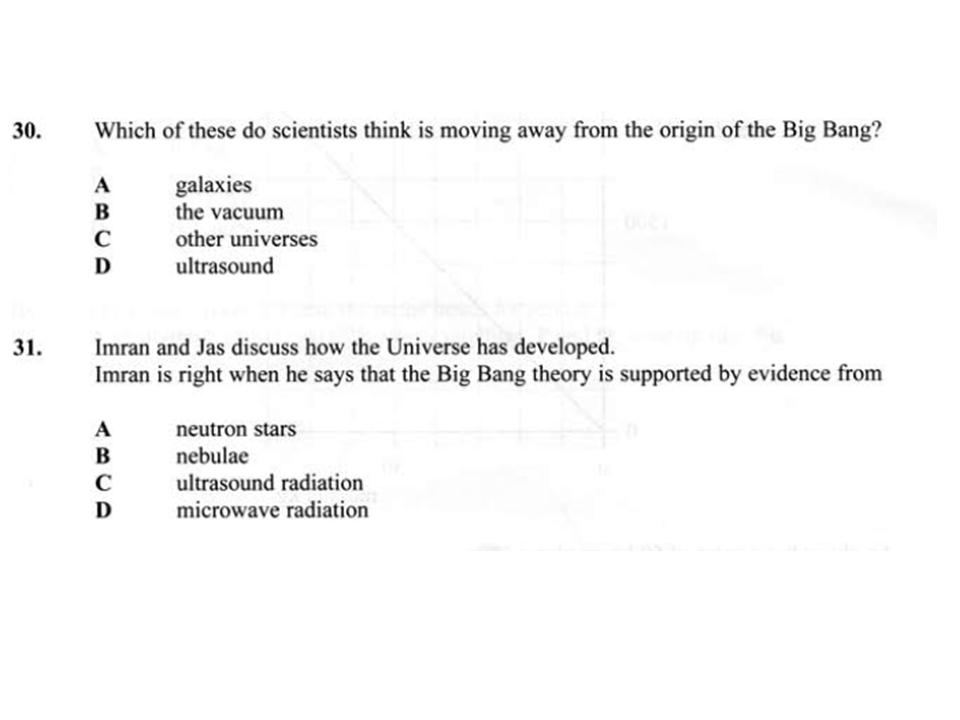
Here’s a couple more, from the “Advanced” section:

The answer to Q30 is, presumably, A. But do any scientists really think that galaxies are “moving away from the origin of the Big Bang”?  I’m worried that this implies that the Big Bang was located at a specific point. Is that what they’re teaching?

Bearing in mind that only one answer is supposed to be right, the answer to Q31 is presumably D. But is there really no evidence from “nebulae” that supports the Big Bang theory? The expansion of the Universe was discovered by observing things Hubble called “nebulae”..

I’m all in favour of school students being introduced to fundamental things such as cosmology and particle physics, but my deep worry is that this is being done at the expense of learning any real physics at all and is in any case done in a garbled and nonsensical way.

Lest I be accused of an astronomy-related bias, anyone care to try finding a correct answer to this question?

The more of this kind of stuff I see, the more admiration I have for the students coming to study physics and astronomy at University. How they managed to learn anything at all given the dire state of science education represented by this paper is really quite remarkable.

Ultimately, however, the issue is not whether we have GCSEs or O-level examinations. There’s already far too much emphasis in the education system on assessment instead of   learning. That runs all the way through schools and into the university system. The excessive time we spend examining students reduces what we can teach them and turns the students’ learning experience into something resembling a treadmill. I agree that we need better examinations than we have now, but we also need   fewer. And we need to stop being obsessed by them.