Archive for the Education Category

UCAS Update: Worrying for Wales?

Posted in Education, Finance with tags , , , , , on January 5, 2012 by telescoper

Just time for a quick post today, to comment on the latest batch of application figures released by the Universities and Colleges Admissions Service (UCAS). A late rush of applications has changed the situation since I last posted about the topic of university admissions, and there is a mixture of good and bad news.

Overall, applications to UK universities are down 6.4% on last year. That’s not surprising, given the introduction of much higher fees this year and the fact that applications were up last year on the previous year. In fact, it’s a much smaller decrease than many predicted.

It also appears that the Physical Sciences are bucking the national trend. Applications in these subjects are actually up 0.5% on last year. It’s a very slight increase, of course, but better than a drop.

However, there does seem to be some bad news for those of us in  Welsh Higher Education. As I’ve blogged about before, the Welsh Assembly Government has decided to subsidise Welsh domiciled students wherever in the UK they decide to go to University. Funding the  required bursaries means that  money has to be clawed back from Welsh Higher Education Institutions.

Leighton Andrews, the Minister responsible for administering this policy,  has argued that the resulting shortfall will be more than offset by funds brought into Wales by English students electing to study here and bringing their own money with them. That argument can only be sustained if the number of English students wanting to study in Wales is greater than the number of Welsh students wanting to study in England, which has been the case in previous years. Currently about 25,000 English students study in Wales whereas about 16,000 Welsh students study in England.

The latest application figures, however, reveal a potentially worrying trend. Applications from English students to Wales are down a massive 11.1%, while applications from Welsh students to English universities are up 2.9%. These are application figures, of course, and it’s by no means clear how they will translate into actual numbers of students next year. However, any drop in income from English students and/or increase in expenditure on Welsh students will squeeze the Welsh Higher Education budget.

In fact Welsh universities expecting a massive shortfall next year anyway, because HEFCW will be forced to slash the core support for existing students at Welsh universities in order to pay for those going to England.The School of Physics & Astronomy at Cardiff University, for example, is currently running a comfortable surplus. Next year, however, we are planning on the basis that we be losing all of our core teaching support for students in Years 2, 3 and 4, money which has been allocated to support existing students in Wales but which instead will be clawed back and given to new students wanting to study at English HEIs. Only the first year students will be bringing in the new £9K fee, so this policy will plunge us into deficit and we’ll have to rely on the goodwill of the University administration to tide us over with a subsidy until we have a full complement of fee-paying students. It will only after be several years of the new fee-paying regime , if at all, that the deficit situation is reversed. Meanwhile it might just provide University administrators with an excuse for closing expensive departments….

Happy New Year.

Lecture less, teach more…

Posted in Education with tags , , , , , on January 2, 2012 by telescoper

I was just about to go to the shops just now, but the weather is so extreme – dark apocalyptic skies and violent hailstorms – that I thought I’d have a quick go on the blog in the hope that  things quieten down a little. I was going to write something a bit earlier, as I was up at 7am, but all that came into my head were dark imaginings about the future and I didn’t want to depress myself and everyone else going on about that. The e-astronomer has already done something along those lines anyway.

Fortunately I saw something on Twitter that is a more appropriate theme for a blog post, namely a very interesting article about the role of lectures in university physics education. This is a topic I feel very strongly about, and I agree with most of what the article says, which is basically that the traditional lecture format is a very ineffective way of teaching physics. I wouldn’t go as far as to say that lectures are inherently useless, but I think they should be used in a very different way from the way they are used now.

When I was an undergraduate, in the dim and distant past, I attended lectures assiduously because that was expected of students. To put it bluntly, though, I don’t think I ever learned anything much from doing so. My real learning was done back in my room, with books and problem sheets as well as my lecture notes, trying to figure out how the physics all went together with other things I had learned, and how to apply it in interesting situations. Sometimes the lecture notes were useful, sometimes not, but I never felt that I had learned anything until I was confident that I knew how to apply the new concepts in solving problems.

But I did find some lectures very enjoyable and worthwhile, because some lecturers were good at making students feel interested in the subject.  The enthusiasm and depth of understanding conveyed by someone who has devoted their life to the study of a subject can be  infectious, and a very enjoyable form of entertainment in its own right. That’s why public lectures remain popular; their intrinsic educational value is limited, but they serve to stimulate the audience to find out more. That’s if they’re good, of course. They can have the opposite effect also.

At Cardiff – like other universities – we hand out questionnaires to students to get feedback on lecturers. Usually the thing that stands out as making one lecturer more popular than others is their enthusiasm. Quite rightly so. If someone who has made a career out of the subject can’t be enthusiastic, why on Earth should the students?

For other comments on what makes a good lecture, see here.

What makes a lecture useless is when it is used simply to transfer material from the lecturer to the student, without passing through the mind of either participant. Slavishly copying detailed notes seems to me a remarkably pointless activity, although taking notes of the key points in a lecture devoted primarily to concepts and demonstrations is far from that. Far better to learn to use resources such as textbooks and internet sites effectively than to endure an hour’s dictation. We don’t want our students to learn physics by rote; we want them to learn to think like physicists!

While I’m on about lectures, I’ll also add that I think the increasing use of Powerpoint in lectures has its downside too. I started using it when I moved to Cardiff, but never felt comfortable with it as a medium for teaching physics. This year I’m going to scrap it. I would revert to “chalk-and-talk” if we had any blackboards, so I’ll have to make do with those hideous whiteboard things. Not all progress is good progress.

Anyway, what we’ve recently done with our new courses in the School of Physics & Astronomy at Cardiff University is to start to move away from an over-reliance on lectures. One way we’ve done this is to merge some of our smaller modules. Whereas a 10-credit module used to have two lectures a week, the new 20 credit modules now have the same number of lectures, complemented by two hours of problems classes in which the students work through exercise with staff members lending assistance. Initial reaction from the students is positive, though there have been some teething troubles. We’ll just  have to wait for the examination results to see how well it has worked.

I dare say other departments around the country are making similar changes in teaching methods in response to the availability of new technologies and changes to the school curriculum. But of course its a path that other trod before. It’s good to have the chance to end by congratulating Derek Raine of the University of Leicester for his MBE in the New Years Honours List for his contributions to science education. He was arguing for a different approach to physics teaching when many of us were still in short pants. It’s just a pity we’ve taken such a long time to realise he was right.

Now the sky’s blue so I can go and do my shopping. Toodle-pip!

School for Scandal

Posted in Education with tags , , , , on December 10, 2011 by telescoper

One of the biggest news stories this week derived from an investigation by the Daily Telegraph into the behaviour of officials connected with the Welsh examination board WJEC who, it appears, have been passing on tips about the content of their examination papers to teachers who have paid to attend their seminars. Of course this reflects very badly on Wales – especially coming so soon after the University of Wales scandals – but it is symptomatic of a much wider malaise;  this  episode  undermines not just the examination process  but  the entire education system in the United Kingdom. The sad thing is that that there’s not really anything new in this story.  It’s been obvious for some time that the whole framework  has become corrupted by the profit motive. There have been previous warnings about how the examination boards compete for customers (and cash) by dumbing down examination papers, but nothing seems to have been done.

The problem is particularly acute for A-level examinations, which universities use to select applicants for admission onto courses. In my own subject, Physics, the A-level course being taught in schools are clearly not fit for this purpose – the syllabuses have been filleted of any challenging material and there’s no correlation that I can discern between high grades at A-level and good performance at undergraduate level. In fact,some of our very best students at Cardiff – who are as good as any I’ve come across anywhere –  came in with very modest A-level grades but have performed brilliantly on the course. Relying only on A-levels might have led to us closing the door on these folks. Actually, I don’t know why we bother making offers based on A-level results at all!

Anyway, it’s clearly time to sort out the examinations system properly. The Exam Boards won’t fix the problem themselves because they are doing very nicely out of the status quo, so what should be done?

I like the suggestion is that the Examination Boards should be scrapped and the business of setting examinations should be carried out by one organization: no competition means no temptation to cheat. I’d also add that, at least for A-levels, the people who set and mark the examinations should be based in universities. I’d envisage a series of national subject panels with representatives from a number of institutions. A single Exam Board with members based in the university sector would also help simplify the process of university admissions, perhaps even streamlining it enough to allow  for post-examination applications without having to have earlier examinations. Above all it would ensure that A-level courses are relevant to university entrance requirements, which they are not at the moment.

Another possibility – which also like but which is probably politically a non-starter – is to scrap our tarnished A-levels altogether and adopt the International Baccalaureate as the UK’s educational gold-standard. The reason this wouldn’t be acceptable to our Lords and Masters in Whitehall is that it would immediately dispel the comforting myth that  standards in British schools are  rising;  I’d bet my bottom dollar that, relative to the rest of the world, they are not and adopting the IB would demonstrate that as it would allow comparisons to be made which can’t be made with A-levels.

Fee Summary – England versus Wales

Posted in Education with tags , , , on December 1, 2011 by telescoper

We’ve just had our first UCAS visit day of the year, for which those involved were given a handout showing the different fee arrangements for Welsh and English students applying to study at Cardiff University.

On the off-chance that some potential students might come across this blog and also for wider information – since there still seems to be quite a lot of confusion about the financial aspects of study in Wales – I thought I’d share the following useful summary here.

–0–

Cardiff University will charge a tuition fee of £9,000 per annum to new undergraduate students beginning their studies from September 2012 onwards.

I currently live in Wales

Cardiff University will charge an annual fee of £9,000 per annum.  However, if you live in Wales and studying towards your first degree you will not have to pay your tuition fee upfront. You will be eligible for:

• a non-repayable tuition fee grant of £5,535 from the Welsh Government, subject to terms and conditions.
• a repayable tuition fee loan of £3,465 which you only start to pay back when you have finished your studies and are earning more than £21,000pa.
• support towards your living costs – a loan is available to help with your living costs such as food, accommodation, books and travel. Like the tuition fee loan, you only start to pay this back when you have finished your studies and are earning more than £21,000 a year.

You may also be eligible for an Assembly Learning Grant to provide additional help with your living costs such as food, accommodation, books and travel. This grant does not have to be paid back and the amount you receive depends on your household income:

• If your household income is £18,370 a year or less you will be entitled to a full grant of £5,000 a year.
• If your household income is between £18,370 and £50,020 a year you would be entitled to a grant of between £5,000 and £50 a year.

I currently live in England (or elsewhere in the UK)

Cardiff University will charge an annual fee of £9,000 per annum.  However, if you live in England and studying towards your first degree you will not have to pay your tuition fee upfront. You will be eligible for:

• a repayable tuition fee loan of £9,000 which you only start to pay back when you have finished your studies and are earning more than £21,000pa.
• support towards your living costs – a loan is available to help with your living costs such as food, accommodation, books and travel. Like the tuition fee loan, you only start to pay this back when you have finished your studies and are earning more than £21,000 a year.

If you are from England, you may also be eligible for a Maintenance Grant to provide additional help with your living costs such as food, accommodation, books and travel. This grant does not have to be paid back and the amount you receive depends on your household income:

• If your household income is £25,000 a year or less you will be entitled to a full grant of £3,250 a year.
• If your household income is between £25,001 and £42,600 a year you will be entitled to a partial grant.

Please note that the student support arrangements in England are subject to final ratification by Parliament.

I currently live outside the UK but inside the EU

Cardiff University will charge an annual fee of £9,000 per annum.  However, if you are from a country within the EU and studying towards your first degree at Cardiff University, you will not have to pay your tuition fee upfront. You will be eligible for:

• a non-repayable tuition fee grant of £5,535 from the Welsh Government, subject to terms and conditions.
• a repayable tuition fee loan of £3,465 which you only start to pay back when you have finished your studies and are earning more than £21,000pa.

Admissions Latest

Posted in Education, Politics with tags , , , , , , , on November 28, 2011 by telescoper

Only time for a short post today, so I thought I’d just pass on a link to the latest  Higher Education application  statistics, as reported by the Universities and Colleges Admissions Service (UCAS).

It’s still several weeks before the UCAS deadline closes in January so it’s too early to see exactly what is happening, but the figures do nevertheless make interesting reading.

The total number of applications nationally  is down by 12.9% on last year, but the number of  applications from UK domiciled students has fallen by 15.1%; an increase in applications from non-EU students is responsible for the difference in these figures.

Non-science subjects seem to be suffering the biggest falls in application numbers; physical sciences are doing better than average, but still face a drop of 7% in numbers. Anecdotal evidence I’ve gleaned from chatting to Physics & Astronomy colleagues is that some departments are doing very well, even increasing on last year, while others are significantly down. It is, however, far too early to tell how these numbers will translate into bums on seats in lecture theatres.

A particular concern for us here in Wales are the statistics of applications to Welsh universities.  The number of English-domiciled applicants to Welsh universities is down by 17.4% while the number of Welsh applicants to Welsh universities is down by 15.2%. On the other hand, the number of Welsh applicants to English universities is down by just 5.3%.

The pattern of cross-border applications is particularly important for Welsh Higher Education  because of the Welsh Assembly Government’s policy of subsidizing Welsh-domiciled students wherever they study in the United Kingdom, a policy which is generous to students but which is paid for by large cuts in direct university funding.  The more students take the WAG subsidy out of Wales, the larger will be the cuts in grants to Welsh HEIs.

Moreover, in the past, about 40% of the students in Welsh universities come from England.  If the fee income from incoming English students is significantly reduced relative to the subsidy paid to outgoing Welsh students then the consequences for the financial health of Welsh universities are even more dire.

Although it is early days the figures as they stand certainly suggest the possibility that the  number of Welsh students  studying in England will increase both relative to the number staying in Wales and relative to the number of English students coming to study in Wales. Both these factors  will lead to a net transfer of funds from Welsh Higher Education Institutions to their English counterparts.   I think the policy behind this is simply idiotic, but by the time the WAG works this out it may be too late.

Another interesting wrinkle on the WAG’s policy can be found in a piece in last week’s Times Higher. We’re used to the idea that people might relocate to areas where schools or  local services are better or cheaper, but consider the incentives on an English  family who are thinking of the cost of sending their offspring to University. The obvious thing for them  to do is to relocate to Wales in order to collect the WAG subsidy which they can then spend sending their little dears to university in England. That will save them tens of thousands of pounds per student, all taken directly from the Welsh Higher Education budget and paid into to the coffers of an English university.

There are already dark rumours circulating that the WAG subsidy will turn out to be so expensive that the Higher Education Funding Council for Wales is thinking of cancelling all its research funding. That means that Welsh universities face the prospect of having to take part in the burdensome Research Excellence Framework, in competition with much better funded English and Scottish rivals, but getting precisely no QR funding at the end of it.

And all this is because the Welsh Assembly Government wants to hand a huge chunk of its budget back to England. Is this how devolution is supposed to work? Madness.

The Unprofessional Professors

Posted in Education with tags , , , on November 26, 2011 by telescoper

I’ve been so preoccupied with other things over the past week or so that I haven’t had time until now to comment on an article I saw in last week’s  Times Higher about the role of a Professor in a modern university; there’s also an accompanying editorial in the same issue although, as is usual for editorials in the Times Higher, it doesn’t actually say anything that adds to the original piece.

People outside academia probably wonder what makes a Professor different from a Lecturer or Reader, apart from being older and getting paid a bit more. Undergraduate students probably wonder even more because they don’t see any obvious evidence that Prof. X is any better at teaching than plain Dr. Y. Quite possibly the reverse, in fact.

If you look at the contract of a Professor you won’t find that helps much either. Mine just says words to the effect that I should do whatever the Head of School asks me to do. In my case I have no complaints. I do teaching (lecturing, project supervision, tutorials, exercise classes), administration (various committees, and Director of Postgraduate Studies) and research (including supervising PhD students and a PDRA, publishing papers, etc) and I also do a few things outside the University such as STFC panels. I’m not complaining at all about this workload, for which  consider myself to be quite well paid. What I find difficult is swapping between so many different tasks even during the course of a single day, and I am all too aware that things  do sometimes fall through the cracks.

The criteria for promotion to the rank of Professor (i.e. to a “Chair”)  operated by most universities generally state that a professor must excel at teaching, administration and research. This provides for even greater mystification when you look around the average department because you’ll find many – probably even a majority – who couldn’t administer the skin on a rice pudding, and who make only derisory attempts to teach. These are the ones who have done it all on research, which in reality easily trumps the other two. To paraphrase Paul’s letter to the Corinthians: there are teaching, administration and research but the greatest of these is research. In fact the others don’t matter much at all.

The point is, at least in physics, that current levels of funding for undergraduate teaching mean that departments are financially unviable if they rely on undergraduate teaching as their primary source of income. It’s therefore inevitable that the primary criterion for appointing and retaining staff is their ability to win research grants and be a star performer in the REF. Indeed, many promotions to Chair happen when a member of staff threatens to leave, and take  their research grants and publication statistics with them. Furious negotiations then take place, a promotion to Chair ensues, and more likely than not a reduced teaching and administration load for the newly minted Prof.  Of course this means the load for someone  else has to go up. And if they are given management tasks to do, the Prof will manage the workload by simply not doing it, letting everything fall to bits until the job is allocated to someone else. Likewise with teaching: if you do it so badly that the students fail their exams or complain that you’re useless, you’ll just find your courses are given to someone else and you have more time to indulge your research interests. Studied incompetence is the ally of selfishness. It actually pays to be bad.

This is such a successful strategy that many departments now have as many professors as other teaching staff, if not more, a significant fraction of whom shirk their adminstrative duties and make little effort to teach well. Why should they? They know that as long as they hold onto their research grants they are indispensible, no matter how much strain they put on their colleagues. You might argue that this is unprofessional conduct, but there’s no question that it works.

Given this state of affairs, it’s hardly surprising that junior staff complain that their professors don’t show sufficient leadership and don’t take an active role in mentoring younger staff.  Selfishness pays. How many leaders can a department sustain anyway? If 2/3 of the staff are professors can they all be leaders? Who will follow?

I’ll get into trouble if I name individuals in my department – they know who they are – but I’m sure people in other universities recognize the same thing in their own departments. The situation won’t change until a funding regime is put in place that requires departments to prove commitment to excellence in teaching in the same way that they do for research. Then promotions panels might actually start to follow  their own published criteria instead of doing what they do now, which is nothing short of systematic hypocrisy.

Thinking of Applying for a PhD in Physics or Astronomy?

Posted in Education with tags , , , , , , on November 21, 2011 by telescoper

This afternoon I gave a short talk to our final-year students about postgraduate research in which I passed on some, hopefully useful,  information about how to go about applying for PhDs  in Physics  and Astronomy. I am, for my sins, the Director of Postgraduate Studies within the School of Physics & Astronomy here at Cardiff University.

Although quite a lot of what I talked about was about our own arrangements in Cardiff, I thought I’d jot down here a few general remarks that might be useful to people elsewhere who are thinking of taking the plunge when they graduate. I’m aiming this primarily at UK students applying for places in the UK; special considerations apply for students wanting to do graduate research abroad.

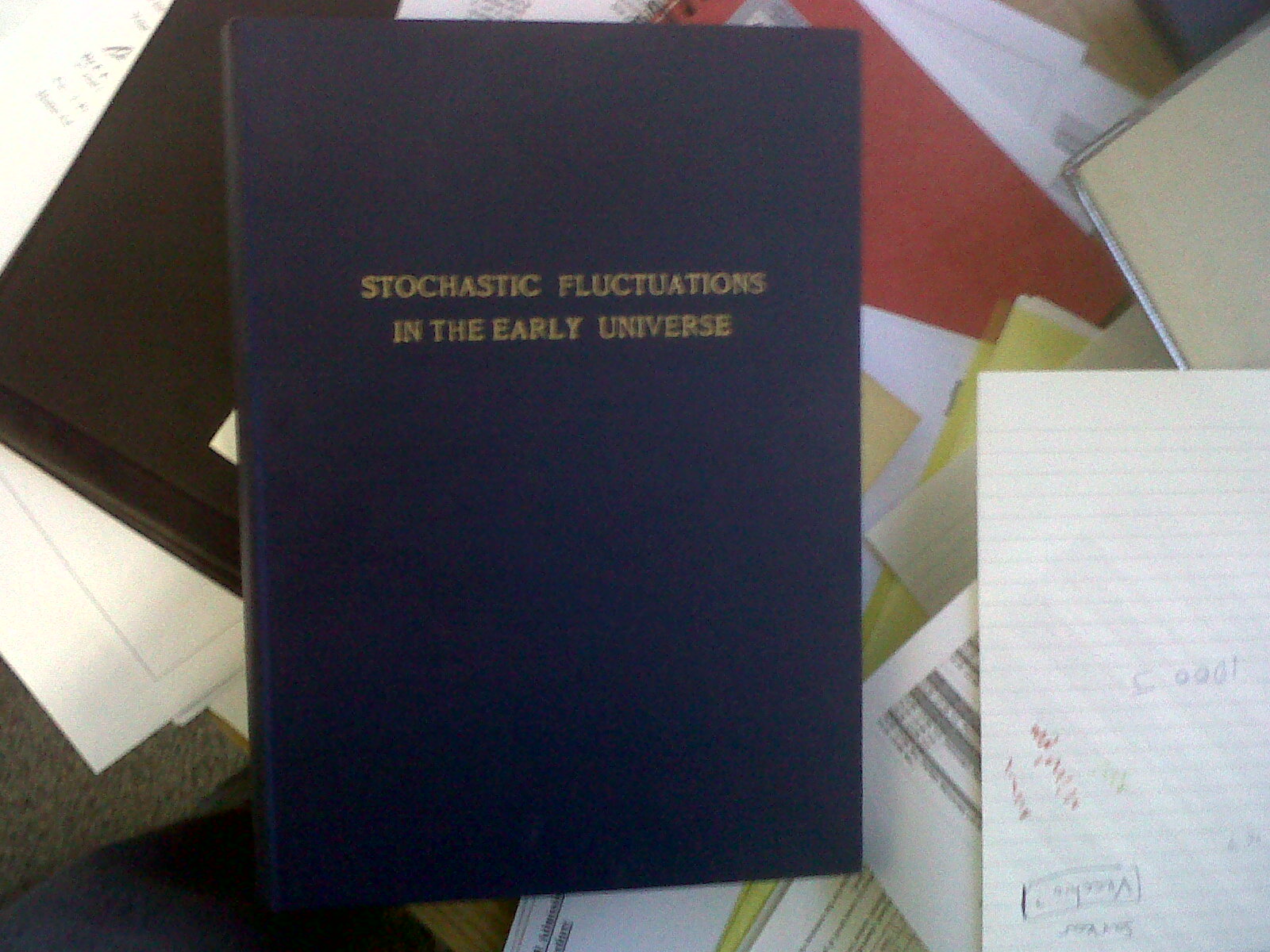
What is a PhD? The answer to that is relatively easy; it’s a postgraduate research degree. In order to obtain a PhD you have to present a thesis like that shown on the left (which happens to be mine, vintage 1988), typically in the range 100-250  pages long. A thesis has to satisfy two conditions for the award of the degree: it should contain original research, which is publishable in an academic journal; and it should present a coherent discussion of that original work within the context of ongoing work in the area of study. In Physics & Astronomy, the PhD is pretty much a prerequisite for any career in academic research, and it usually takes between 3 and 4 years to complete. After submission of the thesis you will have to undergo a viva voce examination conducted by two examiners, one internal and one external. This is quite a tough test, which  can last anywhere between about 2 and about 6 hours, during which you can be asked  detailed questions about your research and wide-ranging questions about the general area.

The Money Side. In the UK most PhDs are supported financially by the research councils, either EPSRC (most physics) or STFC (nuclear & particle physics, astronomy). These generally award quotas of studentships to departments who distribute them to students they admit. A studentship will cover your fees and pay a stipend, currently £13590 pa. That doesn’t sound like a lot, but you should at least remember that it is a stipend rather than a wage; it is therefore not taxed and there is no national insurance payable.

How do I choose a PhD? During the course of a postgraduate degree you are expected to become an expert in the area in which you specialize. In particular you should reach the point where you know more about that specific topic than your supervisor does. You will therefore have to work quite a lot on your own, which means you need determination, stamina and enthusiasm. In my view the most important criterion in your choice of PhD is not the institution where you might study but the project. You need to be genuinely excited by the topic in order to drive yourself to keep through the frustrations (of which there will be many). So, find an area that interests you and find the departments that do active research in that area by looking on the web. Check out the recent publications by staff in each department, to ensure that they are active and to have something to talk about at interview!

Qualifications. Most universities have a formal requirement that candidates for admission to the PhD should have a “good honours degree”, which basically means at least an Upper Second Class Honours degree. Some areas are more competitive than others, however, and in many disciplines you will find you are competing with a great many applicants with First Class degrees.

How to apply successfully. The application procedure at most universities is quite simple and can be done online. You will need to say something about the area in which you wish to do research (e.g. experiment/theory, and particular field, e.g. cosmology or star formation). You’ll also need a CV and a couple of references. Given the competition, it’s essential that you prepare. Give your curriculum vitae some attention, and get other people (e.g. your personal tutor) to help you improve it. It’s worth emphasizing particular skills (e.g. computing). If you get the chance, make use of your summer vacations by taking on an internship or other opportunity to get a taste of research; things like that will undoubtedly give your CV an edge.

The Interview. Good applicants will be invited for an interview, which is primarily to assess whether you have the necessary skills and determination, but also to match applicants to projects and supervisors. Prepare for your interview! You will almost certainly be asked to talk about your final-year project, so it will come across very badly if you’re not ready when they ask you. Most importantly, mug up about your chosen field. You will look really silly if you haven’t the vaguest idea of what’s going on in the area you claimed to be interested in when you wrote your  application!

Don’t be shy! There’s nothing at all wrong with being pro-active about this process. Contact academic staff at other universities by email and ask them about research, PhD opportunities. That will make a good impression. Also, don’t be afraid to ask for advice. Although we’re all keen to recruit good PhD students for our own departments, we academics are  conscious that it is also our job to give impartial advice. Ask your tutor’s opinion.

How many places should I apply for? Some research areas are more fashionable than others so the level of competition varies with field. As a general rule I would advise applying for about half-a-dozen places, chosen because they offer research in the right area. Apply to fewer than that and you might lose out to the competition. Apply to many more and you might not have time to attend the interviews.

What’s the timetable?  Most applications come in early in the new year for entry to the PhD in the following October. The Christmas break is therefore a pretty good time to get your applications sorted out. Interviews are normally held in February or March, and decisions made by late March. STFC runs a deadline system whereby departments can not force students to accept or decline offers before the end of March, so there should be ample time to visit all your prospective departments before having to make any decisions.

That’s all I can think of for now. I hope at least some of these comments are useful to undergraduates anywhere in the UK thinking of applying for a PhD. If there are any further questions, please feel free to ask through the comments box. Likewise if I’ve missed anything important, please feel free to suggest additions in the same manner…

Order-of-magnitude Physics

Posted in Cute Problems, Education with tags , , , on November 14, 2011 by telescoper

A very busy day today so I thought I’d wind down by giving you a chance to test your brains with some order-of-magnitude physics problems. I like using these in classes because they get people thinking about the physics behind problems without getting too bogged down in or turned off by complicated mathematics. I’ve also kept some of these in archaic units just to annoy people who can only do things in the SI system. I think it’s good to practice swapping between systems, especially for us astro-types who use all kinds of bizarre units, so if you don’t know the units, look them up! And if there’s any information missing that you need to solve the problem, make an order-of-magnitude estimate!

Give  order of magnitude answers to the following questions:

  1. What is the mass of a body whose weight is equivalent to the total force exerted by a 40 mph gale on the side of a house 40 ft long and 20 ft high? Express your answer in tons.
  2. What is the power required to keep in the air a helicopter of mass 500 kg whose blades are 3m long? Express your answer in kilowatts.
  3. The base of the Great Pyramid  is 750 ft square and its  height is 500ft. How much work was done building it?  Express your answer in Joules.
  4. How high would the jet of a fountain reach if it were aimed vertically up and supplied by a water main in which the pressure is 3 atmospheres? Express your answer in feet.

There’s no prize involved, but feel free to post answers through the comments box. It would be helpful if you explained a  bit about how you arrived at your answer!


To Edinburgh and Back

Posted in Biographical, Education with tags , , , on November 10, 2011 by telescoper

I’m back home now after a trip to and from the fine city of Edinburgh which, in case you weren’t aware, is known to the locals as Auld Reekie. I wonder if there’s a local internet guide called Reekipedia?

The excuse for this trip was an invitation to take part in an exercise called a Teaching Programme Review in the School of Physics & Astronomy at the University of Edinburgh. The TPR is an exercise that looks at the courses on offer in the department, how they are taught, as well as the technical and administrative arrangements to back it all up. The Panel involved people from other departments inside the University and a couple of external advisers (both physicists), of which I was one. The Panel will be writing a detailed report on our findings which I hope will turn out to be useful, but it definitely wouldn’t be appropriate to comment on the details here.

What I will say here is that, although it was a very intense and busy few days, including face-to-face meetings with all kinds of academic and support staff, as well as current students, it was extremely interesting. As well as hopefully providing some input and suggestions to the TPR, it was also a chance for me to see the inner workings of another department and pick up a few ideas for the way we teach Physics courses in Cardiff.

One of the striking things about this visit was how similar are many of the problems facing Edinburgh to those we encounter in Cardiff. Another is how easy it is to recognize kindred spirits. It may not always be obvious to the students, but physicists are passionate about their subject, not only in terms of their research but also in terms of nurturing the talents of the students in their care. In the Brave New World of Higher Education we’re all supposed to see universities as businesses, competing ruthlessly in an unforgiving marketplace. In fact, most of us at the real business end of the university system (i.e. teaching and research as opposed to PR and marketing) see our competitors more as colleagues than as rivals. Long may that continue, in my opinion.

During the visit I was taken on a tour of the excellent facilities available at Edinburgh, including some really snazzy and impressive “teaching studios” the like of which I’d never seen before. I’d really love to have a go at teaching in one of those some day, as they offer a different style of education which I’m sure complements the more traditional lecture format. The students seem to like them a lot, which is the most important thing.

However, I have to say that the thing that I was most jealous about was the fact that most of their teaching rooms still have blackboards. Ours have all been replaced with horrible whiteboards that require expensive markers and are far less visible to a big audience. “Chalk and talk” is a tried and tested method and when it’s done well I still think it’s a very effective one. I’m all for innovation in teaching, but some traditional methods are actually pretty good!

Anyway, I’d like to thank everyone from Auld Reekie University for hosting this visit. It was hard work, but thoroughly enjoyable. If anyone from Edinburgh reads this I hope they will pass on my thanks to all the staff and students there for making it such a rewarding occasion! I’m just sorry I didn’t have the chance to see a bit more of the city, but the schedule was just too hectic.

What I did enjoy was staying in a nice hotel for 3 days that offered a truly splendid cooked breakfast in the mornings. I hadn’t started the day with kippers for a very long time! Might need to go on a diet for a few days though….

University Admissions in Uncharted Territory

Posted in Education, Politics with tags , , , , , , on October 26, 2011 by telescoper

It turns out I have a few minutes spare before going to our staff Away (half) Day this afternoon, so I thought I’d pass on another interesting bit of news that came out this week.

The Universities and Colleges Admissions Services, known to all and sundry as UCAS, has released some interesting statistical information on numbers of applicants to UK universities and how this compares with the corresponding stage in the admissions timetable last year.

We’re still very early on in the process so it would be unwise to read too much into the figures available so far. The big question, however, is whether the ConDem government’s decision to raise fees for university students to £9K per annum has had any effect on the number of students applying. In fact the headline figure is that after several years of growth in overall applicant numbers, the figures for 2012 entry are down 9% on last year. Still early days, of course, but it does look like the new fee levels may be having the deterrent effect we all expected.

Another interesting thing that struck me, from Table 6 of the UCAS analysis, is that the number of students applying to study courses in the physical sciences (including Physics & Astronomy) is down by just 1.6% on the same stage last year, compared to an average of 7.9% across all subjects. (Note that this is not the same as the 9% mentioned above, because students get more than one choice of course..).

Of particular interest to us in Wales is the breakdown of applicants by domicile and choice of institution.  From Table 4 we see that the number of English students applying to Welsh Universities is down 13.4%, while the number of Welsh-domiciled students applying to study in England is down by only 4.3%. If this differential persists then it will have a big impact on the Welsh Higher Education sector, because of the Welsh Assembly Government’s decision to cut funding for Welsh Universities in order to pay for its  subsidy for  Welsh students wanting to study in England.

It’s too early to predict what will happen to overall student numbers for 2012/13, but I’m sure planning officers in universities all around the UK will be looking at the interim figures with a considerable degree of anxiety.