Archive for the Education Category

University Physics Examinations, Vintage 1892

Posted in Education, History with tags , , on September 7, 2011 by telescoper

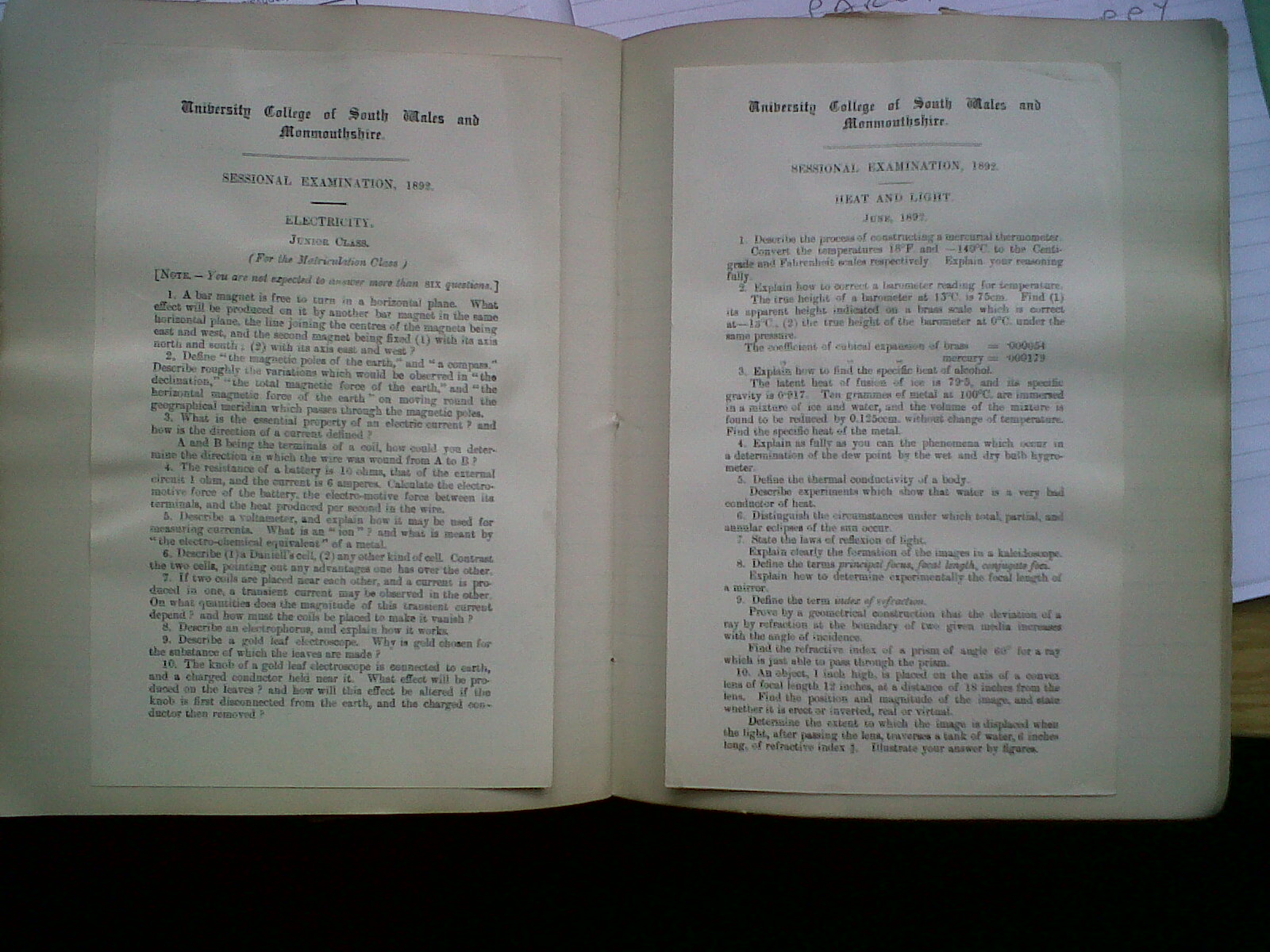
There recently came into my possession a book of very old school and university physics examinations, which are of interest because I’ve been posting slightly less ancient examples in recent weeks. These examinations were set by the University College of South Wales and Monmouthshire, which was founded in 1883,  an institution which eventually became Cardiff University. I find them absolutely fascinating.

The papers are rather fragile, as is the book containing them, so I daren’t risk trying to scan them systematically in case flattening them out causes damage. Here instead are a few random examples that I photographed on my desk, in the manner of an old-fashioned secret agent. Sorry they’re not all that clear, but you can see them blown up if you click on them.

The collection is fairly complete, covering most of classical physics, at all examination levels from university entry to final honours. For some reason, however, the papers on relativity and quantum physics appear to be missing….

An A-level Physics Examination Paper, Vintage 1981

Posted in Education with tags , , , on September 1, 2011 by telescoper

At the risk of becoming one of the Great Bores of the Day on the subject of past examinations I thought I’d follow up  my old O-level Physics paper  with a Physics A-level examination paper to see what people think about it. It might add to the discussion over on another blog I read too.

I took this particular examination myself in 1981. Can it really be 30 years ago? Agh. Paper 1 comprised a collection of short questions of multiple-choice type from which I’ve already posted one example on this blog.  This one is Paper 2 and, as you’ll see, it consists of longer questions with a freer format.

One comment I’ll make is that Question 5 is remarkably similar to a coursework questions we have been using here in the School of Physics & Astronomy at Cardiff University in our First year Physics module on Electricity and Magnetism.

Any other comments from people who’ve done A-levels more recently would be very welcome through the Comments Box, e.g. is there anything  in this paper that you wouldn’t expect to see nowadays? Is it easier, harder, or about the same as current A-level physics papers?

An O-level Physics Examination Paper, Vintage 1979

Posted in Education with tags , , , , on August 30, 2011 by telescoper

My recent post about the O-level Mathematics examination I took way back in 1979 seems to have generated quite a lot of comment, both here and elsewhere, so I thought I’d follow it up with a Physics examination paper to see what people think about that.

One complication with this is that I didn’t actually take Physics O-level; the School I went to preferred to offer Combined Science instead. This examination covered a general syllabus including Physics, Chemistry and Biology but was worth two O-levels rather than three. More or less, therefore, I did 2/3 of a Physics O-level.

I think the reason for choosing Combined Science rather than three separate subjects was to allow us kids the chance to take as broad a range of subjects as possible. In fact I did ten O-levels: Combined Science (2); Mathematics; Additional Mathematics; History; Geography; English Literature; English Language; French; and Latin. My best mark at O-level was in neither mathematics nor science subjects, actually, but in Latin…

Anyway, the examination for Combined Science consisted of four papers. Paper 1 was a general paper with a range of short questions in a booklet into which candidates had to write their answers in the space provided. Obviously I don’t have this paper because I handed it in. The three other papers were each on one of the main subjects and Paper 2, shown below, was the Physics paper.

This also gives me the opportunity to try out slideshare as a better way of displaying the paper than the clumsy method of photographing it on my desk I used for the Mathematics paper.  Unfortunately our temperamental scanner – which is rapidly becoming my arch enemy – seems to have missed some of the question numbers, so I put them in by hand.

The first thing that struck me about Question 5 is “During an experiment a boy obtained…”. Girls don’t do physics, obviously.

Any other comments or comparison with GCSE Physics papers should be written in the space provided.  Write clearly and legibly, and show clearly the reasoning by which you arrive at your conclusions. You may begin.

Back to the Drawing Board

Posted in Art, Education, The Universe and Stuff with tags , , , , , , , , , on August 30, 2011 by telescoper

I came across a press release this morning which contains the following

More should be done to encourage students to use their drawing skills in science education, researchers at The University of Nottingham say.

In a paper being published in Science this week, academics say that although producing visualisations is key to scientific thinking, pupils are often not encouraged to create their own drawings to develop and demonstrate their understanding.

In the paper the authors, led by Dr Shaaron Ainsworth in the University’s School of Psychology and Learning Sciences Research Institute, said: “Scientists do not use words only but rely on diagrams, graphs, videos, photographs and other images to make discoveries, explain findings, and excite public interest.

In the light of this I thought it would be topical to post an updated version of an old piece I wrote on the theme of sketching. This is quite a strange subject for me to have picked pick because drawing is something I’m completely useless at, but I hope you’ll bear with me and hopefully it will make some sense in the end. I always thought that drawing was an important and neglected aspect of education, but I hadn’t until today any solid research to back it up!

-0-

What  spurred me on to think about this subject was the exhibit I was  involved with for the  Architecture Biennale in Venice as part of a project called Beyond Entropy organized by the Architectural Association School of Architecture. In the course of researching this project I came across this image of the Moon as drawn by Galileo

This led to an interesting discussion about the role of drawings like this in science. Of course  the use of sketches for the scientific representation of images has been superseded by photographic techniques, initially using film and more recently by digital techniques. The advantage of these methods is that they are quicker and also more “objective”. However, there are still many amateur astronomers who make drawings of the Moon as well as objects such as Jupiter and Saturn (which Galileo also drew). Moreover there are other fields in which experienced practioners continue to use pencil drawings in preference to photographic techniques. Archaeology provides many good examples, e.g.

The reason sketching still has a role in such fields is not that it can compete with photography for accuracy or objectivity but that there’s something about the process of sketching that engages the sketcher’s brain in a  way that’s very different from taking a photograph. The connection between eye, brain and hand seems to involve a cognitive element that is extremely useful in interpreting notes at a later date. In fact it’s probably their very subjectivity that makes them useful.  A thicker stroke of the pencil, or deliberately enhanced shading, or leaving out seemingly irrelevant detail, can help pick out  features that seem to the observer to be of particular significance. Months later when you’re trying to write up what you saw from your notes, those deliberate interventions against objectivity will take you back to what you  saw with your mind, not just with your eyes.

It doesn’t even matter whether or not you can draw well. The point isn’t so much to explain to other people what you’ve seen, but to record your own interaction with the object you’ve sketched in a way that allows you to preserve something more than a surface recollection.

You might think this is an unscientific thing to do, but I don’t think it is. The scientific process involves an interplay between objective reality and theoretical interpretation and drawing can be a useful part of this discourse. It’s as if the pencil allows the observer to interact with what is observed, forming a closer bond and probably a deeper level of understanding patterns and textures. I’m not saying it replaces a purely passive recording method like photography, but it can definitely help it.

I have not a shred of psychological evidence to back this up, but I’d also assert that sketching is very good for the learning process too.  Nowadays we tend to give out handouts of diagrams involved in physics, whether they relate to the design of apparatus or the geometrical configuration of a physical system. There’s a reason for doing this – they take a long time to draw and there’s a likelihood students will make mistakes copying them down. However, I’ve always  found that the only way to really take in what a diagram is saying is to try to draw it again myself. Even if the level of draftsmanship is worse, the level of understanding is undoubtedly better.Merely looking at someone else’s representation of something won’t give your brain as a good a feeling for what it is trying to say  as you would get if you tried to draw it yourself.

Perhaps what happens is that simply looking at a diagram only involves the connection between eye and brain. Drawing a copy requires also the connection between brain and hand. Maybe  this additional connection brings in additional levels of brain functionality. Sketching iinvolves your brain in an interaction that is different from merely looking.

The problem with excessive use of handouts – and this applies not only to figures  but also to lecture notes – is that they turn teaching into a very passive process. Taking notes in your own hand, and supplementing them with your own sketches – however scribbly and incomprehensible they may appear to other people – is  a much more active way to learn than collecting a stack of printed notes and meticulously accurate diagrams. And if it was good enough for Galileo, it should good enough for most of us!
Results and explanation (via Gowers’s Weblog)

Posted in Education with tags , , on August 26, 2011 by telescoper

I thought I’d reblog this because it pertains to my earlier post from today…

I’ve had a healthy number of responses to my question from the previous post. In case you are reading this post without having read the previous one, I shall continue after the fold, because if you read on it will render you ineligible to participate in the little experiment I am conducting. Every year in Britain, at round about this time of the year, we have the same debate. The GCSE and A-level results come out (these are taken at the ages of 1 … Read More

via Gowers’s Weblog

Are exams getting easier?

Posted in Education with tags , , , on August 26, 2011 by telescoper

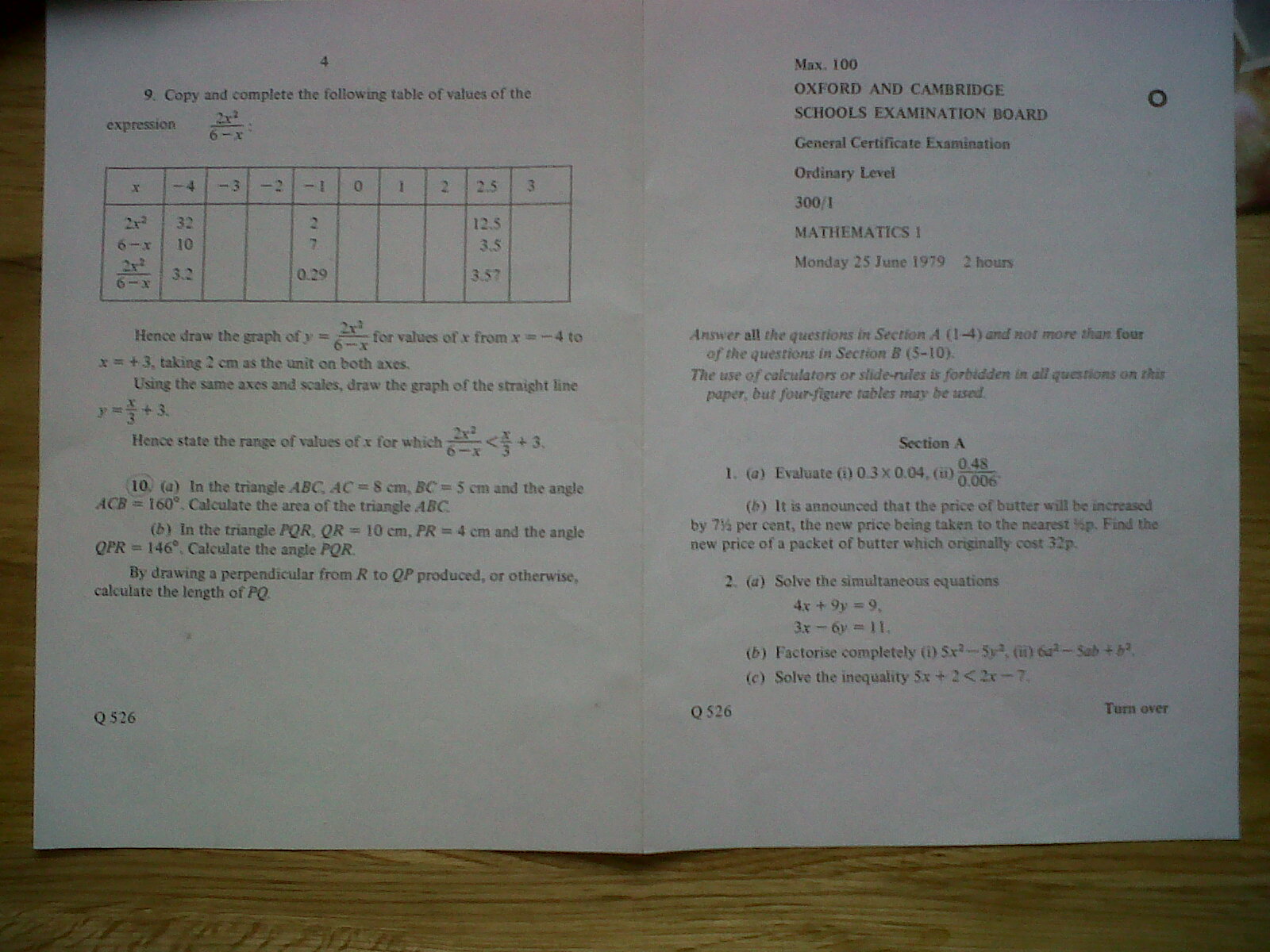
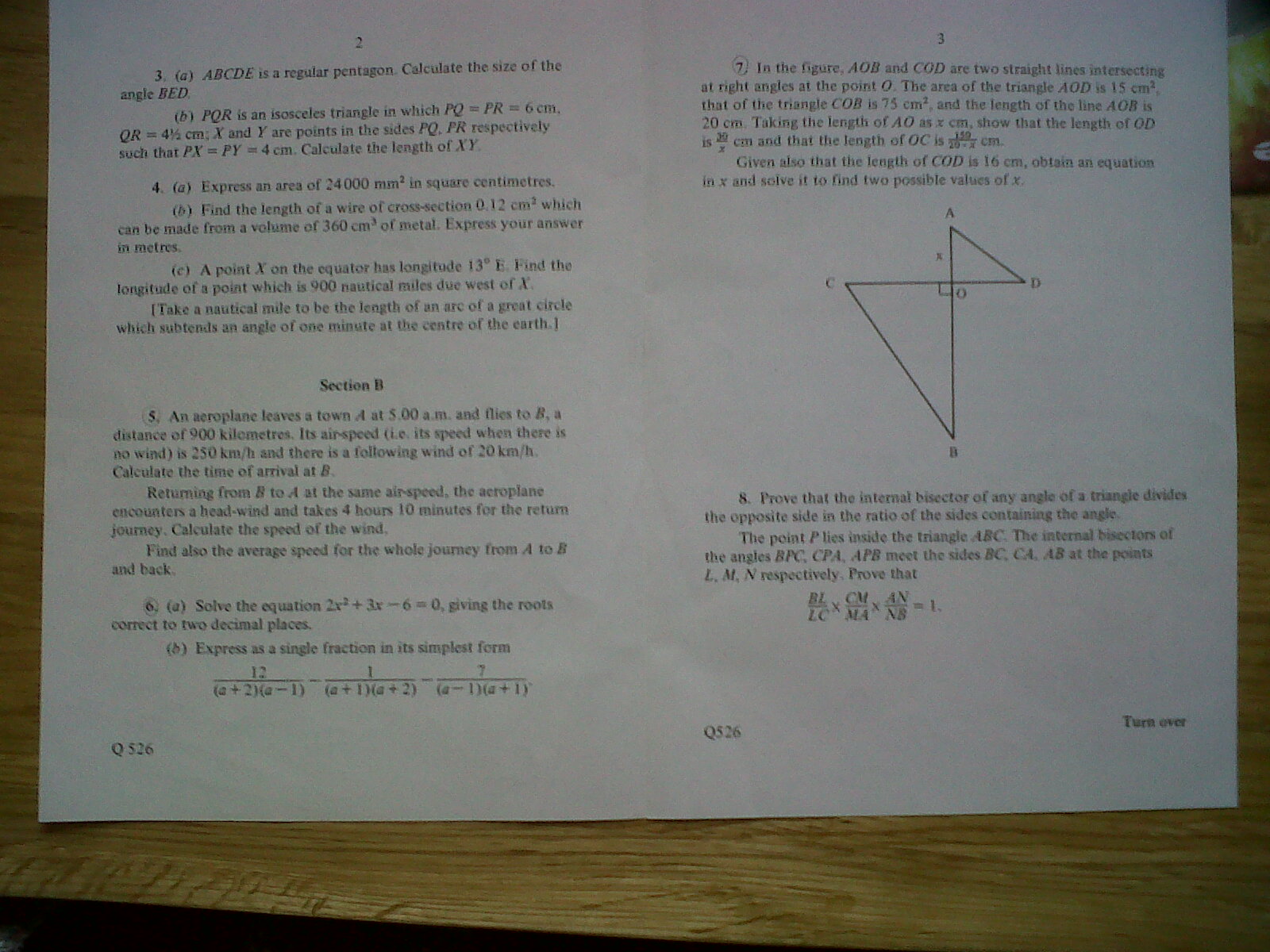
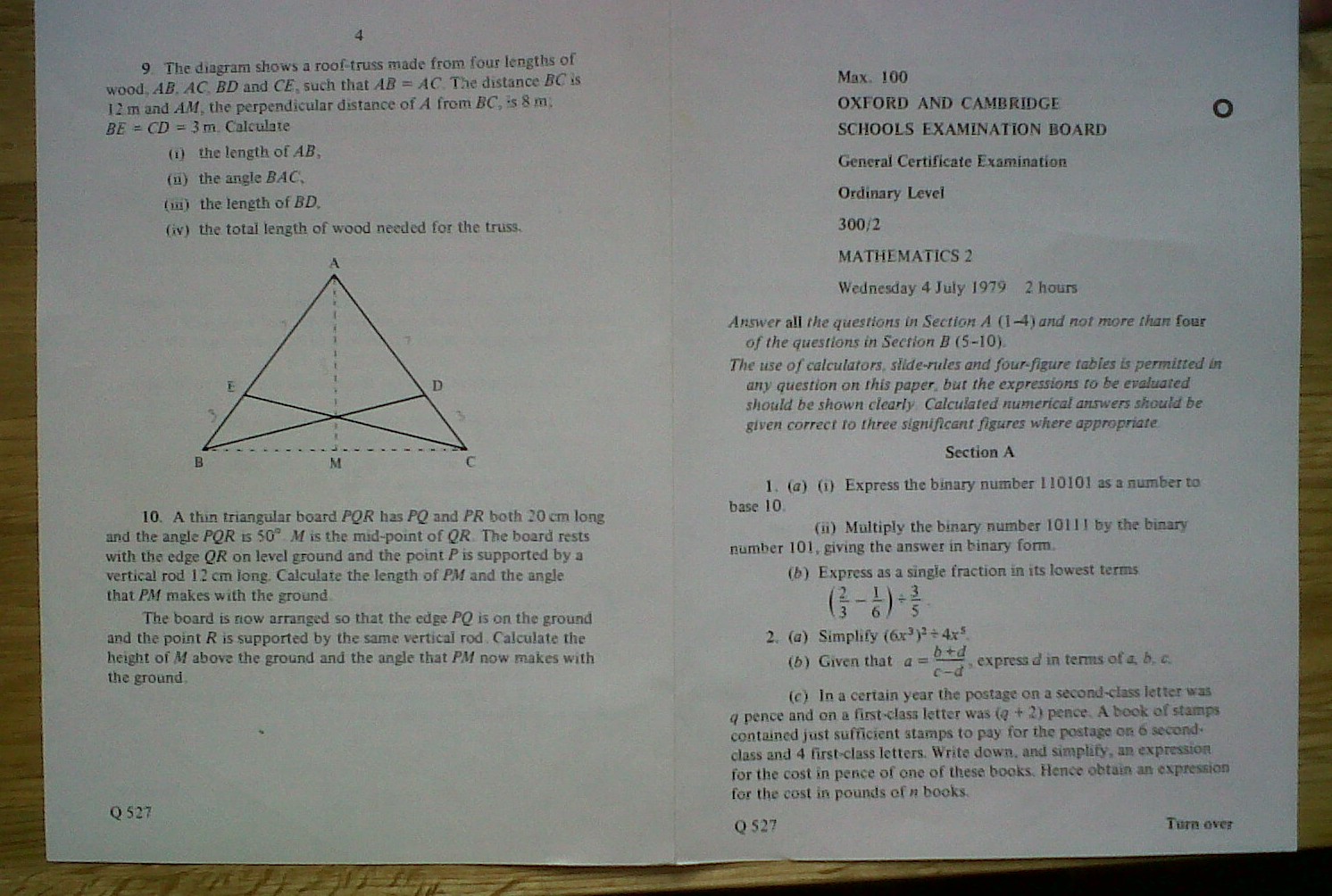
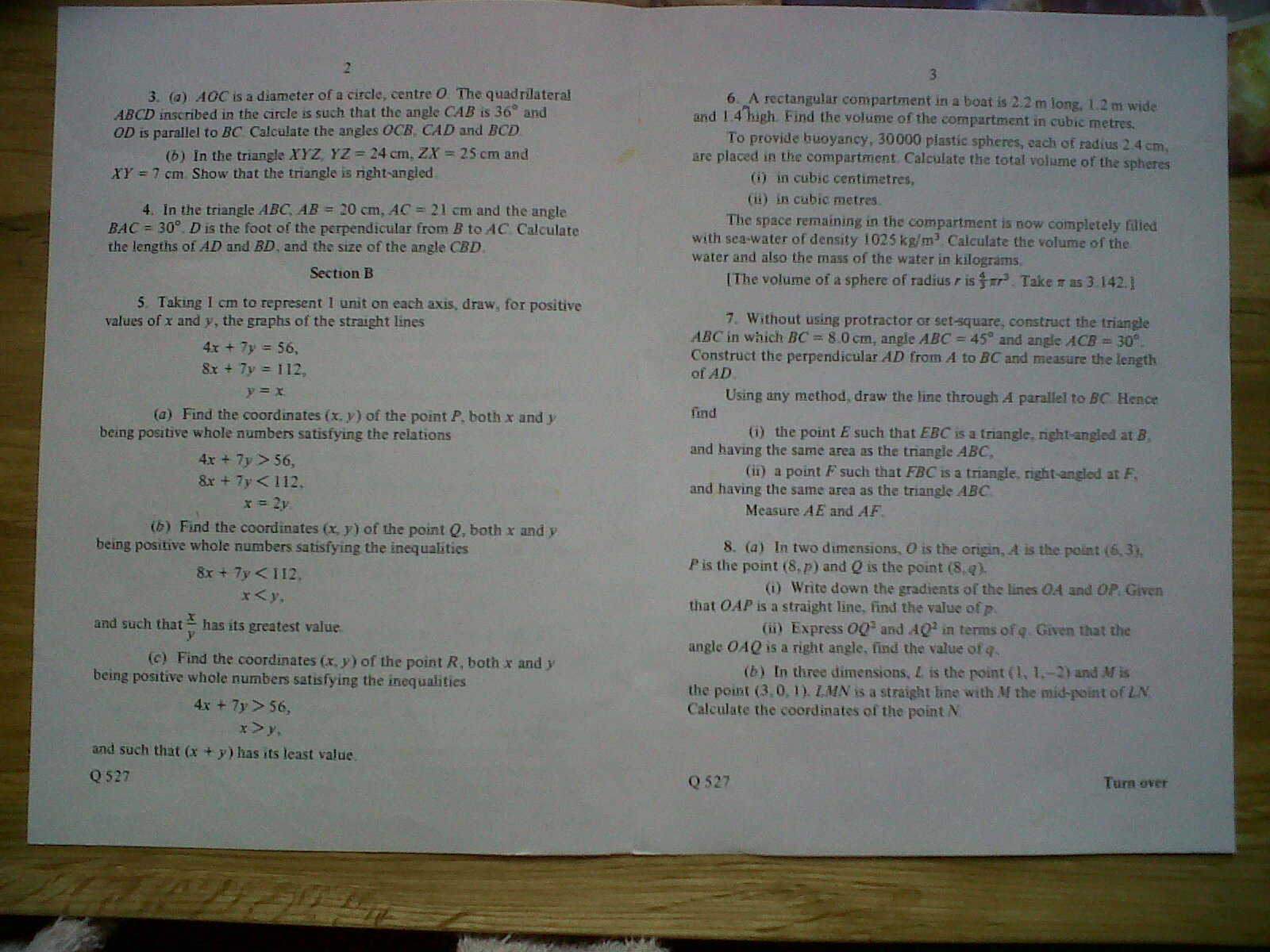
With the publication of this year’s GCSE results there’s been the usual clamour about “dumbing down” of educational standards. So are these examinations getting easier or not? I can’t answer that question because I’m far too old to have done GCSEs. The examinations I took at the equivalent stage of my school career were O-levels. But, being an inveterate hoarder of useless articles, I kept the exam papers that I took, so what I can do is put up and example the O-level papers I took (in 1979) and let you decide. I thought the Mathematics one might be of interest, so here it is or rather here they are, because there were two 2-hour written papers; there was no coursework component, so these counted 100% of the final grade.

If you’ve done GCSE mathematics recently, have a look and see what you think!

(You can click on the images to make them bigger if they’re difficult to read…)

I’d be interested in any comments you might have, especially if you’ve actually done GCSE Mathematics (recently or a long time ago). I suspect the most obvious difference is that in my day we did much more geometry…

I might put up the Physics papers if there’s enough interest!

A Healthy Increase

Posted in Education with tags , , , on August 25, 2011 by telescoper

Up early again this morning, I thought I’d do a quick post because I just remembered that there’s a bit of a loose end I’ve left dangling for a week or so owing to my recent indisposition.

I posted about 10 days ago about my week as “responsible person” for the School of Physics & Astronomy at Cardiff University owing to the absence of all the really responsible people on their respective vacations. By sheer coincidence my week in charge spanned the day that A-level results were announced and therefore the period during which we finalised this year’s UCAS admissions process. I had thought this might be quite a stressful time because rather late in the day we were given a significant increase in funded student numbers by the Higher Education Funding Council for Wales (HEFCW) which made it necessary for us to enter the clearing system to find the extra students.

As it turned out however the prospective students to whom we’d made offers paid back our confidence in them and a large fraction got the necessary grades. We did go into clearing, but only briefly, to pick up a relatively small number of unattached applicants who matched our criteria. I’m happy to report, therefore, that we’ve got a very healthy intake of 120 students this year, up by about 30 on last year. That’s exactly the increase we had planned for and we can cope with it without making drastic changes, such as increasing the size of tutorial groups, that would remove the personal touch that makes this such a pleasant School to work and, I hope, study in.

The hard work done all year round by admissions teams in University departments tends to be drastically undervalued, so I’d like to take this opportunity to thank Carole Tucker for doing such a great job for the School of Physics & Astronomy, ably supported by Nicola Hunt. Where we’d be without them I don’t know.

Modesty forbids me, of course, from pointing out who was acting Head of School while this all came to fruition, and who therefore really deserves the credit….

Stellar Research?

Posted in Education, Science Politics with tags , , , , on August 24, 2011 by telescoper

I heard today that  Chief Scientific Advisor to the Welsh Government, John Harries, has called for Welsh universities to be more “predatory” in attracting “star researchers” to Wales. At first sight I thought that sounded like good news for astronomy, but reading the article more closely I realise that’s not what he meant!

The point is that, according to the BBC article,  Welsh universities currently only attract about 3% of the UK’s research funding whereas the famous Barnett formula allocates Wales about 5% of the total in other areas of expenditure.  Nobody involved in research  would argue for funds to be allocated on any other basis than through quality, so there’s no clamour for having research funding allocated formulaically a là Barnett; the only way to improve the success rate is to improve the quality of applications. John Harries suggests that means poaching groups from elsewhere who’ve already got a big portfolio of research grants…

The problem with that strategy is that it’s not very easy to persuade such people to leave their current institutions, especially if they’ve already spend years acquiring the funding needed to equip their laboratories. It’s not just a question of moving people, which is relatively easy, but can involve trying to replace lots of expensive and delicate equipment. The  financial inducements needed to fund the relocation of a major research group and fight off counter-offers from its present host are likely to be so expensive that the benefit gained from doing this takes years to accrue, even they are successful.

I agree with Prof. Harries that Welsh universities need to raise their game in research, but I don’t think this “transfer market” approach is likely to provide a solution on its own. I think Wales needs a radical restructuring of research, especially in science, across the whole sector, which I think is unacceptably complacent about the challenges ahead.

For a start, much more needs to be done to identify and nurture  younger researchers, i.e. future research stars  rather than present ones.  Most football clubs nowadays have an “academy” dedicated to the development of promising youngsters, so why can’t we do a similar thing for research? Research groups in different Welsh universities also need to develop closer collaborations, and perhaps even full mergers, in order to compete with larger English institutions.

More controversially I’d say that the problem is not being helped by Welsh universities continuing to be burdened by the monstrous bureaucracy and bizarre practices of the Research Excellent Framework, which allocates “QR” research funds according to priorities set by HEFCE in a way that reflects the thinking of the Westminster parliament. The distribution of QR funding in Wales, which is meant to supplement competitive grant income from UK  funding bodies, should be decided by HEFCW in line with Welsh strategic priorities. Wales would be far better off withdrawing from the REF and doing its own thing under the auspices of the Welsh Assembly Government.

What I’m saying is that I’ve got nothing against Welsh universities trying to entice prominent research leaders here;  we’ve recently tried (unsuccessfully) to do it here in the School of Physics & Astronomy at Cardiff University, in fact. But in the current funding climate it’s not easy to persuade their current institutions to let them go. In any case,  I don’t think parachuting in a few high-profile individuals will in itself solve the deep-rooted problems of the Welsh university system. A longer term strategy needs to be found.

Scotland already punches above its weight in terms of research income for its universities and there’s no reason why, in the long run, Wales can’t do likewise.

Acting and Clearing

Posted in Education, Finance, Politics, Science Politics with tags , , , , , , on August 14, 2011 by telescoper

Now that I’m back from my trip to Copenhagen, it’s going to be back to work with a vengeance. To those of you who think academics have massively long summer breaks, I can tell you that mine ends on Monday when I will be doing a stint as Acting Head of School. That’s not usually a particularly onerous task during the summer months, but next week happens to be the week that A-level results come out and it promises to be a hectic and critical period. It’s obviously a sheer coincidence that all the other senior professors have decided to take their leave at this time…

There are several reasons for this being a particularly stressful time. First the  number of potential students applying to study Physics (and related subjects) this forthcoming academic year (2011/12) in the School of Physics & Astronomy at Cardiff University was up by a whopping 53% on last year. I blogged about this a few months ago when it became obvious that we were having a bumper year.

The second reason is that Cardiff’s  School of Physics & Astronomy has been given a big increase in funded student numbers  from HEFCW. In fact we’ve been given an extra 60 funded places (over two years), which is a significant uplift in our quota and a much-needed financial boost for the School. This has happened basically because of HECFW‘s desire to bolster STEM subjects as part of a range of measures related to the Welsh Assembly Government’s plans for the regions. Preparations have been made to accommodate the extra students in tutorial groups and we’re even modifying one of our larger lecture rooms to increase capacity.

Unfortunately the extra places were announced after the normal applications cycle was more-or-less completed, so the admissions team had been proceeding on the basis that demand would exceed supply for this year so has set our undergraduate offers rather high. In order to fill the extra places that have been given to us late in the day, even with our vastly increased application numbers, we will  almost certainly have to go into the clearing system to recruit some of the extra students.

In case you didn’t realise,  universities actually get a sneak preview of the A-level results a couple of days before the applicants receive them. This helps us plan our strategy, whether to accept “near-misses”, whether to go into clearing, etc.

On top of these local factors there is the sweeping change in tuition fees coming in next year (2012-13). Anxious to avoid the vastly increased cost of future university education many fewer students will be opting to defer entry than in previous years. Moreover, some English universities have had cuts in funded student places making entry highly competitive. As an article in today’s Observer makes clear, this all means that clearing is likely to be extremely frantic this year.

And once that’s out of the way I’ll be working more-or-less full time until late September on business connected with the STFC Astronomy Grants Panel, a task likely to be just as stressful as UCAS admissions for both panel members and applicants.

Ho hum.

What do children need to develop in science during KS3 and KS4? (via 13scidave)

Posted in Education with tags , , , , , on July 25, 2011 by telescoper

I thought I’d reblog this post in order to send some traffic in its direction. The piece is asking for input concerning the science curriculum for Years 7 to 11. We didn’t have Years like this when I was at School, so I’ll translate this as meaning the age group 11 to 16, i.e. secondary school.

I’m going to have a think before I post a comment on the site, but I will do eventually, and I hope many of you will consider doing likewise.

You’ll have already gathered that I’m a school science adviser with the Hampshire Science Team. We support all schools in Hampshire in trying to develop exciting and inspiring science, as well as helping children make the best possible progress. Schools often feel under pressure to ‘teach to the test’ in order to achieve good examination results and this pressure can actually impede the development of good scientific thinking. Yesterday we began … Read More

via 13scidave