Archive for the Education Category

Class of ’11

Posted in Biographical, Education with tags , , on July 19, 2011 by telescoper

Just a quick note to mark today’s graduation ceremony for students in the School of Physics & Astronomy at Cardiff University, which took place at 10 o’clock this morning in St David’s Hall. I took part in the staff procession this year – as I have done on several previous occasions – so was there bright and early, all togged up in academic drag, ready for the kick-off. You can see a replay of the whole thing here so I don’t need to describe it in detail; I’m seated towards the left hand side of the stage so am fortunately out of shot for most of the video.

I admit to having had a bit of a hangover this morning because yesterday evening I attended a posh (black tie) graduation dinner at the invitation of the Vice-Chancellor. The splendid dinner was preceded by a drinks reception that lasted a full hour – at which much champagne was quaffed – and then followed by some lengthy and rather uninspiring speeches, during which I sought solace in the form of port. When proceedings were over, a few of us decanted ourselves into a local bar for a bit more to drink. I only realised how much I must have drunk when Columbo woke me up by jumping on my bed at 5am at which point I felt distinctly sub-optimal.

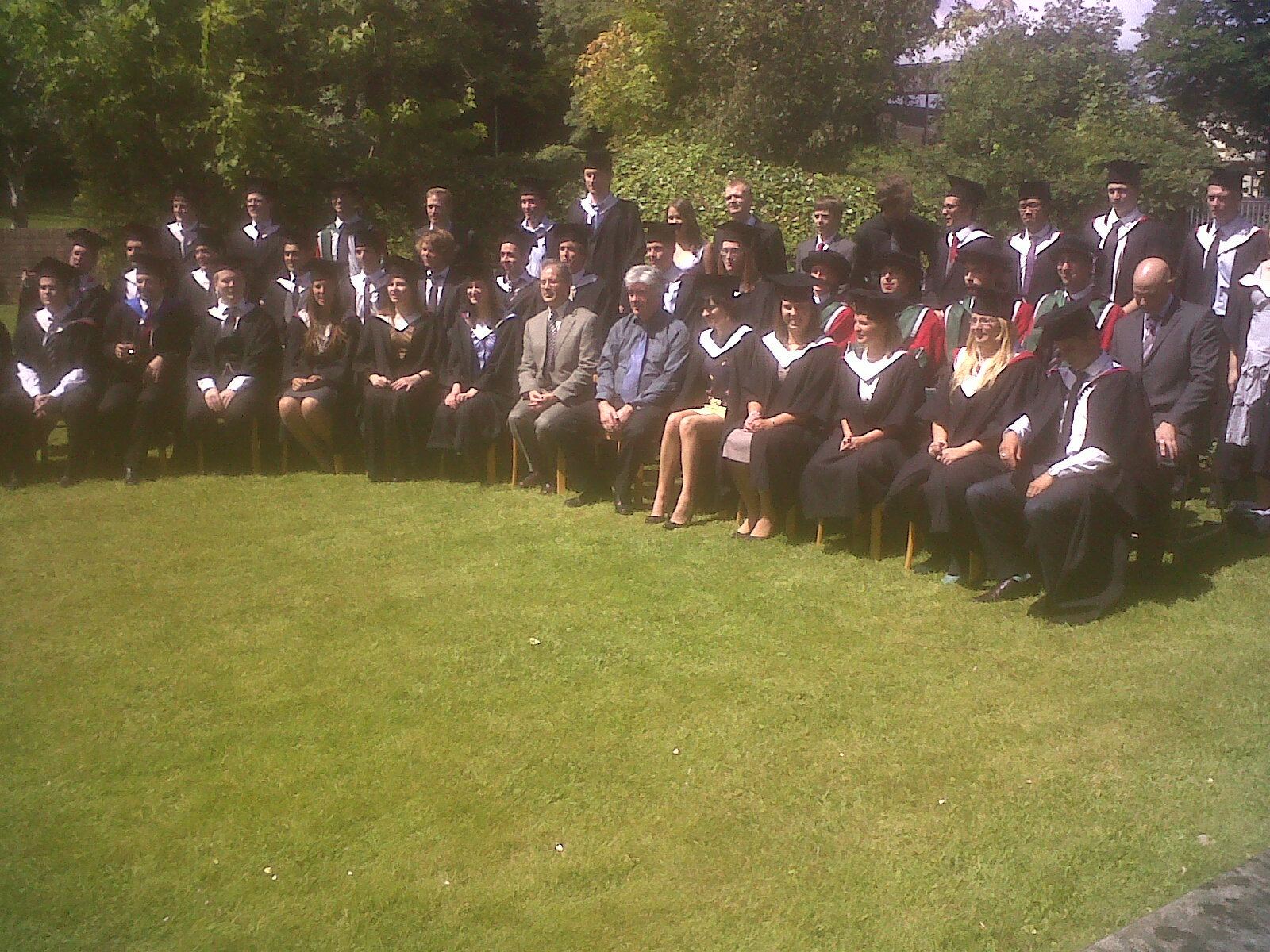
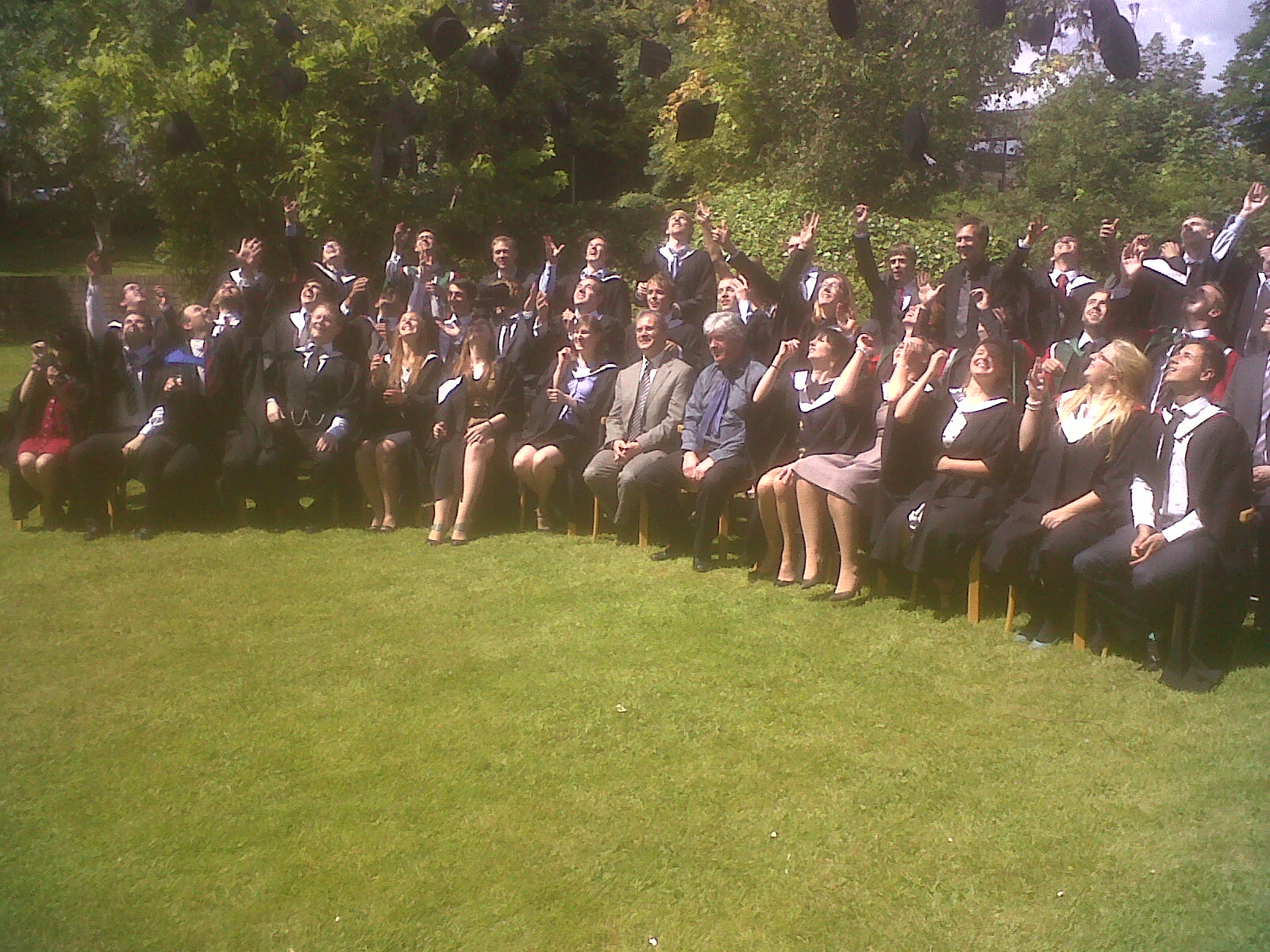
After the graduation ceremony there was a reception for graduates, parents, partners and assorted hangers-on back at the School of Physics & Astronomy followed by the obligatory pictures with the Head of School, Walter Gear, and Director of Undergraduate Studies, Bernard Richardson, including several attempts at the old “mortar-boards-in-the-air” shot…

..of which my attempt with a phone camera came out surprisingly well!

The MPhys students graduating this year are the first such group that I’ve seen go all the way from first year to graduation, as I moved to Cardiff University in 2007.  Graduation is always a bittersweet occasion, with joy  at the students’ success, but also sadness that we have to say goodbye.   Some will be staying to do PhDs and some will remain in Cardiff for a host of other reasons, but there’s a  number of students in this group that I will miss a lot.


Cardiff News

Posted in Education, Politics with tags , , , , , on July 12, 2011 by telescoper

It’s been a while since I’ve blogged about local affairs, but the emergence of three items of news in the past few days has given me an opportunity to remedy that.

First, and hot off the press this morning, is the news that Cardiff University has at last decided who its next Vice-Chancellor will be after the incumbent,  David Grant, retires next year. The lucky winner is Professor Colin Riordan, who is currently Vice-Chancellor of the University of Essex (which apparently exists). His background is in the humanities, and his speciality post-war German literature. Since his previous institution doesn’t have a Physics Department, we’re probably  safe for a few years until he finds out Cardiff has one and decides to close it.

Anyway, Professor Riordan became a Vice Chancellor for the first time at the age of 48, which is the same age I am now. Maybe I should be climbing aboard the gravy train? I hear there’s a vacancy as Vice Chancellor at the University of Essex. I would apply, but I fear I have all the wrong vices…

That brings me to yesterday’s news that Cardiff University, along with all the proper most other universities in Wales, is to charge annual tuition fees of, you guessed it, £9K. This is despite recent reports that the Higher Education Funding Council for Wales (HEFCW) was set to refuse permission to set such high fees. I always thought it was inevitable that Welsh universities would want to charge as much as possible to bring funding levels closer to those in England, but it remains to be seen what effect the new regime will have on student recruitment.  The £9K level is substantially higher than the Welsh Assembly Government’s initial estimate of £7K so it also remains to be seen what the implications are for the WAG budget. We live in interesting times…

However, not wishing to end on a down note, I’ll finish by passing on a bit of up-beat news. Apparently – according to the esteemed National Geographic Magazine – Cardiff is one of the top ten places in the world to visit in 2011, coming in at Number 6 in  this rigorously compiled and totally objective league table. I’m usually a bit skeptical about such things, but who could possibly disagree with the ranking?

1. Muskoka Orange County, Ontario, Canada
2. Patagonia, Argentina
3. San Juan Islands, Washington
4. Minneapolis, Minnesota
5. Glacier Bay National Park, Alaska
6. Cardiff, Wales
7. Stockholm Archipelago Sweden
8. Azores, Portugal
9. Roatan, Honduras
10. Istria, Croatia

Hang on a minute. Minneapolis? At Number 4?

Late Talking

Posted in Biographical, Education with tags , , , , , , on July 5, 2011 by telescoper

In the course of linking my previous post to Richard Feynman’s wikipedia page, I happened upon an interesting fact:

Feynman (in common with the famous physicists Edward Teller and Albert Einstein) was a late talker; by his third birthday he had yet to utter a single word.

I therefore have something in common with these famous physicists. I didn’t learn to speak until I was well past my third birthday, as my mum never tires of reminding me.  In fact, as I have blogged about before,  I was a very slow developer in other ways and when I started school was immediately earmarked as an educational basket case.

I subsequently discovered that

Neuroscientist Steven Pinker postulates that a certain form of language delay may be associated with exceptional and innate analytical prowess in some individuals, such as Albert Einstein, Richard Feynman and Edward Teller.

Which is obviously where the similarity between me and these chaps ends, as I certainly don’t have “exceptional and innate analytical prowess”. I am however intrigued by the fact that I at least shared their  failure to develop language abilities on the same timescale as “normal” infants. I don’t know very much at all about this field, even to the extent of not knowing at what age most children learn to talk…

So here’s a couple of questions for my readers out there in blogoland. Were any of you late talkers? And how unusual is it for a child not to speak until they’re three years old?

Contributions welcomed through the comments box!

Old School

Posted in Biographical, Education with tags , , on June 29, 2011 by telescoper

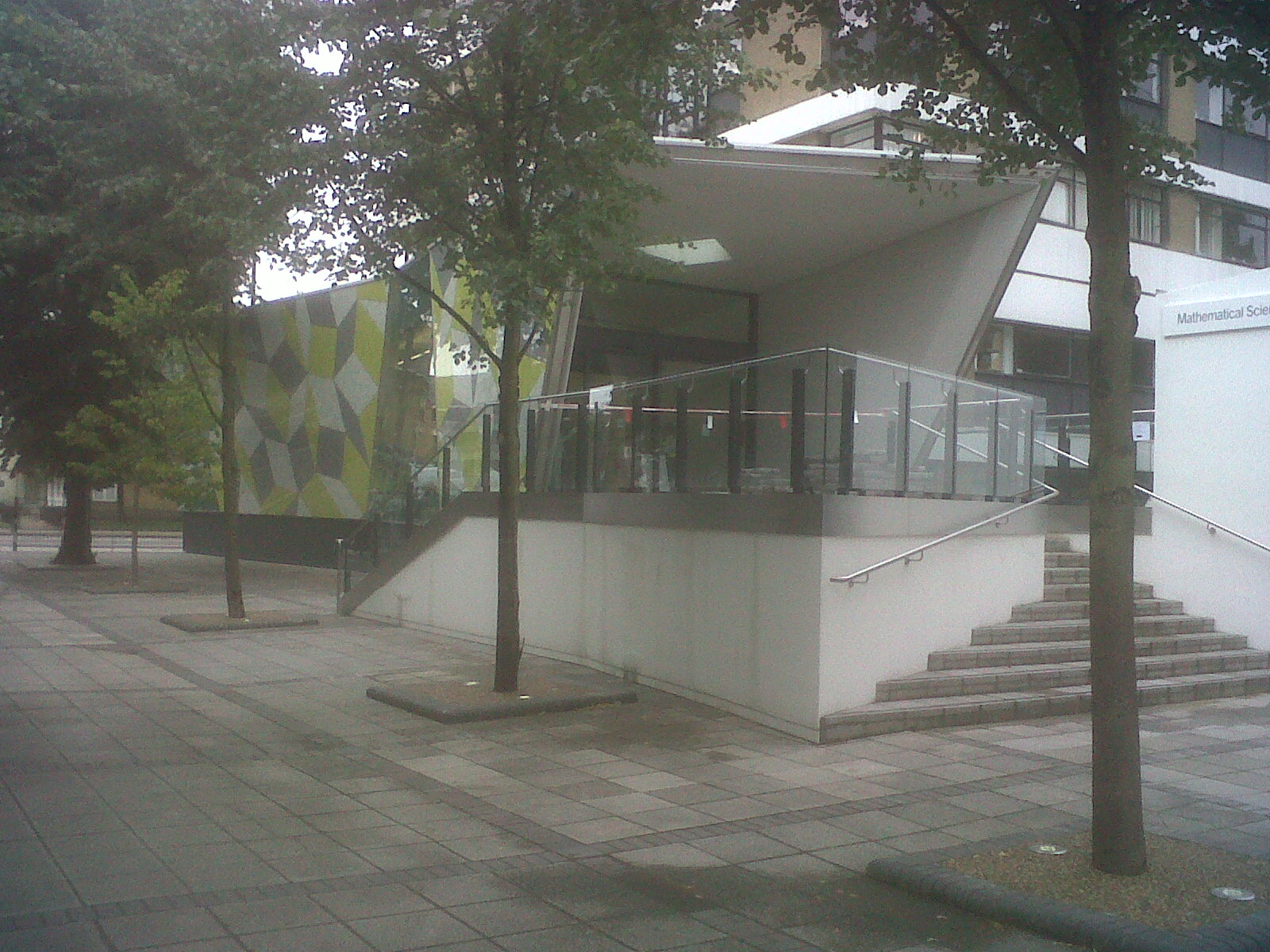
Yesterday was a busy day, involving me travelling to London in order to carry out my duties as external examiner for the MSc in Astrophysics in the School of Mathematical Sciences at Queen Mary, University of London. Every time I go to my old stomping ground on Mile End Road,  the East End something seems to have changed, whether in the college or in the environs. This time was no exception, as they’ve finally finished the new entrance to the Mathematical Sciences Building:

You can’t see it all that well, but it’s decorated with Penrose Tiling (although it’s not specified who did the grouting). Inside there’s a spacious new foyer area – devoid of any possible teaching use, but probably a nice area for students to gather informally. Inside has a sort of 1960s retro feel, with bright yellow plastic floors and modernist soft furnishings. Austin Powers would probably feel at home there. The large lecture theatre has also been comprehensively refurbished and looks very nice, although its capacity has been reduced. Less emphasis on teaching facilities, more on “the student experience” I suppose.

I used to work at Queen Mary, in the Astronomy Unit; in this very building, in fact. I can’t help being a bit cynical about the new front entrance. There are so many other things wrong with the building – grubby concrete exterior, badly fitting windows and lavatories that don’t work, to name but a few – that I can’t really understand what made someone decide that what it really needed was a new garish plastic foyer. It’s up to Queen Mary to decide where to spend its money, of course, but I think it’s strange.

Other, bigger, news about the Astronomy Unit which I learned yesterday is that this summer, at long last, it’s moving from the School of Mathematical Sciences to merge with the Physics department in order to form a new School of Physics & Astronomy. In fact, when I was there there were astronomers in Physics (mainly instrumental and observational) and in Mathematical Sciences (mainly theoretical, including myself). Some years ago most of the instrumentation people moved from the School of Physics here to Cardiff, where they are still. The remaining astronomers moved to Mathematical Sciences. Now they’re moving back to Physics along with those currently in Maths. Oh what a tangled web.

For the time being the Astronomy Unit will stay in their existing offices but will eventually move in with Physics once that building is refurbished. I guess the main thing that will change immediately is that various astronomers will have new letterheads and will have to start teaching physics courses instead of mathematics.

Feelings about the move among the staff appear to be rather mixed, but I wish them well in their new School and with their plans to build up Physics & Astronomy in the future.

Ex Officio

Posted in Education, Finance on June 23, 2011 by telescoper

I’ve been remarkably subdued and rant-free these days – partly because I’ve been too engaged with other things. However, I just came across a story in the Times Higher which put me in the mood for a short diatribe.

It seems that the Higher Education Council for England (HEFCE) has published a report entitled “Performance in Higher Education” which looks into university estates management. Among other things, this report states that in English universities academics are assigned an average of 13.2 sq m of office space per person, Scottish institutions offer 14.5 sq m, and Welsh universities a “whopping” 15.7 sq m. By contrast the average office space per person across all sectors in the UK 10-12 sq m.

The conclusion is that

The enduring perception of an office as a status symbol has contributed to the higher education sector lagging behind nearly all others in the efficient use of space.

An interesting inference, this, especially as it gives no definition of what is meant by “efficient”. Note also that it resorts to the pure cliché of the office as status symbol without a shred of evidence to support this as an explanation of alleged inefficiency. I have quite a large office – it seems Welsh universities are generous in this regard – but I don’t see it as a status symbol at all. It just means I use it for more things.

For one thing, I use my office for research. I can’t speak for anyone else but for me that means having a space to myself, free from distractions, for thinking. My room also contains many books and research papers that I use for both teaching and research. I also hold tutorials and discussion group meetings for which the large whiteboard is essential (although I would have preferred an old-fashioned blackboard). On occasion I also have private meetings with students and other staff at which confidential matters can be discussed in private.

Given the variety of activities carried out in a space which is only fractionally larger than the national norm, I would be quite confident of making a case that universities -or at least those that do both research and teaching –  already use their space more efficiently than other sectors.

And another thing. Many of us work in old buildings. Mine is a hundred years old. Converting it to an open plan environment would cost a fortune. Perhaps in order to effect the “cultural change” HEFCE desires universities should knock down the old buildings and put up brand new, smaller ones, with open plan offices? Pity in that case that capital funding has been slashed.

The HEFCE report states that “other sectors have … embraced a more open-plan scenario”. That may be the case, but other sectors are not universities and they don’t do the range of things we do. How am I supposed to hold tutorials in an open-plan office? And how would I be expected to do research with chit-chat going on all around?

Managers will probably argue that we could have dedicated rooms that could be booked for tutorials, etc. Fine. So we would have to decamp from our (small) offices to a bare cell with a group of students. If something comes up that makes me want to refer to a book or paper, I couldn’t pop over to my bookshelf and get it, I’d have to come back to my office. Or just not bother. There’d also be no space for impromptu meetings. No room for books either, but who needs them? Most university libraries don’t bother with them any more so why should staff?

I know exactly what would happen if these measures were introduced. First, academics would have to do their research at home. Opportunities for interaction between staff members, and between staff and students, would be greatly diminished. Students would no longer feel that the staff were accessible for advice and discussions, greatly diminishing the student experience. The impact on research would be extremely negative, as would be the effect on staff morale.

But who cares about teaching or research? It would be more efficient.


Welsh fee plans up in the air…

Posted in Education, Politics with tags , , , , , , , , on June 15, 2011 by telescoper

I had just finished the exciting job of marking my examinations and collating all the results with coursework when I noticed a rumour circulating on twitter about the Higher Education Funding Council for Wales (HEFCW) having rejected plans by all Welsh universities to charge higher fees than the basic £4K laid down by the Welsh Assembly Government. The rumour later developed into a story on the NUS website and then on the local BBC News, Wales Online and the Times Higher.

In case you’re not up with the intricacies of Welsh Higher Education policy, universities here in the Principality will, from 2012, be allowed to charge fees of up to £9K per annum (as in England) if and only if they have approval from HEFCW for plans relating “to widening access and to improving the student experience.” Note there’s apparently no requirement of providing a better education in that. As a mere university teacher I have no idea at all what has gone into Cardiff University’s plan nor do I know why it is deemed satisfactory. Such things are done by our lords and masters in the University administration.

It does seem strange, though, that the process works this way, i.e. that HEIs have to produce plans that they hope will be accepted by HEFCW. Why doesn’t HEFCW simply tell the HEIs what they have to do to be able to charge the fees? I wonder how the clear the guidance from HEFCW was. It might be a case of “Read my mind to see what I want, and if you don’t give it to me I’ll shoot you”.

Universities wishing to charge £9K (which is, predictably, nearly all of them) had to submit their plans to HEFCW by the end of May. Several universities did so, including Cardiff, Aberystwyth, Bangor, and even Glamorgan, who all want to charge the maximum £9K. HEFCW has now announced that none of them meet the standard needed to charge more than £4k. There’s still quite a bit of time for universities to amend their plans before the deadline of 11th July, so this is by no means the end of the story, but it has certainly set alarm bells ringing where I work!

The point is that the Welsh Assembly Government is heavily cutting the funds it allocates to Welsh Universities from 2012, so if institutions are not allowed to charge sufficiently high fees to recoup that loss then many departments are going to be in really big trouble, especially those teaching expensive subjects.

Education Minister Leighton Andrews is quoted as saying

I asked for Hefcw to be thorough and robust when scrutinising the fee plans submitted by our higher education and further education institutions. It is clear that they have been and I heartily endorse this.

There are a number of ways of reading the lie of the land here. One is that it’s actually a sensible process of consultation between individual institutions and HEFCW. Since this is uncharted territory for both there may well be things that need to be clarified on both sides, and HEFCW may therefore be engaging in a sensible process of consultation and iteration in order to help institutions produce acceptable plans. It could also represent an element brinkmanship, so the Minister and HEFCW can be seen to be flexing a bit of muscle, in contrast to the situation in England, where it appears the government has no power to prevent institutions charging higher fees. I always felt it was inevitable that Cardiff, as a Russell Group University, would want to charge £9K, but I can imagine Leighton Andrews being irritated by places like Glamorgan wanting to charge the same.

Whatever game is being played, it’s a very dangerous one and the stakes are very high. The Welsh Assembly Government has already indicated it will pay the fees of any Welsh domiciled students wherever they study in the UK. For the most part that will mean £9K per student per year for Welsh students wanting to study in England. If Welsh universities can only charge £4K per year for students coming from England to Wales then there will be a huge imbalance in funds flowing in and out of the higher education sector. In effect, the Welsh Assembly Government will be subsidising English universities at the expense of Welsh ones.

Currently the number of English students coming to Wales exceeds the number of Welsh students studying in England. The WAG’s plan relies on a net influx of funds to offset the cuts in central funding needed to pay student bursaries. However, English students do not come in equal numbers to all Welsh institutions. More come to Cardiff University than, say, Bangor. So how will this extra income from England benefit the Welsh HE sector generally? Is the proposal to cut HEFCW funds to Universities who succeed in attracting English cash cows students and redistribute the dosh among those institutions that don’t? That hardly seems equitable to me.

I’m certainly not in a panic about this news, although I may be on July 11th when we find out the final outcome. In the meantime, as a humble academic at the bottom of the ladder when it comes to such matters, I’ll get on with my teaching and research and pray that those in charge actually know what they’re doing…
The Final Analysis

Posted in Education with tags , , , , on June 14, 2011 by telescoper

It’s that time of year again. The annual meeting of the Board of Examiners of the School of Physics & Astronomy at Cardiff University met this afternoon to consider the marks for students due to graduate this year and to draw up recommendations for the final degree classifications.

This year’s meeting was actually quite interesting and, at just over two hours, somewhat shorter than some we’ve had in previous years.  A group of students has already gathered in the foyer waiting for the dreaded list to be posted, and many will no doubt be celebrating or drowning their sorrows in local hostelries shortly after their fate is revealed.

Cardiff is a little old-fashioned in the way the final examiners’ meetings are conducted. For a start we still have a system of viva voce examinations for borderline candidates; they happened yesterday, in fact. Many universities have dispensed with this aspect of the process, but I still think they’re worthwhile. The Board of Examiners, including the two External Examiners,  also still has some discretion in how it arrives at the degree boundaries (which are nominally at 70% for a first, 60% for a 2.1, 50% for a 2.2, and 40% for a 3rd).

The tide is turning against this very traditional approach, however, and there are moves here to dispense with the viva examinations and with academic discretion. I’m not sure when this will happen, but it’s likely to be sooner rather than later. I think the main reason for this is to make the system more automatic so there’s less chance of legal challenge. In any case there doesn’t seem to me that there can be any educational reason for it.

The one thing that strikes me about the system we have is that it’s the whole business of classifying degrees into broad categories which is where the problem lies.  It was suggested some time ago that we should dispense with, e.g., the “Desmond” (2.2) and the “Thora Hird” (3rd) and instead simply give each student a transcript containing details of the entire spectrum of their academic performance. It’s been suggested again just recently too. That would seem to me to make much more sense than the current system of classifying degrees which involves (a) trying to condense a huge amout of information – examination marks, coursework, project assignments and the like – into a single number and then (b) drawing boundaries based on this number precisely where the distribution is most densely peaked. However, years have passed and nothing concrete has happened. The academic world is good at inertia.

Anyway, this isn’t the time or the place for a lengthy diatribe about the ins-and-outs of degree classifications. I’ve got to go back to marking my 1st year examination papers shortly in fact; these are considered by a separate meeting of the Board of Examiners.

It is time, however, for me to congratulate all our graduating students on their success. It’s the first group of Cardiff MPhys students that I’ve seen all the way through from entry  to graduation. I’ll be sad to see them go, but wish them all the best as they venture forth into the real world. At least I hope to see them back next month for graduation.  Until then, however, all I’ll  say is

Congratulations!

Topological Escapology

Posted in Education, The Universe and Stuff with tags , on June 13, 2011 by telescoper

The occasional  teasers I post on here seem to go down quite well so I thought I’d try this one on you.  I recently found it in an old book on the topic of  topology, a fascinating field that finds many applications in physics, including several in my own field of  cosmology.

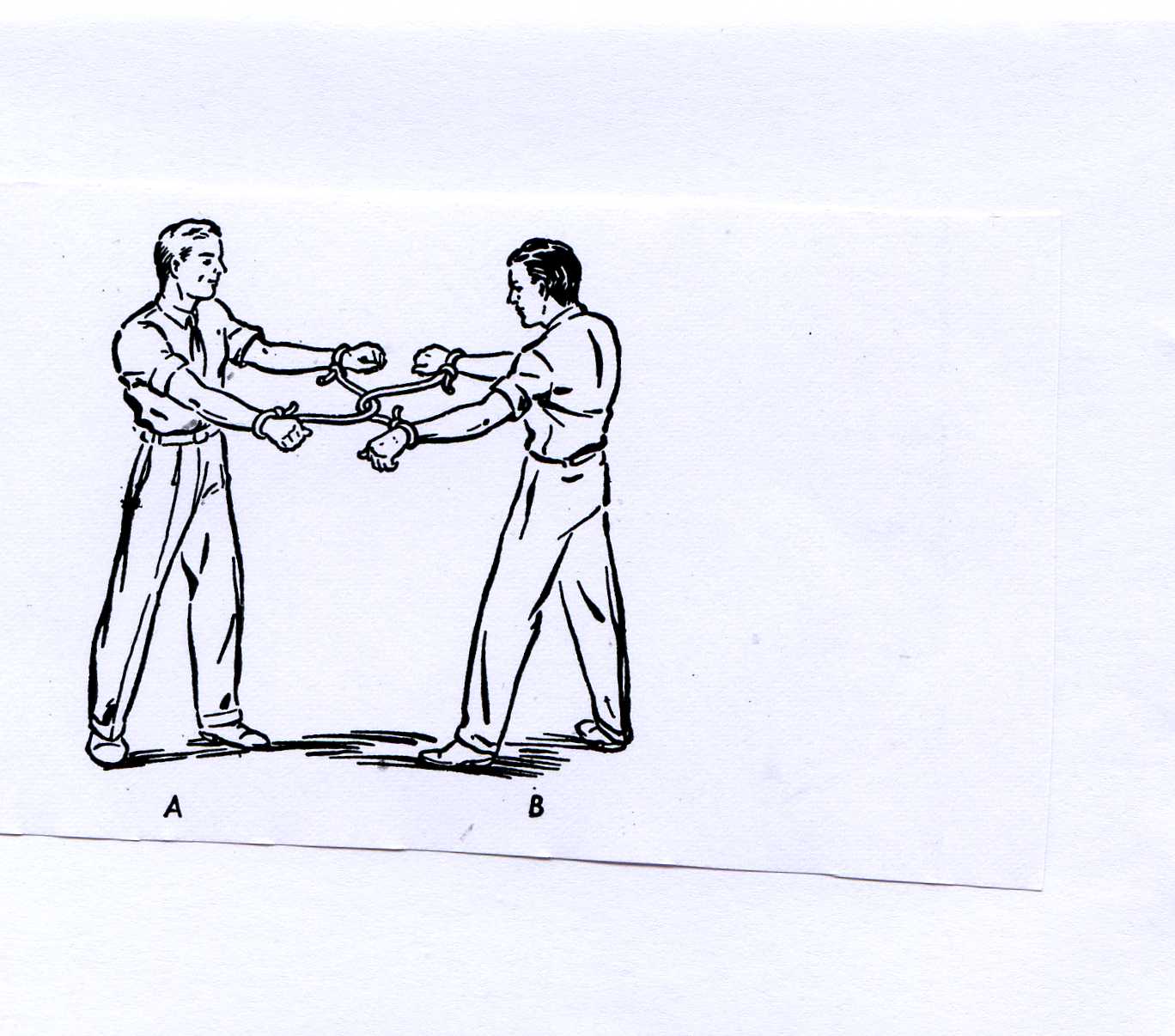
It’s probably best not to ask why, but the two gentlemen in the picture, A and B, are tied together in the following way. One end of a piece of rope is tied about A’s right wrist, the other about his left wrist. A second rope is passed around the first and its ends are tied to B’s wrists.

Can A and B free each other without cutting either rope, performing amputations,  or untying the knots at either person’s wrists?

If so, how?

A Bridge Too Far

Posted in Education with tags , , , on June 11, 2011 by telescoper

My commitment to the education of the great unwashed knows no bounds. Tonight’s subjects are architecture and geography.

Not a lot of people know that the relatively unknown Sydney Harbour Bridge is in fact a cheap replica of a much more famous structure in a much more interesting location:

Sydney Harbour Bridge

Tyne Bridge

Echo of Creation – the Trailer

Posted in Education, The Universe and Stuff with tags , , , on May 27, 2011 by telescoper

Each day I find myself pressed for time and unable to think of anything to post, something seems to come along to rescue me. I found this on Twitter this morning and couldn’t resist sharing it, partly because it’s a cute video in its own right, and partly because it gives me the chance to advertise the event that it trails. Here’s the film …

..and it advertises a forthcoming event at the Cheltenham Science Festival, featuring the excellent Andrew Pontzen who is based at the Institute of Astronomy in Cambridge. Andrew is not only a whizzkid cosmology theorist but also an excellent public speaker, so do go and see his lecture if you can. Here’s the blurb:

Billions of years after the birth of the Universe, scientists realised they could tune into an echo of creation itself using nothing more sophisticated than a de-tuned television set. Andrew Pontzen explains the cosmos’ ‘background noise’ with hula hoops, beach balls and amazing telescopic pictures. But hold onto your hats: all is not as it seems with space and time…

Sounds fascinating! The talk is on Saturday 11th June 2011, 10am at the Town Hall in Cheltenham. You can book tickets here.