Archive for the Education Category

Whatever happened to Euclid?

Posted in Education, The Universe and Stuff with tags , , , , , , on May 24, 2011 by telescoper

An interesting article on the BBC website about the innate nature of our understanding of geometry reminded me that I have been meaning to post something about the importance of geometry in mathematics education – and, more accurately, the damaging consequences of the lack of geometry in the modern curriculum.

When I was a lad – yes, it’s one of those tedious posts about how things were better in the old days – we grammar school kids spent a disproportionate amount of time learning geometry in pretty much the way it has been taught since the days of Euclid. In fact, I still have a copy of the classic Hall & Stevens textbook based on Euclid’s Elements, from which I scanned the proof shown below (after checking that it’s now out of copyright).

This, Proposition 5 of Book I of the Elements, is in fact quite a famous proof known as the Pons Asinorum:

The old-fashioned way we learned geometry required us to prove all kinds of bizarre theorems concerning the shapes and sizes of triangles and parallelograms, properties of chords intersecting circles, angles subtended by various things, tangents to circles, and so on and so forth. Although I still remember various interesting results I had to prove way back then – such as the fact that the angle subtended by a chord at the centre of a circle is twice that subtended at the circumference (Book III, Proposition 20) – I haven’t actually used many of them since. The one notable exception I can think of is Pythagoras’ Theorem (Book I, Proposition 47), which is of course extremely useful in many branches of physics.

The apparent irrelevance of most of the theorems one was required to prove is no doubt the reason why “modern” high school mathematics syllabuses have ditched this formal approach to geometry. I think this was a big mistake. The bottom line in a geometrical proof is not what’s important – it’s how you get there. In particular, it’s learning how to structure a mathematical argument.

That goes not only for proving theorems, but also for solving problems; many of Euclid’s propositions are problems rather than theorems, in fact. I remember well being taught to end the proof of a theorem with QED (Quod Erat Demonstrandum; “which was to be proved”) but end the solution of a problem with QEF (Quod Erat Faciendum; “which was to be done”).

You can see what I mean by looking at the Pons Asinorum, which is a very simple theorem to prove but which illustrates the general structure:

  1. GIVEN
  2. TO PROVE
  3. CONSTRUCTION
  4. PROOF

When you have completed many geometrical proofs this way it becomes second nature to confront any  problem in mathematics (or physics) by first writing down what is given (or can be assumed), often including the drawing of a diagram. These are key ingredients of a successful problem solving strategy. Next you have to understand precisely what you need to prove, so write that down too. It seems trivial, but writing things down on paper really does help. Not all theorems require a “construction”, and that’s usually the bit where ingenuity comes in so is more difficult. However, the “proof” then follows as a series of logical deductions, with reference to earlier (proved) propositions given in the margin.

This structure carries over perfectly well to problems involving algebra or calculus (or even non-Euclidean geometry) but I think classical geometry provides the ideal context to learn it because it involves visual as well as symbolic logic – it’s not just abstract reasoning in that compasses, rulers and protractors can help you!

I don’t think it’s a particular problem for universites that relatively few students know how to prove the perpendicular bisector theorem, but it definitely is a problem that so many have no idea what a mathemetical proof should look like.

Come back Euclid, all is forgiven!

Share/Bookmark

Local Matters

Posted in Education, Finance, Politics, Science Politics with tags , , , , , on May 12, 2011 by telescoper

I think I’ve caught up with most of the signficant things that happened during my travels, so I thought I’d end this series of updates with some local news from Cardiff (and Wales generally).

First, I can pass on some information relating to the  number of potential students applying to study Physics (and related subjects) this forthcoming academic year (2011/12) in the School of Physics & Astronomy at Cardiff University.  I blogged about this a few months ago when it became obvious that we were having a bumper year. As it turns out, we finished with applications up by a whopping 53% on last year.

Second, and related to the first item, the detailed allocations of university funding in Wales have finally filtered down all the way from HEFCW, through the Cardiff University management, and onto individual schools.  As it happens, this has also turned out not too badly for us here in Physics & Astronomy. For various reasons we’ve finally been given the increase in student numbers that we have been requesting for some time without success. In fact we’ve been given an extra 60 funded places, which is a significant uplift in our quota and a much-needed financial boost for the School. This has happened basically because of HECFW‘s desire to bolster STEM subjects as part of a range of measures related to the Welsh Assembly Government’s plans for the regions.

Unfortunately the admissions team have so far been proceeding on the basis that demand would exceed supply for this year so has set our undergraduate offers rather high. In order to fill the extra places that have been given to us late in the day, even with our vastly increased application numbers we may have to go into the clearing system to recruit some of the extra bodies. We’ll have to wait until the A-level results come out in August, however, before we know what the situation really is.

It would have been a lot easier if we’d known the rules at the start of the game, rather than near the end, but that’s the way it goes when politicians start tinkering with things…

We will have to lay on extra tutorials and laboratory sessions to cope with the anticipated increase in student numbers, which will be a bit of a struggle, but the extra money they bring in should keep the wolf from the door for a while.

Another thing worth mentioning concerns research in Wales. In the run-up to the Welsh Assembly elections, the Campaign for Science and Engineering (CASE) produced a couple of interesting documents. One was about science policy in the devolved nations and the other was a comparison of STEM subjects across the UK.

These documents make it clear that Wales lags far beyond England and (particularly) Scotland in terms of investment in, and productivity of, its scientific research.  In its  recommendations for Wales, CASE included

    • The Higher Education Funding Council for Wales must increase its investment in research – as well as improving the research base directly, this investment should bring more success in winning competitive, UK-wide funding. The indirect costs of charitably funded research should continue to be covered.
    • Policies should continue to build up the critical mass of research through collaboration, including with overseas researchers or businesses.

As I reported recently, we (Cardiff, Swansea and Aberystwyth) have tried to persuade HECFW to fund a Welsh physics initiative, intended to achieve precisely what CASE suggests. Unfortunately HECFW turned our bid down. At least for the short term, additional investment in physics research is clearly not on the agenda for HEFCW.  There’s not much sign of it happening in the future either, but we will have to wait and see…

Share/Bookmark

Community Matters

Posted in Education, Science Politics with tags , , on April 21, 2011 by telescoper

Well, here I am back in sunny Cardiff after a pleasant journey back from Llandudno and a very enjoyable and productive National Astronomy Meeting. I’d like to take this opportunity to thank all those involved at the Royal Astronomical Society in putting the programme together and doing a huge amount of work behind the scenes. The staff at the Venue Cymru in Llandudno were very friendly as well as highly professional and well organised, and everything seems to run exceptionally smoothly.

Oh, and I shouldn’t forget the conference dinner on Tuesday night, which ended with a serenade from the magnificent Maelgwyn Male Voice Choir. It was fitting to have the chance to experience a fine Welsh tradition, and I thought they were wonderful to listen to.

Anyway, I might get a bit of time over the Easter break to comment on some things that struck me over the course of the past week but for today – because I’m quite tired after the journey (and several late nights at NAM) – I thought I’d just comment a bit further on the first session I attended, on Monday evening, attended by various representatives of STFC, at which John Womersley gave a presentation about the status of various projects in the existing astronomy programme and prospects for the future. It was clear from that presentation that there are many challenges ahead, but I was relieved that the atmosphere of the meeting wasn’t anything like as confrontational as on many previous occasions. This process of reconciliation will no doubt take futher steps forward when the new Chief Executive takes over next year.

Drinking in the bar much later in the evening with a number of senior figures from diverse branches of astronomy the issue arose of the now notorious petition that George Efstathiou blogged about in a guest post some time ago. Two things are now clear about this initiative. One is that it caused deep ructions within the astronomical community, with a number of senior figures vociferously both for and against it – even within the same department. When I revealed that I had signed it myself, a few of the assembled company expressed their views in forthright language about why I had been wrong, but I have to say without much coherence in the actual logic.

The other thing that emerged during the STFC session was an explicit acknowledgment that the petition had, in one particular respect, made a very big difference, namely that the criteria for the appointment of the next Chief Executive of STFC specifically took into account some of the comments made in it.

Anyway, the point of raising the dreaded petition is not to rake over this whole business but simply to try to put it to rest. We need to move on, and should be trying to heal any wounds that it may inadvertantly have caused. There are definitive signs that the STFC Executive is now really starting to listen, so now there’s a chance to really engage with them through the channels they are opening up rather than having to resort to extreme measures such as George’s petition.

Oh, and I’ll just remind anyone who is interested in the vacancy at the top of STFC that the deadline for applications is April 28th….

Share/Bookmark

(Guest Post) Physics and Binary Creep

Posted in Education, Finance, Science Politics with tags , , , , , , on April 15, 2011 by telescoper

His Excel-lence (geddit?) Paul Crowther has been at it again, using his favourite packages sophisticated graph-plotting facilities to produce the interesting figures that go with another guest post….

–0–

Last week’s Times Higher Ed included a news item headlined ‘binary creep’, in which HEFCE were considering restricting support for PhD research students to universities of the highest research quality. Concerns were expressed in the article about a two stream future for universities – research intensives in the fast lane and ‘the rest’ in the slow lane. This reminded me of a recent Times Higher Ed interview with the former Commons’ Science and Technology Committee chairman, Lord (Phil) Willis. Lord Willis argued that the UK could probably sustain “no more than 30” universities with the capacity to attract the best global researchers and carry out world-class research, a view no doubt shared by ministers and civil servants within BIS. I should qualify the following line of thought by emphasising that this is not Government policy, although both stories reflect moves by funding agencies to further concentrate increasingly scarce resources on the highest ranked research universities. For example, in England HEFCE is expected to withdraw all quality-related (QR) support from 2* RAE research from 2012 onwards.

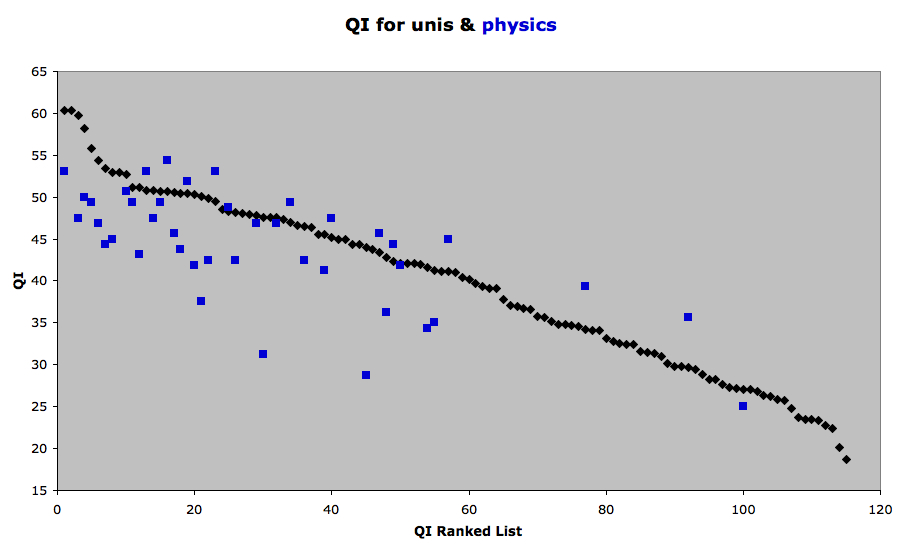
Mindful of the fact that in such a vision for the future, there would be a comparatively few, research intensive universities (`winners’) where would that leave the remainder (‘losers’), especially for physics? Research quality can be quantified in all manner of ways, but for simplicity I have adopted the Quality Index (QI) from Research Fortnight which provides a single mark out of 100 based on RAE quality profiles (4*:3*:2*:1* weighted 8:4:2:1). The chart below shows the  QI-ranked list of more-or-less all 120 UK universities who were rated in RAE 2008. It will come as no surprise to anyone that Oxbridge, LSE and Imperial top the rankings, closely followed by UCL and a few other high flyers, but beyond the top 10 perhaps more surprising there are no natural breaks in quality from Durham and QMUL in joint 11th place, to Bolton at 107th.

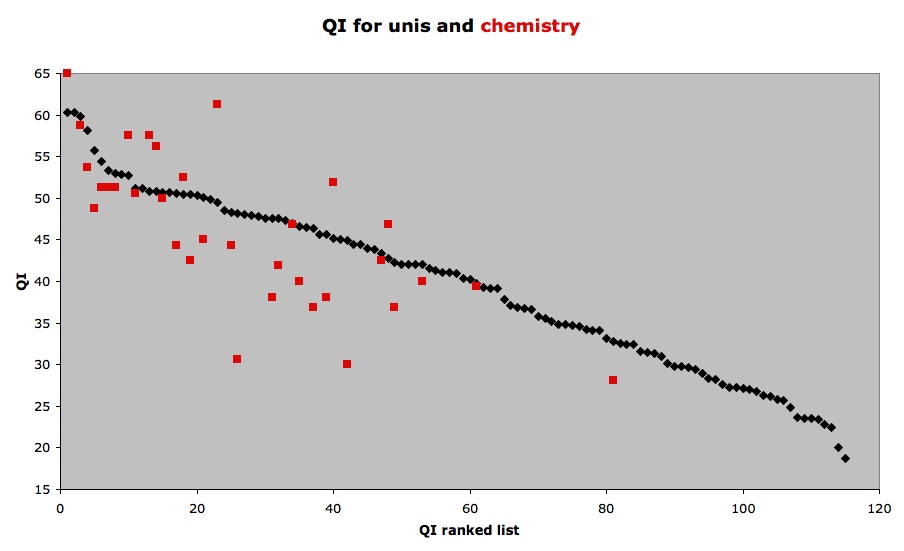
Thinking out loud about Willis’ assertion that the UK should not be spreading the jam more thinly than, say, the leading 30 universities, there would obviously be individual physics departments currently outside the top 30 which are ranked significantly higher than those within the top 30. To illustrate this, the chart also includes (in blue) physics QI scores for all teaching institutions that were assessed under the UOA 19 in RAE 2008. To blindly follow Lord Willis’ suggestion, 16 out of 42 institutions involved with physics research – comprising 37 per cent of all academic staff – would be clear losers. These would include one physics department raked within the top 10 (scoring 49) because its host institution is ranked 34th overall, while winners would include a department scoring 31, i.e. ranked 40th (out of 42) for physics, as a result of its university squeezing into the top 30. Chemistry – within the same RAE sub-panel as physics – reveals a broadly similar distribution, although there is perhaps a greater concentration of the highest research quality in the overall top 20, as the chart below illustrates.

Alternatively, if there is to be further concentration, one could argue that research funding should focus on, say, the top 20 physics departments regardless of the performance of their host institution. Indeed, already 80 percent of STFC spending goes to only 16 universities. Still, as RAE grades indicate, a strength of UK physics is the breadth of high quality research, with no natural break points until beyond 30th place in the rankings, as the final chart shows. Of course, RAE scores aren’t the sole criterion being discussed, with “critical mass” the other main driver. Due in large part to the big four, 70 per cent of physics academic staff submitted for RAE 2008 are in departments that are currently ranked in the top 20. Chemistry has a similar story to tell in the chart, albeit displaying a somewhat steeper QI gradient.

What might be the long-term consequences of a divergence between a small number of “research-facing” universities and the rest? It is apparent that if the number of physics departments involved in research were reduced by a third, some high quality research groups would be lost, regardless of precisely where the cleaver ultimately fell. Let’s too not forget that astrophysics represents the largest sub-field of physics from the last IOP survey, as measured in numbers of academics.

If policy makers don’t see anything fundamentally wrong with A-level physics being taught by teachers qualified, say, in biology, then they might too wonder whether physics degrees could be taught by academics lacking a physics research background? This might work for first year undergraduate courses, but thereafter isn’t more specialist knowledge needed that a research background most readily provides? How would the third of physics academics outside the top 30 universities react to the prospects of a teaching-only future? Many surely would consider jumping ship either to one of the chosen few or overseas, further decreasing the pool of those with research experience in the remaining physics departments. This is further complicated by the expected political desire that physics departments should be appropriately distributed geographically across England, Scotland, Wales and Northern Ireland.

As a final thought experiment, the fate of physics departments facing the prospect of a teaching-only future might also be binary in nature, either (a) whither and die, decreasing the range of institutions offering degrees in physics (or physical sciences, natural sciences etc.); perversely at a time when the Government are anxious to maintain the number of students studying Science, Technology, Engineering and Mathematics (STEM) subjects, or (b) thriving – free from the distractions of chasing dwinding research grants – by adapting to offer shorter duration physics degrees, described as “cheap and cheerful” by Dr David Starkey during the discussion on student fees on last Thursday’s Newsnight. To reiterate, it is not explicit Government policy to actively reduce the number of physics departments that receive research allocations, but this seems to be the general “direction of travel” in policy-makers speak, so I fear a rocky path ahead..


Share/Bookmark

Loose Ends

Posted in Biographical, Education, Finance with tags , , , , , on April 2, 2011 by telescoper

Just a brief post today, I think, in order to tie up a few loose ends from this week.

For reasons that I really don’t understand my blog suddenly became very popular on Thursday (31st March), attracting nearly 5000 hits in a day. That’s nearly four times my current daily average and a couple of thousand more than my previous busiest day. So this week I had my busiest day, last week was my busiest week, and last month was my busiest month. I guess it’s all downhill from here.

I couldn’t figure out what happened to cause all this interest, as not all the hits were on any specific article and no particular search terms were used to find this blog, at least not that I could figure out. I presume that it was my sarcastic take on Wonders of the Universe that was behind it. At any rate that was the post that generated the deluge of abusive comments that my spam filter caught.

Anyway, other items of relevant news are that two new members of Staff joined the School of Physics & Astronomy yesterday (April 1st; no, seriously…) and there are a couple more expected to join soon. It’s nice to have a few new faces around the place, and I’m sure they’ll all be bringing new ideas about research and teaching to the physics side of the School.

A week or so ago I passed on some pretty disappointing news about the funding climate here in Welsh universities. More details emerged this week about what this means for individual institutions; you can find the full list of allocations here (PDF). The figures don’t tally with those in the newspaper article I referred to in the previous post which was presumably inaccurate.

The picture isn’t as bad as I feared but, with a total cut of about 5% (in cash terms) across the sector it could hardly be described as good, especially when inflation is running about 5% on top of that. My employer, Cardiff University, has done slightly better than average, with a cut of only 3% in cash.

However – and it’s really delightful to be able to pass on some good news for once – the School of Physics & Astronomy has just been awarded a pretty large increase in its quota of undergraduate students. This is excellent, as I’ve previously reported that we have had a huge surge in applications this year. We’ll have to work hard to squeeze the extra bodies into laboratories, tutorials and even lecture theatres, but the income they will generate should help us carry out the strategic plans we have developed, perhaps bringing in even more new members of staff.

I’m still a bit grumpy, though, as our teaching terms has another two weeks to run, while some lucky bastards have finished already and are now on their Easter holidays…


Share/Bookmark

The Dissolution of the Assembly

Posted in Education, Finance, Politics with tags , , , on March 27, 2011 by telescoper

Yesterday’s mail included a polling card for the forthcoming elections to the Welsh Assembly. Coincidentally, I found out this morning that the Welsh Assembly will be dissolved on 31st March, to be re-convened on or after 5th May when the elections are finished.

Until Thursday the Welsh Assembly Government comprises a coalition of New Labour and Plaid Cymru and, although I don’t know enough about Welsh politics to predict what’s going to happen with any real confidence, it seems reasonably likely that not much will change. I can’t see the Tories or LibDems making any gains, at any rate.

I’m not sure of the extent to which Higher Education will be important in the forthcoming election campaign. It sure be, of course, as the relevant issues are those over which the Assembly has direct responsibility, education being one. The WAG’s hands are tied to a large extent by the funding it receives from Westminster, and it also has many other calls on its purse, but I do hope the new WAG, whatever its complexion is, will do the right thing by Welsh universities when it re-forms in May.

I have to admit, though, that I’m very worried for the future. As I predicted when the new funding arrangements for English universities were announced, the vast majority – and certainly all the research intensive ones – will be charging the full £9K fee level from 2012. That means the current WAG’s commitment to pay fees for Welsh-domiciled students wanting to study in England will be much more expensive than the WAG’s estimates, which were based on an average fee level of £7.5K. English students wanting to study in Wales will have to pay whatever fee Welsh universities charge, which isn’t known yet.

Currently about 25,000 English students study in Wales, compared with the 16,000 Welsh students who study in England. If numbers remain the same, in order for the funds coming in from England to exceed the money going to England, the fee level charged in Wales must  be at least 64% of that charged in England, i.e. £5760 if all English universities charge £9K. That’s way above the putative mininum fee level of £4K announced by the WAG; if Welsh universities charge fees at that level then the WAG will be providing a large net subsidy to English universities.

And breaking even isn’t anywhere near enough. The WAG has signalled an intention to top-slice teaching budgets by about 40%. We don’t yet know how that will be implemented, university-by-university and department-by-department,  but unless there are to be wholesale closures of “expensive” subjects (i.e. science and engineering) fee levels will have to rise substantially above the level calculated above. My own employer, Cardiff University, a member of the Russell Group of research-led universities, will probably want to brand itself alongside the English universities belonging  to this club by charging a high fee. I hope it doesn’t do this, but  the WAG’s policies are pushing it in that direction. As one of Wales’ biggest recruiters of English students, Cardiff will have to charge high fees in order to be seen as being of the same quality as leading English universities as well as to make up for funding lost in the latest round of deep cuts to recurrent grants.

The recent rhetoric of the WAG is all about achieving greater control of the HE sector in Wales to align it with strategic priorities within the Principality. This is certainly justifiable in principle as Wales has a university system which is far too fragmented and chaotic. Paradoxically, however,  the WAG’s own policies seem to be forcing Welsh universities to look to England for income to make up for the big cuts recently announced.

So what’s the alternative?

I think it would be much more rational to ditch the commitment to fund Welsh-domiciled students for studying in England. If a student wants to go to England then they should experience the same fee regime as students domiciled there. After all, you wouldn’t expect the WAG to pay fees for a Welsh student to go to America, would you? The cash thus saved should be reinvested in Welsh Higher Education, in accordance with the WAG’s strategic priorities, and in keeping tuition fee levels as low as possible within the Principality. The best way to avoid tuition fee levels of £9K is to maintain core grants at a level that makes it unnecessary to charge so much.

It seems to me that this plan is a better deal for Welsh students, for English students wanting to study in Wales,  for Welsh universities, and for the Welsh Assembly Government, but then I’m used to being in a minority of one.

Let’s just say I’ll be reading the party manifesto statements with great interest over the next few weeks…


Share/Bookmark

A Tale of Two Balls

Posted in Biographical, Education with tags , , , , on March 26, 2011 by telescoper

This morning was definitely the one after the night before, as Friday was the occasion of the Annual Chaos Society Physics Ball. The Chaos Society organises a number of social events for both staff and students from the School of Physics & Astronomy at Cardiff University. This year’s ball was nearly a whole month earlier than last year’s, because we’re not having a term break before Easter this year as Easter is so late. There’s still another three weeks of teaching, in fact, whereas in most years we would stop now and resume after Easter.

Anyway, the do last night started off with a champagne reception at the Parc Thistle Hotel in central Cardiff, followed by dinner and dancing in the function room there. There was a fine band playing a sort of funky soul jazz mix at the start and end of dinner. There were a bit loud to make conversation possible at the beginning, but once the food arrived they took a break and resumed when coffee was served. Instead of attempting to make ourselves heard over the music, I decided to try to set the ball rolling by getting up and dancing with a lady called Tanys, who was a guest of the Head of School Walter Gear. Nobody else joined us, but it was fun anyway.

We then went “informal” so to speak. The DJ got going, but I didn’t reckon much to the music so went and mixed in the bar. Some final-year students celebrating having secured PhD places here and there, so congratulations to them, and there was a beautiful moment when Michael proposed to Matthew. They’re not allowed to be properly married here in the UK, and a proposal of “civil partnership” doesn’t quite have the same ring to it, but it was one of the highlights of the evening. Matthew accepted, of course.

After that we adjourned to a boutique nightclub called Crystal, an exotic place with peculiar soft furnishings and a bevy of bare chested muscle men in attendance. Around 3am I was poured into a taxi and got home quarter of an hour or so later, reasonably intact. Bad hangover this morning, though.

I’d like to add my personal thanks to the organisers of what was a hugely enjoyable evening, the Chaos Society generally and especially Natasha who did sterling work persuading so many people to come along. This was the third of these bashes I’ve been to, and it was definitely the best.

I’ve worked in a number of universities so far in my career as a jobbing astrophysicist, but the students at Cardiff are by far the friendliest and the most fun of all the groups I’ve had the pleasure to teach. And, yes, it does mean an awful lot to me when people tell me to my face that they enjoy my lectures. Even if they are drunk when they do so!

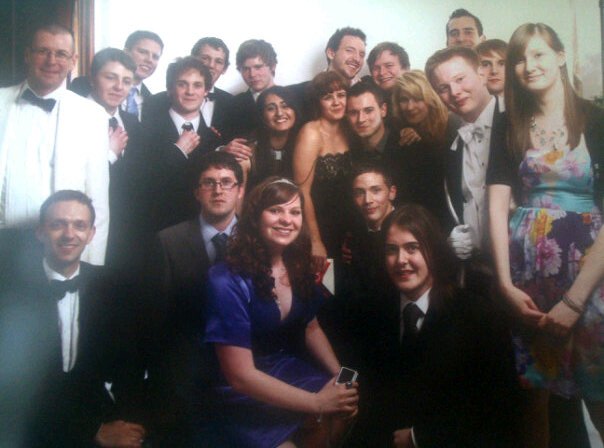
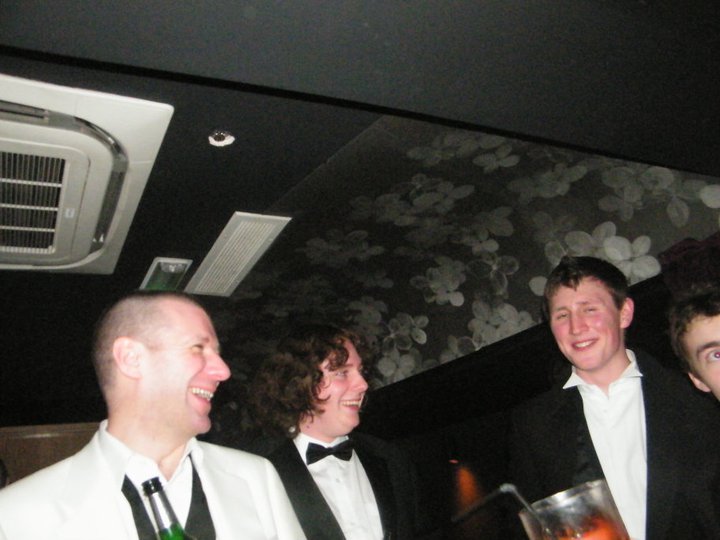
Anyway, some pictures are floating around on facebook. Here’s a couple, and I may add some more as they emerge from various cameras and phones. Of course it must be some kind of optical defect that makes me look so old in these, or perhaps it’s just because I’m surrounded by people less than half my age?

You’ll notice that I got the old white DJ out. Strictly speaking, UK tradition dictates that these should only be worn when abroad but I like wearing one when the weather is nice as it was yesterday whether it’s consistent with etiquette or not. There were plenty more serious breaches going on last night anyway, chiefly involving gentlemen removing their jackets at the dining table which is extremely poor manners.

You’re probably wondering what the second ball  refers to in the title of this post. Well, it’s just to remark that today in Cardiff  Wales played England at Football  (the “Association” variety, with a round ball, which I believe in some backward countries is called “soccer”). It was good to have an excuse for avoiding the city centre, and I was in a sufficiently vegetative state not to venture out of the house at all until the match was over. England beat Wales comfortably, 2-0.

UPDATE: Here’s a few more pictures, starting with one of me and the lovely Matthew. Well, at least one of us is photogenic…

These two were snapped at the club later on…

Here’s a couple more, one of me and the gorgeous Flo…

..and one last one, which I suspect was taken very late in the proceedings


Share/Bookmark

Local News

Posted in Education, Finance, Politics with tags , , , , , , , on March 25, 2011 by telescoper

I’m looking forward to tonight’s Annual Chaos Society Physics Ball, in advance of which I’ll have to go home to get my glad rags sorted out.

This posh night out should provide some welcome fun at the end of a week in which various items of news concerning Welsh universities have generated considerable anxiety around these parts.

For a start the Welsh Assembly Government has announced funding levels for HEFCW, the body that distributes funding to Welsh universities. According to a newspaper article

The Higher Education Funding Council for Wales (Hefcw) has seen its core budget slashed by 8.5% from £453m in 2010-11 to £388m in 2011-12.

Well, pardon my numeracy but a cut from £453m  to £388m is actually a drop of 14.3% not 8.5%. This is much worse than the cuts already announced by HEFCE for English universities, although it remains to be seen how HEFCW will pass on this cut to the institutions it funds. Whatever it does will cause considerable pain, as this cut is being imposed a full year before universities will be allowed to recoup any losses by charging increased tuition fees.

There was also some even more local and even more disappointing news this week concerning HEFCW. Over the past year or so, the three remaining physics departments in Wales (at Cardiff, Swansea and Aberystwyth) have developed a proposal to form a strategic alliance along the lines of similar initiatives in Scotland, the Midlands, and South-East of England which resulted in the injection of large amounts of cash into physics research in those areas. The bid went into HEFCW in January and this week we received the decision. No.

I suppose the decision wasn’t surprising given the current funding climate, but it’s nevertheless extremely disappointing to realise we’ve  missed a very important boat. If  Welsh physics had gone down this road a decade ago – which I believe it should – then we would be in much better shape to face the very uncertain future that hangs over us. Still, I suppose it spares us the effort of trying to think up an acronym.

What’s especially worrying about this is that it seems to me that it makes it  inevitable that Welsh physics will do as poorly in the forthcoming Research Excercise Framework as it did in the 2008 Research Assessment Exercise.
I think it’s worth quoting the observations made by Sub-panel 19 (physics) after the 2008 Research Assessment Exercise:

Sub-panel 19 regards the Scottish Universities Physics Alliance collaboration between Scottish departments as a highly positive development enhancing the quality of research in Scotland. South of the border other collaborations have also been formed with similar objectives. On the other hand we note with concern the performance of three Welsh departments where strategic management did not seem to have been as effective as elsewhere.

Ouch! The final sentence is completely out of order, of course, as it exceeds the remit of HEFCE (which administered the RAE) to try to dictate how Higher Education is run in Wales, as this responsibility is devolved to the Welsh Assembly Government. It is, however, to some extent a valid criticism. England and Scotland have pumped money into physics in order the develop strategic alliances. Wales hasn’t. And it isn’t going to either.

Given Wales’ relative autonomy when it comes to Higher Education I still don’t understand why its universities forced to participate in the REF anyway, but since it looks like we are stuck with it, I worry what the outcome will be, especially since Welsh physicists have been systematically excluded from the physics panel.

The last item of news concerns HEFCW itself. A report produced by John McCormick has recommended that it be scrapped and replaced with a new body called Universities Wales.

There are many reasons why scrapping HEFCW could turn out to be a good thing. For one thing, a new body might realise that continuing involvement in the REF is wasting a huge amount of time and money in the Welsh HE sector on an exercise that takes no account of Welsh strategic objectives. Nevertheless, I’m  a bit worried by some of the rhetoric coming out of the Welsh Assembly about this issue.

Universities are not the property of the Welsh Assembly (which in fact only funds part of their activity). Universities are independent charitable institutions. Their autonomy is essential in allowing them to do what they do best, free from the short-term expediency that dominates the thinking of the political establishment.

But that’s not to say that the Welsh Assembly is wrong to expect universities to respond to the changing socio-economic landscape. It’s all a matter of balance. If Universities Wales is sufficiently “hands-off” to allow universities to do what they do best – teaching and research – but sufficiently “hands-on” that it can help the HE sector to reorganize in the ways it clearly must, then this could be a very good move.

And if HEFCW does die, I’m afraid there will be few around these parts that mourn its passing.


Share/Bookmark

That Old “Two Cultures” Thing…

Posted in Art, Biographical, Education with tags , , , , , on March 20, 2011 by telescoper

Just a very brief follow-up to a post earlier this week about the 2nd Bright Club Wales. First, for all of you who refuse to believe I actually did stand-up, here is a picture of me doing it, i.e. standing up. It’s a bit blurred, I’m afraid. The person taking the picture must either have been drunk or was laughing so hysterically that he couldn’t hold the camera still. You can also find a review of the evening here, which is where I got the picture from.

I mentioned in the comments on the earlier posts that one of the other “acts” that evening was a lecturer in Film Studies. In fact that was a chap called Daryl Perrins who works at the University of Glamorgan.

He started his 8 minutes with the comment “I hate science” and followed it up with a number of unfunny remarks that relied on crude stereotypes of what a scientist is. None of that endeared him very much to me, nor, judging by the stony silence did the rest of the audience appreciate it much. I wouldn’t have minded him taking the piss out of scientists at all had it been funny. After all, I do a fair bit of that on here..

Anti-science attitudes are far from unusual amongst the Arts & Humanities fraternity, which I think is a real shame. After all, you’ll have to work very hard to find a scientist who would be prepared to stand up in front of audience and proudly announce “I hate art”. Many of my scientific colleagues have deep passions for the performing arts (especially music and drama) as well as being very well read across a wide range of subjects.  Many also hold strong  (and often idiosyncratic) political opinions and are involved in a huge range of activities outside science.

In short, scientists don’t just sit in their labs and offices torturing small animals. We live in the real world and have as much contact with wider society as anyone else. Imagination, creativity and free thinking can be found in scientists, just as they can in the arts.  Scientists both contribute to and participate in our society’s cultural heritage.Scientists are human beings. Culture belongs to us too.

Coincidentally this week there was an article in the Times Higher with the title “Life depends on science but the arts make it worth living“. I agree with a lot of what is written in the piece, in fact, although it does seem also to contain numerous examples of non sequitur and I think it’s both poorly argued and highly exaggerated. The arts are undoubtedly among the things that make  life worth living, but there are others, such as “ordinary” human relationships and the “simple” enjoyment of the natural world, which academics of all persuasions all too frequently neglect. I am a scientist, however, and I do think that the government should be spending more on science, but I certainly don’t think it should be robbing the arts and humanities which is what its current policies are doing.

You probably think I’m going to go off on a rant about the famous Two Cultures thesis advanced  by C.P. Snow, but I’m not. I think Snow’s analysis is only marginally relevant. I do think that there are “two cultures”, but these are not “science” and “the arts”. One is a creative, thinking culture that encompasses arts, the humanities and science. The other is its antithesis, a “culture” that sees the sole function of education as being to train people  to take their place on the never-ending treadmill of production and consumption.

The way we are heading, it’s not “two cultures” that we should be worried about. It’s no culture at all.


Share/Bookmark

Sentimental Education

Posted in Education, The Universe and Stuff with tags , , , on March 10, 2011 by telescoper

We’ve now reached the half-way point of the Spring Semester, which means that my teaching load has just doubled; I do the “Particle” bit of a third-year module on “Nuclear and Particle Physics”, which means I have 11 lectures from now until the end of the Semester to tell the students everything I know about particle physics. More than enough time.

Anyway, the first lecture today, as it was last year, was all about Natural Units. I always find it fun doing this, partly because the students stare at me as if I’ve taken leave of my senses. Come to think of it, they do that anyway.

The other night I was having a drink with some colleagues after work. Various topics came up, but we spent a bit of time talking about teaching. It appears that I’m in a small minority of my physics colleagues in that I actually like teaching. In fact, the older I’ve got the more I enjoy it. There’s always a limit, of course, and I wouldn’t like to do so much teaching that I couldn’t do other things, especially research, but I wouldn’t like to be in a job that didn’t involve teaching at all. I think most of my colleagues would jump at the chance to abandon teaching altogether. I can’t understand that attitude, mainly because I find it so rewarding myself, but I’m in a minority of one about so many things nowadays that I’ve ceased worrying about it.

I do sometimes wonder why I find teaching so rewarding. Perhaps it’s because I’m already middle-aged and don’t have any kids of my own. Teaching at least gives me a chance to play some sort of a role in someone else’s development as a person. I can’t guarantee that it’s necessarily a positive role, but there you are.  Another thing is that sometimes when I travel about at conferences and whatnot I get to meet people I taught years ago. It means a lot when they say they remember the lectures, especially if they’ve now embarked on scientific careers of their own.

One of the problems of the government’s push for greater concentration of research funds and the simultaneous slashing of teaching budgets is that the quality of University teaching is bound to suffer. If research funding is allocated only to self-styled research  “superstars” then Universities will obviously spare them from other duties. Teaching loads for ordinary foot soldiers will increase, with obvious consequences in decreasing enthusiasm among lecturing staff.

It’s already the case that teaching is grossly undervalued, and it’s probably worse in physics departments than anywhere else because, without research funding, most would simply go bust. Teaching funding is nowhere near sufficient to cover the real cost of a physics degree and in any case we can’t deliver advanced physics training without access to the research labs.

On top of this there’s the way teaching is entirely disregarded in promotion cases. On paper, promotion to Professor requires demonstrated commitment to teaching. In reality, all that committees care about is how much research income the candidate brings in. Excellence in teaching counts very little, if anything at all, in the assessment of a promotion case. I think this situation must change, especially with tuition fees set to rise to unprecedented levels, but all the forces currently at play are acting in precisely the wrong direction.

If we concentrate physics research funding any further then we’ll have a small number of rich institutions stuffed full of research professors whom the undergraduates never see. The less successful academics in these departments will be put on teaching-only contracts, not because they like teaching but because their alternative is Her Majesty’s Dole. Meanwhile, less favoured research labs – i.e. those who don’t get lucky in the REF – won’t be able to sustain world-class research or teaching activities and will be forced to shut up shop. Further research concentration is bad news all round for the higher education system.

But I digress.

One of the other things we talked about in the pub was the National Lottery. As regular readers of this blog might know, I put the princely sum of £1 on the lottery every Saturday. Some think this is strange, but I see it partly as one of those little rituals we all invent for ourselves and partly as a small price to pay for a little frisson of excitement when the numbers are drawn.

But I do sometimes wonder what on Earth I would do if I won a multi-million pound jackpot prize. Would I quit my job? Would I quit teaching? Actually, I’m not sure I would do either of those. If I could ditch the admin stuff, I would of course do so. I don’t have a car and have no interest in getting one, especially a fancy one. I don’t need a bigger house, or a yacht.  In fact, frankly, there’s nothing that I would really want to buy that I couldn’t buy already. It’s not that I have a huge salary, just that I’m not exactly very materialistic.

So even if I were rich I’d probably carry on doing pretty much what I do now. And that thought brings home just how lucky we are, those of us working in academia. For all the frustrations, the fact remains that we are fortunate to be getting paid for things that we enjoy doing.

Or am I just a sentimental old fool?

Anyway, I feel a poll coming on…


Share/Bookmark