I think this will probably alienate serious jazz fans and serious classical music fans in equal measure, but I stumbled across this while searching for something else and couldn’t resit posting it here. It’s from the 1963 film Live it Up and it features Kenny Ball and his Jazzmen playing their arrangement of the famous Rondo alla Turca from the third movement Mozart’s Piano Sonata No. 11 (K331). It’s not as far fetched as you might think to perform this with a band led by a trumpet player because Mozart’s composition deliberately imitated the music of the Janissary marching bands which were much in vogue in Austria in the latter part of the 18th Century.
Anyway, when I clicked on this I thought I was going to hate it, but you know what? I rather like it!
I thought you might find this film interesting. I think it’s rather wonderful, actually, though it’s silent and definitely pre-CGI. It’s also a bit dodgy on the science in a few places.
However, made way back in 1923 by Max Fleischer, The Einstein Theory of Relativity has to be one of the first science films ever made. Who can think of an earlier one?
P.S. Bonus points if you can name the soundtrack music!
Today is the Ides of March so I thought I’d keep up the little tradition I’ve established of posting this priceless bit of British cultural history relevant to such a fateful day.
This is from the First Folio Edition of Carry On Cleo, and stars the sublime Kenneth Williams as Julius Caesar delivering one of the funniest lines in the whole Carry On series. The joke may be nearly as old as me, but it’s still a cracker…
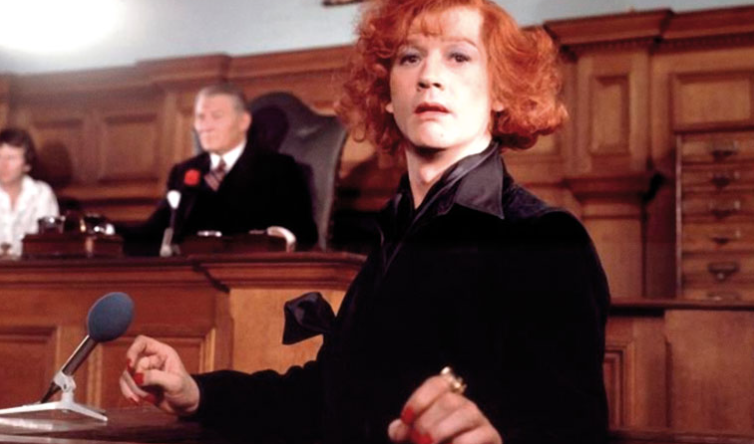
I just heard today of the death (on Wednesday 25th January, aged 77) of the great British actor John Hurt.
John Hurt was an extremely versatile actor who starred in many different roles, from Elephant Man to Alien, but I shall always remember him best as Quentin Crisp (above) in the 1975 television drama adapted from Crisp’s book The Naked Civil Servant which I saw on TV when it was first broadcast.
I realized this afternoon that I was going to have to come into my office at Cardiff University as there is something I was supposed to finish by midnight today and I had forgotten to bring some stuff I needed to complete it. Setting aside the absurdity of an employer who sets deadlines at 24.00 on a Sunday evening, I was planning to have a quiet night doing the Azed crossword. As I got ready to leave the house I heard myself muttering “Sunday Bloody Sunday” under my breath, and walking through town to get here I was thinking about John Schlesinger’s 1971 film of that title, starring Glenda Jackson, Peter Finch and Murray Head. This film was shown on TV – rather late at night – when I was a teenager in the late 1970s and I’ll never forget the impact this particular scene had on me then. Here’s a clip of Murray Head talking about the scene, which caused quite a stir at the time in some quarters, in which he describes it as a “giant step forward”. Let’s hope we’re not all about to take giant steps backward.
Over the Christmas break Composer of the Week on BBC Radio 3 featured Ivor Novello. Ivor Novello was considered old-fashioned even in his own lifetime, but I have no shame in admitting that I love his music, which I think is beautifully crafted. Ivor Novello was born David Ivor Davies, in Cardiff. In fact the house in which he was born is very close to mine:
Anyway, the Radio programme about Ivor Novello encouraged me to put on a DVD of the fine film Gosford Park, the script for which, written by Julian Fellowes, won an Oscar. In the movie, Ivor Novello is played by Jeremy Northam who sings a number of songs with his brother Christopher accompanying him at the piano, including this one. With music by Ivor Novello and lyrics by Edward Moore, it conveys that sense of longing for a better world that many of us are feeling right now.
Somewhere there’s another land
different from this world below,
far more mercifully planned
than the cruel place we know.
Innocence and peace are there–
all is good that is desired.
Faces there are always fair;
love grows never old nor tired.
We shall never find that lovely land of might-have-been. I can never be your king nor you can be my queen. Days may pass and years may pass and seas may lie between– We shall never find that lovely land of might-have-been.
Sometimes on the rarest nights comes the vision calm and clear, gleaming with unearthly lights on our path of doubt and fear. Winds from that far land are blown, whispering with secret breath– hope that plays a tune alone, love that conquers pain and death.
Shall we ever find that lovely land of might-have-been? Will I ever be your king or you at last my queen? Days may pass and years may pass and seas may lie between– Shall we ever find that lovely land of might-have-been?
For those of you who haven’t seen the Maltese Falcon, here’s my favourite scene from the film. Everything about this is just right: perfect dialogue (from the novel by Dashiel Hammett, adapted by director John Huston), perfect acting (Humphrey Bogart and Sidney Greenstreet), and perfect lighting and camera work (credit the great cinematographer, Arthur Edeson). This film is 75 years old this year but I don’t think it has dated at all!
Today is the Ides of March and we’re entering the final straight before crossing the finishing line of term and collapsing in a sweaty mess into the arms of the Easter holiday. I’ve been ridiculously busy today so, being too knackered to think of anything else to post, I thought I’d tap into a priceless bit of British cultural history relevant to this auspicious day.
This is from the First Folio Edition of Carry On Cleo, and stars the sublime Kenneth Williams as Julius Caesar delivering one of the funniest lines in the whole Carry On series. The joke may be nearly as old as me, but it’s still a cracker…
The other day I came across the interesting news that my favourite film, The Maltese Falcon, directed by John Huston, is being shown in “movie theaters” around the United States on 21st and 24th February to celebrate the 75th anniversary of the film’s release. The choice of dates is a little odd because the film actually premiered in October 1941, but I presume the timing is dictated by business considerations. Although I have seen this film many times on TV and on DVD I have never seen it in a cinema, and I hope there is a possibility I can do so somewhere in the UK this year. Here is the original trailer as shown in cinemas back in the day. I imagine that the sizeable frame of Sidney Greenstreet made quite an impression on movie-goers as he loomed out of the darkness!
I was listening to BBC Radio 3 last night. The evening concert happened to feature Mahler’s wonderful 4th Symphony, so obviously I turned the volume up. All of which reminded me of this scene from the film Educating Rita, featuring Julie Walters and Maureen Lipman. Fortunately in my case nobody rang the doorbell. I am not to be disturbed when listening to old Gustav.
The views presented here are personal and not necessarily those of my employer (or anyone else for that matter).
Feel free to comment on any of the posts on this blog but comments may be moderated; anonymous comments and any considered by me to be vexatious and/or abusive and/or defamatory will not be accepted. I do not necessarily endorse, support, sanction, encourage, verify or agree with the opinions or statements of any information or other content in the comments on this site and do not in any way guarantee their accuracy or reliability.