O Captain! my Captain! our fearful trip is done, The ship has weather’d every rack, the prize we sought is won, The port is near, the bells I hear, the people all exulting, While follow eyes the steady keel, the vessel grim and daring; But O heart! heart! heart! O the bleeding drops of red, Where on the deck my Captain lies, Fallen cold and dead.
O Captain! my Captain! rise up and hear the bells; Rise up—for you the flag is flung—for you the bugle trills, For you bouquets and ribbon’d wreaths—for you the shores a-crowding, For you they call, the swaying mass, their eager faces turning; Here Captain! dear father! This arm beneath your head! It is some dream that on the deck, You’ve fallen cold and dead.
My Captain does not answer, his lips are pale and still, My father does not feel my arm, he has no pulse nor will, The ship is anchor’d safe and sound, its voyage closed and done, From fearful trip the victor ship comes in with object won; Exult O shores, and ring O bells! But I with mournful tread, Walk the deck my Captain lies, Fallen cold and dead.
by Walt Whitman (1819-1892), posted in memoriam Robin Williams.
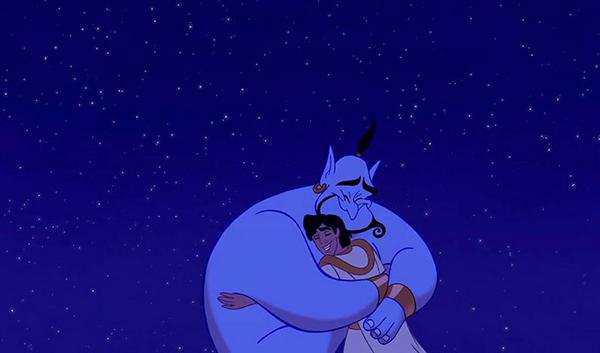
It’s been a hectic day so far but I couldn’t resist taking a little time out to post a little tribute to the enormous talent that was Robin Williams, who died last night having apparently taken his own life. Robin Williams was a unique comic talent, best displayed during his legendary stand-up routines, but also demonstrated to great effect on film, especially in Good Morning Vietnam and as the voice of the Genie in Disney’s Aladdin. These movies allowed him to express his remarkable spontaneous ability to connect ideas, characters and voices in a freewheeling improvised scenarios of breathtaking inventiveness; in both the films I mentioned his work was largely unscripted. In Good Morning Vietnam the cutaways to other actors while he did his bit in the radio studio clearly don’t show them acting, just cracking up as he cut loose his extraordinarily fertile imagination; and all the animators on Aladdin had to do to make a great film was to fill in images to match his free-flowing monologues, with celebrity impersonations and other funny voices thrown in for good measure.
Much has already been written about the sad circumstances of his death, and how he seems to have lost his long battle against depression. That a light that could shine so brightly has been lost to the darkness should be a cause of deep sadness, but no-one can really understand another person’s pain and it would be quite wrong to judge him selfish or weak because of the manner of his death. Instead, I shall remember him by the joy he gave – he was one of the comic actors who could reduce me to hysterics – and hope that in some way his loss might lead in some way to greater understanding of depression and other mental health problems.
My frame of mind for the day is largely determined by what is playing on BBC Radio 3 when it switches on at 6am as it does every morning to wake me up. This morning it happened to be the rousing Intermezzo from the Karelia Suite by Jean Sibelius. An intermezzo is very often a piece of fairly nondescript music played while people change the sets on stage during an opera or theatre performance, but this one is actually a terrific piece in its own right.
Often when the radio switches on when I’m asleep I don’t actually wake up immediately, but somehow seem to be able to incorporate the music into a dream. As I slowly emergedfrom my slumbers this morning my half-asleep mind somehow put this music together with a sort of action replay of the Ride of the Rohirrim, as Theoden’s army arrives to relieve the siege of Minas Tirith from The Lord of the Rings; the preamble fits well with the riders and horses gathering into line and preparing for battle, and the main theme conjures up the subsequent cavalry charge in rousing fashion.
My lunchtime task today has therefore been to find a clip of the film on Youtube and see how the music works. I suggest you turn the sound off the film clip (first youtube link) and let it run until about 58s in before starting the second which has the actual music on it. That way the peak of the crescendo and loud cymbal crash in Sibelius’ score coincides with the impact of the charge upon the orc formation.
Following on from yesterday’s post about George Green, I thought I’d add this little bit of Green trivia.
George Green’s sponsor and patron was the mathematician Edward Bromhead, a Baronet and member of the landed gentry of the county of Lincolnshire. Two generations later in the Bromhead family you will find a certain Gonville Bromhead (presumably named after Gonville & Caius College, the Cambridge college that both Edward Bromhead and George Green attended). As a young man, in January 1879, Lt. Gonville Bromhead fought in the Battle of Rorke’s Drift. Almost a century later he was played by Michael Caine in the film Zulu.
The other day I decided to treat myself by watching a DVD of the film Double Indemnity. It’s a great movie for many reasons, not least because when it was released in 1944 it immediately established much of the language and iconography of the genre that has come to be known as film noir, which I’ve written about on a number of occasions on this blog; see here for example. Like many noir movies the plot revolves around the destructive relationship between a femme fatale and male anti-hero and, as usual for the genre, the narrative strategy involves use of flashbacks and a first-person voice-over. The photography is done in such a way as to surround the protagonists with dark, threatening shadows. In fact almost every interior in the film (including the one shown in the clip below) has Venetian blinds for this purpose. These chiaroscuro lighting effects charge even the most mundane encounters with psychological tension or erotic suspense.
To the left is an example still from Double Indemnity which shows a number of trademark features. The shadows cast by venetian blinds on the wall, the cigarette being smoked by Barbara Stanwyck and the curious construction of the mise en scene are all very characteristic of the style. What is even more wonderful about this particular shot however is the way the shadow of Fred McMurray’s character enters the scene before he does. The Barbara Stanwyck character is just about to shoot him with a pearl-handled revolver; this image suggests that he is already on his way to the underworld as he enters the room.
I won’t repeat any more of the things I’ve already said about this great movie, but I will say a couple of things that struck me watching it again at the weekend. The first is that even after having seen it dozens of times of the year I still found it intense and gripping. The other is that I think one of the contributing factors to its greatness which is not often discussed is a wonderful cameo by Edward G Robinson , who steals every scene he appears in as the insurance investigator Barton Keyes. Here’s an example, which I’ve chosen because it provides an interesting illustration of the the scientific use of statistical information, another theme I’ve visited frequently on this blog:
One for the file marked “they don’t make films like this any more”. Here is a clip from very near the beginning of the extraordinarily imaginative romantic fantasy A Matter of Life and Death. It’s not quite the opening sequence as titled, though: there’s an astronomically themed preamble before the sequence shown in the clip.
Directed by Michael Powell and Emeric Pressberger and released in 1946, A Matter of Life and Death has remained in most film critics’ lists of top British movies for almost seventy years. If you really want to know why then you’ll have to watch the whole film, but this is a memorable opening to a film if ever there was one.
Incidentally, the splendid poem by Sir Walter Raleigh from which Peter Carter character (played by David Niven) quotes is called The Passionate Man’s Pilgrimage. Here it is in full:
GIVE me my scallop-shell of quiet, My staff of faith to walk upon, My scrip of joy, immortal diet, My bottle of salvation, My gown of glory, hope’s true gage; And thus I’ll take my pilgrimage.
Blood must be my body’s balmer, No other balm will there be given; Whilst my soul, like a quiet palmer, Travelleth towards the land of heaven; Over the silver mountains, Where spring the nectar fountains: There will I kiss The bowl of bliss; And drink mine everlasting fill Upon every milken hill: My soul will be a-dry before; But after, it will thirst no more. Then by that happy blestful day, More peaceful pilgrims I shall see, That have cast off their rags of clay, And walk apparelled fresh like me. I’ll take them first To quench their thirst, And taste of nectar suckets, At those clear wells Where sweetness dwells Drawn up by saints in crystal buckets.
And when our bottles and all we Are filled with immortality, Then the blessed paths we’ll travel, Strowed with rubies thick as gravel; Ceilings of diamonds, sapphire floors, High walls of coral, and pearly bowers. From thence to heavens’s bribeless hall, Where no corrupted voices brawl; No conscience molten into gold, No forged accuser bought or sold, No cause deferred, nor vain-spent journey ; For there Christ is the King’s Attorney, Who pleads for all without degrees, And he hath angels, but no fees. And when the grand twelve-million jury Of our sins, with direful fury, ‘Gainst our souls black verdicts give, Christ pleads his death, and then we live.
Be thou my speaker, taintless pleader, Unblotted lawyer, true proceeder! Thou giv’st salvation even for alms ; Not with a bribèd lawyer’s palms. And this is my eternal plea To him that made heaven, earth, and sea, That, since my flesh must die so soon, And want a head to dine next noon, Just at the stroke, when my veins start and spread, Set on my soul an everlasting head. Then am I ready, like a palmer fit; To tread those blest paths which before I writ.
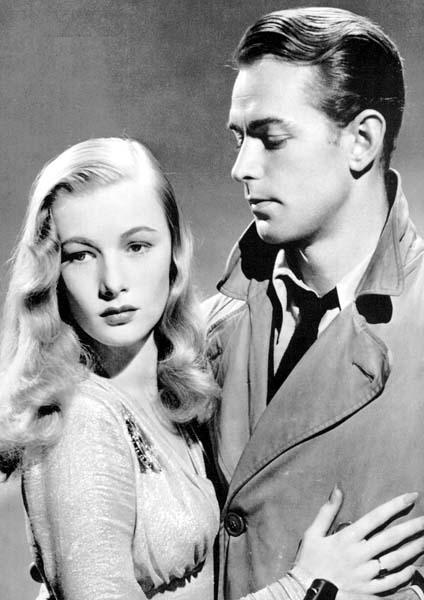
There’s a pragmatic reason why Paramount Studios chose Veronica Lake to star with Alan Ladd, namely her size. Alan Ladd was quite a small man, standing just a shade under 5′ 5″ tall, and the casting directors consequently found it difficult to locate a leading lady who didn’t tower over him. Veronica Lake, however, was only 4′ 11″ and fitted the bill nicely:
Veronica Lake and Alan Ladd
It wasn’t just her diminutive stature that propelled Veronica Lake to stardom; she was also very beautiful and managed to project a screen image of cool detachment which made her a perfect choice as femme fatale, a quintessential ingredient of any Film Noir. She’s absolutely great in both the movies I watched, and in many more besides. Her looks and screen presence turned her into a true icon -a vera icon in fact- appropriately enough, because the name Veronica derives from that anagram. The cascade of blond hair, often covering one eye, became a trademark that later found its way into, for example, the character of Jessica Rabbit in the animated film Who Framed Roger Rabbit?
However, her success as a movie star was short-lived and Veronica Lake disappeared from Hollywood entirely in the 1950s. She was rediscovered in the 1960s working as a waitress in a downmarket New York bar, and subsequently made a film called Footsteps in the Snow but it disappeared without trace and failed to revitalize her career. She died in 1973.
So why did an actress of such obvious talent experience such a dramatic reversal of fortune? Sadly, the answer is a familiar one: problems with drink and drugs, struggles with mental illness, a succession of disastrous marriages, and a reputation for being very difficult to work with. Her famous screen persona seems largely to have been a result of narcotics abuse. “I wasn’t a Sex Symbol, I was Sex Zombie”, as she wrote in her biography. She appeared to be detached, because she was stoned.
It’s a sad tale that would cast a shadow over even over the darkest Film Noir but though she paid a heavy price she still left a priceless legacy. Forty years after her death, all that remains of her is what you can see on the screen, and that includes some of the greatest movies of all time.
In case you didn’t know, today is St Crispin’s Day. It’s also the anniversary of the Battle of Agincourt, which took place on this day in 1415, and which features in Shakespeare’s Henry V. Here is the famous St Crispin’s Day Speech, delivered in stirring style by Laurence Olivier, in the classic 1944 film.
And here is the orginal text, slightly different from the film version, Henry V in Act IV Scene iii 18-67. Scene: The English Camp:
WESTMORELAND. O that we now had here But one ten thousand of those men in England That do no work to-day!
KING. What’s he that wishes so? My cousin Westmoreland? No, my fair cousin; If we are mark’d to die, we are enow To do our country loss; and if to live, The fewer men, the greater share of honour. God’s will! I pray thee, wish not one man more. By Jove, I am not covetous for gold, Nor care I who doth feed upon my cost; It yearns me not if men my garments wear; Such outward things dwell not in my desires. But if it be a sin to covet honour, I am the most offending soul alive. No, faith, my coz, wish not a man from England. God’s peace! I would not lose so great an honour As one man more methinks would share from me For the best hope I have. O, do not wish one more! Rather proclaim it, Westmoreland, through my host, That he which hath no stomach to this fight, Let him depart; his passport shall be made, And crowns for convoy put into his purse; We would not die in that man’s company That fears his fellowship to die with us. This day is call’d the feast of Crispian. He that outlives this day, and comes safe home, Will stand a tip-toe when this day is nam’d, And rouse him at the name of Crispian. He that shall live this day, and see old age, Will yearly on the vigil feast his neighbours, And say “To-morrow is Saint Crispian.” Then will he strip his sleeve and show his scars, And say “These wounds I had on Crispian’s day.” Old men forget; yet all shall be forgot, But he’ll remember, with advantages, What feats he did that day. Then shall our names, Familiar in his mouth as household words- Harry the King, Bedford and Exeter, Warwick and Talbot, Salisbury and Gloucester- Be in their flowing cups freshly rememb’red. This story shall the good man teach his son; And Crispin Crispian shall ne’er go by, From this day to the ending of the world, But we in it shall be remembered- We few, we happy few, we band of brothers; For he to-day that sheds his blood with me Shall be my brother; be he ne’er so vile, This day shall gentle his condition; And gentlemen in England now-a-bed Shall think themselves accurs’d they were not here, And hold their manhoods cheap whiles any speaks That fought with us upon Saint Crispin’s day.
You pick up a lot of interesting snippets listening to BBC Radio 3. Last night I was listening to a programme about Alex North, a prolific composer of music scores, including one of my favourite films A Streetcar Named Desire. Alex North also wrote a complete soundtrack for Kubrick’s 2001: A Space Odyssey and must have been mortified when he turned up for the Premiere and found that not a single note of the music he’d written was used in the final version. Anyway, one thing I learnt that I didn’t know before was that Alex North also wrote the tune Unchained Melodyfor a relatively unknown prison movie called, appropriately enough, Unchained. The song was a massive hit in the 60s for the Righteous Brothers, and gained popularity again as a consequence of the 1990 film Ghost. It’s also been murdered by countless karaoke singers since then…
Anyway, here is the original version of Unchained Melody as it appears in the 1955 film. Knowing the background to the song (i.e. that the enforced separation of the singer and his sweetheart is because the former is in prison) makes it all the more poignant, and Todd Duncan (whose style clearly owes a debt to Paul Robeson) gives it a bluesy feel present in none of the cover versions I’ve heard…
Having survived the chairing of our lengthy Progression and Award Board this morning here in Sussex, I thought I’d just spend a few minutes on the blog before going up to London for an event at the Royal Society this evening.
The event was a special preview screening of the a feature length documentary called Hawking, about the life and career of celebrated British cosmologist and theoretical physicist Stephen Hawking, followed by a question-and-answer session with the producer and director. There have been many films about Hawking already, but the distinctive thing about this one is that Hawking himself contributed to the script so, to some extent, it’s “in his own words”. It’s quite clear that it wasn’t meant so much as a science documentary as an unflinching look at Hawking’s struggle against Motor Neurone Disease, with his scientific work merely serving as background to the human interest story. It is, of course, a very moving narrative not only because of the hardship he has been forced to endure but also because of what he has achieved as a scientist in the face of difficulties that would have defeated persons of lesser determination.
I found the film interesting but a little frustrating because, while it raised many interesting issues (such as the conflict between celebrity and privacy), it moved on so quickly that none of them were really explored in any depth. I did strike me, however, as a very honest film – the discussion of the break-up of his first marriage was very candid, but it was nice to discover that in recent years Stephen and Jane have are at least on speaking terms again. Hawking’s sense of humour, which is often concealed by his disability, also came across very well. I could give an example of this from my own experience, but given the nature of the prank he played I think it’s better not to!
Anyway, I won’t say anything more because I don’t want to colour anyone’s judgement about the film, which doesn’t go on general release in the UK until later in the year. Go to see it yourself, and make your own mind up! In the meantime, here is the official trailer:
The views presented here are personal and not necessarily those of my employer (or anyone else for that matter).
Feel free to comment on any of the posts on this blog but comments may be moderated; anonymous comments and any considered by me to be vexatious and/or abusive and/or defamatory will not be accepted. I do not necessarily endorse, support, sanction, encourage, verify or agree with the opinions or statements of any information or other content in the comments on this site and do not in any way guarantee their accuracy or reliability.
 George Green’s sponsor and patron was the mathematician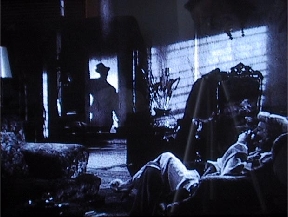


 In the Dark