Archive for the History Category

The Number 1 Scientist from the North

Posted in History, The Universe and Stuff on November 10, 2013 by telescoper

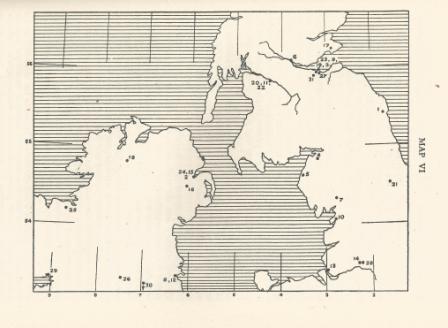
This morning I was glancing through an old book called Science since 1500, which was written by H.T. Pledge and published in 1939 by Her Majesty’s Stationery Office on behalf of the Ministry of Education.

The map shows the distribution of birthplaces of famous British scientists (from about 1800 to about 1900). This map is restricted to the “exact” sciences, and I’m not exactly sure what that means, but judging by the names, it includes physics, astronomy and chemistry. Clustering is apparent, especially in Edinburgh and Glasgow but also in Ireland.

Note, however, the relative dearth of such scientists from the North of England. In fact there is only one (appropriately enough labelled ‘1’), though there are several born in the Midlands, especially near Manchester..

I have scanned the legend which reveals the names, and will post it in due course, but I thought it would be fun to have a small competition to see who knows the identity of the Number 1 Scientist from the North.

If you’d like to guess any of the others please feel free too. Just to give an example, No. 7 is Arthur Stanley Eddington (who was born in 1882 in Kendal, in what is now Cumbria).

Answers through the comments box please!

The Shadow of Newton

Posted in History, The Universe and Stuff with tags , , , , , , , on November 7, 2013 by telescoper

Yesterday I overheard some Electrodynamics students talking about the fact that all the famous names attached to pioneering laws or theorems in that subject seem to be either French (Biot-Savart, Laplace, Poisson..) or German (Gauss, Helmholtz…). Why are there no British names in this list?

Well, there was Faraday, of course. But Michael Faraday was primarily an experimentalist rather than a theorist, which sets him apart from the others already mentioned. So why is it that British theoretical was behind continental Europe in the early part of the 19th Century when all this important work on electricity and magnetism was being done.

There was also Maxwell, but he came along a bit later; he published his theory of electromagnetism in 1861/2. So why were the British so slow to enter this field?

Well, my theory of this is that it’s all the fault of Isaac Newton. I came to this conclusion when reading about the work of British mathematician and physicist George Green, who lived from 1793 until 1841, and who left a substantial legacy for modern theoretical physicists, in Green’s theorems and Green’s functions. George Green is also credited as being the first person to use the word “potential” in electrostatics. Green was the son of a Nottingham miller who, amazingly, taught himself mathematics and did most of his best work, especially his remarkable Essay on the Application of mathematical Analysis to the theories of Electricity and Magnetism (1828) before starting his studies as an undergraduate at the University of Cambridge (which he did at the age of 30, after his father died, and he leased out the mill he consequently inherited, to pay for his studies).

Extremely unusually for British mathematicians of his time, Green taught himself from books that were published in France. This gave him a huge advantage over his national contemporaries in that he learned the form of differential calculus that originated with Leibniz, which was far more elegant than that devised by Isaac Newton (which was called the method of fluxions).

Great scientist though he was, Newton’s influence on the development of physics in Britain was not entirely positive. Newton was held in such awe, especially in Cambridge, that his inferior mathematical approach was deemed to be the “right” way to do calculus and generations of scholars were forced to use it. This held back British science until the use of fluxions was phased out. Green himself was forced to learn fluxions when he went as an undergraduate to Cambridge despite having already learned the better method.

Unfortunately, Green’s great pre-Cambridge work on mathematical physics didn’t reach wide circulation in the United Kingdom until after his death. William Thomson, later Lord Kelvin, found a copy of Green’s Essay in 1845 and promoted it widely as a work of fundamental importance. This contributed to the eventual emergence of British theoretical physics from the shadow cast by Isaac Newton which reached one of its heights just a few years later with the publication a fully unified theory of electricity and magnetism by James Clerk Maxwell.

The astronomer who came in from the cold

Posted in History, Politics, The Universe and Stuff with tags , , , , on November 1, 2013 by telescoper

Here’s a fascinating little bit of history for you. The other day I discovered the old Visitor’s Book in which staff of the Astronomy Centre at the University of Sussex used to record the names of distinguished guests who appeared here to give seminars. There are many illustrious names in the book, including for example at the bottom of this page (from 1968), Ed Salpeter.
Cold War

However, the name to which I’d like to draw your attention is in the middle of this page. On 17th August 1968 the Astronomy Centre played host to two Russian visitors, an astrophysicist called Dr G.S. Khromov from the Sternberg Astronomical Institute in Moscow and a chap from the state-run Novosti Press Agency by the name of Gennadi I. Gerasimov.

I know little of Khromov’s work in astrophysics, but it is significant that he was permitted to visit the United Kingdom during the Cold War period, long before Glasnost and the eventual break-up of the Soviet Union. The second name is much more famous. Gennadi Ivanovich Gerasimov rose through the ranks of the Soviet System and eventually during the 1980s became Foreign Affairs spokesman for Mikhail Gorbachev and press spokesman for Eduard Shevardnadze.

So what was he doing in Sussex in 1968 attending an astronomy seminar? Well, the answer to that is that during the 1960s Russian scientists were generally only allowed to visit the West if they were accompanied by a “minder”, usually some form of KGB operative whose job was to ensure the scientist did not defect; the use of a press agency as cover story was pretty standard in such cases.  I’ve heard similar stories from Russian colleagues who travelled to the west under similar constraints during this period, and even some in which the scientist was the cover story for the agent!

So Gennadi Gerasimov was almost certainly at one time a KGB agent. Given the career of the current President of Russia, this should come as no surprise…

The Gathering Storm

Posted in Biographical, History with tags , , , on October 27, 2013 by telescoper

Twenty-six years ago I was living in Brighton as a graduate student at the University of Sussex. On October 16th 1987 (a Friday) I woke up to find the electricity had been cut off. Without breakfast, I left the house come up to campus, only t to find the street lined with fallen trees, smashed cars and houses with broken windows. This was the Great Storm of 1987 which, according to weather forecaster Michael Fish, was “not a hurricane” and I had slept through the whole thing…

I didn’t make it up to campus that Friday. The trains weren’t running because there was no electricity, power lines having been brought down by the storm, and even if there had been electricity the trains couldn’t have run because the tracks were blocked by fallen trees. When I did make it up to campus several days later the trees on the hills either side of the campus had been combed flat. It took years for them to recover. I hope they don’t suffer the same fate this time.

Here’s the infamous weather forecast broadcast on the Thursday evening

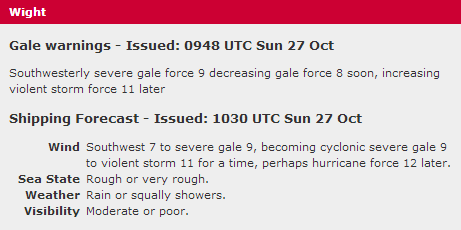
Another storm is forecast to arrive tomorrow; here is the Shipping Forecast for sea area Wight which, includes the town of Brighton and areas to the West.

gale_warning

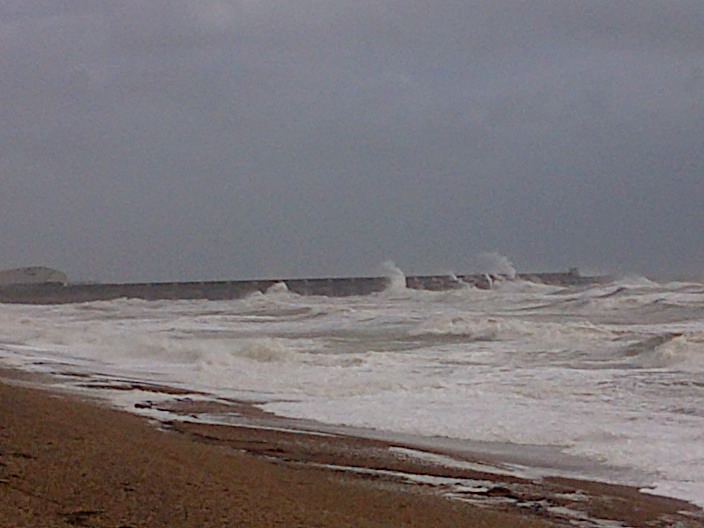
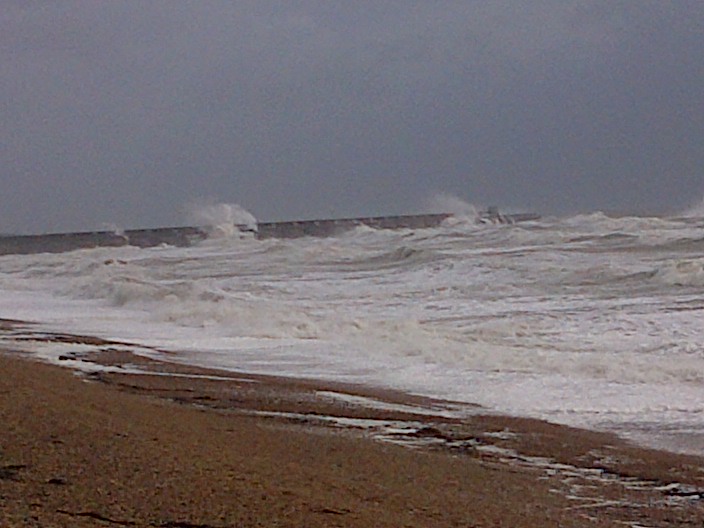
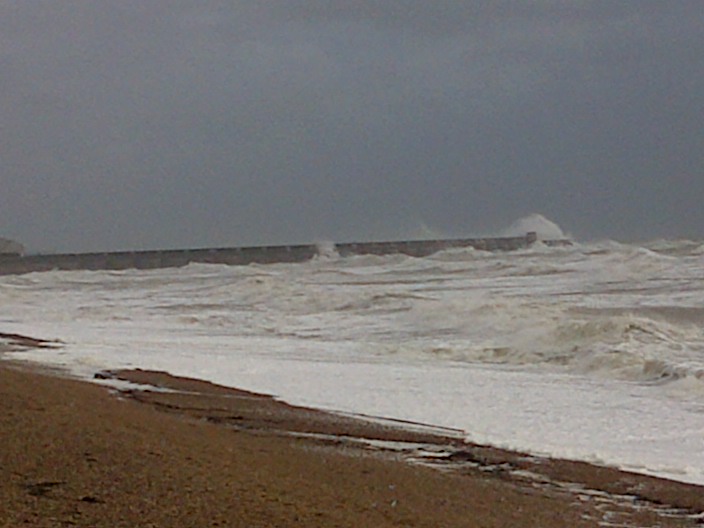
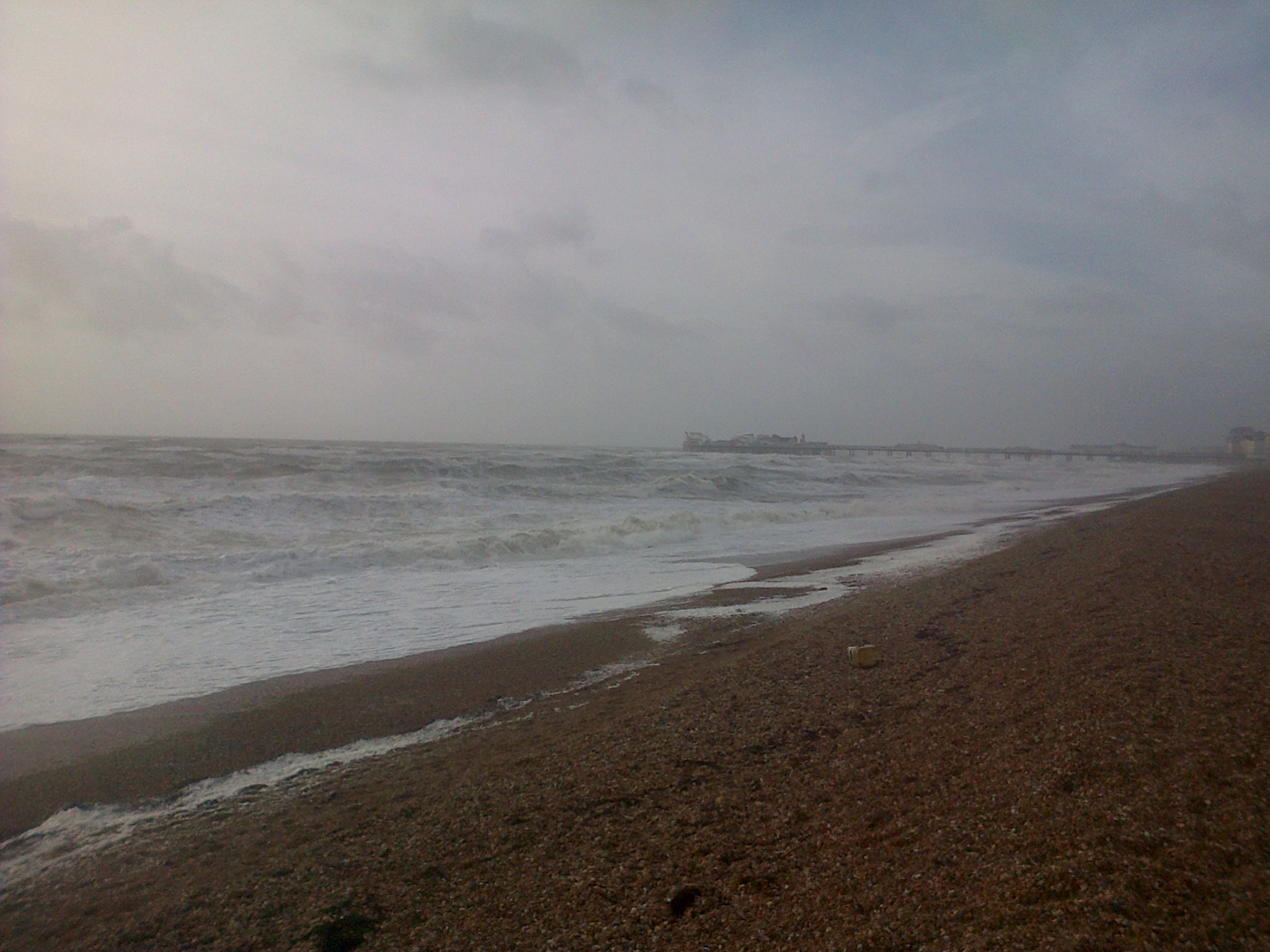
The adjacent sea area, Dover, to the East is just as bad. Evidently it’s not a good day to be messing about in boats. This lunchtime I took a walk along the beach at Brighton to see how bad it was. The wind direction was  from the southwest and I estimated it was about force 7, based on the fact that it nearly blew me over when I turned into it. Not quite a gale, but getting there. A violent storm force 11 is bad enough, but there is a chance of hurricane force 12. That could cause damage on the scale of 1987. I’m now looking very nervously at the scaffolding covering several buildings in my street..

Here are some pictures I took with my phone looking towards the Marina.

IMG-20131027-00193 IMG-20131027-00194 IMG-20131027-00195

And here, in the opposite direction,  is Brighton Pier. There was so much salt spray from the breaking waves that I found hard to keep the lens clear, but the Pier was still open for the usual amusements…

IMG-20131027-00196

These are just the preliminaries, though. The bulk of the storm is yet to hit us. Something tells me we’re in for a stormy night!

Emmy Noether on Ada Lovelace Day

Posted in History, The Universe and Stuff with tags , , on October 15, 2013 by telescoper

It’s been an interesting morning. We had no electricity in the School for most of the morning owing to a power cut, but it was eventually restored while I was away at a meeting elsewhere on campus. Before that I was delayed getting into work because there was an explosion in central Brighton which disrupted the bus service I use to get to Falmer campus. That palaver provides me with a reasonable justification for not having much time to write a blog today.

However, since today is Ada Lovelace day, on which we celebrate inspiring stories of women in science and technology, I thought I’d post a (rather long) video about pioneering mathematical physicist Emmy Noether who is undoubtedly one of the most underrated physicists of all time. When I used to teach Theoretical Particle Physics many moons ago I spent quite a bit of time talking about the very deep connections that Noether uncovered between symmetry and conservation laws. Most of the students were well aware of the laws of conservation of energy and momentum, say, but unaware of the relationship between these laws and symmetries under time and space translations respectively. Making this connection helps to develop a much deeper understanding of many areas of physics. It’s also a very beautiful bit of mathematical analysis.

Anna Bolena at WNO

Posted in History, Opera with tags , , , , on September 9, 2013 by telescoper

It was the Last Night of the Proms on Saturday, but I was otherwise engaged at the First Night of the new production by Welsh National Opera of Anna Bolena by Gaetano Donizetti at the Wales Millennium Centre in Cardiff. This is one of three famous Donizetti operas set in the Tudor period (Anna Bolena, Maria Stuarda and Roberto Devereux) which I was slightly surprised to learn are collectively often described as the “Three Donizetti Queens”; I’m not sure what this implies about the erstwhile Earl of Essex. Anyway, as a fan of Italian bel canto I decided I just had to go to see Anna Bolena in Cardiff, even though it meant a trek back to Brighton yesterday. Hopefully I’ll be able to see the other two Queens in due course.

Anna Bolena is Donizetti’s imagining of the last days of the life of Anne Boleyn, the second wife of Henry VIII, so it’s basically the dark story of a young woman trapped in a web of intrigue and betrayal, a story made all the darker by the fact that it is based on real events. I wonder if such a plot would have ever have been considered plausible if it hadn’t actually happened?

The opera begins with Anna already having lost favour with her husband Enrico (Henry VIII), who is intent on ditching her in favour of  Jane (Giovanna) Seymour (who would shortly become Wife Number Three), but he first has to find a pretext to have her got rid of. Enrico lays a trap involving her brother, George Boleyn (the Lord Rocheford), the young musician Smeaton and Anna’s ex, Lord Percy, into which they and Anna duly fall. The hapless Smeaton confesses to having had an affair with Anna in the mistaken belief that she would be spared if he did so. Unfortunately, this amounts to an admission of treason. Despite Jane Seymour’s plea to Enrico to spare Anna’s life, she is condemned to die. The opera ends with all four people implicated in the plot walking off the stage to face execution, reconciled to their fate.

Of course the story is familiar from school history lessons, but what is especially compelling about it how it is told in this context is how the opera draws the audience into the character and innermost thoughs of the protagonists. For examples, Anna is more complex than you might imagine. It is true that she is naive, and out of her depth in a court so filled with plots and snares, but she is also at the same time ambitious and determined. Anna’s relationship with her rival Jane Seymour is also subtly nuanced, their deep fondness for each other demonstrated in a truly wonderful duet between soprano (Anna) and mezzo (Giovanna). The only real weak spot as far as characterization goes is Enrico, who comes across as little more than a pantomime villain (even to the extent that he received humorous boos on his curtain call). Of course Henry’s behaviour was tyrannical, but the drama would have worked more convincingly if there were at least something about him (other than his crown) that made Anna and Giovanna both adore him so much..

In typical bel canto style the voices of the singers are often extremely exposed, with the orchestra taking a back seat to a succession of dazzling coloratura passages with very little doubling of the vocal line to act as a safety net. At times, Donizetti’s music is little more than a basic backing track, but there is gorgeous orchestral writing in there too where the drama requires it. And that’s the point. Bel canto is not and never has been just about beautiful singing; the great operas in this genre also have great dramatic power and emotional intensity.

Serena Farnocchia’s Anna Bolena (soprano) was ably matched in beauty and clarity of voice by Katharine Goeldner as Giovanna Seymour (mezzo soprano). Faith Sherman (contralto) sang the part of the boy Smeaton with great sensitivity. Alastair Miles was also pretty good as Enrico, but I think the role suits someone with a more powerful bass voice. Robert McPherson as Lord Percy sang accurately enough but his lightish tenor voice has a rather nasal edge to it which took me quite a while to get used to.

The staging is stark and rather minimal, with just a few references to the Tudor period in items of furniture and in the style of the costumes (which are mainly black) but otherwise very little in terms of scenery. Very effective use was made of the revolving centre of the stage which provided movement without distracting from the most important aspect of the opera, namely the emotional turmoil of the characters on stage. The various elements of the staging and music came together in stunning fashion during Anna’s `Mad Scene’ near the end of Act II in which, delirious on the eve of her execution, she lapses into a trance-like state and relives happier moments while her friends gradually drift away into darkness. The lighting is sombre throughout the production, but in the Mad Scene Anna takes on a ghostly appearance. Musically speaking, this scene is quite famous – there’s an amazing version with Maria Callas as Anna here– but I found the cumulative effect of the elements of the life performance quite overwhelming. I’ll have to add this one to my list of pieces of music likely to make me fall to bits and thus to be avoided on trains…

A word too for the Orchestra of Welsh National Opera under conductor Daniele Rusitioni who played the gorgeous music impeccably. And another word for the Chorus of Welsh National Opera who were also excellent, not just in their singing but also in their wider contributions onstage.

All in all, a very fine night at the opera. The only real disappointment for me was that there were so many empty seats. It’s true that Anna Bolena isn’t one of the best known operas, but it is a gem. I hope this production gets the audience it deserves. And I also hope I can get to see the rest of the Tudors!

PS. I notice that the Guardian review has given it 4 stars. Bit stingy, possibly..
The Lindisfarne Gospels

Posted in Art, History with tags , , , , on July 25, 2013 by telescoper

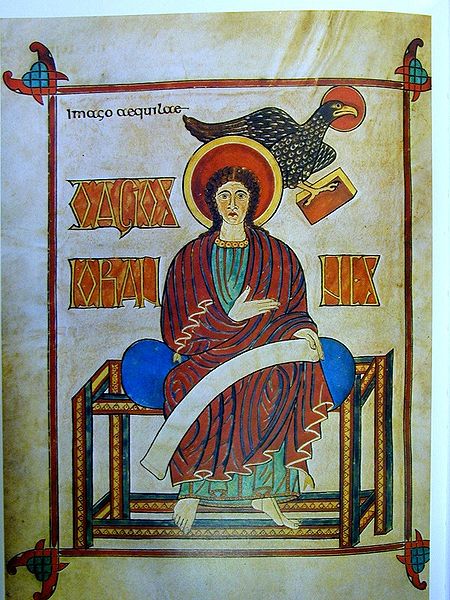
450px-Lindisfarne_Gospels_folio_209vOne of the interesting things going on in Durham during the week of this conference is an exhibition relating to the Lindisfarne Gospels. This extraordinary book was written around 715AD, just after the death of St Cuthbert. For those of you not familiar with Lindisfarne, or “Holy Island” as it is often called, it’s a small island off the Northumbrian coast, connected to the mainland by a causeway which is covered by the tide twice a day.

Although the Lindisfarne Gospels are about 1300 years old, the colours remain extremely vivid. It’s a remarkable thing to look at the pages on view in the exhibition to see the marks made by a human hand all that time ago; it’s difficult not to wonder about the life of the person who devoted what must have been a huge amount of time compiling this exquisite work.

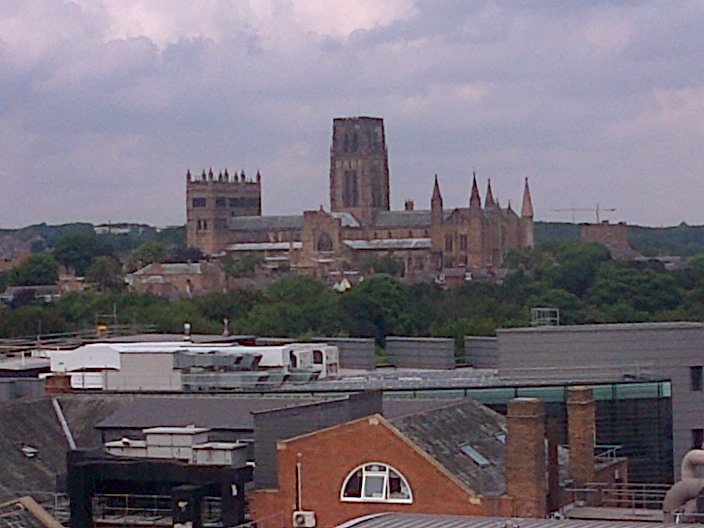
Incidentally, St Cuthbert’s remains now lie in a tomb inside Durham’s magnificent cathedral, of which we have a fine view from the balcony of the Calman Learning  Centre during the coffee breaks:

IMG-20130724-00154

The Joy of Pepys

Posted in Biographical, History with tags , , , , on May 3, 2013 by telescoper

Twitter is much maligned by those who don’t use it, and I’d be the first to admit that it has several million downsides, but every now and again you come across something truly wonderful which makes it worthwhile putting up with the dross. Here’s an example. Some time ago, a nameless genius came up with the idea of tweeting excerpts from the Diaries of Samuel Pepys.  Those of you on Twitter can follow Samuel Pepys by clicking here:

For those of you not familiar with Twitter, its main characteristic is that messages posted on it (“tweets”) are limited to 140 characters. To outsiders this seems to imply that all tweets are banal and pointless, but this is far from the case. The strict length limit forces a form of creativity that is both rare and wonderful. The stroke of genius in this case was to realize that the Pepys Diaries could be tweeted in chunks of the right size, in a manner that almost suggests they were designed for the purpose!

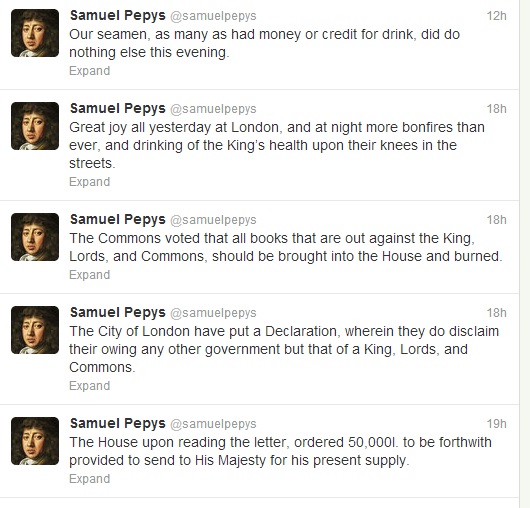
Pepys was a high-ranking naval administrator and Member of Parliament so he had detailed knowledge of the momentous political events of his period. He’s currently tweeting from May 1660 (near the start of the diaries), giving a vivid insight into the background to the Restoration of the Monarchy. Parliament should be recalled in a few days time, on May 8th…

Here is a selection of recent examples:
peps

But it’s not just the fascinating political context that makes these tweets so interesting. They also give glimpses of everyday life in the 17th Century. Pepys was in poor health for much of his life, for example, and there are frequent references to various physicians and their quack remedies. He also manages to conjure up in just a few words the extraordinary atmosphere and energy of the London of the period, along with some of its excesses (especially drinking and fornication).

Following Pepys’ Twitter feed opens a window into 17th Century England, and what comes through it is both refreshing and illuminating. The reason I find this particularly delightful is something that I’ve blogged about before, so won’t repeat at length. I was a very late developer from an education point of view until I was helped with my reading and arithmetic by a wonderful old lady who lived next door. She encouraged me to read and, after a big struggle, I eventually got the hang of it. After a time I had caught up with the rest of the class in School and eventually managed to read just about every book the School had to offer, including the Diaries of Samuel Pepys which were for some reason on the shelves in Class 2 and which I was allowed to borrow. I don’t think anyone had read them before so nobody, including the teachers, knew how rude they were in places. The Restoration period was generally rather bawdy, and Pepys’ Diaries reflect that.

I had no idea at that time, of course, that less than ten years later I would be studying at Magdalene College, Cambridge, site of the Pepys Library where the orignal diaries are kept as well as the rest of Pepys’ own collection of rare books and music.

The UK’s first female professor

Posted in History, Uncategorized on March 9, 2013 by telescoper

admin's avatarWe Are Cardiff

Hello friends. Happy International Womens Day! To celebrate, our friend Kelly Page has written us a We Are Cardiff about the first female professor to be appointed to the (at the time) Cardiff University. Go! Go!

First Female Professor Appointed in the Largest Coal Port in the World

Imagine it is 1904.

You are living and working in Cardiff, the largest coal port in the world.
You are a woman, 40 years young, working as the head of women’s teacher training in the town’s new university.

The university, University College of South Wales and Monmouthshire (now Cardiff University) is only 20 years old. It was founded with 13 staff and 151 students, 15 of who were women (1883).

You are working at one of the first universities in Britain to open its doors to female students and with a residence specifically for women, Aberdare Hall (1885). A hall that is…

View original post 765 more words

Changing Times

Posted in History, Politics with tags , , on February 5, 2013 by telescoper

I couldn’t resist a quick comment about the news that today the House of Commons began a debate on the second reading of the Marriage (Same Sex Couples) Bill. The timing of this when I’ve just moved back to Brighton after an absence of 23 years or so made me think back to what things were like when I was previously here as a DPhil student.

In those days the dominant concern facing LBGT staff and students was the notorious Section 28, part of the Local Government Act of 1988, which, among other things, attacked promotion of “the acceptability of homosexuality as a pretended family relationship”. I remember very well the numerous demonstrations and other protests I went on as part of the campaign against that repugnant and obviously discriminatory piece of legislation, but it passed into law anyway. I know 25 years is a long time, 1988 was before today’s generation of undergraduates was even born, but it’s still amazing to me that attitudes have changed so much that there’s even a remote possibility that same sex marriage might be legalized. And from what I hear, the possibility isn’t remote at all…