Archive for the History Category

To the Warmongers

Posted in History, Poetry, Politics with tags , , , on November 8, 2010 by telescoper

As we approach Remembrance Sunday (which this year lies on 14th November) I find myself once again wearing a poppy on my coat lapel, and having once again to explain this to those I meet in the department and elsewhere who don’t approve. I’ve already said everything I think I need to on this in posts last year and the year before, so I won’t repeat myself at length here.

I am aware (and acutely sensitive to) the danger that the wearing of a poppy might be mistaken for support for militarism and that many of our politicians would like to manipulate the meaning of this symbol in precisely that way for their own ends. Nevertheless, I will wear one and will observe the two minutes’ silence on Thursday too. Why? Lest we forget, that’s why…

But instead of debating this again, I will  post the following poem and letter, both of which were written by Siegfried Sassoon.

The poem is called the To the Warmongers:

I’m back again from hell
With loathsome thoughts to sell;
Secrets of death to tell;
And horrors from the abyss.
Young faces bleared with blood,
Sucked down into the mud,
You shall hear things like this,
Till the tormented slain
Crawl round and once again,
With limbs that twist awry
Moan out their brutish pain,
As for the fighters pass them by.
For you our battles shine
With triumph half-divine;
And the glory of the dead
Kindles in each proud eye.
But a curse is on my head,
That shall not be unsaid,
And the wounds in my heart are red,
For I have watched them die.

The astonishing letter below was written by Siegfried Sassoon in July 1917, and was subsequently read out in the House of Commons. Sassoon narrowly escaped court martial for treason.

It’s worth noting the last two paragraphs:

I have seen and endured the sufferings of the troops and I can no longer be a party to prolonging these sufferings for ends which I believe to be evil and unjust. I am not protesting against the conduct of the war, but against the political errors and insincerities for which the fighting men are being sacrificed.

On behalf of those who are suffering now, I make this protest against the deception which is being practised upon them; also I believe it may help to destroy the callous complacency with which the majority of those at home regard the continuance of agonies which they do not share and which they have not enough imagination to realise.

The tragedy is that these words could equally well have been written about Afghanistan 2010 rather than France or Belgium 1917. The sight of Tony Blair wearing a poppy at the Cenotaph is one that filled me with nausea, but his hypocrisy makes it more, not less, important to hang on to the true meaning. Lest we forget. Nowadays, though, I don’t really “wear my poppy with pride”, but with something rather closer to shame.


Share/Bookmark

Thatcher’s Final Victory?

Posted in History, Politics, Science Politics with tags , , , on October 16, 2010 by telescoper

Next Wednesday (20th October) we will hear the outcome of the Comprehensive Spending Review, and what it means for the scale of the cuts to UK public spending in each of the government departments. After that the detailed breakdown of cuts within each Ministry will gradually be revealed. Some news has already leaked out, of course. The Browne Report published last week almost certainly heralds huge cuts in the state subsidy to the UK University sector, with the cost of Higher Education consequently shifting from the taxpayer to the student. On top of that, and despite the best efforts of the Science is Vital campaign, it seems highly likely that there will be a steep decrease in investment in scientific research – both through the Research Councils and through the research component of Higher Education funding. On the other hand, the defence budget appears to have been spared the worst of the hatchet, with the Trident nuclear submarine programme set to go ahead (with a price tag around £25 billion) and two new aircraft carriers to be built at a cost of £5.5 billion (although it is not clear there will actually be any aircraft to operate from them).

Obviously, knowledge and learning are less important to the future of this country than the ability to fight pointless wars against invented enemies. Morover, we already spend more than most competitor economies on defence as a fraction of GDP, and less on  universities and science. How did we end up with such distorted priorities?

On top of these cuts we have to contend with a draconian cap on immigration. New restrictions on visas for non-EU citizens will make it much harder for British universities to recruit overseas students and staff. The new rules give exemptions only to those coming to the UK to take up highly paid jobs, such as professional footballers. Postdoctoral researchers and university lecturers don’t get paid enough to register as economically relevant, so many fewer will be able to enter this country. While these restrictions may satisfy xenophobic Daily Mail readers, they promise to damage the University sector almost as much as the funding cuts, as a significant fraction of the best staff in UK science departments are from outside the EU (including the two winners of the 2010 Nobel Prize for Physics).

All this sounds depressingly familiar to those of us who lived through the various Thatcher governments and their successors. In fact, looking at the following graph (which I nicked from Andy Lawrence’s blog, but which comes from a document produced by the Royal Society) you’ll see the steady reduction in science investment under previous Conservative governments

I know I’m not alone in interpreting these cuts as not being about the need to secure the country’s finances. The UK’s public debt as a fraction of GDP is rising, of course, and something needs to be done about it. But this graph shows the actual situation:


Serious? Yes, but not sufficient to justify the carnage we’re about to experience.

What is going on is that the parlous state of the UK’s finances is being used as a pretext to resume the Thatcherite attack on the welfare state through a campaign of privatisations and closures so that wealthy Tory voters can get richer at the expense of ordinary working people.

No doubt there will be people reading this who really think that cutting back state expenditure is a good thing, and even I agree with that to some extent. However, there is a part of Thatcher’s legacy that is actually the root of the problem and it represents a fundamental inconsistency of the Thatcher project. Unless it is tackled, the cut-and-burn route will not lead to a sustainable economy, but will take this country into inexorable decline.

The nub of the matter is the Invasion of the Bean Counters into every aspect of public life. The breakdown of trust between government and the public sector that ushered in Margaret Thatcher’s victory in the 1979 General Election has led to a huge increase in red tape involved in the assessment, regulation and general suffocation of public services. As the Thatcher project continued through John Major’s, and, yes, Tony Blair and Gordon Brown’s governments (Blair was undoubtedly a Thatcherite) any rises in public spending went not into providing better services but in a vast and unwieldly machinery of regulation. Now it matters less whether the public sector does things well. What matters is that they tick the boxes imposed by civil service mandarins. This mentality has led to a proliferation of overpaid administrators in the National Health Service, schools are hamstrung by the rigid constraints of the National Curriculum, the Police spend more time filling in forms than they do investigating crime, and the number of staff employed in university administration has increased at the expense of teaching and learning.

You might say that this is all the fault of New Labour, but I don’t think that’s right; the suffocation of the UK’s public sector began with Thatcher and it began as a direct result of the Winter of Discontent (a re-run of which seems eminently possible). The reason why a succession of right-wing governments have failed to get a grip on public spending is that they’ve all been run by control freaks and have pumped money into wasteful self-serving bureaucracies.

Britain has turned into a version of Golgafrincham, with the “useless third” now in the position of wielding the axe over those few remaining things in the UK which are actually pretty good.

Apparently, Margaret Thatcher is not in very good health and may not live much longer. I won’t mourn her passing. In Thatcher’s time in office, this country took giant steps towards becoming a police state. She encouraged xenophobia and intolerance, and spawned the generation of small-minded money-grabbing lizards who now occupy the Government benches. As Britain turns into a wilderness of cashable things once more, it looks like she might be set for her final victory.


Share/Bookmark


The Ladies of Llangollen

Posted in History, Poetry with tags , , on September 19, 2010 by telescoper

I was doing the crossword in the Times Literary Supplement this morning and one of the clues triggered only a distant memory which I had to check via the fount of all wisdom that is Google. The clue referred to a “Vale of Friendship” which I’d vaguely remembered seeing in a poem by William Wordsworth. Anyway, I was right in remembering the origin of the phrase, but I accidentally found out a lot more about the context as well and thought I’d share it here.

In fact there’s an entire wikipedia page devoted to the Ladies of Llangollen, so there’s no need to reproduce it all here. However, for the sake of you who haven’t heard of them, they were Lady Eleanor Charlotte Butler and the Honourable Sarah Ponsonby. They were of Anglo-Irish extraction and had been brought up just a few miles from each other in Ireland. They met in 1768 and immediately hit it off together. They ran off together to avoid being forced into unwanted marriage, and moved to Wales in order to set up home  at Plas Newydd, near Llangollen in Denbighshire, in 1780.

They lived together for the best part of 50 years in Plas Newydd, in relative seclusion, devoting their time to private studies of literature and languages and improving their estate, comprehensively redesigning the house in a Gothic style, and adding a superb garden. They did not actively socialise and town-dwellers of Llangollen seem to have regarded them as eccentrics, simply referring to them as “The Ladies”.

Gradually, their life attracted the interest of the outside world. Their house became a haven for all manner of visitors, mostly writers such as Wordsworth, Robert Southey, Shelley, Byron and Scott, but also the military leader Duke of Wellington and industrialist Josiah Wedgwood; aristocratic novelist Caroline Lamb, who was born a Ponsonby, came to visit too. Even travellers from continental Europe had heard of the couple and came to visit them, for instance Prince Hermann von Pückler-Muskau, the German nobleman and landscape designer who wrote admiringly about them.

The story of the “romantic friendship” between these two ladies is both charming and moving, but it’s also fascinating to learn how their lifestyle was accepted and even celebrated by wider society. One might have thought their relationship would have been regarded as scandalous by their contemporaries, rather than being widely admired as it turned out to be. One is tempted to assume that their  “marriage” had a sexual dimension, which it may well have done, but it could have been a platonic, yet still romantic, friendship. As far as I’m concerned, that doesn’t really matter;  what I find inspiring about them is that they dared to be different.

Anyway, here is the beautiful sonnet that William Wordsworth wrote after meeting the Ladies of Llangollen in 1824, although I believe the Ladies took exception to the description of their magnificent house as a “low-roofed cot”!

A stream, to mingle with your favourite Dee,
Along the vale of meditation flows;
So styled by those fierce Britons, pleased to see
In Nature’s face the expression of repose;
Or haply there some pious hermit chose
To live and die, the peace of heaven his aim;
To whom the wild sequestered region owes
At this late day, its sanctifying name.
Glyn Cafaillgaroch, in the Cambrian tongue,
In ours, the Vale of Friendship, let ‘this’ spot
Be named; where, faithful to a low-roofed Cot,
On Deva’s banks, ye have abode so long;
Sisters in love, a love allowed to climb,
Even on this earth, above the reach of Time!


Share/Bookmark

Postscript: The Bombing of Alnmouth

Posted in Biographical, History with tags , on August 7, 2010 by telescoper

I realised late last night that, in writing yesterday’s account of the air raid on North-East England in August 1940, I had forgotten to mention the reason why I started reading about this particular event. I think it might be interesting to a few people so have decided to put up a short postscript today.

My Uncle George, my late father’s older brother, lives in the picturesque coastal village of Alnmouth in Northumberland. It’s a lovely little place, not far from the market town of Alnwick (which in 2002 was voted the best place to live in Britain by Country Life magazine; it’s always been popular with the huntin’ shootin’ fishin’ crowd). The countryside around is spectacularly beautiful and full of historical interest; Alnwick Castle is particularly interesting. Alnmouth itself is a small port, with a number of splendid pubs and places to eat, and is well worth a visit if you’re in the area. In fact, I intend to move to that part of the world when I retire (if I live that long).

Anyway, Uncle George lives in Argyle Street in the centre of Alnmouth but I was quite surprised to see that the street has a few modern dwellings when virtually every property in the town is quite old, most of the others being of traditional stone construction like so many houses in Northumberland. It turns out that Argyle Street was bombed during World War II and that the new houses were built to replace several that had been destroyed.

It seemed strange to me that the Luftwaffe would bother bombing a tiny place like Alnmouth, so I decided to see what I could find out about the event. Knowing a little about the huge raid I described yesterday, I assumed that it might have been a German bomber involved in that particular raid, jettisoning its load in order to evade an RAF fighter. So I found as many books as I could and started reading about the Battle of Britain, which I found fascinating. Hence yesterday’s post.

However, it turns out that the bombing of Alnmouth in fact took place over  a year later, on Saturday 8th November, 1941 at 19.20:

Two bombs on Alnmouth Village; one on a house in Argyle Street, the other in the roadway (a cul-de-sac). People trapped – still digging for four adults and three children believed buried. Later – five missing presumed dead, two died in hospital and twenty were injured. The bodies of a woman identified, also that of a man believed to be a Major Hawkes. Another woman’s body recovered later. Three houses demolished, eleven uninhabitable and many others damaged badly.

The bombs killed seven people, in fact; one man and six women. It was clearly a traumatic event for the people of the village and one which has left a scar to this day.

At that time in the evening in November it would have been dark, and it is thought that the bombing must have resulted from a failure to maintain the wartime blackout that was usually strictly enforced. Initially the blame was attached to two buses at terminus in Argyle Street whose headlights were thought to be reflecting in the water.

It’s still not clear what this plane actually was or what it was doing there on its own. It might have been on a reconnaissance mission, although that seems unlikely given that it was dark and would have been dark for some time; the sun would have sets around 16.15 at that time of year in Alnmouth, three hours before the bombs were dropped. It is more likely to have been part of a larger raid going elsewhere that noticed a light and went for what they call “a target of opportunity”.

PS. Almnouth is just a few miles North of Acklington, which featured prominently in yesterday’s post.

The Day the War came to Tyneside

Posted in Biographical, History with tags , , , , , , , , on August 6, 2010 by telescoper

We’re now approaching the 70th anniversary of August 15th 1940, the day that most historians regard as the start of the Battle of Britain. There had been a great deal of aerial combat, especially over the English Channel, in the weeks following the fall of France and the evacuation from Dunkirk in 1940, but August 15th was the day when the German Luftwaffe initiated a series massive daytime raids aimed at knocking out Britain’s air defences. Over the following weeks they nearly succeeded. It was only an erroneous change of tactics by the Luftwaffe, away from targetting the airfields and towards the terror bombing of cities, that gave the Royal Air Force time to recover from the punishment it had been taking. Eventually, by late September 1940, the threat of invasion, which at one point appeared imminent, had finally subsided.

I’m sure there will be many commemorations of the Battle of Britain over the next week or so, in which tributes will be paid to the few of The Few that survive to this day and, of course, those that gave their lives in the momentous struggle which happened all those years ago. There will be much talk of famous places such as Kenley, Northolt and Biggin Hill,  key sector airfields for 11 Group, responsible for defending London and the South East, which were under massive attack on August 15th and over the following days and weeks.

But it wasn’t just the South-East that was attacked on August 15th 1940. An enormous incoming raid from the North of France was met by Spitfires and Hurricanes of 10 Group and a terrifying dogfight involving about 200 aircraft brewed up over Portland. Further North, 12 Group’s defences were probed by bombers flying from Denmark intent on destroying airfields in Yorkshire.

And then there was 13 Group, which was charged with the task of defending Scotland and the North-East of England. The map below (courtesy of the RAF website) shows the location of their principal airfields and radar installations in 1940. The Operations HQ for 13 Group, RAF Newcastle,  was in Kenton, not far from the location of what is now Newcastle Airport. In fact I cycled past the place countless times when I used to work at Cramlington without knowing what it was. Then it was opened to the public for a time and all the maps, charts and telephones were still there. I felt a distinct shudder when I saw it.

I’ve always been fascinated by history. I read a lot of books about it and in Britain you’re never very far from the site of some historical event, perhaps a castle or the site of a bloody battle. Whenever I travel I also try to visit places of historical interest. Reading is fine, but there’s no subsitute for being there and seeing it for yourself.

It’s quite a different matter when history comes after you rather than you going to find it. The idea that such a familiar place (to me) as Kenton could have been so central to the epic struggle that was the Battle of Britain brings it home that the things we take for granted haven’t always been so secure. When I was a kid growing up in Newcastle, Biggin Hill seemed to me as distant as Dunkirk or El Alamein, but the idea of German planes flying over such places as the Farne Islands and Tynemouth is something that still gives me the shivers. I’m sure the people of Iraq felt the same way about the American and British planes that bombed their country during the two Gulf Wars…

I’ve therefore decided to post the following short account of some of what happened on August 15th 1940 in my own neck of the woods, partly because of what I said in the previous paragraph and partly because the numerical facts are are pretty representative of the situation all around the country on that day seventy years ago. I got the details from a book called The Narrow Margin by Derek Wood and Derek Dempster, and you can find a more complete report here where there is a full account of every day’s action during the Battle of Britain.

For a start it appears that the Luftwaffe thought that most of Britain’s fighter defences were committed to the South. They were probably aware of the effectiveness of the long-range Radio Direction Finding (RDF, now known as radar) network known as Chain Home, but disregarded it because they thought there would not be many planes around to intercept them even if they were detected. The raid over Tyneside was despatched from Stavanger in Norway and flew in a roughly south-westerly direction across the North Sea.

At 12.08, RDF trackers began to plot the path of a formation of “twenty plus” incoming aircraft opposite the Firth of Forth at a range of over 90 miles. As the raid drew closer, the estimated number was revised up to thirty, in three sections, approaching from the North-East and heading SW towards Tynemouth.

The radar operators of 13 Group hadn’t had as much practice as their colleagues further south in 11 Group, which probably accounts for the difficulty they had in estimating the number of incoming planes. Nevertheless, with a full hour’s warning, the controller was able to put squadrons in excellent positions to attack, with 72 Squadron Spitfires in the path of the enemy off the Farne Islands and 605 Squadron over Tyneside. Nos 79 and 607 were also put up, but while the latter was in the path of the raid, No. 79 was initially too far north.

No. 72 Squadron from Acklington was the first to make contact, seaward of the Farne Islands. Closing rapidly with the incoming aircraft, it came as a distinct shock when the “thirty” materialised as sixty-five Heinkel 111s and thirty-four Messerschmidt-110s (or ME110s for short), i.e. almost a hundred aircraft. The RAF squadron facing them comprised a mere 11 Spitfires.

When I first read the numbers involved I could hardly believe them. Imagine being outnumbered almost ten to one, but knowing that you had no choice but to attack. Reading through the RAF daily reports makes it clear that these odds were by no means unusual. Time and time again during August 1940, a squadron or half a squadron would be scrambled to meet inbound formations of 100-plus aircraft. Although the RAF pilots were both brave and skillful, facing such an overwhelming weight of numbers against them it was inevitable that the attrition rate would be high. It was the steady loss of pilots, rather than planes shot down, that almost brought the RAF to its knees.

The only chance of an effective defence a small group of fighters could offer was to scatter the massed formation by attacking from the front, trying to disrupt them so much that they would not find their targets inland. That was the plan anyway; it didn’t always work. In the absence of a Squadron-Leader, 72 Squadron was led by Flight-Lieutenant Edward Graham, who, as it turned out that day, led one of the most spectacularly successful air combats of the War.

Thirty miles off the coast, the squadron sighted the enemy.  As the RDF stations had predicted, the Germans were flying in three formations – the bombers ahead and the fighters in two waves stepped up to the rear. Misled by the supplementary fuel tanks slung below their wings, which looked like bombs, Graham and his pilots took the closer wave for Junkers 88 bombers whereas they were in fact (twin-engined) ME110s of the fighter escort.

The incoming formation was so vast in comparison with Graham’s small force that he hesitated for a moment, uncertain at what point and from what direction to attack.  Apparently unable to bear the suspense, one of his pilots asked him whether he had seen the enemy aircraft. With a stutter which was habitual, but which deteriorated in times of stress, he replied

Of course I’ve seen the b-b-b-bastards, I’m trying to w-w-w-work out what to do.

The reply was to became famous throughout Fighter Command. I don’t blame him for stuttering. If it had been me I would have been filling my pants.

But he didn’t hesitate for long. The Spitfires had had plenty of time to gain height during their long flight from the coast, and were about three thousand feet above the enemy’s mean height.  Making the most of his advantage, he decided to lead the squadron in a deliberate frontal attack, diving out of the Sun to achieve maximum surprise. Each pilot was free to choose his own target.  Two-thirds attacked bombers or supposed bombers, the remaining third the second wave of fighters, correctly identified as ME110s.

The attack was startlingly effective and caused widespread panic among the German planes whose pilots had been told not to expect that much opposition.  Jettisoning their external tanks, some of the ME110s formed a defensive circle, while others dived almost to sea level and were last seen heading East.  The bombers, less an indeterminate number destroyed by Graham’s squadron, then split into two formations, each accompanied by some of the remaining fighters. One formation headed for Tyneside, apparently with the intention of bombing the sector station at Usworth; the rest turned South-East towards two aerodromes at Linton on Ouse and Dishforth which they had been ordered to attack. Some of them jettisoned their bombs and headed back to Norway, leaving several of their number in the sea.

The separate parts of the remaining formation finally reached the coast, one near Acklington and the other south of Sunderland. The first formation, engaged successively by the remaining (No. 79) squadron from Acklington, the triple-A batteries defending the Tyne area, and some Hurricanes of 605 Squadron which had come south from Scotland, dropped most of their bombs in the sea. The second, engaged by a squadron of Spitfires from Catterick, a Hurricane squadron from Usworth and the anti-aircraft artillery from the Tees batteries, dropped theirs almost as ineffectively near Sunderland and Seaham Harbour.

Overall, backed by the guns of the 7th Anti-Aircraft Division under Major-General R.B. Pargiter, 13 Group’s aircraft destroyed at least eight Heinkels and seven 110s without suffering a single casualty themselves, although several civilians were killed by bombs and there was considerable damage on the ground, including a few airfields. It is known that, in addition to the enemy losses reported during this period, many German aircraft struggled back to their bases with battle damage and some were written off after crash-landings.

This was one of the most successful actions fought during the entire Battle of Britain and its effect was that that 13 Group met no further daylight raids for the duration. However, it was just one episode in a struggle that became increasingly desperate as the summer of 1940 dragged on. As I said at the start, the defences of 11 Group came particularly close to breaking point, but eventually recovered and the expected invasion never materialised.

The rest, as they say, is history…

War Games

Posted in Biographical, History with tags , , , , , on December 13, 2009 by telescoper

It’s strange how esoteric facts – dates, numbers, names or whatever – can stay with you for years despite your best efforts to forget them. I have a notoriously bad memory for most things. I struggle to remember my own phone number, for example.  However, today’s date, it seems, will be stuck in my rather chaotic mental filing system forever although it probably remains obscure for most readers of this blog. In fact, 13th December 2009 is the 70th anniversary of  the Battle of the River Plate which took place on December 13th 1939.

You’re probably wondering why I remember this so well, so I have to go into confessional mode to explain. When I was a youngster, about 11 or 12, for some reason I developed a complete fascination for naval history. I don’t really know how this happened because there’s no seafaring tradition in my family and I wasn’t brought up near the sea either. The first manifestation of this interest was that I borrowed every book I could find in the local library on the subject of naval warfare. I then moved onto the idea of actually recreating famous battles using die-cast models, a very large table (or more often  a floor) and printed tables of hit probabilities. I spent hours engrossed in this type of thing, after school, until the interest faded or, in other words, I grew out of it.

I think I found naval battles absorbing for a number of reasons. First was that it was easier to see them as a kind of game than with hand-to-hand combat, the thought of which always unsettled me. A battle fought at a distance of many miles,  in which one never really sees one’s enemy, seemed to me a less personal and more abstract kind of thing. Another thing was that the pace was very slow: the large range and relatively slow speed of surface warships meant that an engagement would unfold over many hours, and it was possible to recreate it more or less in real time.

Since the Battle of the River Plate involved a small number of ships, it was a set piece I fought several times (as both British and German captain) against various schoolmates. The most interesting thing I learned through all these re-runs was that, whoever was in charge on whichever side, the result of all our games was always a German victory. I think it’s this that makes me remember it all so well, because what really happened way back in 1939 was remarkably different. So, with my apologies for turning back into a teenage anorak, let me give you a quick account of what happened and why it was all so fascinating to me.

The Admiral Graf Spee was a German warship that was sent to the South Atlantic at the outbreak of World War II in order to sink allied merchant shipping. The Treaty of Versailles that ended  World War I had forbidden Germany from building really big warships, such as battleships, but the Graf Spee packed a much more powerful punch than most ships of its relatively small size. Technically a heavy cruiser, the Graf Spee quickly acquired the more accurate nickname of pocket battleship because she was heavily armoured, fast, and with a powerful main armament of  six 11-inch guns, more than a match for any of the Royal Navy’s  own heavy cruisers.

Under  the captaincy of  Hans Langsdorff, the Graf Spee was initially very successful in sinking  nine merchantships in the Indian Ocean and off the coast of South Africa. Langsdorff, however, was absolutely scrupulous in his behaviour towards the crews of the ships he sank, taking pains to rescue all the crews and ensuring that no lives were lost. Merchant seamen held on the Graf Spee were unstinting in their respect for this most chivalrous and kindly man.

The Graf Spee was enjoying such success that, back home in Blighty, the Admiralty decided to assemble ships into eight separate forces to look for her.  Sensing that things might get a bit hot around the African coast, Langsdorff disappeared into the deep ocean and headed across to the other side of the Atlantic to seek rich pickings in the main shipping lane leading from the ports of Buenos Aires and Montevideo. One of the British hunting groups – Force G – had anticipated this move.

Commanded by Commodore Henry Harwood, Force G consisted of two light cruisers of the Leander class, HMS Ajax (Harwood was on board this ship, which was captained by Charles Woodhouse) and HMS Achilles (captained by Edward Parry, from the New Zealand division of the Royal Navy) and one heavy cruiser HMS Exeter, captained by Frederick “Hooky” Bell. Although Harwood had the numerical advantage, his ships were severely outgunned:  there were only 8-inch guns on the Exeter and 6-inch guns on the Ajax and Achilles. He knew that if they came upon the Graf Spee they would certainly have a fight on their hands, but he knew he had to attack and he prepared the best plan he could think of.

Early in the morning of 13th December 1939 the Graf Spee appeared on the horizon to the North of Force G, and the British ships took to their action stations. Harwood’s battle plan was to separate his forces and engage from two sides in an attempt to split the Graf Spee‘s main armament. He also knew that Graf Spee‘s guns had much longer range than any of his ships as well as firing much larger shells. He had to close quickly in order to have any hope of scoring a hit with his lighter guns. The British ships were only lightly armoured and could not absorb heavy shells from their opponent without being seriously damaged, so this was a very risky strategy, but it was a gamble he felt he had to take.

In our childish after-school wargames, in fact, the Graf Spee always won. All you have to do as commander of the German ship is keep your distance. The British cruisers have an edge in speed, but not by an enormous factor. As long as you manoeuvre in such a way as to keep them at reasonable distance, the accuracy of your long-range gunnery will see you through. Like a boxer with a longer reach than your opponent, you keep out of trouble and score with straight jabs instead of mixing it up at close range.

However, on the bridge of the Graf Spee, Langsdorff made a couple of serious mistakes. The first was not entirely his fault. His lookouts had misidentified the British ships as one light cruiser and two destroyers. Langsdorff jumped to the conclusion that the ships he could see were actually convoy escort vessels and that, beyond the horizon behind them to the south, would be a collection of merchant ships that would be entirely at his mercy once he had disposed of their relatively light protection. He therefore gave the order to increase speed and close with the oncoming ships. A few minutes later he was told of the initial error of identification, but although these were clearly not convoy escorts he still couldn’t believe that such lightly armed ships would come charging at him the way these ones were.

This is when Langsdorff  made his real blunder. Realising that these were warships that were actually looking for him, rather than just escorting unarmed merchantmen, he decided that the only reason they would engage him now – when they were clearly outgunned – was that they were trying to push him out towards the bigger ships he thought would be to the north. He had received intelligence that British battlegroup (Force H), containing the battlecruiser Renown  and the aircraft carrier Ark Royal, might be sailing south to find him, as they had  been spotted leaving harbour in Gibraltar some days earlier. Langsdorff therefore continued to close, his error giving the British a chance to fight at close range. It was an opportunity they did not expect to come their way, and they did their best to take advantage of it. However, the Graf Spee was still the strong favourite to win the battle because of her superior firepower and protective armour.

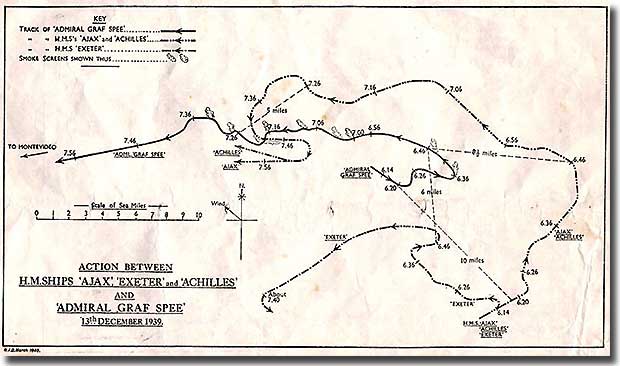
What happened thereafter is shown in the map below, taken from the official Admiralty report into the battle. You can see that Harwood attacked from the south, with Exeter initially turning to port while Ajax and Achilles turned starboard. Langsdorff realised the main threat came from Exeter so he concentrated all his main guns on her, leaving his secondary 5.9 inch guns to engage the two lighter cruisers as they used their superior speed to attack from the other side.

The accuracy of the Graf Spee‘s gunnery soon had Exeter in all sorts of trouble: three out of four main gun turrets were out of action, and the other was being aimed by a gunnery officer standing on the roof with binoculars as the control systems were all shot to pieces; the bridge had been hit, killing most of the officers and knocking out the steering controls, so that for the rest of the battle Exeter was navigated using a small compass taken from one of the ship’s boats; she was also listing about 7 degrees and taking in water. In all, Exeter took seven direct hits from 11-inch shells and 61 of her crew were killed. It was a grim situation but, in the middle of all this, she did manage to score a direct hit on the Graf Spee which didn’t appear at first to be critical but which, it later emerged, was another  stroke of luck for the British.

RiverPlateBattleChart
Realising that Exeter could not go on taking such heavy punishment, and with his own ships too far away to inflict any real damage on their target, Harwood decided to throw caution to the winds, charging repeatedly with Ajax and Achilles to almost suicidally close range to fire torpedoes, and then turning side on to fire full broadsides at the Graf Spee. Although they only inflicted superficial damage, and didn’t by any means emerge unscathed themselves, they did succeed in putting Langsdorff off  his stroke. While Graf Spee switched her attention to the Ajax and Achilles, Exeter used the  breathing space given to her by the courageous action of her sister ships to retire, heavily damaged, under the cover of a smokescreen, southwards to the Falkland Islands for emergency repairs.

Harwood knew he could not carry on the battle with only two ships, so he fell back, expecting the Graf Spee to come after him scenting victory. However, to his surprise, Langsdorff had apparently decided not to finish off the two ligher vessels – nor had he made sure of the Exeter – but instead was steaming due West towards the estuary of River Plate and the port of Montevideo, in neutral Uruguay. The British  fell back and shadowed him, wondering what on earth he was up to.

The reason for Langsdorff’s strange actions seems to be the 8-inch shell hit from the Exeter, which had put the Graf Spee‘s fuel systems out of action. This meant that she only had a few hours fuel left and if she didn’t make it into harbour for repairs then she would be a sitting duck. There were no friendly ports within range, so there was no alternative but to head for the nearest neutral one, which was Montevideo.

The following morning  (14th December 1939) found the Admiral Graf Spee at anchor in Montevideo. The naval battle was over, but another fascinating episode was just starting. The Hague Convention allowed warships to effect repairs in neutral harbours, but only those  that improved their seaworthiness not their fighting efficiency. The British knew that if the Graf Spee came out of harbour she could brush aside force waiting outside in the Estuary. The Ajax and Achilles had been joined by HMS Cumberland, a similar ship to Exeter, but the odds were against them being able to cope. The larger warships of Force H were in fact on their way but would take days to get there.

The British therefore launched an elaborate deception scheme. Unencrypted messages were sent (accidentally on purpose) suggesting battleships were arriving, false  requisitions for aviation fuel for the Ark Royal‘s aircraft were tendered. Phoney wireless traffic filled the Uruguayan airwaves and the notoriously leaky telephone system in Montevideo was used as a highly effective rumour mill. The three British ships outside the harbour busied themselves with making as much smoke as they could to give the impression that a large number of ships were gathering close to the shore.

The Germans were entirely deceived and were convinced that the Graf Spee was cornered by a huge fleet of British warships. Langsdorff took stock. He had used up most of his ammunition in the preceding battle and only had enough left for about 20 minutes action. He had to follow the obligations of international treaties and leave port by 17th December otherwise his ship would be interned. He had been ordered that the latter was not acceptable. He made his decision.

On the appointed date, the Graf Spee slipped out of harbour and proceeded slowly along the Estuary watched by a huge crowd wondering what was going to happen. It appeared that much of the crew had remained behind, suggesting that there might be a skeleton crew onboard preparing to fight one last suicidal battle. Suddenly she stopped. A small launch was seen to leave. A few minutes later a series of enormous explosions ripped the ship apart. Langsdorff had decided to avoid any further loss of life and also avoid the ship falling into enemy hands by deliberately scuttling her. The Admiral Graf Spee sank in the deepest part of the channel, where she remains to this day.

I’m aware of a growing sense of guilt at reliving my childhood fascination with this episode through this blog post. Coming back to it as an adult, however, I am painfully aware of the things I didn’t think about at all when I was much younger. The reality isn’t a game, of course. Over a hundred brave men died in the Battle of the River Plate – 36 on board the Graf Spee and 72 on the British ships (most on HMS Exeter) and one, Captain Langsdorff, committed suicide (on 19th December 1939, by shooting himself in the head while wrapped in the flag of the German Navy).

In fact the character that most exemplifies the sense of tragedy surrounding this story is Hans Langsdorff. An experienced naval officer who served at the Battle of Jutland in 1917 and, by all accounts, a decent and humane man, I see him as someone compelled to fight by a sense of duty rather than anything else. He certainly had no ill-will towards his enemies, and spoke with great admiration of the courage shown by his adversaries. He clearly had no taste for the indiscriminate sinking of defenceless merchant vessels which was what he had been called upon to do.   He may not have been particulrly effective as a tactical commander during the battle, but his errors largely arose from him being supplied with incorrect information.

It should also be noted that, at the funeral of the German sailors who had died in the Battle of the River Plate, Langsdorff gave the traditional German military salute, in contrast to all other officers present who gave the Nazi straight-arm version.

The Curve of Growth

Posted in History with tags , , on December 4, 2009 by telescoper

While I was indisposed earlier this week, I had the chance to read some interesting books about local history. Among the quite surprising facts I turned up about the City of Cardiff was its spectacular population growth. The first official census was held in 1801 and it  showed Cardiff to have a population of 1,870 – much smaller than other Welsh towns like Merthyr Tydfil (7,700) and Swansea (6,000). Every ten years another census was carried out, with the figures for Cardiff growing as follows:

1801 – 1,870
1811 – 2,457
1821 – 3,251
1831 – 6,187
1841 – 10,079
1851 – 18,351
1861 – no data
1871 – 57,363
1881 – no data
1891 – 128,915
1901 – 164,333
1911 – 182,259
1921 – 222,827
1931 – 226,937
1941 – no data
1951 – 243,632
1961 – 283,998
1971 – 293,220
1981 – 286,740
1991 – 296,900
2001 – 305,353

The growth of the docks in Cardiff Bay, driven by the export of coal from the valleys, seems to have been the main factor in driving the population increase, and this accelerated markedly from the middle of the 19th century until the early 20th century.

Early on in the industrial revolution the South Wales valleys were primarily concerned with the production of iron. In February 1794, the 25-mile-long Glamorganshire Canal was opened between Cardiff and Merthyr Tydfil to bring iron products down to the coast and for nearly 50 years was unchallenged as the main transport link between the two towns.  It was later to become the primary route for carrying coal to the Bay.

In October 1839, the Bute West Dock covering 19 acres with 9,400 feet of quays was opened, and the construction of the Dock Feeder to regulate the water supply to the dock from the River Taff was completed.  Entirely paid for by the second Marquis of Bute, this new dock set in motion Cardiff’s amazing growth to become the world’s biggest coal exporting port. The Taff Vale Railway was opened in 1841 between Cardiff and Abercynon and soon overtook the Glamorganshire Canal in economic importance. Coal shipments from Cardiff exceeded one million tons for the first time in 1851. In December 1855, the first historical trainload of Rhondda steam coal arrived at Cardiff, where the Bute East Dock was opened. By 1883 the docks handled six million tons of coal and by 1913 this figure had grown to a staggering 107 million tons.

Much of the labour needed to handle this volume of coal came from immigrants, including very large numbers of Irish but also lots of other people from all around the world. By 1850 there were no less than 20 foreign consulates in Cardiff and the city quickly established the cosmopolitan reputation it has kept to this day.

After the end of the First World War the coal trade suffered because the market was flooded with cheap German coal used for war reparations. That, and the subsequent depression, led to a decline in Cardiff as a port, although it was very busy during the Second World War. About 75 per cent of the supplies for the American forces in Europe were shipped out through Cardiff docks following the D-Day landings in June 1944.  This was a short-lived renaissance; the last ever shipment of coal left Bute Dock in 1950.

Finally, another thing I hadn’t known. Cardiff was only officially recognized as the capital city of Wales in 1955. Prior to that Wales had no separate legal existence, was entirely governed by English Law and was run entirely from Westminster. The strong local rivalry between Cardiff and Swansea largely stems from this time, as Swansea – a much older city – was an unsuccessful contender for the title of capital.

For a whole load of other interesting facts and figures about Cardiff, see the Cardiff Timeline.