I heard this, by the wonderful Ute Lemper, yesterday on Words and Music and thought it was a blast, so couldn’t resist sharing it here!
P.S. The song was written by Mischa Spoliansky.
Follow @telescoperI heard this, by the wonderful Ute Lemper, yesterday on Words and Music and thought it was a blast, so couldn’t resist sharing it here!
P.S. The song was written by Mischa Spoliansky.
Follow @telescoperToday is May 17th, which means that it is International Day Against Homophobia, Transphobia and Biphobia. If you’re wondering why May 17th was chosen, it’s to commemorate May 17th 1990, which is when the World Health Organisation removed homosexuality from its list of “mental illnesses”.
Please remember at although attitudes in the UK are much more enlightened than they were only a few years ago, homophobic violence still happens with distressing frequency and in over 70 countries around the world being gay is still a criminal offence.
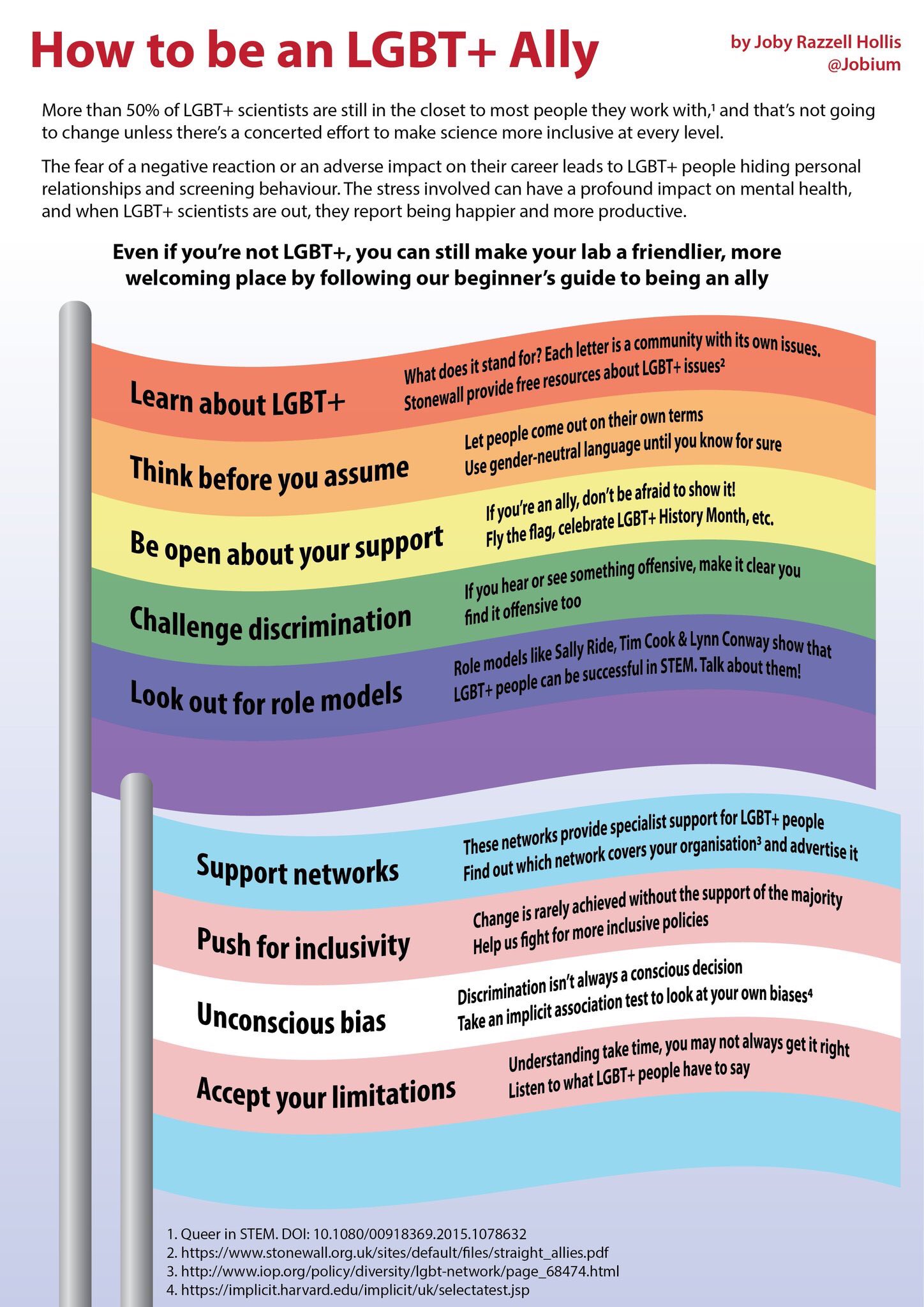
Even if you don’t identify yourself as LGBT+ then this should still be an important day for you. Here, for example, is a handy guide produced by Pride in STEM on how to be an ally:
It seems that Liberal Democrat leader Tim Farron is under fire again for refusing to say whether he thinks gay sex is a sin.
I’m not a particular fan of Mr Farron, and won’t be voting for his party, but I think the flak being directed at him on this issue is unjustified. Much of it is pure humbug, manufactured to cause political damage.
Mr Farron (who is heterosexual) describes himself as a ‘committed Christian’. He no doubt feels that if he spells out in public what he believes in private then it will alienate many potential voters even though he has voted progressively on this issue in the past. He’s probably right. On the other hand, by not spelling it out, he appears weak and shifty. The media are out to exploit his difficulty.
As someone who is neither heterosexual nor Christian I can help him. It seems to me very clear that the Bible does teach that homosexuality is a sin and that if you’re a Christian you have to believe this at some level.
I say ‘at some level’ because another thing that is clear is that the Bible does not consider homosexuality a very important issue. Had it been a hot topic then perhaps Jesus might have been prepared to go on record about it, but there’s no reference in the New Testament to him personally saying anything about gay sex. ‘Thou shalt not have sex with someone of the same gender’ isn’t among the Ten Commandments, either.
I do find it strange that so many people who described themselves as Christian obsess about same-sex relationships while clearly failing to observe some of the more important biblical instructions, notably the one about loving thy neighbour…
But I digress.
I don’t care at all what Tim Farron’s (or anyone else’s) religious beliefs say about homosexuality, as long as they accept that such beliefs give nobody the right to dictate what others should do.
If you believe gay sex is sinful, fine. Don’t do it. If you don’t approve of same-sex marriage, that’s fine too. Don’t marry someone of the same sex. Just don’t try to deny other people rights and freedoms on the basis of your own personal religious beliefs.
And no, refusing you the right to impose your beliefs on others is not a form of discrimination. That goes whether you a Christian, Muslim, Buddhist, Atheist or merely confused. You are free to live by the rules you adopt. I don’t have to.
I’d go further actually. I don’t think religious beliefs should have any place in the the laws of the land. It seems to me that’s the only way to guarantee freedom from religious prejudice. That’s why I’m a member of the National Secular Society. This does not exist to campaign against religion, but against religious privilege.
In fact the UK courts agree with me on this point. This is Lord Justice Laws, on behalf of the Court of Appeal relating to the case described here:
We do not live in a society where all the people share uniform religious beliefs. The precepts of any one religion, any belief system, cannot, by force of their religious origins, sound any louder in the general law than the precepts of any other. If they did, those out in the cold would be less than citizens and our constitution would be on the way to a theocracy, which is of necessity autocratic. The law of a theocracy is dictated without option to the people, not made by their judges and governments. The individual conscience is free to accept such dictated law, but the State, if its people are to be free, has the burdensome duty of thinking for itself.
To come back to Tim Farron, I say judge him and his party by what you see in the Liberal Democrat manifesto and on his track-record as a politician, not by what you think his interpretation might be of a few bits of scripture.
Follow @telescoperI’ve had a busy morning teaching and a busy afternoon meeting some interesting people from IBM and elsewhere in connection with Data Innovation Institute business, so just time to mention that I’m looking forward tonight to an event at Cardiff Metropolitan University (whose campus is not far from my house) featuring renowned rugby referee Nigel Owens who, in case you hadn’t realized, is gay. The event is part of the celebrations in Cardiff of LGBT History Month.
I’ll update later with reflections on the evening, but in the meantime here’s some examples of him in action on the rugby field!
Update: it was a thoroughly absorbing evening. Nigel Owens spoke extremely engagingly (and without notes) about his upbringing in a small village in rural Wales, his mental health struggles as he tried to come to terms with his sexuality, a (nearly successful) suicide attempt when he was in his twenties, and how his decision to come out publicly revitalised his career as an international referee.
When he takes to the field on Saturday to officiate at the Six Nations match between Ireland and France, it will be his 75th international match as a referee, which is the most for any referee ever.
I realized this afternoon that I was going to have to come into my office at Cardiff University as there is something I was supposed to finish by midnight today and I had forgotten to bring some stuff I needed to complete it. Setting aside the absurdity of an employer who sets deadlines at 24.00 on a Sunday evening, I was planning to have a quiet night doing the Azed crossword. As I got ready to leave the house I heard myself muttering “Sunday Bloody Sunday” under my breath, and walking through town to get here I was thinking about John Schlesinger’s 1971 film of that title, starring Glenda Jackson, Peter Finch and Murray Head. This film was shown on TV – rather late at night – when I was a teenager in the late 1970s and I’ll never forget the impact this particular scene had on me then. Here’s a clip of Murray Head talking about the scene, which caused quite a stir at the time in some quarters, in which he describes it as a “giant step forward”. Let’s hope we’re not all about to take giant steps backward.
Follow @telescoperOoh. I’ve just noticed this so thought I’d reblog it.
Dr Carpineti did the London Marathon last weekend too!
Current Job: Science Journalist
Scientific Discipline/Field: Astrophysics
Country: UK
Pick some letters (L,G,B,T,Q etc.): G
LinkedIn: www.theastroholic.co.uk
What does your job involve?
I work for ‘I fucking Love Science’. I write three articles a day about new research being published, mainly on physics and astrophysics.
How did you get to this job (education etc.)?
I have a B.Sc. from La Sapienza, Rome, an M.Sc. in quantum fields and fundamental forces and a Ph.D. in astrophysics both from Imperial College London.
Do you feel being LGBT has affected your career decisions?
Yes, I felt I couldn’t really be myself in Italy so I decided to move to London to continue my studies.
Have you had any reactions from colleagues about being LGBT, either good or bad?
The reactions to my sexuality have mostly been good. I’ve never had a bad reaction personally, but I know of somebody, another Ph.D…
View original post 84 more words
Last night I attended a very enjoyable meeting at the Royal Society in London called Out in STEM. In the 356 years that the Royal Society has been in existence this is the first event that has been devoted to a discussion of LGBT+ matters, so I feel honoured not only to have been present but to have been one of the panellists invited to start off the evening by talking about the question:
“Choosing to be out in the workplace or when studying – what influences that choice?”
In my five-minute answer to this I talked about my own personal decision to be open about my sexuality when I started as a research student at the University of Sussex way back in 1985. In fact, three of the nine panellists as well as a number of other participants did their doctorates at the University of Sussex, an institution has clearly been a kind of incubator of LGBT scientists and engineers! My decision was heavily influenced by the events of the time, chiefly the ongoing AIDS crisis and the infamous Section 28. I felt at the time that it was necessary to stand up and be counted in the face of so much prejudice, a decision which I have never regretted.
Having never really been “in” for my whole research career, coming out wasn’t really an issue for me and I have been openly at every insitution I have worked in – Sussex, Queen Mary, Nottingham and Cardiff. Although I have encounted some isolated examples of unpleasantness, I can’t say that my career has suffered any adverse consequences.
Getting back to the question, I think what influences the choice is a combination of personal factors and the environment of the institution in question. For early career researchers, the choice – and it should always be a choice – can be affected by the perception that one’s career depends on the patronage of persons higher up the hierarchy, be that PhD supervisor, research group leader or departmental head. The less hierarchical the department is, the less likely one is to feel suffocated by the need to conform. It also helps if senior managers make it clear that any bullying or harassment associated with sexual identity or other personal characteristics will not be tolerated. I have tried hard to create such an environment in the School of Mathematical and Physical Sciences, of which I am now the Head. I’ll leave it to others to judge whether or not I have succeeded.
In fact none of the nine panellists described any major adverse consequences of the decision to come out either, but stressed how positive it can be to feel liberated by being open about who you are.
After the nine short answers to the above question, we split up into small groups and discussed other questions. I enjoyed this part very much because the discussion was relaxed and wide-ranging. One theme that ran through many of the responses when groups were asked to feed back a summary of their deliberations was what a big difference it can make to have an LGBT staff network. I am proud to have played a role in the creation of such a network at the University of Sussex, although I am still saddened that it has taken so long for this institution to create one. I am also glad to say that the Institute of Physics is setting up an LGBT network of its own, with a particular emphasis on early career researchers, for whom the sense of isolation that is often involved in working on short-term contracts in highly competitive field can be exacerbated by the perceived need to conceal important aspect of their private life.
Once the discussion session was over we adjourned for wine and canapés, and informal chats. That was extremely pleasant, although I did perhaps have a bit too much wine before I dashed off to catch the train back to Brighton.
It was particularly nice to meet in person some of the people I’d previously known only through social media. I also met an old friend from my previous incarnation at Sussex, Tom Welton, who is now Dean for Natural Sciences at Imperial College. I haven’t seen Tom for over 20 years, actually. I hope we’ll be able to meet up again before too long.
Anyway, I’d like to thank the Royal Society for putting on this event, and especially to Lena Cumberbatch who did a lot of the organizing as well as trying to keep the panellists to time. I enjoyed it greatly and look forward to working with them again. I hope it’s not another 356 years until the next Out in STEM event!
Follow @telescoper
While I took a breather during this afternoon’s Brighton Pride Village Party I checked my Twitter feed only to find the terrible news that 16-year Shira Banki had died of injuries sustained when she was stabbed at Jerusalem Pride three days ago. I didn’t feel much like going back to the Party after that.
Although it seems a feeble gesture, I’d like to take the opportunity to express my condolences to Shira Banki’s family and friends. A young life cut short in such a cruel way must be very difficult to come to terms with.
Shira Banki was one of six people stabbed by an ultra-religious person by the name of Yishai Shlissel, who had only just been released from prison a few weeks ago after serving a ten year sentence for stabbing people at the 2005 pride event. That time however he didn’t kill anyone. Now he has. In fact he stabbed her in the back in the manner of a despicable coward.
I don’t believe in capital punishment but I think this man has demonstrated that he is a danger to the public and should be locked up for the rest of his life. I don’t know if there is a God or not, but if there is, I hope He She or It knows what to do with people like Yishai Shlissel when his time comes. The rest of eternity in chains watching never-ending Pride parades would be my suggestion.
R.I.P. Shira Banki
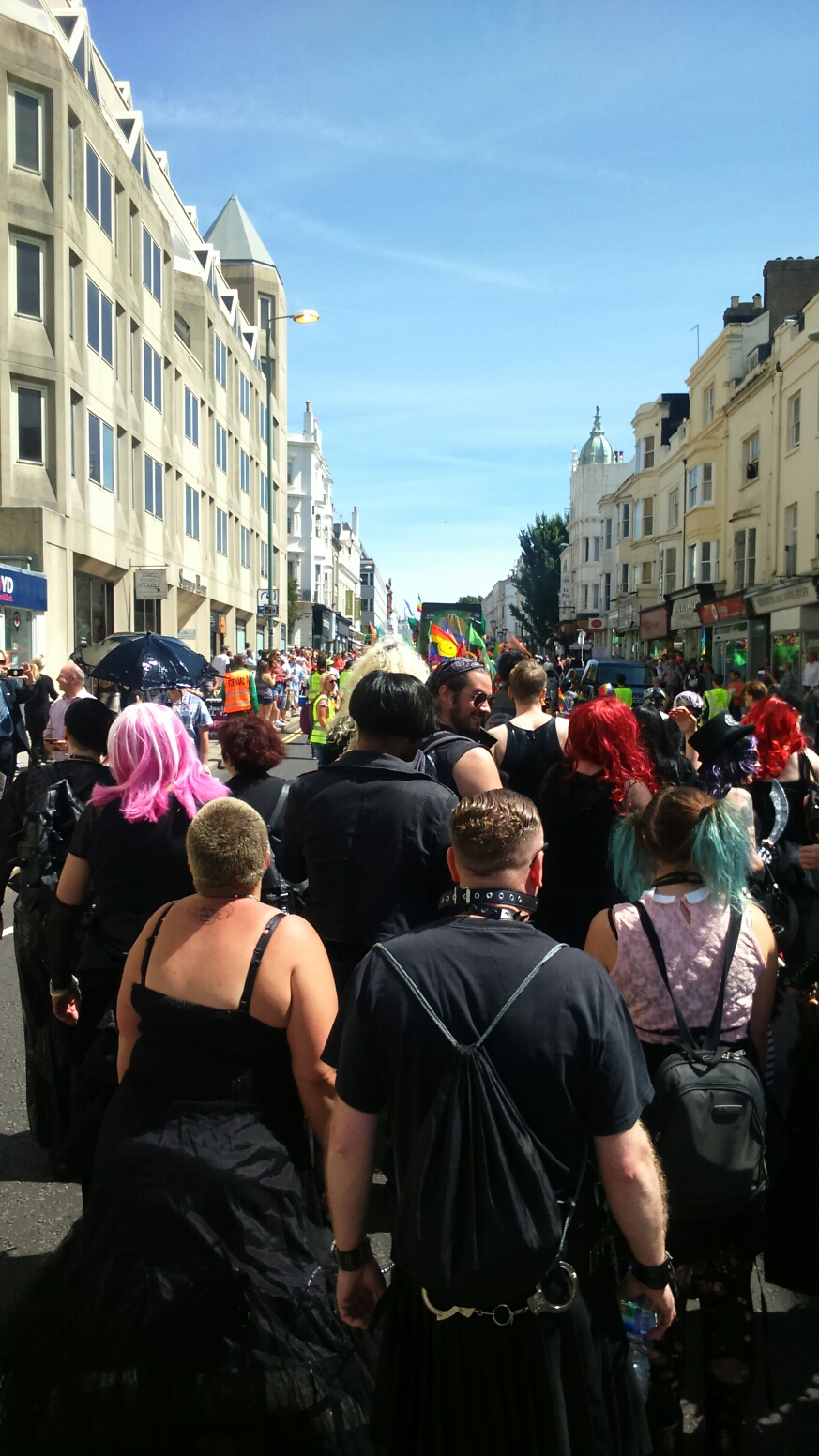
Follow @telescoperToday I’ve been mainly taking part in the 25th Brighton Pride celebrations. The Parade started out 90 minutes late and on a diverted route because of what appears to have been a hoax bomb (in the words of the police, a “suspect package” – no jokes please) but the atmosphere was incredible. Not only was the parade huge, but the streets were lined with thousands and thousands of people. It was all very friendly so my worries that my fear of crowds would resurface were unfounded.
I walked with the Sussex University student society. Hopefully next year there will be an official staff presence!
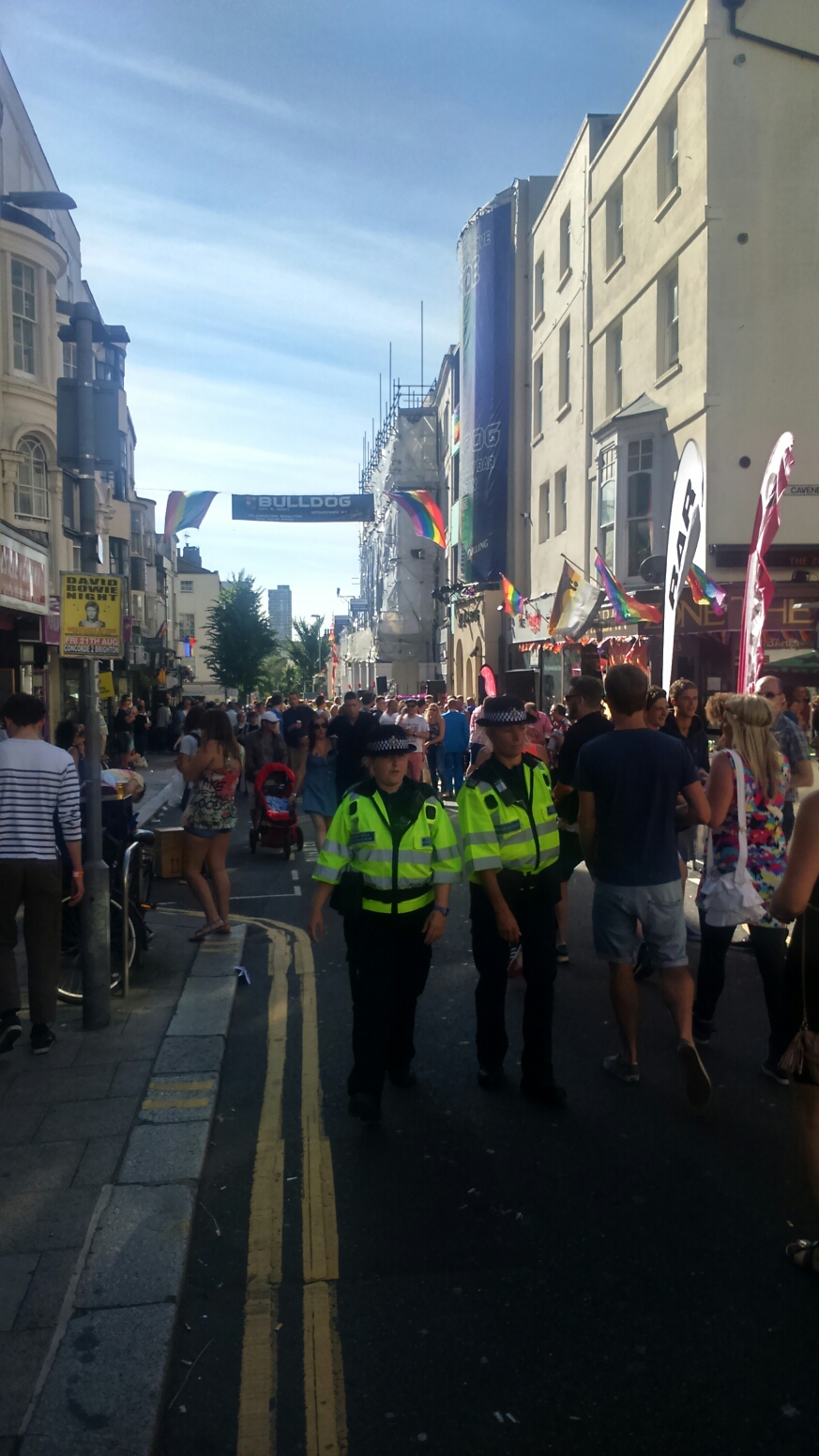
The Pride Carnival in Preston Park after the Parade wasn’t so interesting for me so I only stayed a couple of hours before returning to Kemptown for the Village Party, which will go on all night and all day tomorrow. I am just taking a break for a cup of tea and a bite to eat before deciding whether to rejoin the party a bit later. I am however a bit oldy for that sort of thing and may instead decide to listen to the Proms instead..
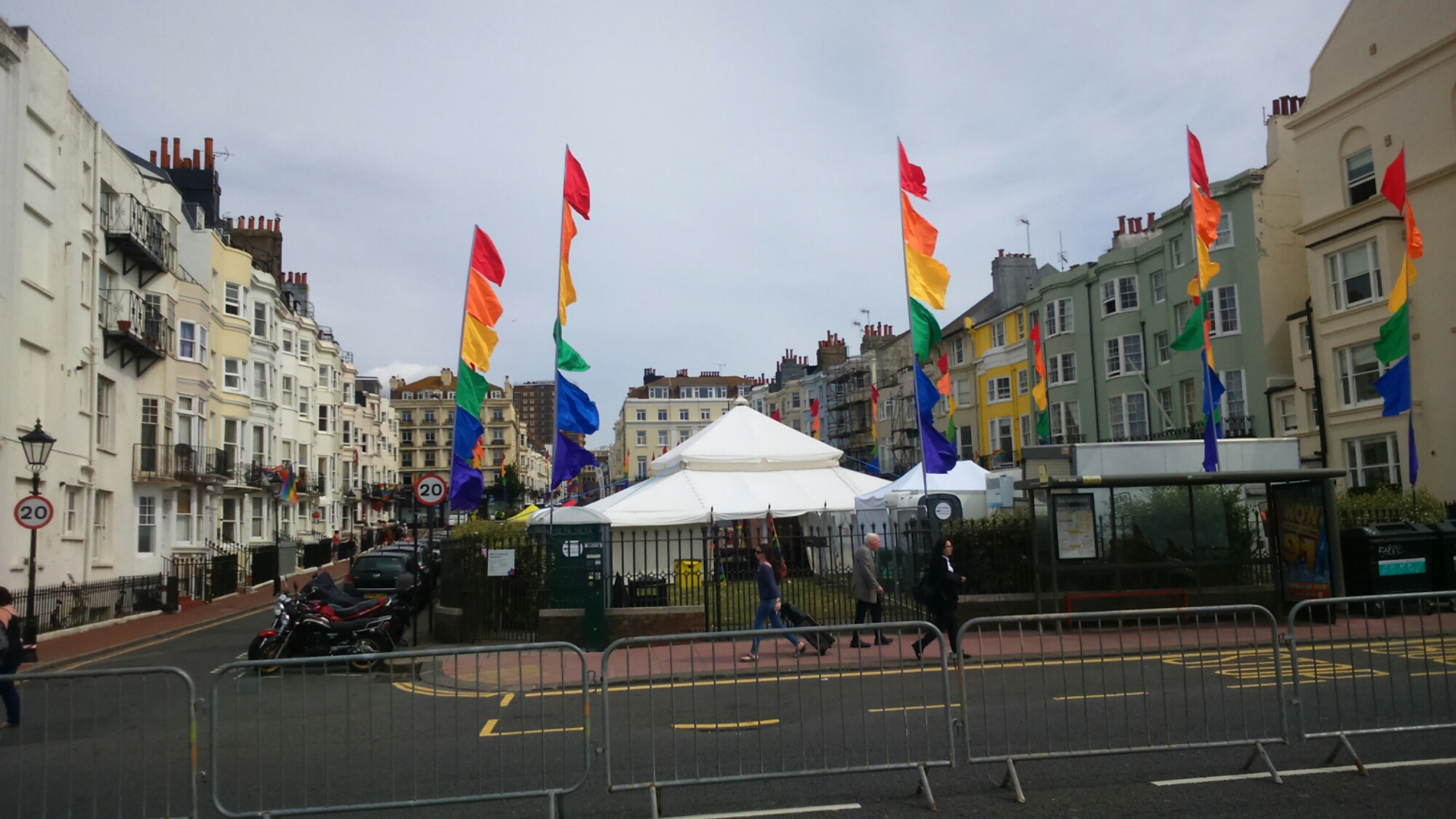
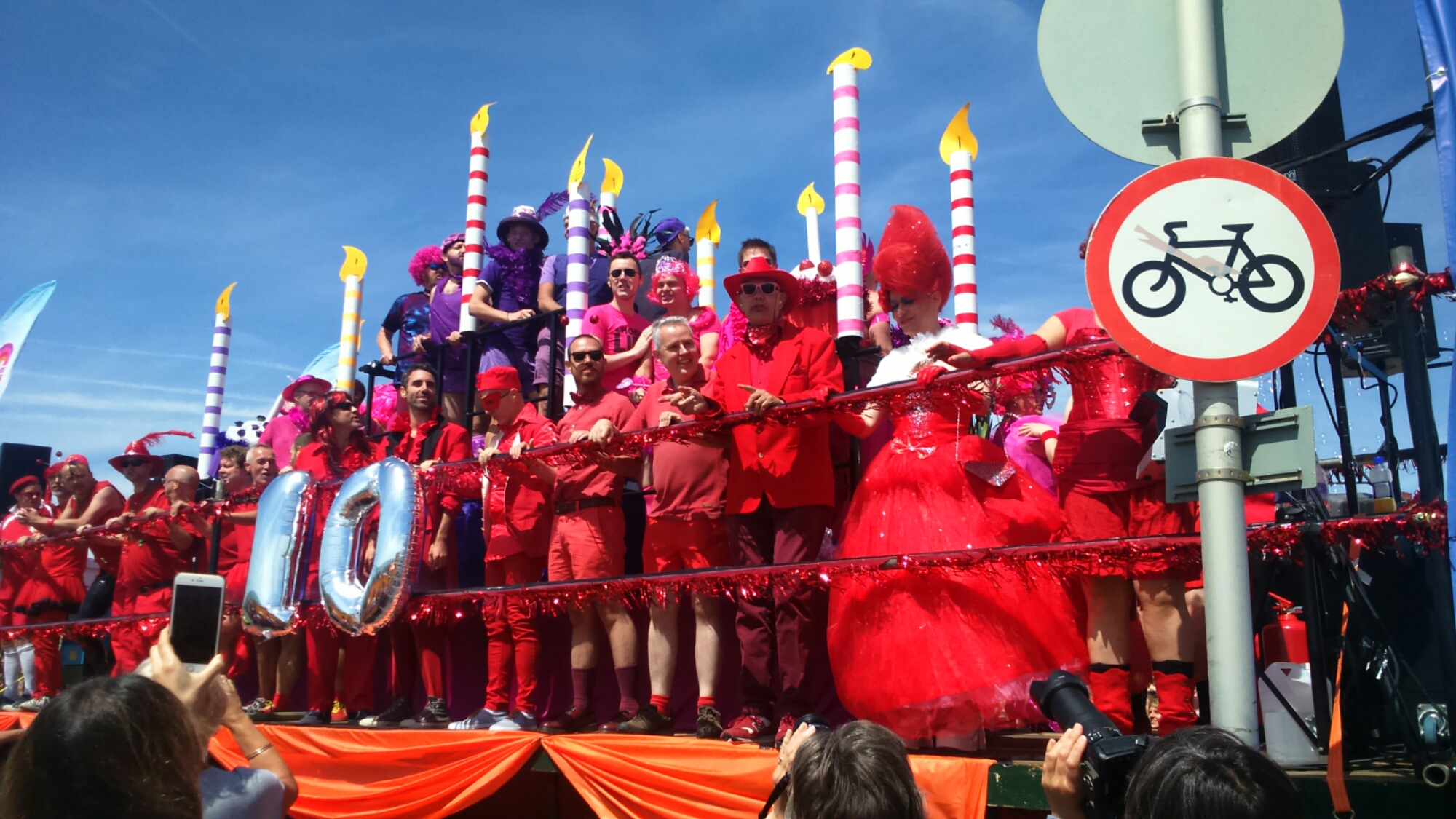
Anyway, here are a few pictures of the parade and village party..