Archive for the Literature Category

Drogheda and its Surroundings – by William Topaz McGonagall

Posted in Literature with tags , on December 29, 2020 by telescoper

I’ve recently been criticized for not posting enough poetry about Ireland nor by Irish poets, hence this truly remarkable poem by the inimitable William Topaz McGonagall (who was Scottish, but of Irish descent). Let this be a lesson to you.

The town of Drogheda is situated on the river Boyne, a few miles from the sea,
And is its head-quarters for the exploration of its scenery;
And portions of its ancient walls and two gate towers remain,
And one of them is quite perfect – St. Laurence by name.

The west gate is in a good state of preservation,
And is well worth the tourist’s observation,
Because it will stir in him great admiration,
And raise his spirits to a great elevation.

The ruined Church of St. Mary I must mention,
The tower of which is very fine and worthy of attention,
A structure dating from the fourteenth century,
And deserves special notice, because it is wonderful to see.

Then there’s King William’s Glen and the Boyne valley to be seen,
The spot where King William’s troops charged across the stream;
And an imposing obelisk is there, which marks the spot
Where the Battle of the Boyne was fought, which will never be forgot.

And as the tourist for beautiful spots there doth range
I advise him to view the chambered Tumulus of New Grange,
And there he will see remarkable caves, wonderful to be seen,
And in the summer-time the entrance is beautiful with shrubberies green.

The Monastery of Mellifont is most wonderful to see,
And will repay the tourist who visits the locality,
For within the enclosure is a tower standing 110 feet high,
Which arrests the attention of strangers while passing by.

Then there’s the celebrated Hill of Slane,
Which is a very great height and of historical fame,
Because on Easter Eve St. Patrick lighted the paschal fire
And worshipped God there to his heart’s desire.

Then the tourist should visit the Castle of Dunmoe,
And the scene there will drive from him all woe;
And spend a day or two in visiting Tara and Bective Abbey,
For around there is some great curiosities to see.

Then there’s Lough Erne, most beautiful to be seen,
And dotted with beautifully wooded isles, charming and green,
And freely thrown open for public inspection
For the visitor’s amusement, and to which the proprietor has no objection.

There the tourist will find comfortable accommodation,
And nothing short of pleasant recreation;
For there’s boating and fishing if the tourist wishes,
Which will be excellent sport while catching the big and little fishes.

Then ye lovers of beautiful scenery away! away!
To Drogheda, in Ireland, and have a holiday,
And view the romantic scenery and inhale pure air,
Emanating from the sea and wild flowers and woodlands there.

written in 1902 by William Topaz McGonagall. I think the “Church of St Mary” referred to is the Church of Ireland church of that name built between 1805 and 1810 on the site of an older (14th Century) Parish Church, and beside a ruined 13th Century Cistercian abbey, but it may also be the Roman Catholic Church of the same name built during 1881 and 1889 (which has the more impressive “tower”)

Nollaig Shona Daoibh

Posted in Biographical, History, Literature on December 25, 2020 by telescoper

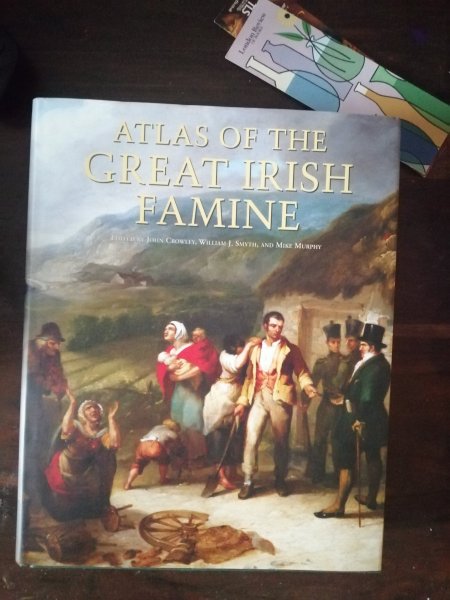
Well here we are, Christmas Day. I got up late this morning and opened the present I bought for myself:

It’s not exactly light reading, but grimly fascinating. I ordered it through the splendid local bookshop, by the way.

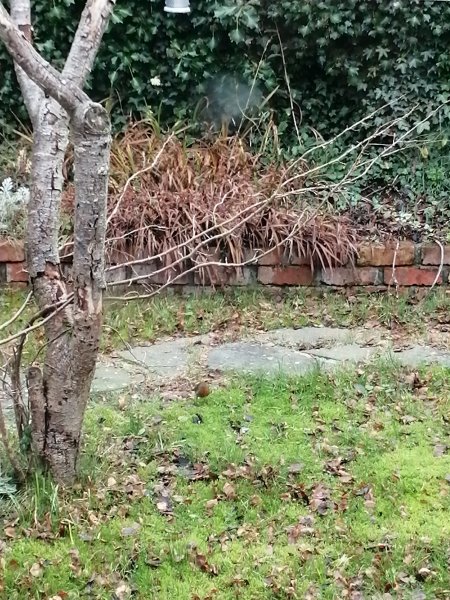
As I had my coffee I had a visit from the local Robin, who seemed to be carrying out a pitch inspection.

A crowd of very noisy seagulls have arrived in the neighbourhood today, which seems to have scared the other birds off.

Now I’m going to have a late breakfast (a fry-up) before preparing this evening’s dinner. I’m not sure it’s worth seeing if there’s anything worth watching on the telly, but there is a complete performance of Handel’s Messiah on the radio this afternoon so I might listen to that.

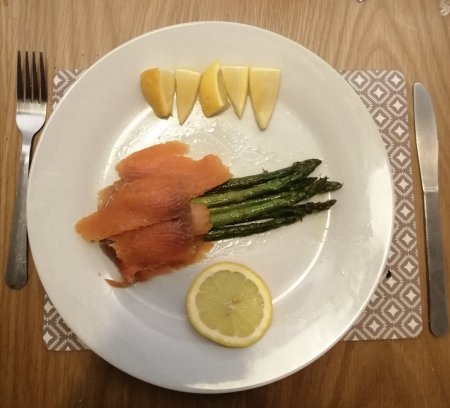
Update: first course. Smoked salmon seasoned with fennel and lemon with pan-fried asparagus.

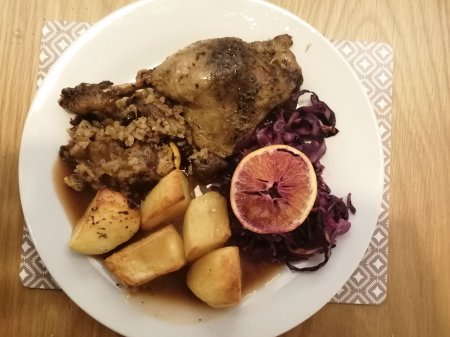
Update: main course. Confit of duck, roast potatoes, red cabbage spiced with cinnamon & apple, chestnut and orange ciabatta stuffing and port sauce.

I don’t mind telling you the duck was delicious!

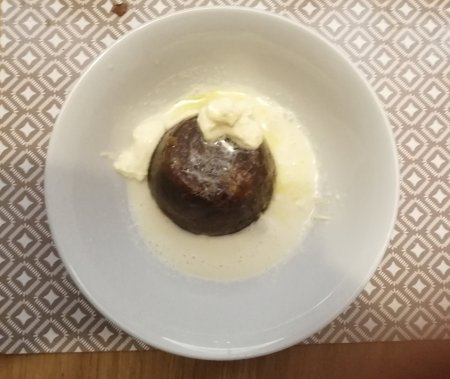
Update 3: Dessert. Plum Pudding with Brandy Cream.

Anyway, let me wish you all a Merry Christmas, Nadolig Llawen, Nollaig Shona, Fröhliche Weihnachten, Joyeux Noël, Buon Natale, Feliz Navidad, Glædelig Jul, etc. And in the words of a traditional Irish toast:

Go mbeirimid beo ar an am seo arís!

R.I.P. John le Carré (1931-2020)

Posted in Biographical, Literature with tags , , , , on December 14, 2020 by telescoper

I was very sad to hear the news last night of the death at the age of 89 of author John le Carré. I’m sure I’m not the only person who discovered his novels as a result of watching the 1979 TV series Tinker Tailor Soldier Spy, which I watched while still a schoolboy. I loved so many things about that series, including the Circus jargon (tradecraft, lamplighters, honey-traps, etc) and the code-names (Gerald the Mole, Source Merlin, Operation Testify). When I got around to reading the novel I realized that there was much greater depth to le Carré’s writing than I’d imagined. I was particularly impressed with the sympathetic way he handled the character of the traitor Bill Haydon who, after he is revealed as the mole says to George Smiley:

Do you know what’s killing Western democracy, George? Greed. And constipation. Moral, political, aesthetic.

I’m with him on that one. “Half-Devils against Half-Angels” is another phrase I remember as a description of the “wretched Cold War” the protagonists found themselves fighting.

I also remember this, from Smiley’s People:

In my time, Peter Guillam, I’ve seen Whitehall skirts go up and come down again. I’ve listened to all the excellent argument for doing nothing, and reaped the consequent frightful harvest. I’ve watched people hop up and down and call it progress. I’ve seen good men go to the wall and the idiots get promoted with a dazzling regularity. All I’m left with is me and thirty-odd years of Cold War without the option.

That’s true in fields other than espionage.

Anyway, having read Tinker Tailor I bought everything I could by John le Carré and devoured all the books avidly. Not all his early books were great, but The Spy who came in from the Cold is excellent as are Tinker Tailor Soldier Spy,The Honourable Schoolboy and Smiley’s People – the so-called Karla trilogy.

Most obituaries circulating today describe John le Carré as a “spy novelist” but I see him as a writer whose excellence as a writer transcended that genre. I think the same way of many great crime novelists, such as Dashiell Hammett, who wrote great novels that happened to be about crime.

The last John le Carré book I bought was A Legacy of Spies (2017), which I haven’t yet got around to reading. I’ll put that on the list of Christmas reading, and drink a toast to an author who has given me so much to enjoy and to think about over so many years.

Rest in peace John le Carré (David Cornwell, 1931-2020).


The Darkling Thrush

Posted in Poetry with tags , , , on December 7, 2020 by telescoper
I leant upon a coppice gate
When Frost was spectre-grey,
And Winter's dregs made desolate
The weakening eye of day.
The tangled bine-stems scored the sky
Like strings of broken lyres,
And all mankind that haunted nigh
Had sought their household fires.

The land's sharp features seemed to be
The Century's corpse outleant,
His crypt the cloudy canopy,
The wind his death-lament.
The ancient pulse of germ and birth
Was shrunken hard and dry,
And every spirit upon earth
Seemed fervourless as I.

At once a voice arose among
The bleak twigs overhead
In a full-hearted evensong
Of joy illimited;
An aged thrush, frail, gaunt, and small,
In blast-beruffled plume,
Had chosen thus to fling his soul
Upon the growing gloom.

So little cause for carolings
Of such ecstatic sound
Was written on terrestrial things
Afar or nigh around,
That I could think there trembled through
His happy good-night air
Some blessed Hope, whereof he knew
And I was unaware.

by Thomas Hardy (1840-1928)

“And” Time Draws Nigh

Posted in History, Poetry, The Universe and Stuff with tags , , , , , , , on November 30, 2020 by telescoper

It’s November 30th 2020, which means we have just three teaching weeks to go until the end of term. I am currently teaching two modules: Mechanics 1 and Special Relativity for first-year students and Vector Calculus and Fourier Series for second years. We’re now getting to the “and” bit in both modules.

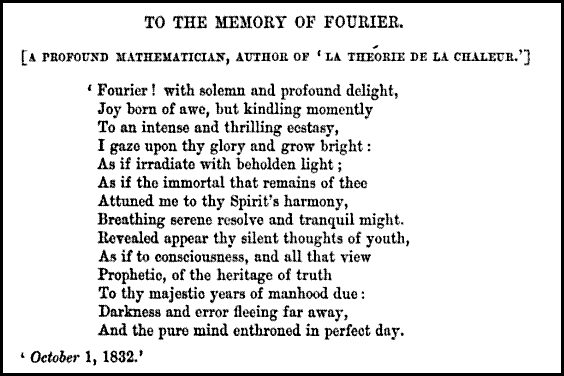
I didn’t want to present the two topics mentioned in the title of the second year module as completely disconnected, so I decided to link them with a lecture in which I use the divergence theorem of vector calculus to derive the heat equation, the solution of which led Joseph Fourier to devise his series in Mémoire sur la propagation de la chaleur dans les corps solides (1807), a truly remarkable work for its time that inspired so many subsequent developments.

That gives me an excuse to repost the following “remarkable” poem about Fourier by William Rowan Hamilton:

In the first-year module I will be spending most of this week talking about potentials and forces before starting special relativity next week, at the proper time.

This day and age we’re living in
Gives cause for apprehension
With speed and new invention
And things like fourth dimension
Yet we get a trifle weary
With Mr. Einstein’s theory
So we must get down to earth at times
Relax relieve the tension
And no matter what the progress
Or what may yet be proved
The simple facts of life are such
They cannot be removed

As time goes by, the other thing drawing nigh is the loosening of Ireland’s current Level 5 Covid-19 restrictions which were imposed about six weeks ago though, judging by the crowds drinking in Courthouse Square on Saturday night, a lot of folks have thrown the rules out the window already.

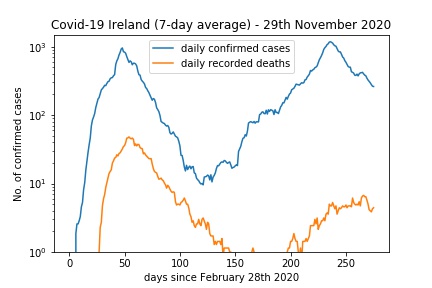
I think it’s a dangerous time. The daily cases are still hovering around the 250-300 mark and will undoubtedly start climbing even before Christmas itself:

The chances of us getting back to anything resembling normality during the early part of next year are exceedingly slim.

John & Diego

Posted in Poetry, The Universe and Stuff with tags , , on November 26, 2020 by telescoper

The Guardian obituary of John Barrow (written by Michael Rowan-Robinson) has finally appeared in today’s print edition*, alongside that of footballer Diego Maradona who passed away yesterday.

As a lifelong football fan I think John would have been amused by the coincidence, especially because John’s first book (co-written with Joe Silk) was called The Left Hand of Creation:

*I don’t usually buy foreign newspapers, but I managed to find a copy of today’s Grauniad in Maynooth.

Dare we hope?

Posted in Covid-19, Poetry, Politics with tags , , , , , on November 9, 2020 by telescoper

A short passage from Seamus Heaney’s verse play The Cure at Troy: A Version of Sophocles’ Philoctetes has been much quoted recently. It even ended the RTÉ News last night:

The passage begins

History says, Don’t hope
On this side of the grave.

Well, there’s an additional reason for hope this morning, in the announcement of good progress in the search for a vaccine against Covid-19. The two pharmaceutical companies involved are Pfizer (USA) and BioNTech SE (Germany). The reported efficacy of the vaccine tested so far is over 90%, which is far higher than experts have predicted. Now these are preliminary results, not yet properly reviewed, based on a sample of only 94 subjects, and I’m not sure what motivated the press release so early in the process. I’m given to understand that the type of vaccine concerned here would also be challenging to manufacture and distribute, but we’re due for some good news on the Coronavirus front so let’s be (cautiously) optimistic.

On top of that it seems that Ireland at least is turning the tide against the second wave, with new cases falling every day for over a week:

Dare we hope?

Out in the Dark – by Edward Thomas / Killed in Action – by W.H. Davies

Posted in History, Poetry with tags , , , , on November 8, 2020 by telescoper

Out in the dark over the snow
The fallow fawns invisible go
With the fallow doe ;
And the winds blow
Fast as the stars are slow.

Stealthily the dark haunts round
And, when the lamp goes, without sound
At a swifter bound
Than the swiftest hound,
Arrives, and all else is drowned ;

And star and I and wind and deer,
Are in the dark together, – near,
Yet far, – and fear
Drums on my ear
In that sage company drear.

How weak and little is the light,
All the universe of sight,
Love and delight,
Before the might,
If you love it not, of night.

by Edward Thomas (1878-1917).

Edward Thomas was killed in action at the Battle of Arras. His friend W.H. Davies was devastated by this and responded by writing this poem called Killed in Action (Edward Thomas):

Happy the man whose home is still
In Nature’s green and peaceful ways;
To wake and hear the birds so loud,
That scream for joy to see the sun
Is shouldering past a sullen cloud.

And we have known those days, when we
Would wait to hear the cuckoo first;
When you and I, with thoughtful mind,
Would help a bird to hide her nest,
For fear of other hands less kind.

But thou, my friend, art lying dead:
War, with its hell-born childishness,
Has claimed thy life, with many more:
The man that loved this England well,
And never left it once before.


The Evening Star – Louise Glück

Posted in Literature with tags , , , on October 9, 2020 by telescoper

The winner of the 2020 Nobel Prize for Literature is American poet Louise Glück (“for her unmistakable poetic voice that with austere beauty makes individual existence universal”). I have only one book of her poems but it is excellent and I’m sure to explore more of them. Here is a poem of hers I like very much. It is called The Evening Star.

Tonight, for the first time in many years,
there appeared to me again
a vision of the earth’s splendor:

in the evening sky
the first star seemed
to increase in brilliance
as the earth darkened

until at last it could grow no darker.
And the light, which was the light of death,
seemed to restore to earth

its power to console. There were
no other stars. Only the one
whose name I knew

as in my other life I did her
injury: Venus,
star of the early evening,

to you I dedicate
my vision, since on this blank surface

you have cast enough light
to make my thought
visible again.

R.I.P. Derek Mahon (1941-2020)

Posted in Covid-19, Poetry with tags , , , , on October 2, 2020 by telescoper

The poet Derek Mahon has died, so it seems apt to pay tribute by posting some examples of his poetry.

This poem, Everything is going to be all right, was read on the main news on RTÉ television when the national lockdown was announced back in March, sounding a note of optimism to a worried nation. I’m not sure everything is going to be all right, but it’s an excellent poem:

How should I not be glad to contemplate
the clouds clearing beyond the dormer window
and a high tide reflected on the ceiling?
There will be dying, there will be dying,
but there is no need to go into that.
The poems flow from the hand unbidden
and the hidden source is the watchful heart.
The sun rises in spite of everything
and the far cities are beautiful and bright.
I lie here in a riot of sunlight
watching the day break and the clouds flying.
Everything is going to be all right.

Sadly he didn’t live to see the end of the pandemic. Over the years I have posted a few poems by Derek Mahon. Here are two more. This one is called The Thunder Shower

A blink of lightning, then
a rumor, a grumble of white rain
growing in volume, rustling over the ground,
drenching the gravel in a wash of sound.
Drops tap like timpani or shine
like quavers on a line.

It rings on exposed tin,
a suite for water, wind and bin,
plinky Poulenc or strongly groaning Brahms’
rain-strings, a whole string section that describes
the very shapes of thought in warm
self-referential vibes

and spreading ripples. Soon
the whispering roar is a recital.
Jostling rain-crowds, clamorous and vital,
struggle in runnels through the afternoon.
The rhythm becomes a regular beat;
steam rises, body heat—

and now there’s city noise,
bits of recorded pop and rock,
the drums, the strident electronic shock,
a vast polyphony, the dense refrain
of wailing siren, truck and train
and incoherent cries.

All human life is there
in the unconfined, continuous crash
whose slow, diffused implosions gather up
car radios and alarms, the honk and beep,
and tiny voices in a crèche
piercing the muggy air.

Squalor and decadence,
the rackety global-franchise rush,
oil wars and water wars, the diatonic
crescendo of a cascading world economy
are audible in the hectic thrash
of this luxurious cadence.

The voice of Baal explodes,
raging and rumbling round the clouds,
frantic to crush the self-sufficient spaces
and re-impose his failed hegemony
in Canaan before moving on
to other simpler places.

At length the twining chords
run thin, a watery sun shines out,
the deluge slowly ceases, the guttural chant
subsides; a thrush sings, and discordant thirds
diminish like an exhausted concert
on the subdominant.

The angry downpour swarms
growling to far-flung fields and farms.
The drains are still alive with trickling water,
a few last drops drip from a broken gutter;
but the storm that created so much fuss
has lost interest in us.

And this one, about the noble self-sacrifice of Captain Lawrence Oates,  is called Antarctica

‘I am just going outside and may be some time.’
The others nod, pretending not to know.
At the heart of the ridiculous, the sublime.
He leaves them reading and begins to climb,
Goading his ghost into the howling snow;
He is just going outside and may be some time.
The tent recedes beneath its crust of rime
And frostbite is replaced by vertigo:
At the heart of the ridiculous, the sublime.
Need we consider it some sort of crime,
This numb self-sacrifice of the weakest? No,
He is just going outside and may be some time
In fact, for ever. Solitary enzyme,
Though the night yield no glimmer there will glow,
At the heart of the ridiculous, the sublime.

Rest in Peace Derek Mahon (1941-2020)