Archive for the Literature Category

John & Diego

Posted in Poetry, The Universe and Stuff with tags , , on November 26, 2020 by telescoper

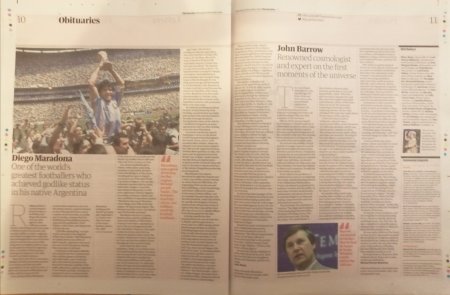
The Guardian obituary of John Barrow (written by Michael Rowan-Robinson) has finally appeared in today’s print edition*, alongside that of footballer Diego Maradona who passed away yesterday.

As a lifelong football fan I think John would have been amused by the coincidence, especially because John’s first book (co-written with Joe Silk) was called The Left Hand of Creation:

*I don’t usually buy foreign newspapers, but I managed to find a copy of today’s Grauniad in Maynooth.

Dare we hope?

Posted in Covid-19, Poetry, Politics with tags , , , , , on November 9, 2020 by telescoper

A short passage from Seamus Heaney’s verse play The Cure at Troy: A Version of Sophocles’ Philoctetes has been much quoted recently. It even ended the RTÉ News last night:

The passage begins

History says, Don’t hope
On this side of the grave.

Well, there’s an additional reason for hope this morning, in the announcement of good progress in the search for a vaccine against Covid-19. The two pharmaceutical companies involved are Pfizer (USA) and BioNTech SE (Germany). The reported efficacy of the vaccine tested so far is over 90%, which is far higher than experts have predicted. Now these are preliminary results, not yet properly reviewed, based on a sample of only 94 subjects, and I’m not sure what motivated the press release so early in the process. I’m given to understand that the type of vaccine concerned here would also be challenging to manufacture and distribute, but we’re due for some good news on the Coronavirus front so let’s be (cautiously) optimistic.

On top of that it seems that Ireland at least is turning the tide against the second wave, with new cases falling every day for over a week:

Dare we hope?

Out in the Dark – by Edward Thomas / Killed in Action – by W.H. Davies

Posted in History, Poetry with tags , , , , on November 8, 2020 by telescoper

Out in the dark over the snow
The fallow fawns invisible go
With the fallow doe ;
And the winds blow
Fast as the stars are slow.

Stealthily the dark haunts round
And, when the lamp goes, without sound
At a swifter bound
Than the swiftest hound,
Arrives, and all else is drowned ;

And star and I and wind and deer,
Are in the dark together, – near,
Yet far, – and fear
Drums on my ear
In that sage company drear.

How weak and little is the light,
All the universe of sight,
Love and delight,
Before the might,
If you love it not, of night.

by Edward Thomas (1878-1917).

Edward Thomas was killed in action at the Battle of Arras. His friend W.H. Davies was devastated by this and responded by writing this poem called Killed in Action (Edward Thomas):

Happy the man whose home is still
In Nature’s green and peaceful ways;
To wake and hear the birds so loud,
That scream for joy to see the sun
Is shouldering past a sullen cloud.

And we have known those days, when we
Would wait to hear the cuckoo first;
When you and I, with thoughtful mind,
Would help a bird to hide her nest,
For fear of other hands less kind.

But thou, my friend, art lying dead:
War, with its hell-born childishness,
Has claimed thy life, with many more:
The man that loved this England well,
And never left it once before.


The Evening Star – Louise Glück

Posted in Literature with tags , , , on October 9, 2020 by telescoper

The winner of the 2020 Nobel Prize for Literature is American poet Louise Glück (“for her unmistakable poetic voice that with austere beauty makes individual existence universal”). I have only one book of her poems but it is excellent and I’m sure to explore more of them. Here is a poem of hers I like very much. It is called The Evening Star.

Tonight, for the first time in many years,
there appeared to me again
a vision of the earth’s splendor:

in the evening sky
the first star seemed
to increase in brilliance
as the earth darkened

until at last it could grow no darker.
And the light, which was the light of death,
seemed to restore to earth

its power to console. There were
no other stars. Only the one
whose name I knew

as in my other life I did her
injury: Venus,
star of the early evening,

to you I dedicate
my vision, since on this blank surface

you have cast enough light
to make my thought
visible again.

R.I.P. Derek Mahon (1941-2020)

Posted in Covid-19, Poetry with tags , , , , on October 2, 2020 by telescoper

The poet Derek Mahon has died, so it seems apt to pay tribute by posting some examples of his poetry.

This poem, Everything is going to be all right, was read on the main news on RTÉ television when the national lockdown was announced back in March, sounding a note of optimism to a worried nation. I’m not sure everything is going to be all right, but it’s an excellent poem:

How should I not be glad to contemplate
the clouds clearing beyond the dormer window
and a high tide reflected on the ceiling?
There will be dying, there will be dying,
but there is no need to go into that.
The poems flow from the hand unbidden
and the hidden source is the watchful heart.
The sun rises in spite of everything
and the far cities are beautiful and bright.
I lie here in a riot of sunlight
watching the day break and the clouds flying.
Everything is going to be all right.

Sadly he didn’t live to see the end of the pandemic. Over the years I have posted a few poems by Derek Mahon. Here are two more. This one is called The Thunder Shower

A blink of lightning, then
a rumor, a grumble of white rain
growing in volume, rustling over the ground,
drenching the gravel in a wash of sound.
Drops tap like timpani or shine
like quavers on a line.

It rings on exposed tin,
a suite for water, wind and bin,
plinky Poulenc or strongly groaning Brahms’
rain-strings, a whole string section that describes
the very shapes of thought in warm
self-referential vibes

and spreading ripples. Soon
the whispering roar is a recital.
Jostling rain-crowds, clamorous and vital,
struggle in runnels through the afternoon.
The rhythm becomes a regular beat;
steam rises, body heat—

and now there’s city noise,
bits of recorded pop and rock,
the drums, the strident electronic shock,
a vast polyphony, the dense refrain
of wailing siren, truck and train
and incoherent cries.

All human life is there
in the unconfined, continuous crash
whose slow, diffused implosions gather up
car radios and alarms, the honk and beep,
and tiny voices in a crèche
piercing the muggy air.

Squalor and decadence,
the rackety global-franchise rush,
oil wars and water wars, the diatonic
crescendo of a cascading world economy
are audible in the hectic thrash
of this luxurious cadence.

The voice of Baal explodes,
raging and rumbling round the clouds,
frantic to crush the self-sufficient spaces
and re-impose his failed hegemony
in Canaan before moving on
to other simpler places.

At length the twining chords
run thin, a watery sun shines out,
the deluge slowly ceases, the guttural chant
subsides; a thrush sings, and discordant thirds
diminish like an exhausted concert
on the subdominant.

The angry downpour swarms
growling to far-flung fields and farms.
The drains are still alive with trickling water,
a few last drops drip from a broken gutter;
but the storm that created so much fuss
has lost interest in us.

And this one, about the noble self-sacrifice of Captain Lawrence Oates,  is called Antarctica

‘I am just going outside and may be some time.’
The others nod, pretending not to know.
At the heart of the ridiculous, the sublime.
He leaves them reading and begins to climb,
Goading his ghost into the howling snow;
He is just going outside and may be some time.
The tent recedes beneath its crust of rime
And frostbite is replaced by vertigo:
At the heart of the ridiculous, the sublime.
Need we consider it some sort of crime,
This numb self-sacrifice of the weakest? No,
He is just going outside and may be some time
In fact, for ever. Solitary enzyme,
Though the night yield no glimmer there will glow,
At the heart of the ridiculous, the sublime.

Rest in Peace Derek Mahon (1941-2020)
Threshold, by R.S. Thomas

Posted in Poetry with tags , , , , on September 30, 2020 by telescoper

I emerge from the mind’s
cave into the worse darkness
outside, where things pass and
the Lord is in none of them.

I have heard the still, small voice
and it was that of the bacteria
demolishing my cosmos. I
have lingered too long on

this threshold, but where can I go?
To look back is to lose the soul
I was leading upwards towards
the light. To look forward? Ah,

what balance is needed at
the edges of such an abyss.
I am alone on the surface
of a turning planet. What

to do but, like Michelangelo’s
Adam, put my hand
out into unknown space,
hoping for the reciprocating touch?

by Ronald Stuart Thomas (1913-2000)


The Strand at Lough Beg – Seamus Heaney

Posted in History, Poetry, Television with tags , , , , , on September 17, 2020 by telescoper

Last night I watched a harrowing but compelling film called Unquiet Graves which is about the activities of the Glenanne gang, a loyalist paramilitary group which carried out in excess of 120 murders during the 1970s including the horrific bombings in Dublin and Monaghan in 1974. Many members of this gang were serving members of the Royal Ulster Constabulary and the Ulster Defence Regiment which ensured that these heinous crimes were never properly investigated and in many cases the families of the victims are still waiting for justice.

The film makes very difficult viewing but is a timely reminder of a terrible period in Irish history and gives reason to reflect on the importance of the Belfast Agreement that brought peace to a part of the world that so recently stood on the brink of civil war.

One of the victims of the Glenanne gang was a young man called Colum McCartney, a cousin of the poet Seamus Heaney. Colum’s car was stopped not far from Armagh by men in army uniforms. He was made to get out and kneel, and then he was shot in the back of the head. His companion, who tried to run away, was shot in the back as he fled. Seamus Heaney composed this poignant elegy to his murdered relative.

In Memory of Colum McCartney

All round this little island, on the strand
Far down below there, where the breakers strive
Grow the tall rushes from the oozy sand.
–Dante, Purgatorio, I, 100-3

Leaving the white glow of filling stations
And a few lonely streetlamps among fields
You climbed the hills toward Newtownhamilton
Past the Fews Forest, out beneath the stars–
Along the road, a high, bare pilgrim’s track
Where Sweeney fled before the bloodied heads,
Goat-beards and dogs’ eyes in a demon pack
Blazing out of the ground, snapping and squealing.
What blazed ahead of you? A faked road block?
The red lamp swung, the sudden brakes and stalling
Engine, voices, heads hooded and the cold-nosed gun?
Or in your driving mirror, tailing headlights
That pulled out suddenly and flagged you down
Where you weren’t known and far from what you knew:
The lowland clays and waters of Lough Beg,
Church Island’s spire, its soft treeline of yew.

There you used hear guns fired behind the house
Long before rising time, when duck shooters
Haunted the marigolds and bulrushes,
But still were scared to find spent cartridges,
Acrid, brassy, genital, ejected,
On your way across the strand to fetch the cows.
For you and yours and yours and mine fought the shy,
Spoke an old language of conspirators
And could not crack the whip or seize the day:
Big-voiced scullions, herders, feelers round
Haycocks and hindquarters, talkers in byres,
Slow arbitrators of the burial ground.

Across that strand of ours the cattle graze
Up to their bellies in an early mist
And now they turn their unbewildered gaze
To where we work our way through squeaking sedge
Drowning in dew. Like a dull blade with its edge
Honed bright, Lough Beg half shines under the haze.
I turn because the sweeping of your feet
Has stopped behind me, to find you on your knees
With blood and roadside muck in your hair and eyes,
Then kneel in front of you in brimming grass
And gather up cold handfuls of the dew
To wash you, cousin. I dab you clean with moss
Fine as the drizzle out of a low cloud.
I lift you under the arms and lay you flat.
With rushes that shoot green again, I plait
Green scapulars to wear over your shroud.

The Ghost Room in Maynooth

Posted in History, Maynooth, Poetry with tags , , , on September 9, 2020 by telescoper

I stumbled across this rather macabre post about Maynooth University and thought I’d share it….don’t have nightmares!

That reminds me of this poem by Emily Dickinson:

One need not be a chamber to be haunted,
One need not be a house;
The brain has corridors surpassing
Material place.

Far safer, of a midnight meeting
External ghost,
Than an interior confronting
That whiter host.

Far safer through an Abbey gallop,
The stones achase,
Than, moonless, one’s own self encounter
In lonesome place.

Ourself, behind ourself concealed,
Should startle most;
Assassin, hid in our apartment,
Be horror’s least.

The prudent carries a revolver,
He bolts the door,
O’erlooking a superior spectre
More near.

Sam's avatarCome Here To Me!

Path leading down to the College Graveyard at Saint Patrick’s College. (Carax)

Just on the outskirts of Dublin lies the historic university town of Maynooth. It is the home of Ireland’s main Roman Catholic seminary, St Patrick’s College, which has been churning out priests since 1795.

One particular room in the college has been associated with demonic apparitions, suicide and paranormal activity for over 150 years.

In the mid 19th century in Room Two of Rhetoric House, two young seminarists took their own lives, nineteen years apart, and the room has been the source of many tales ever since.

Rhetoric House in the South Campus, built in 1834, was formerly a residential house for trainee priests. It now hosts the Department of History.

Rhetoric House, Maynooth (http://bogwarrior.com)

On 1 March 1841, a young student from Limerick by the name of Sean O’Grady (b. 1820) jumped out of room and fell…

View original post 525 more words

Further in Summer than the Birds – Emily Dickinson

Posted in Poetry with tags , , , on August 31, 2020 by telescoper

Further in Summer than the Birds –
Pathetic from the Grass –
A minor Nation celebrates
It’s unobtrusive Mass.

No Ordinance be seen –
So gradual the Grace
A gentle Custom it becomes –
Enlarging Loneliness –

Antiquest felt at Noon –
When August burning low
Arise this spectral Canticle
Repose to typify –

Remit as yet no Grace –
No furrow on the Glow,
But a Druidic Difference
Enhances Nature now –

by Emily Dickinson (1830-1886)


Trustan with Usolde

Posted in Literature, Opera with tags , , , , , , , , on August 1, 2020 by telescoper

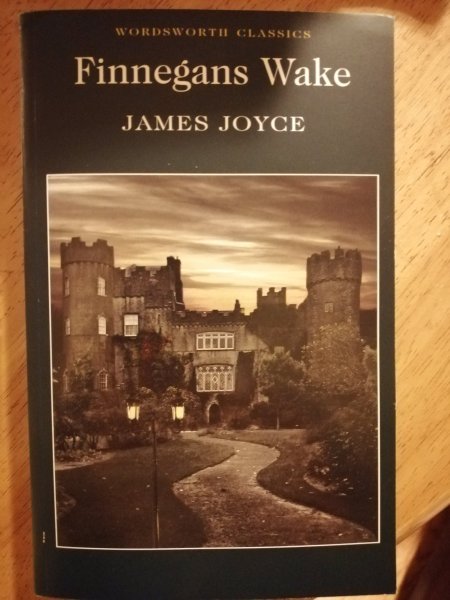
It is, I think, fairly well known that physicist Murray Gell-Mann was inspired to pick the name quark for the name of a type of subatomic particle by a passage from Finnegans Wake by James Joyce:

— Three quarks for Muster Mark!
Sure he hasn’t got much of a bark
And sure any he has it’s all beside the mark.

What is perhaps less well known is the identity of “Muster Mark” in that quote. In fact it is King Mark of Cornwall, husband of Queen Iseult in the legend of Tristan and Iseult. The Iseult in that legend is Irish. She has has an affair with Tristan, nephew of King Mark, with tragic consequences. This legend appears in many literary forms including, most famously, Richard Wagner’s Opera Tristan und Isolde. It also comes up frequently in Finnegans Wake including this passage on the same page (in the edition I have) as the Muster Mark quote above:

That song sang seaswans.
The winging ones. Seahawk, seagull, curlew and plover, kestrel
and capercallzie. All the birds of the sea they trolled out rightbold
when they smacked the big kuss of Trustan with Usolde.

See how Joyce plays with the substitution of “u” for “i” here as in “Muster”. Either that or the “I” key on his typewriter didn’t work properly. Or he had fat fingers and kept hitting the wrong key; U and I are next door on the keyboard.

Incidentally there is a small village in Dublin called Chapelizod which is where a church was built dedicated to Queen Iseult. Whether there is any real connection between this place and the historical Iseult is very doubtful.

Now, where was I. Oh yes. Back to Opera.

Years ago, when I lived in Nottingham, on a warm summer evening I decided to listen to some of the live broadcast on BBC Radio 3 of a performance of Wagner’s Tristan und Isolde from Glyndebourne. I made myself a cocktail and took the radio out into the garden with the intention of listening to a bit of it before going out for the evening. This was back in the days when I actually used to go out on the town on Saturday nights; now I’m too old for that sort of thing.

Anyway, I was hooked right from the Prelude. Act I came and went and I decided to make some dinner in the interval, opened a bottle of wine, and returned to listen to the rest of it. The glorious music washed over me in the sultry twilight. Darkness fell, a second bottle of wine was opened, and still I listened – no doubt to the consternation of my neighbours. The final Liebestod was so beautiful I almost cried. Eventually I retreated to the house having experienced my first all-out Wagner trip.

My enjoyment of that occasion was of course helped by the fact I could get up and walk around occasionally, as well as by the liberal intake of fine wine. Nevertheless I do think Tristan and Isolde works very well on the radio – nothing very much happens on stage anyway (especially in Act II) so you can just let the music work it’s magic.

The reason for all this rambling is that there is a special broadcast of Tristan und Isolde on RTÉ Lyric FM. This performance, recorded in 2012, features as Isolde the celebrated dramatic soprano Miriam Murphy who very sadly passed away suddenly a few weeks ago. Tonight’s programme is a tribute to her memory. I believe Miriam Murphy is the only Irish soprano to have sung the role of Isolde. I’ve heard a few clips from it and her voice sounds amazing.

The Opera is preceded on the radio by a documentary about the production, the first in Ireland for 50 years and the first by a brand new company based in Ireland. I think James Joyce would have approved.

So that’s my Saturday evening sorted out!

Update: I listened to the broadcast and it is an astonishingly wonderful performance by Miriam Murphy.