Archive for the Literature Category

5th June 23.15 GMT

Posted in Literature, The Universe and Stuff with tags , , , on June 6, 2019 by telescoper


Blessent mon cœur
D’une langueur
Monotone.


(This excerpt from a poem by Paul Verlaine formed a coded message broadcast to the French resistance by Radio Londres, 5th June 1944 at 23.15 GMT informing them that the Allied invasion of France was imminent. Preceded by extensive airborne operations, the landings on the beaches of Normandy began on the morning of 6th June 1944.)


The Second Coming

Posted in Poetry with tags , , , on April 19, 2019 by telescoper

Turning and turning in the widening gyre
The falcon cannot hear the falconer;
Things fall apart; the centre cannot hold;
Mere anarchy is loosed upon the world,
The blood-dimmed tide is loosed, and everywhere
The ceremony of innocence is drowned;
The best lack all conviction, while the worst
Are full of passionate intensity.

Surely some revelation is at hand;
Surely the Second Coming is at hand.
The Second Coming! Hardly are those words out
When a vast image out of Spiritus Mundi
Troubles my sight: somewhere in sands of the desert
A shape with lion body and the head of a man,
A gaze blank and pitiless as the sun,
Is moving its slow thighs, while all about it
Reel shadows of the indignant desert birds.
The darkness drops again; but now I know
That twenty centuries of stony sleep
Were vexed to nightmare by a rocking cradle,
And what rough beast, its hour come round at last,
Slouches towards Bethlehem to be born?

by William Butler Yeats (1865-1939): this poem was written in 1919.

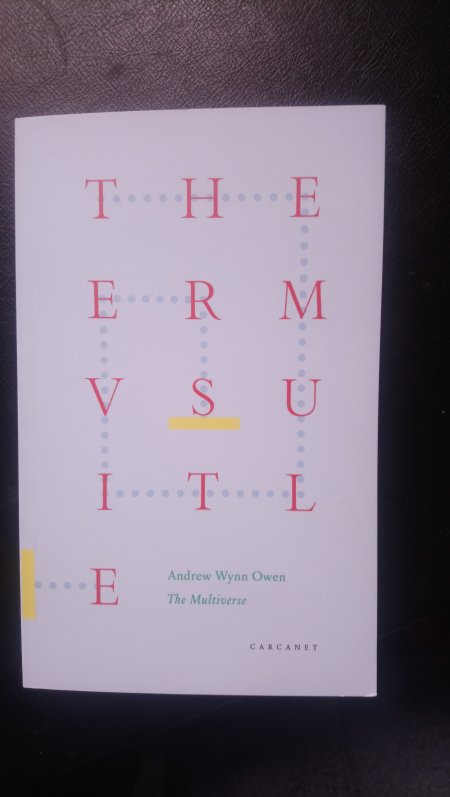
The Multiverse – Andrew Wynn Owen

Posted in Poetry, The Universe and Stuff with tags , , on April 18, 2019 by telescoper

The Multiverse is Andrew Wynn Owen‘s first book of poems. It was published last year by Carcanet Press, but I only found out about it a week or two ago, from a review in a recent edition of the Times Literary Supplement. I had £10 in book tokens left over from a crossword prize so decided to spend them on this exuberant and diverse collection (which cost £9.99).

There are two particularly interesting things about this book. One is its thematic range, which is centred on science and philosophy but spreads out very widely across many fields. It’s actually not unusual for poets to be interested in science, though perhaps it is rather rarer for scientists to be interested in poetry…

The other particularly interesting aspect of these poems is their stylistic range. All of them are written in very precise forms, including the various types of sonnet, each with a strict metre but differing radically in structure from one to the other. As you might expect there are clear echoes of poetry from other eras, including nods in the direction of the metaphysical poets such as George Herbert.

You might infer from what I’ve said that these poems are merely imitative of other works, but that’s not the case. Although they are often very witty, these poems are not just parodies. I think the poet’s intention was to demonstrate how much can still be said that’s relevant to the modern world using established forms. I think he succeeds brilliantly, and he shows such mastery of so many different styles that it’s hard to believe this is a debut collection.

The title The Multiverse plays both on the aspects I described above, the scientific and philosophical themes, and the plurality of verse forms contained in this collection. As a physicist, though I’m not a proponent of the ‘scientific’ Multiverse, I recommend the poetic version very highly!

Patterns – by Amy Lowell

Posted in Poetry with tags , , on April 14, 2019 by telescoper

I walk down the garden paths,
And all the daffodils
Are blowing, and the bright blue squills.
I walk down the patterned garden-paths
In my stiff, brocaded gown.
With my powdered hair and jewelled fan,
I too am a rare
Pattern. As I wander down
The garden paths.

My dress is richly figured,
And the train
Makes a pink and silver stain
On the gravel, and the thrift
Of the borders.
Just a plate of current fashion,
Tripping by in high-heeled, ribboned shoes.
Not a softness anywhere about me,
Only whalebone and brocade.
And I sink on a seat in the shade
Of a lime tree.For my passion
Wars against the stiff brocade.
The daffodils and squills
Flutter in the breeze
As they please.
And I weep;
For the lime-tree is in blossom
And one small flower has dropped upon my bosom.

And the plashing of waterdrops
In the marble fountain
Comes down the garden-paths.
The dripping never stops.
Underneath my stiffened gown
Is the softness of a woman bathing in a marble basin,
A basin in the midst of hedges grown
So thick, she cannot see her lover hiding,
But she guesses he is near,
And the sliding of the water
Seems the stroking of a dear
Hand upon her.
What is Summer in a fine brocaded gown!
I should like to see it lying in a heap upon the ground.
All the pink and silver crumpled up on the ground.

I would be the pink and silver as I ran along the paths,
And he would stumble after,
Bewildered by my laughter.
I should see the sun flashing from his sword-hilt and the buckles
on his shoes.
I would choose
To lead him in a maze along the patterned paths,
A bright and laughing maze for my heavy-booted lover,
Till he caught me in the shade,
And the buttons of his waistcoat bruised my body as he clasped me,
Aching, melting, unafraid.
With the shadows of the leaves and the sundrops,
And the plopping of the waterdrops,
All about us in the open afternoon —
I am very like to swoon
With the weight of this brocade,
For the sun sifts through the shade.

Underneath the fallen blossom
In my bosom,
Is a letter I have hid.
It was brought to me this morning by a rider from the Duke.
“Madam, we regret to inform you that Lord Hartwell
Died in action Thursday se’nnight.”
As I read it in the white, morning sunlight,
The letters squirmed like snakes.
“Any answer, Madam,” said my footman.
“No,” I told him.
“See that the messenger takes some refreshment.
No, no answer.”
And I walked into the garden,
Up and down the patterned paths,
In my stiff, correct brocade.
The blue and yellow flowers stood up proudly in the sun,
Each one.
I stood upright too,
Held rigid to the pattern
By the stiffness of my gown.
Up and down I walked,
Up and down.

In a month he would have been my husband.
In a month, here, underneath this lime,
We would have broke the pattern;
He for me, and I for him,
He as Colonel, I as Lady,
On this shady seat.
He had a whim
That sunlight carried blessing.
And I answered, “It shall be as you have said.”
Now he is dead.

In Summer and in Winter I shall walk
Up and down
The patterned garden-paths
In my stiff, brocaded gown.
The squills and daffodils
Will give place to pillared roses, and to asters, and to snow.
I shall go
Up and down,
In my gown.
Gorgeously arrayed,
Boned and stayed.
And the softness of my body will be guarded from embrace
By each button, hook, and lace.
For the man who should loose me is dead,
Fighting with the Duke in Flanders,
In a pattern called a war.
Christ! What are patterns for?

by Amy Lowell (1874-1925)

The Most Ancient Heavens

Posted in Art, Biographical, Poetry, The Universe and Stuff with tags , , , , , , , , on March 21, 2019 by telescoper

So here I am, in that London, getting ready for the start of a two-day conference at the Royal Astronomical Society on cosmology, large-scale structure, and weak gravitational lensing, to celebrate the work of Professor Alan Heavens, on (or near) the occasion of his 60th birthday. Yes, it is a great name for an astronomer.

I was honoured to be invited to give a talk at this meeting, though my immediate reaction when I was told about was `But he can’t be sixty! He’s only a few years older than me…oh.’ I gather I’m supposed to say something funny after the conference dinner tomorrow night too.

Courtesy of alphabetical order it looks like I’m top of the bill!

Anyway, I’ve known Alan since I was a research student, i.e. over thirty years, and we’re co-authors on 13 papers (all of them since 2011). I’m looking forward to the HeavensFest not only for the scientific programme (which looks excellent) but also for the purpose of celebrating an old friend and colleague.

Just to clear up a couple of artistic points.

First, the title of the meeting, The Most Ancient Heavens, is taken from Ode to Duty by William Wordsworth.

Second, the image on the conference programme shown above is a pastiche of The Creation of Alan Adam which is part of the ceiling of the Sistine Chapel painted by Michelangelo di Lodovico Buonarroti Simoni, known to his friends as Michelangelo. Apparently he worked flat out painting this enormous fresco. It was agony but the ecstasy kept him going. I’ve often wondered (a) who did the floor of the Sistine Chapel and (b) how could Michelangelo create such great art when it was so clearly extremely cold? Anyway, I think that is a picture of Alan at high redshift on the far right, next to the man with beard who at least had the good sense to wear a nightie to spare his embarrassment.

Anyway, that’s all for now. I must be going. Time for a stroll down to Piccadilly.

Update: you can find a bunch of pictures of this conference here.

They – by R.S. Thomas

Posted in Poetry with tags , , on March 14, 2019 by telescoper

The new explorers don’t go
anywhere and what they discover
we can’t see. But they change our lives.

They interpret absence
as presence, measuring it by the movement
of its neighbours. Their world is

an immense place: deep down is as distant
as far out, but is arrived at
in no time. These are the new

linguists, exchanging acrosss closed
borders the currency of their symbols.
Have I been too long on my knees

worrying over the obscurity
of a message? These have their way, too,
other than a prayer of breaking that abstruse code.

by R.S. Thomas (1913-2000)

To Like and to Like not

Posted in Biographical, Poetry with tags , , , on March 8, 2019 by telescoper

Travelling today, I was reminded that exactly a week ago, WordPress sent me this notification:

I was a bit surprised, to be honest, as that I posted a St David’s Day poem and usually when I post poetry the traffic goes down. Last Friday however it seems all my St David’s Day poetry posts going back years attracted traffic (and ‘likes’), so I was quite pleased.

Some time ago a senior astronomer emailed me to say that he thought that, for a science blog, there was far to much other stuff for his liking. Other stuff presumably including poetry, music, sport and the rest.

Anyway my response was that this isn’t really a science blog. It’s just a personal blog written by someone who happens to be a scientist. I post about science fairly often but I wouldn’t enjoy blogging half as much if I only covered that.

Some people have asked me why I post poetry and music and the rest. The answer is simple: to share things I enjoy. If just one person were to discover a poem they like by reading it here then it makes it all worthwhile!

A Poem for St David’s Day

Posted in Poetry with tags , , , on March 1, 2019 by telescoper

It’s St David’s Day today, and a lovely spring morning it is, so I wish you all a big

Dydd Gŵyl Dewi Hapus!


Gratuitous Picture of some Daffodils near the Maynooth University Library.

It has become a bit of a St David’s Day tradition on this this blog to post a piece of verse by the great Welsh poet R.S. Thomas. An Anglican clergyman, Thomas was vicar at St Hywyn’s Church (which was built 1137) in Aberdaron at the western tip of the Llŷn Peninsula. In this, one of his most famous poems, he speaks eloquently and movingly of the frustrations of his calling.

I was vicar of large things
in a small parish. Small-minded
I will not say, there were depths
in some of them I shrank back
from, wells that the word “God”
fell into and died away,
and for all I know is still
falling. Who goes for water
to such must prepare for a long
wait. Their eyes looked at me
and were the remains of flowers
on an old grave. I was there,
I felt, to blow on ashes
that were too long cold. Often,
when I thought they were about
to unbar to me, the draught
out of their empty places
came whistling so that I wrapped
myself in the heavier clothing
of my calling, speaking of light and love
in the thickening shadows of their kitchens

Heroic Failure: Brexit and the Politics of Pain

Posted in Literature, Maynooth, Politics with tags , , on February 21, 2019 by telescoper

Before Christmas I attended a very enjoyable event here in Maynooth featuring journalist, historian and literary critic Fintan O’Toole talking his book Heroic Failure: Brexit and the Politics of Pain. I bought the book and had it signed by the author. Sadly, as I do far too often these days, I put the book on my shelf and promptly forgot about it as I got distracted by a myriad of other things.

This week I finally got round to reading it and very enjoyable it is too, though I expect people who voted Leave won’t like it, as it is probably a bit close to the bone for them.

The book deals with the Brexit referendum, the chaos it unleashed in British politics and the challenges posed to the island of Ireland by a ‘No Deal Brexit’. In particular the book examines how a country that once had colonies is redefining itself as an oppressed nation requiring liberation; the dreams of revolutionary deregulation and privatization that drive Arron Banks, Nigel Farage and Jacob Rees-Mogg; and the silent rise of English nationalism, the force that dare not speak its name. He also discusses the fatal attraction of heroic failure, once a self-deprecating cult in a hugely successful empire that could well afford the occasional disaster: the Charge of the Light Brigade, or Franklin lost in the Arctic. Now failure is no longer heroic – it is just failure, and its terrible costs will be paid by the most vulnerable of Brexit’s supporters, and by those who may suffer the consequences of a hard border in Ireland and the breakdown of a fragile peace.

It’s a very witty book which is at its best picking apart some of the some-contradictory rhetoric deployed by Leave campaigners, such as how the UK can be both grandiosely jingoistic and bullied by the EU at the same time, pulling in references from historical events and literature as well as contemporary culture (including Fifty Shades of Grey, the references to which were lost on me because I haven’t read it). It’s also very perceptive in its observation of how strongly the legacy of World War 2 pervades attitudes towards Brexit, especially the silly references to `Dunkirk Spirit’ and the rest that are the stock-in-trade of many Leavers.

Anyway, I heartily recommend this book to both Leavers and Remainers but it might induce a sense of humour failure in the former.


The Arrival of the Bee Box

Posted in Literature with tags , , , on January 9, 2019 by telescoper

I ordered this, clean wood box
Square as a chair and almost too heavy to lift.
I would say it was the coffin of a midget
Or a square baby
Were there not such a din in it.

The box is locked, it is dangerous.
I have to live with it overnight
And I can’t keep away from it.
There are no windows, so I can’t see what is in there.
There is only a little grid, no exit.

I put my eye to the grid.
It is dark, dark,
With the swarmy feeling of African hands
Minute and shrunk for export,
Black on black, angrily clambering.

How can I let them out?
It is the noise that appalls me most of all,
The unintelligible syllables.
It is like a Roman mob,
Small, taken one by one, but my god, together!

I lay my ear to furious Latin.
I am not a Caesar.
I have simply ordered a box of maniacs.
They can be sent back.
They can die, I need feed them nothing, I am the owner.

I wonder how hungry they are.
I wonder if they would forget me
If I just undid the locks and stood back and turned into a tree.
There is the laburnum, its blond colonnades,
And the petticoats of the cherry.

They might ignore me immediately
In my moon suit and funeral veil.
I am no source of honey
So why should they turn on me?
Tomorrow I will be sweet God, I will set them free.

The box is only temporary.

by Sylvia Plath (1932-1963)