Archive for the Literature Category

Especially when the October Wind

Posted in Poetry with tags , , on October 15, 2018 by telescoper

Especially when the October wind
With frosty fingers punishes my hair,
Caught by the crabbing sun I walk on fire
And cast a shadow crab upon the land,
By the sea’s side, hearing the noise of birds,
Hearing the raven cough in winter sticks,
My busy heart who shudders as she talks
Sheds the syllabic blood and drains her words.

Shut, too, in a tower of words, I mark
On the horizon walking like the trees
The wordy shapes of women, and the rows
Of the star-gestured children in the park.
Some let me make you of the vowelled beeches,
Some of the oaken voices, from the roots
Of many a thorny shire tell you notes,
Some let me make you of the water’s speeches.

Behind a pot of ferns the wagging clock
Tells me the hour’s word, the neural meaning
Flies on the shafted disk, declaims the morning
And tells the windy weather in the cock.
Some let me make you of the meadow’s signs;
The signal grass that tells me all I know
Breaks with the wormy winter through the eye.
Some let me tell you of the raven’s sins.

Especially when the October wind
(Some let me make you of autumnal spells,
The spider-tongued, and the loud hill of Wales)
With fists of turnips punishes the land,
Some let me make you of the heartless words.
The heart is drained that, spelling in the scurry
Of chemic blood, warned of the coming fury.
By the sea’s side hear the dark-vowelled birds.

by Dylan Thomas (1914-1953)


Lines composed upon Hearing News of the Retirement of Mr Alastair Cook from International Cricket

Posted in Cricket, Poetry on September 3, 2018 by telescoper

So.
Farewell then,
Alastair
Cook.

I hear that
You are going
To retire from
Test Match
Cricket.

Does that mean
You will go
Back
To doing
Letter from
America?

by Peter Coles (aged 55 ¼)

The Russell Library, Maynooth

Posted in Books, Education, Literature, Maynooth with tags , on August 29, 2018 by telescoper

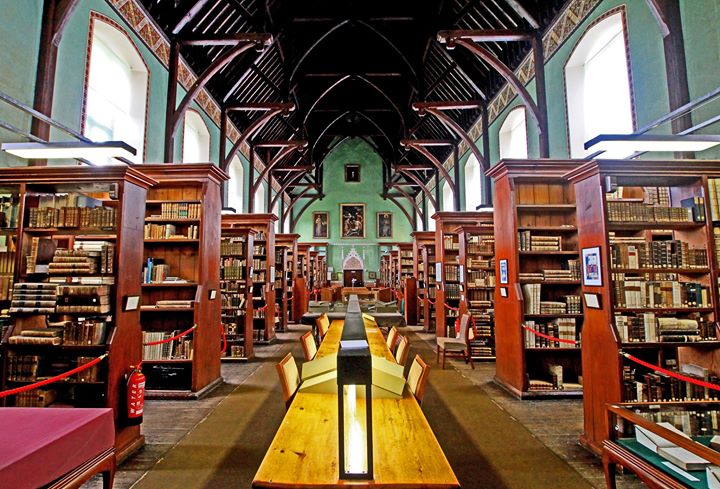
For those of you who like lovely old libraries filled with lovely old books, here’s a picture of the Russell Library, which is on the South Campus of Maynooth University:

Library Picture

According to the website:

The Russell Library houses the historical collections of St Patrick’s College, Maynooth which was founded in 1795 as a seminary for the education of Irish priests. The reading room was designed by renowned British architect and designer Augustus Welby Northmore Pugin (1812-1852) and completed in the year 1861. The Russell Library contains approximately 34,000 printed works dating from the 16th to the mid-19th century across a range of subjects including: theology, mathematics, science, geography and history. Other important collections include: medieval and Gaelic manuscripts, archival material and incunabula (pre-1501 printing).

On His Queerness

Posted in Poetry with tags , , on August 2, 2018 by telescoper

When I was young and wanted to see the sights,
They told me: ‘Cast an eye over the Roman Camp
If you care to.
But plan to spend most of your day at the Aquarium –
Because, after all, the Aquarium –
Well, I mean to say, the Aquarium –
Till you’ve seen the Aquarium you ain’t seen nothing.’

So I cast my eye over
The Roman Camp –
And that old Roman Camp,
That old, old Roman Camp
Got me
Interested.

So that now, near closing-time,
I find that I still know nothing –
And am still not even sorry that I know nothing –
About fish.

by Christopher Isherwood (1904-1986)


The Old Stoic – by Emily Jane Brontë

Posted in Literature, Poetry with tags , , , on July 30, 2018 by telescoper

Today, 30th July 2018, is the 200th anniversary of the birth of Emily Jane Brontë. There are many items celebrating her life in circulation on this day, most of them concentrating on her most famous work, her only novel Wuthering Heights, published under the pseudonym Ellis Bell in 1847. But Emily Brontë was also a fine poet, as indeed were her sisters Anne and Charlotte, so I thought I’d post a poem by her here. Much of her poetry is dominated by images of death and suffering, and her own health was affected by the harsh conditions in which she lived; she died of tuberculosis at the at the age of just 30.

Riches I hold in light esteem,
And Love I laugh to scorn;
And lust of fame was but a dream,
That vanished with the morn:

And if I pray, the only prayer
That moves my lips for me
Is, “Leave the heart that now I bear,
And give me liberty!”

Yes, as my swift days near their goal:
‘Tis all that I implore;
In life and death a chainless soul,
With courage to endure.

Law like Love – W.H. Auden

Posted in Poetry with tags , on July 10, 2018 by telescoper

Law, say the gardeners, is the sun,
Law is the one
All gardeners obey
To-morrow, yesterday, to-day.

Law is the wisdom of the old,
The impotent grandfathers feebly scold;
The grandchildren put out a treble tongue,
Law is the senses of the young.

Law, says the priest with a priestly look,
Expounding to an unpriestly people,
Law is the words in my priestly book,
Law is my pulpit and my steeple.

Law, says the judge as he looks down his nose,
Speaking clearly and most severely,
Law is as I’ve told you before,
Law is as you know I suppose,
Law is but let me explain it once more,
Law is The Law.

Yet law-abiding scholars write:
Law is neither wrong nor right,
Law is only crimes
Punished by places and by times,
Law is the clothes men wear
Anytime, anywhere,
Law is Good morning and Good night.

Others say, Law is our Fate;
Others say, Law is our State;
Others say, others say
Law is no more,
Law has gone away.

And always the loud angry crowd,
Very angry and very loud,
Law is We,
And always the soft idiot softly Me.

If we, dear, know we know no more
Than they about the Law,
If I no more than you
Know what we should and should not do
Except that all agree
Gladly or miserably
That the Law is
And that all know this
If therefore thinking it absurd
To identify Law with some other word,
Unlike so many men
I cannot say Law is again,

No more than they can we suppress
The universal wish to guess
Or slip out of our own position
Into an unconcerned condition.
Although I can at least confine
Your vanity and mine
To stating timidly
A timid similarity,
We shall boast anyway:
Like love I say.

Like love we don’t know where or why,
Like love we can’t compel or fly,
Like love we often weep,
Like love we seldom keep.

by W.H. Auden (1907-1973)

The Workman’s Friend

Posted in Poetry with tags , on July 6, 2018 by telescoper

When things go wrong and will not come right,
Though you do the best you can,
When life looks black as the hour of night –
A pint of plain* is your only man.

When money’s tight and hard to get
And your horse has also ran,
When all you have is a heap of debt –
A pint of plain is your only man.

When health is bad and your heart feels strange,
And your face is pale and wan,
When doctors say you need a change,
A pint of plain is your only man.

When food is scarce and your larder bare
And no rashers grease your pan,
When hunger grows as your meals are rare –
A pint of plain is your only man.

In time of trouble and lousey strife,
You have still got a darlint plan
You still can turn to a brighter life –
A pint of plain is your only man.


by Flann O’Brien (aka Brian O’Nolan; 1911-1966)


*plain here means `stout’ (e..g Guinness).


June, by Francis Ledwidge

Posted in Poetry with tags , , on June 19, 2018 by telescoper

Broom out the floor now, lay the fender by,
And plant this bee-sucked bough of woodbine there,
And let the window down. The butterfly
Floats in upon the sunbeam, and the fair
Tanned face of June, the nomad gipsy, laughs
Above her widespread wares, the while she tells
The farmers’ fortunes in the fields, and quaffs
The water from the spider-peopled wells.
The hedges are all drowned in green grass seas,
And bobbing poppies flare like Elmo’s light,
While siren-like the pollen-staind bees
Drone in the clover depths. And up the height
The cuckoo’s voice is hoarse and broke with joy.
And on the lowland crops the crows make raid,
Nor fear the clappers of the farmer’s boy,
Who sleeps, like drunken Noah, in the shad
And loop this red rose in that hazel ring
That snares your little ear, for June is short
And we must joy in it and dance and sing,
And from her bounty draw her rosy worth.
Ay! soon the swallows will be flying south,
The wind wheel north to gather in the snow,
Even the roses spilt on youth’s red mouth
Will soon blow down the road all roses go.

by Francis Ledwidge (1887-1917*)

*One of Ireland’s foremost poets of the First World War, Ledwidge was killed in action on 31st July 1917 at the Battle of Passchendaele.

Thoughts Suggested by a College Examination – Byron

Posted in Literature with tags , , , on May 24, 2018 by telescoper

High in the midst, surrounded by his peers,
Magnus his ample front sublime uprears:
Plac’d on his chair of state, he seems a God,
While Sophs and Freshmen tremble at his nod;
As all around sit wrapt in speechless gloom,
His voice, in thunder, shakes the sounding dome;
Denouncing dire reproach to luckless fools,
Unskill’d to plod in mathematic rules.

Happy the youth! in Euclid’s axioms tried,
Though little vers’d in any art beside;
Who, scarcely skill’d an English line to pen,
Scans Attic metres with a critic’s ken.

What! though he knows not how his fathers bled,
When civil discord pil’d the fields with dead,
When Edward bade his conquering bands advance,
Or Henry trampled on the crest of France:
Though marvelling at the name of Magna Charta,
Yet well he recollects the laws of Sparta;
Can tell, what edicts sage Lycurgus made,
While Blackstone’s on the shelf, neglected laid;
Of Grecian dramas vaunts the deathless fame,
Of Avon’s bard, rememb’ring scarce the name.

Such is the youth whose scientific pate
Class-honours, medals, fellowships, await;
Or even, perhaps, the declamation prize,
If to such glorious height, he lifts his eyes.
But lo! no common orator can hope
The envied silver cup within his scope:
Not that our heads much eloquence require,
Th’ ATHENIAN’S glowing style, or TULLY’S fire.
A manner clear or warm is useless, since
We do not try by speaking to convince;
Be other orators of pleasing proud,—
We speak to please ourselves, not move the crowd:
Our gravity prefers the muttering tone,
A proper mixture of the squeak and groan:
No borrow’d grace of action must be seen,
The slightest motion would displease the Dean;
Whilst every staring Graduate would prate,
Against what—he could never imitate.

The man, who hopes t’ obtain the promis’d cup,
Must in one posture stand, and ne’er look up;
Nor stop, but rattle over every word—
No matter what, so it can not be heard:
Thus let him hurry on, nor think to rest:
Who speaks the fastest’s sure to speak the best;
Who utters most within the shortest space,
May, safely, hope to win the wordy race.

The Sons of Science these, who, thus repaid,
Linger in ease in Granta’s sluggish shade;
Where on Cam’s sedgy banks, supine, they lie,
Unknown, unhonour’d live—unwept for die:
Dull as the pictures, which adorn their halls,
They think all learning fix’d within their walls:
In manners rude, in foolish forms precise,
All modern arts affecting to despise;
Yet prizing Bentley’s, Brunck’s, or Porson’s note,
More than the verse on which the critic wrote:
Vain as their honours, heavy as their Ale,
Sad as their wit, and tedious as their tale;
To friendship dead, though not untaught to feel,
When Self and Church demand a Bigot zeal.
With eager haste they court the lord of power,
(Whether ’tis PITT or PETTY rules the hour;)
To him, with suppliant smiles, they bend the head,
While distant mitres to their eyes are spread;
But should a storm o’erwhelm him with disgrace,
They’d fly to seek the next, who fill’d his place.
Such are the men who learning’s treasures guard!
Such is their practice, such is their reward!
This much, at least, we may presume to say—
The premium can’t exceed the price they pay.

by George Gordon Byron (1788-1824)
 

The Absence, by R.S. Thomas

Posted in Poetry with tags , on May 16, 2018 by telescoper

It is this great absence
that is like a presence, that compels
me to address it without hope
of a reply. It is a room I enter

from which someone has just
gone, the vestibule for the arrival
of one who has not yet come.
I modernise the anachronism

of my language, but he is no more here
than before. Genes and molecules
have no more power to call
him up than the incense of the Hebrews

at their altars. My equations fail
as my words do. What resources have I
other than the emptiness without him of my whole
being, a vacuum he may not abhor?

by R.S. Thomas (1913-2000)