Archive for the Poetry Category

#WorldPoetryDay: `Solitude’ by Lord Byron

Posted in Poetry with tags , , , , , , on March 21, 2020 by telescoper

Today (Saturday 21st March 2020) is United Nations World Poetry Day. As I think we need poetry now more than ever I thought I’d post some poems to celebrate. There will be five altogether, spread throughout the day. My first choice is by Lord Byron:

To sit on rocks, to muse o’er flood and fell,
To slowly trace the forest’s shady scene,
Where things that own not man’s dominion dwell,
And mortal foot hath ne’er or rarely been;
To climb the trackless mountain all unseen,
With the wild flock that never needs a fold;
Alone o’er steeps and foaming falls to lean;
This is not solitude, ’tis but to hold
Converse with Nature’s charms, and view her stores unrolled.

But midst the crowd, the hurry, the shock of men,
To hear, to see, to feel and to possess,
And roam alone, the world’s tired denizen,
With none who bless us, none whom we can bless;
Minions of splendour shrinking from distress!
None that, with kindred consciousness endued,
If we were not, would seem to smile the less
Of all the flattered, followed, sought and sued;
This is to be alone; this, this is solitude!

by Lord Byron (1788-1824)


Brave World, by Tony Hoagland

Posted in Poetry with tags , , , on March 11, 2020 by telescoper

But what about the courage
of the cancer cell
that breaks out from the crowd
it has belonged to all its life

like a housewife erupting
from her line at the grocery store
because she just can’t stand
the sameness anymore?

What about the virus that arrives
in town like a traveler
from somewhere faraway
with suitcases in hand,

who only wants a place
to stay, a chance to get ahead
in the land of opportunity,
but who smells bad,

talks funny, and reproduces fast?
What about the microbe that
hurls its tiny boat straight
into the rushing metabolic tide,

no less cunning and intrepid
than Odysseus; that gambles all
to found a city
on an unknown shore?

What about their bill of rights,
their access to a full-scale,
first-class destiny?
their chance to realize

maximum potential?-which, sure,
will come at the expense
of someone else, someone
who, from a certain point of view,

is a secondary character,
whose weeping is almost
too far off to hear,

a noise among the noises
coming from the shadows
of any brave new world.

by Tony Hoagland (1953-2018).


Three Poems for St David’s Day

Posted in Poetry with tags , , , , , , , on March 1, 2020 by telescoper

It’s St David’s Day today, and I’m glad to say that Storm Jorge has passed, so I wish you all a big

Dydd Gŵyl Dewi Hapus!
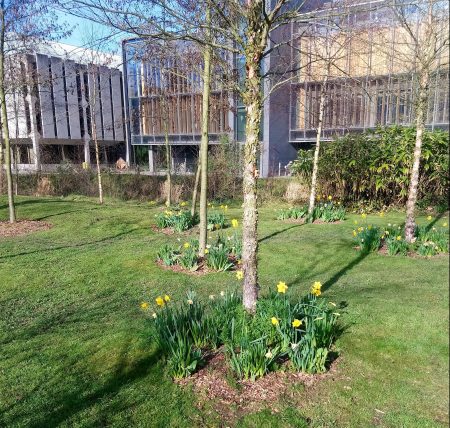
 

Gratuitous Picture of some Daffodils near the Maynooth University Library.

It has become a bit of a St David’s Day tradition on this this blog to post a piece of verse by the great Welsh poet R.S. Thomas, but this year I decided to post three poems by different Welsh poets. But I’ll start with R.S. Thomas. This is The Bright Field.

I have seen the sun break through
to illuminate a small field
for a while, and gone my way
and forgotten it. But that was the pearl
of great price, the one field that had
treasure in it. I realize now
that I must give all that I have
to possess it. Life is not hurrying

on to a receding future, nor hankering after
an imagined past. It is the turning
aside like Moses to the miracle
of the lit bush, to a brightness
that seemed as transitory as your youth
once, but is the eternity that awaits you.

This one is by a poet who shared the same surname (but little else either stylistically or thematically), Dylan Thomas. It’s called Here in This Spring.

Here in this spring, stars float along the void;
Here in this ornamental winter
Down pelts the naked weather;
This summer buries a spring bird.

Symbols are selected from the years’
Slow rounding of four seasons’ coasts,
In autumn teach three seasons’ fires
And four birds’ notes.

I should tell summer from the trees, the worms
Tell, if at all, the winter’s storms
Or the funeral of the sun;
I should learn spring by the cuckooing,
And the slug should teach me destruction.

A worm tells summer better than the clock,
The slug’s a living calendar of days;
What shall it tell me if a timeless insect
Says the world wears away?

And finally, by popular request, a poem by Dannie Abse called The Old Gods.

The gods, old as night, don’t trouble us.
Poor weeping Venus! Her pubic hairs are grey,
and her magic love girdle has lost its spring.
Neptune wonders where he put his trident.
Mars is gaga – illusory vultures on the wing.

Pluto exhumed, blinks. My kind of world, he thinks.
Kidnapping and rape, like my Front Page exploits
adroitly brutal – but he looks out of sorts when
other unmanned gods shake their heads tut tut,
respond boastingly, boringly anecdotal.

Diana has done a bunk, fearing astronauts.
Saturn, Time on his hands, stares at nothing and
nothing stares back. Glum Bacchus talks ad nauseam
of cirrhosis and small bald Cupid, fiddling
with arrows, can’t recall which side the heart is.

All the old gods have become enfeebled,
mere playthings for poets. Few, doze or daft,
frolic on Parnassian clover. True, sometimes
summer light dies in a room – but only
a bearded profile in a cloud floats over.


An die Freude

Posted in Poetry with tags , , , , , on January 30, 2020 by telescoper

Freude, Schöner Götterfunken,
Tochter aus Elysium,
Wir betreten feuer-trunken,
Himmlische, dein Heiligtum!
Deine Zauber binden wieder,
Was die Mode streng geteilt;
Alle Menschen werden Brüder,
Wo dein sanfter Flügel weilt.

Wem der grosse Wurf gelungen,
Eines Freundes Freund zu sein,
Wer ein holdes Weib errungen,
Mische seinen Jubel ein!
Ja, wer auch nur eine Seele
Sein nennt auf dem Erdenrund!
Und wer’s nie gekonnt, der stehle
Weinend sich aus diesem Bund!

Freude trinken alle Wesen
An den Brüsten der Natur;
Alle Guten, alle Bösen
Folgen ihrer Rosenspur.
Küsse gab sie uns und Reben,
Einen Freund, geprüft im Tod;
Wollust ward dem Wurm gegeben,
Und der Cherub steht vor Gott.

Froh, wie seine Sonnen fliegen
Durch des Himmels Prächt’gen Plan,
Laufet, Brüder, eure Bahn,
Freudig, wie ein Held zum Siegen.

Seid umschlungen, Millionen!
Diesen Kuss der ganzen Welt!
Brüder über’m Sternenzelt
Muss ein lieber Vater wohnen.
Ihr stürzt nieder, Millionen?
Ahnest du den Schöpfer, Welt?
Such’ ihn über’m Sternenzelt!
Über Sternen muss er wohnen.

by Friedrich Schiller (as revised by Ludwig van Beethoven)


Love Songs in Age

Posted in Poetry with tags , , , on January 25, 2020 by telescoper

She kept her songs, they kept so little space,
The covers pleased her:
One bleached from lying in a sunny place,
One marked in circles by a vase of water,
One mended, when a tidy fit had seized her,
And coloured, by her daughter –
So they had waited, till, in widowhood
She found them, looking for something else, and stood

Relearning how each frank submissive chord
Had ushered in
Word after sprawling hyphenated word,
And the unfailing sense of being young
Spread out like a spring-woken tree, wherein
That hidden freshness sung,
That certainty of time laid up in store
As when she played them first. But, even more,

The glare of that much-mentionned brilliance, love,
Broke out, to show
Its bright incipience sailing above,
Still promising to solve, and satisfy,
And set unchangeably in order. So
To pile them back, to cry,
Was hard, without lamely admitting how
It had not done so then, and could not now.

by Philip Larkin (1922-1985)

January, by R.S. Thomas

Posted in Poetry with tags , , , on January 16, 2020 by telescoper

The fox drags its wounded belly
Over the snow, the crimson seeds
Of blood burst with a mild explosion,
Soft as excrement, bold as roses.

Over the snow that feels no pity,
Whose white hands can give no healing,
The fox drags its wounded belly.

by R.S. Thomas (1913-2000)


Experience, by Emily Dickinson

Posted in Poetry with tags , , , on December 29, 2019 by telescoper

I stepped from plank to plank
So slow and cautiously;
The stars about my head I felt,
About my feet the sea.

I knew not but the next
Would be my final inch, —
This gave me that precarious gait
Some call experience.

by Emily Dickinson (1830-1886)

R.I.P. Clive James (1939-2019) – Japanese Maple

Posted in Poetry with tags , on November 28, 2019 by telescoper

More sad news arrived yesterday with the announcement of the death at the age of 80 of broadcaster, writer and critic Clive James. Clive James had been gravely ill for some time and had longer than many people to come to terms with his own mortality. In addition to the other things I mentioned above, he was an accomplished poet as he demonstrated in this reflection on his own end in the farewell poem Japanese Maple which he wrote about five years ago:

Your death, near now, is of an easy sort.
So slow a fading out brings no real pain.
Breath growing short
Is just uncomfortable. You feel the drain
Of energy, but thought and sight remain:

Enhanced, in fact. When did you ever see
So much sweet beauty as when fine rain falls
On that small tree
And saturates your brick back garden walls,
So many Amber Rooms and mirror halls?

Ever more lavish as the dusk descends
This glistening illuminates the air.
It never ends.
Whenever the rain comes it will be there,
Beyond my time, but now I take my share.

My daughter’s choice, the maple tree is new.
Come autumn and its leaves will turn to flame.
What I must do
Is live to see that. That will end the game
For me, though life continues all the same:

Filling the double doors to bathe my eyes,
A final flood of colors will live on
As my mind dies,
Burned by my vision of a world that shone
So brightly at the last, and then was gone.

And here is the man himself reading it. It’s very moving to hear him read this verse, his voice recognisable with its Australian accent and characteristic vocal mannerisms, but it is the voice of an invalid, of a dying man, thin and fading.

R.I.P. Clive James (1939-2019)

Because I could not stop for Death

Posted in Poetry with tags , , , on November 10, 2019 by telescoper

Because I could not stop for Death,
He kindly stopped for me;
The carriage held but just ourselves
And Immortality.

We slowly drove, he knew no haste,
And I had put away
My labor, and my leisure too,
For his civility.

We passed the school, where children strove
At recess, in the ring;
We passed the fields of gazing grain,
We passed the setting sun.

Or rather, he passed us;
The dews grew quivering and chill,
For only gossamer my gown,
My tippet only tulle.

We paused before a house that seemed
A swelling of the ground;
The roof was scarcely visible,
The cornice but a mound.

Since then ’tis centuries, and yet each
Feels shorter than the day
I first surmised the horses’ heads
Were toward eternity.

by Emily Dickinson (1830-1886)


The Bush, by R.S. Thomas

Posted in Poetry with tags , , on October 15, 2019 by telescoper

I know that bush,
Moses; there are many of them
in Wales in the autumn, braziers
where the imagination
warms itself. I have put off
pride and, knowing the ground
holy, lingered to wonder
how it is that I do not burn
and yet am consumed.

And in this country
of failure, the rain
falling out of a black
cloud in gold pieces
there are none to gather,
I have thought often
of the fountain of my people
that played beautifully here
once in the sun’s light
like a tree undressing.

by R.S. Thomas (1913-2000)