Archive for the Poetry Category

In the Park – Gwen Harwood

Posted in Poetry with tags , , , on February 10, 2024 by telescoper

Victoria Park, Sydney

She sits in the park. Her clothes are out of date.
Two children whine and bicker, tug her skirt.
A third draws aimless patterns in the dirt
Someone she loved once passed by – too late

to feign indifference to that casual nod.
“How nice” et cetera. “Time holds great surprises.”
From his neat head unquestionably rises
a small balloon…”but for the grace of God…”

They stand a while in flickering light, rehearsing
the children’s names and birthdays. “It’s so sweet
to hear their chatter, watch them grow and thrive, ”
she says to his departing smile. Then, nursing
the youngest child, sits staring at her feet.
To the wind she says, “They have eaten me alive.”

by Gwen Harwood (1920-1995)

The Body in the Bellaghy Bog

Posted in History, Poetry with tags , , , , , , , , on January 27, 2024 by telescoper

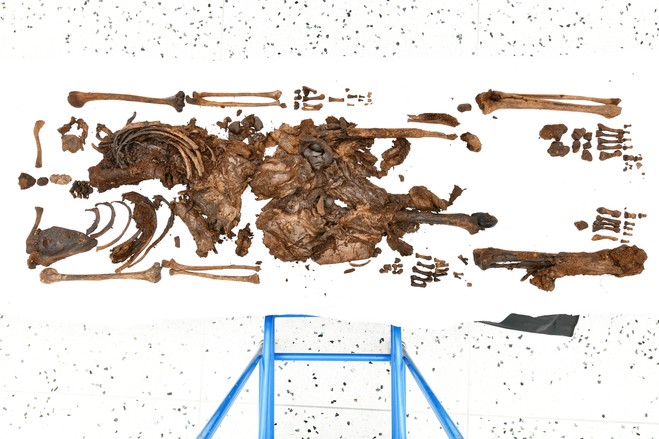
There was an interesting news item last week concerning the discovery of human remains in a peat bog in Bellaghy, County Derry. Radio-carbon dating has established that these remains are about 2,000 years old, so this was a person who lived in the Iron Age; a post-mortem has revealed it to be a teenage boy of around 15 years old. No cause of death has yet been established, but it is generally thought that these bog bodies were people who were executed as a punishment, or perhaps sacrificed for some ritual purpose.

These are neither the oldest nor the best-preserved such remains to be found in Ireland; the oldest belong to Cashel Man, who died, about 4,000 years ago, in the early Bronze Age. Nevertheless, the anaerobic conditions of the bog have slowed decomposition so much that not only bones, but some skin, hair and even parts of internal organs survive. This find is therefore important, not least because it should be possible to obtain detailed information about the DNA of this individual. Understanding of Ireland’s prehistoric past has been upended in recent years by DNA discoveries. What will Bellaghy Boy tell us? And how many more bog bodies are waiting to be found?

Another fascinating aspect of this story is that the location of the remains is very close to the house where the poet Seamus Heaney lived. Heaney wrote a number of poems about bog bodies and it’s ironic that there was one waiting to be found so close to his home.

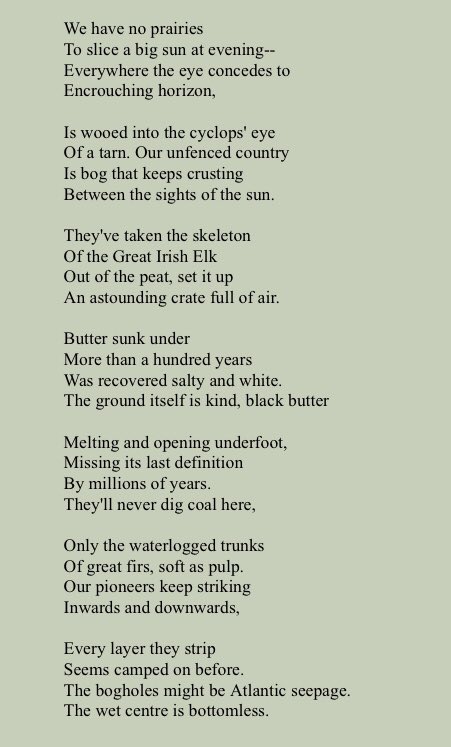
Anyway, this gives me an excuse to post a vaguely relevant poem by Heaney called Bogland which, appropriately for the title of this blog, comes from a collection called Door into the Dark.

Storm on the Island – Seamus Heaney

Posted in Poetry with tags , , , on January 22, 2024 by telescoper

We are prepared: we build our houses squat,
Sink walls in rock and roof them with good slate.
This wizened earth has never troubled us
With hay, so, as you see, there are no stacks
Or stooks that can be lost. Nor are there trees
Which might prove company when it blows full
Blast: you know what I mean – leaves and branches
Can raise a tragic chorus in a gale
So that you listen to the thing you fear
Forgetting that it pummels your house too.
But there are no trees, no natural shelter.
You might think that the sea is company,
Exploding comfortably down on the cliffs
But no: when it begins, the flung spray hits
The very windows, spits like a tame cat
Turned savage. We just sit tight while wind dives
And strafes invisibly. Space is a salvo,
We are bombarded with the empty air.
Strange, it is a huge nothing that we fear.

by Seamus Heaney (1939-2013)

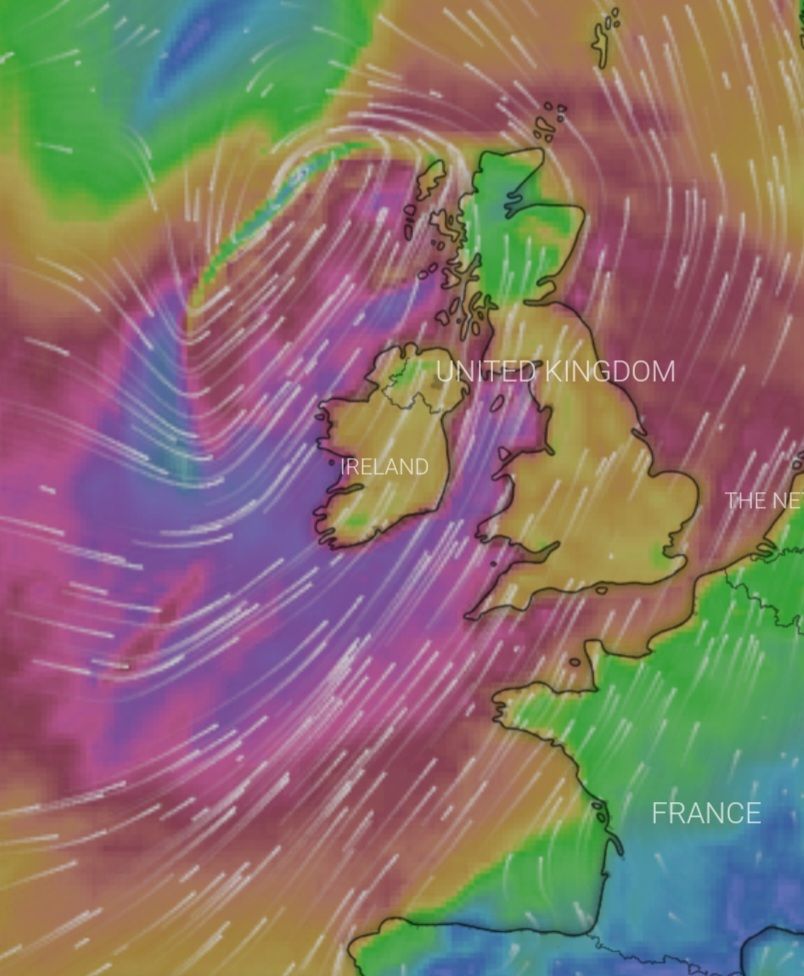
Storm Isha passed overnight, bringing down many trees and leaving many thousands of households without power.

To the Warmongers – Siegfried Sassoon

Posted in History, Poetry, Politics with tags , , on November 6, 2023 by telescoper

As we approach Remembrance Sunday in a time of rising conflict, it seems apt to post the following poem written by Siegfried Sassoon, called the To the Warmongers:

I’m back again from hell
With loathsome thoughts to sell;
Secrets of death to tell;
And horrors from the abyss.
Young faces bleared with blood,
Sucked down into the mud,
You shall hear things like this,
Till the tormented slain
Crawl round and once again,
With limbs that twist awry
Moan out their brutish pain,
As for the fighters pass them by.
For you our battles shine
With triumph half-divine;
And the glory of the dead
Kindles in each proud eye.
But a curse is on my head,
That shall not be unsaid,
And the wounds in my heart are red,
For I have watched them die.

Telescope – Louise Glück

Posted in Poetry, R.I.P. with tags , , , on October 16, 2023 by telescoper

I posted a poem by American poet Louise Glück when she won the 2020 Nobel Prize for Literature (“for her unmistakable poetic voice that with austere beauty makes individual existence universal”). I was sad to read that she passed away just a few days ago at the age of 80. By way of a small tribute here is another poem of hers I like very much. It is called Telescope.

There is a moment after you move your eye away
when you forget where you are
because you’ve been living, it seems,
somewhere else, in the silence of the night sky.

You’ve stopped being here in the world.
You’re in a different place,
a place where human life has no meaning.

You’re not a creature in a body.
You exist as the stars exist,
participating in their stillness, their immensity.

Then you’re in the world again.
At night, on a cold hill,
taking the telescope apart.

You realize afterward
not that the image is false
but the relation is false.

You see again how far away
each thing is from every other thing.

R.I.P. Louise Glück (1943-2023)

No Second Troy, by W.B. Yeats

Posted in Poetry with tags , , on July 27, 2023 by telescoper

Why should I blame her that she filled my days
With misery, or that she would of late
Have taught to ignorant men most violent ways,
Or hurled the little streets upon the great,
Had they but courage equal to desire?
What could have made her peaceful with a mind
That nobleness made simple as a fire,
With beauty like a tightened bow, a kind
That is not natural in an age like this,
Being high and solitary and most stern?
Why, what could she have done, being what she is?
Was there another Troy for her to burn?


by William Butler Yeats (1865-1939)

This Englishwoman – Stevie Smith

Posted in Art, Poetry with tags , on June 17, 2023 by telescoper

Thinking about Stevie Smith after yesterday’s post I thought I’d post something by her. She liked to put funny little sketches or doodles with some of her more whimsical poems, some of which are very short like this one, which brought a smile to my face so I thought I’d share it.

R.I.P. Glenda Jackson (1936-2023)

Posted in Film, Poetry, Politics, R.I.P. with tags , , , , on June 16, 2023 by telescoper

I’ve been writing far too many R.I.P. posts recently, but I had to say something to mark the passing of Glenda Jackson who has died at the age of 87. Glenda Jackson had an illustrious acting career during which she won many awards (including two Oscars) and then turned her hand to politics; she was a Labour Member of Parliament from 1992 to 2015.

Glenda Jackson in Stevie (1978)

The role in which I remember Glenda Jackson best was in the film Stevie (1978) in which she played the poet Stevie Smith, whose poetry I have admired greatly for its dark yet whimsical tone since I was introduced to it while at school. The originality of her voice is the reason I’ve posted some of her poems on this blog from time to time.

Stevie Smith, who died in 1971, made a number of radio broadcasts and, without really trying to impersonate her, I think Glenda Jackson captured perfectly her quirky mixture of wit and melancholia. It was a marvelous performance in what I think is a neglected film masterpiece.

Rest in peace, Glenda Jackson (1936-2023)

And the woodbine spices are wafted abroad…

Posted in Maynooth, Poetry with tags , on June 14, 2023 by telescoper
Lonicera Japonica

Following the recent spell of very warm weather in Maynooth, and perhaps encouraged by heavy overnight rain, the Japanese Honeysuckle (Lonicera Japonica) in my garden has now started to bloom. Each flower only lasts a few days – starting white, turning yellow, then gold, then dying – but new ones keep coming, so for a while you can see all the different stages of evolution. In among the white and yellow tones there are many buds that are yet to open. The colours of the flowers are not the best part of a honeysuckle, though: that’s the richly perfumed aroma they give off, especially in the evening. As Tennyson put it “the woodbine* spices are wafted abroad…”. The weather isn’t always warm enough to sit out in the garden when mine flowers, but it is now and it’s very lovely.

*woodbine is another name for honeysuckle, in case you didn’t know…

Them Ducks Died for Ireland – Paula Meehan

Posted in History, Poetry with tags , , on June 12, 2023 by telescoper

When I blogged last week about English Paper 2 of the 2023 Leaving Certificate, I mentioned that one of the poets that came up was Paula Meehan. I wasn’t at all familiar with her work before then I looked around for some examples, and found some lovely poems. I’m not surprised the students were glad she came up this year. She has a very distinctive and powerful sense of imagery and a wry sense of humour, as exemplified by this witty but poignant poem, which takes an unusual perspective of the Easter Rising 2016.  Inspired by the epigram which is quoted from the Irish Architectural Archive, it is a meditation on what is commemorated and what is not.

–0–

6 of our waterfowl were killed or shot, 7 of the garden seats broken and about 300 shrubs destroyed.

Park Superintendent in his report on the damage to St. Stephen’s Green, during the Easter Rising 1916

Time slides slowly down the sash window
puddling in light on oaken boards. The Green
is a great lung, exhaling like breath on the pane
the seasons’ turn, sunset and moonset, the ebb and flow
of stars. And once made mirror to smoke and fire,
a Republic’s destiny in a Countess’ stride,
the bloodprice both summons and antidote to pride.
When we’ve licked the wounds of history, wounds of war,
we’ll salute the stretcher bearer, the nurse in white,
the ones who pick up the pieces, who endure,
who live at the edge, and die there and are known
by this archival footnote read by fading light;
fragile as a breathmark on the windowpane or the gesture
of commemorating heroes in bronze and stone.