I’ve been writing far too many R.I.P. posts recently, but I had to say something to mark the passing of Glenda Jackson who has died at the age of 87. Glenda Jackson had an illustrious acting career during which she won many awards (including two Oscars) and then turned her hand to politics; she was a Labour Member of Parliament from 1992 to 2015.
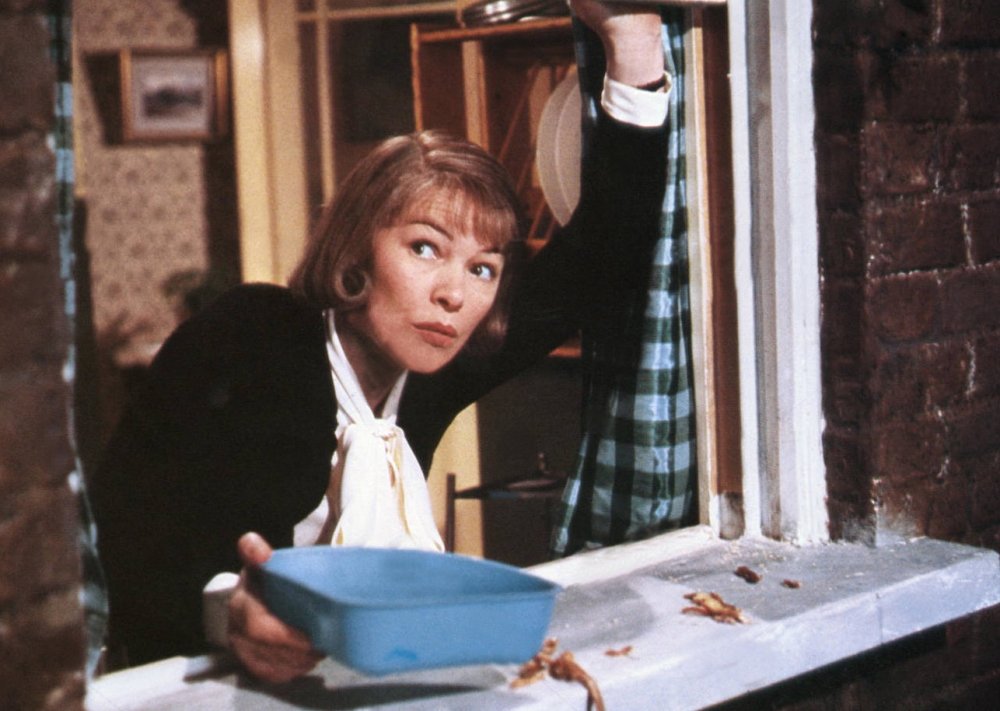
Glenda Jackson in Stevie (1978)
The role in which I remember Glenda Jackson best was in the film Stevie (1978) in which she played the poet Stevie Smith, whose poetry I have admired greatly for its dark yet whimsical tone since I was introduced to it while at school. The originality of her voice is the reason I’ve posted some of her poems on this blog from time to time.
Stevie Smith, who died in 1971, made a number of radio broadcasts and, without really trying to impersonate her, I think Glenda Jackson captured perfectly her quirky mixture of wit and melancholia. It was a marvelous performance in what I think is a neglected film masterpiece.
Following the recent spell of very warm weather in Maynooth, and perhaps encouraged by heavy overnight rain, the Japanese Honeysuckle (Lonicera Japonica) in my garden has now started to bloom. Each flower only lasts a few days – starting white, turning yellow, then gold, then dying – but new ones keep coming, so for a while you can see all the different stages of evolution. In among the white and yellow tones there are many buds that are yet to open. The colours of the flowers are not the best part of a honeysuckle, though: that’s the richly perfumed aroma they give off, especially in the evening. As Tennyson put it “the woodbine* spices are wafted abroad…”. The weather isn’t always warm enough to sit out in the garden when mine flowers, but it is now and it’s very lovely.
*woodbine is another name for honeysuckle, in case you didn’t know…
When I blogged last week about English Paper 2 of the 2023 Leaving Certificate, I mentioned that one of the poets that came up was Paula Meehan. I wasn’t at all familiar with her work before then I looked around for some examples, and found some lovely poems. I’m not surprised the students were glad she came up this year. She has a very distinctive and powerful sense of imagery and a wry sense of humour, as exemplified by this witty but poignant poem, which takes an unusual perspective of the Easter Rising 2016. Inspired by the epigram which is quoted from the Irish Architectural Archive, it is a meditation on what is commemorated and what is not.
–0–
6 of our waterfowl were killed or shot, 7 of the garden seats broken and about 300 shrubs destroyed.
Park Superintendent in his report on the damage to St. Stephen’s Green, during the Easter Rising 1916
Time slides slowly down the sash window
puddling in light on oaken boards. The Green
is a great lung, exhaling like breath on the pane
the seasons’ turn, sunset and moonset, the ebb and flow
of stars. And once made mirror to smoke and fire,
a Republic’s destiny in a Countess’ stride,
the bloodprice both summons and antidote to pride.
When we’ve licked the wounds of history, wounds of war,
we’ll salute the stretcher bearer, the nurse in white,
the ones who pick up the pieces, who endure,
who live at the edge, and die there and are known
by this archival footnote read by fading light;
fragile as a breathmark on the windowpane or the gesture
of commemorating heroes in bronze and stone.
One thing that I forgot to mention in my post about examinations a few days ago is that students at Irish schools all sit exactly the same examination papers at the same time. This is very different from the UK where there are several different Exam Boards that have different syllabuses and set different papers. One consequence of the Irish system is immediately an exam is over, there is a national discussion of the students’ and teachers’ reaction to it. The examination papers are posted online after the examination too – you can find them here – so that everyone can join in the discussion.
I have to admit that when I was a student I was never one for talking about examinations after I had taken them. While most of my peers stood around outside the Exam Hall conducting a post mortem on the paper, I usually just went home. I always figured that there was nothing I could do about the results then so it was best to put it behind me and focus on the next thing. That’s what I’ve recommended to students throughout my career too: don’t look back, look forward.
Anyway, the first Leaving Certificate examination this year (on Wednesday) was English Paper 1, followed by Paper 2 on Thursday. Both seem to have been received relatively favourably by students; see some discussion here and here. Paper 1 is really an English Language Examination, with exercises on comprehension and composition while Paper 2 focuses on literature. Every year summer I look at the set books and poems for the English Leaving Certificate Paper 2 and they’re usually an interesting mix. This year the novels included Mary Shelley’s Frankenstein, Raymond Chandler’s The Big Sleep, Oscar Wilde’s The Picture of Dorian Gray, and Margaret Atwood’s The Handmaid’s Tale. The list of poets for the Higher examination was Elizabeth Bishop, Emily Dickinson, John Donne, Patrick Kavanagh, Derek Mahon, Paula Meehan, Adrienne Rich, and W.B. Yeats. Not all the texts come up in the examination. In the case of the poets, for example, Mahon, Kavanagh, Meehan, Donne and Rich appeared on Paper 2 but there was no Dickinson, Donne or Bishop.
While I have a personal interest in English literature, the English examinations are not relevant to me in a professional capacity. On the other hand, the Leaving Certificate papers in Mathematics are of direct relevance to me as a Professor in the Department of Theoretical Physics because they indicate the level of mathematical preparation of students likely to come in next academic year.
General reaction to Higher Mathematics Paper 1 seems to have been much more mixed than for the English papers, with many students taking to social media to express shock that it was so difficult: the hashtag #MathsPaper1 is still trending on Irish Twitter; you can also find some reaction here.
I have looked at the paper but can’t really comment on the level of difficulty because I haven’s studied previous years examinations in detail but I will say that (a) there’s quite a lot to do in the 150 minutes allowed and (b) there’s nowhere near as much calculus as in my A-level Mathematics over 40 years ago (though remember that Irish students do more subjects in the LC than UK students who do A-levels). Note also that because of the pandemic, this would have been the first state examination taken in Mathematics by many students.
The Leaving Certificate Higher Mathematics examination is split into two sections of equal weight. Section A (‘Concepts and Skills’) requires students to answer 5 questions from 6 (each split into parts); Section B (‘Contexts and Applications’) gives a choice of 3 out of 4 longer questions. That’s less choice than I expected; students have to answer 8 out of 10 questions. The Ordinary Level Examination has the same structure, but the questions are much more straightforward.
Mathematics Paper 2 is on Monday, so I’ll update this post then.
Update: Mathematics Paper 2 seems to have gone down much better than Paper 1. You can find it, along with some reaction, here.
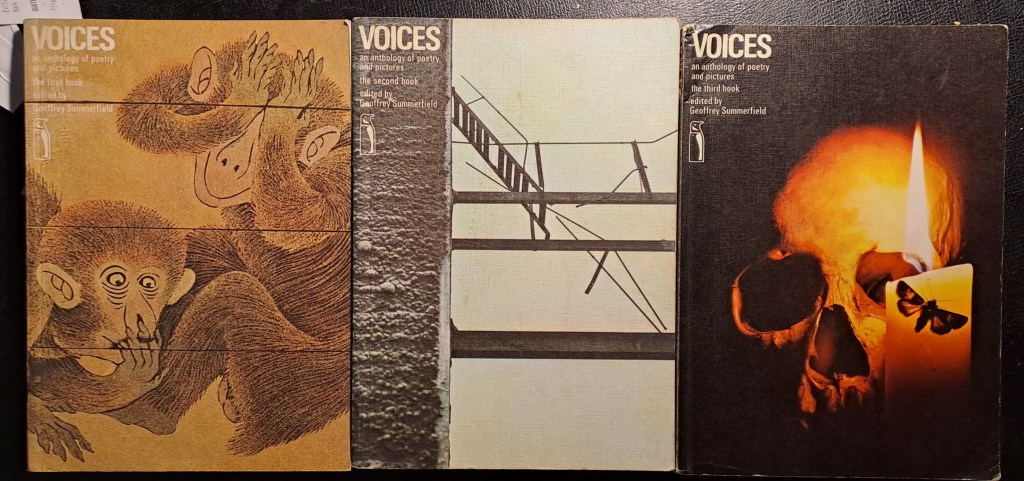
Not long ago I did a post about an anthology of Poems I studied at school many years ago. I bought that second-hand at the same time as I bought the three volumes shown above, Books 1-3 of Voices (edited by Geoffrey Summerfield). I seem to remember that we studied these at an earlier stage of 11+ education, probably in consecutive years before O-level. I remember the covers quite well, especially the rather spooky picture on Book 3.
They’re quite interesting books, each of which contains an eclectic collection of poems, including traditional rhymes and there is even some music at the back to accompany some of the verses that work as songs.
Today is St David’s Day, and it seems apt to celebrate it with a poem by Dylan Thomas. I’ve loved this particular one since I first heard it when I was a student many years ago. I say “heard it” rather than “read it” because it was through buying a tape of the man himself reading his poems that got me hooked. I have posted this on St David’s Day before but that was many years ago and I hope you will forgive the repetition.
Fern Hill reflects about the passage of time, the loss of childhood happiness and the inevitability of death but its mood is defiant rather than gloomy. It’s full of vibrant imagery, but it’s also written with a wonderful feeling for the natural rhythms and cadences language. You can listen to Dylan Thomas reading this exactly as if it were music.
Fern Hill
Now as I was young and easy under the apple boughs
About the lilting house and happy as the grass was green,
The night above the dingle starry,
Time let me hail and climb
Golden in the heydays of his eyes,
And honoured among wagons I was prince of the apple towns
And once below a time I lordly had the trees and leaves
Trail with daisies and barley
Down the rivers of the windfall light.
And as I was green and carefree, famous among the barns
About the happy yard and singing as the farm was home,
In the sun that is young once only,
Time let me play and be
Golden in the mercy of his means,
And green and golden I was huntsman and herdsman, the calves
Sang to my horn, the foxes on the hills barked clear and cold,
And the sabbath rang slowly
In the pebbles of the holy streams.
All the sun long it was running, it was lovely, the hay
Fields high as the house, the tunes from the chimneys, it was air
And playing, lovely and watery
And fire green as grass.
And nightly under the simple stars
As I rode to sleep the owls were bearing the farm away,
All the moon long I heard, blessed among stables, the nightjars
Flying with the ricks, and the horses
Flashing into the dark.
And then to awake, and the farm, like a wanderer white
With the dew, come back, the cock on his shoulder: it was all
Shining, it was Adam and maiden,
The sky gathered again
And the sun grew round that very day.
So it must have been after the birth of the simple light
In the first, spinning place, the spellbound horses walking warm
Out of the whinnying green stable
On to the fields of praise.
And honoured among foxes and pheasants by the gay house
Under the new made clouds and happy as the heart was long,
In the sun born over and over,
I ran my heedless ways,
My wishes raced through the house high hay
And nothing I cared, at my sky blue trades, that time allows
In all his tuneful turning so few and such morning songs
Before the children green and golden
Follow him out of grace.
Nothing I cared, in the lamb white days, that time would take me
Up to the swallow thronged loft by the shadow of my hand,
In the moon that is always rising,
Nor that riding to sleep
I should hear him fly with the high fields
And wake to the farm forever fled from the childless land.
Oh as I was young and easy in the mercy of his means,
Time held me green and dying
Though I sang in my chains like the sea.
As a fully paid-up member of the Campaign for the Rejection of Acronymic Practices I was pleased to see the top brass in the Euclid Consortium issue instructions that encourage authors to limit their use of acronyms in official technical documents. Acronyms are widely used in the names of astronomical instruments and surveys. Take BOOMERanG (Balloon Observations Of Millimetric Extragalactic Radiation And Geophysics) and HIPPARCOS (HIgh Precision PARallax COllecting Satellite) to name just two. A much longer list can be found here.
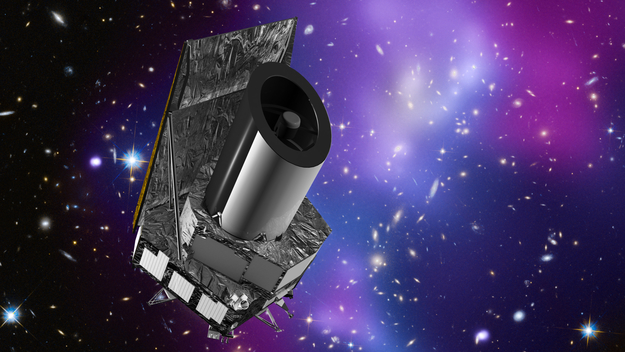
I’m very pleased that the name of the European Space Agency’s Euclid mission is not an acronym. It is actually named after Euclid the Greek mathematician widely regarded as the father of geometry. Quite a few people who have asked me have been surprised that Euclid is not an acronym so I thought it might be fun to challenge my readers – both of them – to construct an appropriate backronym i.e. an acronym formed by expanding the name Euclid into the words of a phrase describing the Euclid mission. The best I’ve seen so far is:
Exploring the Universe with Cosmic Lensing to Identify Dark energy
But Euclid doesn’t just use Cosmic Lensing so I don’t think it’s entirely satisfactory. Anyway, your suggestions are welcome via the box below.
Euclid alone has looked on Beauty bare.
Let all who prate of Beauty hold their peace,
And lay them prone upon the earth and cease
To ponder on themselves, the while they stare
At nothing, intricately drawn nowhere
In shapes of shifting lineage...
I was reminded today that 4th December is the anniversary of the death, in 1131, of the Persian astronomer, mathematician and poet Omar Khayyam. That in turn reminded me that just over year ago I received a gift of a sumptuously illustrated multi-lingual edition of the Rubáiyát of Omar Khayyám:
Edward Fitzgerald‘s famous English translation of these verses is very familiar, but it seems there’s a more of Fitzgerald than Khayyam in many of the poems and the attribution of many of the original texts to Khayyam is dubious in any case. Whatever you think about this collection, I think it’s a bit unfortunate that Khayyam is not more widely recognized for his scientific work, which you can read about in more detail here.
Anyway, as we approach the end of 2022 many of us will be remembering people we have lost during the year so here is a sequence of three quatrains (XXII-XXIV) with an appropriately elegiac theme:
For some we loved, the loveliest and the best That from his Vintage rolling Time hath pressed, Have drunk their Cup a Round or two before, And one by one crept silently to rest.
And we, that now make merry in the Room They left, and Summer dresses in new bloom, Ourselves must we beneath the Couch of Earth Descend–ourselves to make a Couch–for whom?
Ah, make the most of what we yet may spend, Before we too into the Dust descend; Dust into Dust, and under Dust to lie, Sans Wine, sans Song, sans Singer, and–sans End!
The views presented here are personal and not necessarily those of my employer (or anyone else for that matter).
Feel free to comment on any of the posts on this blog but comments may be moderated; anonymous comments and any considered by me to be vexatious and/or abusive and/or defamatory will not be accepted. I do not necessarily endorse, support, sanction, encourage, verify or agree with the opinions or statements of any information or other content in the comments on this site and do not in any way guarantee their accuracy or reliability.





 In the Dark