Archive for the Poetry Category

Black March

Posted in Poetry with tags , on March 14, 2009 by telescoper

By way of a contrast with yesterday’s silliness, I thought I’d mark the time of year with one of my favourite poems by one of my favourite poets, Stevie Smith. Her verses are quirky and enigmatic, sometimes frivolous and sometimes profound and sometimes somehow both of those at the same time. Some of her work is quite religious in nature, but she had a very ambivalent attitude to God.

This particular poem was written near the end of her life and it’s quite typical of her thoughts about death at that time. She had contracted a brain tumour and knew the end was coming soon. It didn’t frighten her at all, as the verse makes clear. She died in 1971, just a few months after writing this and without having to endure a lengthy illness.

There’s always something (usually the weather) that reminds me of this poem at this time of year and I dig out my old book of Stevie Smith’s collected verse and read it again.

This is Black March.

I have a friend
At the end
Of the world.
His name is a breath

Of fresh air.
He is dressed in
Grey chiffon. At least
I think it is chiffon.
It has a
Peculiar look, like smoke.

It wraps him round
It blows out of place
It conceals him
I have not seen his face.

But I have seen his eyes, they are
As pretty and bright
As raindrops on black twigs
In March, and heard him say:

I am a breath
Of fresh air for you, a change
By and by.

Black March I call him
Because of his eyes
Being like March raindrops
On black twigs.

(Such a pretty time when the sky
Behind black twigs can be seen
Stretched out in one
Uninterrupted
Cambridge blue as cold as snow.)

But this friend
Whatever new names I give him
Is an old friend. He says:

Whatever names you give me
I am
A breath of fresh air,
A change for you.

Starless and Bible Black

Posted in Jazz, Literature, Poetry with tags , , , , , on March 7, 2009 by telescoper

A few weeks ago in my bit about the great jazz composer and pianist Thelonious Monk, I mentioned another great musician, Stan Tracey. He was Ronnie Scott’s house pianist for many years, as well as being a composer and leader of his own band. It’s only the fact that he stayed all his life in England that prevented him from gaining wider recognition. No less a musician than Sonny Rollins asked (of British Jazz fans)

Does anyone here realise how good he is?

Well, I think they do but he remains relatively unknown outside these shores.

Amongst the collection of old LPs that I am gradually making into CDs using the USB turntable I got for Christmas is one of the greatest British jazz albums, Under Milk Wood, which was written by Stan Tracey and recorded by his band in 1965.

Living in Wales, I’m somewhat ashamed that I didn’t do this one before because it is of course inspired by the “play for voices” with the same name by Dylan Thomas. The music is brilliant throughout, vividly evoking the atmosphere of various episodes in the play, but my favourite track is about the very first lines. Stan Tracey’s piano and Bobby Wellins‘ saxophone hauntingly evoke the atmosphere of the opening of Under Milk Wood which, if you’ll forgive me for quoting a rather lengthy extract, shows Dylan Thomas extraordinarily imaginative use of language, superb control of rhythm even in a prose setting. His poems are wonderful to listen to as well as to read, especially when read by the poet himself with his sonorous yet lilting voice; if you want a short example try this example, steeped in a sense of nocturnal melancholy

In My Craft or Sullen Art

In my craft or sullen art
Exercised in the still night
When only the moon rages
And the lovers lie abed
With all their griefs in their arms,
I labour by singing light
Not for ambition or bread
Or the strut and trade of charms
On the ivory stages
But for the common wages
Of their most secret heart.

Not for the proud man apart
From the raging moon I write
On these spindrift pages
Nor for the towering dead
With their nightingales and psalms
But for the lovers, their arms
Round the griefs of the ages,
Who pay no praise or wages
Nor heed my craft or art.

Anyway, the play Under Milk Wood‘s famous opening goes along these lines:

It is Spring, moonless night in the small town, starless and bible-black, the cobblestreets silent and the hunched, courter’s-and-rabbits’ wood limping invisible down to the sloeblack, slow, black, crowblack, fishingboat-bobbing sea. The houses are are blind as moles (though moles see fine tonight in the snouting, velvet dingles) or blind as Captain Cat there in the muffled middle by the pump and the town clock, the shops in mourning, the Welfare Hall in widows’
weeds. And all the people of the lulled and dumbfound town are sleeping now.

Hush, the babies are sleeping, the farmers, the fishers, the tradesmen and pensioners, cobbler, schoolteacher, postman and publican, the undertaker and the fancy woman, drunkard, dressmaker, preacher, policeman, the webfoot cocklewomen and the tidy wives. Young girls lie bedded soft or glide in their dreams, with rings and trousseaux, bridesmaided by glow-worms down the aisles of the organplaying wood. The boys are dreaming wicked of the bucking ranches of the night and the jollyrodgered sea. And the anthracite statues of the horses sleep in the fields, and the cows in the byres, and the dogs in the wet-nosed yard; and the cats nap in the slant corners or lope sly, streaking and needling, on the one cloud of the roofs.

You can hear the dew falling, and the hushed town breathing.

Only your eyes are unclosed to see the black and folded town fast, and slow, asleep.

And you alone can hear the invisible starfall, the darkest-before-dawn minutely dewgrazed stir of the black, dab-filled sea where the Arethusa, the Curlew and the Skylark, Zanzibar, Rhiannon, the Rover, the Cormorant, and the Star of Wales tilt and ride.

Listen. It is night in the chill, squat chapel, hymning in bonnet and brooch and bombazine black, butterfly choker and bootlace bow, coughing like nannygoats, sucking mintoes, fortywinking hallelujah; night in the four-ale, quiet as a domino; in Ocky Milkman’s lofts like a mouse with gloves; in Dai Bread’s bakery flying like black flour. It is tonight in Donkey Street, trotting silent, with seaweed on its hooves, along the cockled cobbles, past curtained fernpot, text and trinket, harmonium, holy dresser, watercolours done by hand, china dog and rosy tin teacaddy. It is night neddying among the snuggeries of babies.

Look. It is night, dumbly, royally winding through the Coronation cherry trees; going through the graveyard of Bethesda with winds gloved and folded, and dew doffed; tumbling by the Sailors Arms.

Time passes. Listen. Time passes.

Here are Stan Tracey and Bobby Wellins with Stan Tracey’s meditation on that piece, Starless and Bible Black, played in a way that’s as moving and ethereal as the sound of time passing….

Blackbird has Spoken

Posted in Biographical, Poetry with tags , , , on February 25, 2009 by telescoper

Over the last few days we’ve been having something approximating springtime here in Cardiff. It has been sunny and quite warm, my garden has started to come to life, and the crocuses have appeared in Bute Park. It’s also getting to the time when I won’t feel guilty for walking home in daylight. Soon I’ll even be able to walk home through Bute Park, which closes when it gets dark, currently at 5.15.

I hope this all continues into a pleasant spring and summer, without the heavy continuous rain we had last year. I’m not betting on it though.

However, the clement weather has given me one headache recently. With sunrise happening a bit earlier and the good weather giving the local wildlife something to shout about, the dawn chorus has been waking me up around 4am.

Or, actually, it’s not so much a chorus as a solo. A very loud blackbird has taken to sitting right next to my bedroom window and singing at the top of its voice.

I’m very fond of blackbirds. Once while I was in the garden in my old house in Beeston, a blackbird flew onto a fence post about a yard away from me and sat there looking at me as I stood with a spade in my hand. I looked back. We looked at each other for ages, the blackbird turning its head every now and again so as to peer at me with a different eye. I slowly raised my arm and extended a palm. To my absolute delight the bird hopped onto my open hand. It stayed there only a minute or so, probably until it realised my fingers weren’t actually big fat worms like it thought. For that moment, though, I felt a bit like a latter-day St Francis of Assisi.

Blackbirds have a very attractive song, but this one seems particularly loud and he certainly does go on a bit. For about a week now I’ve been unable to get back to sleep after being woken by this critter, and instead got up and had a cup of tea while he says what he has to say. Columbo finds his song quite interesting too, although the bird is always out of reach…

Years ago, I used to suffer very badly from insomnia so being awake at 4am is not an unfamiliar experience to me, although it’s much nicer to be woken by birdsong than to be unable to sleep in the first place. This all reminded me of a devastatingly brilliant poem called Aubade and written by Philip Larkin that was published in the Times Literary Supplement in 1977. This is one of the last poems written by Larkin, and is undoubtedly one of the greatest.

Written by a jazz-loving bachelor who drank too much, someone not unlike myself in some respects, I found it uncanningly accurate in its depiction of the bleak thoughts that tend to engulf you when you’re alone and awake in the silence before dawn. But I can assure you the mood is a whole lot lighter when you have a blackbird (and a cat) for company!

I work all day, and get half drunk at night.
Waking at four to soundless dark, I stare.
In time the curtain edges will grow light.
Till then I see what’s really always there:
Unresting death, a whole day nearer now,
Making all thought impossible but how
And where and when I shall myself die.
Arid interrogation: yet the dread
Of dying, and being dead,
Flashes afresh to hold and horrify.

The mind blanks at the glare. Not in remorse
– The good not used, the love not given, time
Torn off unused – nor wretchedly because
An only life can take so long to climb
Clear of its wrong beginnings, and may never:
But at the total emptiness forever,
The sure extinction that we travel to
And shall be lost in always. Not to be here,
Not to be anywhere,
And soon; nothing more terrible, nothing more true.

This is a special way of being afraid
No trick dispels. Religion used to try,
That vast moth-eaten musical brocade
Created to pretend we never die,
And specious stuff that says no rational being
Can fear a thing it cannot feel, not seeing
that this is what we fear – no sight, no sound,
No touch or taste or smell, nothing to think with,
Nothing to love or link with,
The anaesthetic from which none come round.

And so it stays just on the edge of vision,
A small unfocused blur, a standing chill
That slows each impulse down to indecision
Most things may never happen: this one will,
And realisation of it rages out
In furnace fear when we are caught without
People or drink. Courage is no good:
It means not scaring others. Being brave
Lets no-one off the grave.
Death is no different whined at than withstood.

Slowly light strengthens, and the room takes shape.
It stands plain as a wardrobe, what we know,
Have always known, know that we can’t escape
Yet can’t accept. One side will have to go.
Meanwhile telephones crouch, getting ready to ring
In locked-up offices, and all the uncaring
Intricate rented world begins to rouse.
The sky is white as clay, with no sun.
Work has to be done.
Postmen like doctors go from house to house.

Poems of Space

Posted in Books, Talks and Reviews, Poetry, The Universe and Stuff with tags , , , , , , , on February 1, 2009 by telescoper

A couple of weeks ago I bought a copy of Dark Matter: Poems of Space, an anthology of poems old and new with astronomical connections edited by Maurice Riordan and Dame Jocelyn Bell Burnell.

I quite like having anthologies because if you open one randomly you’re not absolutely sure what’s going to crop up, which can lead to pleasant surprises. But they’re also unsatisfactory to read through from cover to cover because there are huge differences in style and substance that are difficult to adjust to on a poem-by-poem basis. Random access is definitely better than sequential for this type of thing, so rather than attempt to study it all, over the last fortnight or so I’ve been taking regular dips into this particular collection, and very interesting it has been too.

The book contains over 200 poems mostly by different authors, although there is more than one contribution from a few (including Shelley and Auden). It’s a mixture of the familiar and the brand new, including some commissioned especially for this book. I couldn’t possibly write about the whole, but a few things struck me as I sampled various tidbits.

The first is that while many of these poems celebrate the beauty and majesty of the heavens, and some even embrace the wonder of scientific discovery, quite a few are quite anti-scientific. Two examples spring to mind (both of them paradoxically by favourite poets of mine!). This excerpt from The Song of the Happy Shepherd, a very early poem by WB Yeats is a good example

………………………………Seek, then,
No learning from the starry men,
Who follow with the optic glass
The whirling ways of stars that pass –
Seek, then, for this is also sooth,
No word of theirs – the cold star-bane
Has cloven and rent their hearts in twain,
And dead is all their human truth.

Hardly a ringing endorsement of observational astronomy, although strictly speaking it only refers to optical techniques so I suppose those working in radio-, X-ray and other types of astronomy are off the hook.

Incidentally, if I’d been given the task of picking a poem by Yeats for this collection it would have been this:

HAD I the heavens’ embroidered cloths,
Enwrought with gold and silver light,
The blue and the dim and the dark cloths
Of night and light and the half light,
I would spread the cloths under your feet:
But I, being poor, have only my dreams;
I have spread my dreams under your feet;
Tread softly because you tread on my dreams.

It’s not really much to do with astronomy or space but it’s one of his most beautiful lyrical verses, with a wonderful use of repetition (e.g. light, dreams, spread, tread) and assonance (light/night, spread/tread).

Anyway, another example of this kind of attitude displayed by Yeats Happy Shepherd is provided by Walt Whitman:

WHEN I heard the learn’d astronomer;
When the proofs, the figures, were ranged in columns before me;
When I was shown the charts and the diagrams, to add, divide, and measure them;
When I, sitting, heard the astronomer, where he lectured with much applause in the lecture-room,
How soon, unaccountable, I became tired and sick;
Till rising and gliding out, I wander’d off by myself,
In the mystical moist night-air, and from time to time,
Look’d up in perfect silence at the stars.

I think I’ve been to enough boring seminars to understand how he feels, but the theme of both these poems is that  studying the stars or applying science to them somehow robs them of their wonder. I think many non-scientists probably go along with this view: it’s beautiful to gaze at the sky but reducing it to measurements and graphs somehow ruins it.
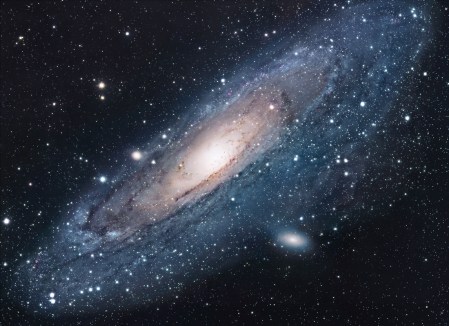
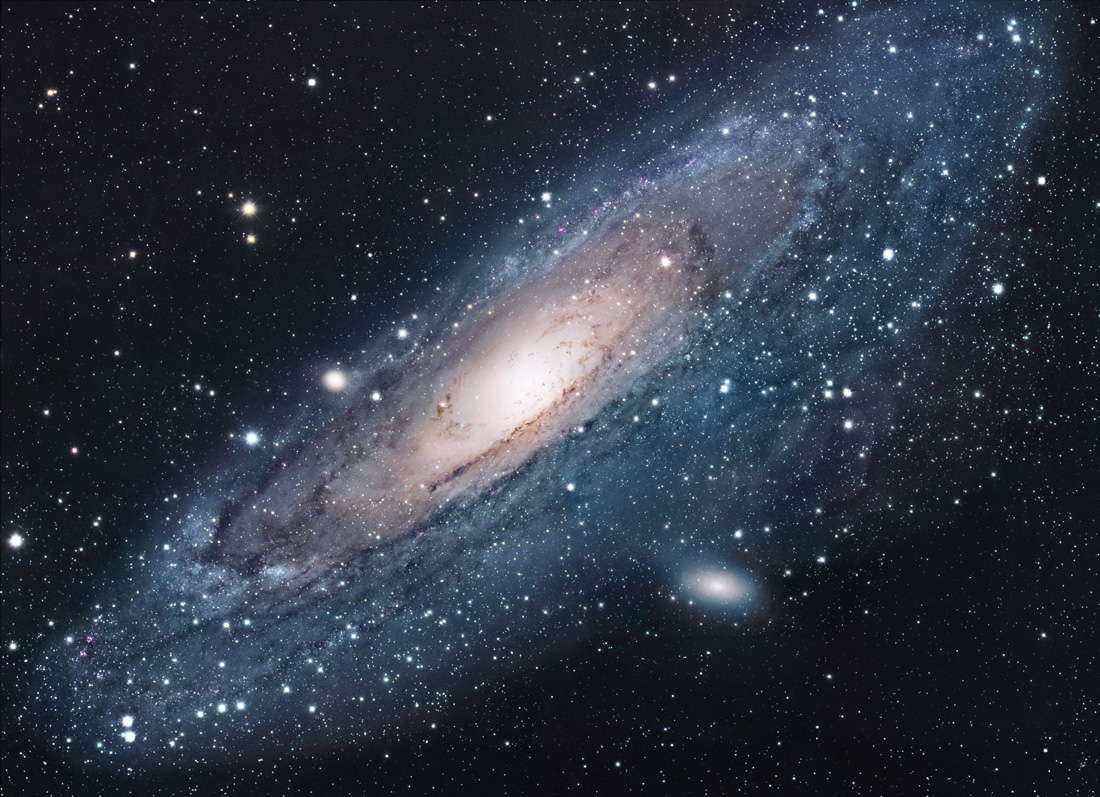
Andromeda_gendler_smOf course I don’t agree.  Without professional astronomers we would never have discovered that, say, the Andromeda Nebula (shown above) was a galaxy just like our own Milky Way containing thousands of millions of stars like our Sun  and that it is rotating about its axis with a timescale of hundreds of millions of years. Knowing things like this surely increases the sense of wonder rather than decreasing it?

On the other hand it is true that the nature of science makes it rather prosaic. When scientists try to write for a popular readership they often spice up their accounts with quotations from poems, even if the quotes aren’t really all that appropriate. Perhaps some will turn to this collection for a source of such snippets. I know I will!

Another thing that struck me was that I always tended to think that engagement between science and poetry was a relatively recent thing, typified by WH Auden’s humorously perplexed After Reading a Child’s Guide to Modern Physics:

Our eyes prefer to suppose
That a habitable place
Has a geocentric view,
That architects enclose
A quiet Euclidian space:
Exploded myths – but who
Could feel at home astraddle
An ever expanding saddle?

But in fact the metaphysical poets of the 17th century also grappled with such issues. Consider this fragment from John Donne’s An Anatomy of the World:

We think the Heavens enjoy their spherical,
Their round proportion embracing all.
But yet their various and perplexed course,
Observed in divers ages, doth enforce
Men to find out so many eccentric parts,
Such divers down-right lines, such overthwarts,
As disproportion that pure form….

That could almost have been written about the possibility of a lop-sided universe that I’ve blogged about here and there, and which is a major topic of current cosmological research.

Other reactions I had were more personal. There is a poem in the collection by Fleur Adcock, who visited the Royal Grammar School in Newcastle when I was there. She judged a poetry reading competition (which I didn’t win) for which the test piece was Stevie Smith’s Not Waving but Drowning. I remember that she was quite a glamorous-looking lady, but she got everybody’s name wrong in her presentation address. She must be getting on a bit by now.

I have also met one of the other poets represented here too, Gwyneth Lewis, who was elected the first national poet for Wales and also spent some time as poet-in-residence in the School of Physics & Astronomy at Cardiff University where I now work. She wrote a number of poems about science but is probably most famous for writing the words “In These Stones Horizons Sing” which are incorporated in the design of the facade of the Wales Millennium Centre.

Anyway, I thoroughly recommend this book which is a rich treasury of verse ancient and modern. Some of the lovely things in it are quite new to me and I am definitely going to read more by some of the poets represented in it. That’s the way to use an anthology: go and read more systematically whoever catches your eye.

Being an old-fashioned romantic I think I’ll finish off with an excerpt from William Wordsworth‘s epic The Prelude. Regular readers (both of you) will know that I greatly admire Wordsworth and, for me, The Prelude is one of the highest pinnacles in all of English literature.

The universal spectacle throughout
Was shaped for admiration and delight,
Grand in itself alone, but in that breach
Through which the homeless voice of waters rose,
That dark deep thoroughfare, had Nature lodged
The Soul, the Imagination of the whole.
The Fall Before

Posted in Poetry with tags on January 15, 2009 by telescoper

Browsing the BBC website for any evidence of at all of good news amid the continuing fiasco that is the British banking system, the murderous onslaught in Gaza, and the defeat of Newcastle United in last night’s FA Cup replay, I happened upon a quite interesting little item from which I picked out the following:

The use of the word ‘fall’ or ‘the fall’ to mean autumn is commonly assumed to be an Americanism, but in fact it is found in the works of Michael Drayton (1563-1631), Thomas Middleton (1580-1627) and Sir Walter Ralegh (1554-1618).

There is also a quotation from John Dryden (1631-1700) to back this up:

What crowds of patients the town doctor kills, Or how, last fall, he raised the weekly bills.

This is more appropriate for the USA than the UK nowadays as over here we now have the wonderful National Health System.

While contributing to a discussion on the e-astronomer, which subsequently evolved into an extended exercise in pedantry here, it struck me that many words we British think of as being Americanisms were in fact in common use over here in the 16th and 17th Centuries. This period marks the birth of American English as the language used by the colonials evolved fairly independently thereafter until films and television re-established contact in the 20th Century and set up a feedback loop. “Fall” seems to be another example of a word which carried on being used in mainstream American usage but was replaced over here by “autumn”.

Another example that strikes me is “gotten” which is commonplace in the USA but rarely used in England except in phrases like “ill-gotten gains”. It is used in Scotland and in other dialects, but in mainstream English is considered to be archaic, and the form “got” is generally used instead. As the past participle of the verb “to get”, however, it is by no means grammatically incorrect and it was a standard form in English during the 16th century and abounds in Shakespeare, such as in the phrase “He was gotten in drink” from The Merry Wives of Windsor.

Conversely and curiously we still use the form “forgotten” for the past participle of “forget” and the form “forgot” (as a participle) is considered archaic or poetic. The phrase “I have forgot much, Cynara! Gone with the wind” occurs in Ernest Dowson’s famous poem Non Sum Qualis Eram Bonae Sub Regno Cynarae, but it wouldn’t be considered correct in modern English prose.

There’s no real logic to all this, which is what makes it interesting…

Although hearing or reading the word “gotten” in contributions from the other side of the pond no longer jars, and I’ve always found the word “fall” to be rather poetic anyway, there are still some divergences that I can’t cope with. Once on a trip to the States I was alarmed when informed that the plane would be landing momentarily.

On First Looking into Chapman’s Homer

Posted in Poetry, The Universe and Stuff with tags , , on November 19, 2008 by telescoper

As a present to those who appear disgruntled by my comments about exoplanets here and there, this is from John Keats:


Much have I travell’d in the realms of gold,
    And many goodly states and kingdoms seen;
    Round many western islands have I been
Which bards in fealty to Apollo hold.
Oft of one wide expanse had I been told
    That deep-brow’d Homer ruled as his demesne;
    Yet did I never breathe its pure serene
Till I heard Chapman speak out loud and bold:
Then felt I like some watcher of the skies
    When a new planet swims into his ken;
Or like stout Cortez when with eagle eyes
    He star’d at the Pacific–and all his men
Look’d at each other with a wild surmise–
    Silent, upon a peak in Darien.
 

This famous sonnet was written in October 1816 and is considered the highlight of Keats’s first volume of poetry. It was originally a gift for his friend, Charles Cowden Clarke. The two men had spent an evening reading George Chapman’s superb 17th century translation of the Iliad and Odyssey.

Please note lines 9 and 10. I’m sure they capture the excitement of discovery although Keats probably wasn’t using the correct IAU nomenclature. I’m not sure about the bit about being “silent” either.

Lost in the City

Posted in Biographical, Poetry with tags , , on November 17, 2008 by telescoper

The second Friday of the month is the day of the regular “open” meeting of the Royal Astronomical Society (at 4pm) preceded by parallel discussion meetings on topics that vary from month to month. This month one of the sessions was organized in memory of Bernard Pagel, who died last year and whom I knew a little, so I decided to go to that.

I met Bernard Pagel when I started my DPhil at Sussex University in 1985. He taught one of the courses on the MSc Astronomy and we research students were required to attend his lectures. I have to say he wasn’t the best lecturer I’ve ever had; he always seemed unable to look at the class, which is a trait I find quite disconcerting. But he did reveal a wonderfully wicked sense of humour. When a visiting seminar speaker arrived late and after the seminar explained he had dozed off on the train and missed his stop, Bernard suggested that he must have been reading through his transparencies.

I left Sussex to move to London around about the time Bernard retired from his position at Sussex but he immediately took up a chair at NORDITA in Copenhagen where age restrictions were somewhat looser. I had been working for a while with Bernard Jones in Copenhagen so I next ran into Bernard Pagel when I visited there. I still found him a strange and rather distant man, but as often happens the ice was broken when a group of staff, students and visitors went to a nice concert in the Tivoli Concert Hall. If I remember correctly it was a Mozart violin concerto. Afterwards, Bernard let his guard down and talked in a much more relaxed way than I had known before and we became quite friendly thereafter. He was in fact a man with very wide interests outside his own sphere of eminence in astrophysical spectroscopy.

After the meeting was over, I went once more to the Athenaeum for dinner with the RAS Club. I was quite surprised when, after the meal, it was announced that I had written on my blog about my previous dinner there. I’m not convinced that everyone there knew what a blog actually is but maybe some of them have found their way here…

Although I got back home to Cardiff in good time on the last occasion I dined at the Club, I had already decided to go to the opera on Saturday night so didn’t have to rush off to make the last train. Walking back to Bloomsbury where I was staying on Friday and Saturday I suddenly realized that it as almost exactly ten years since I moved out of London to Nottingham. In fact I bought my house in Beeston on 13th November 1998 and commuted back to London for about a month, as my position in Nottingham didn’t start until 1st January 1999.

On Saturday morning I decided to behave like a tourist so I first went to the British Museum. I intended to see the new Babylon exhibition, but by the time I got there after a leisurely breakfast it had sold out for the day so I had to content myself with the permanent exhibits. I don’t think I ever went to the British Museum in all the time I lived in London, so it was interesting although I got completely lost.

I did get to see the Elgin Marbles but I still don’t know how to play. I also ended up in a room full of mummies, which is something I find quite distasteful. Although the mortal remains are incredibly old, they are still human bodies and I don’t like the way they are stuck in cases for people to gawp at. Call me sentimental but I think these should be returned to Egypt and laid to rest with some sort of dignity. I also think the Elgin Marbles should go back to Greece, but for different reasons. If we hand them back, we might actually get some votes in the Eurovision song contest for a change.

The rest of the day I wandered around a few of the dozens of bookshops that clutter the area between Charing Cross Road and Covent Garden, feeling all the time like a complete stranger to the city. So much has changed that it’s nearly impossible for me to believe that I ever actually lived there at all. In one shop I picked up a (very expensive) old book of poems by Shelley and found the following lines (written about Naples rather than London):

I stood within the city disinterred;
And heard the autumnal leaves like footfalls
Of spirits passing through the streets
;

I didn’t buy the book. My mood wasn’t helped by the gloomy light. Although it was quite warm for November, there was a curious purple tinge to the late afternoon which I found a bit unsettling.

On my way back I revisited an old tradition of mine of peering in through the window of one of the electrical goods shops on Tottenham Court Road to check the football results. When I was living in London I was usually out most of the day on weekends somewhere in the West End, so that was the only way to keep apprised of developments. Nowadays I don’t go out as much as I used to, so I find quieter ways of filling the gap between the end of Final Score and the start of Match of the Day that seems to me to symbolize middle age.

Then it was time to get to the Coliseum for the opera followed by supper with Joao and Kim at Belgo‘s where our table, ironically, was next to that of a dozen very raucous girls from Cardiff in town for a birthday celebration.

Statistics

Posted in Music, Poetry with tags , , on November 11, 2008 by telescoper

Not many summers ago, in 2004, I spent an enjoyable day walking in the beautiful Peak District of Derbyshire followed by an evening at the opera in the pleasant spa town of Buxton, where there is an annual music festival. The opera I saw was A Turn of the Screw, by Benjamin Britten: a little incongruous for Buxton’s fine little Opera House which is decorated with chintzy Edwardiana and which was probably intended for performances of Gilbert & Sullivan comic operettas rather than stark tales of psychological terror. When Buxton’s theatre was built, in 1903, the town was a fashionable resort at which the well-to-do could take the waters and relax in the comfort of one of the many smart hotels.

Arriving over an hour before the opera started, I took a walk around the place and ended up on a small hill overlooking the town centre where I found the local war memorial. This is typical of the sort of thing one can see in small towns the length and breadth of Britain. It lists the names and dates of those killed during the “Great War” (1914-1918). Actually, it lists the names but mostly there is only one date, 1916.

The 1st Battalion of the Nottingham and Derbyshire Regiment (known as the Sherwood Foresters) took part in the Battle of the Somme that started on 1st July 1916. For many of them it ended that day too. Some of their names are listed on Buxton’s memorial. On the first day of this offensive, the British Army suffered 58,000 casualties as, all along the western front, troops walked slowly and defencelessly into heavy fire from machine guns that were supposed to have been knocked out by an artillery barrage that had been tragically ineffective. Rather than calling off the attack in the face of this slaughter, the powers that be carried on sending troops to their doom for months on end. By the end of the battle in November that year the British losses were a staggering 420,000, while those on the German side were estimated at half a million.

These numbers are beyond comprehension, but their impact on places like Buxton was measurably real. Buxton became a town of widows. The material loss of manpower made it impossible for many businesses to continue after 1918 and a steep economic decline followed. It never fully recovered from the devastation of 1916 and its pre-war posterity never returned.

And the carnage didn’t end on the Somme. As the “Great War” stumbled on, battle after battle degenerated into bloody fiasco. A year later the Third Battle of Ypres saw another 310,000 dead on the British side as another major assault on the German defences faltered in the mud of Passchendaele. By the end of the War on 11th November 1918, losses on both sides were counted in millions.

The First World War ended a long time ago, and there is now only one living survivor of the British trenches, but the tragedy that it was shouldn’t be forgotten and neither should the sacrifices made by those caught up in the slaughter. Every year, we have Remembrance Sunday (which passed yesterday) for which it is traditional to wear a poppy after John McCrae’s poem In Flanders Fields:

In Flanders fields the poppies blow
Between the crosses, row on row,
That mark our place; and in the sky
The larks, still bravely singing, fly
Scarce heard amid the guns below.

We are the Dead. Short days ago
We lived, felt dawn, saw sunset glow,
Loved and were loved, and now we lie
In Flanders fields.

Take up our quarrel with the foe:
To you from failing hands we throw
The torch; be yours to hold it high.
If ye break faith with us who die
We shall not sleep,
though poppies grow
In Flanders fields.

And tomorrow morning, at the 11th hour of the 11th day of the 11th month – when the guns fell silent 90 years ago – I will stand (as I always do) for the two minutes of silence observed across the country. Some people consider the wearing of a poppy and the observance of the two minutes’ silence to be celebrations of militarism. I don’t. I wear mine with respect for those who have made the ultimate sacrifice (on both sides, including non-combatants, and in all wars not just the “Great” one). As their deaths recede into the past, these rituals are needed to stop us seeing them as mere statistics. Each name on the war memorial at Buxton represents a human life extinguished and is evidence of the capacity for inhumanity which we all possess and from which we must not be allowed to hide.

For me the poppy also symbolises anger for those whose arrogance and mendacity has led us into wars that we should have avoided. I thank my lucky stars that I never had to live through conflict on the scale my grandparents’ generation had to face and curse those who have inflicted that fate on others. I quote another great First World War poet, Siegfried Sassoon (writing here in prose) whose words are as apt today as they were ninety years ago:

I have seen and endured the sufferings of the troops, and I can no longer be a party to prolonging these sufferings for ends which I believe to be evil and unjust. On behalf of all those who are suffering now I make this protest against the deception that is being practised on them; also I believe that I may help to destroy the callous complacency with which the majority of those at home regard the continuance of agonies which they do not share, and which they have not sufficient imagination to realize.

That could just as easily have been written about Iraq (2003) as Flanders (1917).

Benjamin Britten was the reason I went to Buxton that day in 2004 so its only fitting I should mention the moving performance of his War Requiem I listened to yesterday on the radio. This is a powerful work that interleaves the latin mass for the dead with poetry from the greatest of all the war poets, Wilfred Owen. This is his Anthem for Doomed Youth , which is set right at the beginning of the War Requiem, the references in the poem to church services adding tragic irony to his already powerful verse.

What passing-bells for these who die as cattle?
-Only the monstrous anger of the guns.
Only the stuttering rifles’ rapid rattle
Can patter out their hasty orisons.
No mockeries now for them; no prayers nor bells;
Nor any voice of mourning save the choirs,-
The shrill, demented choirs of wailing shells;
And bugles calling for them from sad shires.

What candles may be held to speed them all?
Not in the hands of boys but in their eyes
Shall shine the holy glimmers of good-byes.
The pallor of girls’ brows shall be their pall;
Their flowers the tenderness of patient minds,
And each slow dusk a drawing-down of blinds.

Wilfred Owen died in battle in 1918, aged 25, just a week before the armistice was signed. Another statistic.

Intimations of Immortality from a Little Red Book

Posted in Poetry with tags , on September 27, 2008 by telescoper

It’s now late september and there’s no sign that the Indian summer we’ve been having is going to fade. Once again, I’m sitting outside in the sunshine while Columbo daydreams. In the newspapers there’s yet more panic about the global financial crisis and the US Government’s attempts to persuade Congress to bail out the profligate bankers. The Republicans don’t want to play along, apparently because they don’t like the idea of government getting involved in the markets. I’m opposed to it for the opposite reason, which is I think those who have caused the problem should be the ones that pay for it. If the UK government decides to bail out any banks, I hope it will be at the price of public representation on their boards or even nationalisation.

Not long ago there was talk about energy companies having a windfall tax levied upon them owing to the sudden leap in their profits arising from high oil and gas prices. This seemed like a good idea to me. A retrospective windfall tax on city bonuses to pay for any packages cobbled together to pay the financial sector’s debts appears at least as justifiable as that proposed for the energy sector.

It’s now about a year since my father died. He hadn’t left a will so I had to travel to Weymouth to tidy up his things and organise a funeral. I hadn’t seen him much in recent years and was never particularly close, since my parents split up when I was about 12 and I went to live with my mother when that happened.

My dad never really came to terms with life after the break up of the family. His business eventually went down the tubes and he left Newcastle to live in Weymouth near his sister, my Auntie Ann, who had lived there for quite a while. He had a history of heart problems so his death wasn’t really a shock, but it did bring feelings of guilt to me, for not having kept in touch very well, as well sudden and unpredictable pangs of nostalgia which I’m still a bit prone to.

Among the memories that popped uncontrollably into my mind last year was a visit we made as a family to the house of my late Auntie Vi, who I don’t think I ever met. I don’t remember when this was but it was just after she died, when I guess I was probably about seven or eight which would make it around 1970 or so. My dad was among those invited to the house to help clear it by taking away anything they wanted.

I don’t remember the house very well except that it was rather dark, decorated with Victorian designs, and cluttered with heavy old-fashioned furniture. I imagined Auntie Vi (or “Violetta”, which was her real name) to be quite scary, perhaps like a governess in some gothic novel. I don’t know much about her except that she wasn’t well liked by the rest of the family. There was talk of some scandal, but I never found out what it was. I was just intrigued how she got the name Violetta. Perhaps her parents liked opera.

The only relic from that visit that I still know about was a little red book that we took home with us. It was a book of Poems by Wordsworth which my mum kept when she split up with my dad and moved out. I asked her about it last year, after my dad’s funeral, and was quite surprised to find she still had it. She gave it to me to keep, and it is on the table beside me now as I write this.

Out of curiosity last year I looked for the date the little book was published, but couldn’t find one anywhere inside. I don’t know why, but the lack of that little bit of information bothered me. I looked on the web to see if there was information about this or similar books was to be found. No luck.

I turned instead to the task of finding out whatever I could about the publisher. The book is in a series called “Canterbury Poets” which was published by the Walter Scott Publishing company (London, New York and Felling). That made be laugh. As if anyone could ever have imagined Felling to be on a par with New York or London!

I had assumed that Sir Walter Scott was the famous novelist of Ivanhoe and the Waverley novels, but digging about a little I found out that it was named for someone else entirely. This particular Sir Walter Scott was born in 1826. He had very little formal education, but became a highly successful businessman. By the 1880s he owned a large network of business interests in the North East, primarily involving engineering and construction companies. In 1882 Scott expanded his empire by buying a publishing company “The Tyne Publishing Company”, which had just gone bust. Scott built a new factory (at Felling) and established a new office in London for his new publishing house, and the Walter Scott Publishing Company was born.

I think Scott must have been a very shrewd entrepreneur because the printing business grew rapidly, primarily through its list of editions of classic works of literature that were out of copyright. The Canterbury Poets series was first published in 1884, which is also the date of their first edition of the Wordsworth. These books were extremely well made, with hard covers, fine quality paper and good stitching . They sold for a shilling, which is an astonishingly low price for books of this quality. I can’t be sure, but have a feeling that a lot of them were given as “rewards” , for good behaviour at sunday schools and the like. That market accounted for a lot of the book trade in those days.Sir Walter Scott died in 1910 and the company ceased trading in 1931. At its peak it did indeed have offices in New York, and also sold large quantities of books in Australia.

I found this all out quite easily, because the Walter Scott Company turned out to be quite famous for the role it played in the story of working class literacy, but it didn’t tell me about the specific edition I had. However, I did discover that a scholarly work had been published in 1997 that contained a complete biliography of all the works it published until the company finally went down the tubes. Quite apart from the connection with my peculiar Aunt, I found the whole story quite fascinating. I sent off for the bibliography, which is basically a kind of catalogue that painstakingly records the size, typeface, cover design, and printers colophons for all known editions. (It’s quite boring to read, as you can imagine). I searched through it to find references to William Wordsworth. Number 99c is the entry for the “Poems” of William Wordsworth.

With a bit of work I established that the specific edition I have was first published in 1892 but reprinted many times after that. Details of the book, however, indicate that my version was actually printed in 1902. Among the clues is the fact that the colophon states “The Walter Scott Publishing Co, Ltd.” and it didn’t become a limited company until 1902. The company also moved its London and New York offices a couple of times which helps pin down the date, as these changes are noted on the imprint.

So there you have it. The little red book was printed in Felling in 1902, which happens to be the same year that my little house in Pontcanna was built, just after the death of Queen Victoria. I don’t know how old Auntie Vi was when she died, but she must have been a young girl when she got it and had obviously kept it all the rest of her life. That fits with the way her name is written in pencil, in what looks like a child’s hand, inside the front cover.

The book isn’t particularly valuable. A lot were printed and it’s not particularly rare. I’m not sure Wordsworth is very collectible nowadays either. I am still amazed, though, how well it had withstood the passage of time. Today’s books are cheaply bound and printed on chatty paper. Most modern paperbacks are in bad condition only a few years after you buy them. They made things to last in those days.

It seems appropriate to end with one of Wordsworth’s poems, of which (I forgot to mention) I’m very fond indeed. I’ve picked the start of the Ode “Intimations of Immortality from Recollections of Early Childhood”, partly because there’s a wonderful setting of this work to music by Gerald Finzi which was performed at this years Proms.

I think it’s apt enough.

There was a time when meadow, grove, and stream,
The earth, and every common sight,
To me did seem
Apparelled in celestial light
The glory and the freshness of a dream
It is not now as it hath been of yore;-
Turn whereso’er I may,
By night or day
The things which I have seen I now can see no more.

The Rainbow comes and goes.
And lovely is the Rose,
The Moon doth with delight
Look round her when the heavens are bare,
Waters on a starry night
Are beautiful and fair;
The sunshine is a glorious birth;
But yet I know, where’er I go,
That there hath past away a glory from the earth.