Archive for the mathematics Category

Putting girls off Physics

Posted in Education, mathematics, Maynooth, Politics with tags , , on January 9, 2023 by telescoper

I see that Katharine Birbalsingh has resigned from her job as UK Government commissioner for social mobility. Apparently she feels she was “doing more harm than good”. If only the rest of the Government had that level of self-awareness.

I wrote about Katharine Birbalsingh last year, and her departure gives me the excuse to repeat what I said then. Birbalsingh is Head of a school in which only 16% of the students taking physics A-level are female (the national average is about 23%) and tried to explain this by saying that girls don’t like doing “hard maths”.

..physics isn’t something that girls tend to fancy. They don’t want to do it, they don’t like it.

Gender stereotyping begins at school, it seems.

There is an easy rebuttal of this line of “reasoning”. First, there is no “hard maths” in Physics A-level. Most of the mathematical content (especially differential calculus) was removed years ago. Second, the percentage of students taking actual A-level Mathematics in the UK who are female is more like 40% than 20% and girls do better at Mathematics than boys at A-level. The argument that girls are put off Physics because it includes Maths is therefore demonstrably bogus.

An alternative explanation for the figures is that schools (especially the one led by Katharine Birbalsingh, where the take-up is even worse than the national average) provide an environment that actively discourages girls from being interested in Physics by reinforcing gender stereotypes even in schools that offer Physics A-level in the first place. The attitudes of teachers and school principals undoubtedly have a big influence on the life choices of students, which is why it is so depressing to hear lazy stereotypes repeated once again.

There is no evidence whatsoever that women aren’t as good at Maths and Physics as men once they get into the subject, but plenty of evidence that the system dissuades then early on from considering Physics as a discipline they want to pursue. Indeed, at University female students generally out-perform male students in Physics when it comes to final results; it’s just that there are few of them to start with.

Anyway, I thought of a way of addressing gender inequality in physics admissions about 8 years ago. The idea was to bring together two threads. I’ll repeat the arguments here.

The first is that, despite strenuous efforts by many parties, the fraction of female students taking A-level Physics has flat-lined at around 20% for at least two decades. This is the reason why the proportion of female physics students at university is the same, i.e. 20%. In short, the problem lies within the school system.

The second line of argument is that A-level Physics is not a useful preparation for a Physics degree anyway because it does not develop the sort of problem-solving skills or the ability to express physical concepts in mathematical language on which university physics depends. In other words it not only avoids “hard maths” but virtually all mathematics and, worse, is really very boring. As a consequence, most physics admissions tutors that I know care much more about the performance of students at A-level Mathematics than Physics, which is a far better indicator of their ability to study Physics at University than the Physics A-level.

Hitherto, most of the effort that has been expended on the first problem has been directed at persuading more girls to do Physics A-level. Since all UK universities require a Physics A-level for entry into a degree programme, this makes sense but it has not been very successful.

I believe that the only practical way to improve the gender balance on university physics course is to drop the requirement that applicants have A-level Physics entirely and only insist on Mathematics (which has a much more even gender mix). I do not believe that this would require many changes to course content but I do believe it would circumvent the barriers that our current school system places in the way of aspiring female physicists, bypassing the bottleneck at one stroke.

I suggested this idea when I was Head of the School of Mathematical and Physical Sciences at Sussex, but it was firmly rejected by Senior Management because we would be out of line with other Physics departments. I took the view that in this context being out of line was a positive thing but that wasn’t the view of my bosses so the idea sank.

In case you think such a radical step is unworkable, I give you the example of our Physics programmes in Maynooth. We have a variety of these, including Theoretical Physics & Mathematics, Physics with Astrophysics, and Mathematical Physics and/or Experimental Physics through our omnibus science programme. Not one of these courses requires students to have taken Physics in their Leaving Certificate (roughly the equivalent of A-level) though as I explained in yesterday’s post, Mathematics is a compulsory subject at Leaving Certificate. The group of about first-year 130 students I taught this academic year is considerably more diverse than any physics class I ever taught in the UK, and not only in terms of gender…

I contend that the evidence suggests it’s not Mathematics that puts female students off Physics, a large part of it is A-level Physics.
Mathematics for All?

Posted in Education, mathematics, Maynooth, Politics with tags , , on January 8, 2023 by telescoper
Random maths stuff to scare Simon Jenkins.

One of the things I noticed in the news from the UK last week was PM Rishi Sunak’s suggestion that all school students in England should study mathematics to age 18. I’ve emphasized in England because responsibility for education is devolved to the governments of Scotland, Wales and Northern Ireland so what the Prime Minister on this matter says has no bearing outside England.

Anyway, two of the obvious fundamental problems with Sunak’s proposal are:

  1. How will making mathematics a compulsory subject at age 16-18 fit within the current system of A-levels, in which most students study only three subjects?
  2. Who is going to teach all the extra lessons required when there is already a shortage of STEM teachers?

I’m not sure of the extent to which Sunak has thought through this plan. I suspect it’s nothing more than the usual sort of half-baked idea that his type of politician likes to float in order to distract attention away from serious problems elsewhere (e.g. NHS, the economy, strikes, etc). The suggestion has generated a wide range of responses, including from the Guardian’s resident idiot Simon Jenkins who, as usual, misses the point spectacularly when he writes:

Like many of my generation, I did basic and advanced maths to age 16. This embraced complex algebra, trigonometry, quadratic equations, differential calculus, the use of logarithms and old-fashioned slide rules. I cannot recall ever using one jot of it, all now forgotten. 

I’m tempted to suggest that if Simon Jenkins hadn’t forgotten what he’d learnt at school he might write less garbage, but I won’t. I also studied these things to age 16 and, because I chose a career in science, I have used all of them (except slide rules, which were obsolete, but including logarithms). Of course not everyone will feel the same.

I should however point out that as well as Mathematics and science subjects I also studied Geography, History, French, Latin, and English Literature to O-level (which I took at age 16). I don’t think I have ever “used” any of these since, but I do not for one minute regret having studied them. In my opinion education is not just about the acquisition of things to use, but represents a way of opening the mind up to a range of different ways of thinking. Mathematical reasoning is not the only way of thinking but it is important, as is the process involved in learning another language. As I have written on this blog many times before, education is not just about “skills training”: it’s about expanding the mind.

Putting most of Simon Jenkins’s childish rant to one side, there is a serious point buried in it. What Sunak seems to want to achieve is increased levels of basic numeracy which does not require the fluency in trigonometry or differential calculus. The question then is what has gone wrong with the education of a student who hasn’t acquired that knowledge by the age of sixteen? I’d suggest that indicates as significant failing of the pre-16 education system, which is therefore what needs to be fixed. Remedial action in post-16 education is at best a sticking-plaster solution, when more fundamental reform is required.

I feel obliged to point out, however, that here in Ireland, Mathematics is indeed a compulsory subject up to age 18 at least for those students who take the Leaving Certificate. This plays a role here similar to that of GCE A-levels in the UK, but most students take 7 subjects rather than just three. Mathematics is compulsory (as are English and Irish). All subjects can be taken at Ordinary or Higher level in the Leaving Certificate and Mathematics can also be taken at Foundation level (as can Irish).

Last Semester I was involved in teaching Mathematical Physics to a class of about 130 first-year students at Maynooth University. Most of these students are doing our General Science degree, entry to which requires just Ordinary level mathematics and one science subject at Leaving Cert.

The great strength of the Leaving Certificate, which it shares with the International Baccalaureate, is its breadth. I think having English as a compulsory subject for everyone is just as positive as the Mathematics requirement. The concentration of subjects at A-level can work very well for students who know what they want to do after School – as it did with me – but there are dangers involved in pigeonholing students at age 16. A broader education does not put so much pressure on students to decide so young.

Moving to something more like the Leaving Certificate addresses Item 1. at the start of this piece, but Item 2. remains an issue for England as it does in Ireland. In reality the choice for many students is restricted not by the examination system by the lack of specialist teachers in schools, especially (not not only) in STEM subjects. The problem there is that the pay and working conditions for teachers in state schools are not commensurate with their importance to society. I don’t see Sunak showing any inclination to change that situation.

Sine and Other Curves

Posted in History, mathematics with tags , , , , , , on December 10, 2022 by telescoper

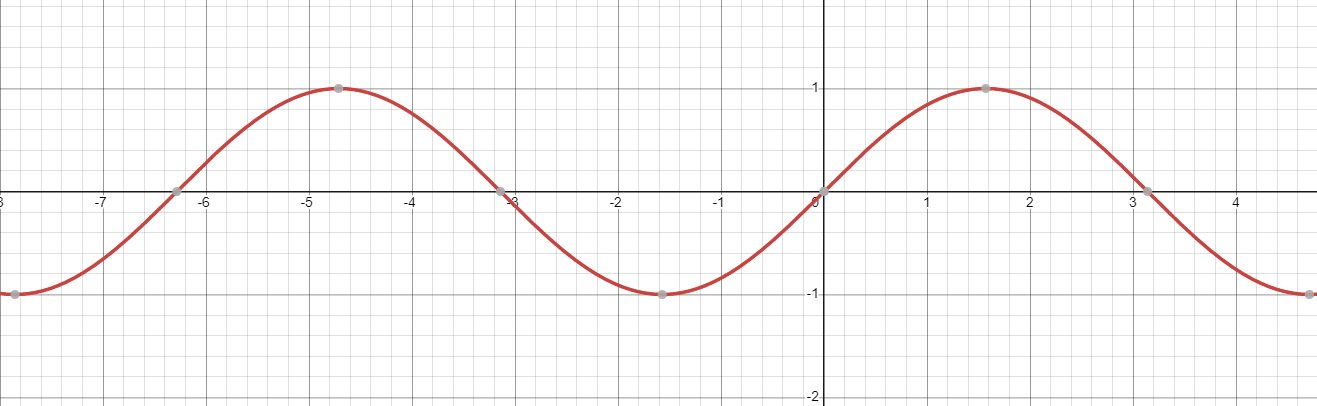
Last week I learned something I never knew before about the origin of the word sine as in the well-known trigonometric function sin(x). I came to this profound knowledge via a circuitous route which I won’t go into now, involving the Italian word for sine which is seno. Another meaning of this word in Italian is “breast”. The same word is used in both senses in Spanish, and there’s a word in French, sein, which also means breast, although the French use the word sinus for sine. The Latin word sinus is used for both sine and breast (among other things); its primary meaning is a bend or a curve.

A friend suggested that it has this name because of the shape of the curve (above) but I didn’t think it would be so simple, and indeed it isn’t.

Since trigonometry was developed for largely for the purpose of compiling astronomical tables, I looked in the excellent History of Ancient Mathematical Astronomy by Otto Neugebauer. What follows is a quick summary.

Astronomical computations only became possible after the adoption of the Babylonian sexagesimal notation for numbers, which is why we still use seconds and minutes of arc. Trigonometry is indispensable in most such computations, such as passing from equatorial to ecliptic coordinates. This is needed for such things as calculating the time of sunrise and sunset. Spherical trigonometry was more important than plane trigonometry for this type of calculation, though both were developed alongside each other.

As an aside I’ll remark that I had to do spherical trigonometry at school, but I don’t think it’s taught anymore at that level. Because everything is done by computers nowadays it’s no longer such a big part of astronomy syllabuses even at university level either. I’m also of an age when we had to use the famous four-figure tables for sine and cosine. But I digress.

The first great work in the field of spherical trigonometry was Spherics by Menelaus of Alexandria which was written at the end of the First Century AD. If Menelaus compiled any trigonometric tables these have not survived. The earliest surviving work where trigonometry is fully developed is Ptolemy‘s Almagest which was written in the 2nd Century contains the first known trigonometric tables.

Almagest, however, does not use our modern trigonometric functions. Indeed, the only trigonometric function used and tabulated there was the chord, define in terms of modern sin(x) by 

chd(x)= 2 sin(x/2).

If you’re familiar with the double-angle formulae you will see that chd2(x)=2[1-cos(x)].

Sine was used by Persian astronomer and mathematician Abu al Wafa Buzjani in the 10th Century from which source it began t spread into Europe. The term had however been used elsewhere much earlier and many historians believe it was initially developed in India at least as early as the 6th century. Anyway, sine proved more convenient than chord, but its usage spread only very slowly in Europe. Nicolaus Copernicus used sine in the discussion of trigonometry in his De revolutionibus orbium coelestium but called it “half of the chord of the double angle”.

But what does all this have to do with breasts?

Well, the best explanation I’ve seen is that Indian mathematicians used the Sanskrit word jīva which means bow-string (as indeed does the Greek chordē). When Indian astronomical works were translated into Arabic, long before they reached Europe, the Indian term was translated as jīb. This word is written and pronounced in the same way as the word jayb which means the “hanging fold of a loose garment” or “breast pocket”, and this subsequently mistranslated into Latin as sinus “breast”.

I hope this clarifies the situation.

P.S. I’m told that if you Google seno iperbolico with your language set to Italian, you get some very interesting results…

String Theory – Dead Again?

Posted in Biographical, mathematics, The Universe and Stuff on December 5, 2022 by telescoper

The other day I came across an old clipping from the December 2005 issue of Physics World. It’s from an article called What will they think in 2105? looking forward from 2005 at likely developments in the next 100 years of physics, given the context of the centenary of Einstein’s “year of miracles” (1905) in which he came up with, among other things, Special Relativity which I start teaching today.

The article asks what present-day discoveries would be remembered in a hundred years. Many of those asked the question said string theory. My response was somewhat less enthusiastic:

I got quite a lot of stick at the time from senior physicists for this statement! My use of the phrase “dead again” was based on the observation that the popularity of string theory has waxed and waned several times over the years. It may not have died in 2015 as I predicted, but it does seem to me to be in a moribund state, in terms of its impact (or lack thereof) on physics.

I’m mindful of the fact that many mathematicians think string theory is great. I’ve had it pointed out to me that it has a really big influence on for example geometry, especially non-commutative geometry, and even some number theory research in the past few decades. It has even inspired work that has led to Fields medals. That’s all very well and good, but it’s not physics. It’s mathematics.

Of course physicists have long relied on mathematics for the formulation of theoretical ideas. Riemannian geometry was `just’ mathematics before its ideas began to be used in the formulation of the general theory of relativity, a theory that has since been subjected to numerous experimental tests. It may be the case that string theory will at some point provide us with predictions that enable it to be tested in the way that general relativity did. But it hasn’t done that yet and until it does it is not a scientifically valid physical theory.

I remember a quote from Alfred North Whitehead that I put in my PhD DPhil thesis many years ago. I wasn’t thinking of string theory at the time, but it seems relevant:

There is no more common error that to assume that, because prolonged and accurate mathematical calculations have been made, the application of the result to some fact of nature is absolutely certain.

My problem is not with string theory itself but with the fact that so many string theorists have become so attached to it that it has become a universe in its own right, with very little to do with the natural universe which is – or at least used to be – the subject of theoretical physics. I find it quite alarming, actually, that in the world outside academia you will find many people who think theoretical physics and string theory are more-or-less synonymous.

The most disturbing manifestation of this tendency is the lack of interest shown by some exponents of string theory in the issue of whether or not it is testable. By this I don’t mean whether we have the technology at the moment to test it (which we clearly don’t). After all, many predictions of the standard model of particle physics had to wait decades before accelerators got big enough to reach the required energies. The question is whether string theory can be testable in principle, and surely this is something any physicist worthy of the name should consider to be of fundamental importance?

Remembering Omar Khayyam

Posted in mathematics, Poetry, The Universe and Stuff with tags , , on December 4, 2022 by telescoper

I was reminded today that 4th December is the anniversary of the death, in 1131, of the Persian astronomer, mathematician and poet Omar Khayyam. That in turn reminded me that just over year ago I received a gift of a sumptuously illustrated multi-lingual edition of the Rubáiyát of Omar Khayyám:

Edward Fitzgerald‘s famous English translation of these verses is very familiar, but it seems there’s a more of Fitzgerald than Khayyam in many of the poems and the attribution of many of the original texts to Khayyam is dubious in any case.  Whatever you think about this collection, I think it’s a bit unfortunate that Khayyam is not more widely recognized for his scientific work, which you can read about in more detail here.

Anyway, as we approach the end of 2022 many of us will be remembering people we have lost during the year so here is a sequence of three quatrains (XXII-XXIV) with an appropriately elegiac theme:

For some we loved, the loveliest and the best
That from his Vintage rolling Time hath pressed,
    Have drunk their Cup a Round or two before,
And one by one crept silently to rest.

And we, that now make merry in the Room
They left, and Summer dresses in new bloom,
    Ourselves must we beneath the Couch of Earth
Descend–ourselves to make a Couch–for whom?

Ah, make the most of what we yet may spend,
Before we too into the Dust descend;
    Dust into Dust, and under Dust to lie,
Sans Wine, sans Song, sans Singer, and–sans End!

Another Riddle in Mathematics

Posted in Books, mathematics on December 3, 2022 by telescoper

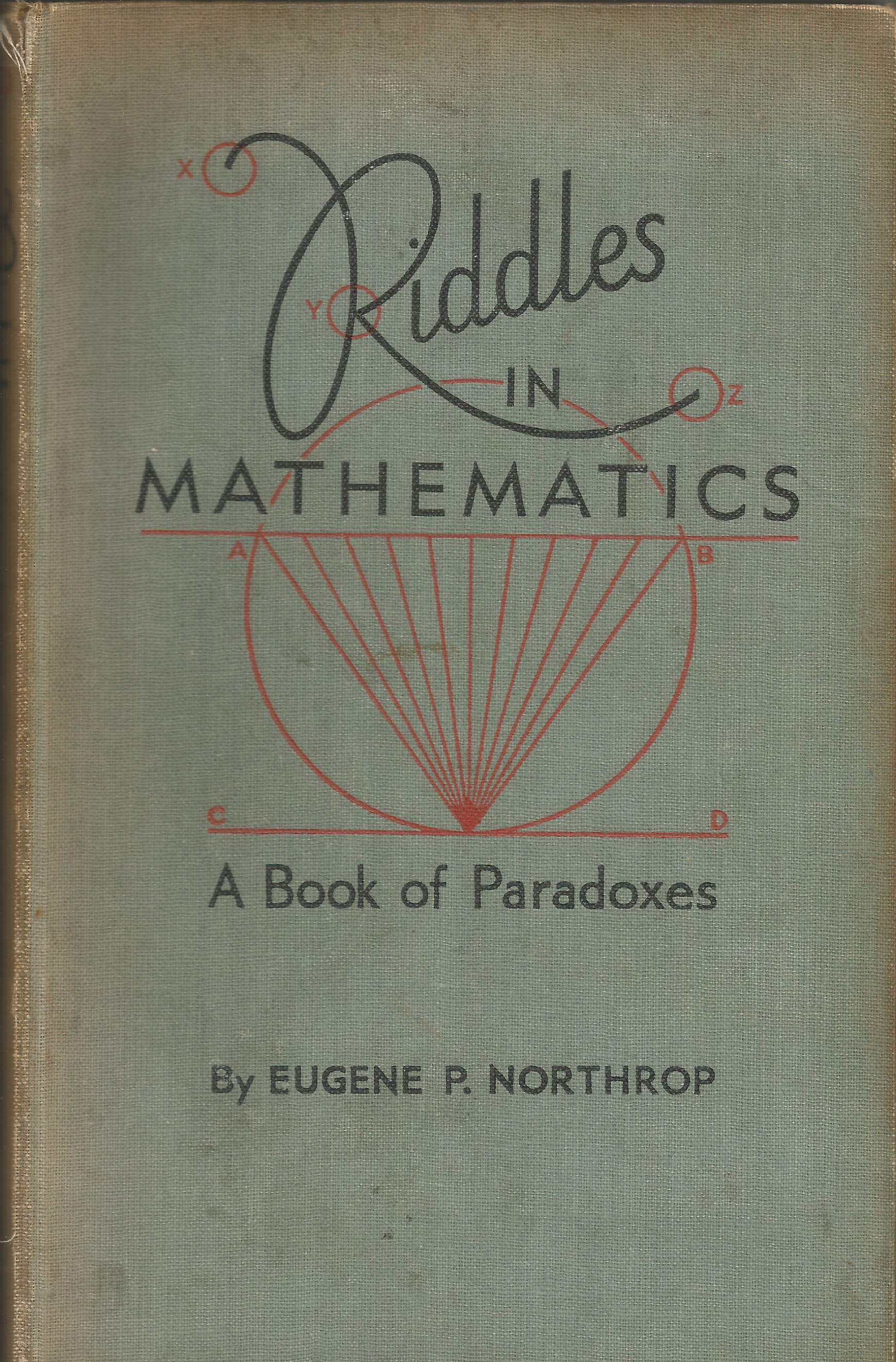
The little paradox in probability that I posted earlier in the week seemed to go down quite well so I thought I’d try a different paradox on a different topic from the same book of paradoxes, which is this one:

It’s quite old. I have the first edition, published in 1945, but many of the “riddles” are still interesting.

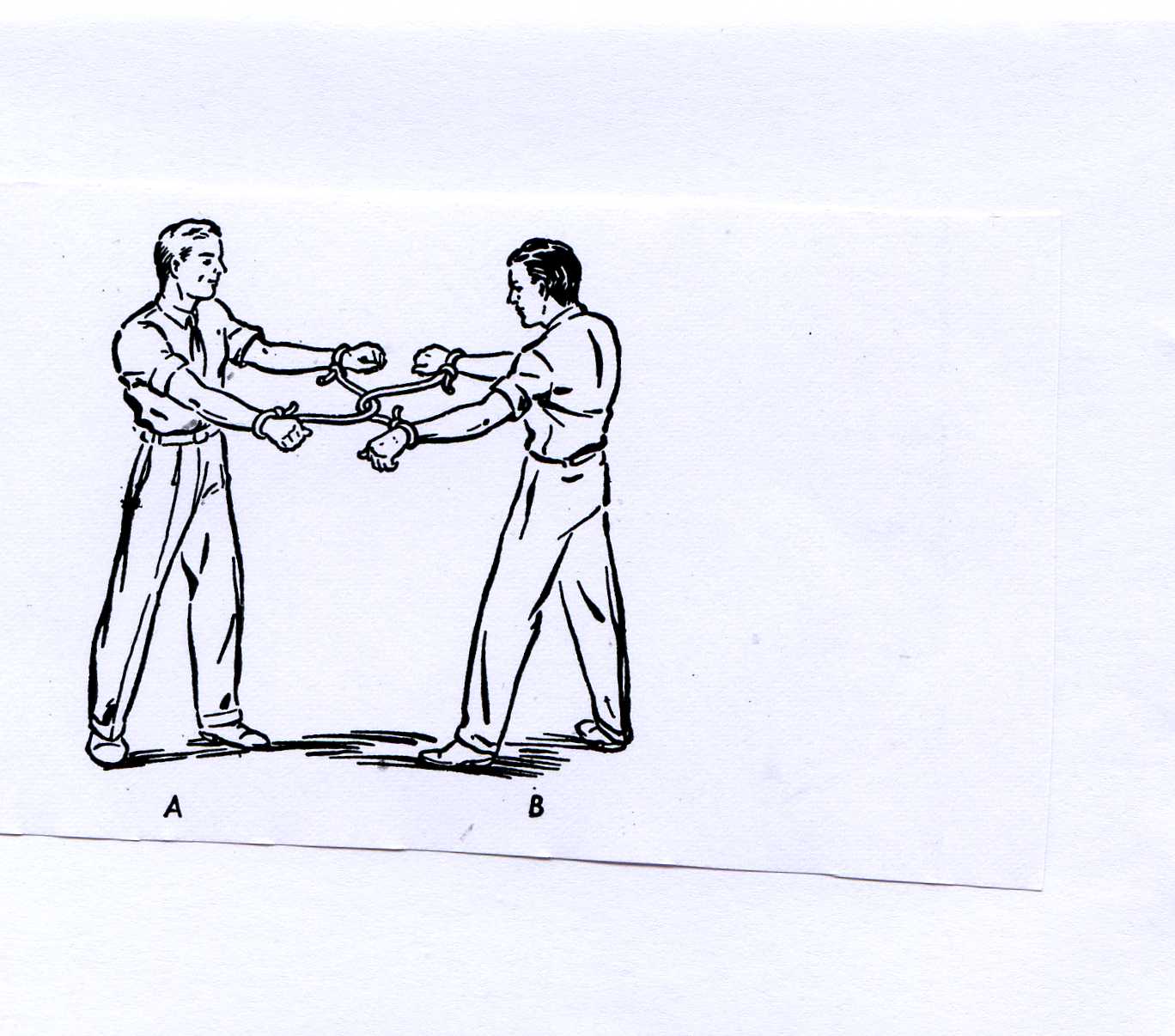
Here is one which you might describe as being about “knot theory”…

It’s probably best not to ask why, but the two gentlemen in the picture, A and B, are tied together in the following way: one end of a piece of rope is tied about A’s right wrist, the other about his left wrist. A second rope is passed around the first and its ends are tied to B’s wrists.

Can A and B free each other without cutting either rope, performing amputations,  or untying the knots at either person’s wrists?

If so, how?

Teaching and Fourier Series

Posted in Education, mathematics, The Universe and Stuff with tags , , , , on December 1, 2022 by telescoper

Now as we approach the last fortnight of term, I am nearing the end of both my modules, MP110 Mechanics 1 and Special Relativity and MP201 Vector Calculus and Fourier Series, and in each case am about to start the bit following the “and”…

In particular, having covered just about everything I need to do on Vector Calculus for MP201, tomorrow I start doing a block of lectures on Fourier Series. I have to wait until Monday to start doing Special Relativity with the first years.

As I have observed periodically, the two topics mentioned in the title of the module MP201 (Vector Calculs and Fourier Series) are not disconnected, but are linked via the heat equation, the solution of which led Joseph Fourier to devise his series in Mémoire sur la propagation de la chaleur dans les corps solides (1807), a truly remarkable work for its time that inspired so many subsequent developments.

Anyway I was looking for nice demonstrations of Fourier series to help my class get to grips with them when I remembered this little video recommended to me some time ago by esteemed Professor George Ellis. It’s a nice illustration of the principles of Fourier series, by which any periodic function can be decomposed into a series of sine and cosine functions.

This reminds me of a point I’ve made a few times in popular talks about astronomy. It’s a common view that Kepler’s laws of planetary motion according to which which the planets move in elliptical motion around the Sun, is a completely different formulation from the previous Ptolemaic system which involved epicycles and deferents and which is generally held to have been much more complicated.

The video demonstrates however that epicycles and deferents can be viewed as the elements used in the construction of a Fourier series. Since elliptical orbits are periodic, it is perfectly valid to present them in the form a Fourier series. Therefore, in a sense, there’s nothing so very wrong with epicycles. I admit, however, that a closed-form expression for such an orbit is considerably more compact and elegant than a Fourier representation, and also encapsulates a deeper level of physical understanding. What makes for a good physical theory is, in my view, largely a matter of economy: if two theories have equal predictive power, the one that takes less chalk to write it on a blackboard is the better one!

A Paradox in Probability

Posted in Cute Problems, mathematics with tags , on November 29, 2022 by telescoper

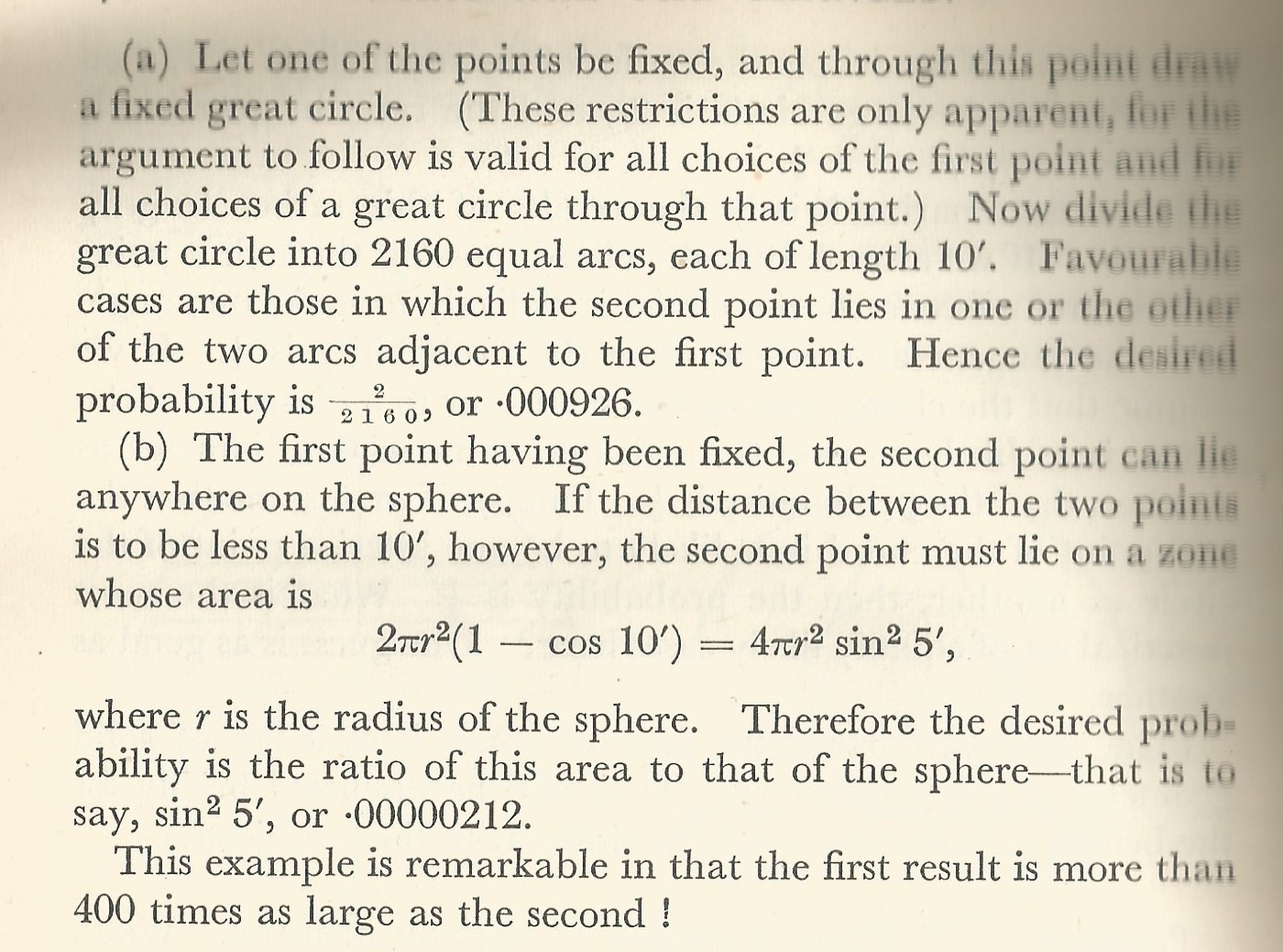
I just came across this paradox in an old book of mathematical recreations and thought it was cute so I’d share it here:

Here are two possible solutions to pick from:

Since we are now in the era of precision cosmology, an uncertainty of a factor of 400 is not acceptable so which answer is correct? Or are they both wrong?

A Question of Distributions and Entropies

Posted in mathematics with tags , , on November 28, 2022 by telescoper

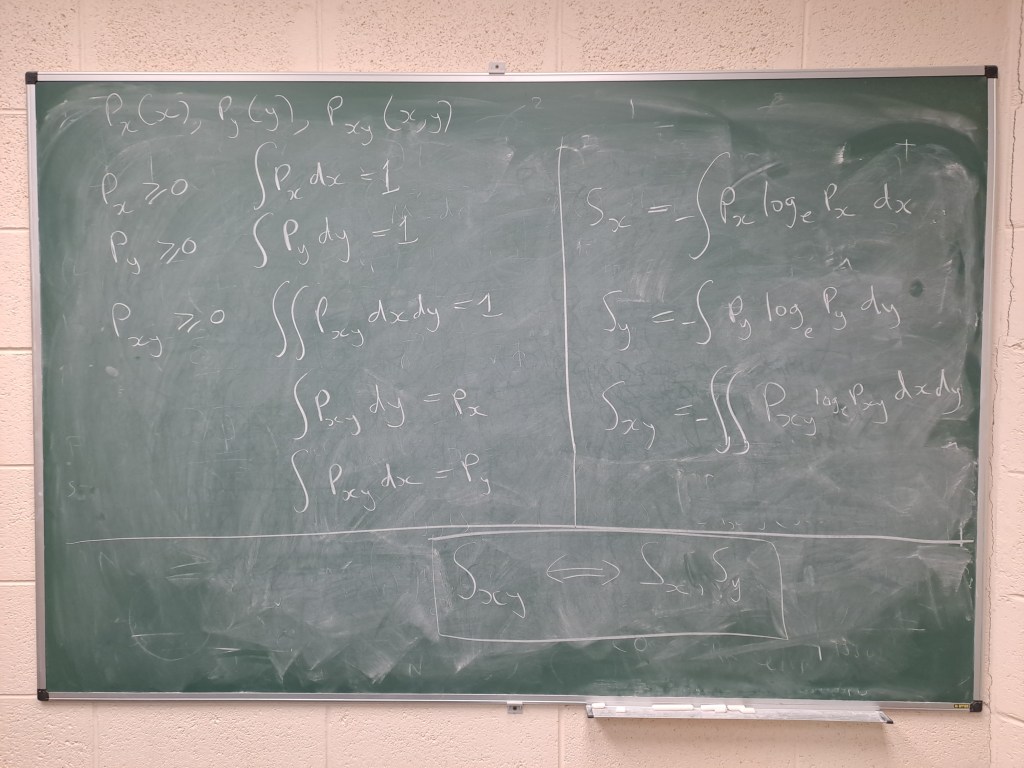
I thought I’d use the medium of this blog to pick the brains of my readers about some general questions I have about probability and entropy as described on the chalkboard above in order to help me with my homework.

Imagine that px(x) and py(y) are one-point probability density functions and pxy(x,y) is a two-point (joint) probability density function defined so that its marginal distributions are px(x) and py(y) and shown on the left-hand side of the board. These functions are all non-negative definite and integrate to unity as shown.

Note that, unless x and y are independent, in which case pxy(x,y) = px(x) py(y), the joint probability cannot be determined from the marginals alone.

On the right we have Sx, Sy and Sxy defined by integrating plogp for the two univariate distributions and the bivariate distributions respectively as shown on the right-hand side of the board. These would be proportional to the Gibbs entropy of the distributions concerned but that isn’t directly relevant.

My question is: what can be said in general terms (i.e. without making any further assumptions about the distributions involved) about the relationship between Sx, Sy and Sxy ?

Answers on a postcard through the comments block please!

Sizes, Shapes and Minkowski Functionals

Posted in mathematics, The Universe and Stuff with tags , , , , on August 27, 2022 by telescoper

Before I forget I thought I would do a brief post on the subject of Minkowski Functionals, as used in the paper we recently published in the Open Journal of Astrophysics. As as has been pointed out, the Wikipedia page on Minkowski Functionals is somewhat abstract and impenetrable so here is a much simplified summary of their application in a cosmological setting.

One of things we want to do with a cosmological data set to characterize its statistical properties to compare theoretical predictions with observations. One interesting way of doing this is to study the morphology of the patterns involved using quantitative measures based on topology.

The approach normally used deals with Excursion Sets, i.e. regions where a field exceeds a certain level usually given in terms of the rms fluctuation or defined by the fraction of space above the threshold. The field could, for example, be the temperature field on the CMB Sky or the density field traced by galaxies. In general the excursion set will consist of a number of disjoint pieces which may be simply or multiply connected. As the threshold is raised, the connectivity of the excursion set will shrink but also its connectivity will change, so we need to study everything as a function of threshold to get a full description.

One can think of lots of ways of defining measures related to an excursion set. The Minkowski Functionals are the topological invariants that satisfy four properties:

  1. Additivity
  2. Continuity
  3. Rotation Invariance
  4. Translation Invariance

In D dimensions there are (D+1) invariants so defined. In cosmology we usually deal with D=2 or D=3. In 2D, two of the characteristics are obvious: the total area of the excursion set and the total length of its boundary (perimeter). These are clearly additive.

In order to understand the third invariant we need to invoke the Gauss-Bonnet theorem, shown in this graphic:

The Euler-Poincare characteristic (χ) is our third invariant. The definition here allows one to take into account whether or not the data are defined on a plane or curved surface such as the celestial sphere. In the simplest case of a plane we get:

As an illustrative example consider this familiar structure:

Instead of using a height threshold let’s just consider the structure defined by land versus water. There is one obvious island but in fact there are around 80 smaller islands surrounding it. That illustrates the need to define a resolution scale: structures smaller than the resolution scale do not count. The same goes with lakes. If we take a coarse resolution scale of 100 km2 then there are five large lakes (Lough Neagh, Lough Corrib, Lough Derg, Lough Ree and Lower Lough Erne) and no islands. At this resolution, the set consists of one region with 5 holes in it: its Euler-Poincaré characteristic is therefore χ=-4. The change of χ with scale in cosmological data sets is of great interest. Note also that the area and length of perimeter will change with resolution too.

One can use the Gauss-Bonnet theorem to extend these considerations to 3D by applying to the surfaces bounding the pieces of the excursion set and consequently defining their corresponding Euler-Poincaré. characteristics, though for historical reasons many in cosmology refer not to χ but the genus g.

A sphere has zero genus (χ=1) and torus has g=1 (χ=0).

In 3D the four Minkowski Functionals are: the volume of the excursion set; the surface area of the boundary of the excursion set; the mean curvature of the boundary; and χ (or g).

Great advantage of these measures is that they are quite straightforward to extract from data (after suitable smoothing) and their mean values are calculable analytically for the cosmologically-relevant case of a Gaussian random field.

Here endeth the lesson.